• No results
ElementalAmplified
Manuscript
Notes
#
The Pulter Project
pulterproject.northwestern.edu
Poem 102

The Ugly Spider
(Emblem 37)

Edited by Leah Knight and Wendy Wall
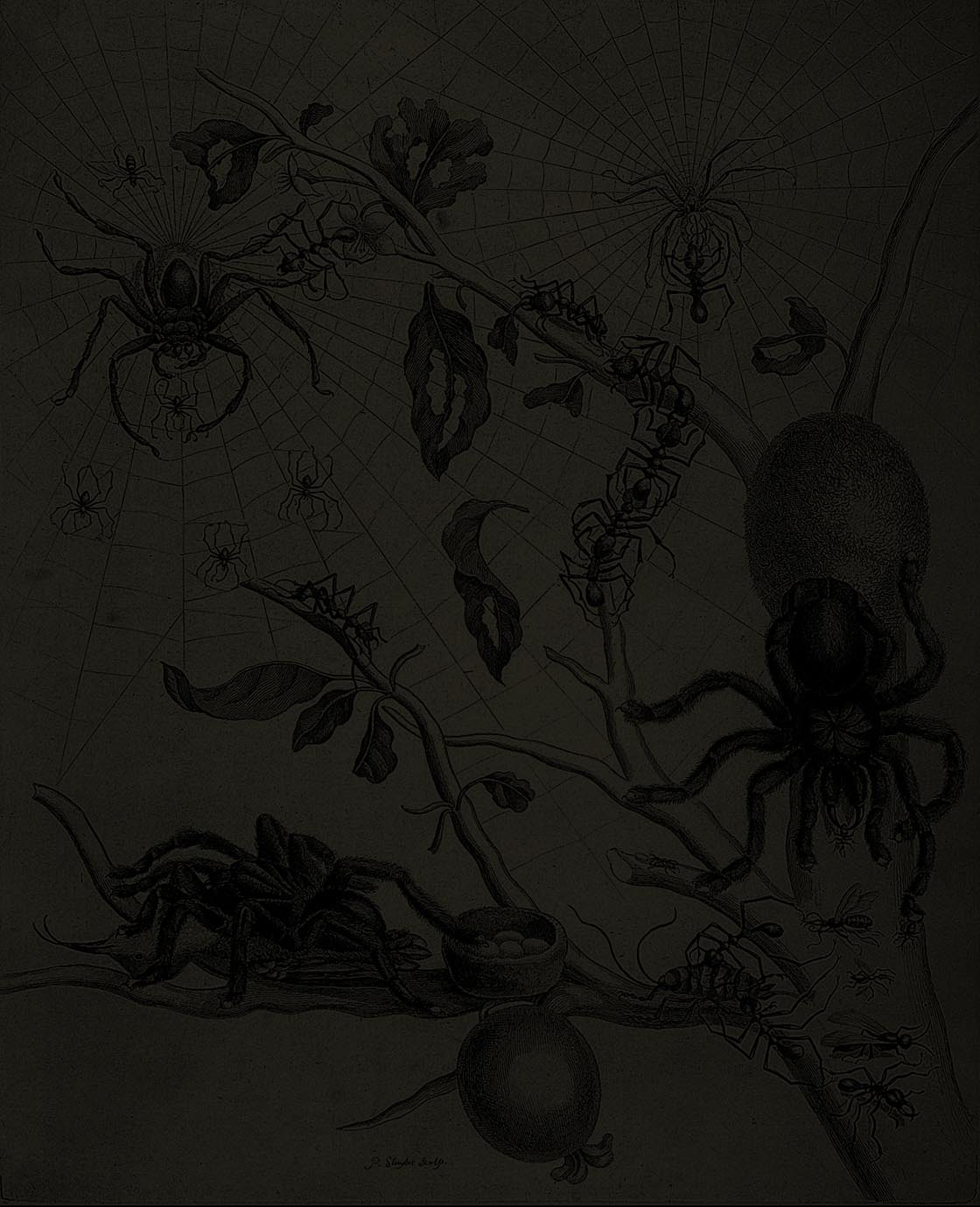
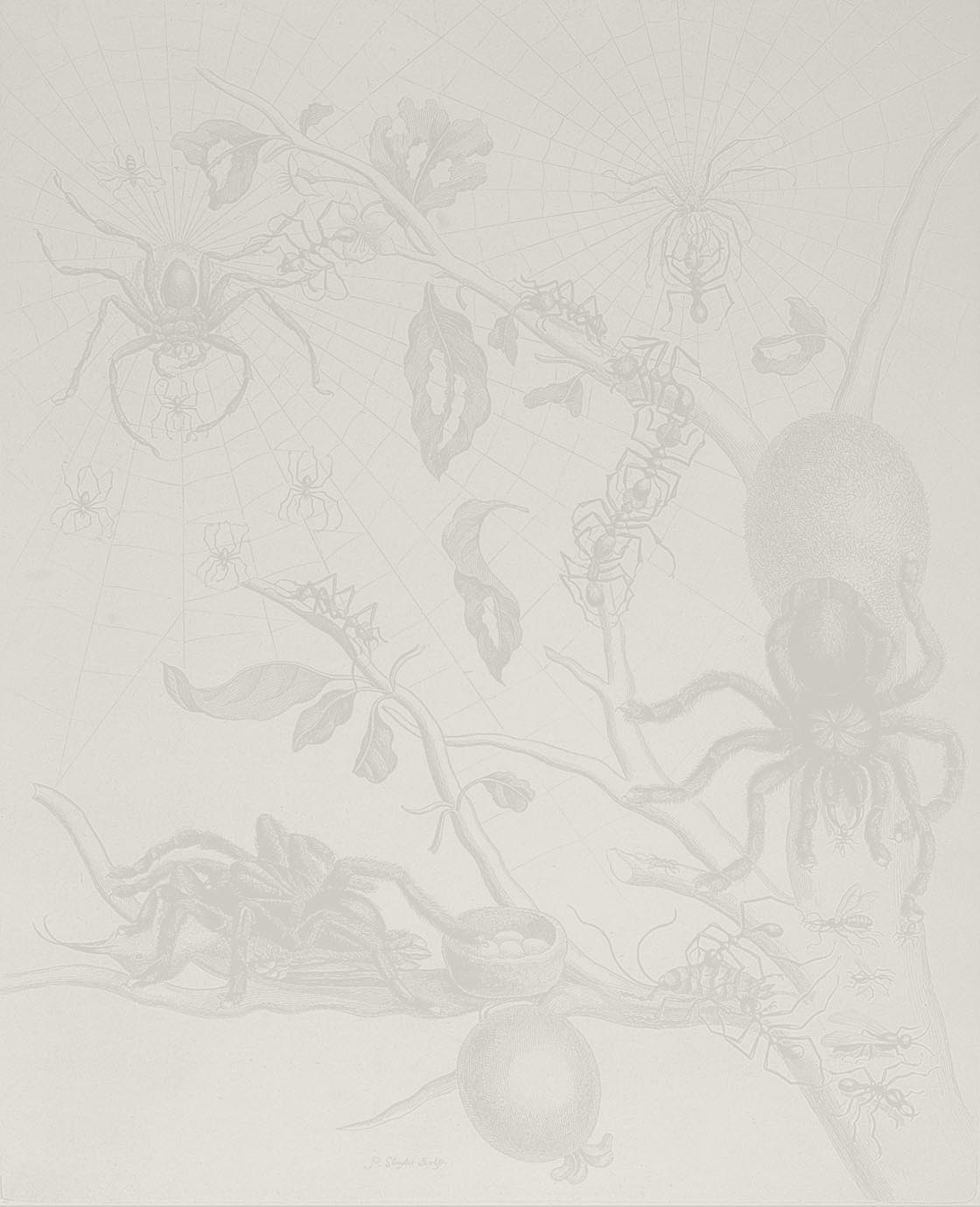
This emblem takes up two vices—tyranny and meat-eating—each spun from the emblematic reading of a powerful spider who is undone by the tiny fly she eats. From the fly’s example, the speaker catalogues classical emperors, warriors, and rulers who are all undone, in the end, by their short-sighted sinfulness. What seems to be a poem about the vanity of worldly power shifts abruptly as the speaker doubles back to scrutinize her own comparison: “But why do I blame spiders’ tyranny / When man’s the greatest beast of prey of all?”). Rather than aligning humans with bloodsucking spiders, she denounces humans as more carnivorous than other creatures in their propensity to kill and eat other humans (their own “kind”). After positing a type of negative human exceptionalism, in which humans are the only truly cannibalistic creatures on Earth, she shifts to celebrate communities who choose vegetarianism and thus define their idea of “kind” more capaciously. In the final couplet of the poem, the speaker abruptly reverses course once again. “But stay my pen, write no more than is meet,” she says, punning on “meet” in the senses of “appropriate” and “flesh,” as she recalls that God expressly authorized human to eat animals within a grand food chain. The poem thus becomes a study in how to make and then rethink comparisons in ways that stabilize a conventional hierarchy of creatures. But the opening emblem’s lesson, in which the seemingly consumable dinner of the tiny fly overcomes the blood-thirsty spider, remains to haunt the poem: “Might the butchery that humans require for dinner come back to bite us?”
Compare Editions
i
1Behold how many cobwebs doth
invest1
2This ugly spider in her nasty nest,
3Where, barricaded, she in ambush lies,
4
Domitian-like2
, to murder
sportive3
flies.
5Yet such a monstrous spider once I saw
6That would with ease flies, wasps and hornets draw
7Most cruelly into her dusty nest;
8Then, tyrant-like she on their blood would feast.
9Yet did I see a slender
azure4
fly
10Make this bloodsucking monster fall and die.
11So the most
impious5
tyrants in the world,
12Even in a moment, to the grave are
whirled6
.
13That
king of terrors7
doth by sentence just
14Grind even their very skeletons to
dust8
;
15When
he upon the pale horse9
doth appear,
16A
Julianus10
then begins to fear,
17Throwing his blood and spirits in the skies,
18Confessed, yet died, in his
apostasies11
.
19What by the wars was
Alexander’s12
gains
20When guilt his conscience, poison, stung his veins?
21So
he that hath three kingdoms in his power13
:
22What comfort will they yield that fatal hour
23
Whenas14
that sea of innocent blood shall roar
24To heaven for vengeance? Who can but
implore15
?
25But why do I blame spider’s tyranny
26Who, forced by hunger, kills a
silly16
fly,
27When man’s the greatest beast of prey of all?
28His house a
shamble17
is, or butcher’s stall.
29In all those books which I have read, I find
30There’s none but man doth kill and
eat his kind18
.
31The
antediluvian patriarchs19
happy were
32That lived by what the earth did freely bear.
33The
Pythagoreans20
no blood would spill;
34The
Banians21
now no animals do kill
35But such as murderers they do esteem
36
And oft will buy those creatures to redeem.22
37But stay my pen, write no more than is
meet23
,
38Lest I forget
Noah’s license, Peter’s sheet24
.
Macron symbol indicating the end of a poem.

Elemental Edition,

edited by Leah Knight and Wendy Walli

Editorial Note

The aim of the elemental edition is to make the poems accessible to the largest variety of readers, which involves modernizing spelling and punctuation as well as adding basic glosses. Spelling and punctuation reflect current standard American usage; punctuation highlights syntax which might otherwise be obscure. Outmoded but still familiar word forms (“thou,” “‘tis,” “hold’st”) are not modernized, and we do not modernize grammar when the sense remains legible.

After a brief headnote aimed at offering a “way in” to the poem’s unique qualities and connections with other verse by Pulter or her contemporaries, the edition features a minimum of notes and interpretative framing to allow more immediate engagement with the poem. Glosses clarify synonyms or showcase various possible meanings in Pulter’s time. Other notes identify named people and places or clarify obscure material. We rely (without citation) primarily on the Oxford English Dictionary (OED), the Oxford Reference database, and the King James Version (KJV) of the Bible. When we rely on Alice Eardley’s edition of Pulter’s work, we cite her text generally (“Eardley”); other sources are cited in full. The result is an edition we consider a springboard for further work on Pulter’s poetry.

See the full conventions for the elemental edition here.

Macron symbol indicating the end of a poem.
  • Leah Knight, Brock University
  • Wendy Wall, Northwestern University
  • invest
    clothe, cover
  • Domitian-like
    Domitian (51–96) was a Roman emperor who came to power when he and his father battled the general Vitellius. He was reputed to enjoy torturing and killing flies. “At the beginning of his reign he used to spend hours in seclusion every day, doing nothing but catch flies and stab them with a keenly-sharpened stylus” (Suetonius, The Lives of the Twelve Caesars [Loeb Classical Library, 1914], p. 345).
  • sportive
    playful, lively
  • azure
    blue
  • impious
    wicked
  • whirled
    Pulter often describes death in terms of the revolving of elements; see The Revolution16, My Soul: Why Art Thou Full of Trouble?40 and Why Art Thou Sad at the Approach of Night47. The spelling in the manuscript of this word—“whorld”—further emphasizes its homonym, “world,” which Pulter’s poems portray as caught up in a cycle of rotations and turns that include death.
  • king of terrors
    Death
  • dust
    Ecclesiastes 3:20: “All go unto one place; all are of the dust, and all turn to dust again.”
  • he upon the pale horse
    Death; see Revelations 6:8: “And I looked, and behold a pale horse: and his name that sat on him was Death, and Hell followed with him."
  • Julianus
    Roman emperor, also known as Julian the Apostate. Eardley cites Alexander Ross’s account of the legend of how Julian, having renounced religion and been injured, flung the blood from his wound into the air and cried out, “Thou has overcome me O Galilean” (referring to Christ). See Ross, The History of the World (London, 1652), p. 85.
  • apostasies
    abandonment of one’s faith
  • Alexander’s
    Alexander the Great, who reputedly died by poison
  • he that hath three kingdoms in his power
    Oliver Cromwell, who ruled over England, Ireland and Scotland
  • Whenas
    when
  • implore
    request, pray for
  • silly
    helpless, insignificant, foolish
  • shamble
    slaughterhouse or place where meat is sold
  • eat his kind
    eat other humans
  • antediluvian patriarchs
    according to the Bible, the male authorities who existed before the flood. See the final note on their reputed vegetarianism until Noah was given permission to eat animals after the flood.
  • Pythagoreans
    Pythagoreans in the ancient Greek world abstained from eating animals partly because of their belief that humans and animals share a common soul, and partly because they appear to have considered the diet a healthier one.
  • Banians
    Hindu traders
  • And oft will buy those creatures to redeem.
    Hindu traders considered those who eat animal flesh to be murderers; they are reputed to have bought animals from butchers to save the animals’ lives.
  • meet
    appropriate
  • Noah’s license, Peter’s sheet
    After the flood, according to the Bible, Noah is given permission to eat animal flesh: “Every moving thing that liveth shall be meat for you; even as the green herb have I given you all things” (Genesis 9:3). See also God’s injunction for Peter to eat meat: “And he became very hungry, and would have eaten: but while they made ready, he fell into a trance, And saw heaven opened, and a certain vessel descending upon him, as it had been a great sheet knit at the four corners, and let down to the earth: Wherein were all manner of fourfooted beasts of the earth, and wild beasts, and creeping things, and fowls of the air. And there came a voice to him, Rise, Peter; kill, and eat” (Acts 10:10–13).
The Pulter Project

Copyright © 2023
Wendy Wall, Leah Knight, Northwestern University, others.

Except where otherwise noted, this site is licensed
under a Creative Commons CC BY-NC-SA 4.0 License.

How to cite
About the project
Editorial conventions
Who is Hester Pulter?
Resources
Get in touch