• No results
ElementalAmplified
Manuscript
Notes
#
The Pulter Project
pulterproject.northwestern.edu
Poem 74

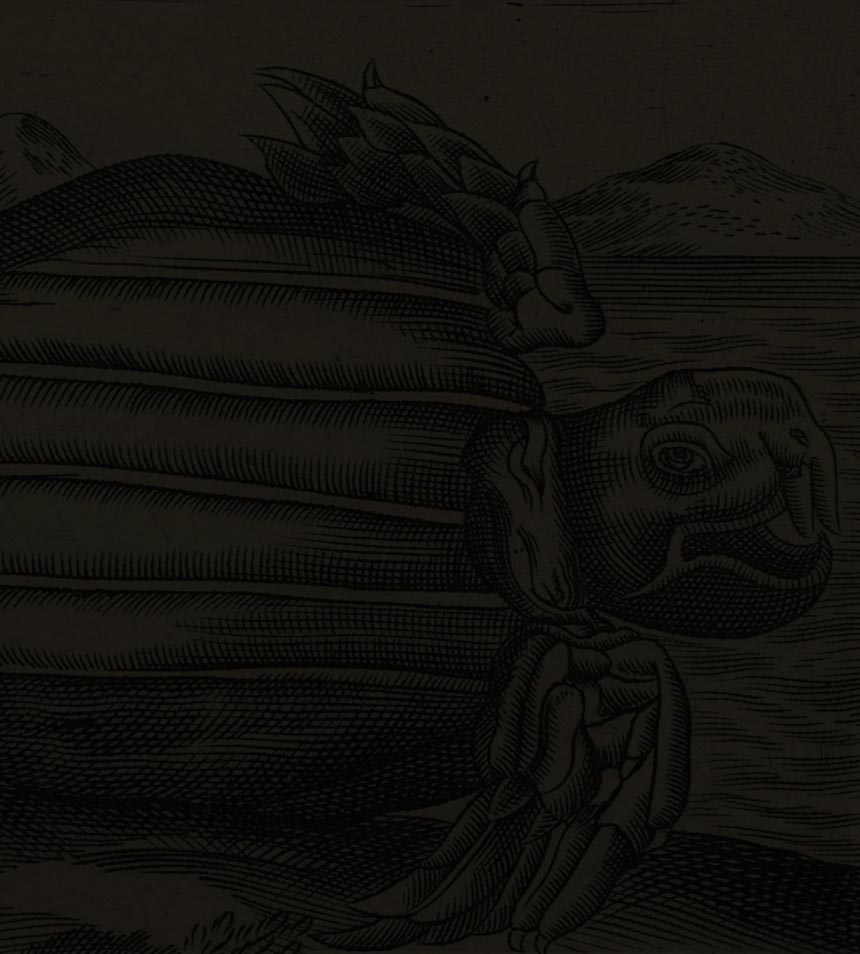
The Turtle
(Emblem 8)

Edited by Leah Knight and Wendy Wall
Why do people obstinately cling to bad ways, even when facing death? In this emblem, Pulter assumes the persona of the wise counsellor who warns young people about the follies and vanities that can lead a person to damnation. She stacks example upon example of how animals and humans stubbornly refuse to give up immoral behaviors: from the “simple creature” of the title who revels in the earth and oceans, to mythical minute dragons who can exist only in burning fire, to misers who sink their investments in money. The speaker reserves the bulk of her reprimand for the frivolous gallants and ladies of her age who like to gamble, drink, indulge in fashions, and have sex. Calling these folks “ranters” connects the general riotous and noisy partiers to religious radicals in mid-seventeenth-century England who rejected religious authority. What seems to irritate the speaker is their complete immersion in their chosen worlds: as if earthbound pleasures have become the air they breathe. Being removed from sin and entertainment leaves these impassioned fools without the divine life support they need, much like a blubbering turtle gasping for breath or a fish washed ashore.
Compare Editions
i
1
How fast this creature runs upon the earth1
;
2
Her loving it shows her ignoble birth.2
3How swift she swims within the
taméd3
seas;
4Let her but
grov’lling4
be, she is in peace.
5But do but turn this turtle to the skies:
6
She sighs and sobs and discontented lies,5
7And in this passion, bathed in tears, she dies.
8So let a miser fear the loss
of’s6
gold;
9His heart like
Nabal’s7
instantly is cold.
10Tell
him8
that Death is come to take his due,
11He’ll call for interest or your bonds renew.
12Bid
gallants9
leave their dames, their drink, their dice;
13Not they, they’ll swear, for present paradise.
14Tell them in love they’re at
th’abyss’s10
brink;
15They’ll
yawl and bawl11
for
wenches12
or more drink.
16Bid a
light13
lady leave her wanton love;
17Not she, she vows, for all the joys above.
18Tell her, ere long
her paint won’t hide her clay14
;
19What doth she care, she’ll do it while she may.
20Put but these
ranters15
where they cannot
roar16
,
21
They lie like fish on the forsaken shore.17
22Or curb these gallants of their vain desire,
23They’re like
pyraustas18
kept out of the fire.
24Or take these wantons from their vanity;
25They’ll like this simple creature
blubb’ring19
lie,
26And in despair most commonly they die.
27Then hear a friend that tells you but the truth:
28Remember thy Creator in thy youth.
29And leave those follies ere they do leave you,
30Or else expect that Hell will have its due.

Macron symbol indicating the end of a poem.

Elemental Edition,

edited by Leah Knight and Wendy Walli

Editorial Note

The aim of the elemental edition is to make the poems accessible to the largest variety of readers, which involves modernizing spelling and punctuation as well as adding basic glosses. Spelling and punctuation reflect current standard American usage; punctuation highlights syntax which might otherwise be obscure. Outmoded but still familiar word forms (“thou,” “‘tis,” “hold’st”) are not modernized, and we do not modernize grammar when the sense remains legible.

After a brief headnote aimed at offering a “way in” to the poem’s unique qualities and connections with other verse by Pulter or her contemporaries, the edition features a minimum of notes and interpretative framing to allow more immediate engagement with the poem. Glosses clarify synonyms or showcase various possible meanings in Pulter’s time. Other notes identify named people and places or clarify obscure material. We rely (without citation) primarily on the Oxford English Dictionary (OED), the Oxford Reference database, and the King James Version (KJV) of the Bible. When we rely on Alice Eardley’s edition of Pulter’s work, we cite her text generally (“Eardley”); other sources are cited in full. The result is an edition we consider a springboard for further work on Pulter’s poetry.

See the full conventions for the elemental edition here.

Macron symbol indicating the end of a poem.
  • Leah Knight, Brock University
  • Wendy Wall, Northwestern University
  • How fast this creature runs upon the earth
    “Fast” here means firmly fixed in its place; not easily moved or shaken. “Runs upon” refers to the action of pushing violently; driving its head fruitlessly against the earth. The line seems to invite the reader to see the creature as moving swiftly, but when l. 5 reveals that the creature is a turtle, it forces a return and reinterpretation of these initial lines.
  • Her loving it shows her ignoble birth.
    The turtle’s passion for the earth (ground) displays her “ignoble birth,” meaning her base, sordid, lowly and dishonourable character.
  • taméd
    Eardley sees this word as a scribal mistake for “tumid,” meaning swollen, puffed out with the wind,” but taméd also fits the turtle’s luxurious swimming in the calm oceans.
  • grov’lling
    lying prone. According to Pliny, turtles found it pleasant to float facing downwards with their shells out of the water. Pulter reads their discomfort with being turned upside down as a refusal to look to God in Heaven.
  • She sighs and sobs and discontented lies,
    The scribe added this line between two existing lines, thus correcting a couplet into a rhyming triplet.
  • of’s
    of his
  • Nabal’s
    In the Bible, Nabal is a rich man whose heart is turned to stone when he rejects the peace offering and request for resources that David sends to him. The story features Nabal’s wife, Abigail, who defies her husband so as to prevent war and negotiate a political truce. See 1 Sam 25: 2–42.
  • him
    the miser
  • gallants
    fashionable gentlemen
  • th’abyss’s
    The abyss was infernal Hell, a seemingly bottomless gulf beneath the earth, or a general negative condition from which recovery was impossible or unlikely.
  • yawl and bawl
    cry out loudly
  • wenches
    wanton women in this context, though sometimes just meaning girls or lower-class servants
  • light
    frivolous; unchaste; immodest
  • her paint won’t hide her clay
    Her cosmetics cannot cover over her mortality. Numerous Renaissance texts hold up women’s use of cosmetics as a futile and deceptive attempt to stay corruption and decay. See Hamlet’s meditations on Yorick’s skull (5.1) and Bosola’s hectoring of the Old Lady in John Webster’s The Duchess of Malfi (2.1)
  • ranters
    people who declaim noisily; riotous, dissolute people; religious radicals in mid-seventeenth-century England who rejected religious authority and formal worship, and gained a reputation for ostentatiously promiscuous, drunken, or blasphemous behavior.
  • roar
    behave in a lively and noisy manner
  • They lie like fish on the forsaken shore.
    fish washed ashore and stranded on land, a figure for people out of their environment
  • pyraustas
    The pyrausta was a “mythical moth-size dragon that, like the salamander, lives in fire” (Eardley). If removed from fire, the creature dies.
  • blubb’ring
    The creature is the turtle; “blubb’ring” is corrected from “blubling” in the manuscript, since it seems to refer to the turtle’s sobbing in l. 5.
The Pulter Project

Copyright © 2023
Wendy Wall, Leah Knight, Northwestern University, others.

Except where otherwise noted, this site is licensed
under a Creative Commons CC BY-NC-SA 4.0 License.

How to cite
About the project
Editorial conventions
Who is Hester Pulter?
Resources
Get in touch