• No results
ElementalAmplified
Manuscript
Notes
#
The Pulter Project
pulterproject.northwestern.edu
Poem 75

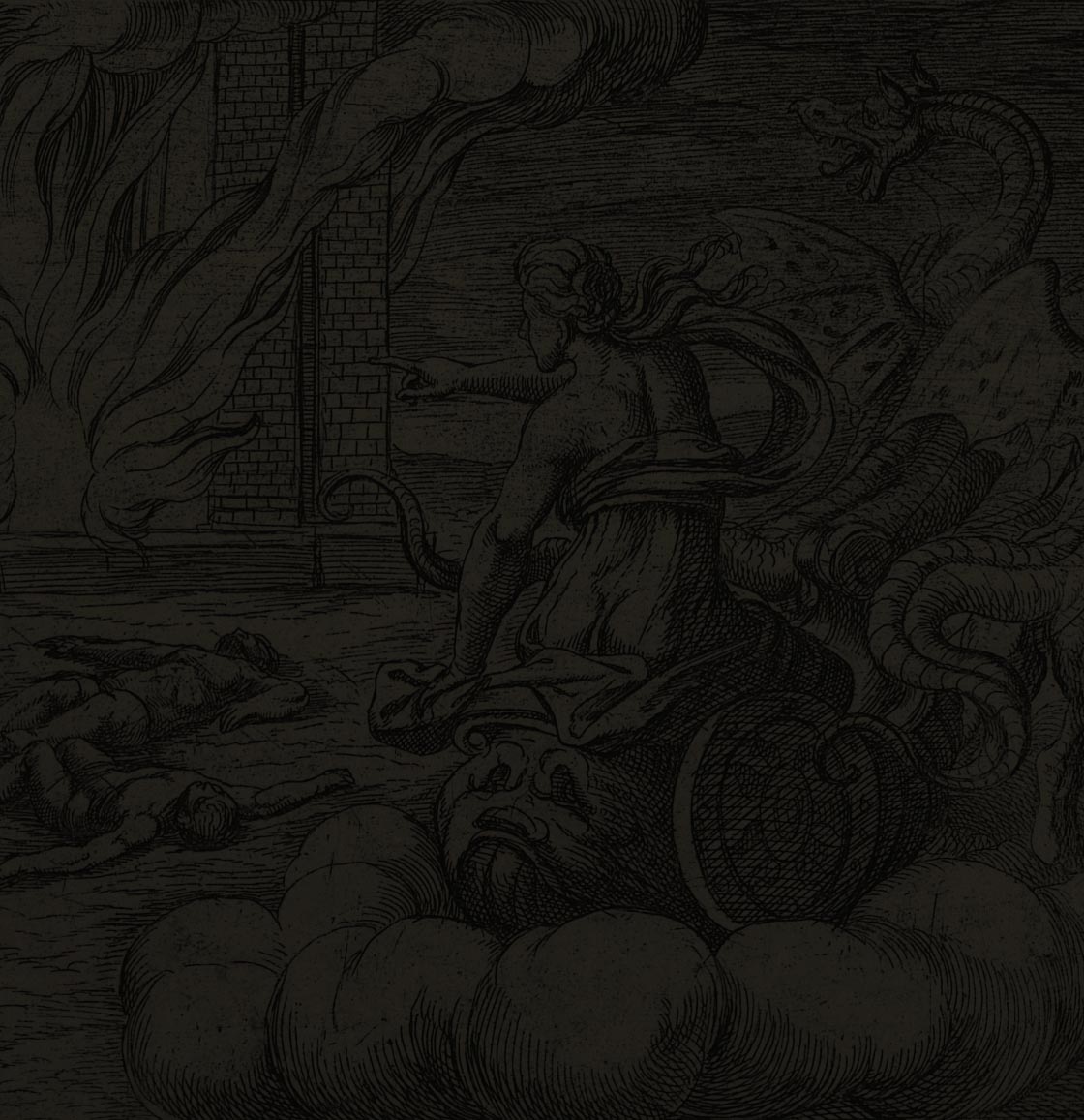
Scorned Medea
(Emblem 9)

Edited by Leah Knight and Wendy Wall
Pulter here portrays two women, each betrayed in love by a man, and each responding to such betrayal in perfectly polar ways: Medea grows outrageously homicidal, while Ariadne’s patient piety is divinely rewarded. These contrasting portraits are then processed into a rather pat moral: “So,” the speaker calmly advises, if you’re afflicted, don’t go stabbing your children and poisoning your rival; just trust in God. The emblem might now be complete—but Pulter doesn’t stop. She proceeds to offer what seems a superfluous warning to “those / That injure others”: “not to trust their foes.” The warning’s utility emerges only in the final couplet, as the poem involutes toward its speaker’s special challenge: “my enemies within me be.” Rather than identifying with the wronged Creusa and Ariadne, or even an avenging Medea, the speaker offers a more terrifying prospect: others betray others, but she cannot trust herself. She begs deliverance from this self-betraying self, a Creusa to her own Medea: an odd and unexpected doubling and division of Pulter’s otherwise often quite unitary-seeming identity.
Compare Editions
i
1When scorned
Medea1
saw Creusa led
2A bride to her ungrateful spouse’s bed,
3She vowed revenge, hid underneath a smile
4Which did the
royal virgin2
so beguile
5That
she3
received of
her4
the robe and crown
6And, overjoyed, put on the
Napthian gown5
;
7But, putting holy incense in the fire,
8The palace soon became her funeral pyre.
9Then fierce Medea with
her dragons6
flew,
10
Killing her children in their father’s view.7
11O, horrid! She (even she) that gave them birth
12Stabbed those sweet boys, then flung them to the earth.
13Her mad impiety did rise thus far
14To dare the gods to do as much by her.
15Poor
Ariadne8
did not so when she
16Fair Phaedra in false Jason’s arms did see;
17When she forsaken was on Naxos’s shore,
18The pity of the gods she did implore.
19Then
Liber Pater9
took her for his spouse;
20With nine
refulgent10
orbs he crowned her brows.
21So, though afflictions doth thy soul surround,
22Yet trust in God thy patience will be
crowned11
.
23Then let this
flaming fabric12
warn all those
24That injure others not to trust their foes:
25But O, my enemies within me be;
26Then from
my self13
, dear God, deliver me.
Macron symbol indicating the end of a poem.

Elemental Edition,

edited by Leah Knight and Wendy Walli

Editorial Note

The aim of the elemental edition is to make the poems accessible to the largest variety of readers, which involves modernizing spelling and punctuation as well as adding basic glosses. Spelling and punctuation reflect current standard American usage; punctuation highlights syntax which might otherwise be obscure. Outmoded but still familiar word forms (“thou,” “‘tis,” “hold’st”) are not modernized, and we do not modernize grammar when the sense remains legible.

After a brief headnote aimed at offering a “way in” to the poem’s unique qualities and connections with other verse by Pulter or her contemporaries, the edition features a minimum of notes and interpretative framing to allow more immediate engagement with the poem. Glosses clarify synonyms or showcase various possible meanings in Pulter’s time. Other notes identify named people and places or clarify obscure material. We rely (without citation) primarily on the Oxford English Dictionary (OED), the Oxford Reference database, and the King James Version (KJV) of the Bible. When we rely on Alice Eardley’s edition of Pulter’s work, we cite her text generally (“Eardley”); other sources are cited in full. The result is an edition we consider a springboard for further work on Pulter’s poetry.

See the full conventions for the elemental edition here.

Macron symbol indicating the end of a poem.
  • Leah Knight, Brock University
  • Wendy Wall, Northwestern University
  • Medea
    in various accounts of Greek myth, a princess and sorceress who fell in love with, married, and had children with Jason, who later abandoned her for Creusa
  • royal virgin
    Creusa was the daughter of King Creon of Corinth.
  • she
    Creusa
  • her
    Medea
  • Napthian gown
    Naphtha was a flammable substance of liquid petroleum, used by Medea on Creusa’s wedding gown to burn her to death.
  • her dragons
    Medea’s chariot was drawn by dragons given to her by her grandfather, Helios, god of the sun.
  • Killing her children in their father’s view.
    In some accounts, Medea deliberately murdered some of her children.
  • Ariadne
    a figure of Greek myth; as Eardley notes, Theseus (not Jason) is usually seen as the husband who abandons her on the island of Naxos; Pulter conflates the mythological stories.
  • Liber Pater
    the god Dionysus; as Eardley notes, the crown he gives her is usually understood to have seven stars (the “orbs” in the next line), not nine.
  • refulgent
    radiant, bright
  • crowned
    glorified; rewarded
  • flaming fabric
    Since “fabric” can refer to cloth or a building, the phrase might refer to the torched “gown” (l.6) or the “palace” (l.8) that became Medea’s pyre.
  • my self
    The manuscript features a space between these words, which we have chosen to retain rather than to render them as a single word.
The Pulter Project

Copyright © 2023
Wendy Wall, Leah Knight, Northwestern University, others.

Except where otherwise noted, this site is licensed
under a Creative Commons CC BY-NC-SA 4.0 License.

How to cite
About the project
Editorial conventions
Who is Hester Pulter?
Resources
Get in touch