• No results
ElementalAmplified
Manuscript
Notes
#
The Pulter Project
pulterproject.northwestern.edu
Poem 116

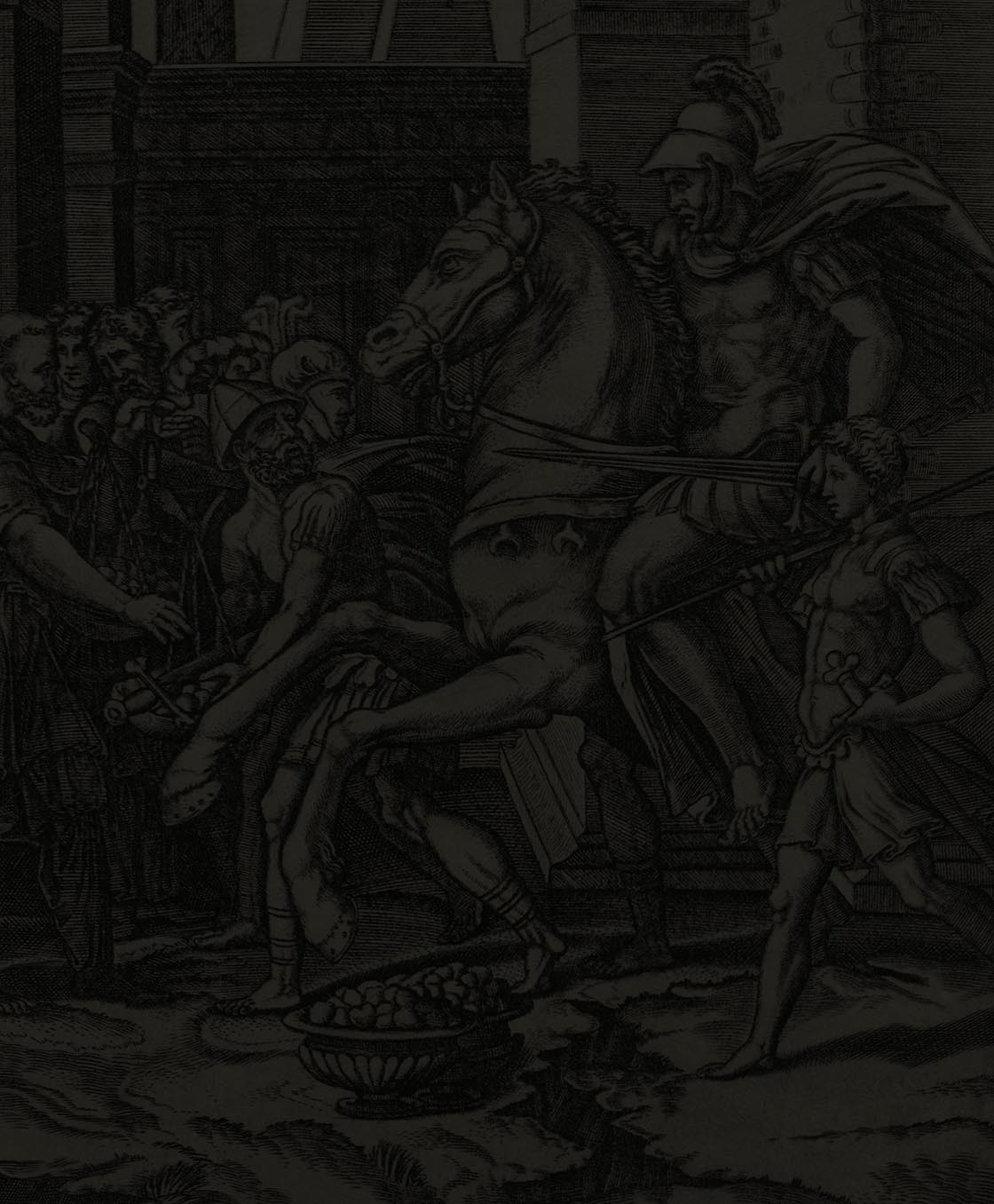
British Brennus
(Emblem 51)

Edited by Leah Knight and Wendy Wall
How can a single alphabetic letter collapse time? In this poem, Pulter draws from the story of the Gallic conquest of Rome (and the Romans’ subsequent overthrow of its captors) to stridently protest the Cromwellian regime while also plaintively imploring God to enact a political restoration of monarchy. Rather than merely creating an analogy between the Gauls’ invasion of Rome and the republicans’ victory in the English civil war, however, Pulter creates a kind of temporal vertigo. By insisting that the tyrannical Brennus is a British foreign invader of Rome (seen in her term “British Brennus”), Pulter makes the conquering English of the present seem the brutal villains of an ancient story. Secondly, Pulter allows the emblem to refer at once to past and present times by creating ambiguities around historical players whose names begin with the letter “C.” Can C refer to Camillus, the Roman hero, and Charles II, the exiled English king, simultaneously? But elsewhere refer to Cromwell? And to Christ? If names are withheld, can the reader make the present and past (and future, at the end of the poem) co-exist?
Compare Editions
i
1When
British Brennus sacked that noble city1
,
2
To age, nor sex, nor infants he shewed pity2
;
3Then those which did the capital defend
4
Weighed out their gold3
to have their suff’rings end,
5On which the
Briton4
bold his sword did lay;
6
“Woe to the conquered,” then the people say5
.
7Then came
C_______6
, banished long before,
8And made the Britons pay the Romans’ score.
9So let all
impious7
, sacrilegious men
10Have
lex talionis8
: Heaven, say Thou “Amen”!
11If any underneath the sun may cry
12
“Vae victis,”9
reader, it is thou and I.
13
C.C.10
killed and banished, we with sad hearts
deplore11
;
14O, let a
C.12
come and our joys restore.
15For
C. his sake13
, dear God, I Thee implore,
16Or we are slaves to
C.14
evermore.
Macron symbol indicating the end of a poem.

Elemental Edition,

edited by Leah Knight and Wendy Walli

Editorial Note

The aim of the elemental edition is to make the poems accessible to the largest variety of readers, which involves modernizing spelling and punctuation as well as adding basic glosses. Spelling and punctuation reflect current standard American usage; punctuation highlights syntax which might otherwise be obscure. Outmoded but still familiar word forms (“thou,” “‘tis,” “hold’st”) are not modernized, and we do not modernize grammar when the sense remains legible.

After a brief headnote aimed at offering a “way in” to the poem’s unique qualities and connections with other verse by Pulter or her contemporaries, the edition features a minimum of notes and interpretative framing to allow more immediate engagement with the poem. Glosses clarify synonyms or showcase various possible meanings in Pulter’s time. Other notes identify named people and places or clarify obscure material. We rely (without citation) primarily on the Oxford English Dictionary (OED), the Oxford Reference database, and the King James Version (KJV) of the Bible. When we rely on Alice Eardley’s edition of Pulter’s work, we cite her text generally (“Eardley”); other sources are cited in full. The result is an edition we consider a springboard for further work on Pulter’s poetry.

See the full conventions for the elemental edition here.

Macron symbol indicating the end of a poem.
  • Leah Knight, Brock University
  • Wendy Wall, Northwestern University
  • British Brennus sacked that noble city
    Brennus was the chieftain of the Gauls (or Celts of Northern Europe) who was legendary for invading and destroying Rome in the fourth-century BCE. Presumably by describing Brennus as “British,” Pulter is comparing him to Oliver Cromwell, whom she elsewhere denounced as ruining the city of London as well as usurping the government.
  • To age, nor sex, nor infants he shewed pity
    Plutarch describes the savage massacre of Rome by the Gauls, noting that they killed indiscriminately, including unresisting priests and patricians, as well as elderly people, women, and children. See The Lives of the Noble Grecians and Romans, trans. Thomas North (1579), 153-4.
  • Weighed out their gold
    The Romans reputedly took gold as a ransom for their city, but when, as the next lines describe, the gold was being weighed and measured, Brennus laid his sword on the scales, presumably as an act of contempt and perhaps in response to a complaint that the scales were weighted unfairly.
  • Briton
    British person, here the English version of the tyrant invader Brennus
  • “Woe to the conquered,” then the people say
    Pulter revises the myth by having the conquered Romans lament their woe by uttering this famous phrase (“vae victis,” Latin for “woe to the conquered”). Legend had it that Brennus articulated these words to the Romans when they complained about him laying his sword on the scales (as described above) in order to assert his pure, unadulterated power over war’s losers.
  • C_______
    The name left blank refers, in Roman history, to Marcus Furius Camillus, a Roman statesman and general, who, according to Livy, was regarded as the second founder of Rome after its occupation by Brennus and his Gauls. Having been accused of appropriating booty and banished, he returned triumphantly to settle the score with the Gauls (making them “pay the Romans’ score,” meaning revenging an injury or settling a debt). By leaving the name blank, Pulter allows the reader to imagine a British replay of this event, as “Charles II” might return from exile to overturn Cromwell.
  • impious
    irreverent
  • lex talionis
    Latin for “law of retaliation,” according to which deserved punishment is commensurate and ideally mirrors the crime. See Exodus 21-25, which evokes a “life for life, eye for eye, tooth for tooth.”
  • “Vae victis,”
    “Woe to the conquered,” as line 5 above explains; the cry of oppressed people, in Pulter’s unusual revision. As she explains in the next lines, England is the conquered entity currently under oppressive Cromwellian rule.
  • C.C.
    Charles I and his son Charles; here Pulter cryptically aligns the Gallic sack of Rome with the civil war in England.
  • deplore
    lament
  • C.
    The bare letter “C” allows the reader to fill in the name as Camillus, the Roman statesman described above in the poem as overthrowing the Gauls in Rome, or as Charles II, whom Pulter hopes can be restored to the British throne. Someone has filled in the blank with “Charles” in the manuscript.
  • C. his sake
    Charles II’s sake, but perhaps with a resonance of “Christ’s sake”
  • C.
    Presumably “Cromwell,” which an annotator has penned in superscript; this not in the hand of the main scribe or that we identify as probably Pulter’s.
The Pulter Project

Copyright © 2023
Wendy Wall, Leah Knight, Northwestern University, others.

Except where otherwise noted, this site is licensed
under a Creative Commons CC BY-NC-SA 4.0 License.

How to cite
About the project
Editorial conventions
Who is Hester Pulter?
Resources
Get in touch