• No results
ElementalAmplified
Manuscript
Notes
#
The Pulter Project
pulterproject.northwestern.edu
Poem 119

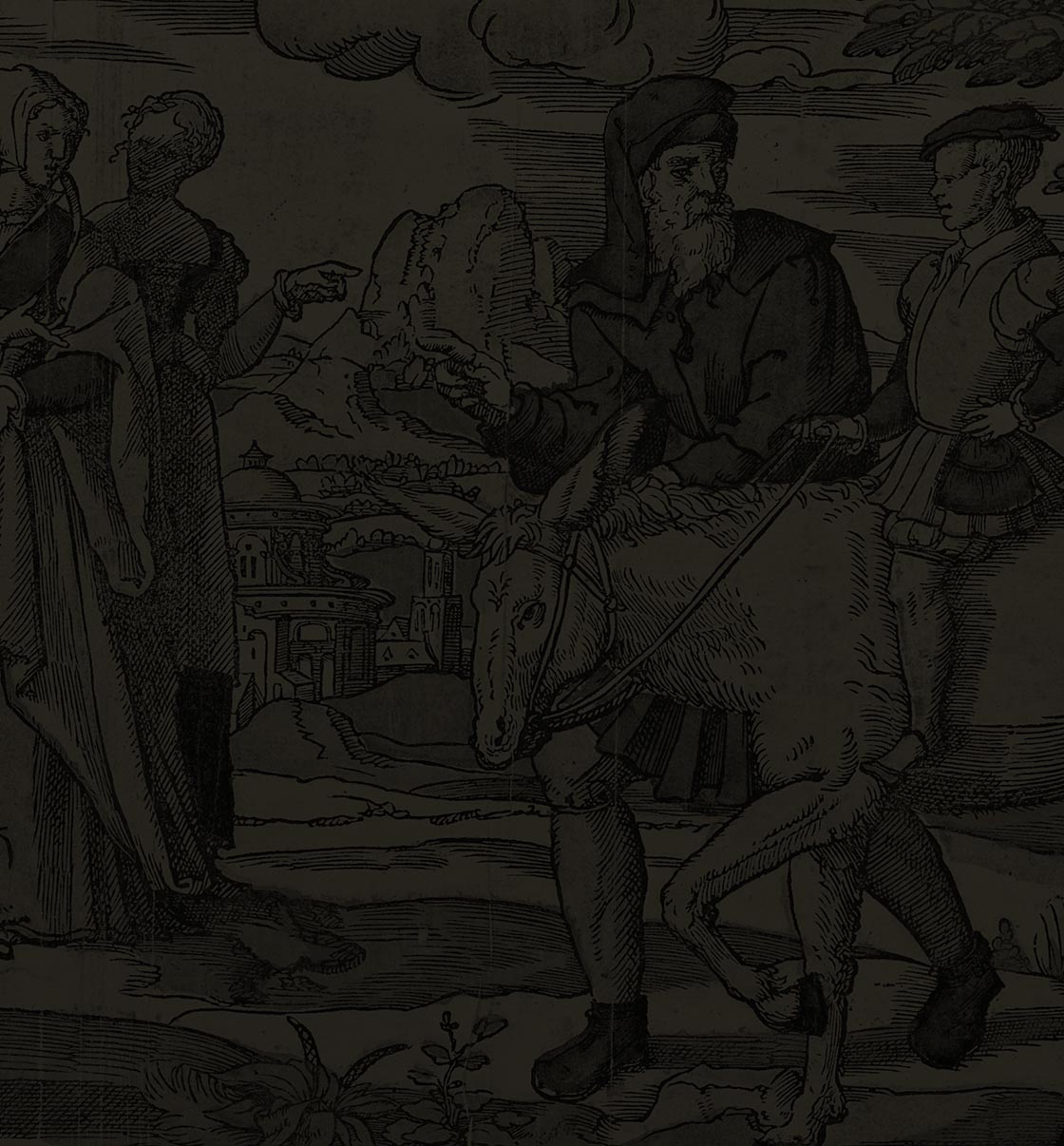
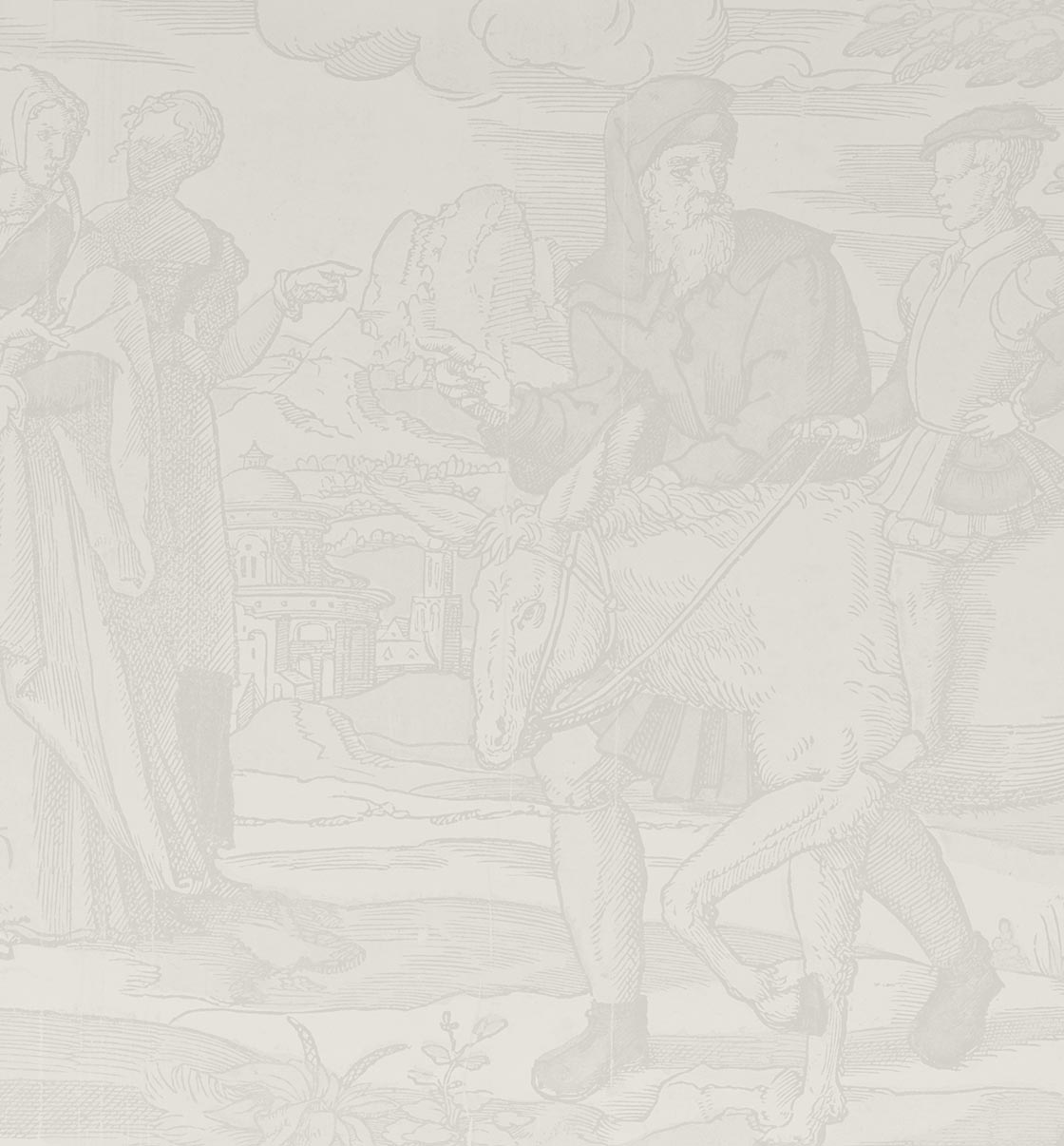
An Old Man, a Stripling, and an Ass
(Emblem 54)

Edited by Leah Knight and Wendy Wall
You can’t please all of the people all of the time: Pulter transforms that truism into both political history and prophecy in a poem which begins as a light-hearted fable before taking a darkly murderous turn. The villain here is the instability and inconstancy of public opinion, figured commonly as a multi-headed Hydra. Pulter uses the Aesopian tale of how people mercilessly mock any choice made by a man riding through town to threaten Oliver Cromwell and those who came to power with him in the aftermath of the civil war: Cromwell will undoubtedly be hoisted on his own petard and suffer the violent fates of others in history who relied on popular acclamation to overthrow sovereignty.
Compare Editions
i
1An old man through a town did often pass;
2With him, a pretty
stripling1
and an ass.
3The man did ride; the boy was
pedester2
,
4
As fit it was, he wait upon his master3
.
5At this, the people laughéd out aloud,
6Saying the man was merciless or proud
7To let the pretty child go sweating by,
8Whilst he rode, ambling in his majesty.
9
The boy rode next4
; the man did trudge afoot:
10But then, the people did so laugh and shout
11Because the man did favor so the lad
12To go afoot whilst he rode on his
pad5
.
13Next time this poor man through the town did pass,
14The man and boy got both upon the ass;
15But then the people bade him
light, for shame6
;
16He’d
spoil7
the ass, or make him sick, or lame.
17Next time, beside the ass they both did walk;
18But then they were the town and county’s talk.
19The people laughed and
made the welkin ring8
;
20Children their folly up and down did sing.
21Once more the man resolved the road to pass,
22And then the youth and he did
bear9
the ass,
23At which the people did so laugh and roar
24That the poor man would ne’er more
explore10
25The
Hydrian monstrosity11
to please,
26But sadly flung his ass into the seas.
27By this you see they do themselves delude
28That think to please the
giddy12
multitude.
29
Andronicus13
did make this story good;
30Even he that shed his royal sovereign’s blood,
31
Sejanus14
, so by pop’lar breath up borne,
32By
Briareus15
was in pieces torn.
33So
some alive16
the Hydra’s love will rue
34
Whenas17
to them they give to these their due18
.
35For certainly ’twill one day come to pass
36They’ll have the death and burial of
this ass19
.
Macron symbol indicating the end of a poem.

Elemental Edition,

edited by Leah Knight and Wendy Walli

Editorial Note

The aim of the elemental edition is to make the poems accessible to the largest variety of readers, which involves modernizing spelling and punctuation as well as adding basic glosses. Spelling and punctuation reflect current standard American usage; punctuation highlights syntax which might otherwise be obscure. Outmoded but still familiar word forms (“thou,” “‘tis,” “hold’st”) are not modernized, and we do not modernize grammar when the sense remains legible.

After a brief headnote aimed at offering a “way in” to the poem’s unique qualities and connections with other verse by Pulter or her contemporaries, the edition features a minimum of notes and interpretative framing to allow more immediate engagement with the poem. Glosses clarify synonyms or showcase various possible meanings in Pulter’s time. Other notes identify named people and places or clarify obscure material. We rely (without citation) primarily on the Oxford English Dictionary (OED), the Oxford Reference database, and the King James Version (KJV) of the Bible. When we rely on Alice Eardley’s edition of Pulter’s work, we cite her text generally (“Eardley”); other sources are cited in full. The result is an edition we consider a springboard for further work on Pulter’s poetry.

See the full conventions for the elemental edition here.

Macron symbol indicating the end of a poem.
  • Leah Knight, Brock University
  • Wendy Wall, Northwestern University
  • stripling
    a youth
  • pedester
    on foot
  • As fit it was, he wait upon his master
    since it was suitable for him to serve his master
  • The boy rode next
    That is, the man dismounted and the boy mounted the horse.
  • pad
    usually, a riding horse; here, the ass; alternatively, a saddle or saddle pad
  • light, for shame
    “light” as in alight or dismount; “for shame” ventriloquizes the people’s admonition, as does the next line.
  • spoil
    injure
  • made the welkin ring
    an expression indicative of a loud noise (with “welkin” meaning the sky)
  • bear
    carry
  • explore
    attempt
  • Hydrian monstrosity
    The Hydra was the many-headed serpent in classical mythology that could grow additional heads when one was cut off; the adjective can be used to refer to anything similarly destructive, multi-headed, or hard to kill.
  • giddy
    flighty, inconstant; whirling with bewildering speed
  • Andronicus
    Andronicus had his joint emperor of Greece, Alexius, killed; the people then revolted against and tortured Andronicus.
  • Sejanus
    an influential officer in ancient Rome who was arrested and executed (with his body was torn to pieces by the crowd) on suspicion of intent to kill the emperor Tiberius
  • Briareus
    The manuscript reads “Barrierus,” which Eardley interprets as Briareus, a monster in ancient Greek mythology with a hundred arms and fifty heads.
  • some alive
    Oliver Cromwell and those who came to power in his regime, supported by popular opinion
  • Whenas
    When
  • to them they give to these their due
    When people rely on popular opinion (referred to in the line above as the “Hydra’s love”); to give someone their due is to pay respect to them.
  • this ass
    Cromwell, whom the speaker hopes will be rejected and destroyed like the ass in the fable
The Pulter Project

Copyright © 2023
Wendy Wall, Leah Knight, Northwestern University, others.

Except where otherwise noted, this site is licensed
under a Creative Commons CC BY-NC-SA 4.0 License.

How to cite
About the project
Editorial conventions
Who is Hester Pulter?
Resources
Get in touch