

Approaches to Early Modern Chastity
byEmma K. Atwood
In “The Turtle and his Paramour,” Pulter advises her women readers that “Nothing gains love like virgin Modestie” (18). But if the “love” you get look…




Pulter’s “The Turtle and his Paramour” is a short emblem poem that recounts a turtle’s persistent pursuit of a mate. The paramour is a largely unwilling partner, impossibly described as wise, fair, chaste, modest, fearful, reluctant and, simultaneously, coy. Conventional in many ways—in form, theme, and allusion—this poem also contends with the complex problem of early modern consent and offers direct advice to women readers at its conclusion. Pulter’s gendered subject position transforms this poem into a subversive critique of coquetry rather than a recapitulation of the familiar game of cat and mouse (or, in this case, turtle and turtle). Rather than a playful account of two amorous animals, this poem offers a pointed interrogation of Renaissance ideas about rape.
Of exceptional note is Pulter’s command of form. The heroic couplets mimic the language of epic poetry, though the poem comprises only twenty-two lines. The form elevates the subject matter, casting sexual assault as a subject worthy of epic weight. Pulter deploys other formal poetic devices with skillful wit. When she breaks the regular iambic meter with anapests and dactyls, she uses sound to emphasize the slow, methodical terror of brutal immobilization (“Soe the grand Sygnior makes his vassels yield” (15)) or the frenzied speed of the turtle’s chase (“Love made him nimble fear made her make hast” (9)). In this particular line, the caesura between “nimble” and “fear” separates the two figures mid-chase as form echoes poetic function.
Pulter’s emblem poems derive inspiration from natural history and from the popular genre of emblem books. Mara R. Wade defines the emblem as “one of the primary vehicles of cultural knowledge during the early modern period (ca. 1500–1750), capable of expressing highly complex ideas in compact and compelling forms.”1 Typically, emblems consist of both words and pictures, yet Pulter evokes pictures with her words. The Turtle and his Paramour (Emblem 47)112 is not her only emblem poem to feature a turtle. The Turtle (Emblem 8)74 also centers on a female turtle, but there it serves as a warning of the turtle’s physical vulnerability: “But do but turn this turtle to the skies: / She sighs and sobs and discontented lies / And in this passion, bathed in tears, she dies” (5–7). The Porcupine (Emblem 13)79 features a tortoise who is similarly vulnerable but whose shell protects her soul: “What if they hurt my flesh? ’Tis but my shell / That suffers; my enfranchised soul is well” (30–31). This Poor Turtledove (Emblem 20)85 features a turtledove, a distinct animal with an analogous name that, like The Turtle and his Paramour (Emblem 47)112, emphasizes constancy, as she encourages her readers to “imitate this turtledove” (21).
The Turtle and his Paramour (Emblem 47)112 begins with an amorous turtle burning, in Petrarchan fashion, with “Reinflamd desire.” This reference echoes other aggressive pursuers in Pulter’s work, like Rodrigo the rapist in The Unfortunate Florinda who is “inflamed with the love of Florinda.”2 Interestingly, the “Beauteous Paramore” does not catch the turtle’s eye until line 3. His desire is a precondition that exists before she appears. It is the “Geniall Universall fire” that burns in line 1—an animalistic desire to procreate, reminiscent of Shakespeare’s urging the fair youth to reproduce in the first line of his sonnet sequence (“From fairest creatures we desire increase”3). This language is purposefully deceptive, though. What fronts as “genial” in the sense of a pleasant, welcoming, or kind demeanor is in fact “genial” in the sense that this pursuer is hell-bent on generation, procreation, and sex by any means necessary to achieve his goal.
In her 2014 edition of Pulter’s poetry, Alice Eardley cites Holland’s translation of Pliny’s Natural History as a possible source for her depiction of the turtles.4 Holland published his English translation in 1601 and describes tortoise copulation as follows: “The female flieth from the male, and will not abide to engender, untill such time as he pricke her behind and sticke somewhat in her taile for running away from him so fast.”5 This adversarial relationship between male and female tortoise is expanded in the Renaissance bestiary The history of four-footed beasts and serpents. In this illustrated account, Edward Topsell expounds upon tortoise (and sea turtle) copulation, giving human characteristics and motivations to these animals in their sexual pursuit: “the male is very salacious and given to carnal copulation, but the female is not so; for when she is attempted by the male, they fight it out by the teeth, and at last the male overcometh, whereat he rejoyceth as much as one that in a hard conflict, fight, or battail, hath won a fair Woman; the reason of this unwillingnesse is, because it is exceedingly painful to the female.”6 Topsell further elaborates that “the female [tortoise of the sea] resisteth the copulation with the male, until he set against her a stalk or stem of some tree or plant.”7
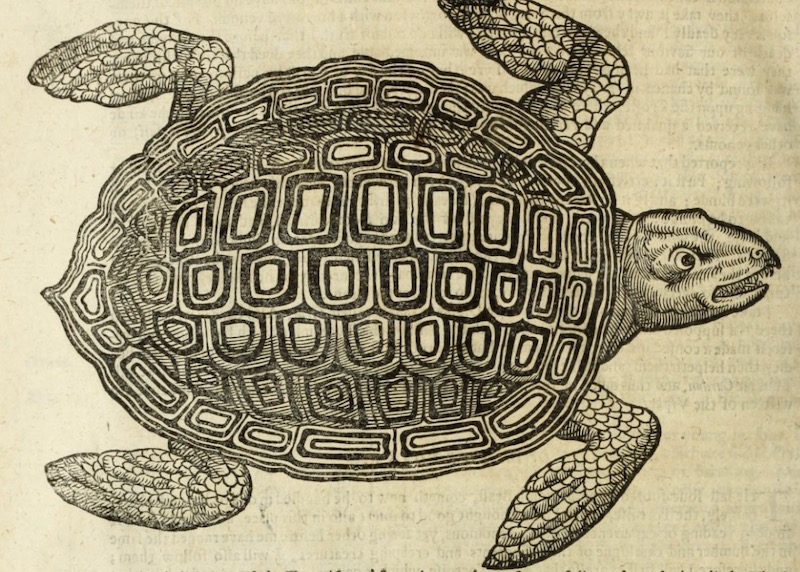
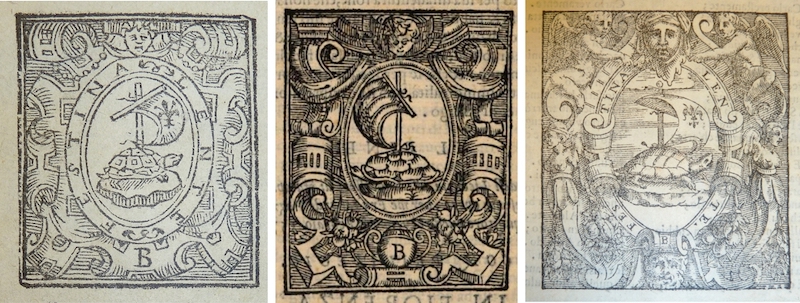
At first, the choice of a turtle seems odd for depicting a swift and aggressive chase, but this is likely due to a conflation between the turtle and the tortoise in Pulter’s sources. Aesop characterizes the tortoise as slow and steady; other Renaissance emblems associate turtles with the paradox “festina lente,” depicting a turtle decorated with sails to “make haste slowly.”
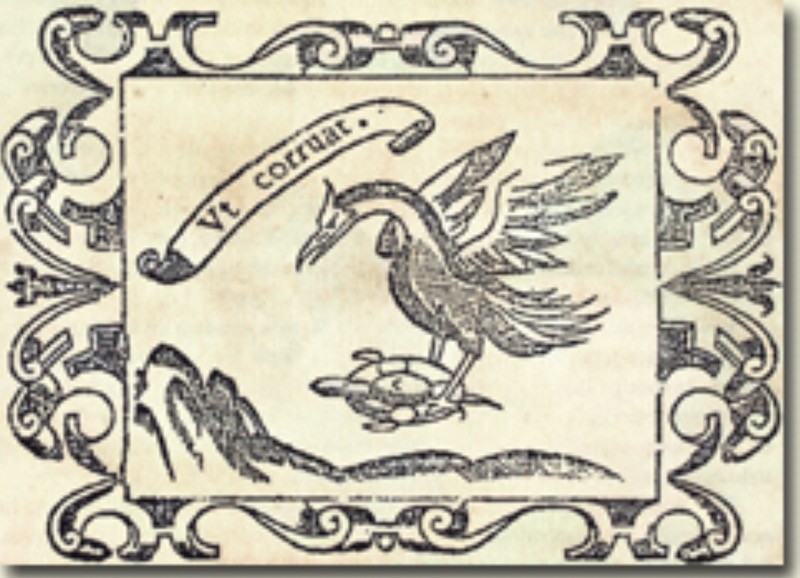
The turtle shows up in another common Renaissance emblem tradition, depicting an eagle carrying a turtle to a dizzying height in his talons, “ut lapsu graviore ruat” or “ut corruat,” so that it may fall.
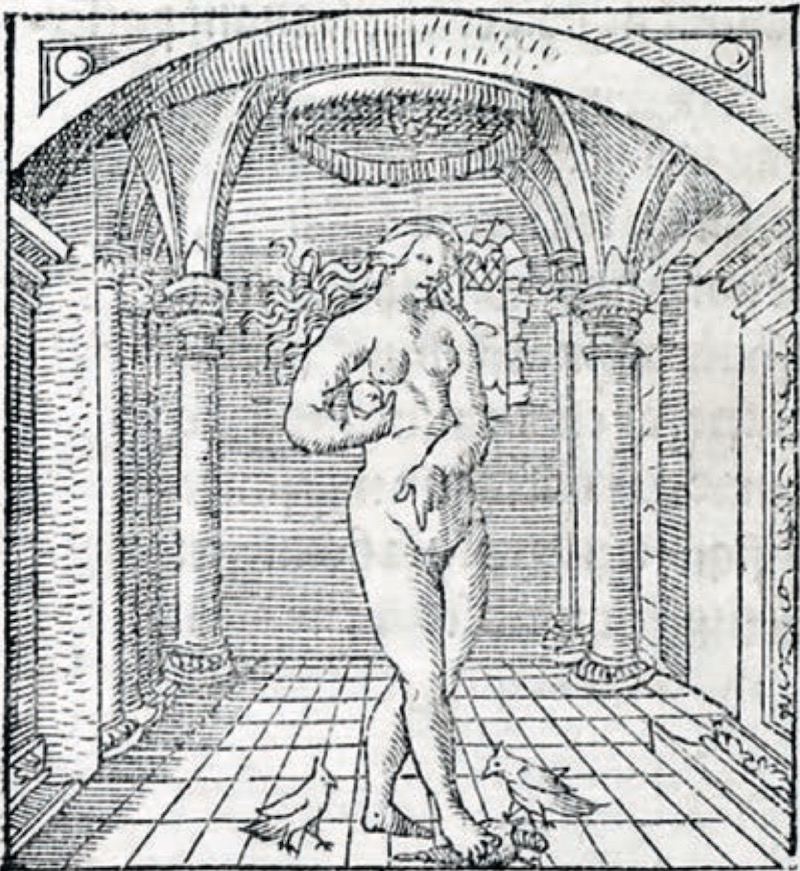
Another puzzle derives from the Renaissance emblem tradition that depicts Venus, or Aphrodite, standing atop a turtle, or tortoise, as in Alciato’s 16th-century emblem.9
But this Ovidian reading—whereby “no” means “yes” and, as Marlowe translates it, “red shame becomes white cheeks”12—is further complicated by the violence of Pulter’s ensuing metaphors. The two turtles are first likened to Daphne and Apollo, an aggressive pursuit so unwelcome that Daphne prays to be transformed into a tree to escape. Unfortunately, the faster Daphne runs away, the more Apollo wants her: Daphne “seemed most lovely to his fancy in her flight.”13 Troublingly, Pulter’s narrator similarly warns, “Love Repulst doth more increase desire,” invoking a skewed logic endemic to rape culture. [See Curation: “Love Repulst”: Paradoxical Desire].
Rape culture is a sociological concept originating with second-wave feminism in the 1970s that identifies the normalization of (male) sexual violence and the blame placed on victims of sexual assault. Peter Herman aptly notes Pulter’s evocation of a gender binary that shapes men’s and women’s expected sexual behavior in his analysis of Pulter’s romance The Unfortunate Florinda: “Pulter situates the divide between the chaste and the licentious, between men as sexual predators and women as their prey.”14 Kay Stanton discusses the pressing connections between contemporary rape culture and early modern antecedents in Shakespeare/Sex: Contemporary Readings in Gender and Sexuality.15 In her discussion of Shakespeare’s “The Rape of Lucrece,” Stanton considers the ways women are blamed for their own rapes. “The fault,” Stanton notes, is “not on the whore side of a virgin-whore binary in a short skirt or too much makeup, as is often the accusation against women today, but rather on its virginal side.”16 Superlative virtues make an attractive victim in many early modern representations, Pulter’s included. In many early modern indications of rape culture, the more chaste or virginal a woman appears, and the more she resists sexual advances, the more enticing she becomes to her attacker. As Pulter puts it in this emblem, “Oyl Thrown on to quench augments the fire” (20).
Where Pulter’s turtles differ from Daphne and Apollo is not in the chase but in the catch: Daphne prays to transform her body in order to elude capture, but the female turtle is caught, a perverse “love conquers all” outcome: “Thus Love then fear did prove more Swift in Chase” (13). Cynthia E. Garrett connects such poetic rationalization of rape to the legal practice of “post facto consent”: “the medieval concept of post facto consent lends credence to the timeline built into Ovid’s legitimation of male force, in which a woman may ‘at first’ resist but will eventually yield willingly. Indeed, the notion that a woman can yield internally while resisting externally defers denial indefinitely.”17 Indeed, it seems the female turtle consents to the match after the fact—he is now described as “her love” as if they have come to a mutually affectionate arrangement—though the resistance is palpable: “Which forct her Yield Unto her Loves imbrace” (14). In her study Writing Rape, Writing Women in Early Modern England, Jocelyn Catty explores the historical phenomenon of a “yielding rape” that casts women as both a helpless victim and a responsible agent: “although a woman is apparently not to blame for a ‘yielding-rape’, this definition [that is, the term ‘yielding rape’ itself] subtly allocates a degree of responsibility to her. However resolutely she may have clung to the ideal of chastity, however she may have resisted, if verbal threats or physical violence induce her to yield, she is technically consenting.”18 The perception of the turtle’s “imbrace” is thus open to interpretation, ambiguously consensual and menacing. [See Curation: “Forct Her Yield”: Consent and Early Modern Rape].
Yielding to sexual violence could, ironically, offer early modern women a sense of agency. If they perceive the outcome as inevitable, yielding might allow them some control over the situation and a degree of preserved respectability. Pulter entertains these alternatives in The Unfortunate Florinda. Florinda, “a most unparalleled lady of an electrical beauty, superlative in all virtues, especially chastity,”19 vehemently resists her rape and publicly denounces the violation. However, Zabra chooses to yield rather than resist: “The royal Zabra, wisely considering the violence of the king’s affection, chose rather to yield upon honorable terms than to be taken by storm.”20 Florinda’s “too, too proud” chastity attracts her rapist and exacerbates her suffering; her superlative virtues are, to her detriment, what make her so attractive a victim. Zabra’s “yielding,” like the paramour’s in The Turtle and his Paramour (Emblem 47)112, preserves her social standing and her sense of self.
Importantly, yielding does not negate violence. The violence of the catch is only reinforced by the whiplash shift Pulter makes to a pseudo-historical reference, invoking the brutality of the Grand Seignior, Turkish sultan of the Ottoman Empire: “Soe the grand Sygnior makes his vassels yield / When through their foot his cruell spheir they feild” (15–16). This metaphor evokes an alluring orientalist fantasy, mixing “terrors, pleasures, [and] desires.”21 While the paramour’s yielding is shaded in gray, this yielding is expressly involuntary; there is no illusion of choice. These vassals are quite literally stopped in their tracks with a spear through their foot, and like Daphne, they are rooted to the ground, unable to run. Eardley provides this commentary: “A precise reference has not been identified, but this is a reference to a Turkish emperor using his spear to force the women in his seraglio, or harem, to yield to his advance.”22 A possible resonance is the legend of an Ottoman footrace that would allow a condemned man to attempt to outrun his executioner.23 Such a mythology evokes the Daphne and Apollo myth, the dichotomy between speed and stillness, and the serious repercussions of the chase.
Pulter ends her poem with a direct appeal—and warning—to her women readers. Pulter advises, “the Weomen of this age may see / Nothing gains love like virgin Modestie.” Coming on the heels of such violent metaphors, “love” feels like an unsavory euphemism. Call it what you will: love—unwanted attention—post facto consent—rape. If this is the reward for “virgin Modestie,” perhaps the game isn’t worth playing. As Jocelyn Catty argues in Writing Rape, Writing Women in Early Modern England, “The concept of female sexual ‘coyness’, then, which at its most extreme is portrayed as a masochistic desire for violence, becomes closely connected with rape.”24 In asking her women readers to witness, to “see” this outcome, Pulter critiques the social role of coy affectation from the woman’s perspective.
Pulter’s advice climaxes in an ambiguously worded conclusion: “Ladyes leave your Impudence for shame / Let not the Turtle have A Chaster flame” (21–22). The imperative command, “leave your Impudence for shame,” offers a few alternative interpretations. Impudence might reference immodest behavior (OED def. 1); in her edition, Eardley glosses “impudence” as “shamelessness; immodesty.”25 However, read another way, it might also reference a “cool confidence” (OED def. 3), more in line with coy performance. Is Pulter suggesting that the reader should “leave your immodesty” or “leave your cool confidence”? The ambiguity hints at the nature of a sexual double standard—women must be chaste enough to avoid shame, but not so performatively chaste to draw unwanted attention. Her use of the phrase “for shame” further complicates her message. Taken simply, impudence is being traded for shame. But punctuated differently, Pulter may be scolding her women readers for their behavior: “for shame!” Pulter offers her final piece of advice in the last line: “Let not the Turtle have A Chaster flame.” Here, she reminds her readers that they would be wise not to seem too chaste, thus avoiding a situation whereby they become the turtle’s next victim. Pulter thus advocates for chastity (as she does explicitly in The Elephant (Emblem 19)84 and Mark But Those Hogs (Emblem 34)99, among others) but also warns women against seeming too chaste, too precious, too modest so as to attract undue attention from the wrong admirers.
 Curations