• No results
ElementalAmplified
Manuscript
Notes
#
The Pulter Project
pulterproject.northwestern.edu
Poem 80

Emblem 14 (Untitled)

Edited by Bruce Boehrer
Over time, the unicorn has served as a—perhaps the—quintessential bestiary beast, one existing only in the pages of the bestiaries and related works. Pulter’s fourteenth emblem falls into the latter category. It takes as its point of departure a common piece of bestiary lore: that when the otherwise-elusive unicorn encounters a female virgin, “it leaps into her lap and embraces her, and goes to sleep there,” and so is taken.1 As fanciful as this tale may sound to modern ears, Pulter then applies it to a still more curious purpose, associating it with the biblical histories of Samson and Solomon as an example of perfidious feminine seduction. Never mind that the stories in question draw on very different literary sources. Never mind that the unicorn’s maiden coexists uneasily with malign temptress-figures like Samson’s Dalila and Solomon’s wives. And never mind that the unicorn, who is not even human, seems a poor cautionary figure for “Youthfull Gallants” ensnared by feminine wiles. In fact, Pulter pursues a different logic here, a logic of metaphorical and typological association that trumps all these issues. Again the bestiaries offer guidance, commonly noting that “Our Lord Jesus Christ is the spiritual unicorn of whom it is said: ‘My beloved is like the son of the unicorns’ [Song of Songs 2.9].”2 This connection established, it becomes easy to relate the unicorn to Samson and Solomon, both of whom were understood from classical times forward to be Old Testament anticipations of Christ.3 On this logic, Samson, betrayed into slavery by Dalila, and Solomon, betrayed into idolatry by his wives, both prefigure the unicorn Jesus, consigned to the cross by the first and worst of all feminine betrayals—Eve’s. To be sure, Samson and Solomon collude in their downfall by yielding to what Milton would call “uxoriousness”—the fault of overvaluing the feminine—but in the case of the unicorn/Christ, masculinity evades even this secondary level of responsibility, which is relayed instead onto Adam. Woman remains the root of all evil, and the emblem develops out of a hermeneutics as conservative as its gender politics.
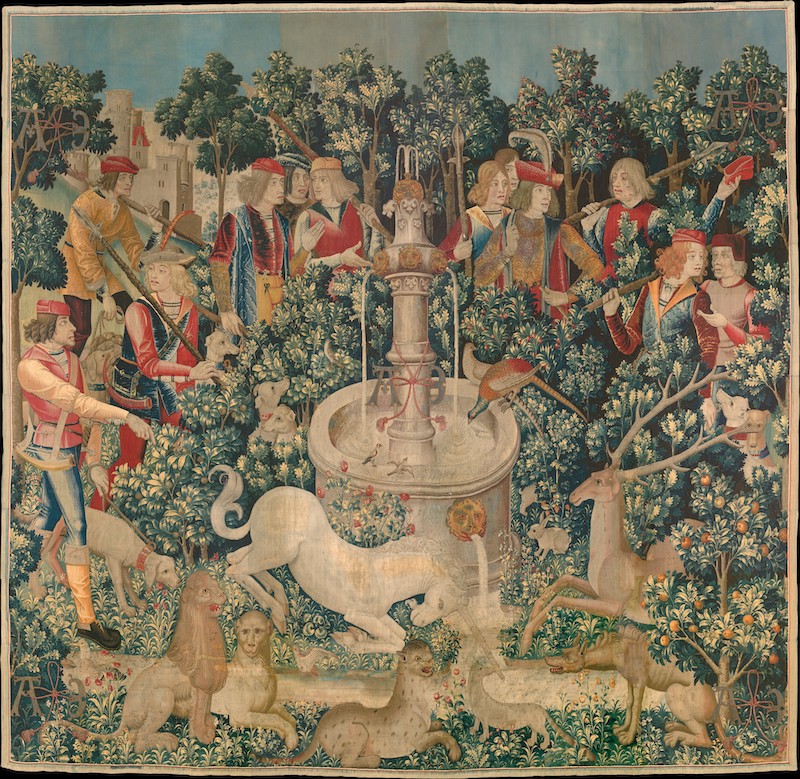
The Unicorn Purifies Water (from the Unicorn Tapestries)
Tapestry 2 of the Unicorn Tapestries (1495-1505) presents the unicorn dipping its horn in a fountain to purify the water as other assembled beasts wait to drink (courtesy of the Met Cloisters).
  • 1. Bestiary, ed. Richard Barber (Woodbridge: Boydell, 1993), 36.
  • 2. Bestiary 36-7.
  • 3. Saint Caesarius of Arles, Sermons, trans. Sister Mary Magdeleine Mueller, 3 vols. (Washington, DC: Catholic UP, 1964), vol. 2, sermon 118, pp.182-9. Origen, Commentary on John, in The Ante-Nicene Fathers, ed. Allan Menzies, v. 9 (New York: Charles Scribner’s Sons, 1912), 10.22, p. 403.
Compare Editions
i
1In
Affrica1
about the Fountain’s brink
2Where Beasts Assemble, None presumes to drink
3Untill they see the stately Unicorn,
4Who stirs the Poysonous Waters with his Horn.
5Then with extended Jaws
they drink their Fill2
.
6Thus
hee the Forrest Governeth3
at his Will.
7Hee Scorns all Huntsmen, who can never take
8
This Gallant Beast4
till they a Mayden make
9To Sit where hee doth haunt, him to allure,
10For in her lap hee’l lie and sleep secure.
11Thus hee that Scorn’d his Potent’st Enemie
12Is now inslav’d by A Virgins Eye.
13Soe Sampson though Enabled from above
14Found Death and Ruin from his Wanton Love.
15Hee that a Thousand Slaughterd with a
Jaw5
,
16Beeing Blind and Captive, in A Mill did draw.
17
Soe Solloman6
allur’d by various Love
18Did Leave the True and Glorious God above
19To Worship those whose Fabricke is of Dust;
20The Wisest King was thus inslav’d by Lust.
21The Strongest and the Wisest thus you see
22Fool’d by their strength and Wisdome often bee.
23Then let all Youthfull Gallants warning take
24
To choose by Reason7
, not for
Fancies sake8
.
Macron symbol indicating the end of a poem.

Amplified Edition,

edited by Bruce Boehreri

Editorial Note

I’ve chosen to preserve Pulter’s spelling and capitalization, while expanding superscripts and contractions and lightly modernizing punctuation.
Macron symbol indicating the end of a poem.
  • Bruce Boehrer, Florida State University
  • Affrica
    The earliest accounts of the unicorn associate it with India (see e.g. Ctesias’ Indica). However, by the 1500s, travelers had begun placing it in Africa—especially Ethiopia—as well.
  • they drink their Fill
    Jan van Linschoten attributes this behavior to the rhinoceros, which he notes “some think . . . the right Unicorne, because there as yet hath no other been founde” (Discourse of Voyages into ye Easte and West Indies [London, 1598], 1.47, p. 88). The second of the so-called Unicorn Tapestries, woven in the Low Countries between 1495 and 1505 and currently housed in the Met Cloisters, depicts this activity (see image in the headnote for this edition).
  • hee the Forrest Governeth
    The three key figures in this emblem—the unicorn, Samson, and Solomon—all serve as models of governance or leadership, qualities compromised in each case by an abdication of reason in the face of feminine wiles.
  • This Gallant Beast
    According to a wholly separate tradition repeated by Shakespeare, the unicorn could also be “betrayed with trees” (Julius Caesar 2.1)—i.e. captured by being induced to run its horn into a tree-trunk.
  • Jaw
    Notably among his exploits, Samson slew a thousand Philistines using the jawbone of an ass as a club (Judges 15.19). As to his similarity to Christ, Caesarius of Arles (468-542) observes, “What was the meaning of Samson? If I say he signified Christ, it seems to me that I speak the truth. . . . Inasmuch as Samson performed virtues and miracles he prefigured Christ, the head of the Church. When he acted prudently, he was an image of those who live justly in the Church” (Sermons, trans. Sister Mary Magdeleine Mueller, 3 vols. [Washington, DC: Catholic UP, 1964], vol. 2, sermon 118, pp.182-9).
  • Soe Solloman
    For Origen, “Solomon was an image of the Saviour” (Origen, Commentary on John, in The Ante-Nicene Fathers, ed. Allan Menzies, vol. 9 [New York: Charles Scribner’s Sons, 1912], 10.22, p. 403). Saint Augustine declares that whereas “[t]he name of Solomon is interpreted to mean peacemaker: now Christ is the True Peacemaker, of whom the Apostle says, ‘He is our Peace, who has made both one.’ Ephesians 2:4 . . . [T]herefore, He is the true Solomon; for that Solomon was the figure of this Peace maker, when he built the temple” (Exposition on Psalm 127, 1, in Philip Schaff, ed. Nicene and Post-Nicene Fathers, trans. J. E. Tweed [Buffalo, NY: Christian Literature Publishing, 1888], first series, vol. 8).
  • To choose by Reason
    Sexual infatuation was understood as madness and therefore the opposite of reason. See Shakespeare: “Love is merely madness” (As You Like It 3.2).
  • Fancies sake
    “Fancy” appears here in the sense of “to take a fancy to; to entertain a liking for; to be pleased with; to like . . . (in early use often=to be or fall in love with)” (OED “Fancy” v. II.8.a).
The Pulter Project

Copyright © 2023
Wendy Wall, Leah Knight, Northwestern University, others.

Except where otherwise noted, this site is licensed
under a Creative Commons CC BY-NC-SA 4.0 License.

How to cite
About the project
Editorial conventions
Who is Hester Pulter?
Resources
Get in touch