

• No results
ElementalAmplified
Manuscript
Notes
#
The Pulter Project
pulterproject.northwestern.edu
Poem 83

Emblem 17

Edited by Thomas Ward

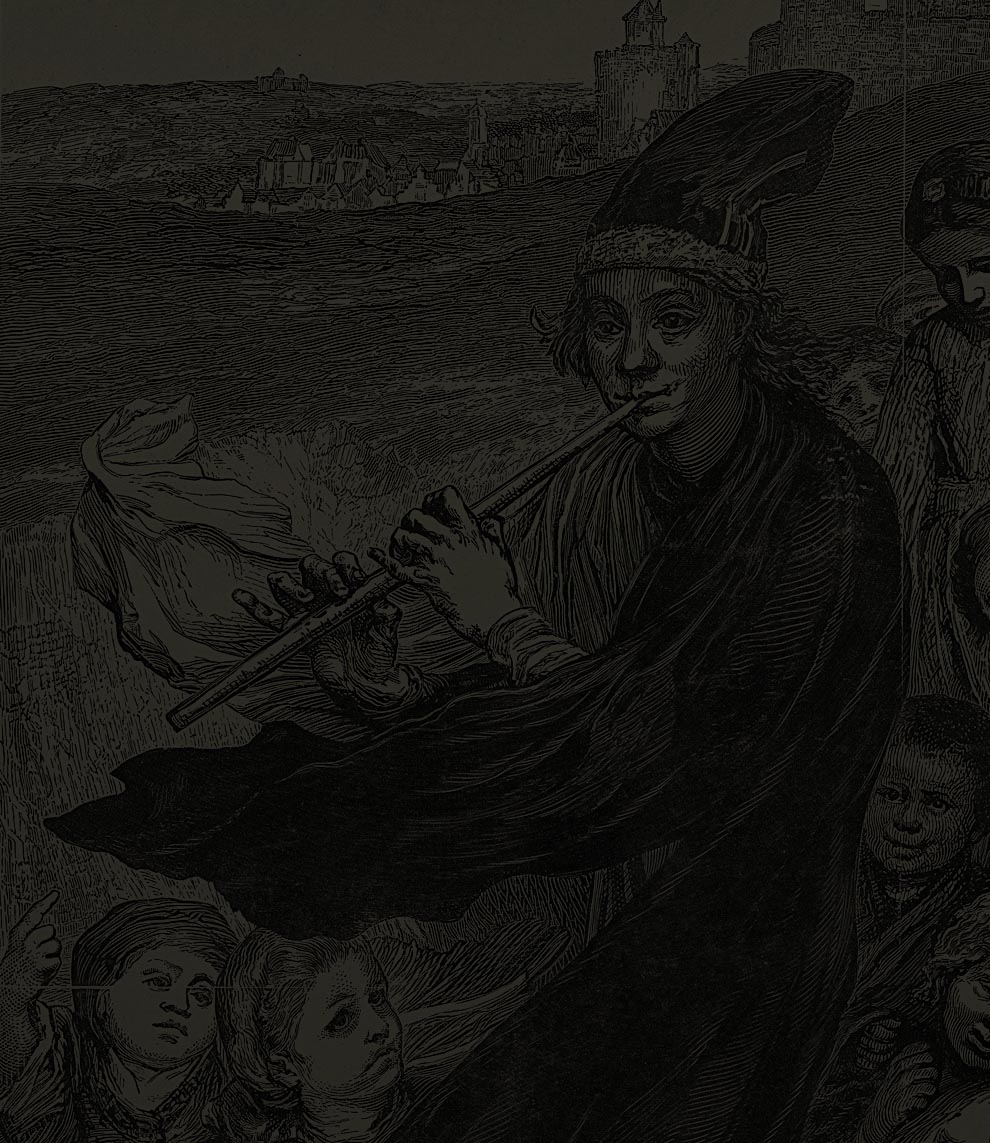
Emblem 17 tells the familiar story of the Pied Piper of Hamelin (or Hamelle, as Hester Pulter and her contemporaries tended to say), in which a mysterious stranger lures away the town’s children in order to punish the townspeople for greedily withholding the payment they owe him for ridding the town of rats. In connecting the natural world – specifically vermin – with cosmic or divine justice, the poem recalls several other of Pulter’s emblem poems in which even the lowliest and most contemptible parts of Creation are given a providential purpose. The Bishop and the Rats (Emblem 46)111, for example, narrates how the Bishop of Mainz was consumed by rats as punishment for burning a group of starving peasants during a grain shortage, and gives numerous examples of how “each despiséd reptile or insect / He [i.e. God] can empower, when we his laws neglect.” Along similar lines, Emblem 17 opens with a series of generalization about how God “will not neglect,” or scorn, to use even “reptile[s] or insect[s] / Or basest animal[s]” to inflict total destruction on a disobedient people, and the examples that follow – all taken from a section of Pliny’s Natural History dealing with the “much hurt and dammage [that] hath ben known to come from small contemptible creatures, which otherwise are of no reckoning and account” – suggest that we are in for a lecture on how God uses base means to humble the proud.1

However, the poem does not make good on its initial promise. Unlike the “contemptible creatures” that bring proud civilizations and tyrannical rulers to their knees, the rats of Hamelle actually end up having nothing to do with divine punishment – or, if they do, the initial sin that incurred such punishment is never identified. The “vermin” are simply introduced as a “rout” afflicting the town, so that, like the townspeople, readers might well “stand in doubt” as to whether the infestation arose from supernatural or merely natural causes. Instead of providing a moral about God’s punishment through base means, the poem abruptly shifts in line 20 with the announcement of a new ostensible moral, for which nothing in the poem so far has prepared us: “The fruits of curséd avarice now see.” Ironically, within this new moralizing frame, the rats serve not as the punishment for sin but, rather, its occasion, when the stingy townspeople notoriously rip off the piper after he has lured the pests to their death in the river Weser. But even this new moral does not fully survive until the end of the poem. Omitting a detail from her source (Richard Verstegan’s A Restitution of Decayed Intelligence [1605]), in which the townspeople’s miserliness is foregrounded when they attempt to offer the piper “far less then hee lookt for,” the poem ends with yet another explicitly moralizing pronouncement – “Now see how breach of promise is accursed” – shifting the focus once again, this time away from the specific vice of avarice and toward the more general sin of bad faith.2 Having been lured into what initially seemed to be a story about divinely ordained plagues of vermin only to find a quite different moral lesson about avarice and then promise-breaking, readers might end up feeling faintly defrauded of their initial investment in the poem.

As it turns out, the shifting moral frames in Emblem 17 reflect an apparent uncertainty among other seventeenth-century tellers of the tale as to its significance. The version published in James Howell’s Epistolae Ho-Elianae (1645), which is framed by an account of “som odd fellows” who “went skulking up and down London-streets, and with Figs and Reasons [i.e. raisins] allur’d little children, and so pourloy’d them away from their parents,” probably comes the closest to the story’s modern associations with literal stranger danger (along with its homophobic undertones).3 Interestingly, Howell reprints a somewhat different version of the story in A German Diet (1653), where it appears in the context of an anti-German oration by one “John Gulielm of Retwitz” and identifies the piper with “the devill” himself.4 Similarly, Robert Burton mentions the Hamelle disappearance in The Anatomy of Melancholy (1621) in “A Digression of the Nature of Spirits, Bad Angels, or Devils, and how they cause Melancholy.”5 The piper’s association with diabolical powers pervades a number of seventeenth-century versions. An anonymous anti-Ranter pamphlet, The Black and Terrible Warning Piece (1653), writes the piper out of the story altogether, the children simply “being carried away by the Devil in a flame of fire” after the townspeople, “holding the same Tenents with the Ranters, Shakers, &c. Of our times,” set them upon a hill in a deliberate attempt “to dare and defie the Lord of all spirits.”6 While such retellings present the occurrence as a literal example of Satan’s power on earth, Thomas Hodges’s The Growth and Spreading of Hæresie (1647) allegorizes the tale in terms of the “pyde piper Haeresie” that might lead “those that are near and deare unto you, you know not whither.”7 Striking in all of these accounts is their attribution of the children’s disappearance to the piper’s (or devil’s) own sinister nature, rather than presenting it as retribution for the wrong the townspeople commit by not paying him. Indeed, John Gaule’s Pus-mantia the Mag-astro-mancer (1652) turns the story into a cautionary tale about “the danger, misery, and ruine of such as have affectedly favoured, or preferred, and superstitiously credited, or consulted Magicall and Astrologicall predictors.”8 If the townspeople’s sin in Pulter’s poem is their “breach of promise” to the piper, in Gaule’s account it is their foolish decision to employ such a “Magicall” charmer in the first place.

The polysemous nature of the Pied Piper story helps to account for its presence in some surprising places, such as William Ramesey’s discourse on parasitic worms, Helminthologia (1668), which explicitly cites Verstegan’s account as an example of the “wonderful permission of GOD to the Rage of the Devil,” who, like the vermicular pest Ramesey discusses, “destroys life and all, where he can.”9 Verstegan himself presents the Hamelle story not with any kind of moralizing import but, unexpectedly, as part of his discussion of the Saxon diaspora – specifically, as a fanciful explanation (which he ends up dismissing) for why “among the Saxons in Transilvnia” there are some “that have lyke surnames unto divers of the burgers of Hamel.”10 Appropriately enough, given its theme, Verstegan introduces the story as something that has lured him away from his main topic, “one digression [having] drawn on another.”11 It is with a similar apology that the tale is prefaced in another unlikely source, The Vanitie of the Eye, first begun for the comfort of a gentlewoman bereaved of her sight (1615), whose author, George Hakewell, “confess[es]” that he has included it “not so much for the fitnesse, as the strangeness of the story.”12 Relieved of the imperative to “fit” the story to any particular end (moralizing, geographical, mag-astro-mantical, or otherwise), perhaps the least surprising context in which the Pied Piper appears in the seventeenth century is in collections of miraculous occurrences such as The Wonders of the Little World (1673) or Extraordinary Adventures and Discoveries of Several Famous Men (1683), which simply introduce the event as a “strange Accident.”13

Read in the context of these various (and variously explicated) versions, Pulter’s transformation of the Pied Piper legend into an emblem with shifting significances also transforms the genre itself from one of static exposition of a calcified moral into a dynamic meditation on the complex relationships between divine and human justice, avarice and fair trade, labor and exploitation, promise and betrayal, as well as the human and the non-human. Working backwards from what may seem like its overly trite conclusion (“Then keep your word, for better or for worse”), the poem unravels into a promiscuous array of competing possibilities that intermingle and coalesce in unexpected ways, like the mythemes of the legend itself in its various guises. For instance, given early modern associations between avarice and sodomy, Pulter’s tale of a piper luring the “pretty boys” of the town away through the use of some kind of unmentionable means (“what he did, I think no man can say”) potentially emerges as a sublimated form of poetic justice.14 The poem’s odd (and oddly unnecessary) citation of 1 Samuel 6 as a possible explanation for “how ‘twas done” (along with the five golden mice the Philistines offered Jehovah to mitigate their rodent infestation, they also presented five golden “emerods” to alleviate the divine smiting that was afflicting them “in their secret parts”) probably raises more questions than it answers.15

Indeed, the ambiguous relationship between the rats and divine punishment in Emblem 17 suggests a type of pest that refuses to be controlled either by literal extermination or by providentialist narratives. As Lucinda Cole points out, “given their endless reproducibility and the unpredictable nature of their swarming motion,” rats, mice, and other vermin represented in early modern texts “may actually threaten the ideas of an orderly universe and the regeneration of Nature symbolized by Noah’s Ark,” often resisting neat ontological (and even taxonomic) categorization.16 Thus, in seventeenth-century depictions of the biblical plagues of Egypt, for example, it is unclear whether “lice, frogs, and swarming things [are] to be read allegorically or literally” and, indeed, whether the story is “about political sovereignty or natural populations.”17 Similarly, behind Pulter’s moralizing representation of rats in Emblem 17 may lurk concerns about the real historical presence of rodents in seventeenth-century England (and a future Amplified Edition might fruitfully connect the poem to such on-the-ground conditions).

Ultimately, the poem’s shifting moral framework can have the effect of making Emblem 17 feel like two poems: one about Old-Testament-style divine retribution involving plagues of locusts, frogs, serpents – and, of course, rats – and the other about the all-too-human world of greed, bad faith, and revenge, in which such pests are simply the given facts of life, part of the meaningless chaos of existence. In fact, this doubleness is arguably reflected in a scribal error in Pulter’s manuscript: a neatly-written “18” at the top of folio 102, after the page-break, indicates what its writer evidently mistook for the beginning of a new poem: Emblem 18. Realizing her mistake, the scribe crossed it out; however, by then it was too late: having already continued numbering the next poem (The Elephant (Emblem 19)84) as number 19, making the correction would necessarily mean leaving out a number from the total sequence. Like the missing children of Hamelle, Emblem 18 ends up being an absent presence in Pulter’s manuscript: itself an emblem, perhaps, for the material vicissitudes of textual production and circulation that strain against the text’s own pursuit of a world whose meanings are legible in the form of emblems – a world (“Though some may think’t a fiction or a dream”) where betrayal, destruction, and loss are more easily attributable to divine ordination, rather than to the unaccountable and stupid realm of the “strange Accident.”

  • 1. C. Plinius Secundus, The Historie of the World. Trans. Philemon Holland (London, 1601), p. 212.
  • 2. Richard Verstegan, A Restitution of Decayed Intelligence (London, 1605), p. 85.
  • 3. James Howell, Epistolae Ho-elianae (London, 1645), p. 71. For the modern association between child kidnapping and homophobia, see Paul M. Renfro, Stranger Danger: Family Values, Childhood, and the American Carceral State (Oxford University Press, 2020), esp. Chapter 1. Robert Dixon’s Canidia, or, The witches (London, 1683) notably associates the Pied Piper with sexual deviance, listing the “Roguish Clown” who “lo[st] all the Boys in Hammel Town” alongside “Eels and Frogs” that “have no sex” and “Others” who “from between their Legs did speak, / And act many a Haggish feat” (p. 60).
  • 4. James Howell, A German Diet (London, 1653), pp. 34-35.
  • 5. Robert Burton, The Anatomy of Melancholy (London, 1621), p. 68.
  • 6. The Black and Terrible Warning Piece (London, 1653), pp. 3-4.
  • 7. Thomas Hodges, The Growth and Spreading of Hæresie (London, 1647), pp. 36-37.
  • 8. John Gaule, Pus-mantia the Mag-astro-mancer (London, 1652), pp. 364, 366.
  • 9. William Ramesey, Helminthologia (London, 1668), p. 66.
  • 10. Verstegan, A Restitution, p. 87.
  • 11. Verstegan, A Restitution, p. 85.
  • 12. George Hakewell, The Vanitie of the Eye, first begun for the comfort of a gentlewoman bereaved of her sight (London, 1615), p. 61.
  • 13. Extraordinary Adventures and Discoveries of Several Famous Men (London, 1683), p. 188.
  • 14. The piper’s queerness is emphasized in several of the early modern versions, which, in addition to emphasizing his flamboyant dress, often describe him with the epithet “odd,” as in Verstegan’s characterization of him as “an od kynd of compagnion” (p. 85). For the connection between avarice and sodomy, see, for example, John Harris, The destruction of sodome (London, 1625), p. 35: “And had couetousnesse a habitation in Sodome? and was filthy auarice a cause of her desolation? then Lord bee mercifull vnto our Land, that hath many a member in it, who out of a couetous desire, haue made a marriage with siluer, and giuen a bill of diuorce to Iesus Christ!” For a larger discussion connecting sodomy more broadly to the misuse of money, particularly through usury and counterfeiting, see Will Fisher, “Queer Money” ELH 66 (1999): 1-23.
  • 15. Even more suggestively, the Latin Vulgate describes the Philistines’ offering as “quinque anos aureos” (“five golden anuses”). For the premodern interpretation of the plagues of 1 Samuel 5-6 specifically in relation to both avarice and “sodomitirie,” see Robert Mills, “Seeing Sodomy in the Bibles moralisées” Speculum 87 (2012): 413-468.
  • 16. Lucinda Cole, Imperfect Creatures: Vermin, Literature, and the Sciences of Life, 1600-1740 (Ann Arbor: University of Michigan Press, 2016), 17.
  • 17. Cole, Imperfect Creatures, 19.
Compare Editions
i
1When God (who is to mercy most inclined)
2
To punish or to try1
hath once designed
3A people, each reptile or insect
4Or basest animal will not
neglect2
,
5But will
their3
habitation so annoy
6
Without a countermand4
they’ll5
all destroy.
7
Thus6
Spain by rabbits, moles made Thessaly,
8Locusts made Africa a desert lie;
9France frogs, Amyclæ serpents, did destroy;
10Flies,
lice7
, and frogs, all Egypt did
annoy8
;
11Gyaros, rats; and too, too many more
12Their sufferings
(though not sins)9
did then deplore.
13
This10
made the town of
Hamelle11
stand in doubt
14’Cause of those vermin they had such a rout.
15They tried all
ways, as12
poisons, traps, and cats13
,
16Yet still their houses pestered were with rats.
17At last a
piper14
chanced to come that way,
18With whom they bargained, for a certain pay,
19Their town of
this15
base loathsome beasts to free.
20
The fruits of curséd avarice now see.16
21This fellow piping went to Weser brim,
22And all the rats ran dancing after him;
23
Then instantly they skipped into the stream.17
24Though some may think’t a fiction or a dream,
25Yet true it is, for drowning was their fate;
26But how ’twas done, no story doth relate.
27For whether a
Telesma18
he did take,
28
Five such of gold the Philistines did make,19
29Or what he did, I think no man can say;
30But when he came and askéd for his pay,
31The burghers in their gravity refused
32To pay the same; the piper, thus abused,
33
Did vow revenge; they bid him do his worst.20
34
Now see how breach of promise is accursed.21
35The fellow piping went away again,
36
A hundred and thirty22
children in his train;
37
Into a hill he led these pretty boys,23
38And thus their parents lost their hopes and joys;
39Which, with sad hearts, they now too late deplore,
40For they, nor he, were ever heard of more.
41By these, their grievous suff’rings,
you may see24
42That breach of promise punished sure will be.
43Then keep your word, for better or for worse,
44Lest with these Saxons you partake
like curse25
.
Macron symbol indicating the end of a poem.

Amplified Edition,

edited by Thomas Wardi

Editorial Note

For this edition I have chosen to modernize spelling for accessibility, with two exceptions: for the modern place-name “Hamelin” I have retained the manuscript’s “Hamelle” (line 13) as the form that appeared most commonly in printed sources from the seventeenth century, and for “talisman” I have opted for the manuscript’s “Telesma” (line 27) out of respect for a possible irony the more etymologically sensitive spelling of that word might activate. In general, I have added some light punctuation for clarity but have refrained from doing so in instances where such clarity would come at the cost of obscuring an interesting ambiguity (as in the case of line 6). My notes and headnote are informed by the same errant principle I take to be driving the poem’s own – often ironic – relationship to its emblematic subject, highlighting the poem’s shifting moralizing framework by drawing particular attention to repeated and contradictory addresses to the reader, grammatical ambiguities, and features of the material text that threaten (or promise) to lead readers astray. Additionally, I have attempted to place Emblem 17 in the context of other versions of the Pied Piper story in order to show Pulter’s particular engagement with a popular legend just at the moment when it was beginning to emerge into the popular English consciousness through printed sources.

I should say something about an important omission from this edition: to my surprise, given my own scholarly interest in early modern musical discourses, I found I had nothing much to say about the piper’s Orphic powers over the rats and the children in Pulter’s telling. I attribute this omission to the way the poem seems deliberately to avoid the possibility of magical music when it seeks alternative explanations for how the piper performed his feat in lines 24-29. However, readers who are interested in considering the poem in this light (perhaps for a future Amplified Edition) might consult the work of Linda Phyllis Austern, Penelope Gouk, Gary Tomlinson, and others who discuss early modern magical and natural philosophical theories of music’s power over human and animal realms.

Macron symbol indicating the end of a poem.
  • Thomas Ward, United States Naval Academy
  • To punish or to try
    The tortuous syntax of the opening lines encourages misreading. Immediately following the prepositional phrase “to mercy,” the infinitive phrases “to punish” and “to try” suggest a parallel between God’s mercy and the punishments and trials he metes out on his people. The humble close-parenthesis is the only thing that separates a God “who is to mercy most inclined” from a God who is “most inclined) / To punish or to try.”
  • neglect
    That is, God will not scorn to use these base creatures as instruments of punishment. See The Bishop and the Rats (Emblem 46)111, lines 25-26: “For each despiséd reptile or insect / He can empower, when we his laws neglect.” An account of the Bishop of Mainz and his unfortunate encounter with rats appears immediately before a retelling of the Pied Piper story in James Howell, A German Diet (London, 1653), p. 34.
  • their
    The antecedent of “their” is “people” (3), but it could easily be mistaken for “each reptile or insect / Or basest animal” (3-4), suggesting perhaps a conflation between the human objects and the non-human instruments of punishment. This conflation also foreshadows the way in which humans and animals turn out to be equally susceptible to the alluring sound of the piper’s pipe later in the poem.
  • Without a countermand
    A lot depends on the placement of the implied “that” completing the “so” of line 5. If it follows “annoy,” then the sense is that the vermin will “all destroy” unless God issues a “countermand” (leaving open the possibility that God could perhaps relent). On the other hand, placing the implied “that” after “countermand” makes God’s decree seem more absolute and unchanging: in this reading, “without a countermand” functions less as a conditional specifying the circumstances (however unlikely) under which the destruction would be less than total, and more as a categorical denial that such a retraction would ever occur: the pests will simply and ruthlessly “so annoy / Without a countermand,” that “they’ll all destroy.” The lack of punctuation in Pulter’s manuscript effectively confronts readers with the same hedging uncertainty that led the townspeople of Hamelle to renege on their payment: a God – or a Piper – who is inclined more to mercy than to punishment and who thus does not always follow through with his threats is also one whose bluff might more safely be called (or so the townspeople think, to their peril).
  • they’ll
    This time, the third-person-plural pronoun takes “each reptile or insect / Or basest animal” (3-4) as its antecedent, but, again, the syntax (as well as the fact that “each” is singular) encourages a misreading that attaches the pronoun to “people” (3), requiring readers to take special care to distinguish between man and beast.
  • Thus
    The section of Pliny’s Natural History from which Pulter draws the examples in lines 7-11 focuses on how “much hurt and dammage hath ben known to come from small contemptible creatures, which otherwise are of no reckoning and account,” recalling the poem’s opening claim about how God “each reptile or insect / Or basest animal will not neglect” in his punishment of disobedient people (C. Plinius Secundus, The Historie of the World, Trans. Philemon Holland [London, 1601], p. 212).
  • lice
    See The Bishop and the Rats (Emblem 46)111, line 28: “Sulla and Herod by a louse did die.”
  • annoy
    The reversal of the order of the rhyming words “annoy”/“destroy” from lines 5-6 sits in ironic counterpoint to the notion of a destruction that is supposed to occur “without a countermand” (6).
  • (though not sins)
    The relegation of “sins” to parentheses mirrors the people’s spiritually negligent failure to “deplore” their sins as the just cause of their divinely ordained “sufferings.”
  • This
    The poem never specifies what the citizens of Hamelle did to invite the plague of rats in the first place; oddly, we don’t know what sin the vermin are meant to punish.
  • Hamelle
    A town in Lower Saxony, Germany, more commonly known from the Pied Piper legend as Hamelin.
  • ways, as
    The words “waies, as” were added to the line with a caret.
  • poisons, traps, and cats
    For some of the methods the townspeople might have tried, see Leonard Mascall, A booke of engines and traps to take polcats, buzardes, rattes, mice and all other kindes of vermine and beasts whatsoever, most profitable for all warriners, and such as delight in this kinde of sport and pastime (London, 1590).
  • piper
    The poem itself never refers to the piper as “Pied,” although the word does appear in a marginal note referring readers to “the story of this Pied Piper” in Richard Verstegan’s A Restitution of Decayed Intelligence (London, 1605). (The page number in the note [85] indicates that Pulter was using one of the first three editions of the book: 1605, 1628, or 1634.) Verstegan explains how the piper earned his popular epithet “for the fantastical cote which hee wore beeing wrought with sundry colours,” another common feature in various tellings of the story that is left out of Pulter’s poem (p. 85).
  • this
    The (perhaps unintentionally) ungrammatical singular form, as it appears in the manuscript, may indicate that Pulter is thinking of the rats as a single mass, as in the “rout” of line 14.
  • The fruits of curséd avarice now see.
    This first direct address to the reader moralizes the tale in terms of the townspeople’s greed in withholding payment from the piper.
  • Then instantly they skipped into the stream.
    This first line after a page break in the middle of the poem is preceded by a marginal “18” that has been crossed out, indicating that its writer mistook this line as the beginning of a new poem. Since the person numbering the poems had continued with 19 for the next poem in the sequence (The Elephant (Emblem 19)84) before realizing the mistake, there is no Emblem 18.
  • Telesma
    An object meant to ward off various evils, including pests. Cognate with “talisman,” Pulter’s more unusual spelling reflects the word’s Greek root from τέλεσμα, “payment,” which often appears in the context of religious rites in the sense of “propitiation,” as of a deity – a kind of supernatural “protection money.” This sense of the word is especially ironic given the townspeople’s refusal to pay the piper for ridding the town of rats. Although the accent is on the first syllable in the Greek, Pulter appears to be scanning the word with an accented second syllable. She uses a similar spelling in The Bishop and the Rats (Emblem 46)111, where the Bishop of Mainz is unsuccessful in his attempt to ward off a rodent swarm either by magical or more this-worldly means: “by Tel’sma or Gun” (line 16). In suggesting that some means other than the sound of the piper’s instrument were responsible for luring away the rats and the children, Pulter may be drawing on Nathaniel Ingeno’s prose romance Bentivoglio and Urania (London, 1660), which asks, “Who knows but the Piper of Halberstade was of this Profession [i.e. a magician], and had some Talismans in his Pocket when he drove the Rats into the River and the Boys into the Hill?” (p. 158).
  • Five such of gold the Philistines did make,
    In 1 Samuel 5-6, the Philistines of Ashdod are visited with a plague of mice and a plague of “emerods [hemorrhoids, tumors, or boils] in their secret parts” after capturing the Ark of the Covenant. Following the counsel of their priests and diviners, the Philistines return the Ark along with a “trespass offering” of “five golden emerods and five golden mice.” These objects were regarded with some ambivalence by early modern commentators. Arthur Jackson, in his Annotations upon the remaining historicall part of the Old Testament (London, 1646), considers the possibility “that the sending of such absurd and ridiculous gifts with the Ark, as emerods and mice, was suggested by Sathan to their diviners in contempt of God,” and remarks on “what a shame must it needs be to the Philistines to send to the Israelites the images of their secret parts, thus tortured with an ignominious disease” (p. 238). Of particular interest in relation to Pulter’s characterization of these objects as “Telesma” in line 27 is John Chetwynd’s Anthologia historica (London, 1674), which lists the biblical “Images of Emrods and Mice” that “were made by the Astrologers directions and were Telesmatical signes” alongside accounts of other “Telesmatical practices” used to ward off scorpions, crocodiles, flies, serpents, and dormice (pp. 322-25).
  • Did vow revenge; they bid him do his worst.
    Pulter lifts this language directly from Verstegan: “hee threatened them with revenge; they bad him do his wurst” (p. 66).
  • Now see how breach of promise is accursed.
    Repeating “now see” from line 20, this second direct address to the reader compounds the ostensible moral about “curséd avarice” with a new one about promise-breaking and, in doing so, asks readers to consider the relationship between the two vices.
  • A hundred and thirty
    Pulter follows Verstegan in her account of how many children went missing. Many other early modern English versions of the story also specify the number as 130.
  • Into a hill he led these pretty boys,
    Several early modern English sources for the Pied Piper story, including Verstegan’s, say that it was specifically the town’s boys that the piper lured away, whereas others do not specify the gender of the children. Interestingly, Peter Heylyn’s Mikrokosmos (London, 1625) explicitly draws his account from “a story recited by Verstegan,” but instead of “a number of boyes,” it is “all the children male and female of the Towne” who follow the piper in his account (p. 364).
  • you may see
    With this third direct address to the reader (compare lines 20 and 34), and after introducing at least two other possible morals (i.e. God’s use of base creatures to mete out punishment; the evils of avarice), the poem ends by repeating the moral stated in line 34.
  • like curse
    Given Verstegan’s heavy investment in recovering England’s Saxon identity, it is ironic that Pulter ends her poem warning English readers not to “partake like curse” with their Saxon cousins. For Verstegan and England’s Saxon cultural identity, see Richard W. Clement, “Richard Verstegan’s Reinvention of Anglo-Saxon England: A Contribution from the Continent,” Reinventing the Middle Ages and the Renaissance: Constructions of the Medieval and Early Modern Periods (Turnhout: Brepols, 1998), 19-36.
The Pulter Project

Copyright © 2023
Wendy Wall, Leah Knight, Northwestern University, others.

Except where otherwise noted, this site is licensed
under a Creative Commons CC BY-NC-SA 4.0 License.

How to cite
About the project
Editorial conventions
Who is Hester Pulter?
Resources
Get in touch