• No results
ElementalAmplified
Manuscript
Notes
#
The Pulter Project
pulterproject.northwestern.edu
Poem 75

Scorned Medea
(Emblem 9)

Edited by Millie Godfery and Sarah C. E. Ross

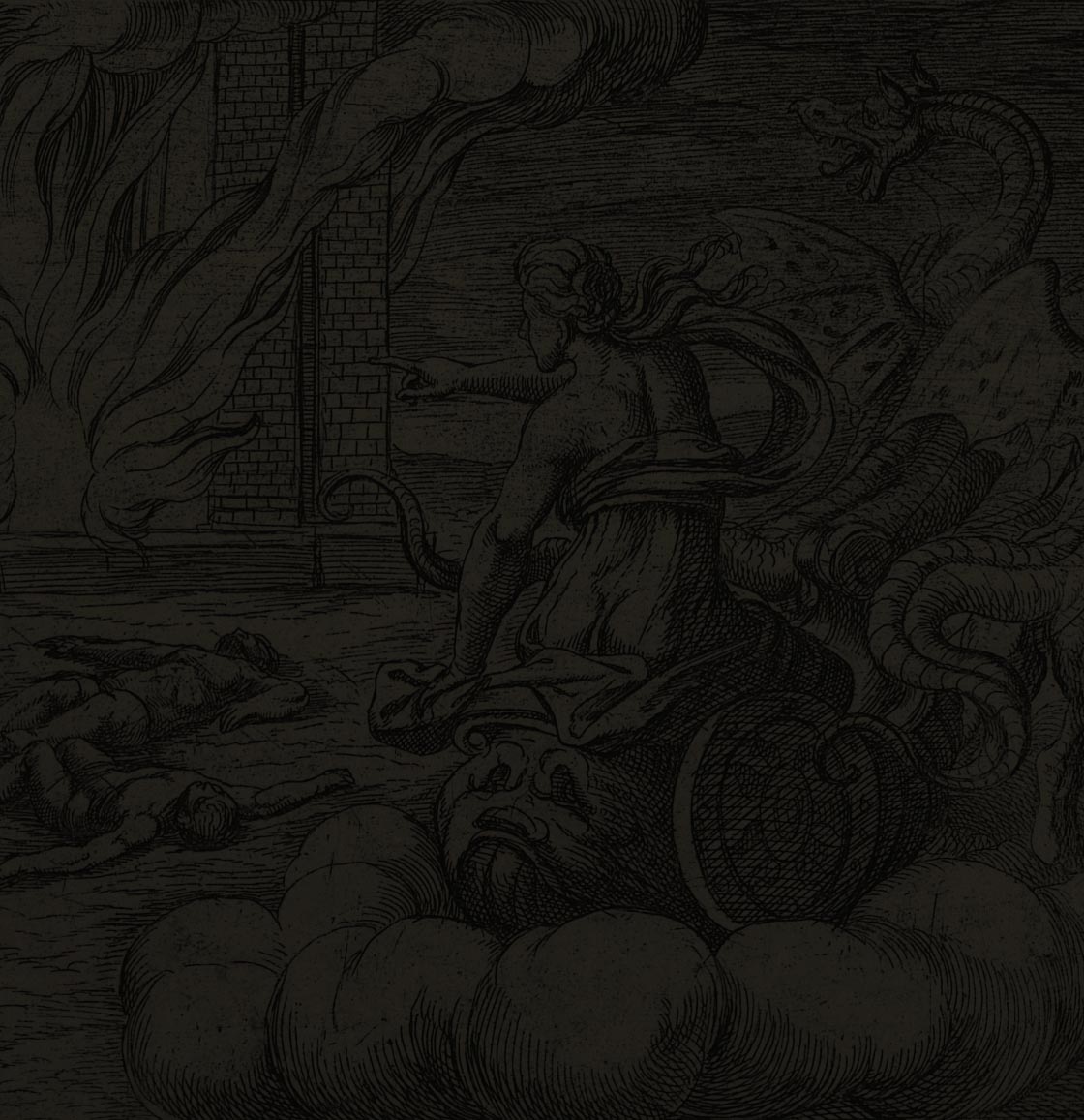
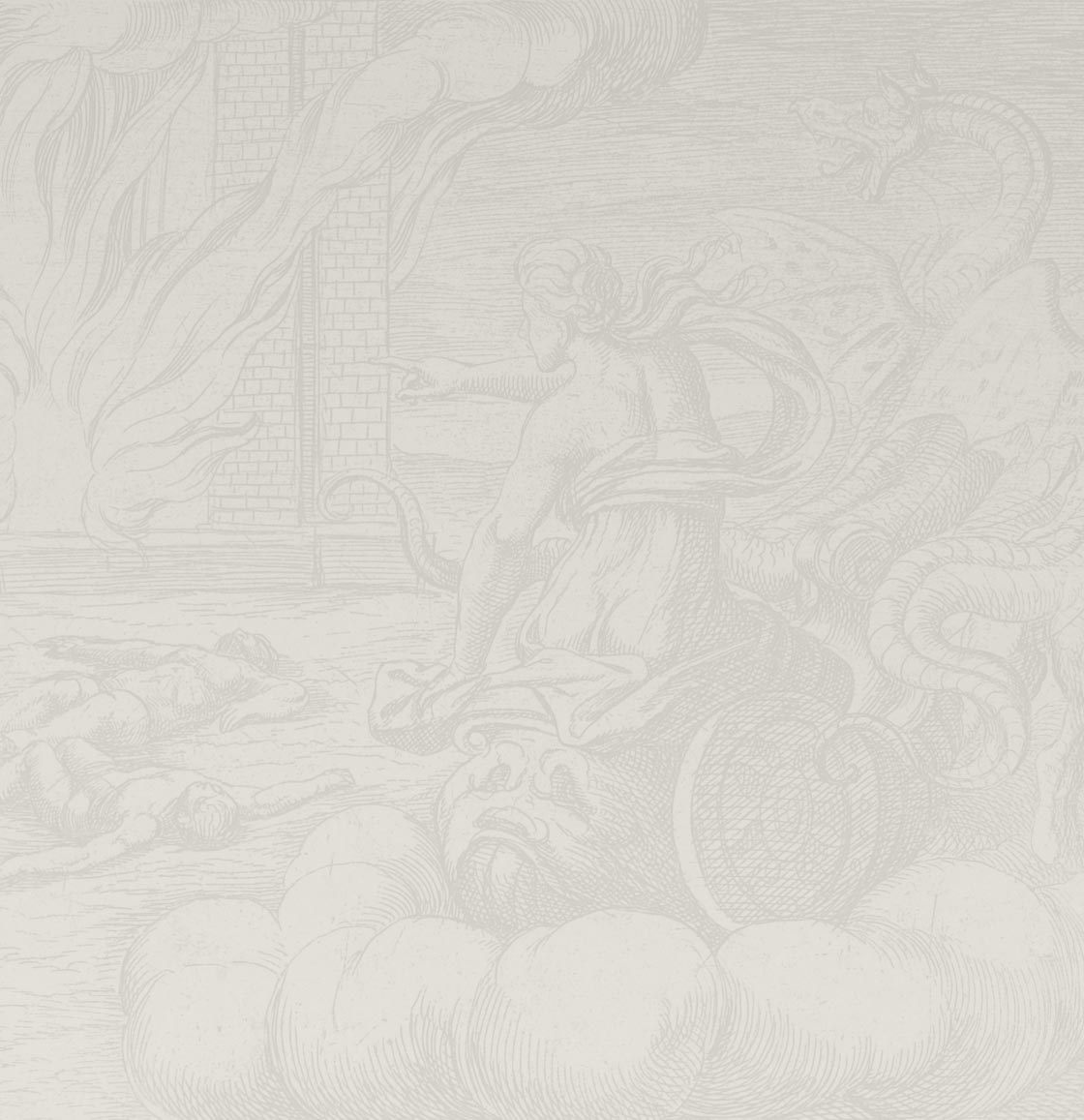
Medea’s vengeance is this emblem’s central image, as Pulter moralises on the consequences of revenge, both for those who seek it, and those whose actions might provoke it. The story, relayed in Ovid’s Metamorphoses, begins when Jason, leader of the Argonauts, arrives in Colchis to retrieve the Golden Fleece, which his uncle Pelias has requested in exchange for the throne of Iolcus. In Colchis, King Aeetes sets Jason three challenges he must complete in order to receive the fleece, and, in a “violent conflict between reason and passion”, Aeetes’ daughter Medea decides to aid him (Sandys 252).1 Jason promises to marry Medea in return for her help, and they flee to Iolcus, where Medea then further assists her husband by murdering Pelias. When she returns to her husband, however, she discovers he has married Creusa, the daughter of King Creon. It is from this point that Pulter documents the revenge Medea enacts for this betrayal: setting fire to Creusa and committing infanticide.

Pulter contrasts Medea’s active revenge with the analogous story of Ariadne, also in the Metamorphoses, whose passive response to a similar abandonment by her husband Theseus is to marry and devote herself to another, Bacchus. Where Medea’s “mad impiety” goes as far as to “dare the gods to do as much by her”, Ariadne implores the “pity” of the gods and is rewarded with a crown of constellations (lines 13, 14, 18). The moralising turn Pulter takes at the end of the poem is perhaps unexpected, however, as she moves her focus from comparing the actions of both women to instead highlighting the fate of Creusa as warning to “all those / That injure others not to trust their foes” (lines 23-4). It is worth noting that both Medea and Ariadne also appear as speakers in Ovid’s Heroides, a text which also may have informed Pulter. This series of epistolary laments written by Ovid engage in the complaint genre to give Medea and Ariadne (alongside other female figures from Greek mythology) female-voiced narratives expressing the rejection and frustration they suffer in the Metamorphoses (Heroides, translated by John Sherburne [1639], pp. 55-61, 66-74). Pulter herself was well acquainted with the complaint genre: see The Complaint of Thames, 16474, Universal Dissolution6, and A Dialogue Between Two Sisters, Virgins Bewailing Their Solitary Life56 for examples of political and religious complaints.

From line 21, Pulter shifts from her classical narrative to a Christian moral, suggesting that “trust in God” will, like Ariadne’s piety, be “crowned” in reward (line 22). This movement from classical to Christian interpretation is affirmed in her final couplet, as she takes an inward turn to reflect on her own mortal condition and her susceptibility to sin. She asks God to “deliver” her from any “enemies” within, fearing that her own self is worse than the Medeas and Creusas of the world (lines 26, 25). This phrase echoes Matthew 6:13 (“deliver us from evil”), demonstrating a repurposing of the plural “us” to appeal to God for assistance from the “enemies” that she fears exist within her. Pulter here displays a “psalmic inwardness” which affirms the movement from a classical to Christian moral, as Pulter adapts the emblem form to conclude in self-reflection (Rachel Dunn [Zhang]. “Breaking a Tradition: Hester Pulter and the English Emblem Book”, The Seventeenth Century, 30.1 [2015], 64). Thus, her ninth emblem offers a complex didacticism, offering three resolutions: first, she encourages readers to be patient and devout like Ariadne, then she uses Creusa as a reminder to be aware of how one’s actions can provoke enemies, and finally she concludes with a meditation on her own fallibility. Her use of Ovid’s mythology to give greater affinity to her moral and religious expressions demonstrates a sophisticated engagement in contemporary humanist discourses, one that can also be seen in her comparison of the biblical figure Nimrod with Ovid’s ambitious giants in Mighty Nimrod (Emblem 1)67.

  • 1. George Sandys’s translation of Ovid’s Metamorphoses Englished (1632) is the most contemporaneous translation to Pulter’s writing, and so we have used it as our point of reference in this edition [New York: Garland Publishing, 1976].

Compare Editions
i
1When
scorned1
Medea2
saw
Creusa3
led,
2A bride, to her
ungrateful spouse’s4
bed,
3She vowed revenge hid underneath a smile,
4Which did the
royal virgin5
so
beguile6
5That she received of her the
robe and crown7
6And overjoyed put on the
napthian gown8
;
7But putting holy incense in the fire,
8The palace soon became her fun’ral pyre.
9Then fierce Medea
with her dragons flew9
,
10
Killing her children in their father’s view.10
11Oh, horrid! She (even she) that gave them birth
12Stabbed those sweet boys, then flung them to the earth;
13Her mad impiety did rise thus far
14To dare the gods to do as much by her.
15
Poor Ariadne11
did not so when she
16Fair
Phaedra12
in false
Jason’s13
arms did see;
17When he forsaken was on
Naxos’ shore14
,
18The pity of the gods she did implore.
19Then
Liber Pater15
took her for his spouse;
20
With nine refulgent orbs he crowned her brows.16
21So, though afflictions doth thy soul surround,
22Yet trust in God
thy patience will be crowned17
;
23Then let this
flaming fabric18
warn all those
24That injure others not to trust their foes.
25But O! My enemies within me be;
26Then from
my self19
, dear God,
deliver me20
.
Macron symbol indicating the end of a poem.

Amplified Edition,

edited by Millie Godfery and Sarah C. E. Rossi

Editorial Note

Our priority in editing these poems has been to modernise, and to achieve interpretative and visual clarity, in order to make the poems as accessible as possible to as wide a modern audience as is possible. Spelling is modernised, as is punctuation. Modernising the latter, in particular, often involves a significant act of editorial interpretation, but in our view this is one of the most productive areas of editorial intervention, particularly for a manuscript text such as Pulter’s where the punctuation is erratic compared to modern usage (and, indeed, compared to early modern printed texts). 1 All biblical references are to the King James Version (1612).
  • 1. See Alice Eardley, “‘I haue not time to point yr booke … which I desire you yourselfe to doe’: Editing the Form of Early Modern Manuscript Verse”, in The Work of Form: Poetics and Materiality in Early Modern Culture, ed. Ben Burton and Elizabeth Scott-Baumann (Oxford: Oxford University Press, 2014), pp. 162-178.
Macron symbol indicating the end of a poem.
  • Millie Godfery
  • Sarah C. E. Ross, Victoria University of Wellington
  • scorned
    despised, contemptible (OED)
  • Medea
    daughter of Aeetes and Hecate, descendant of the sun god Helios. Pulter’s retelling of Medea’s revenge, which appears similarly in Book Seven of Ovid’s Metamorphoses, is the basis for this emblem’s narrative of revenge. Proceeding from the point at which Medea discovers her beloved Jason has married Creusa, Pulter’s poem describes how Medea is spun into a vengeful stupor, demonstrating, as Sandys writes in his interpretation of Ovid’s text, that “no hatred is so deadly as that which proceeds from alienated love” (258). See Headnote for a detailed account of Medea’s story and its role in the emblem.
  • Creusa
    daughter of King Creon and wife of Jason
  • ungrateful spouse’s
    Medea’s husband Jason, who, while she is away on a mission to murder the King of Iolcus and restore his birthright to the throne, marries Creusa, breaking Medea’s heart. Pulter describes him as “ungrateful”, given the faithful way in which Medea has aided him in his quest for the Golden Fleece and restoration of the throne; see Headnote.
  • royal virgin
    Creusa; see note for line 1
  • beguile
    deceive, delude (OED 1a)
  • robe and crown
    In Sandys’s account of the story, Medea “sends a Crowne and a robe to Creusa, infected with magicall poyson: which being put on, sets her all on a flame: consuming Creon also, who came to her rescue” (Sandys 259).
  • napthian gown
    Pliny’s Natural History describes the substance naphtha as having a “great affinitie” with fire, which will “leap onto it immediately”. Here, Pliny reaffirms the link between naphtha and Medea, as he writes “Medea burnt her husbands concubine, by reason that her guirland annointed therewith, was caught by the fire, after she approached neere to the alters, with purpose to sacrifice” (The Historie of the World: Commonly Called, the Naturall Historie of C. Plinius Secundus. Trans. Philemon Holland. Vol. 1 [1635], 47).
  • with her dragons flew
    Ovid writes “The ill-reveng’d [Medea] from Jasons fury fled. / Whom now the swift Titanian Dragons draw / To Pallas towres”, describing Medea’s escape to Athens on the dragons provided by her mother Hecate, who was a descendant of the Titans (Sandys 240).
  • Killing her children in their father’s view.
    Medea commits infanticide, killing her children Mermerus and Pheres, while Jason watches (Sandys 240).
  • Poor Ariadne
    In Ovid's Metamorphoses, Ariadne is the goddess of the labyrinth. Upon falling in love, with Theseus, who comes to Crete as a victim to be sacrificed for the Minotaurus, she helps him to escape by giving a ball of string and instructions to find his way out of the labyrinth. She elopes with him to the Island of Dia; however, once they arrive Theseus, “forgetfull of the many merits of Ariadne, steales away by night, and forsakes his sleeping preserver” (Sandys 288-9).
  • Phaedra
    wife of Theseus and sister of Ariadne
  • Jason’s
    Pulter appears to conflate the two stories of Medea and Ariadne, as she references “Jason”. Traditionally, it is Theseus who abandons Ariadne on the island of Naxos and marries her sister Phaedra.
  • Naxos’ shore
    Ariadne and Theseus first arrive here upon eloping from Athens, only to discover it is Bacchus’s territory. Theseus abandons Ariadne in the middle of the night; see note for line 16.
  • Liber Pater
    Italian god of wine and fertility, often associated with Bacchus. After being left on Naxos, Bacchus discovers Ariadne and takes pity on her, making her his wife; see notes for lines 15 and 16.
  • With nine refulgent orbs he crowned her brows.
    In the myth of Ariadne, Bacchus converts her crown into a constellation “consist[ing] of eyght starrs” when he marries her. Upon Ariadne’s death, Bacchus then sets the crown among the stars, immortalising her in constellation (Sandys 290). Pulter’s constellation consists of nine rather than eight stars.
  • thy patience will be crowned
    echoes Hebrews 6:12: “them who through faith and patience inherit the promises”. Fusing this New Testament echo and her classical story, Pulter moralises on her comparison between Medea and Ariadne, praising Ariadne’s passive response to Theseus’s betrayal of her. She emphasises that God will reward Ariadne’s reaction, as opposed to Medea’s violent revenge.
  • flaming fabric
    Creusa’s “napthian gown” which sets on fire (line 6)
  • my self
    In contrast to Eardley, we have preserved Pulter’s original spacing here, as it nicely isolates the “self” as an entity over which the speaker does not have control. Hence she turns to God, asking for his protection against the “enemies” which might deter her “self” from an appropriate path.
  • deliver me
    a phrase which echoes Matthew 6:13: “deliver us from evil”. For Pulter's recasting of the biblical plural “us”, see Headnote.
The Pulter Project

Copyright © 2023
Wendy Wall, Leah Knight, Northwestern University, others.

Except where otherwise noted, this site is licensed
under a Creative Commons CC BY-NC-SA 4.0 License.

How to cite
About the project
Editorial conventions
Who is Hester Pulter?
Resources
Get in touch