• No results
ElementalAmplified
Manuscript
Notes
#
The Pulter Project
pulterproject.northwestern.edu
Poem 42

[Untitled]1

Edited by Megan Heffernan

“Pardon Me, My Dearest Love” is about the limits of love and fidelity. This is Pulter’s only poem addressed to a lover, who seems likely to be her husband; no other earthly lover is named or introduced. In fact, the problem that animates the poem is the poet’s tenuous investment in her relationship. Even though the speaker owes the addressee her body, he cannot constrain the movement of her soul. She acknowledges that “What’s subsolary is yours”—literally that he owns what is below the sun—for as long as “life endures,” but then immediately concedes that her mind seeks a joy that cannot be found among the muck and dust of “this dirty dunghill earth.” What follows is a story about both the past and the future of her lively soul, which is personified to an unusual degree. Born in a “sparkle” of the light of eternal salvation, her “aspiring mind” yearns—or more basically, breathes towards, from the Latin root spirare–the highest good of heaven.

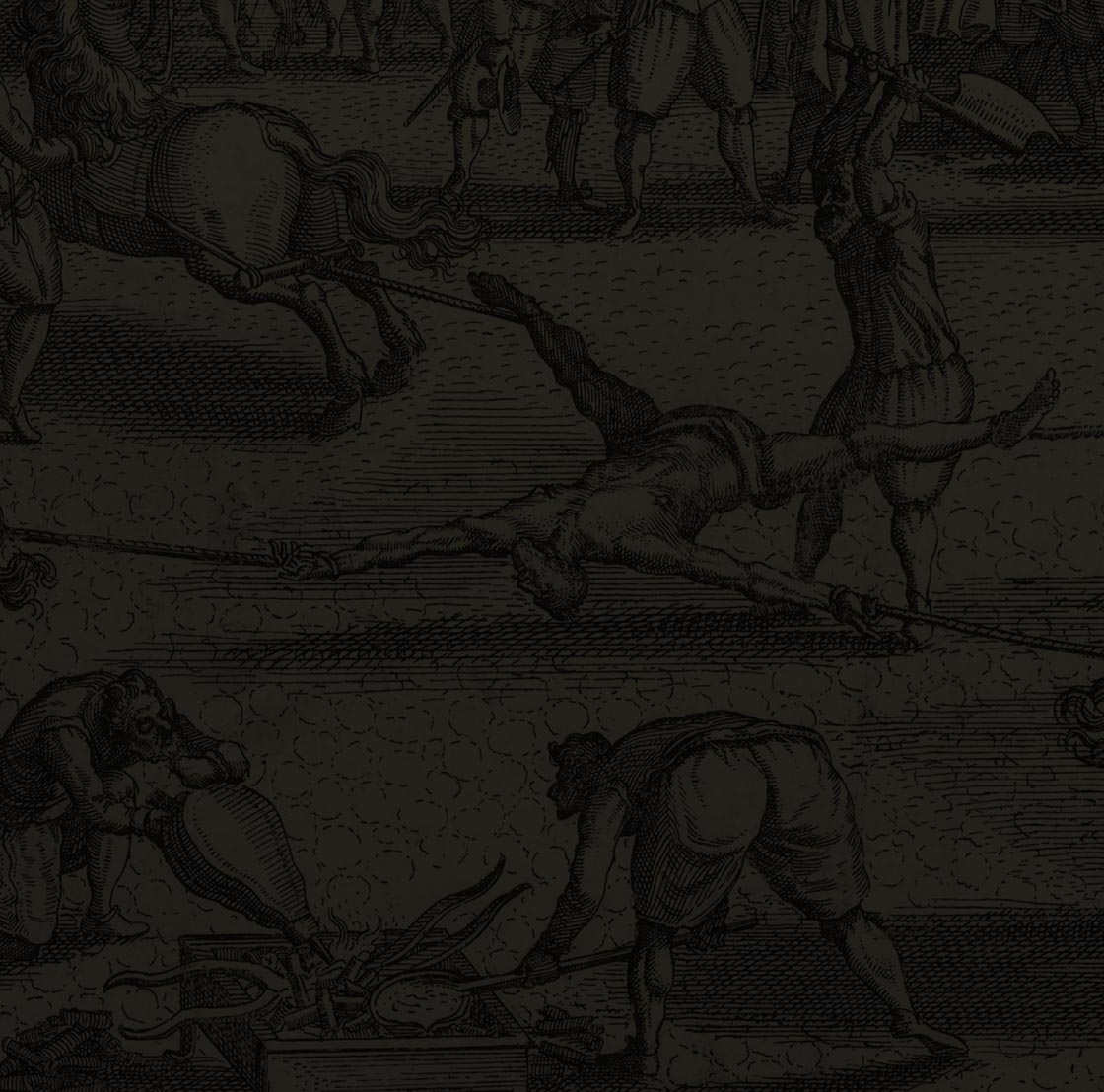
This poem explores marital love by exposing the partial and insufficient satisfaction of erotic commitment. The speaker’s earthly condition is temporary. Death is inevitable, and her body, the “due debt” that she owes her husband, will soon be dissolved back into the elements out of which it is made. When that division takes place, body and soul will be cleaved just as traitors are drawn and quartered in punishment for their rebellion. But in an unexpected turn, this image of violent dismemberment becomes a moment of liberation that will set her “enfranchis’d spirit” free, dissolving the bonds of earthly commitment.

Pulter develops this ambiguous account of marriage through a conceit common to seventeenth-century poetics: the uneasy and mutable tethering together of body and soul. In “Church-Monuments,” George Herbert describes life on earth as a fleshly tomb, a “school” for the body in which it “may learn / To spell his elements, and find his birth / Written in dusty heraldry” (ll. 6-8).1 For Herbert, the body becomes a measure of time, both in the dusty contents it holds and in its form, which will itself dissolve back into dust. Death will “sever that good fellowship of dust” because “flesh is but the glass, which holds the dust / That measures all our time; which also shall / be crumbled into dust” (ll. 13, 20-22). Anticipating this same separation of body and soul, the speaker of Pulter’s “Pardon Me, My Dearest Love” finds solace in the eternal joy promised when her spirit will be free from earthly constraint, “melt[ing] and molder[ing] into dust.”

In a concluding gesture, the poem makes a surprising return to the opening concession, but the plea for a pardon now rings more hollow. The final three lines are a rhyming triplet that add “turtledove,” the bird that famously mates for life, to the pairing of “love” and “above,” a rhyme that appears twice previously in the poem. While triplets are unusual in seventeenth-century poetry, Pulter uses them often. The Revolution16 is written entirely in triplet stanzas, and Let None Sigh More for Lucas or for Lisle [On the Same (2)]15 is also in couplets with a concluding triplet. In “Pardon Me, My Dearest Love,” the effect of the final triplet is to propose that the poem’s exploration of “endless joy and love” cannot be contained by the established couplet rhymes. It offers a concluding “anticouple” that works against the heteroerotic terms of the preceding couplets. The final two lines show the speaker’s mind once again beginning to whirl “above,” away from the “confinement” that currently holds her soul in captivity. With the near repetition of the beginning, we are left to anticipate the poem starting over again, as if the speaker’s lively mind will continually resist the confinement of her dusty body.

  • 1. George Herbert, The Complete Poems, ed. John Tobin (London: Penguin, 1991), pp. 58-59.
Compare Editions
i
1Pardon me, my dearest love,
2That I place my thoughts above:
3What’s
subsolary2
is yours
4And so shall be while life endures.
5Only my aspiring mind
6No felicity can find
7In this dirty
dunghill earth3
.
8My soul remembers still her birth:
9She being a
sparkle4
of that light,
10Which
ne’re5
shall set in death or night.
11Nothing here is worth her love;
12Her
summum bonum6
is above,
13But this body shortly must
14Melt and
molder7
into
dust8
.
15This due debt can’t be denied:
16The elements must me divide.
17Thus, like
traitors quartered out9
18Are old
Adam’s rebel rout10
.
19Then shall my
enfranchised11
spirit
20Those eternal joys inherit,
21Which from me shall never part—
22With these thoughts I cheer my heart.
23Then pardon thy poor
turtledove12
24That hath placed her thoughts above
25Where is endless joy and love.

Macron symbol indicating the end of a poem.

Amplified Edition,

edited by Megan Heffernani

Editorial Note

To make the poem accessible for all readers, I have modernized the text of Pulter’s manuscript by updating spelling, expanding contractions, and standardizing capitalization. The only exceptions are cases where the form or the sense of the poem would be lost by modernizing, particularly the elision of syllables to preserve meter. I have also supplied punctuation because, as was typical for seventeenth-century poetry manuscripts, Pulter’s poems contained almost no punctuation. There are both benefits and liabilities to this approach. While the introduction of punctuation improves the sense of grammatical structures for modern readers, it loses the productive ambiguities of the manuscript, where clauses might connect to each other in multiple ways. So I would invite readers to proceed by comparing the edition to the images of the manuscript and the transcription supplied by The Pulter Project. Do you agree with the punctuation that I’ve introduced? How might the meaning of the poem change without it?
Macron symbol indicating the end of a poem.
  • Megan Heffernan, DePaul University
  • [Untitled]
    Blank space remaining at the top of the manuscript page suggests the scribe may have left room for a title.
  • subsolary
    earthly; literally meaning “below the sun.” The description may be a coy inversion of John Donne’s critique of the bland, mortal desire of “dull sublunary lovers” in his “A Valediction Forbidding Mourning.”
  • dunghill earth
    comparing daily existence to a pile of barnyard excrement. This phrase appears often in Pulter’s poems, including The Pismire35, Why Must I Thus Forever Be Confined57, Of a Young Lady at Oxford, 164643. For Frances E. Dolan, the image evokes the labor required to nurture and maintain earthly life (Frances E. Dolan, ed., “The Pismire,” by Hester Pulter [Poem 35, Amplified Edition], in The Pulter Project: Poet in the Making, edited by Leah Knight and Wendy Wall [2018]).
  • sparkle
    a small spark, perhaps that sets off a larger fire. Pulter depicts her soul as a fragment of an eternal, divine light that is not extinguished at night or in death.
  • ne’re
    A contraction of “never,” shortened to regularize the meter.
  • summum bonum
    highest or supreme good; the soul’s ultimate aim.
  • molder
    to crumble, fall to pieces, rot, or decay.
  • dust
    Pulter frequently describes the breaking down of the body after death, when flesh will dissolve into the basic elements of life: earth, water, air, and fire. See Universal Dissolution6 and The Hope65.
  • traitors quartered out
    A reference to the capital punishment for high treason in which the convicted traitor was drawn through public view by a horse, hung from the gallows until nearly dead, and then cut down to be disemboweled, burnt alive, decapitated. The mutilated body was finally “quartered out,” that is, cut into four pieces which would be displayed with the head. The punishment is a gruesome and literal “dividing” of the earthly body and, interestingly for Pulter, only applied to male traitors. Women were more simply drawn and burnt.
  • Adam’s rebel rout
    an army led by Adam, the first man, whose rebellion against divine law introduced sin into the world. There may be an echo here of John Milton’s Paradise Lost, where the traitorous Satan is the leader of a “Host / Of Rebel Angels” (1. 37-38).
  • enfranchised
    set free; released from slavery or political servitude.
  • turtledove
    a bird that mates for life, emblematizing constancy and devotion. See This Poor Turtle Dove (Emblem 20)85, Mark But Those Hogs (Emblem 34)108, Of A Young Lady at Oxford, 164643, Why Must I thus Forever Be Confined57.
The Pulter Project

Copyright © 2023
Wendy Wall, Leah Knight, Northwestern University, others.

Except where otherwise noted, this site is licensed
under a Creative Commons CC BY-NC-SA 4.0 License.

How to cite
About the project
Editorial conventions
Who is Hester Pulter?
Resources
Get in touch