• No results
ElementalAmplified
Manuscript
Notes
#
The Pulter Project
pulterproject.northwestern.edu
Poem 67

Mighty Nimrod (Emblem 1)

Edited by Millie Godfery and Sarah C. E. Ross

This is the first poem in Pulter’s emblem series titled “The Sighs of a Sad Soul Emblematically Breathed Forth by the Noble Hadassah”. Comprised of fifty-three emblems, this poetic project constitutes a unique contribution to the tradition of English emblem poems, as Pulter revises the traditional tripartite format of the emblem, consisting of inscriptio (a motto), pictura (visual image), and subscriptio (a short epigrammatic verse). Pulter removes the visual image (pictura) to form what are known as “naked” emblems, in doing so placing the emphasis on the visual qualities of her writing (Alice Eardley, Poems, Emblems, and The Unfortunate Florinda / Lady Hester Pulter [Toronto; Iter and Centre for Reformation and Renaissance Studies, 2014], 28). By utilising the didactic affordances of the emblem genre, Pulter continues to address the personal and political concerns of her earlier occasional and devotional lyrics, attending to her experiences as a woman, mother, and royalist during the 1650s, in which the poems are believed to have been written.

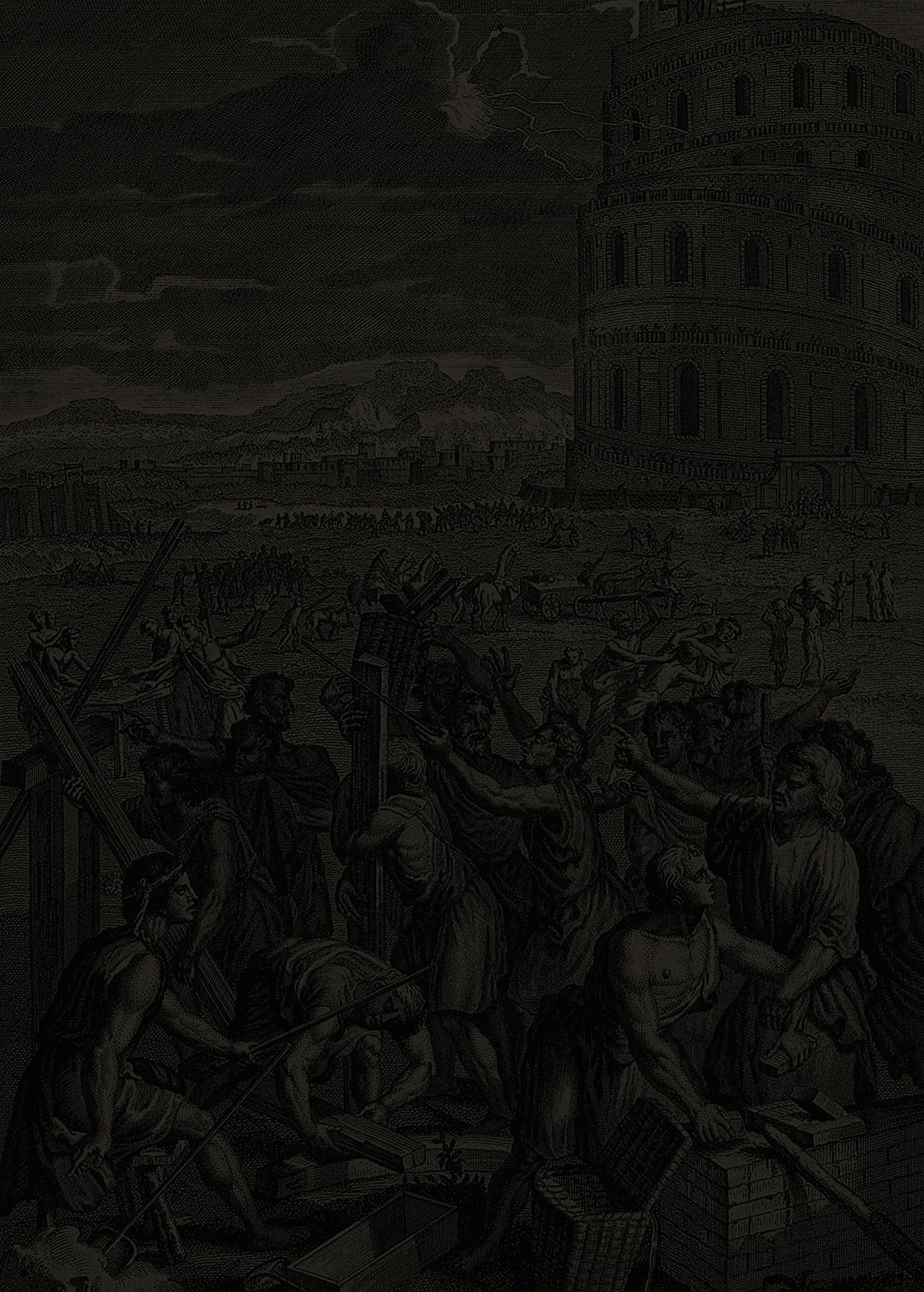
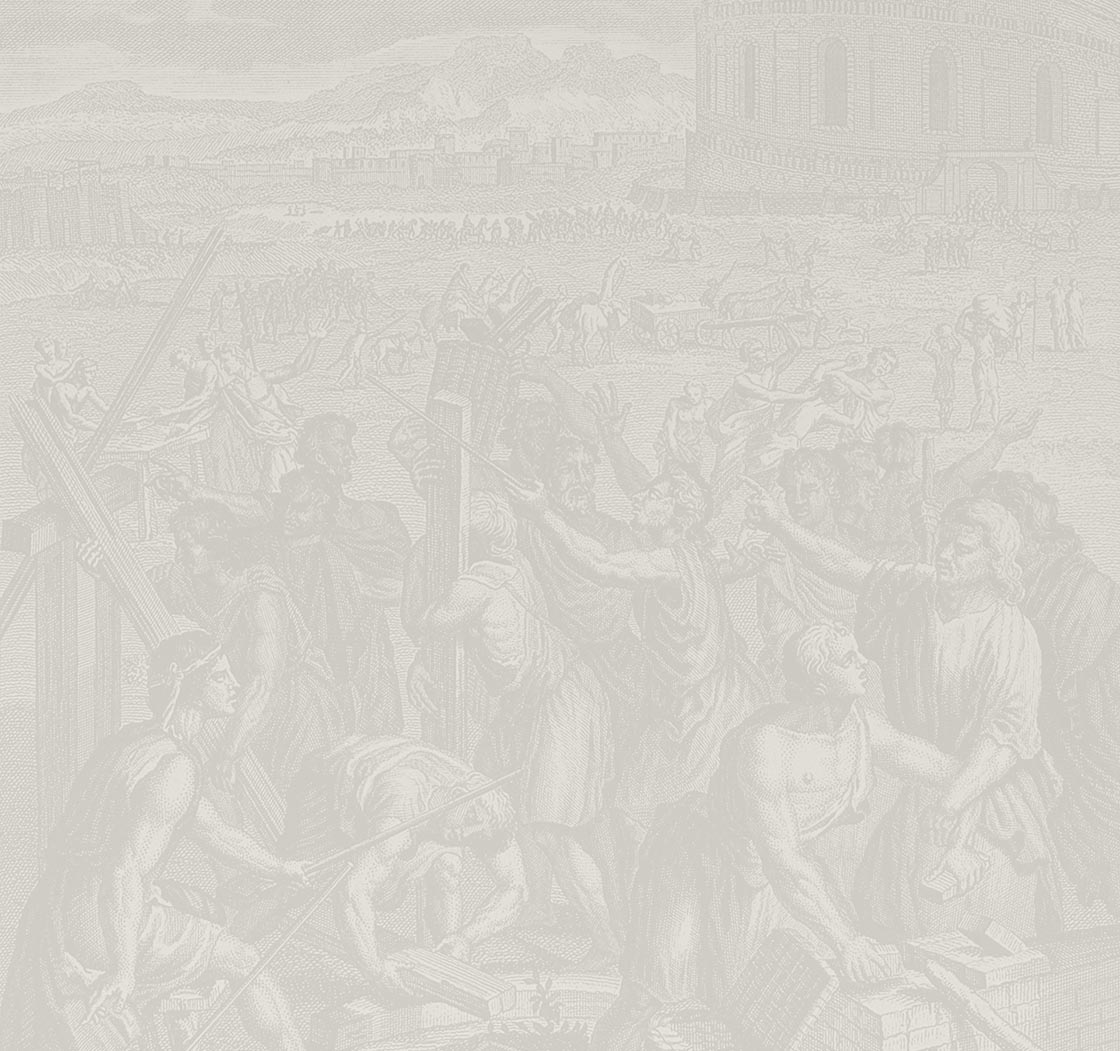
Pulter begins her emblem collection here by asserting a political persona in contrast with the biblical Nimrod, the infamous conspirator behind the construction of the Tower of Babel. Nimrod’s ambitious project resulted in the division of language, God’s punishment for the vain aspirations which possessed Nimrod to seek beyond the “supercelestial bowers” of Heaven (line 8). Likening this to the gigantomachy (struggle between the gods and giants) detailed in Ovid’s Metamorphoses, in which the earthly giants similarly sought a heavenly position, Pulter compares the ambition of the giants and Nimrod. She invokes the suggestion of Ovid’s English translator, George Sandys, that in each story, their ambition results merely in confusion, “one [being] confounded with lighting, and the other by the confusion of languages” (George Sandys, Ovid’s Metamorphoses Englished [New York: Garland, 1976], 27).

Pulter’s first emblem embodies the strongly visual evocations of “naked” emblems, while its account of vain impious ambition suggests the politicised role the collection will proceed to take in its criticism of the current political landscape in England, as the “usurping Nimrods” (line 18) here pertain to the republican parliamentarians (Eardley 28). Pulter elicits an image of humble godly steps to contrast with the Tower of Babel’s “huge fabric” (line 2), imparting to her readers that, by following in God’s footsteps – namely the steps of virtue that are then presented in Pulter’s second emblem – one can be “preserve[d]” from this ambitious folly (lines 2, 21). This message, confirmed in the final two couplets via Pulter’s own turn inward to a meditational prayer, encompasses the direction her following fifty-two emblems will take, as Pulter explores her own relationship to God in relation to the political and personal contexts emerging out of the Civil War. Thus, this emblem establishes her poetic devotion as a political response to the events of the 1650s, as she establishes a moral superiority throughout the collection as a model for her readers to follow.

Compare Editions
i
1When mighty
Nimrod1
, hunting after fame,
2Built this huge
fabric2
to get him a name
3(Fearing another
deluge3
might o’erflow,
4And all man’s petty projects overthrow),
5
With slime and brick, instead of lime and stone,4
6He meant to reach unto God’s glorious throne.
7Oh vain! To think by those
terrestrial5
towers
8They could ascend
supercelestial6
bowers7
,
9Foolishly dreaming their
dim mortal sight8
10Could view invisible, inaccessible light!
11From this, the fiction of the
giants9
rose,
12When they the
Olympic deities10
oppose;
13Then fierce
Egeous11
scorned
Jove’s12
thunderstocks13
,
14When at his head he threw a hundred rocks;
15Like molehills,
mountain14
upon mountains hailed.
16Thus, most presumptuously, they Heaven scaled,
17Till thunder routed this rebellious crew.
18So let
usurping15
Nimrods have their due,
19Let their accursed plots prove their delusion,
20For fancied glory, let them find confusion.
21
But from presumption, Lord, preserve my soul,16
22That in thy mercy I may safely
roll17
,
23Resting in Christ, that blessed
corner-stone18
,
24
Then by his steps I’ll mount his glorious throne.19
Macron symbol indicating the end of a poem.

Amplified Edition,

edited by Millie Godfery and Sarah C. E. Rossi

Editorial Note

Our priority in editing these poems has been to modernise, and to achieve interpretative and visual clarity, in order to make the poems as accessible as possible to as wide a modern audience as is possible. Spelling is modernised, as is punctuation. Modernising the latter, in particular, often involves a significant act of editorial interpretation, but in our view this is one of the most productive areas of editorial intervention, particularly for a manuscript text such as Pulter’s where the punctuation is erratic compared to modern usage (and, indeed, compared to early modern printed texts). 1 All biblical references are to the King James Version (1612).
  • 1. See Alice Eardley, “‘I haue not time to point yr booke … which I desire you yourselfe to doe’: Editing the Form of Early Modern Manuscript Verse”, in The Work of Form: Poetics and Materiality in Early Modern Culture, ed. Ben Burton and Elizabeth Scott-Baumann (Oxford: Oxford University Press, 2014), pp. 162-178.
Macron symbol indicating the end of a poem.
  • Millie Godfery
  • Sarah C. E. Ross, Victoria University of Wellington
  • Nimrod
    In Genesis 11, Nimrod is the leader of those who, in seeking to build the Tower of Babel to reach the Heavens, are motivated by their desire to surpass their mortal position and make “a name” for themselves (KJV Gen. 11.4). God punished this ambitious action by replacing the ubiquitous language of all people on Earth with multiple languages, halting the construction of the Tower by destroying the ability to communicate. Note that in her account, Pulter diverges from the Bible’s emphasis from the collective aim of the Babylonian people, focusing on Nimrod as the sole perpetrator of this ambitious desire. See Gen. 10–11. See also Paradise Lost 12.24–78 for Milton’s description of Nimrod’s “proud ambitious heart”. Sarah Ross compares these two depictions in “‘This Kingdoms Loss’: Hester Pulter’s Elegies and Emblems” (in Women, Poetry, and Politics in Seventeenth-Century Britain [Oxford: Oxford University Press, 2015], 135–73 [160]).
  • fabric
    the Tower of Babel
  • deluge
    a great flood; a destructive overflowing of water (OED 1). Here, “another deluge” alludes to the great Flood in the time of Noah, Nimrod’s great-grandfather (OED 2; Gen. 10).
  • With slime and brick, instead of lime and stone,
    The people of Babel, by the direction of Nimrod, worked to build “a tower with its top in the heavens”, using brick and slime, or “bitumen” (OED 1: a mortar found in Babylon). See Gen. 11.
  • terrestrial
    relating to earth as opposed to heaven; earthly, mundane (OED 1). Nimrod believes that reaching Heaven will endorse his “greatness”. “Terrestrial” emphasizes the mundaneness of the tower and thus Nimrod’s own mortality.
  • supercelestial
    spatially refers to that place in the heavens and beyond (OED 1) but it also can refer to the nature or character of someone as more than heavenly; this is the acknowledgement Nimrod seeks by building the tower (OED 2).
  • bowers
    idealised abodes (OED 1b)
  • dim mortal sight
    Pulter draws on the ineffability topos: the idea that the light of God cannot be looked at directly, nor can it be described accurately by humans. God is described as “dwelling in unapproachable light” in which “no man has ever seen or ever can see him” (1 Tim. 16). See the invocation at the opening of Milton’s Paradise Lost, Book 3, where he appeals for a “celestial Light” to shine inwards so he “may see and tell / Of things invisible to mortal sight” (3.51–5). Aemilia Lanyer also uses the topos in Salve Deus Rex Judaeorum, exhorting that “in these Lines I may no further stray, / Than his most holy Spirit shall giue me Light: / That blindest Weakenesse be not over-bold” (Susanne Woods [ed.], Salve Deus Rex Judaeorum [New York and Oxford: Oxford University Press, 1993], lines 301–304).
  • giants
    Pulter invokes a parallel between Gen. 11 and a story in Greek mythology regarding the ancient creatures’ gigantomachy, meaning struggle with the gods. Ovid’s Metamorphoses recounts the event, in which the giants piled Mount Pelion on top of Mount Olympus in an attempt to reach heaven. Pulter’s following lines retell Jove’s “tear[ing]” down of these mountains “with thunder” (see note to line 13). Pulter compares the actions of Nimrod to those of the giants (see Headnote); this comparison fuses and reconciles classical and biblical sources to confirm the lesson of the poem regarding impious ambition. See Sandys, Ovid’s Metamorphoses Englished [New York: Garland, 1976], 4, 27–8.
  • Olympic deities
    the twelve gods of the Greek Pantheon
  • Egeous
    Pulter is likely referring here to the Greek giant Aegaeon, or Briareus, as outlined by Eardley (Lady Hester Pulter: Poems, Emblems, and The Unfortunate Florinda [Toronto; Iter and Centre for Reformation and Renaissance Studies, 2014], 365). Aegaeon was a part of the gigantomachy (see note on “giants”).
  • Jove’s
    the Roman God also known as Jupiter; the God of thunder and lightning, considered the equivalent to Zeus in Greek mythology
  • thunderstocks
    Pulter’s neologism for “thunder stroke”; one usage of the word “stock” was to describe the act of thrusting a pointed weapon, possibly working figuratively to describe the act of a lightning bolt (OED n.3, 1, 2); alternatively, Pulter could be implying the “stock” of lightning bolts Jove has (OED 55a).
  • mountain
    “Mount” has been written in the main scribal hand and “taine” inserted in the space above by a hand likely to be Pulter’s own. This is likely for metrical purposes.
  • usurping
    Pulter addresses the act of usurpation throughout her emblem collection to contextualise the events leading up the period of the English republic; for example, see Ambitious Apes (Emblem 26)91, which details numerous examples of ambition throughout history. Pulter warns that Nemesis, goddess of retribution, “will look down / On all usurpers”, and concludes that “all confusion from ambition springs,” so “’Tis best for everyone to keep his sphere” (lines 19–20, 40, 43).
  • But from presumption, Lord, preserve my soul,
    Pulter’s emblem concludes with self-reflection, turning inwards as opposed to expanding outwards to encompass the audience in a larger moral truth. She addresses God in direct colloquy, asking Him to “preserve” her soul from “presumption”. Rachel Dunn writes that the effect of this is a “psalmic inwardness” which contrasts with the traditional emblem’s “exegetical unfolding” (“Breaking a Tradition: Hester Pulter and the English Emblem Book”, The Seventeenth Century, 30.1 [2015], 64). This is a notable contrast from Milton’s appeal in Paradise Lost, a text which, although certainly not an emblem itself, draws on the emblematic quality of seeking to unfold a greater truth to readers, encouraging their spiritual edification (Dunn 63–4). For comparison with Milton, see also note to “dim mortal sight”.
  • roll
    Noted in Eardley’s edition as meaning to “be enveloped”, and in Wall and Knight’s elemental edition as meaning “revolve or flow; proceed; curl up; be enveloped”. We would also add the theological meaning “to trust in”, specifically God or Christ (OED 11a, b).
  • corner-stone
    the stone which consolidates a building; forms the quoin of a wall (OED 1). This is appropriate given that this is also a biblical term used in reference to Christ as “the chief cornerstone” supporting the house of God (Ephesians 2.20).
  • Then by his steps I’ll mount his glorious throne.

    This final line introduces the last couplet’s thematic image of godly steps that is pursued throughout Pulter’s emblem collection, as she embarks on a didactic expression of virtue to criticise of the lack thereof in her contemporary English political landscape. It also refers directly to the next (second) emblem’s listing of virtues, which culminate a similar image of godly steps. The image of climbing stairs also resonates with her “stairs of revolution”, an idea she associates in Immense Fount of Truth48 with the transformation of body and soul after death (line 6).
The Pulter Project

Copyright © 2023
Wendy Wall, Leah Knight, Northwestern University, others.

Except where otherwise noted, this site is licensed
under a Creative Commons CC BY-NC-SA 4.0 License.

How to cite
About the project
Editorial conventions
Who is Hester Pulter?
Resources
Get in touch