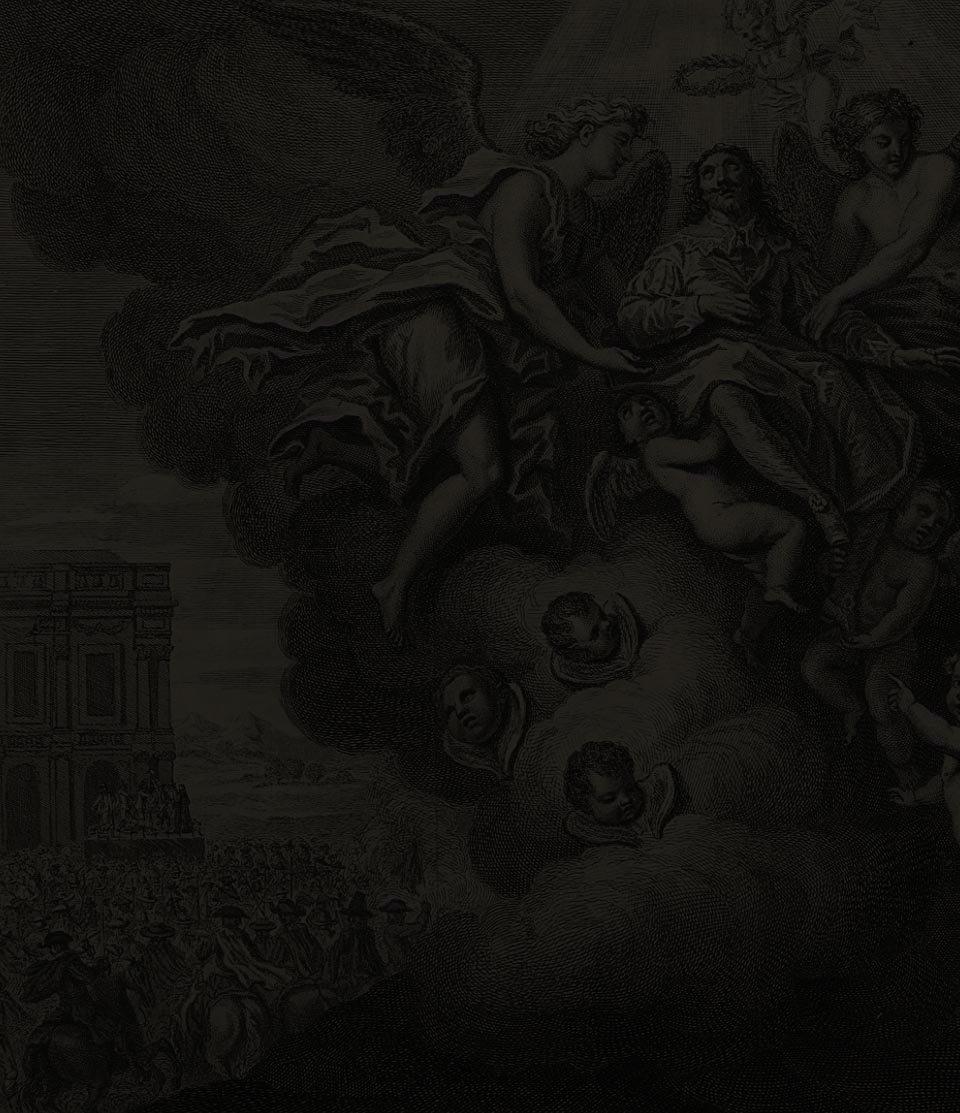
The opening of this poem echoes the preceding one, and likewise refuses sighs as
the poet struggles to find an appropriate language for her grief and shock at the
execution of King Charles I. Here Pulter moves outward from the shock of the regicide
to consider a poem she had recently written, On
Those Two Unparalleled Friends, Sir George Lisle and Sir Charles Lucas, Who Were Shot
to Death at Colchester7. A royalist rising in the spring of 1648 had erupted
into the Second Civil War, which seemed likely for a time to restore the king to
power in London. Instead it was crushed, and amongst the most bitter defeats was the
capture of the royalist garrison at Colchester, where many prisoners were taken and
Sir George Lisle and Sir Charles Lucas were executed by Sir Thomas Fairfax. This
execution, unexpectedly harsh even if technically within the rules of war, had
provoked many royalists into angry verse. When it seemed that they had exhausted
their fury and frustration, the defeated royalists had to face a much greater
calamity, the execution of their king on 30 January 1649. Immediately after a High
Court had condemned the king, a new court tried Arthur, Lord Capel, who had been
reprieved from Fairfax’s military justice at Colchester, and he was executed on 9
March. Old wounds were thus re-opened even as royalists were coping with the trauma
of the king’s death, and several poets treated the deaths of Lucas and Lisle “as
sacrificial prologues to the king’s execution.”1
Pulter wrote a series of poems on the regicide. We cannot be sure of their order
since the manuscript does not run chronologically, and as the headnote to the
Elemental Edition reminds us, we cannot even be certain that this poem was composed before 1660. It and its preceding poem are more disturbed than On That Unparalleled Prince Charles the First, His Horrid Murder8, and may have been written later (for fuller discussion see Exploration: Pulter and Political Revolution). It is possible that Pulter returned to political poetry under the renewed shock of the execution on 9 March 1649 of her husband’s cousin, Arthur, Lord Capel (see further Curation: Arthur, first Baron Capel (1604–49)). This reopened the psychological wounds of the siege of Colchester, for Capel had been present at the siege. One elegist spoke of the three as a “Triumvirate” and a
play on the deaths at Colchester ended with the Chorus pointing at the dead body of
Capel, last of the martyrs.
In mourning both Charles and Capel, Pulter was joining a chorus of royalist poets
who, unable to take up arms, could fight for their cause in verse. These broadsheets
and pamphlets, readily available in Paul’s Churchyard, could easily have found their
way to Broadfield. The contributors to Lachrymae Musarum, a
collection of elegies in which Capel was praised by the influential journalist
Marchamont Nedham, included several poets, Marvell included, who had links with the
Stanley circle (see Exploration: Pulter and Political Revolution), and that volume formed both a tribute to Pulter’s
relative by marriage and a kind of anthology of the leading poets of the day.
Pulter’s gender, and her husband’s desire for neutrality, would have made it hard to
join this company in print, but she responded to the combined political and poetic
stimulus. Her poem does not seem to echo contemporary elegies directly, though
further research may show otherwise. Her anger at the regicides, and the comparison
of them to the Jews who handed over Christ to be condemned, is shared with some royal
propaganda, culminating in the king’s ghosted testament, the Eikon
Basilike. But there is no poem with a comparable structure, first turning from
Lucas and Lisle because the king’s fate is so much more important, but before long
turning to their ally at Colchester. It was common for elegies for Capel to be added
to collections in praise of Charles, but they were kept separate. Some poets did call
attention to the difficulty of going on writing when they were already exhausted by
their mourning for the king (see Curation: Arthur, first Baron Capel (1604–49), poems by “F. H.” and Thomas
Philipot), but Pulter is uniquely concerned with the questions of tact and literary
decorum in praising two people of widely disparate ranks. (Contrast Hutchinson’s
response to applying different standards to aristocrats and others (Exploration: Women Writers and the English Revolution)).
Why, then, has she created this problem for herself? It seems possible that she
may have inserted the Capel material after initially writing on Charles alone: if one
jumps from line 13 to line 34, the poem continues coherently, the “their” of line 34
taking up the “they” of line 12, and with further cuts it would continue as a poem on
Charles as Christ-like martyr. But if she did insert the Capel lines, why did she
choose this over writing a separate poem on him? She has created the problem which
she proceeds to explore in the poem: how to keep praise proportionate. In a separate
poem she could, like other elegists, have said more about the dramatic twists and
turns of his recent life, and about his own conduct on the scaffold, where unlike
Charles he explicitly stated his political and religious views. Instead, though she
claims Capel as a kinsman, she has remarkably little to say about his life, his
conduct on the scaffold, or his wife, all of which interested many contemporaries.
One might say of this as Liza Blake says of The Invitation into the Country, to my D.D.M.P.P.P., 1647, when his
Sacred Majesty was at Unhappy Home2: “this poem offers not only commentary on a
specific historical moment, but also a meta-reflection on the relationship between
poetry and political agency; its formal problems—the questions of poetic form and
genre—also become political problems.” Since John Donne was a point of reference for
many contemporaries, Pulter had perhaps been struck by the complex negotiations
between different patrons found in his verse letters. She is also exploring her own
favorite language of involution and dissolution, as the Capel section becomes
involved (line 23) in the poem to the king and to some extent dissolved (“tossed,”
line 24) into it. The resultant poem is balanced, with thirteen initial lines,
sixteen addressed to Capel, and a further sixteen to Charles, recalling Pulter’s
general preference for forms that are roughly of sonnet length (see Elizabeth
Scott-Baumann, “Hester Pulter’s Well-Wrought Urns: Early Modern Women, Sonnets, and
New Criticism,” Journal for Early Modern Cultural Studies 20: 2 (2020):120–43).
The sense of cosmic catastrophe found in On
That Unparalleled Prince Charles the First, His Horrid Murder8 is less evident
here. Her soul is “trembling” (line 3), but this word is balanced by a vision of the
monarch “smiling” as he looks down from heaven, confident that the struggles of the
puny “monsters” will end. They could have prevailed only by calling the Jews to their
aid (line 10). After contrasting the king’s ultimate glory with the regicides’
inevitable bad end, their “tragic story”, she uses the same rhyme to invoke Capel,
who is nested in Charles’s “unparalled story” as in his rhyming couplet (lines 7–8,
14–15). Pulter proceeds to draw attention to the successive registers of grief by
immediately apologizing to Capel for scarcely being capable of praising him because
her poetic abilities had been exhausted in mourning Charles — a theme found in some
contemporaries, such as John Quarles and Thomas Philipot (see Curation: Arthur, first Baron Capel (1604–49)).
Recalling the previous poem, she regrets that the royalists have scarcely been able
to sigh or weep for Capel, and this section of the poem then becomes a series of
compensatory analogies, arguing that Capel’s apparently lesser standing is not really
diminished by his tribute’s being enclosed within a tribute to Charles. As if this
tribute has unbalanced the praise of Charles, she now turns from addressing Capel to
asking Charles’s pardon for her praise of Capel, declaring that she did it to
“illustrate forth…thy great worth.” Pulter takes up the final image of apology to
Capel where she says that his “splendency” has been “outshined by light” (line 29).
Her language is more positive than the end of “On That Unparalleled Prince”:
Unless our God doth a second Charles illustrate,
(Which, O deny not!) all our hopes are frustrate.
Here Charles I is safe in heaven, trampling over death. She returns to her
familiar language of dissolution and involution, processes which bring Charles and
Capel together (lines 36–7).
The poem now returns to recent events, attributing the nation’s sighs and tears
to a personification of the Church of England, here identified as the spouse of
Christ. Pulter places the emphasis on religious issues rather than on the
constitutionalism that had appealed to the Leveller John Lilburne; this does square
with his final days, when he told his wife and children, in the terms of
patriarchalist political theory, that his obedience to the king came from the
divine commandment to honor one’s father and mother. (Here there is a striking
contrast with Pulter, whose manuscript is matriarchal in focus, with many
references to her children and only one poem addressed to her husband — and that
revealing “the poet’s tenuous investment in her relationship” (see Meg Heffernan’s
Headnote to [Untitled]42)).
Pulter may have emphasized Capel’s orthodoxy the more strongly because critics had
attacked him as a Catholic — a charge against which he felt it necessary to defend
himself on the scaffold, insisting that he was a Calvinist in theology (Quarles
would defend him by saying that he had been more like a Puritan, Regale Lectum, p.
55; see Curation: Arthur, first Baron
Capel (1604–49)). The final triplet gives a note of confidence in turning
from “my Heroick Champions Death” to prophesying the restoration of Charles II,
then in Scotland. In seventeenth-century spelling, “Champions” could be read as
“Champion’s” or as “Champions’”, perhaps leaving a last sense in which Capel is
involved in the poem.
- Andrea Brady
argues that the two men’s deaths were widely depicted as “sacrificial prologues to
the king’s execution” (“Dying with Honour: Literary Propaganda and the Second English
Civil War,” The Journal of Military History 70:1 (2006): 9–30,
p. 11). See further Exploration: Pulter and Political Revolution.