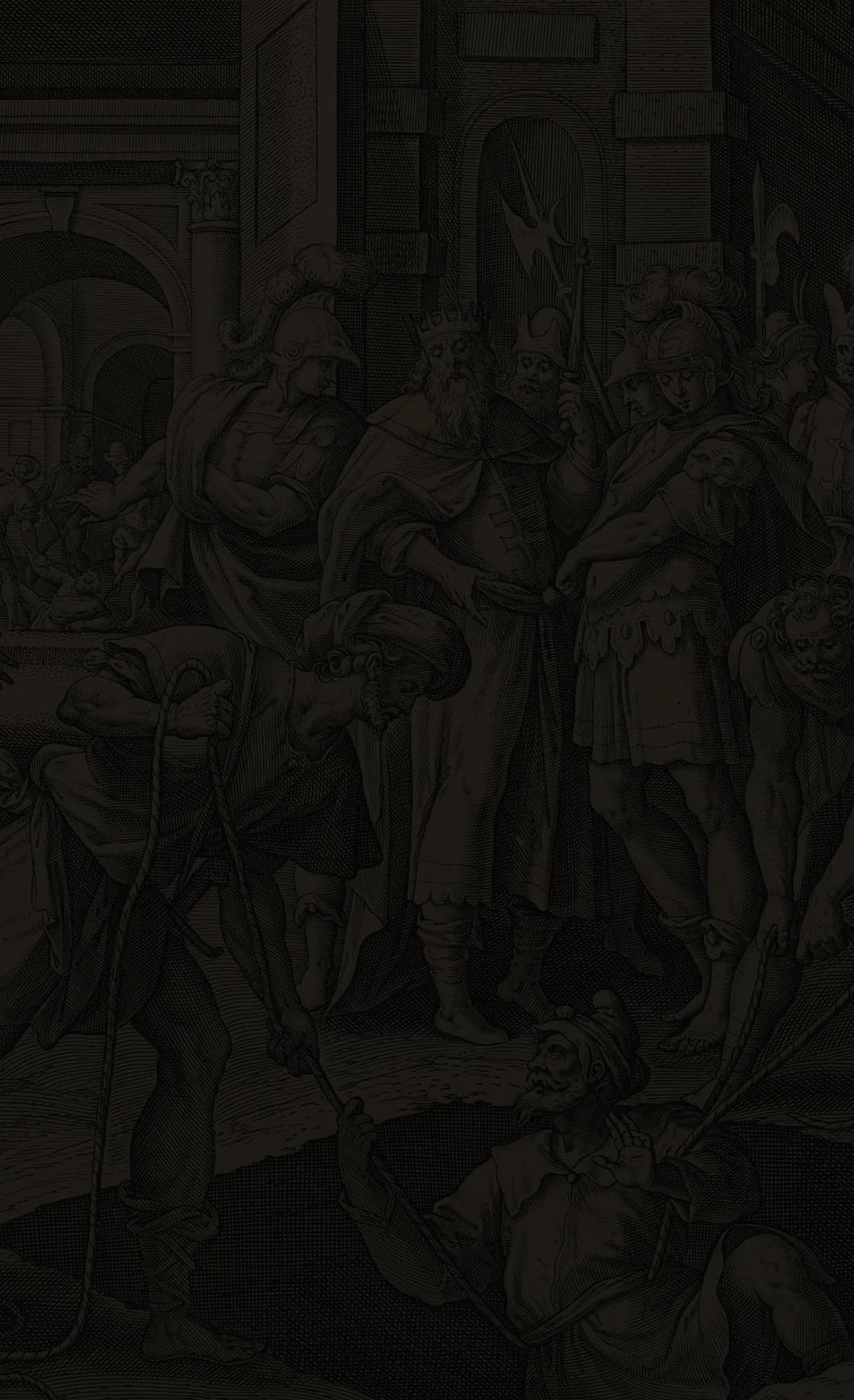
In 1640s and 1650s, war-torn England was abuzz with stories of cunning prison breaks and hairbreadth escapes. With the English Civil Wars came prisoners of war, and when influential political figures were captured on or off the battlefield, their path to freedom could take any number of forms, from a generous bribe to a multi-step plot involving disguises and safe houses. In this twenty-eight-line poem, Pulter curates her own selection of tales of escape. The principal narrative features the ancient Greek warrior, Aristomenes, known for his curious ability to elude his captors. As Greek fables told and Emblem 45 conveys, Aristomenes was cast into a “dismal Dungeon” (line 5) and left for dead. When he detects a fox scavenging on corpses, the hero’s “Courageous Heart” (line 9) moves him to seize the creature by the tail and follow it to a hole in the dungeon’s wall where he digs his way to freedom (see Aristomenes in History). In this poem, Pulter does not linger long in the emotional depths of Aristomenes’ despair, a striking departure from other poems wherein she anatomizes the unnatural imprisonment of the sovereign Charles I (The Complaint of Thames, 1647, When the Best of Kings was Imprisoned by the Worst of Rebels at Holmby4 and Upon the Imprisonment of his Sacred Majesty, That Unparalleled Prince, King Charles the First13), her soul’s captivity in her mortal body (How Long Shall My Dejected Soul24 and To Aurora [3]34), and being “shut up in a country grange” (Why Must I Thus Forever Be Confined57). Instead, the poet urges her readers to test the barriers of confinement with the bravery and cunning of Aristomenes.
From this teaching, Pulter develops another primary lesson. She reminds her readers to “rest in hope, for though no help be found / Above, yet it may come from underground” (lines 19–20). These lines describe Aristomenes’ plight, as no person or creature aboveground offers assistance. Rather, it is the corpse-munching fox, the “Jackal” (line 8) as Pulter calls her, who becomes the prisoner’s savior. For Pulter, this detail is designed to remind her “Royal friends that Captive be” (line 17) that their path to freedom may depend on those of low or common rank—maids, farmers, and traders who can move from place to place without drawing notice—or figures from society’s underbelly—smugglers who can move people or goods through their secret networks. These figures from the “underground”, for instance, were partly responsible for the escape of Charles I’s second son, James, in 1648, when a dressmaker expertly tailored a maid’s gown for the teenage prince to wear when he fled from St. James’ Palace. Likewise, the King’s heir, Charles, owed his escape from the Battle of Worcester in 1651 to a colorful cadre of earls, servants, and maids, and even the notorious highwayman, Captain James Hind, famous for robbing and humiliating Royalists’ enemies (see Noble Escapes and Common Helpers.)
In Emblem 45, Pulter could have celebrated the courage and ingenuity of such friends from low places, but their agency as moral actors is circumscribed. For example, the fox in Aristomenes’ cell is a frightened animal fleeing for its life, which just happens to lead the warrior to freedom. While Pulter alludes to the fox as “old Reynard,” a talking fox in English folklore known for his sharp wit and trickster pranks, the fox in Aristomenes’ dungeon has no intention of helping the prisoner, and in fact, may have been hoping to eat him for lunch. That Pulter effaces the fox’s agency likely derives from her belief in the doctrine of divine providence. Finding comfort in the notion that God is guiding the actions of all of his creatures for the greater good, Pulter marvels in her poetry at the small, insignificant creatures that God chooses to perform his will, from reptiles to flies to lice (The Bishop and the Rats (Emblem 46)111).
When Pulter applies this same hierarchical rationale to human beings in Emblem 45, she adopts and perpetuates racist and nationalist stereotypes, revealing which people on earth she views as inferior to her and her noble friends. The next escapee mentioned in Pulter’s poems is the prophet Jeremiah who was saved from unjust imprisonment by a black servant named Ebed-Melech, the “only” one who showed Jeremiah pity. Pulter culls this story from the Old Testament and expresses disbelief that an African man with black skin, believed to be the modern manifestation of Noah’s curse on Ham’s descendants, was chosen by God to save the prophet. Unlike other early modern writers who explored Ebed-Melech as a model of benevolence, Pulter keeps her focus on the plight of the noble prisoner whom God chooses to rescue (see Ebed-Melech).
Pulter similarly expresses disbelief that the King of Judah, imprisoned for decades by the tyrant Nebuchadnezzar, was freed by his son, the King of Babylon, Evil-Merodach. Just as surprising to Pulter is the Swedish army’s support of Charles I’s nephew in 1638. Believing the “swashing Swedes” (line 25) to be arrogant braggarts, Pulter finds it shocking that they acted heroically and restored the Palatinate to the Elector Charles I Louis. Reminding her noble readers that God works in mysterious ways and may send anyone to their aid, Pulter’s poem clarifies that her investments are in the “royal branches” (line 27) or descendants of Charles I, not any old soldier, highwayman, or maid fighting for the cause. In the end, Pulter acknowledges that God may not choose to rescue the worthy during their lifetimes. If that is the case, she recommends they find comfort in knowing that everlasting freedom in heaven will be their reward. In other words, as God’s chosen, they eventually will be saved.
That Pulter turns to stories of escape to bring comfort to readers positions her alongside other writers of her day. What makes Pulter’s approach unique is her ability to weave together references from a variety of sources and genres, from ancient Greek and medieval English folk-history, to the Old and New Testaments, and seventeenth-century European politics. Such a mix might suggest that Pulter was attempting to communicate a universal truth, one that could be applied across all cultures and all ages; however, the racist and classicist ideologies at the core of her understanding of social hierarchies firmly situates Emblem 45 as a product of England’s problematic past.