• No results
ElementalAmplified
Manuscript
Notes
#
The Pulter Project
pulterproject.northwestern.edu
Poem 119

An Old Man, a Stripling,
and an Ass

Edited by Anna-Rose Shack and Kristine Johanson

In this emblem, an old man, a young boy, and an ass perform various configurations of walking, riding, and carrying each other as an observing crowd mocks their progress. The crowd enacts judgment and attempts to influence the travelers’ behavior by deploying laughter to publicly shame them. In so doing, this laughing community, to use the term mobilized by Werner Röcke and Hans Rudolf Velten (2005), operates as a paradigm of inclusion and exclusion: a means by which to solidify the laughing group’s boundaries and norms by drawing attention to those deemed to have transgressed. At the same time, the poem also highlights how the notion of inclusivity itself is fickle, its boundary constantly redefined by the whims of the crowd, Pulter’s “Hydrian monstrosity” (25). (In Greek mythology, the Hydra was a many-headed monster whose heads reproduced each time one was cut off; Herakles had to kill it as one of his labors. See Victoria Burke’s curation The Many-Headed Hydra).

The old man is at pains to avoid public censure. He risks being perceived as too proud or merciless towards the child for making him walk beside the ass while he rides; too easily manipulated by the same child for letting the child ride the ass in his place; or too cruel towards his ass for forcing the animal to bear their dual weight. Even when neither ride the ass or when they both carry the animal, they still fail to appease the onlookers. The old man and his companions are caught in a net of shifting demands that reinforces the “giddy” (28) behavior of the crowd.

As such, while the crowd’s uproarious mirth at the sight of the travelers dramatizes Pulter’s critique of the old man and his companions (by contorting yourself to please others you end up pleasing no one), she also finds fault with the crowd itself. This roaring “Hydrian monstrosity” (25), as noted above, embodies the fickle instability of public opinion. In the face of relentless pressure, the old man abandons all hope of pleasing the onlooking crowd and sadly flings his ass into the sea. Following his spectacular failure to assert self-sovereignty, the old man’s killing of his ass offers an expedient if disappointing way out of his predicament.

It is at this point that Pulter shifts to a prophetic mode, making a series of allusions to deposed rulers from the Middle Ages and then antiquity to suggest that Oliver Cromwell’s reliance on populist support will lead to his downfall. Ultimately, this emblem suggests that those who rely on “Hydra’s love” (33)—popular opinion—to determine their actions will suffer an ignominious end.

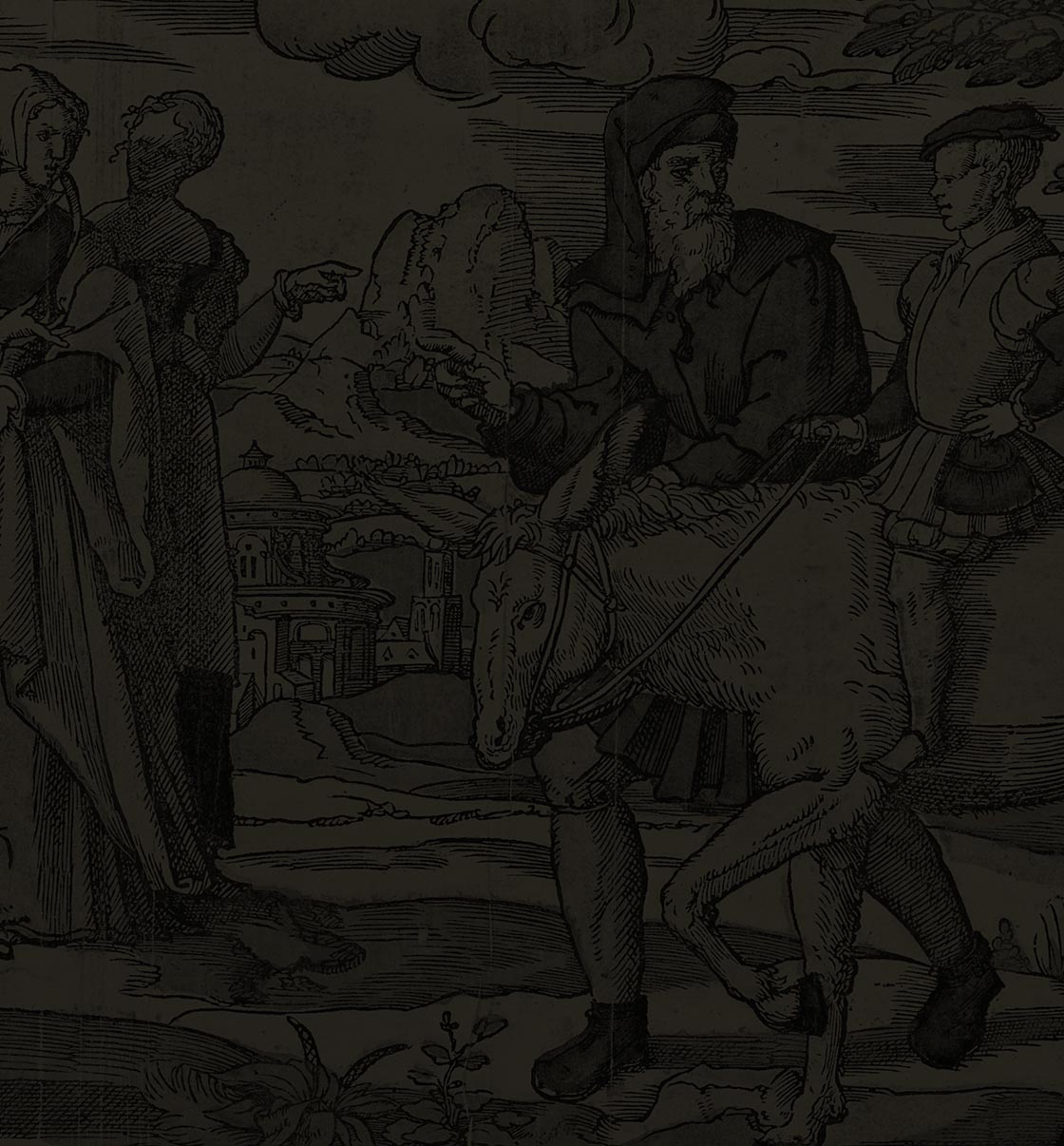
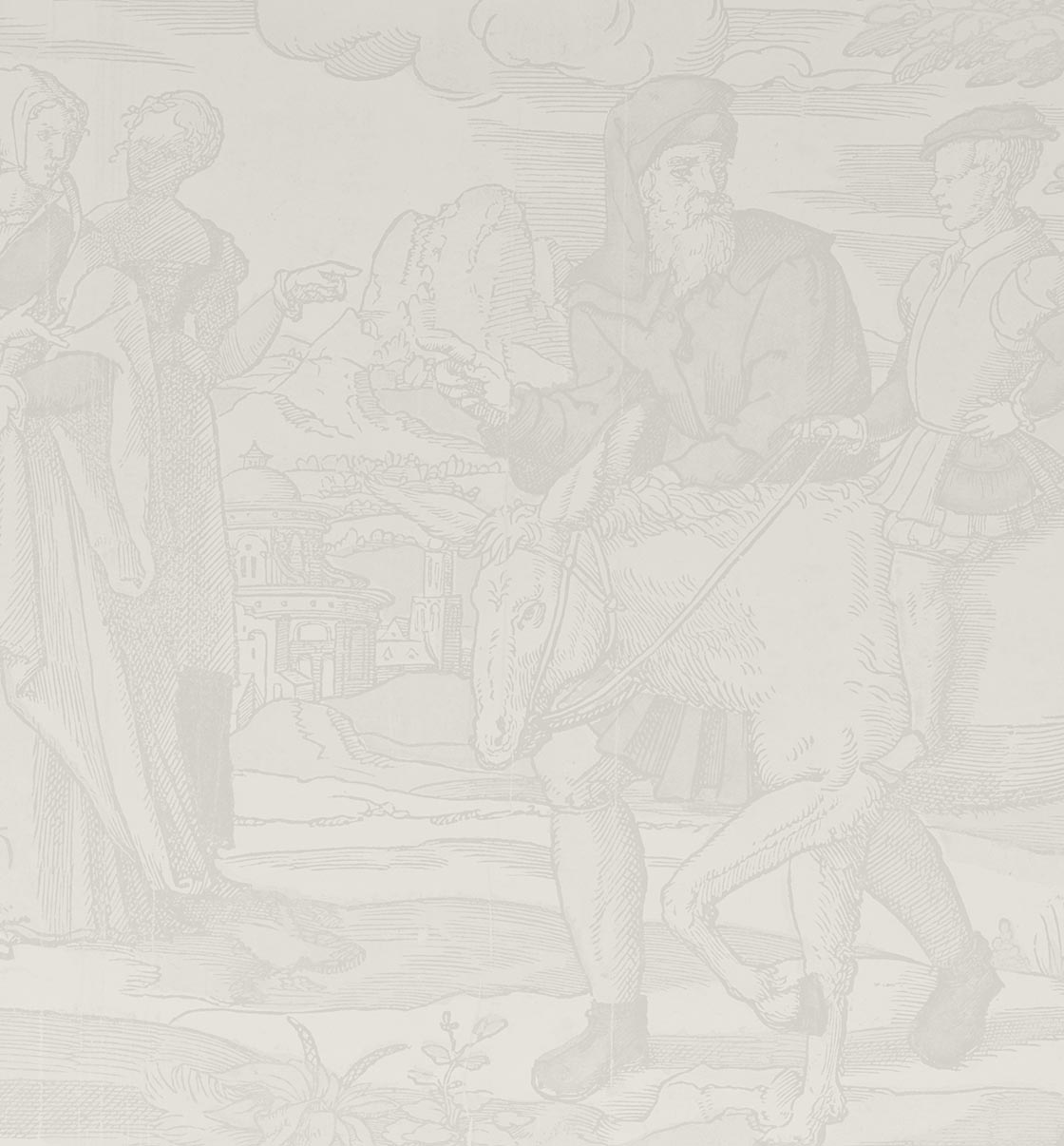
While the precise source of Pulter’s emblem remains unclear, it is evident that the story of the old man, the boy, and the ass circulated across early modern Europe. Blague’s Schole of Wise Conceytes (London, 1572) includes a translation of Poggio Bracciolini’s (also known as Poggio Fiorentino) fable of this triumvirate (Christian 2012); a sixteenth-century, hand-colored, Dutch woodcut print by Cornelis Anthonisz (1509–1553) exists with this fable inscribed beneath associated images; and William Warner’s Albions England, first published in 1586, offers a verse form in rhyming couplets. It is this text’s 1612 edition that Alice Eardley (2014) points to as an alternative version of the emblem and which to us seems the likeliest candidate as Pulter’s source. Additionally, this fable has been mischaracterized as “Aesopian” or “pseudo-Aesopian” (Knight and Wall, Elemental Edition Headnote; Christian 385): this tale is not only absent from Aesop’s fables, but in those tales the animals are the main protagonists, and it is through their interaction with others (human or animal) that they teach a lesson to the reader. Here, the ass has no agency, it does not speak, and it possesses no character.

Citations

Christian, Stefan Graham. “The Poems of Lady Hester Pulter (1605?–1678): An Annotated Edition.” PhD diss., University of Massachusetts Amherst, 2012. ProQuest Dissertations Publishing (3545910).

Eardley, Alice. Poems, Emblems, and The Unfortunate Florinda. By Hester Pulter. Toronto: Iter and Centre for Reformation and Renaissance Studies, 2014.

Knight, Leah and Wendy Wall, eds. “An Old Man, a Stripling, and an Ass,” by Hester Pulter. (Poem 119, Elemental Edition). In The Pulter Project: Poet in the Making, edited by Leah Knight and Wendy Wall, 2018.

Röcke, Werner and Hans Rudolf Velten. Lachgemeinschaften: Kulturelle Inszenierungen und soziale Wirkungen von Gelächter im Mittelalter und in der Frühen Neuzeit. De Gruyter, 2005.

Compare Editions
i
1An old man through a town did often pass,
2With him a pretty
stripling 1
and an ass.
3
The2
man did ride, the boy was
pedester,3
4
As fit as it was,4
he wait upon his master.
5At this the people
laughéd5
out loud6
6Saying the man was
merciless or proud7
7To let the pretty child go sweating by
8Whilst he rode
ambling8
in his
majesty.9
9The boy rode next, the man did
trudge10
afoot.
10But then the people did so laugh and shout
11Because the man did
favour11
so the lad
12To go afoot whilst he rode on his
pad.12
13Next time this
poor13
man through the town did pass,
14The man and boy got both up on the ass.
15But then the people
bade him light 14
for shame,15
16He’d
spoil16
the ass or make him sick or lame.
17Next time beside the ass they both did walk,
18But then they were the
town and country’s17
talk.
19The people
laughed and made the welkin ring,18
20Children their folly up and down did
sing.19
21Once more the man resolved the load to pass
22And then the youth and he did
bear20
the ass,
23At which the people did so
laugh and roar21
24That the poor man would never more explore
25The
Hydrian monstrosity22
to please,
26But
sadly23
flung24
his ass into the seas.
27By this you see they do themselves delude
28That think to please the
giddy multitude.25
29
Andronicus26
did make this story good,
30
Even he that shed his royal sovereign’s blood.27
31
Sejanus28
so
by popular breath29
up born
32By
Barrierus30
was
in pieces torn.31
33
So some alive the Hydra’s love will rue32
34When as to them they
give to these their due.33
35
For certainly ’twill one day come to pass34
36
They’ll have the death and burial of this ass.35
Macron symbol indicating the end of a poem.

Amplified Edition,

edited by Anna-Rose Shack and Kristine Johansoni

Editorial Note

We offer here a modernized edition of this emblem in order to facilitate engagement with the text. Reflecting the manuscript’s origins, we use contemporary British spelling. Capitalization has been regularized; we have expanded thorns and ampersands; we have included possessive apostrophes where necessary. With punctuation we have tried to capture the way the poem creates momentum through its relative absence of punctuation by restricting our interventions to commas and full stops.

Due to a scribal error, there is no Emblem 18 in Pulter’s manuscript: Emblem 17 is followed by Emblem 19. Therefore, as The Pulter Project retains the numbering used in the manuscript (and in Alice Eardley’s edition), Emblem 54 is in fact the fifty-third and final emblem.

Macron symbol indicating the end of a poem.
  • Anna-Rose Shack, University of Amsterdam
  • Kristine Johanson, University of Amsterdam
  • stripling
    a youth, with connotations of coming of age. The OED suggests that the word derives from “a strip,” meaning “one whose figure is not yet filled out.”

    “stripling, n.” OED Online, Oxford University Press, March 2023, www.oed.com/view/Entry/191697. Accessed 5 April 2023.

  • The
    Throughout the manuscript, the scribe has added a superscript e to the end of many words ending in “e” in the text.
  • pedester,
    walking, on foot; pedestrian.
  • As fit as it was,
    as was fitting. Importantly here, the speaker notes that the initial arrangement mirrors conventional ideas about hierarchy and respect for old age over youth.
  • laughéd
    The accent in the word “laughéd” continues the pentameter that is established in the poem.
  • out loud
    This is the first of four times across the poem where Pulter notes that the crowd is explicitly laughing. By including laughter Pulter chooses to depict the crowd as both mocking the trio and treating them as entertainment.
  • merciless or proud
    The description of the man as merciless or proud suggests a tyrannical individual; the people seek to shame the man by suggesting explicitly that he is sinful. The critique of pride is a common theme in Pulter’s emblems (see for example, “The Porcupine” (Emblem 13)79or “The Ostrich” (Emblem 41).106
  • ambling
    smooth, easy or leisurely. The OED indicates that this verb particularly relates to the pace of a quadruped (e.g., a horse).

    “amble, v.” OED Online, Oxford University Press, March 2023, www.oed.com/view/Entry/6181. Accessed 5 April 2023.

  • majesty.
    Given the poem’s political valences, this is a significant noun. Considering that majesty is associated with monarchy, the tone may be understood as sarcastic or ironic; the use of the word “majesty” seems to be the speaker ventriloquizing the crowd, taking on the crowd’s judgment of the old man. When married with the “merciless and proud” description, this again implies a tyrannical strain in this old man. “Majesty” arriving on an ass also possesses latent imagery of Jesus’s arrival in Jerusalem on a donkey, an act similarly disruptive but which was much more positively received by the public. Both situations invite a questioning of hierarchy and power.
  • trudge
    This evocative contrast with “ambling” (line 8) emphasizes the sluggish, weary movement of the man on foot. Interestingly, this moment also suggests some sympathy on the speaker’s part for the old man.
  • favour
    Notably, unlike with the child, the people are not concerned about the welfare of the man, but that there is a hierarchical boundary crossed: that the child should be so “favour[ed]” and thus implicitly spoiled.
  • pad.
    Pulter characterizes the ass as a saddle horse.
  • poor
    The speaker’s sympathy, suggested at line 9, is made explicit here and continues with the repetition of “poor” at line 24.
  • bade him light
    alight, i.e., the people instructed the man to dismount.
  • for shame,
    Again, the speaker ventriloquizes the crowd, which shames the old man.
  • spoil
    injure, thus rendering the ass less useful.
  • town and country’s
    The most recent configuration of the travelers is so radical that the people’s censure spreads beyond the town to the countryside. “Country” could also signal the nation.
  • laughed and made the welkin ring,
    That this laughter is described as reaching the sky (“the welkin”) develops the idea that censure is growing exponentially.
  • sing.
    Within the interior world of the emblem, the story of the foolish traveling companions is related through children’s songs. Again, the emblem repeats the description of ridicule spreading through space and becoming even something of lore, perhaps, immortalized in song. Notably, the emblem genre itself was, in seventeenth-century England, evolving into a form particularly aimed at children.
  • bear
    To carry, with the implication that the load is particularly heavy and cumbersome.
  • laugh and roar
    This bestial depiction of laughter not only aligns the crowd with animal behavior but foreshadows Pulter’s scathing description of it as a Hydrian monstrosity.
  • Hydrian monstrosity
    The crowd is like the Hydra not because they are unruly per se (as Eardley suggests), but because each attempt to appease an opinion only spurs more opinions (just as cutting off the Hydra's heads only causes more to grow in their place), making satisfaction impossible.
  • sadly
    Once more, Pulter’s speaker offers a pitying note that contrasts with the violent mockery of the crowd. She offers a sympathetic description of the old man’s state of mind, the bearing this has on his decision to drown his ass, and the manner in which this action is performed.
  • flung
    “Flung” is inserted above the line. This may be Pulter’s own correction.
  • giddy multitude.
    Once again Pulter emphasizes both the inconstancy and the enormity of the crowd and suggests the inability to control it.
  • Andronicus
    In 1182, during the Byzantine Empire’s Comnenus dynasty, Andronicus (c.1118-1185) seized power and subsequently murdered the young Emperor Alexius II (1169-1183) and his regent mother, Maria of Antioch (c. 1140s-1182/3). Andronicus was a cousin of Alexius II’s father, Emperor Manuel I (1118-80). Widely regarded as a tyrant who inaugurated a reign of terror, the populace ultimately turned against Andronicus. He was tortured to death by a mob in Constantinople in 1185.
  • Even he that shed his royal sovereign’s blood.
    This is an ambiguous line in the manuscript. While other editors (Knight and Wall) have added punctuation to make the line modify “Sejanus”, historically Sejanus did not murder his emperor as Andronicus did. We read the line as an emphatic repetition of the previous line. Our choice also balances out the speaker’s attention to these two historical examples: two lines each are devoted to Andronicus and Sejanus.
  • Sejanus
    While it is unlikely that Pulter would have known Ben Jonson’s Sejanus (1603/1605), she demonstrates her humanist education and familiarity with humanist literary practice in her reference to the historical personage Lucius Aelius Sejanus (20 BC - AD 31), a soldier from an eminent political family in ancient Rome. He was suspected of plotting to overthrow Emperor Tiberius (42 BC - AD 37) and consequently was torn to pieces by a bloodthirsty crowd loyal to the emperor. As Christian notes in his edition of the poems, Sejanus’ “story would have been familiar to Pulter from the accounts of Tacitus, Suetonius, and Juvenal; his fate was proverbial for the consequences of ambition and pride” (386).
  • by popular breath
    Like the roaring crowd in this emblem, Sejanus’ fate is sealed by popular opinion which, as the image of “breath” suggests, is insubstantial. In early modern literature, the people’s breath was often interpreted as stinking and disgusting.
  • Barrierus
    Previous editors concur that Barrierus is a reference to Briareaus, one of the Hekatoncheires found in ancient Greek mythology. With a hundred arms and fifty heads, this gargantuan monster, along with his two brothers, Cottes and Gyges, was often associated with the destructive power of natural elements.
  • in pieces torn.
    Here Barrierus represents a monstrous crowd that tears Sejanus into pieces.
  • So some alive the Hydra’s love will rue
    This is the beginning in a shift of the moral Pulter has been offering. First, the old man is likened to those who delude themselves hoping to please the multitude; then, those who have the love of the multitude (i.e., who are no longer just trying to obtain its love) will “rue” this situation as they will receive what is owed to them. Indeed, she suggests that possessing the people’s favor is itself worthy of censure.
  • give to these their due.
    To give someone their due is to give them what is owed to them for their actions. Here Pulter suggests that there is now something negative owed, “due” to those (“them” / “these”) who possess the Hydra’s/people’s love.
  • For certainly ’twill one day come to pass
    Pulter shifts into a prophetic mode, drawing on historical example and common wisdom.
  • They’ll have the death and burial of this ass.
    Pulter’s shift at the end of the poem surprisingly turns Cromwell into the ass. Her derision of Cromwell repeats ideas present in e.g. Emblem 1984, where she laments the Royalists’ moral failings and Cromwell’s association with commoners: “had not lords in noble breeding failed, / Tinkers and cobblers never had prevailed” (ll.30–1). As Laura Longer Knoppers has shown, Royalist satire associated Cromwell with such “mechanicals” and popular opinion by depicting him as a brewer despite his status as a gentleman (2000). In transforming Cromwell into the ass, Pulter renders guilty what in the poem is in fact an innocent animal; the ass becomes the symbol of the negative, detrimental, irrational and violent ends of wanting to please everyone all the time.

    Knoppers, Laura Longer. “‘Sing Old Noll the Brewer’: Royalist Satire and Social Inversion, 1648–64.” The Seventeenth Century, vol. 15, no. 1, 2000, pp. 32–52, https://doi.org/10.1080/0268117X.2000.10555466

The Pulter Project

Copyright © 2023
Wendy Wall, Leah Knight, Northwestern University, others.

Except where otherwise noted, this site is licensed
under a Creative Commons CC BY-NC-SA 4.0 License.

How to cite
About the project
Editorial conventions
Who is Hester Pulter?
Resources
Get in touch