What can we learn from history?
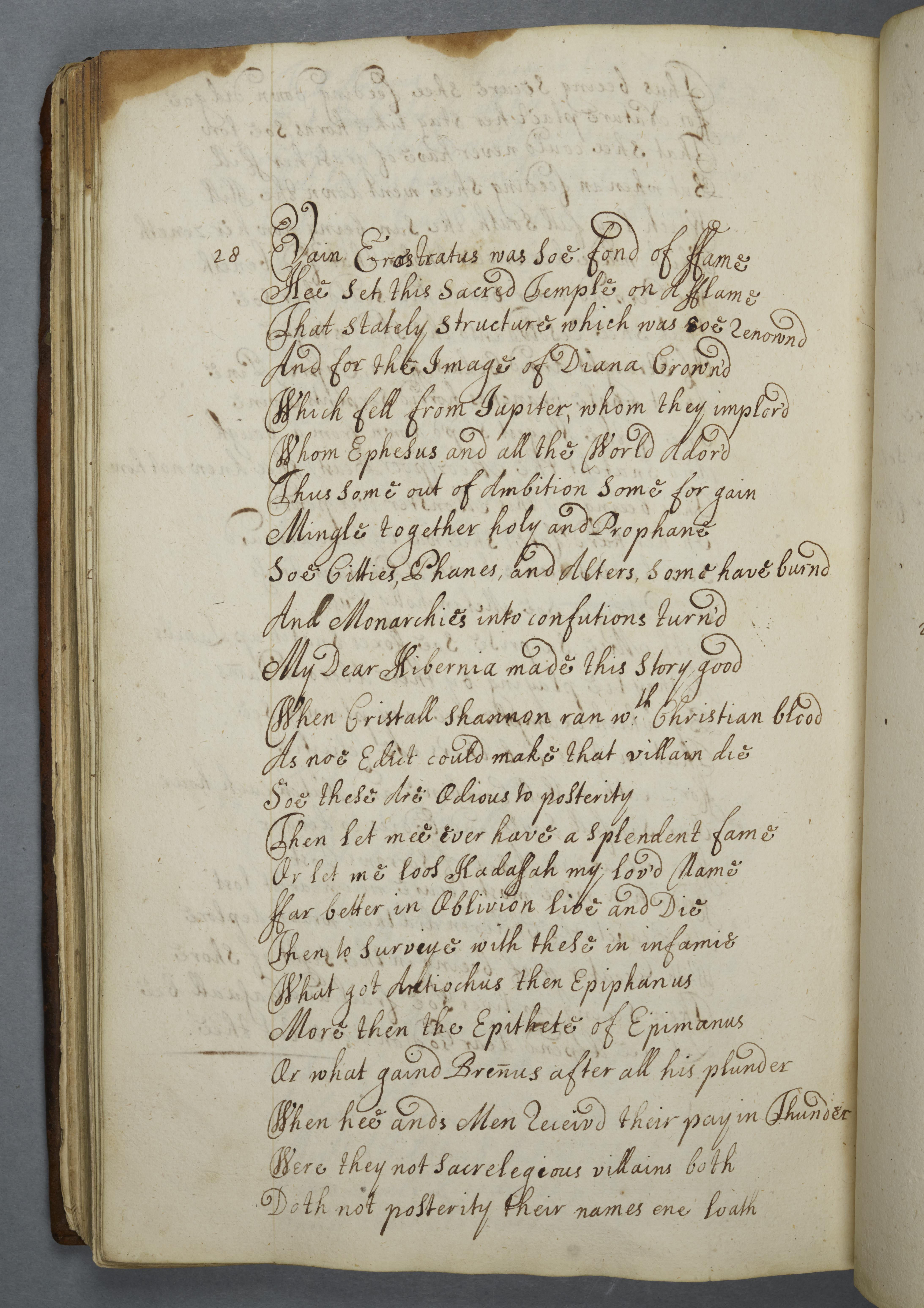
Pulter opens this poem with Herostratus, who burned down the Temple of Diana in Ephesus in the fourth century BCE. Under torture, he reveals that he committed the arson to become famous, so the Ephesians decree that he should be forgotten. He’s not: a classical historian records his name, and now Herostratus is more famous (as Thomas Browne notes) than those who judged him (Urn Burial, 26). As an emblem, then, Herostratus poses two problems that the poem will go on to reckon with.
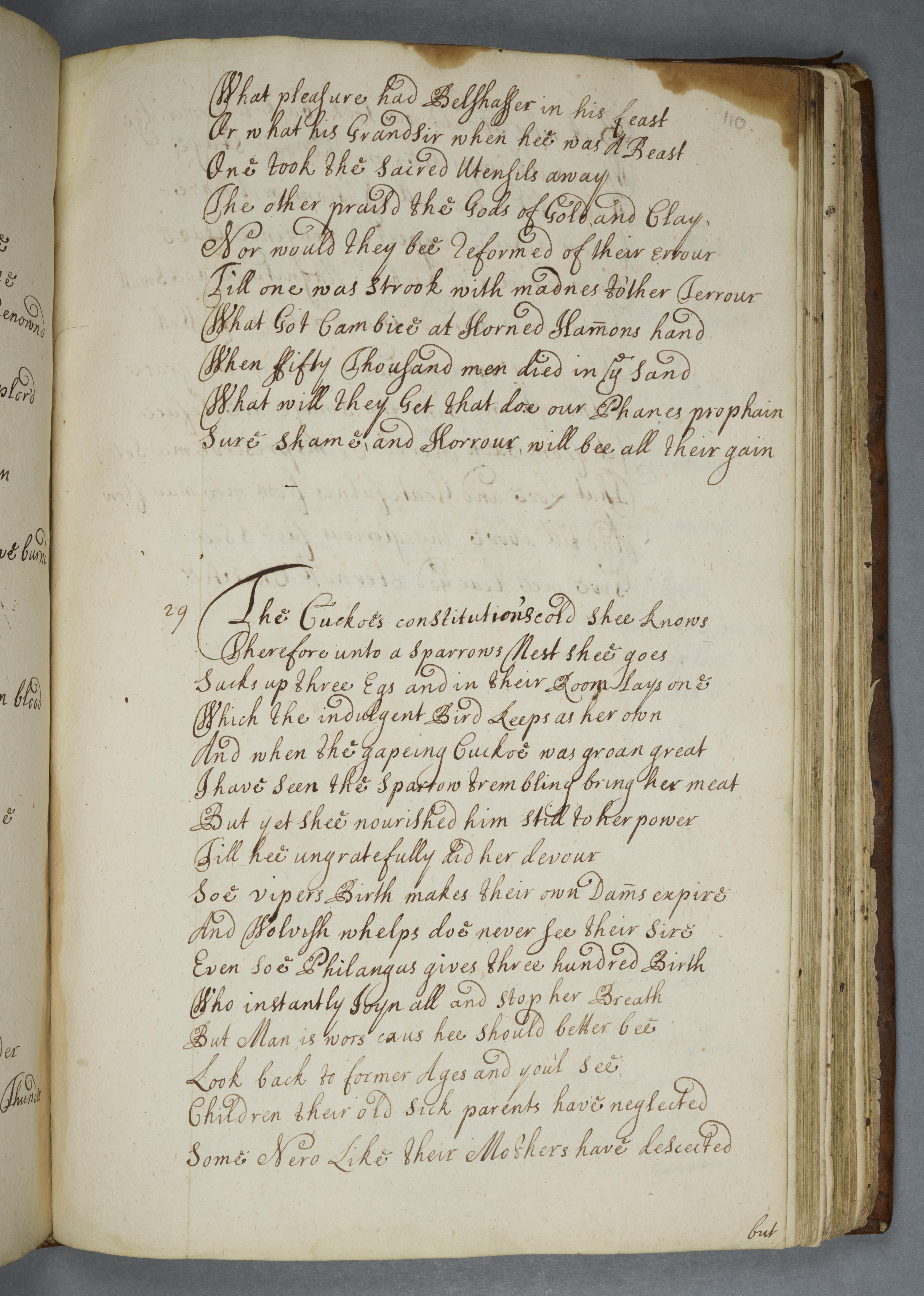
Most explicitly, the poem’s rhyming couplets consider the consequences of monstrous impiety: Brennus’s attack on the Temple at Delphi; Cambyses’s attack on the Temple of Ammon; Nebuchadnezzar’s destruction of the First Temple; Antiochus IV’s desecration of the second Temple; and others. Structured as a series of rhetorical questions, the second half of this poem asks us to reflect on the consequences of such impiety, whether divine punishment in life or a “loath’d” name in “[p]osterity.” Pulter encourages us to read these historical figures alongside the opponents of the King in the English Civil War: those who threw the monarchy into “confutions” and who stripped churches in ways that she viewed as sacrilege. These, too, the poem argues, will “gain” only “shame and horror.” For herself, she says between these two halves of the poem, she would rather lose her name—“Hadassah”—than have a tainted reputation.
But Herostratus is also a figure for the uncertainty of history: he gains the infamy that he sought. As such, this poem might also reflect on the limits of historical memory: its uncertainty, its errors and confusions, and its inadequacy as a response to injustice. The poem’s initial observation—drawn by the “thus” at line seven—is that “ambition” and the desire “for gain” prompt atrocities, as happened in her native Ireland, whether she’s describing the 1641 Catholic Rebellion or the later Cromwellian conquest. In the face of a massacre, the claim that its perpetrators will be poorly remembered can be only a limited consolation.
The second half of the poem, then, turns to a series of rhetorical questions hinting not merely at oblivion but at direct divine punishment for the desecration of temples, from the disease that strikes down Antiochus IV to the sandstorm that obliterates the army of Cambyses. The repeated questions ask us to extrapolate a historical pattern. (Indeed, Pulter has evoked this pattern before: Herostratus, Brennus, and Cambyses appear as figures for the rebellious Parliamentarians in Pulter’s elegy for George Lisle and Charles Lucas (On those Two Unparalleled Friends, Sir George Lisle and Sir Charles Lucas, Who Were Shot to Death at Colchester [Poem 7]) as well.) The inclusion of the Babylonian kings Nebuchadnezzar and Belshazzar reveals the complexity of trying to read historical patterns, though. The book of Daniel describes them as father and son; however, both classical sources and other books of the Bible make clear that isn’t so. Pulter’s word “grandsire” here suggests she might be interested in the larger question this problem raises (whether she’s drawing it from the notes in her Bible, histories of the world like the one written by Sir Walter Raleigh, or a poetic source, like Anne Bradstreet’s “Four Monarchies.”) For historians and theologians of the early modern period, their reigns represent a point of contact between Biblical and classical history, where Herodotus, Josephus, and others might be made to align with scripture.
One reason this debate mattered was that Daniel is a prophetic book, believed to describe the four kingdoms that would fall before the kingdom of God returned. Reading history right promised insight into the future, into God’s role in the fall of monarchies. Indeed, the Fifth Monarchists held that the fall of the English monarchy in the civil war was the prophesied end of the fourth kingdom, prior to the creation of God’s kingdom on earth. As a royalist, Pulter would have detested this conclusion, but it suggests the stakes of reading history right.
One emblem for the poem’s ambivalence about historical memory might be its repeated pun on “fane” (temple) and “profane.” The pun’s first instance (in lines 8–9) emphasizes history’s destruction, the many times “ambition” and “gain” have burned cities, overthrown kingdoms, and deconsecrated churches. When the pun occurs again in the poem’s second-to-last line, the close sonic echo between the two words might emphasize the inevitability of the consequences she will soon predict. Alternatively, it might remind us of the cycles of destruction traced earlier. Like allusions and historical events, poetic devices can be read multiple ways. The poem’s final line reasserts the parallel between Herostratus—tortured to death and remembered as shameful—and contemporary rebels against the king, whom she believes will “get” only “sure shame and horror.” That much justice, the poem insists, is certain. Yet we, like Herostratus’s judges, remain subject to errors and foiled purposes. We can’t know how we will be remembered.
— Leah Knight and Wendy Wall

 Comparison Tool
 Sources