The Pulter Project
Poet in the Making Comparison ToolComparison Tool
 Sources
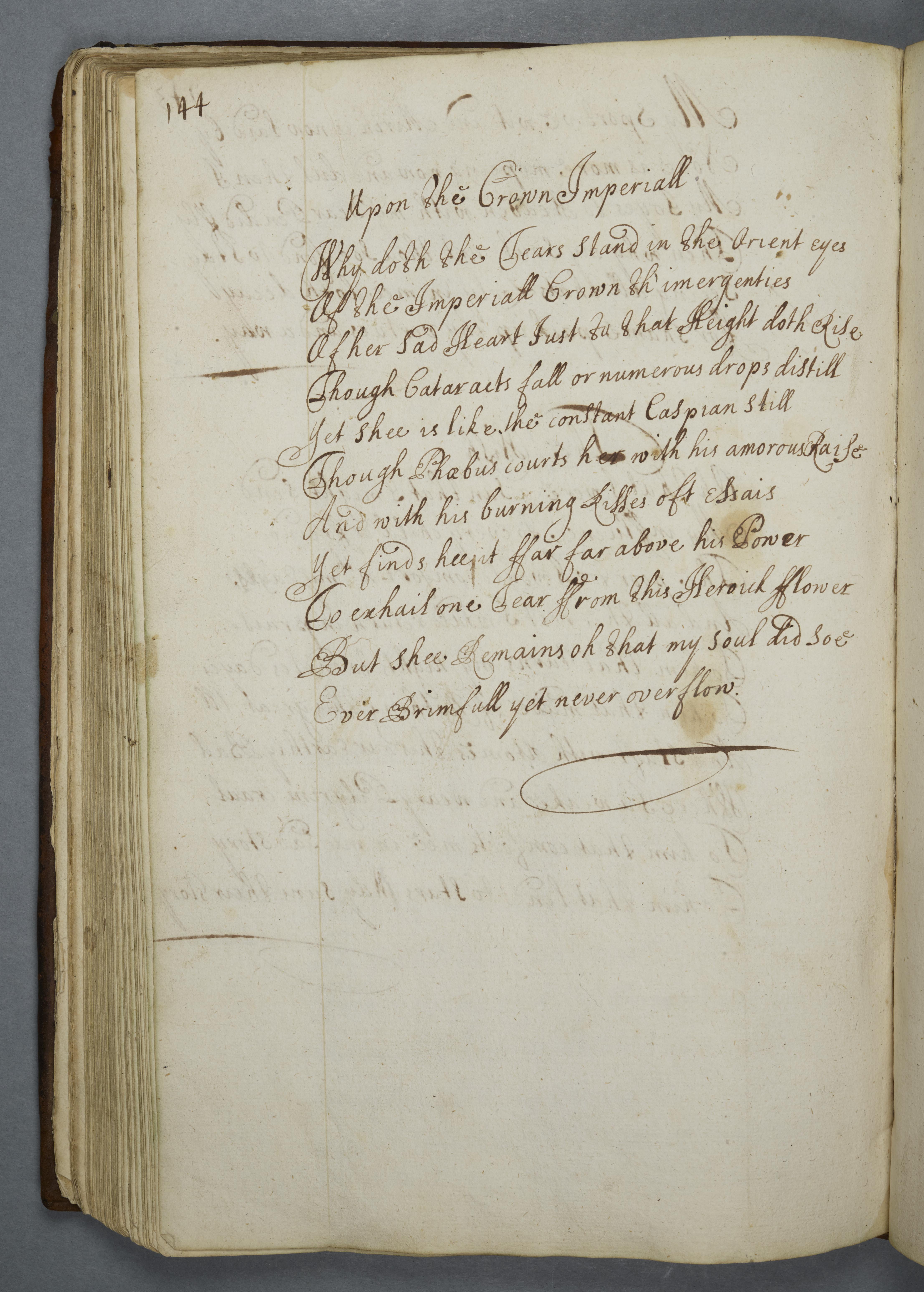
 Facsimile of manuscript: Photographs provided by University of Leeds, Brotherton Collection
Poem IndexNotes: TranscriptionTranscription
The concluding “overflow” presents some issues for interpretation. If, as this Amplified Edition offers, “fflower” is the subject of “overflow,” the line should end in “overflows” to be grammatically correct; however, Pulter may have chosen “overflow” for its rhyming with “soe.” If, as in Knight and Wall’s Elemental Edition, “soul” is the subject, then we can take “overflow” as a subjunctive form in a wish (though this would also be grammatically awkward, following “did” in the previous line). “Overflow” might even be read as an adjective that balances “Brimfull”; however, this would have been an exceptional use of the word as there is no instance of “overflow” used as an adjective recorded in the OED, and the OED records the first use of “overflowed” as an adjective in 1671.
It is also worth noting that, in the Elemental Edition’s reading, the use of the verb “remain” to mean “to continue in the same state” predates the current OED entry, which records its first instance in 1701 and records its use only in recipes, making Pulter’s use of this sense exceptional. However, this Amplified Edition’s reading of the verb “remain” as having the complementing adjectival phrase “ever brimfull” is common and therefore more likely.
 Notes: Elemental EditionElemental Edition
The concluding “overflow” presents some issues for interpretation. If, as this Amplified Edition offers, “fflower” is the subject of “overflow,” the line should end in “overflows” to be grammatically correct; however, Pulter may have chosen “overflow” for its rhyming with “soe.” If, as in Knight and Wall’s Elemental Edition, “soul” is the subject, then we can take “overflow” as a subjunctive form in a wish (though this would also be grammatically awkward, following “did” in the previous line). “Overflow” might even be read as an adjective that balances “Brimfull”; however, this would have been an exceptional use of the word as there is no instance of “overflow” used as an adjective recorded in the OED, and the OED records the first use of “overflowed” as an adjective in 1671.
It is also worth noting that, in the Elemental Edition’s reading, the use of the verb “remain” to mean “to continue in the same state” predates the current OED entry, which records its first instance in 1701 and records its use only in recipes, making Pulter’s use of this sense exceptional. However, this Amplified Edition’s reading of the verb “remain” as having the complementing adjectival phrase “ever brimfull” is common and therefore more likely.
Notes: Amplified EditionThe concluding “overflow” presents some issues for interpretation. If, as this Amplified Edition offers, “fflower” is the subject of “overflow,” the line should end in “overflows” to be grammatically correct; however, Pulter may have chosen “overflow” for its rhyming with “soe.” If, as in Knight and Wall’s Elemental Edition, “soul” is the subject, then we can take “overflow” as a subjunctive form in a wish (though this would also be grammatically awkward, following “did” in the previous line). “Overflow” might even be read as an adjective that balances “Brimfull”; however, this would have been an exceptional use of the word as there is no instance of “overflow” used as an adjective recorded in the OED, and the OED records the first use of “overflowed” as an adjective in 1671.
It is also worth noting that, in the Elemental Edition’s reading, the use of the verb “remain” to mean “to continue in the same state” predates the current OED entry, which records its first instance in 1701 and records its use only in recipes, making Pulter’s use of this sense exceptional. However, this Amplified Edition’s reading of the verb “remain” as having the complementing adjectival phrase “ever brimfull” is common and therefore more likely.
Amplified EditionThe concluding “overflow” presents some issues for interpretation. If, as this Amplified Edition offers, “fflower” is the subject of “overflow,” the line should end in “overflows” to be grammatically correct; however, Pulter may have chosen “overflow” for its rhyming with “soe.” If, as in Knight and Wall’s Elemental Edition, “soul” is the subject, then we can take “overflow” as a subjunctive form in a wish (though this would also be grammatically awkward, following “did” in the previous line). “Overflow” might even be read as an adjective that balances “Brimfull”; however, this would have been an exceptional use of the word as there is no instance of “overflow” used as an adjective recorded in the OED, and the OED records the first use of “overflowed” as an adjective in 1671.
It is also worth noting that, in the Elemental Edition’s reading, the use of the verb “remain” to mean “to continue in the same state” predates the current OED entry, which records its first instance in 1701 and records its use only in recipes, making Pulter’s use of this sense exceptional. However, this Amplified Edition’s reading of the verb “remain” as having the complementing adjectival phrase “ever brimfull” is common and therefore more likely.
All Notes The concluding “overflow” presents some issues for interpretation. If, as this Amplified Edition offers, “fflower” is the subject of “overflow,” the line should end in “overflows” to be grammatically correct; however, Pulter may have chosen “overflow” for its rhyming with “soe.” If, as in Knight and Wall’s Elemental Edition, “soul” is the subject, then we can take “overflow” as a subjunctive form in a wish (though this would also be grammatically awkward, following “did” in the previous line). “Overflow” might even be read as an adjective that balances “Brimfull”; however, this would have been an exceptional use of the word as there is no instance of “overflow” used as an adjective recorded in the OED, and the OED records the first use of “overflowed” as an adjective in 1671.
It is also worth noting that, in the Elemental Edition’s reading, the use of the verb “remain” to mean “to continue in the same state” predates the current OED entry, which records its first instance in 1701 and records its use only in recipes, making Pulter’s use of this sense exceptional. However, this Amplified Edition’s reading of the verb “remain” as having the complementing adjectival phrase “ever brimfull” is common and therefore more likely.