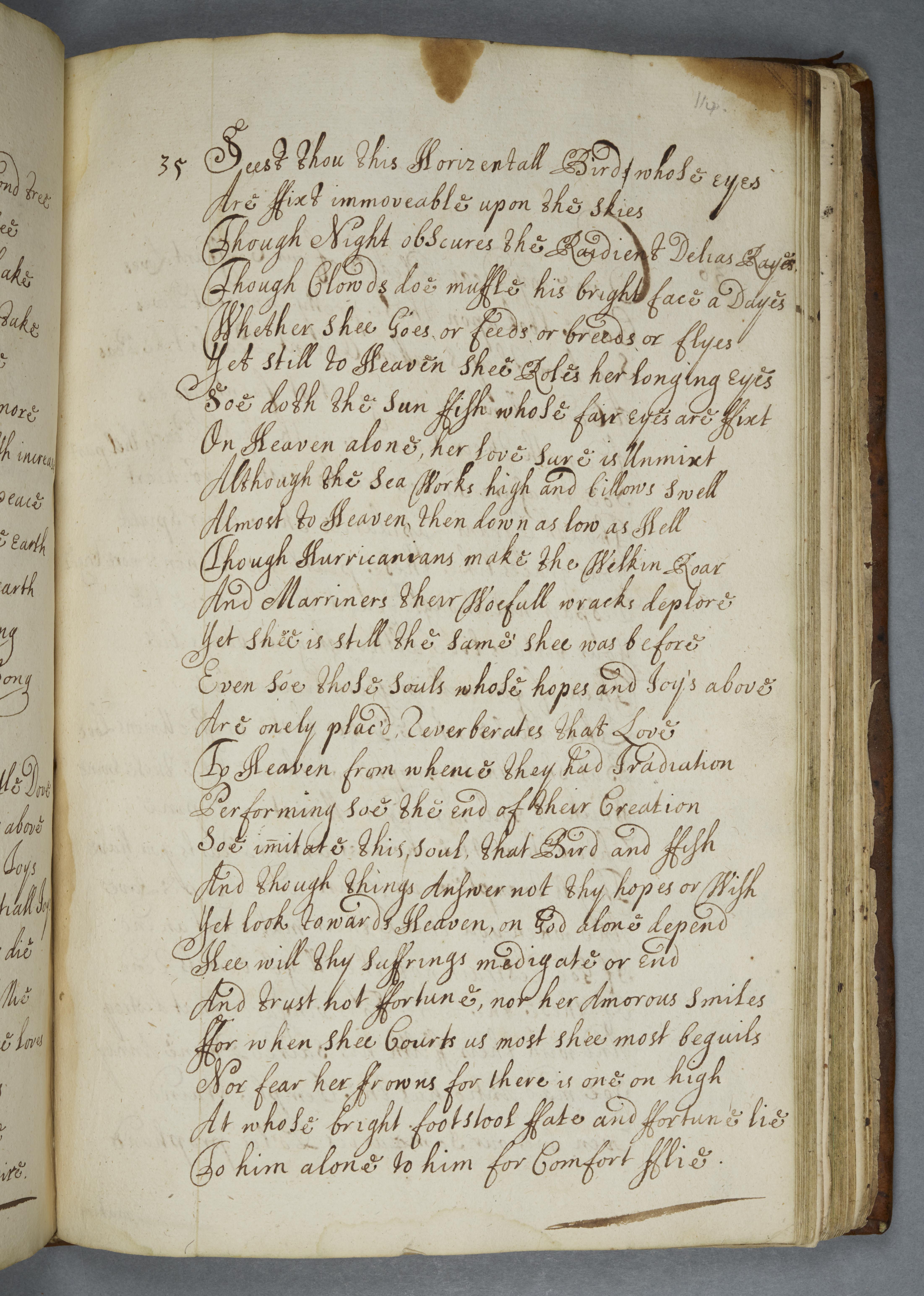
This Horizontal Bird (Emblem 35)

X (Close panel) Sources

This Horizontal Bird (Emblem 35)

Poem #100

Original Source

Hester Pulter, Poems breathed forth by the nobel Hadassas, University of Leeds Library, Brotherton Collection, MS Lt q 32

Versions

  • Facsimile of manuscript: Photographs provided by University of Leeds, Brotherton Collection

  • Transcription of manuscript: By Leah Knight and Wendy Wall.
  • Elemental edition: By Leah Knight and Wendy Wall.
  • Amplified edition: By Emily Barth.

How to cite these versions

Conventions for these editions

The Pulter Project: Poet in the Making

  • Created by Leah Knight and Wendy Wall
  • Encoded by Katherine Poland, Matthew Taylor, Elizabeth Chou, and Emily Andrey, Northwestern University
  • Website designed by Sergei Kalugin, Northwestern University
  • IT project consultation by Josh Honn, Northwestern University
  • Project sponsored by Northwestern University, Brock University, and University of Leeds
X (Close panel)Poem Index
Loading…
X (Close panel)Notes: Transcription

 Editorial note

In these transcriptions we preserve as many details of the original material, textual, and graphic properties of Hester Pulter’s manuscript verse as we have found practical. Whenever possible, for instance, original spelling, punctuation, capitalization, lineation, insertions, deletions, alterations, spacing between words and lines, and indentation are all maintained; abbreviations and brevigraphs are not expanded; and superscript and subscript representations are retained. See full conventions for the transcriptions here.
Line number 1

 Physical note

vertical strike-through
Sorry, but there are no notes associated with any currently displayed witness.
X (Close panel)Transcription
Transcription

Facsimile Image Placeholder

Facsimile Image Placeholder

Facsimile Image Placeholder
[Emblem 35]
This Horizontal Bird
(Emblem 35)
Emblem 35
In these transcriptions we preserve as many details of the original material, textual, and graphic properties of Hester Pulter’s manuscript verse as we have found practical. Whenever possible, for instance, original spelling, punctuation, capitalization, lineation, insertions, deletions, alterations, spacing between words and lines, and indentation are all maintained; abbreviations and brevigraphs are not expanded; and superscript and subscript representations are retained. See full conventions for the transcriptions here.

— Leah Knight and Wendy Wall
The aim of the elemental edition is to make the poems accessible to the largest variety of readers, which involves modernizing spelling and punctuation as well as adding basic glosses. Spelling and punctuation reflect current standard American usage; punctuation highlights syntax which might otherwise be obscure. Outmoded but still familiar word forms (“thou,” “‘tis,” “hold’st”) are not modernized, and we do not modernize grammar when the sense remains legible. After a brief headnote aimed at offering a “way in” to the poem’s unique qualities and connections with other verse by Pulter or her contemporaries, the edition features a minimum of notes and interpretative framing to allow more immediate engagement with the poem. Glosses clarify synonyms or showcase various possible meanings in Pulter’s time. Other notes identify named people and places or clarify obscure material. We rely (without citation) primarily on the Oxford English Dictionary (OED), the Oxford Reference database, and the King James Version (KJV) of the Bible. When we rely on Alice Eardley’s edition of Pulter’s work, we cite her text generally (“Eardley”); other sources are cited in full. The result is an edition we consider a springboard for further work on Pulter’s poetry. See full conventions for this edition here.

— Leah Knight and Wendy Wall
For this Amplified Edition, spelling has been modernized and punctuation follows the Elemental Edition with the aim of increasing clarity and accessibility. Capitalization has been maintained where the context of the poem suggests the probability of a proper noun, though this is to some extent an act of interpretation.

— Leah Knight and Wendy Wall
A footless bird and upturned fish eyes are the unlikely sources of inspiration in this emblem. The unique anatomy (imaginary or not) of two obscure creatures enables apparently spiritual behavior in them which the poet proffers as a model for her readers. The close parallels between this poem’s counsel to constancy and that in many other items in Pulter’s manuscript, far from being a sign of redundancy, is in fact thematically sound in a poem about the resounding virtue of each creature remaining “the same she was before.” However grounded it might be in biology, such a rehearsal is also construed here as a mimetic performance, an art form not unrelated to the verse in which it is both described and inscribed. The beauty as well as difficulty of imitating abstractions and animals alike (“this soul, that bird, and fish”) should galvanize readers to be steadfast in keeping their sights firmly above the earthly fray.

— Leah Knight and Wendy Wall
Most early modern emblems include a visual image to accompany their textual commentaries, which consist of a brief motto followed by a longer piece of text, usually a poem. Pulter’s emblems are “naked” as very few others are (Andrew Willet’s Sacrorum emblemata (1592), a distinctly Protestant book of religious emblems printed in England, is one example). Even in the absence of imagery, Pulter creates an iterative reading experience in which her initial verbal imagery offers an idea that appears again in new form, compounding meaning through recurrence and amplification. As in a typical emblem, where an image, motto, and epigram would echo and expand on one another, Pulter’s emblem offers several distinct examples that reverberate (as she might have it) over the course of the poem’s three parts.
The poem presents the Horizontal Bird and Sunfish, one after the other, as expanding echoes of one another. Both maintain their status as animals while simultaneously acquiring human emotions of longing and love. Both are described with their eyes “fixed” skyward, suggesting a steadfast piety despite both natural distraction and physical necessity. In the description of the Sunfish, this repetition is compounded by a more elaborate account of a tumultuous environment that challenges fixity, stressing the Sunfish’s dedication (and so, in retrospect, that of the Horizontal Bird). The agency ascribed to both the Horizontal Bird and Sunfish gains additional emphasis as the poem’s speaker instructs the reader to “imitate this soul, that Bird, and Fish,” referring the reader to a third example in which a collective of souls interacts with the divine. Making the three (soul, Bird, and Fish) analogous to one another clarifies the extent to which the Horizontal Bird and Sunfish stand in for both reader and speaker in the poem’s earlier descriptions of each, ushering in the poem’s final exhortation. The language in the last third of the poem, increasingly marked by direct address to the reader, comprises what in a typical emblem might be a moral lesson, proverb, or advice.
The poem’s final injunction to depend solely on God, to turn only to God for comfort, produces an emblem’s culminating message, appropriately reiterating the descriptions of the Horizontal Bird and the Sunfish gazing always toward Heaven. It also, in shifting our attention to a simultaneously collective and personal spiritual endeavor, invites the reader to participate more fully in this lyric emblem poem.


— Leah Knight and Wendy Wall
1
35Seest thou this Horizentall
Physical Note
vertical strike-through
Birds
whoſe Eyes
Seest thou
Gloss Note
perhaps the manucodiat or bird of paradise, which Pulter invokes elsewhere (see “The Manucodiats” [Emblem 5] [Poem 71]). Her account may draw on Simon Goulart’s A Learned Summary Upon the Famous Poem of William of Saluste Lord of Bartas, where the birds are described as being “remain[ing] always in the air” and even as having “no feet” (London, 1621), 1.241; the fact that they are always flying might explain Pulter’s epithet of “horizontal.”
this horizontal bird
, whose eyes
Seest thou this
Gloss Note
A dual implication: both that the bird is of the horizon, and that the bird’s body, being horizontal, forms a constant plane from which she gazes toward heaven. The poem continues to emphasize the way the bird’s piety participates in the bird’s naturality. Lara Dodds has glossed this thoroughly in her curation, Birds Without Feet?, accompanying her Amplified Edition, Emblem 5 [Poem 71]. Like the bird that anchors Pulter’s Emblem 5, this bird of paradise lives in perpetual flight, never touching the ground. It was also believed that the bird of paradise fed only on dew and light. Also known as the manucodiat, or “God’s bird,” the bird of paradise had a metaphorical reputation as being of celestial quality.
Horizontal Bird
, whose eyes
2
Are ffixt immoveable upon the Skies
Are fixed, immovable, upon the skies,
Are
Gloss Note
Manuscript = Fixt, implying a particularly direct connection of action, duty, desire, or concentration, perhaps also with attention to a physical connection. “Fixt” as though with a string, stuck in place: the capitalization emphasizes the significance of this faithful fixity (and this emphasis on significance remains true of the scribe’s capitalization practices throughout the poem).
fixed
, immovable, upon the skies,
3
Though Night obſcures the Raidient Delias Rayes
Though night obscures the radiant
Gloss Note
Apollo’s, the sun god’s; for a figure usually called Delius (so named because he was from the island of Delos)
Delia’s
rays,
Though
Gloss Note
Personified Night conceals the light that illuminates Heaven, much as she does in Shakespeare’s “Rape of Lucrece,” where Night, “mother of dread and fear,/ Upon the world dim darkness doth display,/ And in her vaulty prison stows the day” (1594).
Night
obscures the radiant
Critical Note
Pulter’s use of a feminized name to refer to Apollo appears elsewhere (including The Garden, or The Contention of Flowers [Poem 12], and The Snail, the Tulip, and the Bee (Emblem 53) [Poem 118]). Delia’s ambiguity and inconstancy contrasts with the description of the Horizontal Bird that precedes her appearance in the poem, but as in The Eclipse [Poem 1], Delia’s inconstancy results from external influence.
Delia’s rays
,
4
Though Clowds doe muffle his bright face a Dayes
Though clouds do muffle his bright face
Gloss Note
in the daytime
adays
?
Though clouds do muffle his bright face
Gloss Note
During the day, or possibly, at the present time.
a-days
?
5
Whether Shee Goes, or feeds, or breeds, or flyes
Whether she goes, or feeds, or breeds, or flies,
6
Yet Still to Heaven Shee Roles her longing Eyes
Yet still to Heav’n she rolls her longing eyes.
Yet still to Heaven she rolls her longing eyes.
7
Soe doth the Sun ffiſh whoſe fair Eyes are ffixt
So doth the
Gloss Note
A number of fish species (called stargazers) have eyes atop their heads; others, sunfish, bask on their sides near the surface and so appear to stare at the sky. Pulter’s account here may draw on that of Goulart’s summary of Du Bartas (cited above), on the gaping fish, whose Greek name means “beholding the Heaven, because he hath two eyes planted above his head” (1.221).
sunfish
, whose fair eyes are fixed
So doth the
Gloss Note
The Sunfish does as the Horizontal Bird does: she is attentive, constant, and faithful as the bird despite the turbulence of the sea around her described in the next several lines of the poem. Although sunfish spend most of their lives underwater, the large, disc-shaped fish periodically come to the surface to bask, swimming on their sides to warm themselves in the sun as they gaze up at the sky.
Sunfish
, whose fair eyes are fixed
8
On Heaven alone, her love Sure is Unmixt
On Heav’n alone; her love sure is
Gloss Note
pure, undiluted
unmixed
,
On Heaven alone; her love sure is
Gloss Note
Pure; undiluted.
unmixed
,
9
Although the Sea Works high and billows Swell
Although the sea works high, and billows swell
Although the sea
Gloss Note
In this case, “work” meaning to be turbulent or stormy; to toss, seethe, rage; also to strive. The sea acquires some agency as it “works” through its own natural mutability as well as a spiritual struggle. The sunfish’s environment contrasts with her character.
works
high, and billows swell
10
Almost to Heaven, then down as low as Hell
Almost to Heav’n, then down as low as Hell.
Almost to Heaven, then down as low as Hell.
11
Though Hurricanians make the Welkin Roar
Though
Gloss Note
seemingly, hurricanes
hurricanians
make the
Gloss Note
sky
welkin
roar,
Though
Critical Note
“Hurricanians” is in parallel to “Mariners” in the next line. The noun seems to have some agency rather than merely referring to hurricanes.
Hurricanians
make the
Gloss Note
The sky erupts in storm, a vocal expression (perhaps of frustration) in response to the sea’s own turbulence.
Welkin roar
,
12
And Marriners their Woefull wracks deplore
And mariners their woeful
Gloss Note
wrecked ships
wracks
Gloss Note
lament
deplore
,
And Mariners their woeful
Gloss Note
Shipwrecks.
wracks
deplore,
13
Yet Shee is Still the Same Shee was before
Yet she is still the same she was before.
14
Even Soe thoſe Souls whoſe hopes and Joy’s above
E’en so those souls whose hopes and joys above
Gloss Note
Similarly; likewise.
Even so
those souls whose hopes and joys above
15
Are onely plac’d, Reverberates that Love
Are only placed,
Gloss Note
sends back, returns
reverberates
that love
Are only plac’d,
Critical Note
To reverberate in early modern usage entails a deflection, repelling, or sending back of something received (physical or emotional). Here, Pulter connects the idea of a reverberation of emotion (in this case, of love) to a different understanding of reverberation as it would relate to light, linking her comment on a soul that “reverberates that love” to the “irradiation” in the next line. Unlike the reverberations of emotion or physical impact that are deflected, reverberation of light is something that spreads like echoing sound. (See “reverberate,” v., Oxford English Dictionary.)
reverberates
that love
16
To Heaven from whence they had Iradiation
To Heav’n from whence they had
Gloss Note
a beaming forth of spiritual light
irradiation
,
To Heaven from whence they had
Critical Note
She imagines that those who focus their attention (and affection) on Heaven are illuminated from within with spiritual light, or alternatively, that those who are already “irradiated” concentrate their hopes and joys in heaven, reflecting a love that also originates there. This language and concept occurs in both The Manucodiats (Emblem 5) [Poem 71] and here, suggesting a reverberation not only within this poem, but also between the two.
irradiation
,
17
Performing Soe the end of their Creation
Performing so the
Gloss Note
purpose
end
of their creation.
Performing so the
Critical Note
Pulter suggests that the love of God (possibly prayer) practiced in the preceding lines rebounds God’s love, reflecting this love back toward heaven, and that this is the ultimate purpose of creation. This phrase concludes a quatrain that echoes an idea found elsewhere in Pulter’s work, where she describes love and prayer reascending in reciprocity (My God I thee (and onely thee) Adore” [Poem 50]; A Solitary Complaint [Poem 54]; The Manucodiats (Emblem 5) [Poem 71]).
end of their creation
.
18
Soe imitate this Soul, that Bird and ffish
So imitate this soul, that bird, and fish,
So imitate this
Critical Note
“Those souls” from line 14 here condensed to a single representative soul, an example to be followed — as the Bird and Fish referred to in the same line, an emblem that transmits behavioral pedagogy.
soul
, that
Gloss Note
The “Horizontal Bird.”
Bird
, and
Gloss Note
The Sunfish.
Fish
,
19
And though things Anſwer not thy hopes or Wiſh
And though things answer not thy hopes or wish,
And though
Gloss Note
Equally material objects and events occurring in the material world.
things
answer not thy hopes or wish,
20
Yet look towards Heaven, on God alone depend
Yet look towards Heav’n, on God alone depend:
Yet look towards Heaven, on God alone depend:
21
Hee will thy Suffrings medigate or End
He will thy suff’rings mitigate or end.
He will thy suff’rings
Gloss Note
Careful not to promise too much, the speaker suggests either an end to suffering, or a moderation, perhaps a lessening, of that suffering.
mitigate or end
.
22
And trust not ffortune, nor her Amorous Smiles
And trust not Fortune, nor her amorous smiles;
And trust not
Gloss Note
The goddess, who Samuel Johnson describes in volume one of his English Dictionary (1755) as having “the power supposed to distribute the lots of life according to her own humour.” Her humor is based on chance, and her “Amorous smiles” are therefore fickle and not to be trusted.
Fortune
, nor her amorous smiles;
23
ffor when Shee Courts us most Shee most beguils
For when she courts us most, she most
Gloss Note
deceives; disappoints, foils
beguiles
.
Critical Note
In operating “according to her own humor,” Fortune charms and perhaps unintentionally deceives. Despite this warning, the speaker also suggests that we should not fear Fortune.
For when she courts us most, she most beguiles
.
24
Nor fear her ffrowns for there is one on high
Nor fear her frowns, for there is one on high
25
At whoſe bright footstool ffate and ffortune lie
At whose bright footstool Fate and Fortune lie:
At whose bright
Critical Note
Both Fate and Fortune lie under God’s dominion; they are subject to God, as in the King James Version of Isaiah 66:1: “The heaven is my throne, and the earth is my footstool.” In this figurative usage, the footstool indicates subjection or dominion.
footstool
Gloss Note
Fate, the order of events, is more constant than Fortune but, much like Fortune, is something we do not control.
Fate
and Fortune lie:
26
To him alone to him for Comfort fflie.
To Him alone, to Him for comfort
Gloss Note
flee
fly
.
To
Gloss Note
God.
him
alone, to him for comfort
Critical Note
While Pulter’s speaker surely means to urge the reader to turn quickly toward God in search of comfort, the use of the word “fly” at the end of the poem also reminds the reader of the emblem’s opening description of the Horizontal Bird, who turns toward God in unending flight. Recalling Pulter’s rather metaphysical descriptions of love reverberating and “irradiation” returning to heaven, the idea that the reader should fly to God reinforces the advice to emulate the Horizontal Bird, the Sunfish, and those souls who have managed to focus entirely on heaven. The directive to fly, however, might also draw attention to the inherent difficulty in this task for creatures who are bound to earth, and so serve as a reminder that any such emulation will require ongoing effort.
fly
.
ascending straight line
X (Close panel)Notes: Elemental Edition

 Editorial note

The aim of the elemental edition is to make the poems accessible to the largest variety of readers, which involves modernizing spelling and punctuation as well as adding basic glosses. Spelling and punctuation reflect current standard American usage; punctuation highlights syntax which might otherwise be obscure. Outmoded but still familiar word forms (“thou,” “‘tis,” “hold’st”) are not modernized, and we do not modernize grammar when the sense remains legible. After a brief headnote aimed at offering a “way in” to the poem’s unique qualities and connections with other verse by Pulter or her contemporaries, the edition features a minimum of notes and interpretative framing to allow more immediate engagement with the poem. Glosses clarify synonyms or showcase various possible meanings in Pulter’s time. Other notes identify named people and places or clarify obscure material. We rely (without citation) primarily on the Oxford English Dictionary (OED), the Oxford Reference database, and the King James Version (KJV) of the Bible. When we rely on Alice Eardley’s edition of Pulter’s work, we cite her text generally (“Eardley”); other sources are cited in full. The result is an edition we consider a springboard for further work on Pulter’s poetry. See full conventions for this edition here.

 Headnote

A footless bird and upturned fish eyes are the unlikely sources of inspiration in this emblem. The unique anatomy (imaginary or not) of two obscure creatures enables apparently spiritual behavior in them which the poet proffers as a model for her readers. The close parallels between this poem’s counsel to constancy and that in many other items in Pulter’s manuscript, far from being a sign of redundancy, is in fact thematically sound in a poem about the resounding virtue of each creature remaining “the same she was before.” However grounded it might be in biology, such a rehearsal is also construed here as a mimetic performance, an art form not unrelated to the verse in which it is both described and inscribed. The beauty as well as difficulty of imitating abstractions and animals alike (“this soul, that bird, and fish”) should galvanize readers to be steadfast in keeping their sights firmly above the earthly fray.
Line number 1

 Gloss note

perhaps the manucodiat or bird of paradise, which Pulter invokes elsewhere (see “The Manucodiats” [Emblem 5] [Poem 71]). Her account may draw on Simon Goulart’s A Learned Summary Upon the Famous Poem of William of Saluste Lord of Bartas, where the birds are described as being “remain[ing] always in the air” and even as having “no feet” (London, 1621), 1.241; the fact that they are always flying might explain Pulter’s epithet of “horizontal.”
Line number 3

 Gloss note

Apollo’s, the sun god’s; for a figure usually called Delius (so named because he was from the island of Delos)
Line number 4

 Gloss note

in the daytime
Line number 7

 Gloss note

A number of fish species (called stargazers) have eyes atop their heads; others, sunfish, bask on their sides near the surface and so appear to stare at the sky. Pulter’s account here may draw on that of Goulart’s summary of Du Bartas (cited above), on the gaping fish, whose Greek name means “beholding the Heaven, because he hath two eyes planted above his head” (1.221).
Line number 8

 Gloss note

pure, undiluted
Line number 11

 Gloss note

seemingly, hurricanes
Line number 11

 Gloss note

sky
Line number 12

 Gloss note

wrecked ships
Line number 12

 Gloss note

lament
Line number 15

 Gloss note

sends back, returns
Line number 16

 Gloss note

a beaming forth of spiritual light
Line number 17

 Gloss note

purpose
Line number 23

 Gloss note

deceives; disappoints, foils
Line number 26

 Gloss note

flee
Sorry, but there are no notes associated with any currently displayed witness.
X (Close panel)Elemental Edition
Elemental Edition

Facsimile Image Placeholder

Facsimile Image Placeholder

Facsimile Image Placeholder
[Emblem 35]
This Horizontal Bird
(Emblem 35)
Emblem 35
In these transcriptions we preserve as many details of the original material, textual, and graphic properties of Hester Pulter’s manuscript verse as we have found practical. Whenever possible, for instance, original spelling, punctuation, capitalization, lineation, insertions, deletions, alterations, spacing between words and lines, and indentation are all maintained; abbreviations and brevigraphs are not expanded; and superscript and subscript representations are retained. See full conventions for the transcriptions here.

— Leah Knight and Wendy Wall
The aim of the elemental edition is to make the poems accessible to the largest variety of readers, which involves modernizing spelling and punctuation as well as adding basic glosses. Spelling and punctuation reflect current standard American usage; punctuation highlights syntax which might otherwise be obscure. Outmoded but still familiar word forms (“thou,” “‘tis,” “hold’st”) are not modernized, and we do not modernize grammar when the sense remains legible. After a brief headnote aimed at offering a “way in” to the poem’s unique qualities and connections with other verse by Pulter or her contemporaries, the edition features a minimum of notes and interpretative framing to allow more immediate engagement with the poem. Glosses clarify synonyms or showcase various possible meanings in Pulter’s time. Other notes identify named people and places or clarify obscure material. We rely (without citation) primarily on the Oxford English Dictionary (OED), the Oxford Reference database, and the King James Version (KJV) of the Bible. When we rely on Alice Eardley’s edition of Pulter’s work, we cite her text generally (“Eardley”); other sources are cited in full. The result is an edition we consider a springboard for further work on Pulter’s poetry. See full conventions for this edition here.

— Leah Knight and Wendy Wall
For this Amplified Edition, spelling has been modernized and punctuation follows the Elemental Edition with the aim of increasing clarity and accessibility. Capitalization has been maintained where the context of the poem suggests the probability of a proper noun, though this is to some extent an act of interpretation.

— Leah Knight and Wendy Wall
A footless bird and upturned fish eyes are the unlikely sources of inspiration in this emblem. The unique anatomy (imaginary or not) of two obscure creatures enables apparently spiritual behavior in them which the poet proffers as a model for her readers. The close parallels between this poem’s counsel to constancy and that in many other items in Pulter’s manuscript, far from being a sign of redundancy, is in fact thematically sound in a poem about the resounding virtue of each creature remaining “the same she was before.” However grounded it might be in biology, such a rehearsal is also construed here as a mimetic performance, an art form not unrelated to the verse in which it is both described and inscribed. The beauty as well as difficulty of imitating abstractions and animals alike (“this soul, that bird, and fish”) should galvanize readers to be steadfast in keeping their sights firmly above the earthly fray.

— Leah Knight and Wendy Wall
Most early modern emblems include a visual image to accompany their textual commentaries, which consist of a brief motto followed by a longer piece of text, usually a poem. Pulter’s emblems are “naked” as very few others are (Andrew Willet’s Sacrorum emblemata (1592), a distinctly Protestant book of religious emblems printed in England, is one example). Even in the absence of imagery, Pulter creates an iterative reading experience in which her initial verbal imagery offers an idea that appears again in new form, compounding meaning through recurrence and amplification. As in a typical emblem, where an image, motto, and epigram would echo and expand on one another, Pulter’s emblem offers several distinct examples that reverberate (as she might have it) over the course of the poem’s three parts.
The poem presents the Horizontal Bird and Sunfish, one after the other, as expanding echoes of one another. Both maintain their status as animals while simultaneously acquiring human emotions of longing and love. Both are described with their eyes “fixed” skyward, suggesting a steadfast piety despite both natural distraction and physical necessity. In the description of the Sunfish, this repetition is compounded by a more elaborate account of a tumultuous environment that challenges fixity, stressing the Sunfish’s dedication (and so, in retrospect, that of the Horizontal Bird). The agency ascribed to both the Horizontal Bird and Sunfish gains additional emphasis as the poem’s speaker instructs the reader to “imitate this soul, that Bird, and Fish,” referring the reader to a third example in which a collective of souls interacts with the divine. Making the three (soul, Bird, and Fish) analogous to one another clarifies the extent to which the Horizontal Bird and Sunfish stand in for both reader and speaker in the poem’s earlier descriptions of each, ushering in the poem’s final exhortation. The language in the last third of the poem, increasingly marked by direct address to the reader, comprises what in a typical emblem might be a moral lesson, proverb, or advice.
The poem’s final injunction to depend solely on God, to turn only to God for comfort, produces an emblem’s culminating message, appropriately reiterating the descriptions of the Horizontal Bird and the Sunfish gazing always toward Heaven. It also, in shifting our attention to a simultaneously collective and personal spiritual endeavor, invites the reader to participate more fully in this lyric emblem poem.


— Leah Knight and Wendy Wall
1
35Seest thou this Horizentall
Physical Note
vertical strike-through
Birds
whoſe Eyes
Seest thou
Gloss Note
perhaps the manucodiat or bird of paradise, which Pulter invokes elsewhere (see “The Manucodiats” [Emblem 5] [Poem 71]). Her account may draw on Simon Goulart’s A Learned Summary Upon the Famous Poem of William of Saluste Lord of Bartas, where the birds are described as being “remain[ing] always in the air” and even as having “no feet” (London, 1621), 1.241; the fact that they are always flying might explain Pulter’s epithet of “horizontal.”
this horizontal bird
, whose eyes
Seest thou this
Gloss Note
A dual implication: both that the bird is of the horizon, and that the bird’s body, being horizontal, forms a constant plane from which she gazes toward heaven. The poem continues to emphasize the way the bird’s piety participates in the bird’s naturality. Lara Dodds has glossed this thoroughly in her curation, Birds Without Feet?, accompanying her Amplified Edition, Emblem 5 [Poem 71]. Like the bird that anchors Pulter’s Emblem 5, this bird of paradise lives in perpetual flight, never touching the ground. It was also believed that the bird of paradise fed only on dew and light. Also known as the manucodiat, or “God’s bird,” the bird of paradise had a metaphorical reputation as being of celestial quality.
Horizontal Bird
, whose eyes
2
Are ffixt immoveable upon the Skies
Are fixed, immovable, upon the skies,
Are
Gloss Note
Manuscript = Fixt, implying a particularly direct connection of action, duty, desire, or concentration, perhaps also with attention to a physical connection. “Fixt” as though with a string, stuck in place: the capitalization emphasizes the significance of this faithful fixity (and this emphasis on significance remains true of the scribe’s capitalization practices throughout the poem).
fixed
, immovable, upon the skies,
3
Though Night obſcures the Raidient Delias Rayes
Though night obscures the radiant
Gloss Note
Apollo’s, the sun god’s; for a figure usually called Delius (so named because he was from the island of Delos)
Delia’s
rays,
Though
Gloss Note
Personified Night conceals the light that illuminates Heaven, much as she does in Shakespeare’s “Rape of Lucrece,” where Night, “mother of dread and fear,/ Upon the world dim darkness doth display,/ And in her vaulty prison stows the day” (1594).
Night
obscures the radiant
Critical Note
Pulter’s use of a feminized name to refer to Apollo appears elsewhere (including The Garden, or The Contention of Flowers [Poem 12], and The Snail, the Tulip, and the Bee (Emblem 53) [Poem 118]). Delia’s ambiguity and inconstancy contrasts with the description of the Horizontal Bird that precedes her appearance in the poem, but as in The Eclipse [Poem 1], Delia’s inconstancy results from external influence.
Delia’s rays
,
4
Though Clowds doe muffle his bright face a Dayes
Though clouds do muffle his bright face
Gloss Note
in the daytime
adays
?
Though clouds do muffle his bright face
Gloss Note
During the day, or possibly, at the present time.
a-days
?
5
Whether Shee Goes, or feeds, or breeds, or flyes
Whether she goes, or feeds, or breeds, or flies,
6
Yet Still to Heaven Shee Roles her longing Eyes
Yet still to Heav’n she rolls her longing eyes.
Yet still to Heaven she rolls her longing eyes.
7
Soe doth the Sun ffiſh whoſe fair Eyes are ffixt
So doth the
Gloss Note
A number of fish species (called stargazers) have eyes atop their heads; others, sunfish, bask on their sides near the surface and so appear to stare at the sky. Pulter’s account here may draw on that of Goulart’s summary of Du Bartas (cited above), on the gaping fish, whose Greek name means “beholding the Heaven, because he hath two eyes planted above his head” (1.221).
sunfish
, whose fair eyes are fixed
So doth the
Gloss Note
The Sunfish does as the Horizontal Bird does: she is attentive, constant, and faithful as the bird despite the turbulence of the sea around her described in the next several lines of the poem. Although sunfish spend most of their lives underwater, the large, disc-shaped fish periodically come to the surface to bask, swimming on their sides to warm themselves in the sun as they gaze up at the sky.
Sunfish
, whose fair eyes are fixed
8
On Heaven alone, her love Sure is Unmixt
On Heav’n alone; her love sure is
Gloss Note
pure, undiluted
unmixed
,
On Heaven alone; her love sure is
Gloss Note
Pure; undiluted.
unmixed
,
9
Although the Sea Works high and billows Swell
Although the sea works high, and billows swell
Although the sea
Gloss Note
In this case, “work” meaning to be turbulent or stormy; to toss, seethe, rage; also to strive. The sea acquires some agency as it “works” through its own natural mutability as well as a spiritual struggle. The sunfish’s environment contrasts with her character.
works
high, and billows swell
10
Almost to Heaven, then down as low as Hell
Almost to Heav’n, then down as low as Hell.
Almost to Heaven, then down as low as Hell.
11
Though Hurricanians make the Welkin Roar
Though
Gloss Note
seemingly, hurricanes
hurricanians
make the
Gloss Note
sky
welkin
roar,
Though
Critical Note
“Hurricanians” is in parallel to “Mariners” in the next line. The noun seems to have some agency rather than merely referring to hurricanes.
Hurricanians
make the
Gloss Note
The sky erupts in storm, a vocal expression (perhaps of frustration) in response to the sea’s own turbulence.
Welkin roar
,
12
And Marriners their Woefull wracks deplore
And mariners their woeful
Gloss Note
wrecked ships
wracks
Gloss Note
lament
deplore
,
And Mariners their woeful
Gloss Note
Shipwrecks.
wracks
deplore,
13
Yet Shee is Still the Same Shee was before
Yet she is still the same she was before.
14
Even Soe thoſe Souls whoſe hopes and Joy’s above
E’en so those souls whose hopes and joys above
Gloss Note
Similarly; likewise.
Even so
those souls whose hopes and joys above
15
Are onely plac’d, Reverberates that Love
Are only placed,
Gloss Note
sends back, returns
reverberates
that love
Are only plac’d,
Critical Note
To reverberate in early modern usage entails a deflection, repelling, or sending back of something received (physical or emotional). Here, Pulter connects the idea of a reverberation of emotion (in this case, of love) to a different understanding of reverberation as it would relate to light, linking her comment on a soul that “reverberates that love” to the “irradiation” in the next line. Unlike the reverberations of emotion or physical impact that are deflected, reverberation of light is something that spreads like echoing sound. (See “reverberate,” v., Oxford English Dictionary.)
reverberates
that love
16
To Heaven from whence they had Iradiation
To Heav’n from whence they had
Gloss Note
a beaming forth of spiritual light
irradiation
,
To Heaven from whence they had
Critical Note
She imagines that those who focus their attention (and affection) on Heaven are illuminated from within with spiritual light, or alternatively, that those who are already “irradiated” concentrate their hopes and joys in heaven, reflecting a love that also originates there. This language and concept occurs in both The Manucodiats (Emblem 5) [Poem 71] and here, suggesting a reverberation not only within this poem, but also between the two.
irradiation
,
17
Performing Soe the end of their Creation
Performing so the
Gloss Note
purpose
end
of their creation.
Performing so the
Critical Note
Pulter suggests that the love of God (possibly prayer) practiced in the preceding lines rebounds God’s love, reflecting this love back toward heaven, and that this is the ultimate purpose of creation. This phrase concludes a quatrain that echoes an idea found elsewhere in Pulter’s work, where she describes love and prayer reascending in reciprocity (My God I thee (and onely thee) Adore” [Poem 50]; A Solitary Complaint [Poem 54]; The Manucodiats (Emblem 5) [Poem 71]).
end of their creation
.
18
Soe imitate this Soul, that Bird and ffish
So imitate this soul, that bird, and fish,
So imitate this
Critical Note
“Those souls” from line 14 here condensed to a single representative soul, an example to be followed — as the Bird and Fish referred to in the same line, an emblem that transmits behavioral pedagogy.
soul
, that
Gloss Note
The “Horizontal Bird.”
Bird
, and
Gloss Note
The Sunfish.
Fish
,
19
And though things Anſwer not thy hopes or Wiſh
And though things answer not thy hopes or wish,
And though
Gloss Note
Equally material objects and events occurring in the material world.
things
answer not thy hopes or wish,
20
Yet look towards Heaven, on God alone depend
Yet look towards Heav’n, on God alone depend:
Yet look towards Heaven, on God alone depend:
21
Hee will thy Suffrings medigate or End
He will thy suff’rings mitigate or end.
He will thy suff’rings
Gloss Note
Careful not to promise too much, the speaker suggests either an end to suffering, or a moderation, perhaps a lessening, of that suffering.
mitigate or end
.
22
And trust not ffortune, nor her Amorous Smiles
And trust not Fortune, nor her amorous smiles;
And trust not
Gloss Note
The goddess, who Samuel Johnson describes in volume one of his English Dictionary (1755) as having “the power supposed to distribute the lots of life according to her own humour.” Her humor is based on chance, and her “Amorous smiles” are therefore fickle and not to be trusted.
Fortune
, nor her amorous smiles;
23
ffor when Shee Courts us most Shee most beguils
For when she courts us most, she most
Gloss Note
deceives; disappoints, foils
beguiles
.
Critical Note
In operating “according to her own humor,” Fortune charms and perhaps unintentionally deceives. Despite this warning, the speaker also suggests that we should not fear Fortune.
For when she courts us most, she most beguiles
.
24
Nor fear her ffrowns for there is one on high
Nor fear her frowns, for there is one on high
25
At whoſe bright footstool ffate and ffortune lie
At whose bright footstool Fate and Fortune lie:
At whose bright
Critical Note
Both Fate and Fortune lie under God’s dominion; they are subject to God, as in the King James Version of Isaiah 66:1: “The heaven is my throne, and the earth is my footstool.” In this figurative usage, the footstool indicates subjection or dominion.
footstool
Gloss Note
Fate, the order of events, is more constant than Fortune but, much like Fortune, is something we do not control.
Fate
and Fortune lie:
26
To him alone to him for Comfort fflie.
To Him alone, to Him for comfort
Gloss Note
flee
fly
.
To
Gloss Note
God.
him
alone, to him for comfort
Critical Note
While Pulter’s speaker surely means to urge the reader to turn quickly toward God in search of comfort, the use of the word “fly” at the end of the poem also reminds the reader of the emblem’s opening description of the Horizontal Bird, who turns toward God in unending flight. Recalling Pulter’s rather metaphysical descriptions of love reverberating and “irradiation” returning to heaven, the idea that the reader should fly to God reinforces the advice to emulate the Horizontal Bird, the Sunfish, and those souls who have managed to focus entirely on heaven. The directive to fly, however, might also draw attention to the inherent difficulty in this task for creatures who are bound to earth, and so serve as a reminder that any such emulation will require ongoing effort.
fly
.
ascending straight line
X (Close panel)Notes: Amplified Edition

 Editorial note

For this Amplified Edition, spelling has been modernized and punctuation follows the Elemental Edition with the aim of increasing clarity and accessibility. Capitalization has been maintained where the context of the poem suggests the probability of a proper noun, though this is to some extent an act of interpretation.

 Headnote

Most early modern emblems include a visual image to accompany their textual commentaries, which consist of a brief motto followed by a longer piece of text, usually a poem. Pulter’s emblems are “naked” as very few others are (Andrew Willet’s Sacrorum emblemata (1592), a distinctly Protestant book of religious emblems printed in England, is one example). Even in the absence of imagery, Pulter creates an iterative reading experience in which her initial verbal imagery offers an idea that appears again in new form, compounding meaning through recurrence and amplification. As in a typical emblem, where an image, motto, and epigram would echo and expand on one another, Pulter’s emblem offers several distinct examples that reverberate (as she might have it) over the course of the poem’s three parts.
The poem presents the Horizontal Bird and Sunfish, one after the other, as expanding echoes of one another. Both maintain their status as animals while simultaneously acquiring human emotions of longing and love. Both are described with their eyes “fixed” skyward, suggesting a steadfast piety despite both natural distraction and physical necessity. In the description of the Sunfish, this repetition is compounded by a more elaborate account of a tumultuous environment that challenges fixity, stressing the Sunfish’s dedication (and so, in retrospect, that of the Horizontal Bird). The agency ascribed to both the Horizontal Bird and Sunfish gains additional emphasis as the poem’s speaker instructs the reader to “imitate this soul, that Bird, and Fish,” referring the reader to a third example in which a collective of souls interacts with the divine. Making the three (soul, Bird, and Fish) analogous to one another clarifies the extent to which the Horizontal Bird and Sunfish stand in for both reader and speaker in the poem’s earlier descriptions of each, ushering in the poem’s final exhortation. The language in the last third of the poem, increasingly marked by direct address to the reader, comprises what in a typical emblem might be a moral lesson, proverb, or advice.
The poem’s final injunction to depend solely on God, to turn only to God for comfort, produces an emblem’s culminating message, appropriately reiterating the descriptions of the Horizontal Bird and the Sunfish gazing always toward Heaven. It also, in shifting our attention to a simultaneously collective and personal spiritual endeavor, invites the reader to participate more fully in this lyric emblem poem.
Line number 1

 Gloss note

A dual implication: both that the bird is of the horizon, and that the bird’s body, being horizontal, forms a constant plane from which she gazes toward heaven. The poem continues to emphasize the way the bird’s piety participates in the bird’s naturality. Lara Dodds has glossed this thoroughly in her curation, Birds Without Feet?, accompanying her Amplified Edition, Emblem 5 [Poem 71]. Like the bird that anchors Pulter’s Emblem 5, this bird of paradise lives in perpetual flight, never touching the ground. It was also believed that the bird of paradise fed only on dew and light. Also known as the manucodiat, or “God’s bird,” the bird of paradise had a metaphorical reputation as being of celestial quality.
Line number 2

 Gloss note

Manuscript = Fixt, implying a particularly direct connection of action, duty, desire, or concentration, perhaps also with attention to a physical connection. “Fixt” as though with a string, stuck in place: the capitalization emphasizes the significance of this faithful fixity (and this emphasis on significance remains true of the scribe’s capitalization practices throughout the poem).
Line number 3

 Gloss note

Personified Night conceals the light that illuminates Heaven, much as she does in Shakespeare’s “Rape of Lucrece,” where Night, “mother of dread and fear,/ Upon the world dim darkness doth display,/ And in her vaulty prison stows the day” (1594).
Line number 3

 Critical note

Pulter’s use of a feminized name to refer to Apollo appears elsewhere (including The Garden, or The Contention of Flowers [Poem 12], and The Snail, the Tulip, and the Bee (Emblem 53) [Poem 118]). Delia’s ambiguity and inconstancy contrasts with the description of the Horizontal Bird that precedes her appearance in the poem, but as in The Eclipse [Poem 1], Delia’s inconstancy results from external influence.
Line number 4

 Gloss note

During the day, or possibly, at the present time.
Line number 7

 Gloss note

The Sunfish does as the Horizontal Bird does: she is attentive, constant, and faithful as the bird despite the turbulence of the sea around her described in the next several lines of the poem. Although sunfish spend most of their lives underwater, the large, disc-shaped fish periodically come to the surface to bask, swimming on their sides to warm themselves in the sun as they gaze up at the sky.
Line number 8

 Gloss note

Pure; undiluted.
Line number 9

 Gloss note

In this case, “work” meaning to be turbulent or stormy; to toss, seethe, rage; also to strive. The sea acquires some agency as it “works” through its own natural mutability as well as a spiritual struggle. The sunfish’s environment contrasts with her character.
Line number 11

 Critical note

“Hurricanians” is in parallel to “Mariners” in the next line. The noun seems to have some agency rather than merely referring to hurricanes.
Line number 11

 Gloss note

The sky erupts in storm, a vocal expression (perhaps of frustration) in response to the sea’s own turbulence.
Line number 12

 Gloss note

Shipwrecks.
Line number 14

 Gloss note

Similarly; likewise.
Line number 15

 Critical note

To reverberate in early modern usage entails a deflection, repelling, or sending back of something received (physical or emotional). Here, Pulter connects the idea of a reverberation of emotion (in this case, of love) to a different understanding of reverberation as it would relate to light, linking her comment on a soul that “reverberates that love” to the “irradiation” in the next line. Unlike the reverberations of emotion or physical impact that are deflected, reverberation of light is something that spreads like echoing sound. (See “reverberate,” v., Oxford English Dictionary.)
Line number 16

 Critical note

She imagines that those who focus their attention (and affection) on Heaven are illuminated from within with spiritual light, or alternatively, that those who are already “irradiated” concentrate their hopes and joys in heaven, reflecting a love that also originates there. This language and concept occurs in both The Manucodiats (Emblem 5) [Poem 71] and here, suggesting a reverberation not only within this poem, but also between the two.
Line number 17

 Critical note

Pulter suggests that the love of God (possibly prayer) practiced in the preceding lines rebounds God’s love, reflecting this love back toward heaven, and that this is the ultimate purpose of creation. This phrase concludes a quatrain that echoes an idea found elsewhere in Pulter’s work, where she describes love and prayer reascending in reciprocity (My God I thee (and onely thee) Adore” [Poem 50]; A Solitary Complaint [Poem 54]; The Manucodiats (Emblem 5) [Poem 71]).
Line number 18

 Critical note

“Those souls” from line 14 here condensed to a single representative soul, an example to be followed — as the Bird and Fish referred to in the same line, an emblem that transmits behavioral pedagogy.
Line number 18

 Gloss note

The “Horizontal Bird.”
Line number 18

 Gloss note

The Sunfish.
Line number 19

 Gloss note

Equally material objects and events occurring in the material world.
Line number 21

 Gloss note

Careful not to promise too much, the speaker suggests either an end to suffering, or a moderation, perhaps a lessening, of that suffering.
Line number 22

 Gloss note

The goddess, who Samuel Johnson describes in volume one of his English Dictionary (1755) as having “the power supposed to distribute the lots of life according to her own humour.” Her humor is based on chance, and her “Amorous smiles” are therefore fickle and not to be trusted.
Line number 23

 Critical note

In operating “according to her own humor,” Fortune charms and perhaps unintentionally deceives. Despite this warning, the speaker also suggests that we should not fear Fortune.
Line number 25

 Critical note

Both Fate and Fortune lie under God’s dominion; they are subject to God, as in the King James Version of Isaiah 66:1: “The heaven is my throne, and the earth is my footstool.” In this figurative usage, the footstool indicates subjection or dominion.
Line number 25

 Gloss note

Fate, the order of events, is more constant than Fortune but, much like Fortune, is something we do not control.
Line number 26

 Gloss note

God.
Line number 26

 Critical note

While Pulter’s speaker surely means to urge the reader to turn quickly toward God in search of comfort, the use of the word “fly” at the end of the poem also reminds the reader of the emblem’s opening description of the Horizontal Bird, who turns toward God in unending flight. Recalling Pulter’s rather metaphysical descriptions of love reverberating and “irradiation” returning to heaven, the idea that the reader should fly to God reinforces the advice to emulate the Horizontal Bird, the Sunfish, and those souls who have managed to focus entirely on heaven. The directive to fly, however, might also draw attention to the inherent difficulty in this task for creatures who are bound to earth, and so serve as a reminder that any such emulation will require ongoing effort.
Sorry, but there are no notes associated with any currently displayed witness.
X (Close panel)Amplified Edition
Amplified Edition

Facsimile Image Placeholder

Facsimile Image Placeholder

Facsimile Image Placeholder
[Emblem 35]
This Horizontal Bird
(Emblem 35)
Emblem 35
In these transcriptions we preserve as many details of the original material, textual, and graphic properties of Hester Pulter’s manuscript verse as we have found practical. Whenever possible, for instance, original spelling, punctuation, capitalization, lineation, insertions, deletions, alterations, spacing between words and lines, and indentation are all maintained; abbreviations and brevigraphs are not expanded; and superscript and subscript representations are retained. See full conventions for the transcriptions here.

— Emily Barth
The aim of the elemental edition is to make the poems accessible to the largest variety of readers, which involves modernizing spelling and punctuation as well as adding basic glosses. Spelling and punctuation reflect current standard American usage; punctuation highlights syntax which might otherwise be obscure. Outmoded but still familiar word forms (“thou,” “‘tis,” “hold’st”) are not modernized, and we do not modernize grammar when the sense remains legible. After a brief headnote aimed at offering a “way in” to the poem’s unique qualities and connections with other verse by Pulter or her contemporaries, the edition features a minimum of notes and interpretative framing to allow more immediate engagement with the poem. Glosses clarify synonyms or showcase various possible meanings in Pulter’s time. Other notes identify named people and places or clarify obscure material. We rely (without citation) primarily on the Oxford English Dictionary (OED), the Oxford Reference database, and the King James Version (KJV) of the Bible. When we rely on Alice Eardley’s edition of Pulter’s work, we cite her text generally (“Eardley”); other sources are cited in full. The result is an edition we consider a springboard for further work on Pulter’s poetry. See full conventions for this edition here.

— Emily Barth
For this Amplified Edition, spelling has been modernized and punctuation follows the Elemental Edition with the aim of increasing clarity and accessibility. Capitalization has been maintained where the context of the poem suggests the probability of a proper noun, though this is to some extent an act of interpretation.

— Emily Barth
A footless bird and upturned fish eyes are the unlikely sources of inspiration in this emblem. The unique anatomy (imaginary or not) of two obscure creatures enables apparently spiritual behavior in them which the poet proffers as a model for her readers. The close parallels between this poem’s counsel to constancy and that in many other items in Pulter’s manuscript, far from being a sign of redundancy, is in fact thematically sound in a poem about the resounding virtue of each creature remaining “the same she was before.” However grounded it might be in biology, such a rehearsal is also construed here as a mimetic performance, an art form not unrelated to the verse in which it is both described and inscribed. The beauty as well as difficulty of imitating abstractions and animals alike (“this soul, that bird, and fish”) should galvanize readers to be steadfast in keeping their sights firmly above the earthly fray.

— Emily Barth
Most early modern emblems include a visual image to accompany their textual commentaries, which consist of a brief motto followed by a longer piece of text, usually a poem. Pulter’s emblems are “naked” as very few others are (Andrew Willet’s Sacrorum emblemata (1592), a distinctly Protestant book of religious emblems printed in England, is one example). Even in the absence of imagery, Pulter creates an iterative reading experience in which her initial verbal imagery offers an idea that appears again in new form, compounding meaning through recurrence and amplification. As in a typical emblem, where an image, motto, and epigram would echo and expand on one another, Pulter’s emblem offers several distinct examples that reverberate (as she might have it) over the course of the poem’s three parts.
The poem presents the Horizontal Bird and Sunfish, one after the other, as expanding echoes of one another. Both maintain their status as animals while simultaneously acquiring human emotions of longing and love. Both are described with their eyes “fixed” skyward, suggesting a steadfast piety despite both natural distraction and physical necessity. In the description of the Sunfish, this repetition is compounded by a more elaborate account of a tumultuous environment that challenges fixity, stressing the Sunfish’s dedication (and so, in retrospect, that of the Horizontal Bird). The agency ascribed to both the Horizontal Bird and Sunfish gains additional emphasis as the poem’s speaker instructs the reader to “imitate this soul, that Bird, and Fish,” referring the reader to a third example in which a collective of souls interacts with the divine. Making the three (soul, Bird, and Fish) analogous to one another clarifies the extent to which the Horizontal Bird and Sunfish stand in for both reader and speaker in the poem’s earlier descriptions of each, ushering in the poem’s final exhortation. The language in the last third of the poem, increasingly marked by direct address to the reader, comprises what in a typical emblem might be a moral lesson, proverb, or advice.
The poem’s final injunction to depend solely on God, to turn only to God for comfort, produces an emblem’s culminating message, appropriately reiterating the descriptions of the Horizontal Bird and the Sunfish gazing always toward Heaven. It also, in shifting our attention to a simultaneously collective and personal spiritual endeavor, invites the reader to participate more fully in this lyric emblem poem.


— Emily Barth
1
35Seest thou this Horizentall
Physical Note
vertical strike-through
Birds
whoſe Eyes
Seest thou
Gloss Note
perhaps the manucodiat or bird of paradise, which Pulter invokes elsewhere (see “The Manucodiats” [Emblem 5] [Poem 71]). Her account may draw on Simon Goulart’s A Learned Summary Upon the Famous Poem of William of Saluste Lord of Bartas, where the birds are described as being “remain[ing] always in the air” and even as having “no feet” (London, 1621), 1.241; the fact that they are always flying might explain Pulter’s epithet of “horizontal.”
this horizontal bird
, whose eyes
Seest thou this
Gloss Note
A dual implication: both that the bird is of the horizon, and that the bird’s body, being horizontal, forms a constant plane from which she gazes toward heaven. The poem continues to emphasize the way the bird’s piety participates in the bird’s naturality. Lara Dodds has glossed this thoroughly in her curation, Birds Without Feet?, accompanying her Amplified Edition, Emblem 5 [Poem 71]. Like the bird that anchors Pulter’s Emblem 5, this bird of paradise lives in perpetual flight, never touching the ground. It was also believed that the bird of paradise fed only on dew and light. Also known as the manucodiat, or “God’s bird,” the bird of paradise had a metaphorical reputation as being of celestial quality.
Horizontal Bird
, whose eyes
2
Are ffixt immoveable upon the Skies
Are fixed, immovable, upon the skies,
Are
Gloss Note
Manuscript = Fixt, implying a particularly direct connection of action, duty, desire, or concentration, perhaps also with attention to a physical connection. “Fixt” as though with a string, stuck in place: the capitalization emphasizes the significance of this faithful fixity (and this emphasis on significance remains true of the scribe’s capitalization practices throughout the poem).
fixed
, immovable, upon the skies,
3
Though Night obſcures the Raidient Delias Rayes
Though night obscures the radiant
Gloss Note
Apollo’s, the sun god’s; for a figure usually called Delius (so named because he was from the island of Delos)
Delia’s
rays,
Though
Gloss Note
Personified Night conceals the light that illuminates Heaven, much as she does in Shakespeare’s “Rape of Lucrece,” where Night, “mother of dread and fear,/ Upon the world dim darkness doth display,/ And in her vaulty prison stows the day” (1594).
Night
obscures the radiant
Critical Note
Pulter’s use of a feminized name to refer to Apollo appears elsewhere (including The Garden, or The Contention of Flowers [Poem 12], and The Snail, the Tulip, and the Bee (Emblem 53) [Poem 118]). Delia’s ambiguity and inconstancy contrasts with the description of the Horizontal Bird that precedes her appearance in the poem, but as in The Eclipse [Poem 1], Delia’s inconstancy results from external influence.
Delia’s rays
,
4
Though Clowds doe muffle his bright face a Dayes
Though clouds do muffle his bright face
Gloss Note
in the daytime
adays
?
Though clouds do muffle his bright face
Gloss Note
During the day, or possibly, at the present time.
a-days
?
5
Whether Shee Goes, or feeds, or breeds, or flyes
Whether she goes, or feeds, or breeds, or flies,
6
Yet Still to Heaven Shee Roles her longing Eyes
Yet still to Heav’n she rolls her longing eyes.
Yet still to Heaven she rolls her longing eyes.
7
Soe doth the Sun ffiſh whoſe fair Eyes are ffixt
So doth the
Gloss Note
A number of fish species (called stargazers) have eyes atop their heads; others, sunfish, bask on their sides near the surface and so appear to stare at the sky. Pulter’s account here may draw on that of Goulart’s summary of Du Bartas (cited above), on the gaping fish, whose Greek name means “beholding the Heaven, because he hath two eyes planted above his head” (1.221).
sunfish
, whose fair eyes are fixed
So doth the
Gloss Note
The Sunfish does as the Horizontal Bird does: she is attentive, constant, and faithful as the bird despite the turbulence of the sea around her described in the next several lines of the poem. Although sunfish spend most of their lives underwater, the large, disc-shaped fish periodically come to the surface to bask, swimming on their sides to warm themselves in the sun as they gaze up at the sky.
Sunfish
, whose fair eyes are fixed
8
On Heaven alone, her love Sure is Unmixt
On Heav’n alone; her love sure is
Gloss Note
pure, undiluted
unmixed
,
On Heaven alone; her love sure is
Gloss Note
Pure; undiluted.
unmixed
,
9
Although the Sea Works high and billows Swell
Although the sea works high, and billows swell
Although the sea
Gloss Note
In this case, “work” meaning to be turbulent or stormy; to toss, seethe, rage; also to strive. The sea acquires some agency as it “works” through its own natural mutability as well as a spiritual struggle. The sunfish’s environment contrasts with her character.
works
high, and billows swell
10
Almost to Heaven, then down as low as Hell
Almost to Heav’n, then down as low as Hell.
Almost to Heaven, then down as low as Hell.
11
Though Hurricanians make the Welkin Roar
Though
Gloss Note
seemingly, hurricanes
hurricanians
make the
Gloss Note
sky
welkin
roar,
Though
Critical Note
“Hurricanians” is in parallel to “Mariners” in the next line. The noun seems to have some agency rather than merely referring to hurricanes.
Hurricanians
make the
Gloss Note
The sky erupts in storm, a vocal expression (perhaps of frustration) in response to the sea’s own turbulence.
Welkin roar
,
12
And Marriners their Woefull wracks deplore
And mariners their woeful
Gloss Note
wrecked ships
wracks
Gloss Note
lament
deplore
,
And Mariners their woeful
Gloss Note
Shipwrecks.
wracks
deplore,
13
Yet Shee is Still the Same Shee was before
Yet she is still the same she was before.
14
Even Soe thoſe Souls whoſe hopes and Joy’s above
E’en so those souls whose hopes and joys above
Gloss Note
Similarly; likewise.
Even so
those souls whose hopes and joys above
15
Are onely plac’d, Reverberates that Love
Are only placed,
Gloss Note
sends back, returns
reverberates
that love
Are only plac’d,
Critical Note
To reverberate in early modern usage entails a deflection, repelling, or sending back of something received (physical or emotional). Here, Pulter connects the idea of a reverberation of emotion (in this case, of love) to a different understanding of reverberation as it would relate to light, linking her comment on a soul that “reverberates that love” to the “irradiation” in the next line. Unlike the reverberations of emotion or physical impact that are deflected, reverberation of light is something that spreads like echoing sound. (See “reverberate,” v., Oxford English Dictionary.)
reverberates
that love
16
To Heaven from whence they had Iradiation
To Heav’n from whence they had
Gloss Note
a beaming forth of spiritual light
irradiation
,
To Heaven from whence they had
Critical Note
She imagines that those who focus their attention (and affection) on Heaven are illuminated from within with spiritual light, or alternatively, that those who are already “irradiated” concentrate their hopes and joys in heaven, reflecting a love that also originates there. This language and concept occurs in both The Manucodiats (Emblem 5) [Poem 71] and here, suggesting a reverberation not only within this poem, but also between the two.
irradiation
,
17
Performing Soe the end of their Creation
Performing so the
Gloss Note
purpose
end
of their creation.
Performing so the
Critical Note
Pulter suggests that the love of God (possibly prayer) practiced in the preceding lines rebounds God’s love, reflecting this love back toward heaven, and that this is the ultimate purpose of creation. This phrase concludes a quatrain that echoes an idea found elsewhere in Pulter’s work, where she describes love and prayer reascending in reciprocity (My God I thee (and onely thee) Adore” [Poem 50]; A Solitary Complaint [Poem 54]; The Manucodiats (Emblem 5) [Poem 71]).
end of their creation
.
18
Soe imitate this Soul, that Bird and ffish
So imitate this soul, that bird, and fish,
So imitate this
Critical Note
“Those souls” from line 14 here condensed to a single representative soul, an example to be followed — as the Bird and Fish referred to in the same line, an emblem that transmits behavioral pedagogy.
soul
, that
Gloss Note
The “Horizontal Bird.”
Bird
, and
Gloss Note
The Sunfish.
Fish
,
19
And though things Anſwer not thy hopes or Wiſh
And though things answer not thy hopes or wish,
And though
Gloss Note
Equally material objects and events occurring in the material world.
things
answer not thy hopes or wish,
20
Yet look towards Heaven, on God alone depend
Yet look towards Heav’n, on God alone depend:
Yet look towards Heaven, on God alone depend:
21
Hee will thy Suffrings medigate or End
He will thy suff’rings mitigate or end.
He will thy suff’rings
Gloss Note
Careful not to promise too much, the speaker suggests either an end to suffering, or a moderation, perhaps a lessening, of that suffering.
mitigate or end
.
22
And trust not ffortune, nor her Amorous Smiles
And trust not Fortune, nor her amorous smiles;
And trust not
Gloss Note
The goddess, who Samuel Johnson describes in volume one of his English Dictionary (1755) as having “the power supposed to distribute the lots of life according to her own humour.” Her humor is based on chance, and her “Amorous smiles” are therefore fickle and not to be trusted.
Fortune
, nor her amorous smiles;
23
ffor when Shee Courts us most Shee most beguils
For when she courts us most, she most
Gloss Note
deceives; disappoints, foils
beguiles
.
Critical Note
In operating “according to her own humor,” Fortune charms and perhaps unintentionally deceives. Despite this warning, the speaker also suggests that we should not fear Fortune.
For when she courts us most, she most beguiles
.
24
Nor fear her ffrowns for there is one on high
Nor fear her frowns, for there is one on high
25
At whoſe bright footstool ffate and ffortune lie
At whose bright footstool Fate and Fortune lie:
At whose bright
Critical Note
Both Fate and Fortune lie under God’s dominion; they are subject to God, as in the King James Version of Isaiah 66:1: “The heaven is my throne, and the earth is my footstool.” In this figurative usage, the footstool indicates subjection or dominion.
footstool
Gloss Note
Fate, the order of events, is more constant than Fortune but, much like Fortune, is something we do not control.
Fate
and Fortune lie:
26
To him alone to him for Comfort fflie.
To Him alone, to Him for comfort
Gloss Note
flee
fly
.
To
Gloss Note
God.
him
alone, to him for comfort
Critical Note
While Pulter’s speaker surely means to urge the reader to turn quickly toward God in search of comfort, the use of the word “fly” at the end of the poem also reminds the reader of the emblem’s opening description of the Horizontal Bird, who turns toward God in unending flight. Recalling Pulter’s rather metaphysical descriptions of love reverberating and “irradiation” returning to heaven, the idea that the reader should fly to God reinforces the advice to emulate the Horizontal Bird, the Sunfish, and those souls who have managed to focus entirely on heaven. The directive to fly, however, might also draw attention to the inherent difficulty in this task for creatures who are bound to earth, and so serve as a reminder that any such emulation will require ongoing effort.
fly
.
ascending straight line
X (Close panel) All Notes
Transcription

 Editorial note

In these transcriptions we preserve as many details of the original material, textual, and graphic properties of Hester Pulter’s manuscript verse as we have found practical. Whenever possible, for instance, original spelling, punctuation, capitalization, lineation, insertions, deletions, alterations, spacing between words and lines, and indentation are all maintained; abbreviations and brevigraphs are not expanded; and superscript and subscript representations are retained. See full conventions for the transcriptions here.
Elemental Edition

 Editorial note

The aim of the elemental edition is to make the poems accessible to the largest variety of readers, which involves modernizing spelling and punctuation as well as adding basic glosses. Spelling and punctuation reflect current standard American usage; punctuation highlights syntax which might otherwise be obscure. Outmoded but still familiar word forms (“thou,” “‘tis,” “hold’st”) are not modernized, and we do not modernize grammar when the sense remains legible. After a brief headnote aimed at offering a “way in” to the poem’s unique qualities and connections with other verse by Pulter or her contemporaries, the edition features a minimum of notes and interpretative framing to allow more immediate engagement with the poem. Glosses clarify synonyms or showcase various possible meanings in Pulter’s time. Other notes identify named people and places or clarify obscure material. We rely (without citation) primarily on the Oxford English Dictionary (OED), the Oxford Reference database, and the King James Version (KJV) of the Bible. When we rely on Alice Eardley’s edition of Pulter’s work, we cite her text generally (“Eardley”); other sources are cited in full. The result is an edition we consider a springboard for further work on Pulter’s poetry. See full conventions for this edition here.
Amplified Edition

 Editorial note

For this Amplified Edition, spelling has been modernized and punctuation follows the Elemental Edition with the aim of increasing clarity and accessibility. Capitalization has been maintained where the context of the poem suggests the probability of a proper noun, though this is to some extent an act of interpretation.
Elemental Edition

 Headnote

A footless bird and upturned fish eyes are the unlikely sources of inspiration in this emblem. The unique anatomy (imaginary or not) of two obscure creatures enables apparently spiritual behavior in them which the poet proffers as a model for her readers. The close parallels between this poem’s counsel to constancy and that in many other items in Pulter’s manuscript, far from being a sign of redundancy, is in fact thematically sound in a poem about the resounding virtue of each creature remaining “the same she was before.” However grounded it might be in biology, such a rehearsal is also construed here as a mimetic performance, an art form not unrelated to the verse in which it is both described and inscribed. The beauty as well as difficulty of imitating abstractions and animals alike (“this soul, that bird, and fish”) should galvanize readers to be steadfast in keeping their sights firmly above the earthly fray.
Amplified Edition

 Headnote

Most early modern emblems include a visual image to accompany their textual commentaries, which consist of a brief motto followed by a longer piece of text, usually a poem. Pulter’s emblems are “naked” as very few others are (Andrew Willet’s Sacrorum emblemata (1592), a distinctly Protestant book of religious emblems printed in England, is one example). Even in the absence of imagery, Pulter creates an iterative reading experience in which her initial verbal imagery offers an idea that appears again in new form, compounding meaning through recurrence and amplification. As in a typical emblem, where an image, motto, and epigram would echo and expand on one another, Pulter’s emblem offers several distinct examples that reverberate (as she might have it) over the course of the poem’s three parts.
The poem presents the Horizontal Bird and Sunfish, one after the other, as expanding echoes of one another. Both maintain their status as animals while simultaneously acquiring human emotions of longing and love. Both are described with their eyes “fixed” skyward, suggesting a steadfast piety despite both natural distraction and physical necessity. In the description of the Sunfish, this repetition is compounded by a more elaborate account of a tumultuous environment that challenges fixity, stressing the Sunfish’s dedication (and so, in retrospect, that of the Horizontal Bird). The agency ascribed to both the Horizontal Bird and Sunfish gains additional emphasis as the poem’s speaker instructs the reader to “imitate this soul, that Bird, and Fish,” referring the reader to a third example in which a collective of souls interacts with the divine. Making the three (soul, Bird, and Fish) analogous to one another clarifies the extent to which the Horizontal Bird and Sunfish stand in for both reader and speaker in the poem’s earlier descriptions of each, ushering in the poem’s final exhortation. The language in the last third of the poem, increasingly marked by direct address to the reader, comprises what in a typical emblem might be a moral lesson, proverb, or advice.
The poem’s final injunction to depend solely on God, to turn only to God for comfort, produces an emblem’s culminating message, appropriately reiterating the descriptions of the Horizontal Bird and the Sunfish gazing always toward Heaven. It also, in shifting our attention to a simultaneously collective and personal spiritual endeavor, invites the reader to participate more fully in this lyric emblem poem.
Transcription
Line number 1

 Physical note

vertical strike-through
Elemental Edition
Line number 1

 Gloss note

perhaps the manucodiat or bird of paradise, which Pulter invokes elsewhere (see “The Manucodiats” [Emblem 5] [Poem 71]). Her account may draw on Simon Goulart’s A Learned Summary Upon the Famous Poem of William of Saluste Lord of Bartas, where the birds are described as being “remain[ing] always in the air” and even as having “no feet” (London, 1621), 1.241; the fact that they are always flying might explain Pulter’s epithet of “horizontal.”
Amplified Edition
Line number 1

 Gloss note

A dual implication: both that the bird is of the horizon, and that the bird’s body, being horizontal, forms a constant plane from which she gazes toward heaven. The poem continues to emphasize the way the bird’s piety participates in the bird’s naturality. Lara Dodds has glossed this thoroughly in her curation, Birds Without Feet?, accompanying her Amplified Edition, Emblem 5 [Poem 71]. Like the bird that anchors Pulter’s Emblem 5, this bird of paradise lives in perpetual flight, never touching the ground. It was also believed that the bird of paradise fed only on dew and light. Also known as the manucodiat, or “God’s bird,” the bird of paradise had a metaphorical reputation as being of celestial quality.
Amplified Edition
Line number 2

 Gloss note

Manuscript = Fixt, implying a particularly direct connection of action, duty, desire, or concentration, perhaps also with attention to a physical connection. “Fixt” as though with a string, stuck in place: the capitalization emphasizes the significance of this faithful fixity (and this emphasis on significance remains true of the scribe’s capitalization practices throughout the poem).
Elemental Edition
Line number 3

 Gloss note

Apollo’s, the sun god’s; for a figure usually called Delius (so named because he was from the island of Delos)
Amplified Edition
Line number 3

 Gloss note

Personified Night conceals the light that illuminates Heaven, much as she does in Shakespeare’s “Rape of Lucrece,” where Night, “mother of dread and fear,/ Upon the world dim darkness doth display,/ And in her vaulty prison stows the day” (1594).
Amplified Edition
Line number 3

 Critical note

Pulter’s use of a feminized name to refer to Apollo appears elsewhere (including The Garden, or The Contention of Flowers [Poem 12], and The Snail, the Tulip, and the Bee (Emblem 53) [Poem 118]). Delia’s ambiguity and inconstancy contrasts with the description of the Horizontal Bird that precedes her appearance in the poem, but as in The Eclipse [Poem 1], Delia’s inconstancy results from external influence.
Elemental Edition
Line number 4

 Gloss note

in the daytime
Amplified Edition
Line number 4

 Gloss note

During the day, or possibly, at the present time.
Elemental Edition
Line number 7

 Gloss note

A number of fish species (called stargazers) have eyes atop their heads; others, sunfish, bask on their sides near the surface and so appear to stare at the sky. Pulter’s account here may draw on that of Goulart’s summary of Du Bartas (cited above), on the gaping fish, whose Greek name means “beholding the Heaven, because he hath two eyes planted above his head” (1.221).
Amplified Edition
Line number 7

 Gloss note

The Sunfish does as the Horizontal Bird does: she is attentive, constant, and faithful as the bird despite the turbulence of the sea around her described in the next several lines of the poem. Although sunfish spend most of their lives underwater, the large, disc-shaped fish periodically come to the surface to bask, swimming on their sides to warm themselves in the sun as they gaze up at the sky.
Elemental Edition
Line number 8

 Gloss note

pure, undiluted
Amplified Edition
Line number 8

 Gloss note

Pure; undiluted.
Amplified Edition
Line number 9

 Gloss note

In this case, “work” meaning to be turbulent or stormy; to toss, seethe, rage; also to strive. The sea acquires some agency as it “works” through its own natural mutability as well as a spiritual struggle. The sunfish’s environment contrasts with her character.
Elemental Edition
Line number 11

 Gloss note

seemingly, hurricanes
Elemental Edition
Line number 11

 Gloss note

sky
Amplified Edition
Line number 11

 Critical note

“Hurricanians” is in parallel to “Mariners” in the next line. The noun seems to have some agency rather than merely referring to hurricanes.
Amplified Edition
Line number 11

 Gloss note

The sky erupts in storm, a vocal expression (perhaps of frustration) in response to the sea’s own turbulence.
Elemental Edition
Line number 12

 Gloss note

wrecked ships
Elemental Edition
Line number 12

 Gloss note

lament
Amplified Edition
Line number 12

 Gloss note

Shipwrecks.
Amplified Edition
Line number 14

 Gloss note

Similarly; likewise.
Elemental Edition
Line number 15

 Gloss note

sends back, returns
Amplified Edition
Line number 15

 Critical note

To reverberate in early modern usage entails a deflection, repelling, or sending back of something received (physical or emotional). Here, Pulter connects the idea of a reverberation of emotion (in this case, of love) to a different understanding of reverberation as it would relate to light, linking her comment on a soul that “reverberates that love” to the “irradiation” in the next line. Unlike the reverberations of emotion or physical impact that are deflected, reverberation of light is something that spreads like echoing sound. (See “reverberate,” v., Oxford English Dictionary.)
Elemental Edition
Line number 16

 Gloss note

a beaming forth of spiritual light
Amplified Edition
Line number 16

 Critical note

She imagines that those who focus their attention (and affection) on Heaven are illuminated from within with spiritual light, or alternatively, that those who are already “irradiated” concentrate their hopes and joys in heaven, reflecting a love that also originates there. This language and concept occurs in both The Manucodiats (Emblem 5) [Poem 71] and here, suggesting a reverberation not only within this poem, but also between the two.
Elemental Edition
Line number 17

 Gloss note

purpose
Amplified Edition
Line number 17

 Critical note

Pulter suggests that the love of God (possibly prayer) practiced in the preceding lines rebounds God’s love, reflecting this love back toward heaven, and that this is the ultimate purpose of creation. This phrase concludes a quatrain that echoes an idea found elsewhere in Pulter’s work, where she describes love and prayer reascending in reciprocity (My God I thee (and onely thee) Adore” [Poem 50]; A Solitary Complaint [Poem 54]; The Manucodiats (Emblem 5) [Poem 71]).
Amplified Edition
Line number 18

 Critical note

“Those souls” from line 14 here condensed to a single representative soul, an example to be followed — as the Bird and Fish referred to in the same line, an emblem that transmits behavioral pedagogy.
Amplified Edition
Line number 18

 Gloss note

The “Horizontal Bird.”
Amplified Edition
Line number 18

 Gloss note

The Sunfish.
Amplified Edition
Line number 19

 Gloss note

Equally material objects and events occurring in the material world.
Amplified Edition
Line number 21

 Gloss note

Careful not to promise too much, the speaker suggests either an end to suffering, or a moderation, perhaps a lessening, of that suffering.
Amplified Edition
Line number 22

 Gloss note

The goddess, who Samuel Johnson describes in volume one of his English Dictionary (1755) as having “the power supposed to distribute the lots of life according to her own humour.” Her humor is based on chance, and her “Amorous smiles” are therefore fickle and not to be trusted.
Elemental Edition
Line number 23

 Gloss note

deceives; disappoints, foils
Amplified Edition
Line number 23

 Critical note

In operating “according to her own humor,” Fortune charms and perhaps unintentionally deceives. Despite this warning, the speaker also suggests that we should not fear Fortune.
Amplified Edition
Line number 25

 Critical note

Both Fate and Fortune lie under God’s dominion; they are subject to God, as in the King James Version of Isaiah 66:1: “The heaven is my throne, and the earth is my footstool.” In this figurative usage, the footstool indicates subjection or dominion.
Amplified Edition
Line number 25

 Gloss note

Fate, the order of events, is more constant than Fortune but, much like Fortune, is something we do not control.
Elemental Edition
Line number 26

 Gloss note

flee
Amplified Edition
Line number 26

 Gloss note

God.
Amplified Edition
Line number 26

 Critical note

While Pulter’s speaker surely means to urge the reader to turn quickly toward God in search of comfort, the use of the word “fly” at the end of the poem also reminds the reader of the emblem’s opening description of the Horizontal Bird, who turns toward God in unending flight. Recalling Pulter’s rather metaphysical descriptions of love reverberating and “irradiation” returning to heaven, the idea that the reader should fly to God reinforces the advice to emulate the Horizontal Bird, the Sunfish, and those souls who have managed to focus entirely on heaven. The directive to fly, however, might also draw attention to the inherent difficulty in this task for creatures who are bound to earth, and so serve as a reminder that any such emulation will require ongoing effort.
Sorry, but there are no notes associated with any currently displayed witness.
ManuscriptX (Close panel)
image