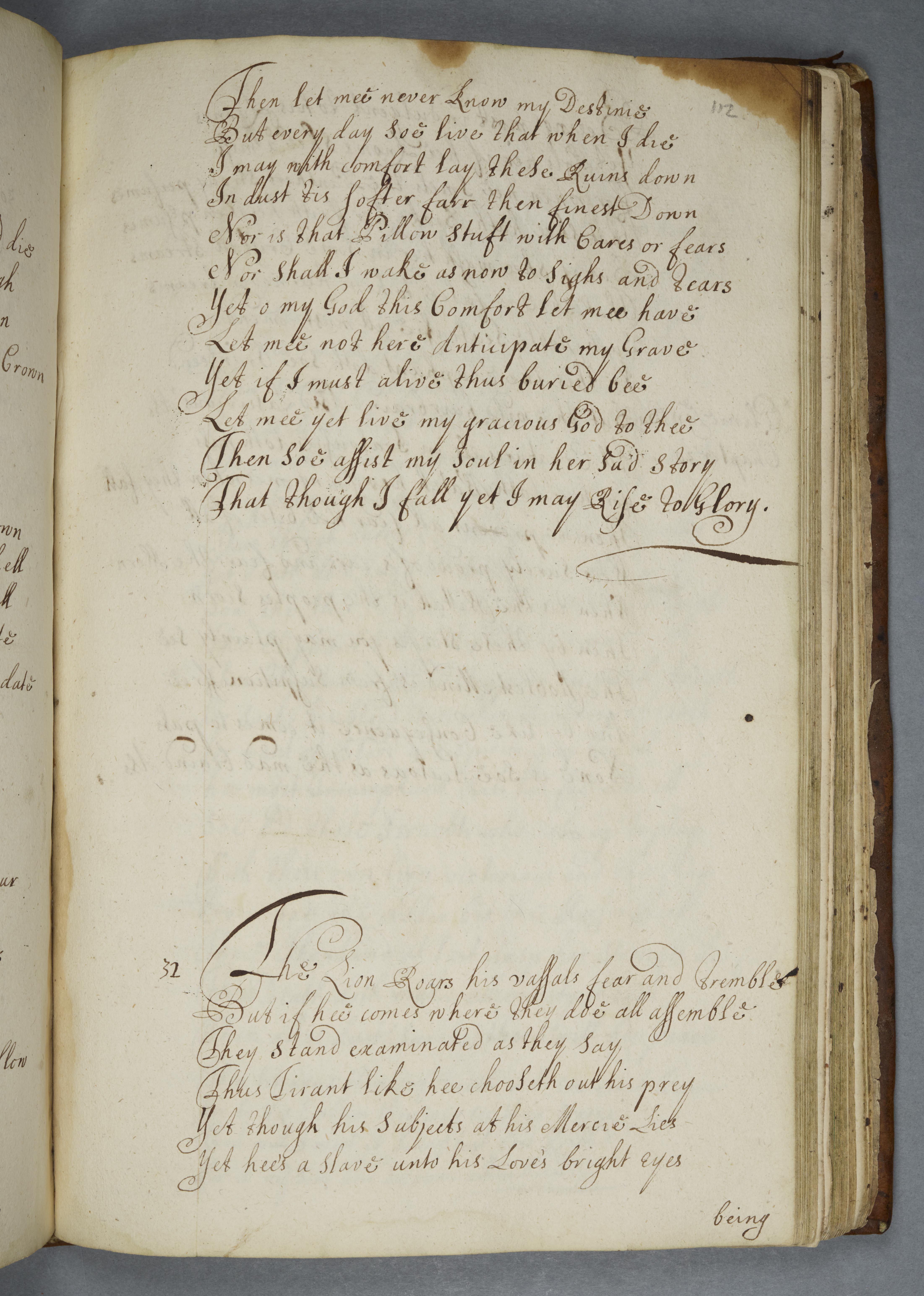
The Lion and the Ass (Emblem 32)

X (Close panel) Sources

The Lion and the Ass (Emblem 32)

Poem 97

Original Source

Hester Pulter, Poems breathed forth by the nobel Hadassas, University of Leeds Library, Brotherton Collection, MS Lt q 32

Versions

  • Facsimile of manuscript: Photographs provided by University of Leeds, Brotherton Collection

  • Transcription of manuscript: By Leah Knight and Wendy Wall.
  • Elemental edition: By Leah Knight and Wendy Wall.
  • Amplified edition: By Felicity Sheehy.

How to cite these versions

Conventions for these editions

The Pulter Project: Poet in the Making

  • Created by Leah Knight and Wendy Wall
  • Encoded by Katherine Poland, Matthew Taylor, Elizabeth Chou, and Emily Andrey, Northwestern University
  • Website designed by Sergei Kalugin, Northwestern University
  • IT project consultation by Josh Honn, Northwestern University
  • Project sponsored by Northwestern University, Brock University, and University of Leeds
X (Close panel)Poem Index
Loading…
X (Close panel)Notes: Transcription

 Editorial note

In these transcriptions we preserve as many details of the original material, textual, and graphic properties of Hester Pulter’s manuscript verse as we have found practical. Whenever possible, for instance, original spelling, punctuation, capitalization, lineation, insertions, deletions, alterations, spacing between words and lines, and indentation are all maintained; abbreviations and brevigraphs are not expanded; and superscript and subscript representations are retained. See full conventions for the transcriptions here.
Line number 1

 Physical note

poem begins near bottom of page on which previous poem ends
Line number 8

 Physical note

written in H2
Line number 15

 Physical note

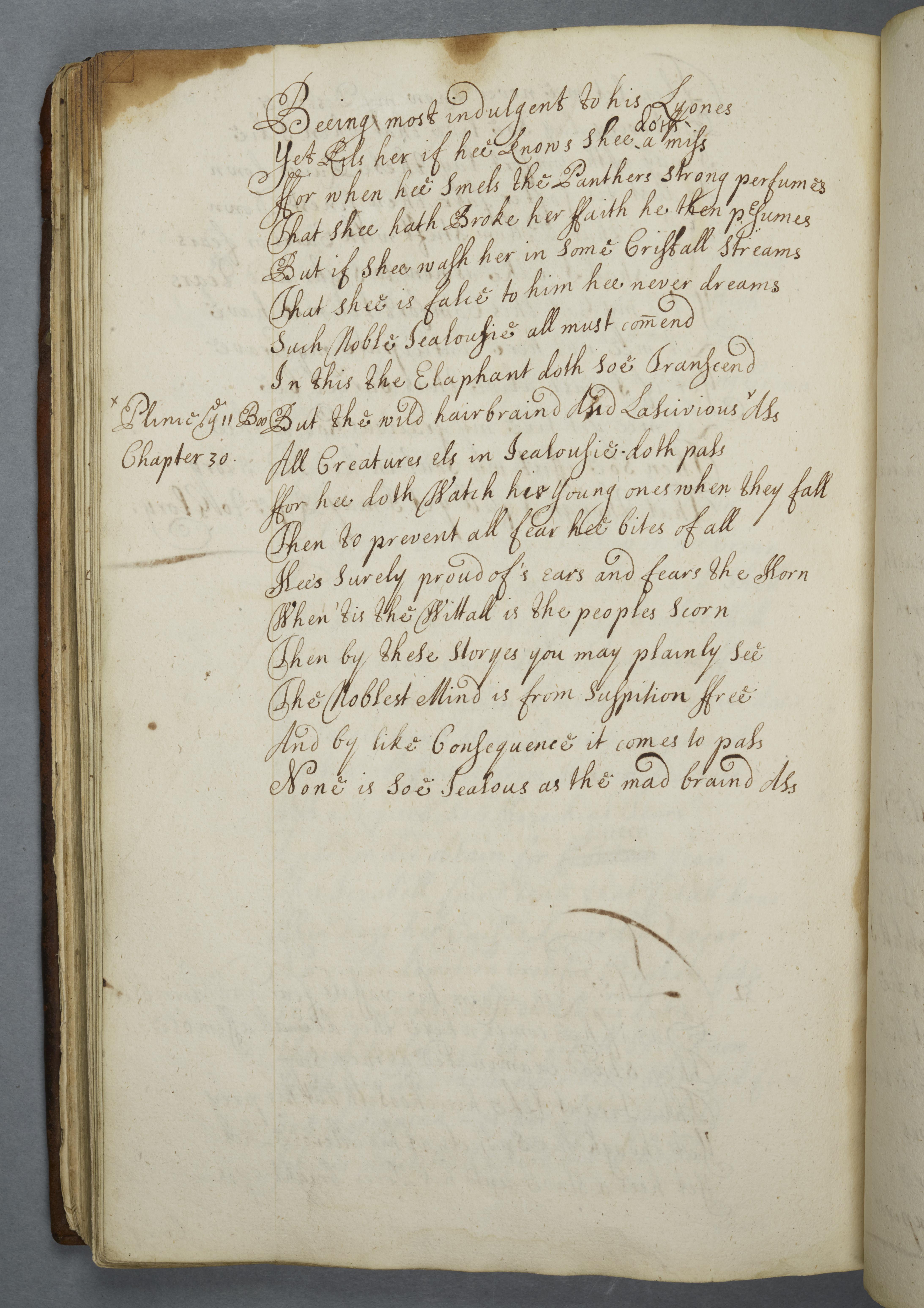
in left margin: “x Plinie ye 11 Boo / Chapter 30.”
Line number 15

 Physical note

“n” appears to correct partly and imperfectly erased letter, possibly “ſ”
Line number 17

 Physical note

“is” written over earlier “er”
Sorry, but there are no notes associated with any currently displayed witness.
X (Close panel)Transcription
Transcription

Facsimile Image Placeholder

Facsimile Image Placeholder

Facsimile Image Placeholder
[Emblem 32]
The Lion and the Ass
(Emblem 32)
The Lion and the Ass
In these transcriptions we preserve as many details of the original material, textual, and graphic properties of Hester Pulter’s manuscript verse as we have found practical. Whenever possible, for instance, original spelling, punctuation, capitalization, lineation, insertions, deletions, alterations, spacing between words and lines, and indentation are all maintained; abbreviations and brevigraphs are not expanded; and superscript and subscript representations are retained. See full conventions for the transcriptions here.

— Leah Knight and Wendy Wall
The aim of the elemental edition is to make the poems accessible to the largest variety of readers, which involves modernizing spelling and punctuation as well as adding basic glosses. Spelling and punctuation reflect current standard American usage; punctuation highlights syntax which might otherwise be obscure. Outmoded but still familiar word forms (“thou,” “‘tis,” “hold’st”) are not modernized, and we do not modernize grammar when the sense remains legible. After a brief headnote aimed at offering a “way in” to the poem’s unique qualities and connections with other verse by Pulter or her contemporaries, the edition features a minimum of notes and interpretative framing to allow more immediate engagement with the poem. Glosses clarify synonyms or showcase various possible meanings in Pulter’s time. Other notes identify named people and places or clarify obscure material. We rely (without citation) primarily on the Oxford English Dictionary (OED), the Oxford Reference database, and the King James Version (KJV) of the Bible. When we rely on Alice Eardley’s edition of Pulter’s work, we cite her text generally (“Eardley”); other sources are cited in full. The result is an edition we consider a springboard for further work on Pulter’s poetry. See full conventions for this edition here.

— Leah Knight and Wendy Wall
This is a semi-diplomatic transcription, with most original spelling, punctuation, and lineation retained. Exceptions include u/v and i/j, which have been silently modernized, and ff, which has been modernized as F. I have silently lowered superscript letters (‘presumes’ in line 10), italicized supplied letters (‘presumes’ in line 10 and ‘commend’ in line 13), and replaced fossil thorn with ‘th’ (‘the’ in note 15). Given the manuscript’s mixture of majuscule ‘S’, minuscule ‘s’, and the elongated version of minuscule ‘s’, I have written majuscule ‘S’ only at the beginning of words. I have marked the interlinear addition of ‘doth’ with a caret (^), and I have discussed the marginal writing in a note.
In comparison to the Elemental Edition, this Amplified Edition therefore allows for a more uncertain and unpredictable reading experience, in line with the poem’s own surprising twists and turns. In my notes, I have glossed unfamiliar words (directly drawing upon the Oxford English Dictionary, without citation) and provided cultural, historical, and literary context. Moreover, I have emphasized this poem’s connections to — and divergences from — other poems in the manuscript. Above all else, I have attempted to preserve the poem’s strangeness: the onward rush of its startling ‘Storyes’, which — whatever Pulter may claim — are not exactly ‘plainly See[n]’ (l. 21). Rather than offering a clear reading, my edition highlights moments of interpretive surprise, uncertainty, or friction.
All glosses have been sourced from The Oxford English Dictionary (2024) <<http://www.oed.com>>


— Leah Knight and Wendy Wall
Jealousy: good or bad? It can be “noble” or not, in Pulter’s terms. The noble kind avoids pre-emptive strikes, such as the dramatic approach of the male wild ass, who bites off the testicles of its male newborns to prevent them mating with their mother (so Pulter’s sources claimed). It is not hard to understand her castigation of this approach to preventing infidelity; more surprising is her apparent endorsement, by contrast, of the lion’s and the elephant’s policy of uxoricide: the killing of their unfaithful mates. What makes the difference? The ass, cynically, predicts the worst—the infidelity and incest of both spouse and offspring—while the lion (like the elephant) waits until he “knows she doth amiss” (emphasis added). The vice emblematized, therefore, is not jealousy, but “suspicion.” This poem joins The Elephant (Emblem 19) [Poem 84] and This Poor Turtledove (Emblem 20) [Poem 85] in their concern with marital fidelity, while sharpening the focus of the preceding emblem in the manuscript (Old Aeschylus (Emblem 31) [Poem 96]) in a preoccupation with avoiding undue apprehension and preconception. “Let me not here anticipate the grave,” the speaker pleads, there, with herself; here, more indirectly, a similar message is proffered to an unspecified “you.”

— Leah Knight and Wendy Wall
At the end of ‘The Lion and The Ass’, Hester Pulter claims to have demonstrated a clear moral. ‘By these Storyes’ of jealous animals, she writes, the reader ‘may plainly See / The Noblest Mind is from Suspition Free’ (ll. 21–22). Such clarity was expected of emblem poems, which ‘educat[ed] their readers by providing a clear moral […] to apply to their own lives’ (see Rachel Zhang’s Curation, Emblem Books as Parenting Guides). Yet this particular emblem does not quite follow the convention. Much like the rest of the manuscript, ‘The Lion and the Ass’ is a complex, even convoluted poem, which builds to a startling conclusion. Pulter does not simply condemn suspicion. Rather, she praises something that is not all that ‘plainly see[n]’: a kind of ‘Noble Jealousie’, which enables the marriage between an ‘indulgent’ cuckold and his cheating spouse (l. 21, l. 13, l. 7).
Part of what makes this poem challenging is its approach to romantic jealousy itself. Here as elsewhere in her manuscript, Pulter praises animals who kill their adulterous spouses. Take her claims about the elephant, who is a kind of ideal husband, an animal who ‘Transcend[s]’ all others in ‘Noble Jealousie’ (l. 14, l. 13). According to an earlier emblem in the manuscript, The Elephant [Poem 84], this creature is superior to the gallants of contemporary England, who let their wives ‘fool out their days / At balls and taverns, seeing wanton plays’ (ll. 38–39). Unlike these men, the elephant is both chaste and attentive, willing to kill his spouse if she cuckolds him: ‘For chastity this gallant creature’s crowned / … / Yet he’s so tender of his reputation / He kills his female if he doubts scortation’ (ll. 16–23). Likewise, in ‘The Lion and the Ass’, the lion is a ‘slave’ to his lioness until — and only until — he has certain knowledge of her infidelity (l. 6). Like a leonine Othello, he demands not ocular but olfactory proof; unlike Othello, he never suffers from agonizing doubt. He kills his lioness if he ‘Smels the Panthers Strong perfumes’; otherwise, ‘That Shee is false to him hee never dreams’ (l. 9, l. 12). The poem imagines a jealousy free from suspicion: an intense care and attentiveness without the concomitant fraught uncertainty.
Yet suspicion was central to the early modern understanding of jealousy. As Bradley Irish has documented, the two were at times rough ‘synonym[s]’ of one another, ‘suspicious’ an acceptable gloss for ‘jealous’.
Gloss Note
Bradley J. Irish, ‘Jealousy in Early Modern England’, Studies in Philology, 121 (2024), 432–463 (p. 437). As Irish writes, ‘the word jealous was sometimes employed in the broadest possible sense as a synonym for suspicious’. I am grateful to Irish for sharing material from his forthcoming book, which has since been published; see Bradley Irish, The Rivalrous Renaissance: Envy and Jealousy in Early Modern England (New York: Routledge, 2025).
1
According to some thinkers, jealousy could in fact be ‘defined’ as a kind of suspicion: a ‘griefe for suspition of dishonesty in married yoake-fellows, Husbands or wives’.
Gloss Note
Thomas Wilson, A Christian Dictionarie (London: Printed by W. Jaggard, 1612), p. 244. See also Irish, ‘Jealousy’, p. 436, which considers this quotation. For a further discussion of jealousy, see also Bradley Irish, Emotion in the Tudor Court: Literature, History, and Early Modern Feeling (Evanston, IL: Northwestern University Press, 2018).
2
For most men, Mark Breitenberg has argued, jealousy was thus indistinguishable from an anxiety-producing ‘interpretive crisis’.
Gloss Note
Mark Breitenberg, ‘Anxious Masculinity: Sexual Jealousy in Early Modern England’, Feminist Studies, 19 (1993), 377–398 (p. 379). See also Breitenberg’s book, which expands upon the article: Anxious Masculinity in Early Modern England (Cambridge: Cambridge University Press, 1996).
3
An entire industry of ‘Renaissance treatises on jealousy, marriage, and the proper conduct of wives’ arose to help these men ‘“read” correctly the signs of women’s sexual behavior’: a task that many believed was doomed from the start.
Gloss Note
Breitenberg, ‘Anxious Masculinity’, p. 384.
4
As the pamphlet Tell-Trothes New-years Gift (1593) puts it, ‘if she means to deceive thee, her invention is hard to be prevented, for, watch her ever so narrowly, she [will] finde a time to performe her knavery’.
Gloss Note
Tell-Trothes New-yeares Gift, ed. by Frederick J. Furnivall (London: N. Trubner & Co., 1876), p. 35. Breitenberg, ‘Anxious Masculinity’, p. 390, also discusses this quotation.
5
In other words, the ‘sexual behavior of women’ was ‘impossible’ to ‘interpret’ conclusively, making jealousy — and cuckoldry itself — inevitable.
Gloss Note
Breitenberg, ‘Anxious Masculinity’, p. 390.
6
The lion faces this very interpretive challenge. As Pulter makes clear, he is readily fooled by his lioness, who ‘wash[es] her[self]’ so effectively ‘in Some Cristall Streams / That Shee is false to him hee never dreams’ (l. 11–12). The rhyme, which also appears in Pulter’s poem The Invitation to the Country [Poem 2], is here, as there, a marker of disappointed idealism. Like the country house, whose ‘Enamelled vales and crystal streams / Prove’ to be nothing but ‘dreams’ (l. 91–92), so too is this lioness’s fidelity a mere ‘dream’, the false product of some ‘crystal stream’ (l. 12, l. 11). If the lion at first seems to be an involved and attentive spouse — much like the elephant — his awareness has its limits. His interpretive process is revealed to be fallible: he may smell the panther, but his lioness can easily wash off this scent. Whatever his ‘Noble Jealousie’, it seems, the lion is at last just another cuckold, tricked by his cunning spouse (l. 13).
Yet the poem does not condemn his cuckoldry. Pulter reserves her ire not for this lion, nor even for this lioness, but for the ‘Ass’: a creature ‘hairbraind’ with jealousy (l. 15). Unlike the lion, who is at times fooled by his wife, the ass attempts ‘to prevent’ any and all adultery (l. 18). As Pulter recounts, he even castrates his children at birth, worried that they may one day sleep with their mother. The comparison between these two animals — the lion and the ass — leads to a surprising conclusion: a cuckold can be preferable to a non-cuckold, if that non-cuckold is ruled by irrational jealousy. As Pulter makes clear, the ass is ‘wild’, ‘hairbraind’, and ‘mad braind’ at least in part because he ‘fears the Horn’ (l. 15, l. 24, l. 19). For Pulter, it seems, this fear of cuckoldry — and not cuckoldry itself — is the real problem.
In fact, Pulter later argues, what people actually ‘scorn’ is not cuckoldry but wittolry (l. 20). The wittol — a ‘man who is aware of and complaisant about the infidelity of his wife’, according to the Oxford English Dictionary — is a problematic figure in her poetry.
Gloss Note
Entry ‘wittol’, The Oxford English Dictionary (2024) <<http://www.oed.com>> [accessed 29 March 2024].
7
More than once, Pulter describes the wittol as especially repugnant: ‘below a beast’ (l. 45), according to ‘The Elephant’ (Poem 84), or ‘the peoples Scorn’ (l. 20), according to ‘The Lion and the Ass’. This distaste was not unusual. Though Jennifer Panek has documented a ‘dynamic continuum of wittols’, not all of whom were met ‘with automatic, unmitigated contempt’, many did believe wittols to be ‘even baser, less manly, and more contemptible than a regular cuckold’.
Gloss Note
Jennifer Panek, ‘“A Wittall cannot be a cookold”: Reading the Contented Cuckold in Early Modern English Drama and Culture’, JEMCS, 1 (2001), 66–92 (p. 67). Panek accounts for the full range of approaches to the early modern wittol, noting that not all commentators were as contemptuous as Pulter.
8
As Jean De Chassanion puts it, the wittol is ‘a monstrous kind of creatures, and degenerate not only from the law of humanity, but of nature also’.
Gloss Note
Jean De Chassanion, The Theatre of Gods Iudgements (London: Printed by Adam Islip, 1597), p. 344. Irish, ‘Jealousy’, p. 460, also discusses this quotation.
9
In this poem about a cuckolded lion, Pulter thus singles out two figures for special condemnation: the ass, who is ruled by fear of cuckoldry, and the wittol, who is complacent with cuckoldry. The poem’s only ‘regular cuckold’, by contrast, receives different treatment.
Gloss Note
Panek, p. 67.
10
The lion, though fooled by his lioness, enjoys something rather surprising: what is in some ways the poem’s best relationship. This is not to say that his marriage is perfect. As Pulter makes clear, the lion is ‘most indulgent’ (l. 7): a term which may be glossed as ‘too forbearing, weakly lenient’.
Gloss Note
Entry ‘indulgent’, The Oxford English Dictionary (2024) <<http://www.oed.com>> [accessed 30 July 2024]. On Pulter’s different approach to parental indulgence, see Elizabeth Zeman Kolkovich, ‘In Defense of Indulgence: Hester Pulter’s Maternal Elegies’, JEMCS, 20 (2020), 43–70.
11
In a world in which ‘an adulterous woman gravely threatened her husband’s allegedly natural authority’, the lion has failed to exercise adequate control over his spouse.
Gloss Note
Irish, ‘Jealousy’, p. 440. On the relationship between cuckoldry and the loss of domestic control, see Panek, p. 71.
12
Yet Pulter’s criticism of the lion, especially in comparison to her clear condemnation of the ass and the wittol, is relatively brief. His ‘Jealousie’ is still ‘Noble’, his ‘indulgent’ approach the best of three bad options (l. 13, l. 7).
Even more curious, this portrait of marriage is incongruous with Pulter’s other writing on the subject. Elsewhere, it seems, Pulter treats adultery as a symptom of wider societal disorder. Her emblems, ‘unusual in the degree to which they comment on immediate political and social events’, often attack young men, the ‘gallants’ of England, who have neglected both their social and political responsibilities (see also the ‘Headnote’ to ‘The Elephant’ (Poem 84)).
Gloss Note
Alice Eardley, ‘Introduction’, in Poems, Emblems, and The Unfortunate Florinda, ed. by Alice Eardley (Toronto: Centre for Reformation and Renaissance Studies Press, 2014), 1–38 (p. 28).
13
As she writes in ‘The Elephant’ (Poem 84), these ‘lords in noble breeding failed’ to be ‘valiant’, a ‘want which [made] us bleed / In our brave king’ (l. 30, l. 28, ll. 27–28). Now, these same ‘gallants of our age’ ‘neglect’ their wives ‘to drink, rant, throw the die’, while these women ‘to temptation […] open lie’ (l. 24, l. 36, l. 37). For Pulter, these marital and social problems mirror one another: ‘the new system of government’ is ‘an inversion of the established social hierarchy’, much like ‘the kind of disorderly, woman-on-top marriage that was conventionally assumed to produce cuckolds’.
Gloss Note
Eardley, pp. 28–29; Panek, p. 67.
14
In ‘The Lion and the Ass’, however, this correspondence between family and state is less pronounced. The lion is a creature of extremes: at once a ‘Tirant’ to his subjects and a ‘Slave’ to his wife (l. 4, l. 6). On the one hand, he is the uncontested ruler of his realm. Much of the poem emphasizes his authority: he is a ‘Tirant’, whose ‘vassals’ ‘all assemble’ to ‘Stand examinated’, ‘Subject’ to ‘his Mercie’ (l. 4, l. 1, l. 2, l. 3, l. 5). Notably, though Pulter claims to have ‘plainly’ shown that the lion is ‘from Suspition Free’, the lion is in fact not without suspicion: in the more expansive sense of the term, he is clearly jealous — that is, suspicious — of his people (l. 21, l. 22).
Gloss Note
See Irish, ‘Jealousy’, p. 437.
15
Yet he takes a different approach to his lioness. With her, this fierce ‘Tirant’ is passive, even ‘indulgent’: a ‘Slave’ to her affections (l. 4, l. 7, l. 6). In a book otherwise full of unappealing portraits of marriage — of men who ‘roam’ in ‘taverns’ or ‘tyrannize at home’ (ll. 15–16), of wives comparable to slaves (see The Marmottane [Poem 89] and This Poor Turtledove [Poem 85]) — Pulter lands upon a surprising portrait of a cuckold and his spouse. What Pulter depicts, that is, is a marriage in which a man, not a woman, is made into a slave. Pulter’s undeniable disapproval of adultery — as well as her disdain for the lion’s indulgence — exists alongside this curious reversal.


— Leah Knight and Wendy Wall
1
32
Physical Note
poem begins near bottom of page on which previous poem ends
The
Lion Roars his vaſſals fear and tremble
The lion roars; his
Gloss Note
subordinates, servants
vassals
fear and tremble.
Thee Lion Roars his
Gloss Note
servants or subordinates, inferiors comparable to feudal vassals
vassals
fear and tremble
2
But if hee comes where they doe all aſſemble
But if he comes where they do all assemble,
But if hee comes where they doe all assemble
3
They Stand examinated as they Say
They stand
Gloss Note
examined, as a witness at a trial, or a student tested for competence. Pulter uses this word to suggest the lion’s “institutional” power over the subjects who are at his mercy.
examinated
, as they say.
They
Gloss Note
examined, as in judged or appraised
Stand examinated
as they Say
4
Thus Tirant like hee chooſeth out his prey
Thus, tyrant-like, he chooseth out his prey;
Thus
Critical Note
Early modern writers often compared husbands to tyrants. As Pulter herself writes in The Marmottane [Poem 89], husbands are known to ‘Tirranise’ their wives ‘at home’ (l. 16). ‘The Lion and the Ass’ changes this pattern by describing the lion as a ‘Tirant’ to his subjects but a ‘Slave’ to his lioness.
Tirant like
hee chooseth out his prey
5
Yet though his Subjects at his Mercie Lies
Yet though his subjects at his mercy lies,
Yet though his
Gloss Note
dependents, subordinates, people of inferior status. Much like ‘vassals’, this word emphasizes the lion’s tyrannical rule over his inferiors.
Subjects
at his Mercie
Critical Note
The first five lines of the poem depict the lion as a kind of jealous tyrant: a figure recognizable to Pulter’s early modern audience. Kings were often said to be jealous (in the sense of suspicious) of their subjects, or even jealous (in the sense of vigilantly watchful) of their authority itself. According to John Warr, ‘Kings have been always jealous of the people’; according to J. Gailhard, ‘Princes are jealous of their Authority’ (John Warr, The Priviledges of the People (London: Printed by G. Dawson for Giles Calvert, 1649), p. 1; J. Gailhard, The Present State of the Princes and Republicks of Italy (London: Printed for John Starkey, 1671), p. 183). Even before Pulter establishes the lion as a jealous lover, that is, she establishes him as a jealous ruler. For a further discussion of these political manifestations of jealousy, see Bradley J. Irish, ‘Jealousy in Early Modern England’, Studies in Philology, 121 (2024), 432–63 (p. 438, p. 436). Irish also discusses these quotations.
Lies
6
Yet hee’s a Slave unto his Love’s bright eyes
Yet he’s a slave unto his love’s bright eyes,
Yet hee’s a
Gloss Note
As in This Poor Turtledove [Poem 85], Pulter compares love to a kind of slavery. In this poem, an oft-widowed bird is described as choosing to ‘be a slave’, despite ‘being freed so oft’ (l. 14).
Slave
unto his
Critical Note
As many have noted, early modern desire operated via a ‘specular economy’, in which vision and sight were paramount. For a discussion, see Mark Breitenberg, ‘Anxious Masculinity: Sexual Jealousy in Early Modern England’, Feminist Studies, 19 (1993), 377–98 (p. 385).
Love’s bright eyes
being

Facsimile Image Placeholder

Facsimile Image Placeholder

Facsimile Image Placeholder
7
Beeing most indulgent to his Lyones
Being most indulgent to his
Gloss Note
See Philemon Holland’s translation of Pliny for a parallel to the next few lines: “Lionesses are very lecherous, and this is the very cause that the lions are so fell and cruel. … The lion knoweth by sent and smell of the pard [panther, leopard] when the lioness his mare hath played false, … and presently with all his might and maine runneth upon her for to chastise and punish her. And therefore when the lioness hath done a fault that way, she either goeth to a river, and washeth away the strong and rank savor of the pard, or els keepeth aloof, and followeth the lion far off, that he may not catch the said smell.” The History of the World (London, 1634), p. 200.
lioness
;
Beeing most
Critical Note
not exercising (as parent or superior) due restraint, too forbearing, weakly lenient. Pulter appears to take a different approach to parental indulgence. In an elegy for her daughter, Elizabeth Kolkovich has argued, Pulter ‘defines […] indulgence as love and protection’, a kind of ‘selfless devotion to children that demonstrates godly behavior’. See Pulter, Upon the Death of my Dear and Lovely Daughter, Jane Pulter [Poem 10]; Elizabeth Kolkovich, ‘In Defense of Indulgence: Hester Pulter’s Maternal Elegies’, JEMCS, 20 (2020), 43–70 (pp. 53–54).
indulgent
to his
Critical Note
Pulter draws upon Philemon Holland’s translation of Pliny, which suggests that lionesses are especially lecherous. As Pliny writes, ‘These Lionesses are very lecherous, and this is the cause that the Lions are so fell and cruell. [In Africa] many strange-shaped beasts of a mixt and mungrell kind are there bred, whiles the males either perforce or for pleasure leap and cover the females of all sorts’. See C. Plinius Secundus, The History of the World (London: Printed by Adam Islip, 1634), p. 200.
Lyones
8
Yet Kils her if hee Knows Shee
Physical Note
written in H2
\do’th\
a miſs
Yet kills her if he knows she doth amiss.
Yet kils her if hee knows Shee
Gloss Note
The insertion of this word fills out the meter.
^doth
a miss
9
ffor when hee Smels the Panthers Strong perfumes
For when he smells
Gloss Note
“Perfumes” may refer to to any odors. See Philemon Holland’s translation of Pliny: “It is said, that all four-footed beasts are wonderfully delighted and enticed by the smell of panthers” The History of the World (London, 1634), p. 204.
the panther’s strong perfumes
,
For when hee Smels the
Critical Note
Pliny’s commentary on lions again appears to be Pulter’s source: ‘The Lion knoweth by scent and smell of the Pard, when the Lionesse his mate hath played false, and suffered her selfe to be covered by him; and presently with all his might and maine runneth upon her for to chastise and punish her. And therefore when the Lionesse hath done a fault that way, she either goeth to a river and washeth away the strong and ranke savor of the Pard, or else keepeth aloofe and followeth the Lion afar off, that he may not catch the said smell’. See C. Plinius Secundus, The History of the World (London: Printed by Adam Islip, 1634), p. 200.
Panthers Strong perfumes
10
That Shee hath Broke her ffaith he then peſumes
That she hath broke her faith he then presumes.
That Shee hath Broke her Faith he then presumes
11
But if Shee waſh her in Some Criſtall Streams
But if she wash her in some crystal streams,
But if Shee wash her in Some
Critical Note
The rhyme between ‘streams’ and ‘dreams’ can also be found in Pulter’s poem The Invitation to the Country [Poem 2]. As she writes there, ‘Enameled vales and crystal streams / Prove now, alas, poor Broadfield’s dreams’ (ll. 91–92). As before, the rhyme appears to signal a kind of disappointed idealism.
Cristall Streams
12
That Shee is falce to him hee never dreams
That she is false to him he never dreams.
That Shee is false to him hee never dreams
13
Such Noble Jealouſie all must comend
Such noble jealousy all must commend.
Such
Critical Note
Jealousy — particularly romantic jealousy — was a fraught emotion in early modern England. To some thinkers, it was indeed somewhat ‘Noble’: a marker of the intensity of one’s love. According to Jacques Ferrand, romantic love in fact could not exist without jealousy: ‘Love, if it have not a tincture of jealousy, is neither Active, nor Efficacious’ (Jacques Ferrand, Erotomania (London: Printed by L. Lichfield, 1640), p. 187). Antoine de Courtin likewise admits that many men — however erroneously — ‘presum[e] […] to render [their] Love very commendable when [they] expresses an exceeding Jealousie’, because jealousy ‘is the strongest Ardure that true Love is capable of’ (Antoine de Courtin, A treatise of jealousie, (London: Printed for W. Freeman, 1684), p. 2). Yet still others considered jealousy to be not the proof but ‘the poyson of Loue’. (Nicolas Coeffeteau, A Table of Humane Passions (London: Printed by Nicholas Okes, 1621), p. 174). Jealousy could turn a once happy marriage into a miserable imprisonment: it ‘doth make domesticall debate betwene man and Wyfe: and tourneth theyr house of libertie, into a miserable prysone’ (William Bullein, Bulletins Bulwarke (London: Printed by Thomas Marshe, 1579), p. 26). Given these effects, jealousy was often understood as a kind of illness or madness, even an ‘incurable wound’. According to Orlando Furioso, ‘it is a cruel wound which steeps the victim in the very abyss of suffering, and brings him to despair and death. O incurable wound, so easily opened in a lover’s heart […] So cruelly does it afflict a person, it clouds his reason and changes him beyond recognition’ (Ludovico Ariosto, Orlando Furioso, trans. by Guido Waldman (Oxford: Oxford University Press, 1974), Canto 31). For a full discussion of these different approaches to jealousy and romantic love, see Bradley J. Irish, ‘Jealousy in Early Modern England’, Studies in Philology, 121 (2024), 432–63 (pp. 438–443). Irish discusses Jacques Ferrand’s, Antoine de Courtin’s, Nicolas Coeffeteau’s, and William Bullein’s writing.
Noble Jealousie
all must commend
14
In this the Elaphant doth Soe Tranſcend
In this, the elephant doth
Gloss Note
equally, to the same extent; or, possibly, short for “also.” The sense is that the lion and elephant equally transcend other creatures in the nobility of their jealousy. See The Elephant (Emblem 19) [Poem 84]: “For chastity this gallant creature’s crowned; / … / Yet, he’s so tender of his reputation / He kills his female if he doubts [fears] scortation [adultery].”
so
transcend.
In this the
Critical Note
Pliny is especially effusive in his praise of the elephant. As he writes, ‘the elephant is the greatest, and commeth the nearest in Wit and capacitie to men […] They embrace goodnesse, honestie, prudence, and equalitie (rare qualities I may tell you to be found in men)’ (C. Plinius Secundus, The History of the World (London: Printed by Adam Islip, 1634), p. 192). Elephants were also widely considered to be jealous. As Robert Burton claims, ‘Elephants […] are more iealous than any other creatures whatsoeuer’ (Robert Burton, Anatomy of Melancholy (Oxford: Printed by Iohn Lichfield and Iames Short, 1621), p. 667). This line likewise recalls Pulter’s earlier emblem on the elephant, which praises his willingness to kill his cheating wife (The Elephant [Poem 84]). Like the lion, she writes here, the elephant ‘Transcend[s]’ other creatures in ‘Noble Jealousie’. On animal jealousy, and for another discussion of Burton’s quotation, see Bradley Irish, The Rivalrous Renaissance: Envy and Jealousy in Early Modern England (London: Routledge, 2025), p. 64.
Elaphant
doth Soe Transcend
15
Physical Note
in left margin: “x Plinie ye 11 Boo / Chapter 30.”
But
the wild hairbraind
Physical Note
“n” appears to correct partly and imperfectly erased letter, possibly “ſ”
And
Laſcivious xAſs
But the wild, hare-brained, and
Gloss Note
lustful or lewd donkey. A note in the margin refers readers to Chapter 30 of Pliny’s 11th book: a reference to an ancient compendium of natural history. For the meter, “lascivious” should take three syllables.
lascivious ass
Gloss Note
A marginal note to the left of this word reads ‘Plinie the 11Boo. Chapter 30’. Pliny actually discusses the ass in Book 8.
But
the wild hairbraind And Lascivious
Critical Note
Various versions of Aesop’s Fables, popular throughout the seventeenth century, pair the lion and the ass together, with the lion described as ‘the king of the Brutes’ and the ass as ‘the dullest of Mutes’. See Old Aesop at Whitehall Giving Advice to Young Aesops (London: J. Nutt, 1698), pp. 29–30.
Ass
16
All Creatures els in Jealouſie doth paſs
All creatures else in jealousy doth pass;
All
Critical Note
Such animal comparisons were not uncommon in early modern writing about jealousy. Many understood jealousy to be a natural emotion, which appeared across the animal kingdom, affecting ‘every bruit Beast as well as man’. In addition to lions, asses, and elephants, Pulter’s contemporaries considered swans, bulls, hens, and doves to be especially jealous. ‘Many sencelesse and bruit beasts’, writes Benedetto Varachi, ‘are […] Jealous, as is apparently seen in Buls, in Swannes, in Lyons, in Doves, in Hennes, and such like’. See Benedetto Varchi, Blazon of Iealousie (London: T.S. for Iohn Busbie, 1615), pp. 56–57. For more on animal jealousy, see Bradley Irish, The Rivalrous Renaissance: Envy and Jealousy in Early Modern England (London: Routledge, 2025), p. 64. Irish discusses this quotation from Varchi.
Creatures
els in Jealousie doth pass
17
ffor hee doth Watch
Physical Note
“is” written over earlier “er”
his
Young ones when they fall
For he doth watch his young ones
Gloss Note
when they are born
when they fall
;
For hee doth Watch his Young ones when they fall
18
Then to prevent all fear hee bites of all
Then,
Gloss Note
The father ass aims to avoid having his sons mate with their mother by castrating them at birth, with “all” referring here to testicles. See Philemon Holland’s translation of Pliny on wild asses (cited in the margin of this line to Chapter 30 of his eleventh book, in error for the eighth): “This beast is so jealous, that they look narrowly to the females great with young: for so soon as they have foaled, they bite off the cods [testicles] of the little ones that be males, and so geld [castrate] them.” The History of the World (London, 1634), p. 212.
to prevent all fear, he bites off all
.
Then to prevent all fear hee
Critical Note
The ass, in other words, castrates his children moments after birth. Pulter’s source, Pliny, describes the male donkey as uniquely jealous, though this jealousy is not entirely unfounded: female donkeys are apparently eager to commit incest. As Pliny writes, ‘This beast is so jealous, that they looke narrowly to the females great with young: for so soone as they have foled, they bite off the cods of the little ones that be males, and so gueld them. But contrariwise, the shee asses when they be big, seeke corners, and keepe out of their way, that they might bring forth their young secretly without the knowledge of the Stallons: for desirous they are to have many males: so lecherous they be, and glad evermore to be covered’ (C. Plinius Secundus, The History of the World (London: Printed by Adam Islip, 1634), p. 212). Other than Pliny, several commentators also describe the ass as unusually jealous. According to Robert Allott, ‘of all beasts, the wild Asse […] is the most jealous, for in an whole Herd of females, there is but one male, and he is so jealous, that he will not suffer any to come among him’ (Robert Allott, Wits Theater of the Little World (London: I.R. for N.L., 1599), p. 75). See also Bradley Irish, The Rivalrous Renaissance: Envy and Jealousy in Early Modern England (London: Routledge, 2025), p. 64. Irish discusses this quotation and other accounts of animal jealousy.
bites of all
19
Hee’s Surely proud of’s Ears and fears the Horn
He’s surely proud
Gloss Note
of his
of’s
ears, and fears
Gloss Note
a cuckold, an insulting term for the husband of an unfaithful wife was imagined to grow a horn or horns
the horn
,
Hee’s Surely proud of’s ears and
Critical Note
Cuckoldry was widely feared in early modern England. To many commentators, it was seemingly ‘inevitable’, a product of marriage itself. On this inevitability, see Jennifer Panek, ‘“A Wittall cannot be a cookold”: Reading the Contented Cuckold in Early Modern English Drama and Culture’, JEMCS, 1 (2001), 66–92 (p. 69). At the end of Much Ado About Nothing, Benedict advises Don Pedro to ‘Get thee a wife, get thee a wife! There is no staff more reverent than one tipped with a horn’ (William Shakespeare, Much Ado About Nothing, ed. by Barbara Mowat and Paul Werstine (New York: Simon and Schuster, 2018), 5.4.122–124). Likewise, the speaker of the ballad ‘Cuckold’s Haven’ (1630) is ‘oftentimes […] hornify’d’, no matter what he does: ‘Though narrowly I doe watch / and use Lock, Bolt, and Latch, / My wife will me o’rematch / my forehead I may scratch: / For though I wait both time and tide, / I oftentimes am hornify’d’ (The Roxburghe Ballads, ed. by W. Chappell (New York: AMS Press, 1966), p. 149). Panek also discusses these quotations.
fears the Horn
20
When ’tis the Wittal is the peoples Scorn
When ’tis the
Gloss Note
a husband who is aware of his wife’s infidelity and puts up with it
wittol
is the people’s scorn.
When ’tis
Critical Note
a man who is aware of and complaisant about the infidelity of his wife; a contented cuckold. The wittol was an especially problematic figure in early modern England. As Laura Gowing writes, ‘popular culture made cuckolds the butt of countless jokes, rituals, and songs: most humiliated of all was the “wittold”: the cuckold who condoned his wife’s adultery’ (Laura Gowing, Domestic Dangers: Women, Words, and Sex in Early Modern London (Oxford: Clarendon Press, 1996), p. 192). According to Nicholas Breton, the ‘Cuckolde is the scorne of marriage, but a Wittoll is a beast in nature’, his ‘shame’ even ‘greater’ (Nicholas Breton, Wits Priuate Wealth (London: Printed by Edw. Allde, for Iohn Tappe, 1612), D1v; Nicholas Breton, Crossing of Prouerbs (London: Printed [By G. Eld] for Iohn Wright, 1616), A7). At the same time, certain commentators found the wittol to be curiously admirable, as a man who was ‘from Suspition Free’ (l. 22). According to Francis Lenton, the wittol ‘lives a very contented life, and is not troubled with Jealousie (the torment of the mind)’ (Francis Lenton, A Piece of the World (London: Printed by John Raworth 1640), F12). The wittol speaker of ‘The Merry Cuckold’, a 1629 ballad, claims to be happy, though ‘daily [he] strives / against jealous assaults’ (The Merry Cuckold (London: Printed by the assignes of Thomas Symcock, 1629), p. 256). Pulter clearly did not share this favorable opinion of wittols. For a full discussion of the wittol, see Bradley J. Irish, ‘Jealousy in Early Modern England’, Studies in Philology, 121 (2024), 432–63 (pp. 459–463). Irish discusses Nicholas Breton’s and Francis Lenton’s writing, as well as ‘The Merry Cuckold’.
the Wittall
is the peoples Scorn
21
Then by theſe Storyes you may plainly See
Then by these stories you may plainly see
Then by these Storyes you may plainly See
22
The Noblest Mind is from Suſpition ffree
The noblest mind is from suspicion free;
The Noblest Mind is from
Critical Note
apprehension of guilt or fault on slight grounds or without clear evidence. In early modern England, suspicion and jealousy were close cousins. At times, Bradley Irish has noted, ‘the word jealous was […] in the broadest possible sense […] a synonym for suspicious’, given that ‘the emotion’s motivational context entails vigilance over a potential loss’. This meaning of jealousy often appeared in political contexts. Early modern kings were said to be jealous — that is, suspicious — of their constituents. See Bradley J. Irish, ‘Jealousy in Early Modern England’, Studies in Philology, 121 (2024), 432–63 (p. 437). Notably, Pulter has here described a figure who is in fact not ‘from Suspition Free’. If the lion is ‘indulgent’ to his spouse, he is clearly suspicious of his ‘Subjects’ (l. 7, l. 5).
Suspition
Free
23
And by like Conſequence it comes to paſs
And by like consequence it comes to pass
And by like Consequence it comes to pass
24
None is Soe Jealous as the mad braind Aſs
None is so jealous as the mad-brained ass.
None is Soe Jealous as thee mad braind Ass
X (Close panel)Notes: Elemental Edition

 Editorial note

The aim of the elemental edition is to make the poems accessible to the largest variety of readers, which involves modernizing spelling and punctuation as well as adding basic glosses. Spelling and punctuation reflect current standard American usage; punctuation highlights syntax which might otherwise be obscure. Outmoded but still familiar word forms (“thou,” “‘tis,” “hold’st”) are not modernized, and we do not modernize grammar when the sense remains legible. After a brief headnote aimed at offering a “way in” to the poem’s unique qualities and connections with other verse by Pulter or her contemporaries, the edition features a minimum of notes and interpretative framing to allow more immediate engagement with the poem. Glosses clarify synonyms or showcase various possible meanings in Pulter’s time. Other notes identify named people and places or clarify obscure material. We rely (without citation) primarily on the Oxford English Dictionary (OED), the Oxford Reference database, and the King James Version (KJV) of the Bible. When we rely on Alice Eardley’s edition of Pulter’s work, we cite her text generally (“Eardley”); other sources are cited in full. The result is an edition we consider a springboard for further work on Pulter’s poetry. See full conventions for this edition here.

 Headnote

Jealousy: good or bad? It can be “noble” or not, in Pulter’s terms. The noble kind avoids pre-emptive strikes, such as the dramatic approach of the male wild ass, who bites off the testicles of its male newborns to prevent them mating with their mother (so Pulter’s sources claimed). It is not hard to understand her castigation of this approach to preventing infidelity; more surprising is her apparent endorsement, by contrast, of the lion’s and the elephant’s policy of uxoricide: the killing of their unfaithful mates. What makes the difference? The ass, cynically, predicts the worst—the infidelity and incest of both spouse and offspring—while the lion (like the elephant) waits until he “knows she doth amiss” (emphasis added). The vice emblematized, therefore, is not jealousy, but “suspicion.” This poem joins The Elephant (Emblem 19) [Poem 84] and This Poor Turtledove (Emblem 20) [Poem 85] in their concern with marital fidelity, while sharpening the focus of the preceding emblem in the manuscript (Old Aeschylus (Emblem 31) [Poem 96]) in a preoccupation with avoiding undue apprehension and preconception. “Let me not here anticipate the grave,” the speaker pleads, there, with herself; here, more indirectly, a similar message is proffered to an unspecified “you.”
Line number 1

 Gloss note

subordinates, servants
Line number 3

 Gloss note

examined, as a witness at a trial, or a student tested for competence. Pulter uses this word to suggest the lion’s “institutional” power over the subjects who are at his mercy.
Line number 7

 Gloss note

See Philemon Holland’s translation of Pliny for a parallel to the next few lines: “Lionesses are very lecherous, and this is the very cause that the lions are so fell and cruel. … The lion knoweth by sent and smell of the pard [panther, leopard] when the lioness his mare hath played false, … and presently with all his might and maine runneth upon her for to chastise and punish her. And therefore when the lioness hath done a fault that way, she either goeth to a river, and washeth away the strong and rank savor of the pard, or els keepeth aloof, and followeth the lion far off, that he may not catch the said smell.” The History of the World (London, 1634), p. 200.
Line number 9

 Gloss note

“Perfumes” may refer to to any odors. See Philemon Holland’s translation of Pliny: “It is said, that all four-footed beasts are wonderfully delighted and enticed by the smell of panthers” The History of the World (London, 1634), p. 204.
Line number 14

 Gloss note

equally, to the same extent; or, possibly, short for “also.” The sense is that the lion and elephant equally transcend other creatures in the nobility of their jealousy. See The Elephant (Emblem 19) [Poem 84]: “For chastity this gallant creature’s crowned; / … / Yet, he’s so tender of his reputation / He kills his female if he doubts [fears] scortation [adultery].”
Line number 15

 Gloss note

lustful or lewd donkey. A note in the margin refers readers to Chapter 30 of Pliny’s 11th book: a reference to an ancient compendium of natural history. For the meter, “lascivious” should take three syllables.
Line number 17

 Gloss note

when they are born
Line number 18

 Gloss note

The father ass aims to avoid having his sons mate with their mother by castrating them at birth, with “all” referring here to testicles. See Philemon Holland’s translation of Pliny on wild asses (cited in the margin of this line to Chapter 30 of his eleventh book, in error for the eighth): “This beast is so jealous, that they look narrowly to the females great with young: for so soon as they have foaled, they bite off the cods [testicles] of the little ones that be males, and so geld [castrate] them.” The History of the World (London, 1634), p. 212.
Line number 19

 Gloss note

of his
Line number 19

 Gloss note

a cuckold, an insulting term for the husband of an unfaithful wife was imagined to grow a horn or horns
Line number 20

 Gloss note

a husband who is aware of his wife’s infidelity and puts up with it
Sorry, but there are no notes associated with any currently displayed witness.
X (Close panel)Elemental Edition
Elemental Edition

Facsimile Image Placeholder

Facsimile Image Placeholder

Facsimile Image Placeholder
[Emblem 32]
The Lion and the Ass
(Emblem 32)
The Lion and the Ass
In these transcriptions we preserve as many details of the original material, textual, and graphic properties of Hester Pulter’s manuscript verse as we have found practical. Whenever possible, for instance, original spelling, punctuation, capitalization, lineation, insertions, deletions, alterations, spacing between words and lines, and indentation are all maintained; abbreviations and brevigraphs are not expanded; and superscript and subscript representations are retained. See full conventions for the transcriptions here.

— Leah Knight and Wendy Wall
The aim of the elemental edition is to make the poems accessible to the largest variety of readers, which involves modernizing spelling and punctuation as well as adding basic glosses. Spelling and punctuation reflect current standard American usage; punctuation highlights syntax which might otherwise be obscure. Outmoded but still familiar word forms (“thou,” “‘tis,” “hold’st”) are not modernized, and we do not modernize grammar when the sense remains legible. After a brief headnote aimed at offering a “way in” to the poem’s unique qualities and connections with other verse by Pulter or her contemporaries, the edition features a minimum of notes and interpretative framing to allow more immediate engagement with the poem. Glosses clarify synonyms or showcase various possible meanings in Pulter’s time. Other notes identify named people and places or clarify obscure material. We rely (without citation) primarily on the Oxford English Dictionary (OED), the Oxford Reference database, and the King James Version (KJV) of the Bible. When we rely on Alice Eardley’s edition of Pulter’s work, we cite her text generally (“Eardley”); other sources are cited in full. The result is an edition we consider a springboard for further work on Pulter’s poetry. See full conventions for this edition here.

— Leah Knight and Wendy Wall
This is a semi-diplomatic transcription, with most original spelling, punctuation, and lineation retained. Exceptions include u/v and i/j, which have been silently modernized, and ff, which has been modernized as F. I have silently lowered superscript letters (‘presumes’ in line 10), italicized supplied letters (‘presumes’ in line 10 and ‘commend’ in line 13), and replaced fossil thorn with ‘th’ (‘the’ in note 15). Given the manuscript’s mixture of majuscule ‘S’, minuscule ‘s’, and the elongated version of minuscule ‘s’, I have written majuscule ‘S’ only at the beginning of words. I have marked the interlinear addition of ‘doth’ with a caret (^), and I have discussed the marginal writing in a note.
In comparison to the Elemental Edition, this Amplified Edition therefore allows for a more uncertain and unpredictable reading experience, in line with the poem’s own surprising twists and turns. In my notes, I have glossed unfamiliar words (directly drawing upon the Oxford English Dictionary, without citation) and provided cultural, historical, and literary context. Moreover, I have emphasized this poem’s connections to — and divergences from — other poems in the manuscript. Above all else, I have attempted to preserve the poem’s strangeness: the onward rush of its startling ‘Storyes’, which — whatever Pulter may claim — are not exactly ‘plainly See[n]’ (l. 21). Rather than offering a clear reading, my edition highlights moments of interpretive surprise, uncertainty, or friction.
All glosses have been sourced from The Oxford English Dictionary (2024) <<http://www.oed.com>>


— Leah Knight and Wendy Wall
Jealousy: good or bad? It can be “noble” or not, in Pulter’s terms. The noble kind avoids pre-emptive strikes, such as the dramatic approach of the male wild ass, who bites off the testicles of its male newborns to prevent them mating with their mother (so Pulter’s sources claimed). It is not hard to understand her castigation of this approach to preventing infidelity; more surprising is her apparent endorsement, by contrast, of the lion’s and the elephant’s policy of uxoricide: the killing of their unfaithful mates. What makes the difference? The ass, cynically, predicts the worst—the infidelity and incest of both spouse and offspring—while the lion (like the elephant) waits until he “knows she doth amiss” (emphasis added). The vice emblematized, therefore, is not jealousy, but “suspicion.” This poem joins The Elephant (Emblem 19) [Poem 84] and This Poor Turtledove (Emblem 20) [Poem 85] in their concern with marital fidelity, while sharpening the focus of the preceding emblem in the manuscript (Old Aeschylus (Emblem 31) [Poem 96]) in a preoccupation with avoiding undue apprehension and preconception. “Let me not here anticipate the grave,” the speaker pleads, there, with herself; here, more indirectly, a similar message is proffered to an unspecified “you.”

— Leah Knight and Wendy Wall
At the end of ‘The Lion and The Ass’, Hester Pulter claims to have demonstrated a clear moral. ‘By these Storyes’ of jealous animals, she writes, the reader ‘may plainly See / The Noblest Mind is from Suspition Free’ (ll. 21–22). Such clarity was expected of emblem poems, which ‘educat[ed] their readers by providing a clear moral […] to apply to their own lives’ (see Rachel Zhang’s Curation, Emblem Books as Parenting Guides). Yet this particular emblem does not quite follow the convention. Much like the rest of the manuscript, ‘The Lion and the Ass’ is a complex, even convoluted poem, which builds to a startling conclusion. Pulter does not simply condemn suspicion. Rather, she praises something that is not all that ‘plainly see[n]’: a kind of ‘Noble Jealousie’, which enables the marriage between an ‘indulgent’ cuckold and his cheating spouse (l. 21, l. 13, l. 7).
Part of what makes this poem challenging is its approach to romantic jealousy itself. Here as elsewhere in her manuscript, Pulter praises animals who kill their adulterous spouses. Take her claims about the elephant, who is a kind of ideal husband, an animal who ‘Transcend[s]’ all others in ‘Noble Jealousie’ (l. 14, l. 13). According to an earlier emblem in the manuscript, The Elephant [Poem 84], this creature is superior to the gallants of contemporary England, who let their wives ‘fool out their days / At balls and taverns, seeing wanton plays’ (ll. 38–39). Unlike these men, the elephant is both chaste and attentive, willing to kill his spouse if she cuckolds him: ‘For chastity this gallant creature’s crowned / … / Yet he’s so tender of his reputation / He kills his female if he doubts scortation’ (ll. 16–23). Likewise, in ‘The Lion and the Ass’, the lion is a ‘slave’ to his lioness until — and only until — he has certain knowledge of her infidelity (l. 6). Like a leonine Othello, he demands not ocular but olfactory proof; unlike Othello, he never suffers from agonizing doubt. He kills his lioness if he ‘Smels the Panthers Strong perfumes’; otherwise, ‘That Shee is false to him hee never dreams’ (l. 9, l. 12). The poem imagines a jealousy free from suspicion: an intense care and attentiveness without the concomitant fraught uncertainty.
Yet suspicion was central to the early modern understanding of jealousy. As Bradley Irish has documented, the two were at times rough ‘synonym[s]’ of one another, ‘suspicious’ an acceptable gloss for ‘jealous’.
Gloss Note
Bradley J. Irish, ‘Jealousy in Early Modern England’, Studies in Philology, 121 (2024), 432–463 (p. 437). As Irish writes, ‘the word jealous was sometimes employed in the broadest possible sense as a synonym for suspicious’. I am grateful to Irish for sharing material from his forthcoming book, which has since been published; see Bradley Irish, The Rivalrous Renaissance: Envy and Jealousy in Early Modern England (New York: Routledge, 2025).
1
According to some thinkers, jealousy could in fact be ‘defined’ as a kind of suspicion: a ‘griefe for suspition of dishonesty in married yoake-fellows, Husbands or wives’.
Gloss Note
Thomas Wilson, A Christian Dictionarie (London: Printed by W. Jaggard, 1612), p. 244. See also Irish, ‘Jealousy’, p. 436, which considers this quotation. For a further discussion of jealousy, see also Bradley Irish, Emotion in the Tudor Court: Literature, History, and Early Modern Feeling (Evanston, IL: Northwestern University Press, 2018).
2
For most men, Mark Breitenberg has argued, jealousy was thus indistinguishable from an anxiety-producing ‘interpretive crisis’.
Gloss Note
Mark Breitenberg, ‘Anxious Masculinity: Sexual Jealousy in Early Modern England’, Feminist Studies, 19 (1993), 377–398 (p. 379). See also Breitenberg’s book, which expands upon the article: Anxious Masculinity in Early Modern England (Cambridge: Cambridge University Press, 1996).
3
An entire industry of ‘Renaissance treatises on jealousy, marriage, and the proper conduct of wives’ arose to help these men ‘“read” correctly the signs of women’s sexual behavior’: a task that many believed was doomed from the start.
Gloss Note
Breitenberg, ‘Anxious Masculinity’, p. 384.
4
As the pamphlet Tell-Trothes New-years Gift (1593) puts it, ‘if she means to deceive thee, her invention is hard to be prevented, for, watch her ever so narrowly, she [will] finde a time to performe her knavery’.
Gloss Note
Tell-Trothes New-yeares Gift, ed. by Frederick J. Furnivall (London: N. Trubner & Co., 1876), p. 35. Breitenberg, ‘Anxious Masculinity’, p. 390, also discusses this quotation.
5
In other words, the ‘sexual behavior of women’ was ‘impossible’ to ‘interpret’ conclusively, making jealousy — and cuckoldry itself — inevitable.
Gloss Note
Breitenberg, ‘Anxious Masculinity’, p. 390.
6
The lion faces this very interpretive challenge. As Pulter makes clear, he is readily fooled by his lioness, who ‘wash[es] her[self]’ so effectively ‘in Some Cristall Streams / That Shee is false to him hee never dreams’ (l. 11–12). The rhyme, which also appears in Pulter’s poem The Invitation to the Country [Poem 2], is here, as there, a marker of disappointed idealism. Like the country house, whose ‘Enamelled vales and crystal streams / Prove’ to be nothing but ‘dreams’ (l. 91–92), so too is this lioness’s fidelity a mere ‘dream’, the false product of some ‘crystal stream’ (l. 12, l. 11). If the lion at first seems to be an involved and attentive spouse — much like the elephant — his awareness has its limits. His interpretive process is revealed to be fallible: he may smell the panther, but his lioness can easily wash off this scent. Whatever his ‘Noble Jealousie’, it seems, the lion is at last just another cuckold, tricked by his cunning spouse (l. 13).
Yet the poem does not condemn his cuckoldry. Pulter reserves her ire not for this lion, nor even for this lioness, but for the ‘Ass’: a creature ‘hairbraind’ with jealousy (l. 15). Unlike the lion, who is at times fooled by his wife, the ass attempts ‘to prevent’ any and all adultery (l. 18). As Pulter recounts, he even castrates his children at birth, worried that they may one day sleep with their mother. The comparison between these two animals — the lion and the ass — leads to a surprising conclusion: a cuckold can be preferable to a non-cuckold, if that non-cuckold is ruled by irrational jealousy. As Pulter makes clear, the ass is ‘wild’, ‘hairbraind’, and ‘mad braind’ at least in part because he ‘fears the Horn’ (l. 15, l. 24, l. 19). For Pulter, it seems, this fear of cuckoldry — and not cuckoldry itself — is the real problem.
In fact, Pulter later argues, what people actually ‘scorn’ is not cuckoldry but wittolry (l. 20). The wittol — a ‘man who is aware of and complaisant about the infidelity of his wife’, according to the Oxford English Dictionary — is a problematic figure in her poetry.
Gloss Note
Entry ‘wittol’, The Oxford English Dictionary (2024) <<http://www.oed.com>> [accessed 29 March 2024].
7
More than once, Pulter describes the wittol as especially repugnant: ‘below a beast’ (l. 45), according to ‘The Elephant’ (Poem 84), or ‘the peoples Scorn’ (l. 20), according to ‘The Lion and the Ass’. This distaste was not unusual. Though Jennifer Panek has documented a ‘dynamic continuum of wittols’, not all of whom were met ‘with automatic, unmitigated contempt’, many did believe wittols to be ‘even baser, less manly, and more contemptible than a regular cuckold’.
Gloss Note
Jennifer Panek, ‘“A Wittall cannot be a cookold”: Reading the Contented Cuckold in Early Modern English Drama and Culture’, JEMCS, 1 (2001), 66–92 (p. 67). Panek accounts for the full range of approaches to the early modern wittol, noting that not all commentators were as contemptuous as Pulter.
8
As Jean De Chassanion puts it, the wittol is ‘a monstrous kind of creatures, and degenerate not only from the law of humanity, but of nature also’.
Gloss Note
Jean De Chassanion, The Theatre of Gods Iudgements (London: Printed by Adam Islip, 1597), p. 344. Irish, ‘Jealousy’, p. 460, also discusses this quotation.
9
In this poem about a cuckolded lion, Pulter thus singles out two figures for special condemnation: the ass, who is ruled by fear of cuckoldry, and the wittol, who is complacent with cuckoldry. The poem’s only ‘regular cuckold’, by contrast, receives different treatment.
Gloss Note
Panek, p. 67.
10
The lion, though fooled by his lioness, enjoys something rather surprising: what is in some ways the poem’s best relationship. This is not to say that his marriage is perfect. As Pulter makes clear, the lion is ‘most indulgent’ (l. 7): a term which may be glossed as ‘too forbearing, weakly lenient’.
Gloss Note
Entry ‘indulgent’, The Oxford English Dictionary (2024) <<http://www.oed.com>> [accessed 30 July 2024]. On Pulter’s different approach to parental indulgence, see Elizabeth Zeman Kolkovich, ‘In Defense of Indulgence: Hester Pulter’s Maternal Elegies’, JEMCS, 20 (2020), 43–70.
11
In a world in which ‘an adulterous woman gravely threatened her husband’s allegedly natural authority’, the lion has failed to exercise adequate control over his spouse.
Gloss Note
Irish, ‘Jealousy’, p. 440. On the relationship between cuckoldry and the loss of domestic control, see Panek, p. 71.
12
Yet Pulter’s criticism of the lion, especially in comparison to her clear condemnation of the ass and the wittol, is relatively brief. His ‘Jealousie’ is still ‘Noble’, his ‘indulgent’ approach the best of three bad options (l. 13, l. 7).
Even more curious, this portrait of marriage is incongruous with Pulter’s other writing on the subject. Elsewhere, it seems, Pulter treats adultery as a symptom of wider societal disorder. Her emblems, ‘unusual in the degree to which they comment on immediate political and social events’, often attack young men, the ‘gallants’ of England, who have neglected both their social and political responsibilities (see also the ‘Headnote’ to ‘The Elephant’ (Poem 84)).
Gloss Note
Alice Eardley, ‘Introduction’, in Poems, Emblems, and The Unfortunate Florinda, ed. by Alice Eardley (Toronto: Centre for Reformation and Renaissance Studies Press, 2014), 1–38 (p. 28).
13
As she writes in ‘The Elephant’ (Poem 84), these ‘lords in noble breeding failed’ to be ‘valiant’, a ‘want which [made] us bleed / In our brave king’ (l. 30, l. 28, ll. 27–28). Now, these same ‘gallants of our age’ ‘neglect’ their wives ‘to drink, rant, throw the die’, while these women ‘to temptation […] open lie’ (l. 24, l. 36, l. 37). For Pulter, these marital and social problems mirror one another: ‘the new system of government’ is ‘an inversion of the established social hierarchy’, much like ‘the kind of disorderly, woman-on-top marriage that was conventionally assumed to produce cuckolds’.
Gloss Note
Eardley, pp. 28–29; Panek, p. 67.
14
In ‘The Lion and the Ass’, however, this correspondence between family and state is less pronounced. The lion is a creature of extremes: at once a ‘Tirant’ to his subjects and a ‘Slave’ to his wife (l. 4, l. 6). On the one hand, he is the uncontested ruler of his realm. Much of the poem emphasizes his authority: he is a ‘Tirant’, whose ‘vassals’ ‘all assemble’ to ‘Stand examinated’, ‘Subject’ to ‘his Mercie’ (l. 4, l. 1, l. 2, l. 3, l. 5). Notably, though Pulter claims to have ‘plainly’ shown that the lion is ‘from Suspition Free’, the lion is in fact not without suspicion: in the more expansive sense of the term, he is clearly jealous — that is, suspicious — of his people (l. 21, l. 22).
Gloss Note
See Irish, ‘Jealousy’, p. 437.
15
Yet he takes a different approach to his lioness. With her, this fierce ‘Tirant’ is passive, even ‘indulgent’: a ‘Slave’ to her affections (l. 4, l. 7, l. 6). In a book otherwise full of unappealing portraits of marriage — of men who ‘roam’ in ‘taverns’ or ‘tyrannize at home’ (ll. 15–16), of wives comparable to slaves (see The Marmottane [Poem 89] and This Poor Turtledove [Poem 85]) — Pulter lands upon a surprising portrait of a cuckold and his spouse. What Pulter depicts, that is, is a marriage in which a man, not a woman, is made into a slave. Pulter’s undeniable disapproval of adultery — as well as her disdain for the lion’s indulgence — exists alongside this curious reversal.


— Leah Knight and Wendy Wall
1
32
Physical Note
poem begins near bottom of page on which previous poem ends
The
Lion Roars his vaſſals fear and tremble
The lion roars; his
Gloss Note
subordinates, servants
vassals
fear and tremble.
Thee Lion Roars his
Gloss Note
servants or subordinates, inferiors comparable to feudal vassals
vassals
fear and tremble
2
But if hee comes where they doe all aſſemble
But if he comes where they do all assemble,
But if hee comes where they doe all assemble
3
They Stand examinated as they Say
They stand
Gloss Note
examined, as a witness at a trial, or a student tested for competence. Pulter uses this word to suggest the lion’s “institutional” power over the subjects who are at his mercy.
examinated
, as they say.
They
Gloss Note
examined, as in judged or appraised
Stand examinated
as they Say
4
Thus Tirant like hee chooſeth out his prey
Thus, tyrant-like, he chooseth out his prey;
Thus
Critical Note
Early modern writers often compared husbands to tyrants. As Pulter herself writes in The Marmottane [Poem 89], husbands are known to ‘Tirranise’ their wives ‘at home’ (l. 16). ‘The Lion and the Ass’ changes this pattern by describing the lion as a ‘Tirant’ to his subjects but a ‘Slave’ to his lioness.
Tirant like
hee chooseth out his prey
5
Yet though his Subjects at his Mercie Lies
Yet though his subjects at his mercy lies,
Yet though his
Gloss Note
dependents, subordinates, people of inferior status. Much like ‘vassals’, this word emphasizes the lion’s tyrannical rule over his inferiors.
Subjects
at his Mercie
Critical Note
The first five lines of the poem depict the lion as a kind of jealous tyrant: a figure recognizable to Pulter’s early modern audience. Kings were often said to be jealous (in the sense of suspicious) of their subjects, or even jealous (in the sense of vigilantly watchful) of their authority itself. According to John Warr, ‘Kings have been always jealous of the people’; according to J. Gailhard, ‘Princes are jealous of their Authority’ (John Warr, The Priviledges of the People (London: Printed by G. Dawson for Giles Calvert, 1649), p. 1; J. Gailhard, The Present State of the Princes and Republicks of Italy (London: Printed for John Starkey, 1671), p. 183). Even before Pulter establishes the lion as a jealous lover, that is, she establishes him as a jealous ruler. For a further discussion of these political manifestations of jealousy, see Bradley J. Irish, ‘Jealousy in Early Modern England’, Studies in Philology, 121 (2024), 432–63 (p. 438, p. 436). Irish also discusses these quotations.
Lies
6
Yet hee’s a Slave unto his Love’s bright eyes
Yet he’s a slave unto his love’s bright eyes,
Yet hee’s a
Gloss Note
As in This Poor Turtledove [Poem 85], Pulter compares love to a kind of slavery. In this poem, an oft-widowed bird is described as choosing to ‘be a slave’, despite ‘being freed so oft’ (l. 14).
Slave
unto his
Critical Note
As many have noted, early modern desire operated via a ‘specular economy’, in which vision and sight were paramount. For a discussion, see Mark Breitenberg, ‘Anxious Masculinity: Sexual Jealousy in Early Modern England’, Feminist Studies, 19 (1993), 377–98 (p. 385).
Love’s bright eyes
being

Facsimile Image Placeholder

Facsimile Image Placeholder

Facsimile Image Placeholder
7
Beeing most indulgent to his Lyones
Being most indulgent to his
Gloss Note
See Philemon Holland’s translation of Pliny for a parallel to the next few lines: “Lionesses are very lecherous, and this is the very cause that the lions are so fell and cruel. … The lion knoweth by sent and smell of the pard [panther, leopard] when the lioness his mare hath played false, … and presently with all his might and maine runneth upon her for to chastise and punish her. And therefore when the lioness hath done a fault that way, she either goeth to a river, and washeth away the strong and rank savor of the pard, or els keepeth aloof, and followeth the lion far off, that he may not catch the said smell.” The History of the World (London, 1634), p. 200.
lioness
;
Beeing most
Critical Note
not exercising (as parent or superior) due restraint, too forbearing, weakly lenient. Pulter appears to take a different approach to parental indulgence. In an elegy for her daughter, Elizabeth Kolkovich has argued, Pulter ‘defines […] indulgence as love and protection’, a kind of ‘selfless devotion to children that demonstrates godly behavior’. See Pulter, Upon the Death of my Dear and Lovely Daughter, Jane Pulter [Poem 10]; Elizabeth Kolkovich, ‘In Defense of Indulgence: Hester Pulter’s Maternal Elegies’, JEMCS, 20 (2020), 43–70 (pp. 53–54).
indulgent
to his
Critical Note
Pulter draws upon Philemon Holland’s translation of Pliny, which suggests that lionesses are especially lecherous. As Pliny writes, ‘These Lionesses are very lecherous, and this is the cause that the Lions are so fell and cruell. [In Africa] many strange-shaped beasts of a mixt and mungrell kind are there bred, whiles the males either perforce or for pleasure leap and cover the females of all sorts’. See C. Plinius Secundus, The History of the World (London: Printed by Adam Islip, 1634), p. 200.
Lyones
8
Yet Kils her if hee Knows Shee
Physical Note
written in H2
\do’th\
a miſs
Yet kills her if he knows she doth amiss.
Yet kils her if hee knows Shee
Gloss Note
The insertion of this word fills out the meter.
^doth
a miss
9
ffor when hee Smels the Panthers Strong perfumes
For when he smells
Gloss Note
“Perfumes” may refer to to any odors. See Philemon Holland’s translation of Pliny: “It is said, that all four-footed beasts are wonderfully delighted and enticed by the smell of panthers” The History of the World (London, 1634), p. 204.
the panther’s strong perfumes
,
For when hee Smels the
Critical Note
Pliny’s commentary on lions again appears to be Pulter’s source: ‘The Lion knoweth by scent and smell of the Pard, when the Lionesse his mate hath played false, and suffered her selfe to be covered by him; and presently with all his might and maine runneth upon her for to chastise and punish her. And therefore when the Lionesse hath done a fault that way, she either goeth to a river and washeth away the strong and ranke savor of the Pard, or else keepeth aloofe and followeth the Lion afar off, that he may not catch the said smell’. See C. Plinius Secundus, The History of the World (London: Printed by Adam Islip, 1634), p. 200.
Panthers Strong perfumes
10
That Shee hath Broke her ffaith he then peſumes
That she hath broke her faith he then presumes.
That Shee hath Broke her Faith he then presumes
11
But if Shee waſh her in Some Criſtall Streams
But if she wash her in some crystal streams,
But if Shee wash her in Some
Critical Note
The rhyme between ‘streams’ and ‘dreams’ can also be found in Pulter’s poem The Invitation to the Country [Poem 2]. As she writes there, ‘Enameled vales and crystal streams / Prove now, alas, poor Broadfield’s dreams’ (ll. 91–92). As before, the rhyme appears to signal a kind of disappointed idealism.
Cristall Streams
12
That Shee is falce to him hee never dreams
That she is false to him he never dreams.
That Shee is false to him hee never dreams
13
Such Noble Jealouſie all must comend
Such noble jealousy all must commend.
Such
Critical Note
Jealousy — particularly romantic jealousy — was a fraught emotion in early modern England. To some thinkers, it was indeed somewhat ‘Noble’: a marker of the intensity of one’s love. According to Jacques Ferrand, romantic love in fact could not exist without jealousy: ‘Love, if it have not a tincture of jealousy, is neither Active, nor Efficacious’ (Jacques Ferrand, Erotomania (London: Printed by L. Lichfield, 1640), p. 187). Antoine de Courtin likewise admits that many men — however erroneously — ‘presum[e] […] to render [their] Love very commendable when [they] expresses an exceeding Jealousie’, because jealousy ‘is the strongest Ardure that true Love is capable of’ (Antoine de Courtin, A treatise of jealousie, (London: Printed for W. Freeman, 1684), p. 2). Yet still others considered jealousy to be not the proof but ‘the poyson of Loue’. (Nicolas Coeffeteau, A Table of Humane Passions (London: Printed by Nicholas Okes, 1621), p. 174). Jealousy could turn a once happy marriage into a miserable imprisonment: it ‘doth make domesticall debate betwene man and Wyfe: and tourneth theyr house of libertie, into a miserable prysone’ (William Bullein, Bulletins Bulwarke (London: Printed by Thomas Marshe, 1579), p. 26). Given these effects, jealousy was often understood as a kind of illness or madness, even an ‘incurable wound’. According to Orlando Furioso, ‘it is a cruel wound which steeps the victim in the very abyss of suffering, and brings him to despair and death. O incurable wound, so easily opened in a lover’s heart […] So cruelly does it afflict a person, it clouds his reason and changes him beyond recognition’ (Ludovico Ariosto, Orlando Furioso, trans. by Guido Waldman (Oxford: Oxford University Press, 1974), Canto 31). For a full discussion of these different approaches to jealousy and romantic love, see Bradley J. Irish, ‘Jealousy in Early Modern England’, Studies in Philology, 121 (2024), 432–63 (pp. 438–443). Irish discusses Jacques Ferrand’s, Antoine de Courtin’s, Nicolas Coeffeteau’s, and William Bullein’s writing.
Noble Jealousie
all must commend
14
In this the Elaphant doth Soe Tranſcend
In this, the elephant doth
Gloss Note
equally, to the same extent; or, possibly, short for “also.” The sense is that the lion and elephant equally transcend other creatures in the nobility of their jealousy. See The Elephant (Emblem 19) [Poem 84]: “For chastity this gallant creature’s crowned; / … / Yet, he’s so tender of his reputation / He kills his female if he doubts [fears] scortation [adultery].”
so
transcend.
In this the
Critical Note
Pliny is especially effusive in his praise of the elephant. As he writes, ‘the elephant is the greatest, and commeth the nearest in Wit and capacitie to men […] They embrace goodnesse, honestie, prudence, and equalitie (rare qualities I may tell you to be found in men)’ (C. Plinius Secundus, The History of the World (London: Printed by Adam Islip, 1634), p. 192). Elephants were also widely considered to be jealous. As Robert Burton claims, ‘Elephants […] are more iealous than any other creatures whatsoeuer’ (Robert Burton, Anatomy of Melancholy (Oxford: Printed by Iohn Lichfield and Iames Short, 1621), p. 667). This line likewise recalls Pulter’s earlier emblem on the elephant, which praises his willingness to kill his cheating wife (The Elephant [Poem 84]). Like the lion, she writes here, the elephant ‘Transcend[s]’ other creatures in ‘Noble Jealousie’. On animal jealousy, and for another discussion of Burton’s quotation, see Bradley Irish, The Rivalrous Renaissance: Envy and Jealousy in Early Modern England (London: Routledge, 2025), p. 64.
Elaphant
doth Soe Transcend
15
Physical Note
in left margin: “x Plinie ye 11 Boo / Chapter 30.”
But
the wild hairbraind
Physical Note
“n” appears to correct partly and imperfectly erased letter, possibly “ſ”
And
Laſcivious xAſs
But the wild, hare-brained, and
Gloss Note
lustful or lewd donkey. A note in the margin refers readers to Chapter 30 of Pliny’s 11th book: a reference to an ancient compendium of natural history. For the meter, “lascivious” should take three syllables.
lascivious ass
Gloss Note
A marginal note to the left of this word reads ‘Plinie the 11Boo. Chapter 30’. Pliny actually discusses the ass in Book 8.
But
the wild hairbraind And Lascivious
Critical Note
Various versions of Aesop’s Fables, popular throughout the seventeenth century, pair the lion and the ass together, with the lion described as ‘the king of the Brutes’ and the ass as ‘the dullest of Mutes’. See Old Aesop at Whitehall Giving Advice to Young Aesops (London: J. Nutt, 1698), pp. 29–30.
Ass
16
All Creatures els in Jealouſie doth paſs
All creatures else in jealousy doth pass;
All
Critical Note
Such animal comparisons were not uncommon in early modern writing about jealousy. Many understood jealousy to be a natural emotion, which appeared across the animal kingdom, affecting ‘every bruit Beast as well as man’. In addition to lions, asses, and elephants, Pulter’s contemporaries considered swans, bulls, hens, and doves to be especially jealous. ‘Many sencelesse and bruit beasts’, writes Benedetto Varachi, ‘are […] Jealous, as is apparently seen in Buls, in Swannes, in Lyons, in Doves, in Hennes, and such like’. See Benedetto Varchi, Blazon of Iealousie (London: T.S. for Iohn Busbie, 1615), pp. 56–57. For more on animal jealousy, see Bradley Irish, The Rivalrous Renaissance: Envy and Jealousy in Early Modern England (London: Routledge, 2025), p. 64. Irish discusses this quotation from Varchi.
Creatures
els in Jealousie doth pass
17
ffor hee doth Watch
Physical Note
“is” written over earlier “er”
his
Young ones when they fall
For he doth watch his young ones
Gloss Note
when they are born
when they fall
;
For hee doth Watch his Young ones when they fall
18
Then to prevent all fear hee bites of all
Then,
Gloss Note
The father ass aims to avoid having his sons mate with their mother by castrating them at birth, with “all” referring here to testicles. See Philemon Holland’s translation of Pliny on wild asses (cited in the margin of this line to Chapter 30 of his eleventh book, in error for the eighth): “This beast is so jealous, that they look narrowly to the females great with young: for so soon as they have foaled, they bite off the cods [testicles] of the little ones that be males, and so geld [castrate] them.” The History of the World (London, 1634), p. 212.
to prevent all fear, he bites off all
.
Then to prevent all fear hee
Critical Note
The ass, in other words, castrates his children moments after birth. Pulter’s source, Pliny, describes the male donkey as uniquely jealous, though this jealousy is not entirely unfounded: female donkeys are apparently eager to commit incest. As Pliny writes, ‘This beast is so jealous, that they looke narrowly to the females great with young: for so soone as they have foled, they bite off the cods of the little ones that be males, and so gueld them. But contrariwise, the shee asses when they be big, seeke corners, and keepe out of their way, that they might bring forth their young secretly without the knowledge of the Stallons: for desirous they are to have many males: so lecherous they be, and glad evermore to be covered’ (C. Plinius Secundus, The History of the World (London: Printed by Adam Islip, 1634), p. 212). Other than Pliny, several commentators also describe the ass as unusually jealous. According to Robert Allott, ‘of all beasts, the wild Asse […] is the most jealous, for in an whole Herd of females, there is but one male, and he is so jealous, that he will not suffer any to come among him’ (Robert Allott, Wits Theater of the Little World (London: I.R. for N.L., 1599), p. 75). See also Bradley Irish, The Rivalrous Renaissance: Envy and Jealousy in Early Modern England (London: Routledge, 2025), p. 64. Irish discusses this quotation and other accounts of animal jealousy.
bites of all
19
Hee’s Surely proud of’s Ears and fears the Horn
He’s surely proud
Gloss Note
of his
of’s
ears, and fears
Gloss Note
a cuckold, an insulting term for the husband of an unfaithful wife was imagined to grow a horn or horns
the horn
,
Hee’s Surely proud of’s ears and
Critical Note
Cuckoldry was widely feared in early modern England. To many commentators, it was seemingly ‘inevitable’, a product of marriage itself. On this inevitability, see Jennifer Panek, ‘“A Wittall cannot be a cookold”: Reading the Contented Cuckold in Early Modern English Drama and Culture’, JEMCS, 1 (2001), 66–92 (p. 69). At the end of Much Ado About Nothing, Benedict advises Don Pedro to ‘Get thee a wife, get thee a wife! There is no staff more reverent than one tipped with a horn’ (William Shakespeare, Much Ado About Nothing, ed. by Barbara Mowat and Paul Werstine (New York: Simon and Schuster, 2018), 5.4.122–124). Likewise, the speaker of the ballad ‘Cuckold’s Haven’ (1630) is ‘oftentimes […] hornify’d’, no matter what he does: ‘Though narrowly I doe watch / and use Lock, Bolt, and Latch, / My wife will me o’rematch / my forehead I may scratch: / For though I wait both time and tide, / I oftentimes am hornify’d’ (The Roxburghe Ballads, ed. by W. Chappell (New York: AMS Press, 1966), p. 149). Panek also discusses these quotations.
fears the Horn
20
When ’tis the Wittal is the peoples Scorn
When ’tis the
Gloss Note
a husband who is aware of his wife’s infidelity and puts up with it
wittol
is the people’s scorn.
When ’tis
Critical Note
a man who is aware of and complaisant about the infidelity of his wife; a contented cuckold. The wittol was an especially problematic figure in early modern England. As Laura Gowing writes, ‘popular culture made cuckolds the butt of countless jokes, rituals, and songs: most humiliated of all was the “wittold”: the cuckold who condoned his wife’s adultery’ (Laura Gowing, Domestic Dangers: Women, Words, and Sex in Early Modern London (Oxford: Clarendon Press, 1996), p. 192). According to Nicholas Breton, the ‘Cuckolde is the scorne of marriage, but a Wittoll is a beast in nature’, his ‘shame’ even ‘greater’ (Nicholas Breton, Wits Priuate Wealth (London: Printed by Edw. Allde, for Iohn Tappe, 1612), D1v; Nicholas Breton, Crossing of Prouerbs (London: Printed [By G. Eld] for Iohn Wright, 1616), A7). At the same time, certain commentators found the wittol to be curiously admirable, as a man who was ‘from Suspition Free’ (l. 22). According to Francis Lenton, the wittol ‘lives a very contented life, and is not troubled with Jealousie (the torment of the mind)’ (Francis Lenton, A Piece of the World (London: Printed by John Raworth 1640), F12). The wittol speaker of ‘The Merry Cuckold’, a 1629 ballad, claims to be happy, though ‘daily [he] strives / against jealous assaults’ (The Merry Cuckold (London: Printed by the assignes of Thomas Symcock, 1629), p. 256). Pulter clearly did not share this favorable opinion of wittols. For a full discussion of the wittol, see Bradley J. Irish, ‘Jealousy in Early Modern England’, Studies in Philology, 121 (2024), 432–63 (pp. 459–463). Irish discusses Nicholas Breton’s and Francis Lenton’s writing, as well as ‘The Merry Cuckold’.
the Wittall
is the peoples Scorn
21
Then by theſe Storyes you may plainly See
Then by these stories you may plainly see
Then by these Storyes you may plainly See
22
The Noblest Mind is from Suſpition ffree
The noblest mind is from suspicion free;
The Noblest Mind is from
Critical Note
apprehension of guilt or fault on slight grounds or without clear evidence. In early modern England, suspicion and jealousy were close cousins. At times, Bradley Irish has noted, ‘the word jealous was […] in the broadest possible sense […] a synonym for suspicious’, given that ‘the emotion’s motivational context entails vigilance over a potential loss’. This meaning of jealousy often appeared in political contexts. Early modern kings were said to be jealous — that is, suspicious — of their constituents. See Bradley J. Irish, ‘Jealousy in Early Modern England’, Studies in Philology, 121 (2024), 432–63 (p. 437). Notably, Pulter has here described a figure who is in fact not ‘from Suspition Free’. If the lion is ‘indulgent’ to his spouse, he is clearly suspicious of his ‘Subjects’ (l. 7, l. 5).
Suspition
Free
23
And by like Conſequence it comes to paſs
And by like consequence it comes to pass
And by like Consequence it comes to pass
24
None is Soe Jealous as the mad braind Aſs
None is so jealous as the mad-brained ass.
None is Soe Jealous as thee mad braind Ass
X (Close panel)Notes: Amplified Edition

 Editorial note

This is a semi-diplomatic transcription, with most original spelling, punctuation, and lineation retained. Exceptions include u/v and i/j, which have been silently modernized, and ff, which has been modernized as F. I have silently lowered superscript letters (‘presumes’ in line 10), italicized supplied letters (‘presumes’ in line 10 and ‘commend’ in line 13), and replaced fossil thorn with ‘th’ (‘the’ in note 15). Given the manuscript’s mixture of majuscule ‘S’, minuscule ‘s’, and the elongated version of minuscule ‘s’, I have written majuscule ‘S’ only at the beginning of words. I have marked the interlinear addition of ‘doth’ with a caret (^), and I have discussed the marginal writing in a note.
In comparison to the Elemental Edition, this Amplified Edition therefore allows for a more uncertain and unpredictable reading experience, in line with the poem’s own surprising twists and turns. In my notes, I have glossed unfamiliar words (directly drawing upon the Oxford English Dictionary, without citation) and provided cultural, historical, and literary context. Moreover, I have emphasized this poem’s connections to — and divergences from — other poems in the manuscript. Above all else, I have attempted to preserve the poem’s strangeness: the onward rush of its startling ‘Storyes’, which — whatever Pulter may claim — are not exactly ‘plainly See[n]’ (l. 21). Rather than offering a clear reading, my edition highlights moments of interpretive surprise, uncertainty, or friction.
All glosses have been sourced from The Oxford English Dictionary (2024) <<http://www.oed.com>>

 Headnote

At the end of ‘The Lion and The Ass’, Hester Pulter claims to have demonstrated a clear moral. ‘By these Storyes’ of jealous animals, she writes, the reader ‘may plainly See / The Noblest Mind is from Suspition Free’ (ll. 21–22). Such clarity was expected of emblem poems, which ‘educat[ed] their readers by providing a clear moral […] to apply to their own lives’ (see Rachel Zhang’s Curation, Emblem Books as Parenting Guides). Yet this particular emblem does not quite follow the convention. Much like the rest of the manuscript, ‘The Lion and the Ass’ is a complex, even convoluted poem, which builds to a startling conclusion. Pulter does not simply condemn suspicion. Rather, she praises something that is not all that ‘plainly see[n]’: a kind of ‘Noble Jealousie’, which enables the marriage between an ‘indulgent’ cuckold and his cheating spouse (l. 21, l. 13, l. 7).
Part of what makes this poem challenging is its approach to romantic jealousy itself. Here as elsewhere in her manuscript, Pulter praises animals who kill their adulterous spouses. Take her claims about the elephant, who is a kind of ideal husband, an animal who ‘Transcend[s]’ all others in ‘Noble Jealousie’ (l. 14, l. 13). According to an earlier emblem in the manuscript, The Elephant [Poem 84], this creature is superior to the gallants of contemporary England, who let their wives ‘fool out their days / At balls and taverns, seeing wanton plays’ (ll. 38–39). Unlike these men, the elephant is both chaste and attentive, willing to kill his spouse if she cuckolds him: ‘For chastity this gallant creature’s crowned / … / Yet he’s so tender of his reputation / He kills his female if he doubts scortation’ (ll. 16–23). Likewise, in ‘The Lion and the Ass’, the lion is a ‘slave’ to his lioness until — and only until — he has certain knowledge of her infidelity (l. 6). Like a leonine Othello, he demands not ocular but olfactory proof; unlike Othello, he never suffers from agonizing doubt. He kills his lioness if he ‘Smels the Panthers Strong perfumes’; otherwise, ‘That Shee is false to him hee never dreams’ (l. 9, l. 12). The poem imagines a jealousy free from suspicion: an intense care and attentiveness without the concomitant fraught uncertainty.
Yet suspicion was central to the early modern understanding of jealousy. As Bradley Irish has documented, the two were at times rough ‘synonym[s]’ of one another, ‘suspicious’ an acceptable gloss for ‘jealous’.
Gloss Note
Bradley J. Irish, ‘Jealousy in Early Modern England’, Studies in Philology, 121 (2024), 432–463 (p. 437). As Irish writes, ‘the word jealous was sometimes employed in the broadest possible sense as a synonym for suspicious’. I am grateful to Irish for sharing material from his forthcoming book, which has since been published; see Bradley Irish, The Rivalrous Renaissance: Envy and Jealousy in Early Modern England (New York: Routledge, 2025).
1
According to some thinkers, jealousy could in fact be ‘defined’ as a kind of suspicion: a ‘griefe for suspition of dishonesty in married yoake-fellows, Husbands or wives’.
Gloss Note
Thomas Wilson, A Christian Dictionarie (London: Printed by W. Jaggard, 1612), p. 244. See also Irish, ‘Jealousy’, p. 436, which considers this quotation. For a further discussion of jealousy, see also Bradley Irish, Emotion in the Tudor Court: Literature, History, and Early Modern Feeling (Evanston, IL: Northwestern University Press, 2018).
2
For most men, Mark Breitenberg has argued, jealousy was thus indistinguishable from an anxiety-producing ‘interpretive crisis’.
Gloss Note
Mark Breitenberg, ‘Anxious Masculinity: Sexual Jealousy in Early Modern England’, Feminist Studies, 19 (1993), 377–398 (p. 379). See also Breitenberg’s book, which expands upon the article: Anxious Masculinity in Early Modern England (Cambridge: Cambridge University Press, 1996).
3
An entire industry of ‘Renaissance treatises on jealousy, marriage, and the proper conduct of wives’ arose to help these men ‘“read” correctly the signs of women’s sexual behavior’: a task that many believed was doomed from the start.
Gloss Note
Breitenberg, ‘Anxious Masculinity’, p. 384.
4
As the pamphlet Tell-Trothes New-years Gift (1593) puts it, ‘if she means to deceive thee, her invention is hard to be prevented, for, watch her ever so narrowly, she [will] finde a time to performe her knavery’.
Gloss Note
Tell-Trothes New-yeares Gift, ed. by Frederick J. Furnivall (London: N. Trubner & Co., 1876), p. 35. Breitenberg, ‘Anxious Masculinity’, p. 390, also discusses this quotation.
5
In other words, the ‘sexual behavior of women’ was ‘impossible’ to ‘interpret’ conclusively, making jealousy — and cuckoldry itself — inevitable.
Gloss Note
Breitenberg, ‘Anxious Masculinity’, p. 390.
6
The lion faces this very interpretive challenge. As Pulter makes clear, he is readily fooled by his lioness, who ‘wash[es] her[self]’ so effectively ‘in Some Cristall Streams / That Shee is false to him hee never dreams’ (l. 11–12). The rhyme, which also appears in Pulter’s poem The Invitation to the Country [Poem 2], is here, as there, a marker of disappointed idealism. Like the country house, whose ‘Enamelled vales and crystal streams / Prove’ to be nothing but ‘dreams’ (l. 91–92), so too is this lioness’s fidelity a mere ‘dream’, the false product of some ‘crystal stream’ (l. 12, l. 11). If the lion at first seems to be an involved and attentive spouse — much like the elephant — his awareness has its limits. His interpretive process is revealed to be fallible: he may smell the panther, but his lioness can easily wash off this scent. Whatever his ‘Noble Jealousie’, it seems, the lion is at last just another cuckold, tricked by his cunning spouse (l. 13).
Yet the poem does not condemn his cuckoldry. Pulter reserves her ire not for this lion, nor even for this lioness, but for the ‘Ass’: a creature ‘hairbraind’ with jealousy (l. 15). Unlike the lion, who is at times fooled by his wife, the ass attempts ‘to prevent’ any and all adultery (l. 18). As Pulter recounts, he even castrates his children at birth, worried that they may one day sleep with their mother. The comparison between these two animals — the lion and the ass — leads to a surprising conclusion: a cuckold can be preferable to a non-cuckold, if that non-cuckold is ruled by irrational jealousy. As Pulter makes clear, the ass is ‘wild’, ‘hairbraind’, and ‘mad braind’ at least in part because he ‘fears the Horn’ (l. 15, l. 24, l. 19). For Pulter, it seems, this fear of cuckoldry — and not cuckoldry itself — is the real problem.
In fact, Pulter later argues, what people actually ‘scorn’ is not cuckoldry but wittolry (l. 20). The wittol — a ‘man who is aware of and complaisant about the infidelity of his wife’, according to the Oxford English Dictionary — is a problematic figure in her poetry.
Gloss Note
Entry ‘wittol’, The Oxford English Dictionary (2024) <<http://www.oed.com>> [accessed 29 March 2024].
7
More than once, Pulter describes the wittol as especially repugnant: ‘below a beast’ (l. 45), according to ‘The Elephant’ (Poem 84), or ‘the peoples Scorn’ (l. 20), according to ‘The Lion and the Ass’. This distaste was not unusual. Though Jennifer Panek has documented a ‘dynamic continuum of wittols’, not all of whom were met ‘with automatic, unmitigated contempt’, many did believe wittols to be ‘even baser, less manly, and more contemptible than a regular cuckold’.
Gloss Note
Jennifer Panek, ‘“A Wittall cannot be a cookold”: Reading the Contented Cuckold in Early Modern English Drama and Culture’, JEMCS, 1 (2001), 66–92 (p. 67). Panek accounts for the full range of approaches to the early modern wittol, noting that not all commentators were as contemptuous as Pulter.
8
As Jean De Chassanion puts it, the wittol is ‘a monstrous kind of creatures, and degenerate not only from the law of humanity, but of nature also’.
Gloss Note
Jean De Chassanion, The Theatre of Gods Iudgements (London: Printed by Adam Islip, 1597), p. 344. Irish, ‘Jealousy’, p. 460, also discusses this quotation.
9
In this poem about a cuckolded lion, Pulter thus singles out two figures for special condemnation: the ass, who is ruled by fear of cuckoldry, and the wittol, who is complacent with cuckoldry. The poem’s only ‘regular cuckold’, by contrast, receives different treatment.
Gloss Note
Panek, p. 67.
10
The lion, though fooled by his lioness, enjoys something rather surprising: what is in some ways the poem’s best relationship. This is not to say that his marriage is perfect. As Pulter makes clear, the lion is ‘most indulgent’ (l. 7): a term which may be glossed as ‘too forbearing, weakly lenient’.
Gloss Note
Entry ‘indulgent’, The Oxford English Dictionary (2024) <<http://www.oed.com>> [accessed 30 July 2024]. On Pulter’s different approach to parental indulgence, see Elizabeth Zeman Kolkovich, ‘In Defense of Indulgence: Hester Pulter’s Maternal Elegies’, JEMCS, 20 (2020), 43–70.
11
In a world in which ‘an adulterous woman gravely threatened her husband’s allegedly natural authority’, the lion has failed to exercise adequate control over his spouse.
Gloss Note
Irish, ‘Jealousy’, p. 440. On the relationship between cuckoldry and the loss of domestic control, see Panek, p. 71.
12
Yet Pulter’s criticism of the lion, especially in comparison to her clear condemnation of the ass and the wittol, is relatively brief. His ‘Jealousie’ is still ‘Noble’, his ‘indulgent’ approach the best of three bad options (l. 13, l. 7).
Even more curious, this portrait of marriage is incongruous with Pulter’s other writing on the subject. Elsewhere, it seems, Pulter treats adultery as a symptom of wider societal disorder. Her emblems, ‘unusual in the degree to which they comment on immediate political and social events’, often attack young men, the ‘gallants’ of England, who have neglected both their social and political responsibilities (see also the ‘Headnote’ to ‘The Elephant’ (Poem 84)).
Gloss Note
Alice Eardley, ‘Introduction’, in Poems, Emblems, and The Unfortunate Florinda, ed. by Alice Eardley (Toronto: Centre for Reformation and Renaissance Studies Press, 2014), 1–38 (p. 28).
13
As she writes in ‘The Elephant’ (Poem 84), these ‘lords in noble breeding failed’ to be ‘valiant’, a ‘want which [made] us bleed / In our brave king’ (l. 30, l. 28, ll. 27–28). Now, these same ‘gallants of our age’ ‘neglect’ their wives ‘to drink, rant, throw the die’, while these women ‘to temptation […] open lie’ (l. 24, l. 36, l. 37). For Pulter, these marital and social problems mirror one another: ‘the new system of government’ is ‘an inversion of the established social hierarchy’, much like ‘the kind of disorderly, woman-on-top marriage that was conventionally assumed to produce cuckolds’.
Gloss Note
Eardley, pp. 28–29; Panek, p. 67.
14
In ‘The Lion and the Ass’, however, this correspondence between family and state is less pronounced. The lion is a creature of extremes: at once a ‘Tirant’ to his subjects and a ‘Slave’ to his wife (l. 4, l. 6). On the one hand, he is the uncontested ruler of his realm. Much of the poem emphasizes his authority: he is a ‘Tirant’, whose ‘vassals’ ‘all assemble’ to ‘Stand examinated’, ‘Subject’ to ‘his Mercie’ (l. 4, l. 1, l. 2, l. 3, l. 5). Notably, though Pulter claims to have ‘plainly’ shown that the lion is ‘from Suspition Free’, the lion is in fact not without suspicion: in the more expansive sense of the term, he is clearly jealous — that is, suspicious — of his people (l. 21, l. 22).
Gloss Note
See Irish, ‘Jealousy’, p. 437.
15
Yet he takes a different approach to his lioness. With her, this fierce ‘Tirant’ is passive, even ‘indulgent’: a ‘Slave’ to her affections (l. 4, l. 7, l. 6). In a book otherwise full of unappealing portraits of marriage — of men who ‘roam’ in ‘taverns’ or ‘tyrannize at home’ (ll. 15–16), of wives comparable to slaves (see The Marmottane [Poem 89] and This Poor Turtledove [Poem 85]) — Pulter lands upon a surprising portrait of a cuckold and his spouse. What Pulter depicts, that is, is a marriage in which a man, not a woman, is made into a slave. Pulter’s undeniable disapproval of adultery — as well as her disdain for the lion’s indulgence — exists alongside this curious reversal.
Line number 1

 Gloss note

servants or subordinates, inferiors comparable to feudal vassals
Line number 3

 Gloss note

examined, as in judged or appraised
Line number 4

 Critical note

Early modern writers often compared husbands to tyrants. As Pulter herself writes in The Marmottane [Poem 89], husbands are known to ‘Tirranise’ their wives ‘at home’ (l. 16). ‘The Lion and the Ass’ changes this pattern by describing the lion as a ‘Tirant’ to his subjects but a ‘Slave’ to his lioness.
Line number 5

 Gloss note

dependents, subordinates, people of inferior status. Much like ‘vassals’, this word emphasizes the lion’s tyrannical rule over his inferiors.
Line number 5

 Critical note

The first five lines of the poem depict the lion as a kind of jealous tyrant: a figure recognizable to Pulter’s early modern audience. Kings were often said to be jealous (in the sense of suspicious) of their subjects, or even jealous (in the sense of vigilantly watchful) of their authority itself. According to John Warr, ‘Kings have been always jealous of the people’; according to J. Gailhard, ‘Princes are jealous of their Authority’ (John Warr, The Priviledges of the People (London: Printed by G. Dawson for Giles Calvert, 1649), p. 1; J. Gailhard, The Present State of the Princes and Republicks of Italy (London: Printed for John Starkey, 1671), p. 183). Even before Pulter establishes the lion as a jealous lover, that is, she establishes him as a jealous ruler. For a further discussion of these political manifestations of jealousy, see Bradley J. Irish, ‘Jealousy in Early Modern England’, Studies in Philology, 121 (2024), 432–63 (p. 438, p. 436). Irish also discusses these quotations.
Line number 6

 Gloss note

As in This Poor Turtledove [Poem 85], Pulter compares love to a kind of slavery. In this poem, an oft-widowed bird is described as choosing to ‘be a slave’, despite ‘being freed so oft’ (l. 14).
Line number 6

 Critical note

As many have noted, early modern desire operated via a ‘specular economy’, in which vision and sight were paramount. For a discussion, see Mark Breitenberg, ‘Anxious Masculinity: Sexual Jealousy in Early Modern England’, Feminist Studies, 19 (1993), 377–98 (p. 385).
Line number 7

 Critical note

not exercising (as parent or superior) due restraint, too forbearing, weakly lenient. Pulter appears to take a different approach to parental indulgence. In an elegy for her daughter, Elizabeth Kolkovich has argued, Pulter ‘defines […] indulgence as love and protection’, a kind of ‘selfless devotion to children that demonstrates godly behavior’. See Pulter, Upon the Death of my Dear and Lovely Daughter, Jane Pulter [Poem 10]; Elizabeth Kolkovich, ‘In Defense of Indulgence: Hester Pulter’s Maternal Elegies’, JEMCS, 20 (2020), 43–70 (pp. 53–54).
Line number 7

 Critical note

Pulter draws upon Philemon Holland’s translation of Pliny, which suggests that lionesses are especially lecherous. As Pliny writes, ‘These Lionesses are very lecherous, and this is the cause that the Lions are so fell and cruell. [In Africa] many strange-shaped beasts of a mixt and mungrell kind are there bred, whiles the males either perforce or for pleasure leap and cover the females of all sorts’. See C. Plinius Secundus, The History of the World (London: Printed by Adam Islip, 1634), p. 200.
Line number 8

 Gloss note

The insertion of this word fills out the meter.
Line number 9

 Critical note

Pliny’s commentary on lions again appears to be Pulter’s source: ‘The Lion knoweth by scent and smell of the Pard, when the Lionesse his mate hath played false, and suffered her selfe to be covered by him; and presently with all his might and maine runneth upon her for to chastise and punish her. And therefore when the Lionesse hath done a fault that way, she either goeth to a river and washeth away the strong and ranke savor of the Pard, or else keepeth aloofe and followeth the Lion afar off, that he may not catch the said smell’. See C. Plinius Secundus, The History of the World (London: Printed by Adam Islip, 1634), p. 200.
Line number 11

 Critical note

The rhyme between ‘streams’ and ‘dreams’ can also be found in Pulter’s poem The Invitation to the Country [Poem 2]. As she writes there, ‘Enameled vales and crystal streams / Prove now, alas, poor Broadfield’s dreams’ (ll. 91–92). As before, the rhyme appears to signal a kind of disappointed idealism.
Line number 13

 Critical note

Jealousy — particularly romantic jealousy — was a fraught emotion in early modern England. To some thinkers, it was indeed somewhat ‘Noble’: a marker of the intensity of one’s love. According to Jacques Ferrand, romantic love in fact could not exist without jealousy: ‘Love, if it have not a tincture of jealousy, is neither Active, nor Efficacious’ (Jacques Ferrand, Erotomania (London: Printed by L. Lichfield, 1640), p. 187). Antoine de Courtin likewise admits that many men — however erroneously — ‘presum[e] […] to render [their] Love very commendable when [they] expresses an exceeding Jealousie’, because jealousy ‘is the strongest Ardure that true Love is capable of’ (Antoine de Courtin, A treatise of jealousie, (London: Printed for W. Freeman, 1684), p. 2). Yet still others considered jealousy to be not the proof but ‘the poyson of Loue’. (Nicolas Coeffeteau, A Table of Humane Passions (London: Printed by Nicholas Okes, 1621), p. 174). Jealousy could turn a once happy marriage into a miserable imprisonment: it ‘doth make domesticall debate betwene man and Wyfe: and tourneth theyr house of libertie, into a miserable prysone’ (William Bullein, Bulletins Bulwarke (London: Printed by Thomas Marshe, 1579), p. 26). Given these effects, jealousy was often understood as a kind of illness or madness, even an ‘incurable wound’. According to Orlando Furioso, ‘it is a cruel wound which steeps the victim in the very abyss of suffering, and brings him to despair and death. O incurable wound, so easily opened in a lover’s heart […] So cruelly does it afflict a person, it clouds his reason and changes him beyond recognition’ (Ludovico Ariosto, Orlando Furioso, trans. by Guido Waldman (Oxford: Oxford University Press, 1974), Canto 31). For a full discussion of these different approaches to jealousy and romantic love, see Bradley J. Irish, ‘Jealousy in Early Modern England’, Studies in Philology, 121 (2024), 432–63 (pp. 438–443). Irish discusses Jacques Ferrand’s, Antoine de Courtin’s, Nicolas Coeffeteau’s, and William Bullein’s writing.
Line number 14

 Critical note

Pliny is especially effusive in his praise of the elephant. As he writes, ‘the elephant is the greatest, and commeth the nearest in Wit and capacitie to men […] They embrace goodnesse, honestie, prudence, and equalitie (rare qualities I may tell you to be found in men)’ (C. Plinius Secundus, The History of the World (London: Printed by Adam Islip, 1634), p. 192). Elephants were also widely considered to be jealous. As Robert Burton claims, ‘Elephants […] are more iealous than any other creatures whatsoeuer’ (Robert Burton, Anatomy of Melancholy (Oxford: Printed by Iohn Lichfield and Iames Short, 1621), p. 667). This line likewise recalls Pulter’s earlier emblem on the elephant, which praises his willingness to kill his cheating wife (The Elephant [Poem 84]). Like the lion, she writes here, the elephant ‘Transcend[s]’ other creatures in ‘Noble Jealousie’. On animal jealousy, and for another discussion of Burton’s quotation, see Bradley Irish, The Rivalrous Renaissance: Envy and Jealousy in Early Modern England (London: Routledge, 2025), p. 64.
Line number 15

 Gloss note

A marginal note to the left of this word reads ‘Plinie the 11Boo. Chapter 30’. Pliny actually discusses the ass in Book 8.
Line number 15

 Critical note

Various versions of Aesop’s Fables, popular throughout the seventeenth century, pair the lion and the ass together, with the lion described as ‘the king of the Brutes’ and the ass as ‘the dullest of Mutes’. See Old Aesop at Whitehall Giving Advice to Young Aesops (London: J. Nutt, 1698), pp. 29–30.
Line number 16

 Critical note

Such animal comparisons were not uncommon in early modern writing about jealousy. Many understood jealousy to be a natural emotion, which appeared across the animal kingdom, affecting ‘every bruit Beast as well as man’. In addition to lions, asses, and elephants, Pulter’s contemporaries considered swans, bulls, hens, and doves to be especially jealous. ‘Many sencelesse and bruit beasts’, writes Benedetto Varachi, ‘are […] Jealous, as is apparently seen in Buls, in Swannes, in Lyons, in Doves, in Hennes, and such like’. See Benedetto Varchi, Blazon of Iealousie (London: T.S. for Iohn Busbie, 1615), pp. 56–57. For more on animal jealousy, see Bradley Irish, The Rivalrous Renaissance: Envy and Jealousy in Early Modern England (London: Routledge, 2025), p. 64. Irish discusses this quotation from Varchi.
Line number 18

 Critical note

The ass, in other words, castrates his children moments after birth. Pulter’s source, Pliny, describes the male donkey as uniquely jealous, though this jealousy is not entirely unfounded: female donkeys are apparently eager to commit incest. As Pliny writes, ‘This beast is so jealous, that they looke narrowly to the females great with young: for so soone as they have foled, they bite off the cods of the little ones that be males, and so gueld them. But contrariwise, the shee asses when they be big, seeke corners, and keepe out of their way, that they might bring forth their young secretly without the knowledge of the Stallons: for desirous they are to have many males: so lecherous they be, and glad evermore to be covered’ (C. Plinius Secundus, The History of the World (London: Printed by Adam Islip, 1634), p. 212). Other than Pliny, several commentators also describe the ass as unusually jealous. According to Robert Allott, ‘of all beasts, the wild Asse […] is the most jealous, for in an whole Herd of females, there is but one male, and he is so jealous, that he will not suffer any to come among him’ (Robert Allott, Wits Theater of the Little World (London: I.R. for N.L., 1599), p. 75). See also Bradley Irish, The Rivalrous Renaissance: Envy and Jealousy in Early Modern England (London: Routledge, 2025), p. 64. Irish discusses this quotation and other accounts of animal jealousy.
Line number 19

 Critical note

Cuckoldry was widely feared in early modern England. To many commentators, it was seemingly ‘inevitable’, a product of marriage itself. On this inevitability, see Jennifer Panek, ‘“A Wittall cannot be a cookold”: Reading the Contented Cuckold in Early Modern English Drama and Culture’, JEMCS, 1 (2001), 66–92 (p. 69). At the end of Much Ado About Nothing, Benedict advises Don Pedro to ‘Get thee a wife, get thee a wife! There is no staff more reverent than one tipped with a horn’ (William Shakespeare, Much Ado About Nothing, ed. by Barbara Mowat and Paul Werstine (New York: Simon and Schuster, 2018), 5.4.122–124). Likewise, the speaker of the ballad ‘Cuckold’s Haven’ (1630) is ‘oftentimes […] hornify’d’, no matter what he does: ‘Though narrowly I doe watch / and use Lock, Bolt, and Latch, / My wife will me o’rematch / my forehead I may scratch: / For though I wait both time and tide, / I oftentimes am hornify’d’ (The Roxburghe Ballads, ed. by W. Chappell (New York: AMS Press, 1966), p. 149). Panek also discusses these quotations.
Line number 20

 Critical note

a man who is aware of and complaisant about the infidelity of his wife; a contented cuckold. The wittol was an especially problematic figure in early modern England. As Laura Gowing writes, ‘popular culture made cuckolds the butt of countless jokes, rituals, and songs: most humiliated of all was the “wittold”: the cuckold who condoned his wife’s adultery’ (Laura Gowing, Domestic Dangers: Women, Words, and Sex in Early Modern London (Oxford: Clarendon Press, 1996), p. 192). According to Nicholas Breton, the ‘Cuckolde is the scorne of marriage, but a Wittoll is a beast in nature’, his ‘shame’ even ‘greater’ (Nicholas Breton, Wits Priuate Wealth (London: Printed by Edw. Allde, for Iohn Tappe, 1612), D1v; Nicholas Breton, Crossing of Prouerbs (London: Printed [By G. Eld] for Iohn Wright, 1616), A7). At the same time, certain commentators found the wittol to be curiously admirable, as a man who was ‘from Suspition Free’ (l. 22). According to Francis Lenton, the wittol ‘lives a very contented life, and is not troubled with Jealousie (the torment of the mind)’ (Francis Lenton, A Piece of the World (London: Printed by John Raworth 1640), F12). The wittol speaker of ‘The Merry Cuckold’, a 1629 ballad, claims to be happy, though ‘daily [he] strives / against jealous assaults’ (The Merry Cuckold (London: Printed by the assignes of Thomas Symcock, 1629), p. 256). Pulter clearly did not share this favorable opinion of wittols. For a full discussion of the wittol, see Bradley J. Irish, ‘Jealousy in Early Modern England’, Studies in Philology, 121 (2024), 432–63 (pp. 459–463). Irish discusses Nicholas Breton’s and Francis Lenton’s writing, as well as ‘The Merry Cuckold’.
Line number 22

 Critical note

apprehension of guilt or fault on slight grounds or without clear evidence. In early modern England, suspicion and jealousy were close cousins. At times, Bradley Irish has noted, ‘the word jealous was […] in the broadest possible sense […] a synonym for suspicious’, given that ‘the emotion’s motivational context entails vigilance over a potential loss’. This meaning of jealousy often appeared in political contexts. Early modern kings were said to be jealous — that is, suspicious — of their constituents. See Bradley J. Irish, ‘Jealousy in Early Modern England’, Studies in Philology, 121 (2024), 432–63 (p. 437). Notably, Pulter has here described a figure who is in fact not ‘from Suspition Free’. If the lion is ‘indulgent’ to his spouse, he is clearly suspicious of his ‘Subjects’ (l. 7, l. 5).
Sorry, but there are no notes associated with any currently displayed witness.
X (Close panel)Amplified Edition
Amplified Edition

Facsimile Image Placeholder

Facsimile Image Placeholder

Facsimile Image Placeholder
[Emblem 32]
The Lion and the Ass
(Emblem 32)
The Lion and the Ass
In these transcriptions we preserve as many details of the original material, textual, and graphic properties of Hester Pulter’s manuscript verse as we have found practical. Whenever possible, for instance, original spelling, punctuation, capitalization, lineation, insertions, deletions, alterations, spacing between words and lines, and indentation are all maintained; abbreviations and brevigraphs are not expanded; and superscript and subscript representations are retained. See full conventions for the transcriptions here.

— Felicity Sheehy
The aim of the elemental edition is to make the poems accessible to the largest variety of readers, which involves modernizing spelling and punctuation as well as adding basic glosses. Spelling and punctuation reflect current standard American usage; punctuation highlights syntax which might otherwise be obscure. Outmoded but still familiar word forms (“thou,” “‘tis,” “hold’st”) are not modernized, and we do not modernize grammar when the sense remains legible. After a brief headnote aimed at offering a “way in” to the poem’s unique qualities and connections with other verse by Pulter or her contemporaries, the edition features a minimum of notes and interpretative framing to allow more immediate engagement with the poem. Glosses clarify synonyms or showcase various possible meanings in Pulter’s time. Other notes identify named people and places or clarify obscure material. We rely (without citation) primarily on the Oxford English Dictionary (OED), the Oxford Reference database, and the King James Version (KJV) of the Bible. When we rely on Alice Eardley’s edition of Pulter’s work, we cite her text generally (“Eardley”); other sources are cited in full. The result is an edition we consider a springboard for further work on Pulter’s poetry. See full conventions for this edition here.

— Felicity Sheehy
This is a semi-diplomatic transcription, with most original spelling, punctuation, and lineation retained. Exceptions include u/v and i/j, which have been silently modernized, and ff, which has been modernized as F. I have silently lowered superscript letters (‘presumes’ in line 10), italicized supplied letters (‘presumes’ in line 10 and ‘commend’ in line 13), and replaced fossil thorn with ‘th’ (‘the’ in note 15). Given the manuscript’s mixture of majuscule ‘S’, minuscule ‘s’, and the elongated version of minuscule ‘s’, I have written majuscule ‘S’ only at the beginning of words. I have marked the interlinear addition of ‘doth’ with a caret (^), and I have discussed the marginal writing in a note.
In comparison to the Elemental Edition, this Amplified Edition therefore allows for a more uncertain and unpredictable reading experience, in line with the poem’s own surprising twists and turns. In my notes, I have glossed unfamiliar words (directly drawing upon the Oxford English Dictionary, without citation) and provided cultural, historical, and literary context. Moreover, I have emphasized this poem’s connections to — and divergences from — other poems in the manuscript. Above all else, I have attempted to preserve the poem’s strangeness: the onward rush of its startling ‘Storyes’, which — whatever Pulter may claim — are not exactly ‘plainly See[n]’ (l. 21). Rather than offering a clear reading, my edition highlights moments of interpretive surprise, uncertainty, or friction.
All glosses have been sourced from The Oxford English Dictionary (2024) <<http://www.oed.com>>


— Felicity Sheehy
Jealousy: good or bad? It can be “noble” or not, in Pulter’s terms. The noble kind avoids pre-emptive strikes, such as the dramatic approach of the male wild ass, who bites off the testicles of its male newborns to prevent them mating with their mother (so Pulter’s sources claimed). It is not hard to understand her castigation of this approach to preventing infidelity; more surprising is her apparent endorsement, by contrast, of the lion’s and the elephant’s policy of uxoricide: the killing of their unfaithful mates. What makes the difference? The ass, cynically, predicts the worst—the infidelity and incest of both spouse and offspring—while the lion (like the elephant) waits until he “knows she doth amiss” (emphasis added). The vice emblematized, therefore, is not jealousy, but “suspicion.” This poem joins The Elephant (Emblem 19) [Poem 84] and This Poor Turtledove (Emblem 20) [Poem 85] in their concern with marital fidelity, while sharpening the focus of the preceding emblem in the manuscript (Old Aeschylus (Emblem 31) [Poem 96]) in a preoccupation with avoiding undue apprehension and preconception. “Let me not here anticipate the grave,” the speaker pleads, there, with herself; here, more indirectly, a similar message is proffered to an unspecified “you.”

— Felicity Sheehy
At the end of ‘The Lion and The Ass’, Hester Pulter claims to have demonstrated a clear moral. ‘By these Storyes’ of jealous animals, she writes, the reader ‘may plainly See / The Noblest Mind is from Suspition Free’ (ll. 21–22). Such clarity was expected of emblem poems, which ‘educat[ed] their readers by providing a clear moral […] to apply to their own lives’ (see Rachel Zhang’s Curation, Emblem Books as Parenting Guides). Yet this particular emblem does not quite follow the convention. Much like the rest of the manuscript, ‘The Lion and the Ass’ is a complex, even convoluted poem, which builds to a startling conclusion. Pulter does not simply condemn suspicion. Rather, she praises something that is not all that ‘plainly see[n]’: a kind of ‘Noble Jealousie’, which enables the marriage between an ‘indulgent’ cuckold and his cheating spouse (l. 21, l. 13, l. 7).
Part of what makes this poem challenging is its approach to romantic jealousy itself. Here as elsewhere in her manuscript, Pulter praises animals who kill their adulterous spouses. Take her claims about the elephant, who is a kind of ideal husband, an animal who ‘Transcend[s]’ all others in ‘Noble Jealousie’ (l. 14, l. 13). According to an earlier emblem in the manuscript, The Elephant [Poem 84], this creature is superior to the gallants of contemporary England, who let their wives ‘fool out their days / At balls and taverns, seeing wanton plays’ (ll. 38–39). Unlike these men, the elephant is both chaste and attentive, willing to kill his spouse if she cuckolds him: ‘For chastity this gallant creature’s crowned / … / Yet he’s so tender of his reputation / He kills his female if he doubts scortation’ (ll. 16–23). Likewise, in ‘The Lion and the Ass’, the lion is a ‘slave’ to his lioness until — and only until — he has certain knowledge of her infidelity (l. 6). Like a leonine Othello, he demands not ocular but olfactory proof; unlike Othello, he never suffers from agonizing doubt. He kills his lioness if he ‘Smels the Panthers Strong perfumes’; otherwise, ‘That Shee is false to him hee never dreams’ (l. 9, l. 12). The poem imagines a jealousy free from suspicion: an intense care and attentiveness without the concomitant fraught uncertainty.
Yet suspicion was central to the early modern understanding of jealousy. As Bradley Irish has documented, the two were at times rough ‘synonym[s]’ of one another, ‘suspicious’ an acceptable gloss for ‘jealous’.
Gloss Note
Bradley J. Irish, ‘Jealousy in Early Modern England’, Studies in Philology, 121 (2024), 432–463 (p. 437). As Irish writes, ‘the word jealous was sometimes employed in the broadest possible sense as a synonym for suspicious’. I am grateful to Irish for sharing material from his forthcoming book, which has since been published; see Bradley Irish, The Rivalrous Renaissance: Envy and Jealousy in Early Modern England (New York: Routledge, 2025).
1
According to some thinkers, jealousy could in fact be ‘defined’ as a kind of suspicion: a ‘griefe for suspition of dishonesty in married yoake-fellows, Husbands or wives’.
Gloss Note
Thomas Wilson, A Christian Dictionarie (London: Printed by W. Jaggard, 1612), p. 244. See also Irish, ‘Jealousy’, p. 436, which considers this quotation. For a further discussion of jealousy, see also Bradley Irish, Emotion in the Tudor Court: Literature, History, and Early Modern Feeling (Evanston, IL: Northwestern University Press, 2018).
2
For most men, Mark Breitenberg has argued, jealousy was thus indistinguishable from an anxiety-producing ‘interpretive crisis’.
Gloss Note
Mark Breitenberg, ‘Anxious Masculinity: Sexual Jealousy in Early Modern England’, Feminist Studies, 19 (1993), 377–398 (p. 379). See also Breitenberg’s book, which expands upon the article: Anxious Masculinity in Early Modern England (Cambridge: Cambridge University Press, 1996).
3
An entire industry of ‘Renaissance treatises on jealousy, marriage, and the proper conduct of wives’ arose to help these men ‘“read” correctly the signs of women’s sexual behavior’: a task that many believed was doomed from the start.
Gloss Note
Breitenberg, ‘Anxious Masculinity’, p. 384.
4
As the pamphlet Tell-Trothes New-years Gift (1593) puts it, ‘if she means to deceive thee, her invention is hard to be prevented, for, watch her ever so narrowly, she [will] finde a time to performe her knavery’.
Gloss Note
Tell-Trothes New-yeares Gift, ed. by Frederick J. Furnivall (London: N. Trubner & Co., 1876), p. 35. Breitenberg, ‘Anxious Masculinity’, p. 390, also discusses this quotation.
5
In other words, the ‘sexual behavior of women’ was ‘impossible’ to ‘interpret’ conclusively, making jealousy — and cuckoldry itself — inevitable.
Gloss Note
Breitenberg, ‘Anxious Masculinity’, p. 390.
6
The lion faces this very interpretive challenge. As Pulter makes clear, he is readily fooled by his lioness, who ‘wash[es] her[self]’ so effectively ‘in Some Cristall Streams / That Shee is false to him hee never dreams’ (l. 11–12). The rhyme, which also appears in Pulter’s poem The Invitation to the Country [Poem 2], is here, as there, a marker of disappointed idealism. Like the country house, whose ‘Enamelled vales and crystal streams / Prove’ to be nothing but ‘dreams’ (l. 91–92), so too is this lioness’s fidelity a mere ‘dream’, the false product of some ‘crystal stream’ (l. 12, l. 11). If the lion at first seems to be an involved and attentive spouse — much like the elephant — his awareness has its limits. His interpretive process is revealed to be fallible: he may smell the panther, but his lioness can easily wash off this scent. Whatever his ‘Noble Jealousie’, it seems, the lion is at last just another cuckold, tricked by his cunning spouse (l. 13).
Yet the poem does not condemn his cuckoldry. Pulter reserves her ire not for this lion, nor even for this lioness, but for the ‘Ass’: a creature ‘hairbraind’ with jealousy (l. 15). Unlike the lion, who is at times fooled by his wife, the ass attempts ‘to prevent’ any and all adultery (l. 18). As Pulter recounts, he even castrates his children at birth, worried that they may one day sleep with their mother. The comparison between these two animals — the lion and the ass — leads to a surprising conclusion: a cuckold can be preferable to a non-cuckold, if that non-cuckold is ruled by irrational jealousy. As Pulter makes clear, the ass is ‘wild’, ‘hairbraind’, and ‘mad braind’ at least in part because he ‘fears the Horn’ (l. 15, l. 24, l. 19). For Pulter, it seems, this fear of cuckoldry — and not cuckoldry itself — is the real problem.
In fact, Pulter later argues, what people actually ‘scorn’ is not cuckoldry but wittolry (l. 20). The wittol — a ‘man who is aware of and complaisant about the infidelity of his wife’, according to the Oxford English Dictionary — is a problematic figure in her poetry.
Gloss Note
Entry ‘wittol’, The Oxford English Dictionary (2024) <<http://www.oed.com>> [accessed 29 March 2024].
7
More than once, Pulter describes the wittol as especially repugnant: ‘below a beast’ (l. 45), according to ‘The Elephant’ (Poem 84), or ‘the peoples Scorn’ (l. 20), according to ‘The Lion and the Ass’. This distaste was not unusual. Though Jennifer Panek has documented a ‘dynamic continuum of wittols’, not all of whom were met ‘with automatic, unmitigated contempt’, many did believe wittols to be ‘even baser, less manly, and more contemptible than a regular cuckold’.
Gloss Note
Jennifer Panek, ‘“A Wittall cannot be a cookold”: Reading the Contented Cuckold in Early Modern English Drama and Culture’, JEMCS, 1 (2001), 66–92 (p. 67). Panek accounts for the full range of approaches to the early modern wittol, noting that not all commentators were as contemptuous as Pulter.
8
As Jean De Chassanion puts it, the wittol is ‘a monstrous kind of creatures, and degenerate not only from the law of humanity, but of nature also’.
Gloss Note
Jean De Chassanion, The Theatre of Gods Iudgements (London: Printed by Adam Islip, 1597), p. 344. Irish, ‘Jealousy’, p. 460, also discusses this quotation.
9
In this poem about a cuckolded lion, Pulter thus singles out two figures for special condemnation: the ass, who is ruled by fear of cuckoldry, and the wittol, who is complacent with cuckoldry. The poem’s only ‘regular cuckold’, by contrast, receives different treatment.
Gloss Note
Panek, p. 67.
10
The lion, though fooled by his lioness, enjoys something rather surprising: what is in some ways the poem’s best relationship. This is not to say that his marriage is perfect. As Pulter makes clear, the lion is ‘most indulgent’ (l. 7): a term which may be glossed as ‘too forbearing, weakly lenient’.
Gloss Note
Entry ‘indulgent’, The Oxford English Dictionary (2024) <<http://www.oed.com>> [accessed 30 July 2024]. On Pulter’s different approach to parental indulgence, see Elizabeth Zeman Kolkovich, ‘In Defense of Indulgence: Hester Pulter’s Maternal Elegies’, JEMCS, 20 (2020), 43–70.
11
In a world in which ‘an adulterous woman gravely threatened her husband’s allegedly natural authority’, the lion has failed to exercise adequate control over his spouse.
Gloss Note
Irish, ‘Jealousy’, p. 440. On the relationship between cuckoldry and the loss of domestic control, see Panek, p. 71.
12
Yet Pulter’s criticism of the lion, especially in comparison to her clear condemnation of the ass and the wittol, is relatively brief. His ‘Jealousie’ is still ‘Noble’, his ‘indulgent’ approach the best of three bad options (l. 13, l. 7).
Even more curious, this portrait of marriage is incongruous with Pulter’s other writing on the subject. Elsewhere, it seems, Pulter treats adultery as a symptom of wider societal disorder. Her emblems, ‘unusual in the degree to which they comment on immediate political and social events’, often attack young men, the ‘gallants’ of England, who have neglected both their social and political responsibilities (see also the ‘Headnote’ to ‘The Elephant’ (Poem 84)).
Gloss Note
Alice Eardley, ‘Introduction’, in Poems, Emblems, and The Unfortunate Florinda, ed. by Alice Eardley (Toronto: Centre for Reformation and Renaissance Studies Press, 2014), 1–38 (p. 28).
13
As she writes in ‘The Elephant’ (Poem 84), these ‘lords in noble breeding failed’ to be ‘valiant’, a ‘want which [made] us bleed / In our brave king’ (l. 30, l. 28, ll. 27–28). Now, these same ‘gallants of our age’ ‘neglect’ their wives ‘to drink, rant, throw the die’, while these women ‘to temptation […] open lie’ (l. 24, l. 36, l. 37). For Pulter, these marital and social problems mirror one another: ‘the new system of government’ is ‘an inversion of the established social hierarchy’, much like ‘the kind of disorderly, woman-on-top marriage that was conventionally assumed to produce cuckolds’.
Gloss Note
Eardley, pp. 28–29; Panek, p. 67.
14
In ‘The Lion and the Ass’, however, this correspondence between family and state is less pronounced. The lion is a creature of extremes: at once a ‘Tirant’ to his subjects and a ‘Slave’ to his wife (l. 4, l. 6). On the one hand, he is the uncontested ruler of his realm. Much of the poem emphasizes his authority: he is a ‘Tirant’, whose ‘vassals’ ‘all assemble’ to ‘Stand examinated’, ‘Subject’ to ‘his Mercie’ (l. 4, l. 1, l. 2, l. 3, l. 5). Notably, though Pulter claims to have ‘plainly’ shown that the lion is ‘from Suspition Free’, the lion is in fact not without suspicion: in the more expansive sense of the term, he is clearly jealous — that is, suspicious — of his people (l. 21, l. 22).
Gloss Note
See Irish, ‘Jealousy’, p. 437.
15
Yet he takes a different approach to his lioness. With her, this fierce ‘Tirant’ is passive, even ‘indulgent’: a ‘Slave’ to her affections (l. 4, l. 7, l. 6). In a book otherwise full of unappealing portraits of marriage — of men who ‘roam’ in ‘taverns’ or ‘tyrannize at home’ (ll. 15–16), of wives comparable to slaves (see The Marmottane [Poem 89] and This Poor Turtledove [Poem 85]) — Pulter lands upon a surprising portrait of a cuckold and his spouse. What Pulter depicts, that is, is a marriage in which a man, not a woman, is made into a slave. Pulter’s undeniable disapproval of adultery — as well as her disdain for the lion’s indulgence — exists alongside this curious reversal.


— Felicity Sheehy
1
32
Physical Note
poem begins near bottom of page on which previous poem ends
The
Lion Roars his vaſſals fear and tremble
The lion roars; his
Gloss Note
subordinates, servants
vassals
fear and tremble.
Thee Lion Roars his
Gloss Note
servants or subordinates, inferiors comparable to feudal vassals
vassals
fear and tremble
2
But if hee comes where they doe all aſſemble
But if he comes where they do all assemble,
But if hee comes where they doe all assemble
3
They Stand examinated as they Say
They stand
Gloss Note
examined, as a witness at a trial, or a student tested for competence. Pulter uses this word to suggest the lion’s “institutional” power over the subjects who are at his mercy.
examinated
, as they say.
They
Gloss Note
examined, as in judged or appraised
Stand examinated
as they Say
4
Thus Tirant like hee chooſeth out his prey
Thus, tyrant-like, he chooseth out his prey;
Thus
Critical Note
Early modern writers often compared husbands to tyrants. As Pulter herself writes in The Marmottane [Poem 89], husbands are known to ‘Tirranise’ their wives ‘at home’ (l. 16). ‘The Lion and the Ass’ changes this pattern by describing the lion as a ‘Tirant’ to his subjects but a ‘Slave’ to his lioness.
Tirant like
hee chooseth out his prey
5
Yet though his Subjects at his Mercie Lies
Yet though his subjects at his mercy lies,
Yet though his
Gloss Note
dependents, subordinates, people of inferior status. Much like ‘vassals’, this word emphasizes the lion’s tyrannical rule over his inferiors.
Subjects
at his Mercie
Critical Note
The first five lines of the poem depict the lion as a kind of jealous tyrant: a figure recognizable to Pulter’s early modern audience. Kings were often said to be jealous (in the sense of suspicious) of their subjects, or even jealous (in the sense of vigilantly watchful) of their authority itself. According to John Warr, ‘Kings have been always jealous of the people’; according to J. Gailhard, ‘Princes are jealous of their Authority’ (John Warr, The Priviledges of the People (London: Printed by G. Dawson for Giles Calvert, 1649), p. 1; J. Gailhard, The Present State of the Princes and Republicks of Italy (London: Printed for John Starkey, 1671), p. 183). Even before Pulter establishes the lion as a jealous lover, that is, she establishes him as a jealous ruler. For a further discussion of these political manifestations of jealousy, see Bradley J. Irish, ‘Jealousy in Early Modern England’, Studies in Philology, 121 (2024), 432–63 (p. 438, p. 436). Irish also discusses these quotations.
Lies
6
Yet hee’s a Slave unto his Love’s bright eyes
Yet he’s a slave unto his love’s bright eyes,
Yet hee’s a
Gloss Note
As in This Poor Turtledove [Poem 85], Pulter compares love to a kind of slavery. In this poem, an oft-widowed bird is described as choosing to ‘be a slave’, despite ‘being freed so oft’ (l. 14).
Slave
unto his
Critical Note
As many have noted, early modern desire operated via a ‘specular economy’, in which vision and sight were paramount. For a discussion, see Mark Breitenberg, ‘Anxious Masculinity: Sexual Jealousy in Early Modern England’, Feminist Studies, 19 (1993), 377–98 (p. 385).
Love’s bright eyes
being

Facsimile Image Placeholder

Facsimile Image Placeholder

Facsimile Image Placeholder
7
Beeing most indulgent to his Lyones
Being most indulgent to his
Gloss Note
See Philemon Holland’s translation of Pliny for a parallel to the next few lines: “Lionesses are very lecherous, and this is the very cause that the lions are so fell and cruel. … The lion knoweth by sent and smell of the pard [panther, leopard] when the lioness his mare hath played false, … and presently with all his might and maine runneth upon her for to chastise and punish her. And therefore when the lioness hath done a fault that way, she either goeth to a river, and washeth away the strong and rank savor of the pard, or els keepeth aloof, and followeth the lion far off, that he may not catch the said smell.” The History of the World (London, 1634), p. 200.
lioness
;
Beeing most
Critical Note
not exercising (as parent or superior) due restraint, too forbearing, weakly lenient. Pulter appears to take a different approach to parental indulgence. In an elegy for her daughter, Elizabeth Kolkovich has argued, Pulter ‘defines […] indulgence as love and protection’, a kind of ‘selfless devotion to children that demonstrates godly behavior’. See Pulter, Upon the Death of my Dear and Lovely Daughter, Jane Pulter [Poem 10]; Elizabeth Kolkovich, ‘In Defense of Indulgence: Hester Pulter’s Maternal Elegies’, JEMCS, 20 (2020), 43–70 (pp. 53–54).
indulgent
to his
Critical Note
Pulter draws upon Philemon Holland’s translation of Pliny, which suggests that lionesses are especially lecherous. As Pliny writes, ‘These Lionesses are very lecherous, and this is the cause that the Lions are so fell and cruell. [In Africa] many strange-shaped beasts of a mixt and mungrell kind are there bred, whiles the males either perforce or for pleasure leap and cover the females of all sorts’. See C. Plinius Secundus, The History of the World (London: Printed by Adam Islip, 1634), p. 200.
Lyones
8
Yet Kils her if hee Knows Shee
Physical Note
written in H2
\do’th\
a miſs
Yet kills her if he knows she doth amiss.
Yet kils her if hee knows Shee
Gloss Note
The insertion of this word fills out the meter.
^doth
a miss
9
ffor when hee Smels the Panthers Strong perfumes
For when he smells
Gloss Note
“Perfumes” may refer to to any odors. See Philemon Holland’s translation of Pliny: “It is said, that all four-footed beasts are wonderfully delighted and enticed by the smell of panthers” The History of the World (London, 1634), p. 204.
the panther’s strong perfumes
,
For when hee Smels the
Critical Note
Pliny’s commentary on lions again appears to be Pulter’s source: ‘The Lion knoweth by scent and smell of the Pard, when the Lionesse his mate hath played false, and suffered her selfe to be covered by him; and presently with all his might and maine runneth upon her for to chastise and punish her. And therefore when the Lionesse hath done a fault that way, she either goeth to a river and washeth away the strong and ranke savor of the Pard, or else keepeth aloofe and followeth the Lion afar off, that he may not catch the said smell’. See C. Plinius Secundus, The History of the World (London: Printed by Adam Islip, 1634), p. 200.
Panthers Strong perfumes
10
That Shee hath Broke her ffaith he then peſumes
That she hath broke her faith he then presumes.
That Shee hath Broke her Faith he then presumes
11
But if Shee waſh her in Some Criſtall Streams
But if she wash her in some crystal streams,
But if Shee wash her in Some
Critical Note
The rhyme between ‘streams’ and ‘dreams’ can also be found in Pulter’s poem The Invitation to the Country [Poem 2]. As she writes there, ‘Enameled vales and crystal streams / Prove now, alas, poor Broadfield’s dreams’ (ll. 91–92). As before, the rhyme appears to signal a kind of disappointed idealism.
Cristall Streams
12
That Shee is falce to him hee never dreams
That she is false to him he never dreams.
That Shee is false to him hee never dreams
13
Such Noble Jealouſie all must comend
Such noble jealousy all must commend.
Such
Critical Note
Jealousy — particularly romantic jealousy — was a fraught emotion in early modern England. To some thinkers, it was indeed somewhat ‘Noble’: a marker of the intensity of one’s love. According to Jacques Ferrand, romantic love in fact could not exist without jealousy: ‘Love, if it have not a tincture of jealousy, is neither Active, nor Efficacious’ (Jacques Ferrand, Erotomania (London: Printed by L. Lichfield, 1640), p. 187). Antoine de Courtin likewise admits that many men — however erroneously — ‘presum[e] […] to render [their] Love very commendable when [they] expresses an exceeding Jealousie’, because jealousy ‘is the strongest Ardure that true Love is capable of’ (Antoine de Courtin, A treatise of jealousie, (London: Printed for W. Freeman, 1684), p. 2). Yet still others considered jealousy to be not the proof but ‘the poyson of Loue’. (Nicolas Coeffeteau, A Table of Humane Passions (London: Printed by Nicholas Okes, 1621), p. 174). Jealousy could turn a once happy marriage into a miserable imprisonment: it ‘doth make domesticall debate betwene man and Wyfe: and tourneth theyr house of libertie, into a miserable prysone’ (William Bullein, Bulletins Bulwarke (London: Printed by Thomas Marshe, 1579), p. 26). Given these effects, jealousy was often understood as a kind of illness or madness, even an ‘incurable wound’. According to Orlando Furioso, ‘it is a cruel wound which steeps the victim in the very abyss of suffering, and brings him to despair and death. O incurable wound, so easily opened in a lover’s heart […] So cruelly does it afflict a person, it clouds his reason and changes him beyond recognition’ (Ludovico Ariosto, Orlando Furioso, trans. by Guido Waldman (Oxford: Oxford University Press, 1974), Canto 31). For a full discussion of these different approaches to jealousy and romantic love, see Bradley J. Irish, ‘Jealousy in Early Modern England’, Studies in Philology, 121 (2024), 432–63 (pp. 438–443). Irish discusses Jacques Ferrand’s, Antoine de Courtin’s, Nicolas Coeffeteau’s, and William Bullein’s writing.
Noble Jealousie
all must commend
14
In this the Elaphant doth Soe Tranſcend
In this, the elephant doth
Gloss Note
equally, to the same extent; or, possibly, short for “also.” The sense is that the lion and elephant equally transcend other creatures in the nobility of their jealousy. See The Elephant (Emblem 19) [Poem 84]: “For chastity this gallant creature’s crowned; / … / Yet, he’s so tender of his reputation / He kills his female if he doubts [fears] scortation [adultery].”
so
transcend.
In this the
Critical Note
Pliny is especially effusive in his praise of the elephant. As he writes, ‘the elephant is the greatest, and commeth the nearest in Wit and capacitie to men […] They embrace goodnesse, honestie, prudence, and equalitie (rare qualities I may tell you to be found in men)’ (C. Plinius Secundus, The History of the World (London: Printed by Adam Islip, 1634), p. 192). Elephants were also widely considered to be jealous. As Robert Burton claims, ‘Elephants […] are more iealous than any other creatures whatsoeuer’ (Robert Burton, Anatomy of Melancholy (Oxford: Printed by Iohn Lichfield and Iames Short, 1621), p. 667). This line likewise recalls Pulter’s earlier emblem on the elephant, which praises his willingness to kill his cheating wife (The Elephant [Poem 84]). Like the lion, she writes here, the elephant ‘Transcend[s]’ other creatures in ‘Noble Jealousie’. On animal jealousy, and for another discussion of Burton’s quotation, see Bradley Irish, The Rivalrous Renaissance: Envy and Jealousy in Early Modern England (London: Routledge, 2025), p. 64.
Elaphant
doth Soe Transcend
15
Physical Note
in left margin: “x Plinie ye 11 Boo / Chapter 30.”
But
the wild hairbraind
Physical Note
“n” appears to correct partly and imperfectly erased letter, possibly “ſ”
And
Laſcivious xAſs
But the wild, hare-brained, and
Gloss Note
lustful or lewd donkey. A note in the margin refers readers to Chapter 30 of Pliny’s 11th book: a reference to an ancient compendium of natural history. For the meter, “lascivious” should take three syllables.
lascivious ass
Gloss Note
A marginal note to the left of this word reads ‘Plinie the 11Boo. Chapter 30’. Pliny actually discusses the ass in Book 8.
But
the wild hairbraind And Lascivious
Critical Note
Various versions of Aesop’s Fables, popular throughout the seventeenth century, pair the lion and the ass together, with the lion described as ‘the king of the Brutes’ and the ass as ‘the dullest of Mutes’. See Old Aesop at Whitehall Giving Advice to Young Aesops (London: J. Nutt, 1698), pp. 29–30.
Ass
16
All Creatures els in Jealouſie doth paſs
All creatures else in jealousy doth pass;
All
Critical Note
Such animal comparisons were not uncommon in early modern writing about jealousy. Many understood jealousy to be a natural emotion, which appeared across the animal kingdom, affecting ‘every bruit Beast as well as man’. In addition to lions, asses, and elephants, Pulter’s contemporaries considered swans, bulls, hens, and doves to be especially jealous. ‘Many sencelesse and bruit beasts’, writes Benedetto Varachi, ‘are […] Jealous, as is apparently seen in Buls, in Swannes, in Lyons, in Doves, in Hennes, and such like’. See Benedetto Varchi, Blazon of Iealousie (London: T.S. for Iohn Busbie, 1615), pp. 56–57. For more on animal jealousy, see Bradley Irish, The Rivalrous Renaissance: Envy and Jealousy in Early Modern England (London: Routledge, 2025), p. 64. Irish discusses this quotation from Varchi.
Creatures
els in Jealousie doth pass
17
ffor hee doth Watch
Physical Note
“is” written over earlier “er”
his
Young ones when they fall
For he doth watch his young ones
Gloss Note
when they are born
when they fall
;
For hee doth Watch his Young ones when they fall
18
Then to prevent all fear hee bites of all
Then,
Gloss Note
The father ass aims to avoid having his sons mate with their mother by castrating them at birth, with “all” referring here to testicles. See Philemon Holland’s translation of Pliny on wild asses (cited in the margin of this line to Chapter 30 of his eleventh book, in error for the eighth): “This beast is so jealous, that they look narrowly to the females great with young: for so soon as they have foaled, they bite off the cods [testicles] of the little ones that be males, and so geld [castrate] them.” The History of the World (London, 1634), p. 212.
to prevent all fear, he bites off all
.
Then to prevent all fear hee
Critical Note
The ass, in other words, castrates his children moments after birth. Pulter’s source, Pliny, describes the male donkey as uniquely jealous, though this jealousy is not entirely unfounded: female donkeys are apparently eager to commit incest. As Pliny writes, ‘This beast is so jealous, that they looke narrowly to the females great with young: for so soone as they have foled, they bite off the cods of the little ones that be males, and so gueld them. But contrariwise, the shee asses when they be big, seeke corners, and keepe out of their way, that they might bring forth their young secretly without the knowledge of the Stallons: for desirous they are to have many males: so lecherous they be, and glad evermore to be covered’ (C. Plinius Secundus, The History of the World (London: Printed by Adam Islip, 1634), p. 212). Other than Pliny, several commentators also describe the ass as unusually jealous. According to Robert Allott, ‘of all beasts, the wild Asse […] is the most jealous, for in an whole Herd of females, there is but one male, and he is so jealous, that he will not suffer any to come among him’ (Robert Allott, Wits Theater of the Little World (London: I.R. for N.L., 1599), p. 75). See also Bradley Irish, The Rivalrous Renaissance: Envy and Jealousy in Early Modern England (London: Routledge, 2025), p. 64. Irish discusses this quotation and other accounts of animal jealousy.
bites of all
19
Hee’s Surely proud of’s Ears and fears the Horn
He’s surely proud
Gloss Note
of his
of’s
ears, and fears
Gloss Note
a cuckold, an insulting term for the husband of an unfaithful wife was imagined to grow a horn or horns
the horn
,
Hee’s Surely proud of’s ears and
Critical Note
Cuckoldry was widely feared in early modern England. To many commentators, it was seemingly ‘inevitable’, a product of marriage itself. On this inevitability, see Jennifer Panek, ‘“A Wittall cannot be a cookold”: Reading the Contented Cuckold in Early Modern English Drama and Culture’, JEMCS, 1 (2001), 66–92 (p. 69). At the end of Much Ado About Nothing, Benedict advises Don Pedro to ‘Get thee a wife, get thee a wife! There is no staff more reverent than one tipped with a horn’ (William Shakespeare, Much Ado About Nothing, ed. by Barbara Mowat and Paul Werstine (New York: Simon and Schuster, 2018), 5.4.122–124). Likewise, the speaker of the ballad ‘Cuckold’s Haven’ (1630) is ‘oftentimes […] hornify’d’, no matter what he does: ‘Though narrowly I doe watch / and use Lock, Bolt, and Latch, / My wife will me o’rematch / my forehead I may scratch: / For though I wait both time and tide, / I oftentimes am hornify’d’ (The Roxburghe Ballads, ed. by W. Chappell (New York: AMS Press, 1966), p. 149). Panek also discusses these quotations.
fears the Horn
20
When ’tis the Wittal is the peoples Scorn
When ’tis the
Gloss Note
a husband who is aware of his wife’s infidelity and puts up with it
wittol
is the people’s scorn.
When ’tis
Critical Note
a man who is aware of and complaisant about the infidelity of his wife; a contented cuckold. The wittol was an especially problematic figure in early modern England. As Laura Gowing writes, ‘popular culture made cuckolds the butt of countless jokes, rituals, and songs: most humiliated of all was the “wittold”: the cuckold who condoned his wife’s adultery’ (Laura Gowing, Domestic Dangers: Women, Words, and Sex in Early Modern London (Oxford: Clarendon Press, 1996), p. 192). According to Nicholas Breton, the ‘Cuckolde is the scorne of marriage, but a Wittoll is a beast in nature’, his ‘shame’ even ‘greater’ (Nicholas Breton, Wits Priuate Wealth (London: Printed by Edw. Allde, for Iohn Tappe, 1612), D1v; Nicholas Breton, Crossing of Prouerbs (London: Printed [By G. Eld] for Iohn Wright, 1616), A7). At the same time, certain commentators found the wittol to be curiously admirable, as a man who was ‘from Suspition Free’ (l. 22). According to Francis Lenton, the wittol ‘lives a very contented life, and is not troubled with Jealousie (the torment of the mind)’ (Francis Lenton, A Piece of the World (London: Printed by John Raworth 1640), F12). The wittol speaker of ‘The Merry Cuckold’, a 1629 ballad, claims to be happy, though ‘daily [he] strives / against jealous assaults’ (The Merry Cuckold (London: Printed by the assignes of Thomas Symcock, 1629), p. 256). Pulter clearly did not share this favorable opinion of wittols. For a full discussion of the wittol, see Bradley J. Irish, ‘Jealousy in Early Modern England’, Studies in Philology, 121 (2024), 432–63 (pp. 459–463). Irish discusses Nicholas Breton’s and Francis Lenton’s writing, as well as ‘The Merry Cuckold’.
the Wittall
is the peoples Scorn
21
Then by theſe Storyes you may plainly See
Then by these stories you may plainly see
Then by these Storyes you may plainly See
22
The Noblest Mind is from Suſpition ffree
The noblest mind is from suspicion free;
The Noblest Mind is from
Critical Note
apprehension of guilt or fault on slight grounds or without clear evidence. In early modern England, suspicion and jealousy were close cousins. At times, Bradley Irish has noted, ‘the word jealous was […] in the broadest possible sense […] a synonym for suspicious’, given that ‘the emotion’s motivational context entails vigilance over a potential loss’. This meaning of jealousy often appeared in political contexts. Early modern kings were said to be jealous — that is, suspicious — of their constituents. See Bradley J. Irish, ‘Jealousy in Early Modern England’, Studies in Philology, 121 (2024), 432–63 (p. 437). Notably, Pulter has here described a figure who is in fact not ‘from Suspition Free’. If the lion is ‘indulgent’ to his spouse, he is clearly suspicious of his ‘Subjects’ (l. 7, l. 5).
Suspition
Free
23
And by like Conſequence it comes to paſs
And by like consequence it comes to pass
And by like Consequence it comes to pass
24
None is Soe Jealous as the mad braind Aſs
None is so jealous as the mad-brained ass.
None is Soe Jealous as thee mad braind Ass
X (Close panel) All Notes
Transcription

 Editorial note

In these transcriptions we preserve as many details of the original material, textual, and graphic properties of Hester Pulter’s manuscript verse as we have found practical. Whenever possible, for instance, original spelling, punctuation, capitalization, lineation, insertions, deletions, alterations, spacing between words and lines, and indentation are all maintained; abbreviations and brevigraphs are not expanded; and superscript and subscript representations are retained. See full conventions for the transcriptions here.
Elemental Edition

 Editorial note

The aim of the elemental edition is to make the poems accessible to the largest variety of readers, which involves modernizing spelling and punctuation as well as adding basic glosses. Spelling and punctuation reflect current standard American usage; punctuation highlights syntax which might otherwise be obscure. Outmoded but still familiar word forms (“thou,” “‘tis,” “hold’st”) are not modernized, and we do not modernize grammar when the sense remains legible. After a brief headnote aimed at offering a “way in” to the poem’s unique qualities and connections with other verse by Pulter or her contemporaries, the edition features a minimum of notes and interpretative framing to allow more immediate engagement with the poem. Glosses clarify synonyms or showcase various possible meanings in Pulter’s time. Other notes identify named people and places or clarify obscure material. We rely (without citation) primarily on the Oxford English Dictionary (OED), the Oxford Reference database, and the King James Version (KJV) of the Bible. When we rely on Alice Eardley’s edition of Pulter’s work, we cite her text generally (“Eardley”); other sources are cited in full. The result is an edition we consider a springboard for further work on Pulter’s poetry. See full conventions for this edition here.
Amplified Edition

 Editorial note

This is a semi-diplomatic transcription, with most original spelling, punctuation, and lineation retained. Exceptions include u/v and i/j, which have been silently modernized, and ff, which has been modernized as F. I have silently lowered superscript letters (‘presumes’ in line 10), italicized supplied letters (‘presumes’ in line 10 and ‘commend’ in line 13), and replaced fossil thorn with ‘th’ (‘the’ in note 15). Given the manuscript’s mixture of majuscule ‘S’, minuscule ‘s’, and the elongated version of minuscule ‘s’, I have written majuscule ‘S’ only at the beginning of words. I have marked the interlinear addition of ‘doth’ with a caret (^), and I have discussed the marginal writing in a note.
In comparison to the Elemental Edition, this Amplified Edition therefore allows for a more uncertain and unpredictable reading experience, in line with the poem’s own surprising twists and turns. In my notes, I have glossed unfamiliar words (directly drawing upon the Oxford English Dictionary, without citation) and provided cultural, historical, and literary context. Moreover, I have emphasized this poem’s connections to — and divergences from — other poems in the manuscript. Above all else, I have attempted to preserve the poem’s strangeness: the onward rush of its startling ‘Storyes’, which — whatever Pulter may claim — are not exactly ‘plainly See[n]’ (l. 21). Rather than offering a clear reading, my edition highlights moments of interpretive surprise, uncertainty, or friction.
All glosses have been sourced from The Oxford English Dictionary (2024) <<http://www.oed.com>>
Elemental Edition

 Headnote

Jealousy: good or bad? It can be “noble” or not, in Pulter’s terms. The noble kind avoids pre-emptive strikes, such as the dramatic approach of the male wild ass, who bites off the testicles of its male newborns to prevent them mating with their mother (so Pulter’s sources claimed). It is not hard to understand her castigation of this approach to preventing infidelity; more surprising is her apparent endorsement, by contrast, of the lion’s and the elephant’s policy of uxoricide: the killing of their unfaithful mates. What makes the difference? The ass, cynically, predicts the worst—the infidelity and incest of both spouse and offspring—while the lion (like the elephant) waits until he “knows she doth amiss” (emphasis added). The vice emblematized, therefore, is not jealousy, but “suspicion.” This poem joins The Elephant (Emblem 19) [Poem 84] and This Poor Turtledove (Emblem 20) [Poem 85] in their concern with marital fidelity, while sharpening the focus of the preceding emblem in the manuscript (Old Aeschylus (Emblem 31) [Poem 96]) in a preoccupation with avoiding undue apprehension and preconception. “Let me not here anticipate the grave,” the speaker pleads, there, with herself; here, more indirectly, a similar message is proffered to an unspecified “you.”
Amplified Edition

 Headnote

At the end of ‘The Lion and The Ass’, Hester Pulter claims to have demonstrated a clear moral. ‘By these Storyes’ of jealous animals, she writes, the reader ‘may plainly See / The Noblest Mind is from Suspition Free’ (ll. 21–22). Such clarity was expected of emblem poems, which ‘educat[ed] their readers by providing a clear moral […] to apply to their own lives’ (see Rachel Zhang’s Curation, Emblem Books as Parenting Guides). Yet this particular emblem does not quite follow the convention. Much like the rest of the manuscript, ‘The Lion and the Ass’ is a complex, even convoluted poem, which builds to a startling conclusion. Pulter does not simply condemn suspicion. Rather, she praises something that is not all that ‘plainly see[n]’: a kind of ‘Noble Jealousie’, which enables the marriage between an ‘indulgent’ cuckold and his cheating spouse (l. 21, l. 13, l. 7).
Part of what makes this poem challenging is its approach to romantic jealousy itself. Here as elsewhere in her manuscript, Pulter praises animals who kill their adulterous spouses. Take her claims about the elephant, who is a kind of ideal husband, an animal who ‘Transcend[s]’ all others in ‘Noble Jealousie’ (l. 14, l. 13). According to an earlier emblem in the manuscript, The Elephant [Poem 84], this creature is superior to the gallants of contemporary England, who let their wives ‘fool out their days / At balls and taverns, seeing wanton plays’ (ll. 38–39). Unlike these men, the elephant is both chaste and attentive, willing to kill his spouse if she cuckolds him: ‘For chastity this gallant creature’s crowned / … / Yet he’s so tender of his reputation / He kills his female if he doubts scortation’ (ll. 16–23). Likewise, in ‘The Lion and the Ass’, the lion is a ‘slave’ to his lioness until — and only until — he has certain knowledge of her infidelity (l. 6). Like a leonine Othello, he demands not ocular but olfactory proof; unlike Othello, he never suffers from agonizing doubt. He kills his lioness if he ‘Smels the Panthers Strong perfumes’; otherwise, ‘That Shee is false to him hee never dreams’ (l. 9, l. 12). The poem imagines a jealousy free from suspicion: an intense care and attentiveness without the concomitant fraught uncertainty.
Yet suspicion was central to the early modern understanding of jealousy. As Bradley Irish has documented, the two were at times rough ‘synonym[s]’ of one another, ‘suspicious’ an acceptable gloss for ‘jealous’.
Gloss Note
Bradley J. Irish, ‘Jealousy in Early Modern England’, Studies in Philology, 121 (2024), 432–463 (p. 437). As Irish writes, ‘the word jealous was sometimes employed in the broadest possible sense as a synonym for suspicious’. I am grateful to Irish for sharing material from his forthcoming book, which has since been published; see Bradley Irish, The Rivalrous Renaissance: Envy and Jealousy in Early Modern England (New York: Routledge, 2025).
1
According to some thinkers, jealousy could in fact be ‘defined’ as a kind of suspicion: a ‘griefe for suspition of dishonesty in married yoake-fellows, Husbands or wives’.
Gloss Note
Thomas Wilson, A Christian Dictionarie (London: Printed by W. Jaggard, 1612), p. 244. See also Irish, ‘Jealousy’, p. 436, which considers this quotation. For a further discussion of jealousy, see also Bradley Irish, Emotion in the Tudor Court: Literature, History, and Early Modern Feeling (Evanston, IL: Northwestern University Press, 2018).
2
For most men, Mark Breitenberg has argued, jealousy was thus indistinguishable from an anxiety-producing ‘interpretive crisis’.
Gloss Note
Mark Breitenberg, ‘Anxious Masculinity: Sexual Jealousy in Early Modern England’, Feminist Studies, 19 (1993), 377–398 (p. 379). See also Breitenberg’s book, which expands upon the article: Anxious Masculinity in Early Modern England (Cambridge: Cambridge University Press, 1996).
3
An entire industry of ‘Renaissance treatises on jealousy, marriage, and the proper conduct of wives’ arose to help these men ‘“read” correctly the signs of women’s sexual behavior’: a task that many believed was doomed from the start.
Gloss Note
Breitenberg, ‘Anxious Masculinity’, p. 384.
4
As the pamphlet Tell-Trothes New-years Gift (1593) puts it, ‘if she means to deceive thee, her invention is hard to be prevented, for, watch her ever so narrowly, she [will] finde a time to performe her knavery’.
Gloss Note
Tell-Trothes New-yeares Gift, ed. by Frederick J. Furnivall (London: N. Trubner & Co., 1876), p. 35. Breitenberg, ‘Anxious Masculinity’, p. 390, also discusses this quotation.
5
In other words, the ‘sexual behavior of women’ was ‘impossible’ to ‘interpret’ conclusively, making jealousy — and cuckoldry itself — inevitable.
Gloss Note
Breitenberg, ‘Anxious Masculinity’, p. 390.
6
The lion faces this very interpretive challenge. As Pulter makes clear, he is readily fooled by his lioness, who ‘wash[es] her[self]’ so effectively ‘in Some Cristall Streams / That Shee is false to him hee never dreams’ (l. 11–12). The rhyme, which also appears in Pulter’s poem The Invitation to the Country [Poem 2], is here, as there, a marker of disappointed idealism. Like the country house, whose ‘Enamelled vales and crystal streams / Prove’ to be nothing but ‘dreams’ (l. 91–92), so too is this lioness’s fidelity a mere ‘dream’, the false product of some ‘crystal stream’ (l. 12, l. 11). If the lion at first seems to be an involved and attentive spouse — much like the elephant — his awareness has its limits. His interpretive process is revealed to be fallible: he may smell the panther, but his lioness can easily wash off this scent. Whatever his ‘Noble Jealousie’, it seems, the lion is at last just another cuckold, tricked by his cunning spouse (l. 13).
Yet the poem does not condemn his cuckoldry. Pulter reserves her ire not for this lion, nor even for this lioness, but for the ‘Ass’: a creature ‘hairbraind’ with jealousy (l. 15). Unlike the lion, who is at times fooled by his wife, the ass attempts ‘to prevent’ any and all adultery (l. 18). As Pulter recounts, he even castrates his children at birth, worried that they may one day sleep with their mother. The comparison between these two animals — the lion and the ass — leads to a surprising conclusion: a cuckold can be preferable to a non-cuckold, if that non-cuckold is ruled by irrational jealousy. As Pulter makes clear, the ass is ‘wild’, ‘hairbraind’, and ‘mad braind’ at least in part because he ‘fears the Horn’ (l. 15, l. 24, l. 19). For Pulter, it seems, this fear of cuckoldry — and not cuckoldry itself — is the real problem.
In fact, Pulter later argues, what people actually ‘scorn’ is not cuckoldry but wittolry (l. 20). The wittol — a ‘man who is aware of and complaisant about the infidelity of his wife’, according to the Oxford English Dictionary — is a problematic figure in her poetry.
Gloss Note
Entry ‘wittol’, The Oxford English Dictionary (2024) <<http://www.oed.com>> [accessed 29 March 2024].
7
More than once, Pulter describes the wittol as especially repugnant: ‘below a beast’ (l. 45), according to ‘The Elephant’ (Poem 84), or ‘the peoples Scorn’ (l. 20), according to ‘The Lion and the Ass’. This distaste was not unusual. Though Jennifer Panek has documented a ‘dynamic continuum of wittols’, not all of whom were met ‘with automatic, unmitigated contempt’, many did believe wittols to be ‘even baser, less manly, and more contemptible than a regular cuckold’.
Gloss Note
Jennifer Panek, ‘“A Wittall cannot be a cookold”: Reading the Contented Cuckold in Early Modern English Drama and Culture’, JEMCS, 1 (2001), 66–92 (p. 67). Panek accounts for the full range of approaches to the early modern wittol, noting that not all commentators were as contemptuous as Pulter.
8
As Jean De Chassanion puts it, the wittol is ‘a monstrous kind of creatures, and degenerate not only from the law of humanity, but of nature also’.
Gloss Note
Jean De Chassanion, The Theatre of Gods Iudgements (London: Printed by Adam Islip, 1597), p. 344. Irish, ‘Jealousy’, p. 460, also discusses this quotation.
9
In this poem about a cuckolded lion, Pulter thus singles out two figures for special condemnation: the ass, who is ruled by fear of cuckoldry, and the wittol, who is complacent with cuckoldry. The poem’s only ‘regular cuckold’, by contrast, receives different treatment.
Gloss Note
Panek, p. 67.
10
The lion, though fooled by his lioness, enjoys something rather surprising: what is in some ways the poem’s best relationship. This is not to say that his marriage is perfect. As Pulter makes clear, the lion is ‘most indulgent’ (l. 7): a term which may be glossed as ‘too forbearing, weakly lenient’.
Gloss Note
Entry ‘indulgent’, The Oxford English Dictionary (2024) <<http://www.oed.com>> [accessed 30 July 2024]. On Pulter’s different approach to parental indulgence, see Elizabeth Zeman Kolkovich, ‘In Defense of Indulgence: Hester Pulter’s Maternal Elegies’, JEMCS, 20 (2020), 43–70.
11
In a world in which ‘an adulterous woman gravely threatened her husband’s allegedly natural authority’, the lion has failed to exercise adequate control over his spouse.
Gloss Note
Irish, ‘Jealousy’, p. 440. On the relationship between cuckoldry and the loss of domestic control, see Panek, p. 71.
12
Yet Pulter’s criticism of the lion, especially in comparison to her clear condemnation of the ass and the wittol, is relatively brief. His ‘Jealousie’ is still ‘Noble’, his ‘indulgent’ approach the best of three bad options (l. 13, l. 7).
Even more curious, this portrait of marriage is incongruous with Pulter’s other writing on the subject. Elsewhere, it seems, Pulter treats adultery as a symptom of wider societal disorder. Her emblems, ‘unusual in the degree to which they comment on immediate political and social events’, often attack young men, the ‘gallants’ of England, who have neglected both their social and political responsibilities (see also the ‘Headnote’ to ‘The Elephant’ (Poem 84)).
Gloss Note
Alice Eardley, ‘Introduction’, in Poems, Emblems, and The Unfortunate Florinda, ed. by Alice Eardley (Toronto: Centre for Reformation and Renaissance Studies Press, 2014), 1–38 (p. 28).
13
As she writes in ‘The Elephant’ (Poem 84), these ‘lords in noble breeding failed’ to be ‘valiant’, a ‘want which [made] us bleed / In our brave king’ (l. 30, l. 28, ll. 27–28). Now, these same ‘gallants of our age’ ‘neglect’ their wives ‘to drink, rant, throw the die’, while these women ‘to temptation […] open lie’ (l. 24, l. 36, l. 37). For Pulter, these marital and social problems mirror one another: ‘the new system of government’ is ‘an inversion of the established social hierarchy’, much like ‘the kind of disorderly, woman-on-top marriage that was conventionally assumed to produce cuckolds’.
Gloss Note
Eardley, pp. 28–29; Panek, p. 67.
14
In ‘The Lion and the Ass’, however, this correspondence between family and state is less pronounced. The lion is a creature of extremes: at once a ‘Tirant’ to his subjects and a ‘Slave’ to his wife (l. 4, l. 6). On the one hand, he is the uncontested ruler of his realm. Much of the poem emphasizes his authority: he is a ‘Tirant’, whose ‘vassals’ ‘all assemble’ to ‘Stand examinated’, ‘Subject’ to ‘his Mercie’ (l. 4, l. 1, l. 2, l. 3, l. 5). Notably, though Pulter claims to have ‘plainly’ shown that the lion is ‘from Suspition Free’, the lion is in fact not without suspicion: in the more expansive sense of the term, he is clearly jealous — that is, suspicious — of his people (l. 21, l. 22).
Gloss Note
See Irish, ‘Jealousy’, p. 437.
15
Yet he takes a different approach to his lioness. With her, this fierce ‘Tirant’ is passive, even ‘indulgent’: a ‘Slave’ to her affections (l. 4, l. 7, l. 6). In a book otherwise full of unappealing portraits of marriage — of men who ‘roam’ in ‘taverns’ or ‘tyrannize at home’ (ll. 15–16), of wives comparable to slaves (see The Marmottane [Poem 89] and This Poor Turtledove [Poem 85]) — Pulter lands upon a surprising portrait of a cuckold and his spouse. What Pulter depicts, that is, is a marriage in which a man, not a woman, is made into a slave. Pulter’s undeniable disapproval of adultery — as well as her disdain for the lion’s indulgence — exists alongside this curious reversal.
Transcription
Line number 1

 Physical note

poem begins near bottom of page on which previous poem ends
Elemental Edition
Line number 1

 Gloss note

subordinates, servants
Amplified Edition
Line number 1

 Gloss note

servants or subordinates, inferiors comparable to feudal vassals
Elemental Edition
Line number 3

 Gloss note

examined, as a witness at a trial, or a student tested for competence. Pulter uses this word to suggest the lion’s “institutional” power over the subjects who are at his mercy.
Amplified Edition
Line number 3

 Gloss note

examined, as in judged or appraised
Amplified Edition
Line number 4

 Critical note

Early modern writers often compared husbands to tyrants. As Pulter herself writes in The Marmottane [Poem 89], husbands are known to ‘Tirranise’ their wives ‘at home’ (l. 16). ‘The Lion and the Ass’ changes this pattern by describing the lion as a ‘Tirant’ to his subjects but a ‘Slave’ to his lioness.
Amplified Edition
Line number 5

 Gloss note

dependents, subordinates, people of inferior status. Much like ‘vassals’, this word emphasizes the lion’s tyrannical rule over his inferiors.
Amplified Edition
Line number 5

 Critical note

The first five lines of the poem depict the lion as a kind of jealous tyrant: a figure recognizable to Pulter’s early modern audience. Kings were often said to be jealous (in the sense of suspicious) of their subjects, or even jealous (in the sense of vigilantly watchful) of their authority itself. According to John Warr, ‘Kings have been always jealous of the people’; according to J. Gailhard, ‘Princes are jealous of their Authority’ (John Warr, The Priviledges of the People (London: Printed by G. Dawson for Giles Calvert, 1649), p. 1; J. Gailhard, The Present State of the Princes and Republicks of Italy (London: Printed for John Starkey, 1671), p. 183). Even before Pulter establishes the lion as a jealous lover, that is, she establishes him as a jealous ruler. For a further discussion of these political manifestations of jealousy, see Bradley J. Irish, ‘Jealousy in Early Modern England’, Studies in Philology, 121 (2024), 432–63 (p. 438, p. 436). Irish also discusses these quotations.
Amplified Edition
Line number 6

 Gloss note

As in This Poor Turtledove [Poem 85], Pulter compares love to a kind of slavery. In this poem, an oft-widowed bird is described as choosing to ‘be a slave’, despite ‘being freed so oft’ (l. 14).
Amplified Edition
Line number 6

 Critical note

As many have noted, early modern desire operated via a ‘specular economy’, in which vision and sight were paramount. For a discussion, see Mark Breitenberg, ‘Anxious Masculinity: Sexual Jealousy in Early Modern England’, Feminist Studies, 19 (1993), 377–98 (p. 385).
Elemental Edition
Line number 7

 Gloss note

See Philemon Holland’s translation of Pliny for a parallel to the next few lines: “Lionesses are very lecherous, and this is the very cause that the lions are so fell and cruel. … The lion knoweth by sent and smell of the pard [panther, leopard] when the lioness his mare hath played false, … and presently with all his might and maine runneth upon her for to chastise and punish her. And therefore when the lioness hath done a fault that way, she either goeth to a river, and washeth away the strong and rank savor of the pard, or els keepeth aloof, and followeth the lion far off, that he may not catch the said smell.” The History of the World (London, 1634), p. 200.
Amplified Edition
Line number 7

 Critical note

not exercising (as parent or superior) due restraint, too forbearing, weakly lenient. Pulter appears to take a different approach to parental indulgence. In an elegy for her daughter, Elizabeth Kolkovich has argued, Pulter ‘defines […] indulgence as love and protection’, a kind of ‘selfless devotion to children that demonstrates godly behavior’. See Pulter, Upon the Death of my Dear and Lovely Daughter, Jane Pulter [Poem 10]; Elizabeth Kolkovich, ‘In Defense of Indulgence: Hester Pulter’s Maternal Elegies’, JEMCS, 20 (2020), 43–70 (pp. 53–54).
Amplified Edition
Line number 7

 Critical note

Pulter draws upon Philemon Holland’s translation of Pliny, which suggests that lionesses are especially lecherous. As Pliny writes, ‘These Lionesses are very lecherous, and this is the cause that the Lions are so fell and cruell. [In Africa] many strange-shaped beasts of a mixt and mungrell kind are there bred, whiles the males either perforce or for pleasure leap and cover the females of all sorts’. See C. Plinius Secundus, The History of the World (London: Printed by Adam Islip, 1634), p. 200.
Transcription
Line number 8

 Physical note

written in H2
Amplified Edition
Line number 8

 Gloss note

The insertion of this word fills out the meter.
Elemental Edition
Line number 9

 Gloss note

“Perfumes” may refer to to any odors. See Philemon Holland’s translation of Pliny: “It is said, that all four-footed beasts are wonderfully delighted and enticed by the smell of panthers” The History of the World (London, 1634), p. 204.
Amplified Edition
Line number 9

 Critical note

Pliny’s commentary on lions again appears to be Pulter’s source: ‘The Lion knoweth by scent and smell of the Pard, when the Lionesse his mate hath played false, and suffered her selfe to be covered by him; and presently with all his might and maine runneth upon her for to chastise and punish her. And therefore when the Lionesse hath done a fault that way, she either goeth to a river and washeth away the strong and ranke savor of the Pard, or else keepeth aloofe and followeth the Lion afar off, that he may not catch the said smell’. See C. Plinius Secundus, The History of the World (London: Printed by Adam Islip, 1634), p. 200.
Amplified Edition
Line number 11

 Critical note

The rhyme between ‘streams’ and ‘dreams’ can also be found in Pulter’s poem The Invitation to the Country [Poem 2]. As she writes there, ‘Enameled vales and crystal streams / Prove now, alas, poor Broadfield’s dreams’ (ll. 91–92). As before, the rhyme appears to signal a kind of disappointed idealism.
Amplified Edition
Line number 13

 Critical note

Jealousy — particularly romantic jealousy — was a fraught emotion in early modern England. To some thinkers, it was indeed somewhat ‘Noble’: a marker of the intensity of one’s love. According to Jacques Ferrand, romantic love in fact could not exist without jealousy: ‘Love, if it have not a tincture of jealousy, is neither Active, nor Efficacious’ (Jacques Ferrand, Erotomania (London: Printed by L. Lichfield, 1640), p. 187). Antoine de Courtin likewise admits that many men — however erroneously — ‘presum[e] […] to render [their] Love very commendable when [they] expresses an exceeding Jealousie’, because jealousy ‘is the strongest Ardure that true Love is capable of’ (Antoine de Courtin, A treatise of jealousie, (London: Printed for W. Freeman, 1684), p. 2). Yet still others considered jealousy to be not the proof but ‘the poyson of Loue’. (Nicolas Coeffeteau, A Table of Humane Passions (London: Printed by Nicholas Okes, 1621), p. 174). Jealousy could turn a once happy marriage into a miserable imprisonment: it ‘doth make domesticall debate betwene man and Wyfe: and tourneth theyr house of libertie, into a miserable prysone’ (William Bullein, Bulletins Bulwarke (London: Printed by Thomas Marshe, 1579), p. 26). Given these effects, jealousy was often understood as a kind of illness or madness, even an ‘incurable wound’. According to Orlando Furioso, ‘it is a cruel wound which steeps the victim in the very abyss of suffering, and brings him to despair and death. O incurable wound, so easily opened in a lover’s heart […] So cruelly does it afflict a person, it clouds his reason and changes him beyond recognition’ (Ludovico Ariosto, Orlando Furioso, trans. by Guido Waldman (Oxford: Oxford University Press, 1974), Canto 31). For a full discussion of these different approaches to jealousy and romantic love, see Bradley J. Irish, ‘Jealousy in Early Modern England’, Studies in Philology, 121 (2024), 432–63 (pp. 438–443). Irish discusses Jacques Ferrand’s, Antoine de Courtin’s, Nicolas Coeffeteau’s, and William Bullein’s writing.
Elemental Edition
Line number 14

 Gloss note

equally, to the same extent; or, possibly, short for “also.” The sense is that the lion and elephant equally transcend other creatures in the nobility of their jealousy. See The Elephant (Emblem 19) [Poem 84]: “For chastity this gallant creature’s crowned; / … / Yet, he’s so tender of his reputation / He kills his female if he doubts [fears] scortation [adultery].”
Amplified Edition
Line number 14

 Critical note

Pliny is especially effusive in his praise of the elephant. As he writes, ‘the elephant is the greatest, and commeth the nearest in Wit and capacitie to men […] They embrace goodnesse, honestie, prudence, and equalitie (rare qualities I may tell you to be found in men)’ (C. Plinius Secundus, The History of the World (London: Printed by Adam Islip, 1634), p. 192). Elephants were also widely considered to be jealous. As Robert Burton claims, ‘Elephants […] are more iealous than any other creatures whatsoeuer’ (Robert Burton, Anatomy of Melancholy (Oxford: Printed by Iohn Lichfield and Iames Short, 1621), p. 667). This line likewise recalls Pulter’s earlier emblem on the elephant, which praises his willingness to kill his cheating wife (The Elephant [Poem 84]). Like the lion, she writes here, the elephant ‘Transcend[s]’ other creatures in ‘Noble Jealousie’. On animal jealousy, and for another discussion of Burton’s quotation, see Bradley Irish, The Rivalrous Renaissance: Envy and Jealousy in Early Modern England (London: Routledge, 2025), p. 64.
Transcription
Line number 15

 Physical note

in left margin: “x Plinie ye 11 Boo / Chapter 30.”
Transcription
Line number 15

 Physical note

“n” appears to correct partly and imperfectly erased letter, possibly “ſ”
Elemental Edition
Line number 15

 Gloss note

lustful or lewd donkey. A note in the margin refers readers to Chapter 30 of Pliny’s 11th book: a reference to an ancient compendium of natural history. For the meter, “lascivious” should take three syllables.
Amplified Edition
Line number 15

 Gloss note

A marginal note to the left of this word reads ‘Plinie the 11Boo. Chapter 30’. Pliny actually discusses the ass in Book 8.
Amplified Edition
Line number 15

 Critical note

Various versions of Aesop’s Fables, popular throughout the seventeenth century, pair the lion and the ass together, with the lion described as ‘the king of the Brutes’ and the ass as ‘the dullest of Mutes’. See Old Aesop at Whitehall Giving Advice to Young Aesops (London: J. Nutt, 1698), pp. 29–30.
Amplified Edition
Line number 16

 Critical note

Such animal comparisons were not uncommon in early modern writing about jealousy. Many understood jealousy to be a natural emotion, which appeared across the animal kingdom, affecting ‘every bruit Beast as well as man’. In addition to lions, asses, and elephants, Pulter’s contemporaries considered swans, bulls, hens, and doves to be especially jealous. ‘Many sencelesse and bruit beasts’, writes Benedetto Varachi, ‘are […] Jealous, as is apparently seen in Buls, in Swannes, in Lyons, in Doves, in Hennes, and such like’. See Benedetto Varchi, Blazon of Iealousie (London: T.S. for Iohn Busbie, 1615), pp. 56–57. For more on animal jealousy, see Bradley Irish, The Rivalrous Renaissance: Envy and Jealousy in Early Modern England (London: Routledge, 2025), p. 64. Irish discusses this quotation from Varchi.
Transcription
Line number 17

 Physical note

“is” written over earlier “er”
Elemental Edition
Line number 17

 Gloss note

when they are born
Elemental Edition
Line number 18

 Gloss note

The father ass aims to avoid having his sons mate with their mother by castrating them at birth, with “all” referring here to testicles. See Philemon Holland’s translation of Pliny on wild asses (cited in the margin of this line to Chapter 30 of his eleventh book, in error for the eighth): “This beast is so jealous, that they look narrowly to the females great with young: for so soon as they have foaled, they bite off the cods [testicles] of the little ones that be males, and so geld [castrate] them.” The History of the World (London, 1634), p. 212.
Amplified Edition
Line number 18

 Critical note

The ass, in other words, castrates his children moments after birth. Pulter’s source, Pliny, describes the male donkey as uniquely jealous, though this jealousy is not entirely unfounded: female donkeys are apparently eager to commit incest. As Pliny writes, ‘This beast is so jealous, that they looke narrowly to the females great with young: for so soone as they have foled, they bite off the cods of the little ones that be males, and so gueld them. But contrariwise, the shee asses when they be big, seeke corners, and keepe out of their way, that they might bring forth their young secretly without the knowledge of the Stallons: for desirous they are to have many males: so lecherous they be, and glad evermore to be covered’ (C. Plinius Secundus, The History of the World (London: Printed by Adam Islip, 1634), p. 212). Other than Pliny, several commentators also describe the ass as unusually jealous. According to Robert Allott, ‘of all beasts, the wild Asse […] is the most jealous, for in an whole Herd of females, there is but one male, and he is so jealous, that he will not suffer any to come among him’ (Robert Allott, Wits Theater of the Little World (London: I.R. for N.L., 1599), p. 75). See also Bradley Irish, The Rivalrous Renaissance: Envy and Jealousy in Early Modern England (London: Routledge, 2025), p. 64. Irish discusses this quotation and other accounts of animal jealousy.
Elemental Edition
Line number 19

 Gloss note

of his
Elemental Edition
Line number 19

 Gloss note

a cuckold, an insulting term for the husband of an unfaithful wife was imagined to grow a horn or horns
Amplified Edition
Line number 19

 Critical note

Cuckoldry was widely feared in early modern England. To many commentators, it was seemingly ‘inevitable’, a product of marriage itself. On this inevitability, see Jennifer Panek, ‘“A Wittall cannot be a cookold”: Reading the Contented Cuckold in Early Modern English Drama and Culture’, JEMCS, 1 (2001), 66–92 (p. 69). At the end of Much Ado About Nothing, Benedict advises Don Pedro to ‘Get thee a wife, get thee a wife! There is no staff more reverent than one tipped with a horn’ (William Shakespeare, Much Ado About Nothing, ed. by Barbara Mowat and Paul Werstine (New York: Simon and Schuster, 2018), 5.4.122–124). Likewise, the speaker of the ballad ‘Cuckold’s Haven’ (1630) is ‘oftentimes […] hornify’d’, no matter what he does: ‘Though narrowly I doe watch / and use Lock, Bolt, and Latch, / My wife will me o’rematch / my forehead I may scratch: / For though I wait both time and tide, / I oftentimes am hornify’d’ (The Roxburghe Ballads, ed. by W. Chappell (New York: AMS Press, 1966), p. 149). Panek also discusses these quotations.
Elemental Edition
Line number 20

 Gloss note

a husband who is aware of his wife’s infidelity and puts up with it
Amplified Edition
Line number 20

 Critical note

a man who is aware of and complaisant about the infidelity of his wife; a contented cuckold. The wittol was an especially problematic figure in early modern England. As Laura Gowing writes, ‘popular culture made cuckolds the butt of countless jokes, rituals, and songs: most humiliated of all was the “wittold”: the cuckold who condoned his wife’s adultery’ (Laura Gowing, Domestic Dangers: Women, Words, and Sex in Early Modern London (Oxford: Clarendon Press, 1996), p. 192). According to Nicholas Breton, the ‘Cuckolde is the scorne of marriage, but a Wittoll is a beast in nature’, his ‘shame’ even ‘greater’ (Nicholas Breton, Wits Priuate Wealth (London: Printed by Edw. Allde, for Iohn Tappe, 1612), D1v; Nicholas Breton, Crossing of Prouerbs (London: Printed [By G. Eld] for Iohn Wright, 1616), A7). At the same time, certain commentators found the wittol to be curiously admirable, as a man who was ‘from Suspition Free’ (l. 22). According to Francis Lenton, the wittol ‘lives a very contented life, and is not troubled with Jealousie (the torment of the mind)’ (Francis Lenton, A Piece of the World (London: Printed by John Raworth 1640), F12). The wittol speaker of ‘The Merry Cuckold’, a 1629 ballad, claims to be happy, though ‘daily [he] strives / against jealous assaults’ (The Merry Cuckold (London: Printed by the assignes of Thomas Symcock, 1629), p. 256). Pulter clearly did not share this favorable opinion of wittols. For a full discussion of the wittol, see Bradley J. Irish, ‘Jealousy in Early Modern England’, Studies in Philology, 121 (2024), 432–63 (pp. 459–463). Irish discusses Nicholas Breton’s and Francis Lenton’s writing, as well as ‘The Merry Cuckold’.
Amplified Edition
Line number 22

 Critical note

apprehension of guilt or fault on slight grounds or without clear evidence. In early modern England, suspicion and jealousy were close cousins. At times, Bradley Irish has noted, ‘the word jealous was […] in the broadest possible sense […] a synonym for suspicious’, given that ‘the emotion’s motivational context entails vigilance over a potential loss’. This meaning of jealousy often appeared in political contexts. Early modern kings were said to be jealous — that is, suspicious — of their constituents. See Bradley J. Irish, ‘Jealousy in Early Modern England’, Studies in Philology, 121 (2024), 432–63 (p. 437). Notably, Pulter has here described a figure who is in fact not ‘from Suspition Free’. If the lion is ‘indulgent’ to his spouse, he is clearly suspicious of his ‘Subjects’ (l. 7, l. 5).
Sorry, but there are no notes associated with any currently displayed witness.
ManuscriptX (Close panel)
image
ManuscriptX (Close panel)
image