The Elephant (Emblem 19)

X (Close panel) Sources

The Elephant (Emblem 19)

Poem 84

Original Source

Hester Pulter, Poems breathed forth by the nobel Hadassas, University of Leeds Library, Brotherton Collection, MS Lt q 32

Versions

  • Facsimile of manuscript: Photographs provided by University of Leeds, Brotherton Collection

  • Transcription of manuscript: By Leah Knight and Wendy Wall.
  • Elemental edition: By Leah Knight and Wendy Wall.
  • Amplified edition: By Karen Raber.

How to cite these versions

Conventions for these editions

The Pulter Project: Poet in the Making

  • Created by Leah Knight and Wendy Wall
  • Encoded by Katherine Poland, Matthew Taylor, Elizabeth Chou, and Emily Andrey, Northwestern University
  • Website designed by Sergei Kalugin, Northwestern University
  • IT project consultation by Josh Honn, Northwestern University
  • Project sponsored by Northwestern University, Brock University, and University of Leeds
X (Close panel)Poem Index
Loading…
X (Close panel)Notes: Transcription

 Editorial note

In these transcriptions we preserve as many details of the original material, textual, and graphic properties of Hester Pulter’s manuscript verse as we have found practical. Whenever possible, for instance, original spelling, punctuation, capitalization, lineation, insertions, deletions, alterations, spacing between words and lines, and indentation are all maintained; abbreviations and brevigraphs are not expanded; and superscript and subscript representations are retained. See full conventions for the transcriptions here.
Line number 25

 Physical note

darker “h” possibly over another letter
Line number 29

 Physical note

darker “e” possibly in different hand from main scribe
Line number 41

 Physical note

comma erased imperfectly
Sorry, but there are no notes associated with any currently displayed witness.
X (Close panel)Transcription
Transcription

Facsimile Image Placeholder

Facsimile Image Placeholder

Facsimile Image Placeholder
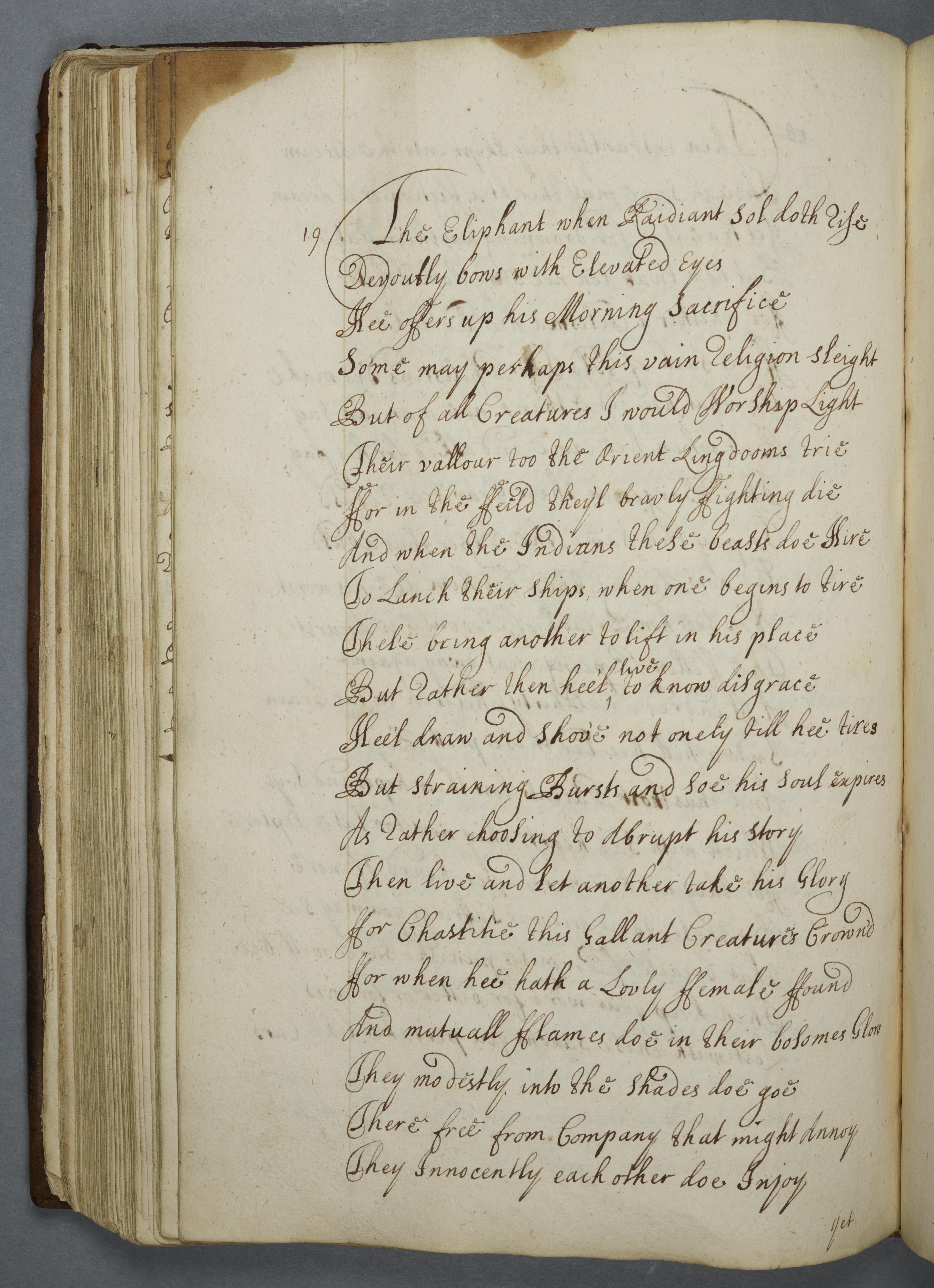
[Emblem 19]
The Elephant
(Emblem 19)
The Elephant (Emblem 19)
In these transcriptions we preserve as many details of the original material, textual, and graphic properties of Hester Pulter’s manuscript verse as we have found practical. Whenever possible, for instance, original spelling, punctuation, capitalization, lineation, insertions, deletions, alterations, spacing between words and lines, and indentation are all maintained; abbreviations and brevigraphs are not expanded; and superscript and subscript representations are retained. See full conventions for the transcriptions here.

— Leah Knight and Wendy Wall
The aim of the elemental edition is to make the poems accessible to the largest variety of readers, which involves modernizing spelling and punctuation as well as adding basic glosses. Spelling and punctuation reflect current standard American usage; punctuation highlights syntax which might otherwise be obscure. Outmoded but still familiar word forms (“thou,” “‘tis,” “hold’st”) are not modernized, and we do not modernize grammar when the sense remains legible. After a brief headnote aimed at offering a “way in” to the poem’s unique qualities and connections with other verse by Pulter or her contemporaries, the edition features a minimum of notes and interpretative framing to allow more immediate engagement with the poem. Glosses clarify synonyms or showcase various possible meanings in Pulter’s time. Other notes identify named people and places or clarify obscure material. We rely (without citation) primarily on the Oxford English Dictionary (OED), the Oxford Reference database, and the King James Version (KJV) of the Bible. When we rely on Alice Eardley’s edition of Pulter’s work, we cite her text generally (“Eardley”); other sources are cited in full. The result is an edition we consider a springboard for further work on Pulter’s poetry. See full conventions for this edition here.

— Leah Knight and Wendy Wall
I have modernized spelling and punctuation, and provided glosses on cultural and other references of significance.

— Leah Knight and Wendy Wall
Elephants provide the model for a surprising number of virtues in this poem. If upper-class Royalists in England had emulated their piety, industriousness, bravery, and fidelity, Pulter suggests, they might have turned the political tide and prevented the regicide of King Charles I, along with the side benefit of keeping their wives in line. Drawing on moralizing natural histories, Pulter excoriates the elites of her own class for their interlaced personal and political failures, flaws which extend into the realm of sexuality. Gentlemen, she advises directly at the poem’s conclusion, need to stop wasting their time by gallivanting about, drinking and gambling. If they don’t attend to their mates (which the male elephants do so scrupulously that they murder mates suspected of infidelity), they are likely to wind up with wives who fritter away their time attending plays, frequenting taverns, and committing adultery. The elephant’s graceful bowing to the rising sun, with which the emblem begins, gives way to a stern lecture on how the social hierarchy may crumble under the weight of its own immorality.

— Leah Knight and Wendy Wall
Emblem 19 uses the elephant as a counter-example to English men and women whose surrender to vice Pulter blames for the Civil War and regicide of King Charles I. Unlike elephants, which take pride in their prowess as great beasts of burden, demonstrate valor in war, and above all enforce absolute chastity in their marriages, the English—particularly those among the upper classes Pulter deems most responsible for the nation’s defense and good governance—have failed in their “breeding” and become drinking, gambling, play-going, “wanton” seekers of pleasure. Pulter implies that the hierarchy of God’s creation has thus been dismantled: humans, who should possess reason and be capable of self-restraint, have degenerated into fools and “wittols” (cuckolds) who surrender authority to those beneath them. Sexuality is a significant part of this failure, given that Pulter suggests her fellow English have ceased to value marriage and, if men, neglect their wives, or if women, act out as if they were lustful “city dames.” The emblem’s criticism of an eroded social hierarchy is directly linked to religious faith, the underpinning and guarantor of the scale of creation: even elephants know to worship something greater than themselves, while human “gallants” have become atheists (those who challenge the justification for monarchical rule as God’s design). The significance of religious faith is subtly conveyed by the poem’s rhyme scheme: all lines are rhymed couplets except the opening triplet, which ends with the word “sacrifice.” The opening two lines give the elephant’s perspective on the rising sun: there, reference to “Sol” or the sun carries the homophonic evocation of the “Son” as Christ; the fact that the Sun/Son is “rising” while the elephants bow to it establishes the image of a resurrected deity framing the remainder of the poem as it turns first to elephant virtue and then to human vice. The Son’s unique role in the salvation of humankind is indirectly affirmed by the third line’s inclusion of the word “sacrifice” when describing the elephants’ efforts to celebrate what they clearly recognize as a supreme being. The poem suggests that the monotheism that elephants in their natural and naïve way seem to practice, humans have abandoned.
Pulter’s chaste and religious elephants belong to a pre-modern tradition that saw elephants as distinctly noble creatures, different from other animals. In contrast to apes and other primates who were recognized as physically resembling humans but who were also regarded with anxious contempt for their perceived viciousness, elephants were imagined by early moderns to be closer in mind and spirit to humans than other mammals. In Giovanni Battista Gelli’s La Circe (1549), Ulysses debates with a series of humans that Circe has punished by magically transforming them into various animals. Circe gives Ulysses the chance to convince them to return to their original form if they so choose. The dialogue travels upward through the strata of animal complexity when Ulysses converses with an oyster, mole, hare, deer, goat, horse, dog, steer, and lion before arriving at the final animal, the elephant. Among all these creatures, only the elephant, at one time a philosopher named Aglafemos, agrees to be returned to his human state: he is convinced by the logic presented by Ulysses that humans are indeed superior to all other animals. Where the other animals stubbornly prefer the simplicity and safety of not being human (exposing the reader to intense critiques of human institutions and behavior), the elephant ultimately exercises his reason and, in his enlightened state, is transformed. Other classical and premodern sources of natural history including Pliny reported anecdotes illustrating elephants’ extraordinary merits: they were reputed to respond to art and music, honor and mourn their dead, punish sexual promiscuity, demonstrate pride in their achievements, and exhibit loyalty to humans. Pliny credits them with “wiseness and policy” (Natural History 8:12), while Topsell describes elephant death rituals that include strewing dust on the grave and covering it with green boughs. He notes that they seem to understand their own mortality (History of Four-Footed Beasts, 163). In other words, they display quasi-human political, religious, and intellectual capacities.
Emblem 19 thus confirms that what Aristotle proposed was the divinely ordained scala naturae, or “ladder of nature,” is a slippery ladder indeed. Pulter characterizes those who betrayed England’s “brave king” in terms that reflect the class and religious tensions that led to regicide. Like The Turtle (Emblem 8) [Poem 74] and This Poor Turtledove (Emblem 20) [Poem 85], Emblem 19 uses references to gallants who “rant” (an allusion to religious radicals) and fall prey to “temptations” like gambling, tavern-going, “fool[ing] away in licentious pursuits.” Yet if religious and political error, sexual promiscuity, marital strife, drinking, gambling, or merely going to plays and parties can render one “below a beast,” how secure can the position of humans be in God’s scala naturae?


— Leah Knight and Wendy Wall
1
19The Eliphant when Raidiant Sol Doth Riſe
The elephant, when radiant
Gloss Note
personification of the Sun and an ancient Roman god
Sol
doth rise,
The elephant, when radiant
Gloss Note
personification of the Sun and an ancient Roman god
Sol
doth rise,
2
Devoutly bows with Elevated Eyes
Devoutly bows; with elevated eyes
Critical Note
This description of the worshipping elephant directly echoes accounts in classical and Renaissance natural histories, but is physically unlikely.
Devoutly bows; with elevated eyes
3
Hee offers up his Morning Sacrifice
He offers up his morning sacrifice.
He offers up his
Critical Note
Natural histories like Pliny’s, on which Pulter based her descriptions of elephants, refer to elephants holding up tree boughs, part of their nourishment, at the sky as a morning orison (The Historie of the World, trans. Philemon Holland [1601], Book VIII, pp. 198–99).
morning sacrifice
.
4
Some may perhaps this vain Religion Sleight
Some may perhaps this
Gloss Note
Pulter’s description of the elephants’ worship, which may seem “vain” (idle, unprofitable, useless) to some, is drawn from Edward Topsell: “They have also a kind of Religion, for they worship, reverence, and observe the course of the Sun, Moon, and Stars … they reverence the Sun rising, holding up their trunk or hand to heaven, in congratulation of her rising” (Edward Topsell, History of Four-Footed Beasts [1607], p. 192; cited by Stefan Christian, “The Poems of Lady Hester Pulter (1605?–1678): An Annotated Edition.” PhD diss. [University of Massachusetts Amherst, 2012], p. 310).
vain religion
slight,
Some may perhaps this
Critical Note
Pulter’s description of the elephants’ worship, which may seem “vain” (idle, unprofitable, useless) to some, is drawn from Edward Topsell: “They have also a kind of Religion, for they worship, reverence, and observe the course of the Sun, Moon, and Stars … they reverence the Sun rising, holding up their trunk or hand to heaven, in congratulation of her rising” (Edward Topsell, History of Four-Footed Beasts [1607], p. 192; cited by Stefan Christian, “The Poems of Lady Hester Pulter (1605?–1678): An Annotated Edition.” PhD diss. [University of Massachusetts Amherst, 2012], p. 310)
vain religion
slight,
5
But of all Creatures I would Worſhip Light
But of all
Gloss Note
created things; the created universe
creatures
, I would worship light.
But of all
Gloss Note
created things; the created universe
creatures
, I would worship light.
6
Their vallour too the Orient Kingdooms trie
Gloss Note
the elephants’
Their
valor too the
Gloss Note
the countries in the East “try” (test or prove)
Orient kingdoms try
,
Gloss Note
the elephants’
Their
valor too the
Gloss Note
the countries in the East “try” (test or prove)
Orient kingdoms try
,
7
ffor in the ffeild they’l bravly ffighting die
For in the field they’ll bravely fighting die;
For in the field they’ll
Critical Note
Pliny notes elephants’ sense of honor in battle and in other efforts is extreme, even recounting a tale of an elephant that committed suicide by starvation when humiliated by failing to ford a river for King Antiochus during a military campaign (194).
bravely fighting die
;
8
And when the Indians theſe beaſts doe Hire
And when
Gloss Note
Pulter’s description of the elephants as launching ships, fighting in battle, and mating is based on Pliny, The History of the World, trans. Philemon Holland (London, 1634), 8th chapter, pp. 192–99.
the Indians these beasts do hire
And when
Critical Note
Pulter’s description of the elephants as launching ships, fighting in battle, and mating is based on Pliny’s Historie of the World, 192–99.
the Indians these beasts do hire
9
To Lanch their Ships, when one begins to tire
To launch their ships, when one begins to tire,
10
Thel’e bring another to lift in his place
They’ll bring another to lift in his place;
11
But Rather then hee’l ^live to know diſgrace
But rather than he’ll live to know disgrace,
But rather than he’ll
Critical Note
As in the case of military matters as in the note on line 7 above, elephants were reputed to be capable of deep shame about any failure on their part, and careful of their reputations.
live to know disgrace
,
12
Hee’l draw and Shov’e not onely till hee tires
He’ll draw and shove not only till he tires,
13
But Straining Bursts and Soe his Soul expires
But straining, bursts; and so his soul expires,
14
As Rather chooſing to Abrupt his Story
As rather choosing to
Gloss Note
break off
abrupt
his
Gloss Note
life
story
As rather choosing to
Gloss Note
break off
abrupt
his
Gloss Note
life
story
15
Then live and let another take his Glory
Than live and let another take his glory.
16
ffor Chastitie this Gallant Creature’s Crown’d
For chastity this
Gloss Note
attractive in manners; excellent, admirable
gallant
creature’s crowned,
For chastity this
Gloss Note
attractive in manners; excellent, admirable
gallant
creature’s crowned,
17
ffor when hee hath a Lovly ffemale ffound
For when he hath a lovely female found
18
And mutuall fflames doe in their boſomes Glow
And mutual flames do in their bosoms glow,
19
They modestly into the Shades doe goe
They modestly into the
Gloss Note
shadows
shades
do go;
Critical Note
“Shades” means shadows. Pliny notes that “owing to their modesty, elephants never mate except in secret” away from the herd (Historie of the World, p. 194). Topsell adds that they seek “deserts, woods, and secret places from procreation” (History of Four-Footed Beasts [1658], p. 155). Hiding their “mutual flames” suggests the burning of desire, and hence is linked to the elephant’s extreme violence in cases of adultery.
They modestly into the shades do go
;
20
There free from Company that might Annoy
There, free from company that might annoy,
21
They Innocently each other doe Injoy
They innocently each other do enjoy.
yet

Facsimile Image Placeholder

Facsimile Image Placeholder

Facsimile Image Placeholder
22
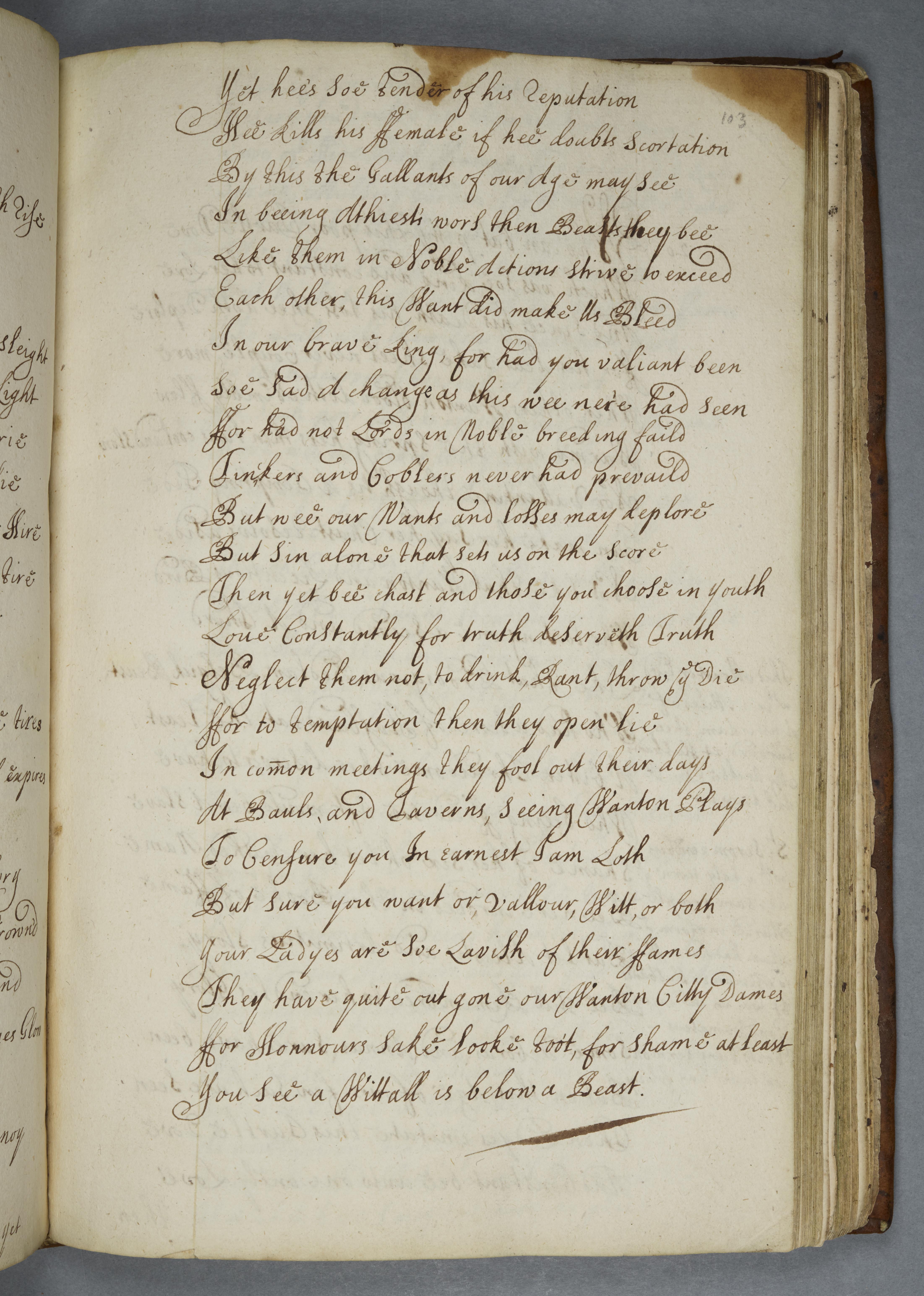
Yet hee’s Soe tender of his Reputation
Yet he’s so
Gloss Note
concerned with
tender of
his reputation
Yet he’s so
Gloss Note
concerned with
tender of
his reputation
23
Hee kills his ffemale if hee doubts Scortation
He kills his female if he
Gloss Note
fears adultery
doubts scortation
.
He kills his female if he
Gloss Note
fears adultery. Scortation indicates fornication, and works as a stronger term than adultery
doubts scortation
.
24
By this the Gallants of our Age may See
By this the
Gloss Note
men of fashion and pleasure; fine gentlemen (sometimes ironic); those who pay attention to ladies; lovers or (derogatively) paramours
gallants
of our age may see,
By this the
Gloss Note
men of fashion and pleasure; fine gentlemen (sometimes ironic); those who pay attention to ladies; lovers or (derogatively) paramours
gallants
of our age may see,
25
In beeing Athiest’s worſ then Beaſts
Physical Note
darker “h” possibly over another letter
they
bee
In being
Gloss Note
those who deny or disbelieve the existence of God but used as an anti-Royalist label for religious or political opponents in England’s civil war
atheists
, worse than beasts they be.
In being
Gloss Note
those who deny or disbelieve the existence of God but used as an anti-Royalist label for religious or political opponents in England’s civil war
atheists
,
Critical Note
The hierarchy Pulter emphasizes places those who fail to acknowledge any God below the status of beasts who may have a version of religious faith, even if that version is “vain,” as the poem describes it.
worse than beasts they be
.
26
Like them in Noble Actions Strive to exceed
Gloss Note
Be like them in noble actions; this is directed to the reader
Like them in noble actions
, strive to exceed
Gloss Note
Be like them in noble actions; this is directed to the reader
Like them in noble actions
, strive to exceed
27
Each other, this Want did make Us Bleed
Each other: this
Gloss Note
lack or flaw
want
did make us bleed
Each other: this
Gloss Note
lack or flaw
want
did make us bleed
28
In our brave King, for had you valiant been
In
Gloss Note
Charles I, executed by beheading in 1649; “this want did make us bleed / In our brave king” suggests that a flaw in England or its nobility led to the nation metaphorically losing blood when the king bled (at his execution).
our brave king
. For had you valiant been,
In
Critical Note
Charles I, executed by beheading in 1649; “this want did make us bleed / In our brave king” suggests that a flaw in England or its nobility led to the nation metaphorically losing blood when the king bled (at his execution).
our brave king
. For had you valiant been,
29
Soe Sad A
Physical Note
darker “e” possibly in different hand from main scribe
change
as this wee ne’re had Seen
So sad a change as this we ne’er had seen.
30
ffor had not Lords in Noble breeding faild
For had not
Gloss Note
Pulter suggests that aristocrats (“lords”), also known as nobles, failed to live up to their upbringing as such (thus invoking “noble” in its moral sense).
lords in noble breeding failed
,
For had not
Critical Note
Pulter suggests that aristocrats (“lords”), also known as nobles, failed to live up to their upbringing as such (thus invoking “noble” in its moral sense). The choice of the term “breeding” allows Pulter to suggest that even animals like elephants live up to the standards of their species, where English aristocrats fail to do so, just as they fail to demonstrate “valiant” action she has already associated with elephants.
lords in noble breeding failed
,
31
Tin^ckers and Coblers never had prevaild
Gloss Note
pot-menders and shoemakers; here, representatives of commoners
Tinkers and cobblers
never had prevailed.
Gloss Note
pot-menders and shoemakers; here, representatives of commoners
Tinkers and cobblers
never had prevailed.
32
But wee our Wants and loſſes may deplore
Gloss Note
Nothing but
But
we our wants and losses may
Gloss Note
lament
deplore
,
Gloss Note
Nothing but
But
we our wants and losses may
Gloss Note
lament
deplore
,
33
But Sin alone that Sets us on the Score
But sin alone, that
Gloss Note
causes us to be in debt
sets us on the score
.
But sin alone, that
Gloss Note
causes us to be in debt
sets us on the score
.
34
Then yet bee chast and thoſe you chooſe in youth
Then yet be chaste, and those you choose in youth,
Then yet be chaste, and
Critical Note
Interestingly, according to Pliny elephants mated young (at 5–10 years, though he places adulthood at 60 years out of a life of more than 200 years) yet rejected any form of adultery (Historie of the World, 194–95).
those you choose in youth
,
35
Loue Conſtantly for truth deſerveth Truth
Love constantly, for
Gloss Note
here, in the sense of fidelity (i.e., marital fidelity to “those you choose in youth”)
truth
deserveth truth.
Love constantly, for
Critical Note
here, in the sense of fidelity (i.e., marital fidelity to “those you choose in youth”); the root sense is “troth,” a pledge or bond, suggesting both an actual agreement and a principled choice.
truth
deserveth truth.
36
Neglect them not, to drink, Rant, throw ye Die
Neglect them not, to
Gloss Note
drink alcohol, “rant” (be jovial, boisterous, or uproariously merry; lead a riotous or dissolute life; sing loudly, dance or play music), or gamble (throw dice)
drink, rant, throw the die
,
Neglect them not, to
Critical Note
drink alcohol, “rant” (be jovial, boisterous, or uproariously merry; lead a riotous or dissolute life; sing loudly, dance or play music), or gamble (throw dice)
drink, rant, throw the die
,
37
ffor to temptation then they open lie
For to temptation then
Gloss Note
the wives
they
open lie.
For to temptation then
Gloss Note
the wives
they
open lie.
38
In comon meetings they fool out their days
In
Gloss Note
public gatherings open to all classes of people; “common” could refer to the community of a people or place, or the subset distinguished as from those of higher rank; it was sometimes used as a slur to imply lower-class status.
common meetings
they fool out their days
In
Critical Note
public gatherings open to all classes of people; “common” could refer to the community of a people or place, or the subset distinguished as from those of higher rank; it was sometimes used as a slur to imply lower-class status.
common meetings
they fool out their days
39
At Bauls, and Taverns, Seeing Wanton Plays
At balls and taverns, seeing
Gloss Note
rebellious, unruly, lawless; lustful, inciting lasciviousness; profligate, wasteful; frivolous, pleasure-seeking
wanton
plays.
At balls and taverns, seeing
Gloss Note
rebellious, unruly, lawless; lustful, inciting lasciviousness; profligate, wasteful; frivolous, pleasure-seeking
wanton
plays.
40
To Cenſure you In earnest I am Loth
To censure you in earnest I am
Gloss Note
averse, reluctant
loath
,
To censure you in earnest I am
Gloss Note
averse, reluctant
loath
,
41
But Sure you want or
Physical Note
comma erased imperfectly
,
Vallour, Witt, or both
But sure
Gloss Note
you lack either bravery or “wit” (reason, intellect)
you want or valor, wit
, or both.
But sure
Gloss Note
you lack either bravery or “wit” (reason, intellect)
you want or valor, wit
, or both.
42
Your Ladyes are Soe Laviſh of their ffames
Your ladies are so
Gloss Note
either the noblewomen are so extravagant or undisciplined in spending money that their reputations are damaged; or they are so extravagant in circulating that they get bad reputations
lavish of their fames
,
Your ladies are so
Critical Note
either the noblewomen are so extravagant or undisciplined in spending money that their reputation are damaged; or they are so extravagant in circulating that they get bad reputations
lavish of their fames
,
43
They have quite out gone our Wanton Citty Dames
They have quite
Gloss Note
exceeded unruly or lustful London-based, non-elite women
outgone our wanton city dames
.
They have quite
Gloss Note
exceeded unruly or lustful London-based, non-elite women
outgone our wanton city dames
.
44
ffor Honnours Sake looke too’t, for Shame at least
For honor’s sake look
Gloss Note
to it; here referring to moral behavior in general, or attending to their wives in particular
to’t
; for shame at least!
For honor’s sake look
Gloss Note
to it; here referring to moral behavior in general, or attending to their wives in particular
to’t
; for shame at least!
45
You See a Wittall is below a Beast.
You see a
Gloss Note
a contented man who knows that his wife is unfaithful; also, a half-witted person
wittol
is below a beast.
You see a
Gloss Note
a contended man who knows that his wife is unfaithful; also, a half-witted person
wittol
is below a
Critical Note
While Pulter uses the term “beast” here to indicate depravity, the term was perhaps most often used in the 16th and 17th centuries to make a category distinction: beasts are the lower orders of mammals (as in the Bible’s language describing “beasts of the field”), that is, those who are not supposed to be capable of reason and thus are definitionally not human. At the same time, the term could denote a devil or other evil and hellish supernatural creature. As such, the word beast functions to tie together multiple threads of the poem.
beast
.
ascending straight line
X (Close panel)Notes: Elemental Edition

 Editorial note

The aim of the elemental edition is to make the poems accessible to the largest variety of readers, which involves modernizing spelling and punctuation as well as adding basic glosses. Spelling and punctuation reflect current standard American usage; punctuation highlights syntax which might otherwise be obscure. Outmoded but still familiar word forms (“thou,” “‘tis,” “hold’st”) are not modernized, and we do not modernize grammar when the sense remains legible. After a brief headnote aimed at offering a “way in” to the poem’s unique qualities and connections with other verse by Pulter or her contemporaries, the edition features a minimum of notes and interpretative framing to allow more immediate engagement with the poem. Glosses clarify synonyms or showcase various possible meanings in Pulter’s time. Other notes identify named people and places or clarify obscure material. We rely (without citation) primarily on the Oxford English Dictionary (OED), the Oxford Reference database, and the King James Version (KJV) of the Bible. When we rely on Alice Eardley’s edition of Pulter’s work, we cite her text generally (“Eardley”); other sources are cited in full. The result is an edition we consider a springboard for further work on Pulter’s poetry. See full conventions for this edition here.

 Headnote

Elephants provide the model for a surprising number of virtues in this poem. If upper-class Royalists in England had emulated their piety, industriousness, bravery, and fidelity, Pulter suggests, they might have turned the political tide and prevented the regicide of King Charles I, along with the side benefit of keeping their wives in line. Drawing on moralizing natural histories, Pulter excoriates the elites of her own class for their interlaced personal and political failures, flaws which extend into the realm of sexuality. Gentlemen, she advises directly at the poem’s conclusion, need to stop wasting their time by gallivanting about, drinking and gambling. If they don’t attend to their mates (which the male elephants do so scrupulously that they murder mates suspected of infidelity), they are likely to wind up with wives who fritter away their time attending plays, frequenting taverns, and committing adultery. The elephant’s graceful bowing to the rising sun, with which the emblem begins, gives way to a stern lecture on how the social hierarchy may crumble under the weight of its own immorality.
Line number 1

 Gloss note

personification of the Sun and an ancient Roman god
Line number 4

 Gloss note

Pulter’s description of the elephants’ worship, which may seem “vain” (idle, unprofitable, useless) to some, is drawn from Edward Topsell: “They have also a kind of Religion, for they worship, reverence, and observe the course of the Sun, Moon, and Stars … they reverence the Sun rising, holding up their trunk or hand to heaven, in congratulation of her rising” (Edward Topsell, History of Four-Footed Beasts [1607], p. 192; cited by Stefan Christian, “The Poems of Lady Hester Pulter (1605?–1678): An Annotated Edition.” PhD diss. [University of Massachusetts Amherst, 2012], p. 310).
Line number 5

 Gloss note

created things; the created universe
Line number 6

 Gloss note

the elephants’
Line number 6

 Gloss note

the countries in the East “try” (test or prove)
Line number 8

 Gloss note

Pulter’s description of the elephants as launching ships, fighting in battle, and mating is based on Pliny, The History of the World, trans. Philemon Holland (London, 1634), 8th chapter, pp. 192–99.
Line number 14

 Gloss note

break off
Line number 14

 Gloss note

life
Line number 16

 Gloss note

attractive in manners; excellent, admirable
Line number 19

 Gloss note

shadows
Line number 22

 Gloss note

concerned with
Line number 23

 Gloss note

fears adultery
Line number 24

 Gloss note

men of fashion and pleasure; fine gentlemen (sometimes ironic); those who pay attention to ladies; lovers or (derogatively) paramours
Line number 25

 Gloss note

those who deny or disbelieve the existence of God but used as an anti-Royalist label for religious or political opponents in England’s civil war
Line number 26

 Gloss note

Be like them in noble actions; this is directed to the reader
Line number 27

 Gloss note

lack or flaw
Line number 28

 Gloss note

Charles I, executed by beheading in 1649; “this want did make us bleed / In our brave king” suggests that a flaw in England or its nobility led to the nation metaphorically losing blood when the king bled (at his execution).
Line number 30

 Gloss note

Pulter suggests that aristocrats (“lords”), also known as nobles, failed to live up to their upbringing as such (thus invoking “noble” in its moral sense).
Line number 31

 Gloss note

pot-menders and shoemakers; here, representatives of commoners
Line number 32

 Gloss note

Nothing but
Line number 32

 Gloss note

lament
Line number 33

 Gloss note

causes us to be in debt
Line number 35

 Gloss note

here, in the sense of fidelity (i.e., marital fidelity to “those you choose in youth”)
Line number 36

 Gloss note

drink alcohol, “rant” (be jovial, boisterous, or uproariously merry; lead a riotous or dissolute life; sing loudly, dance or play music), or gamble (throw dice)
Line number 37

 Gloss note

the wives
Line number 38

 Gloss note

public gatherings open to all classes of people; “common” could refer to the community of a people or place, or the subset distinguished as from those of higher rank; it was sometimes used as a slur to imply lower-class status.
Line number 39

 Gloss note

rebellious, unruly, lawless; lustful, inciting lasciviousness; profligate, wasteful; frivolous, pleasure-seeking
Line number 40

 Gloss note

averse, reluctant
Line number 41

 Gloss note

you lack either bravery or “wit” (reason, intellect)
Line number 42

 Gloss note

either the noblewomen are so extravagant or undisciplined in spending money that their reputations are damaged; or they are so extravagant in circulating that they get bad reputations
Line number 43

 Gloss note

exceeded unruly or lustful London-based, non-elite women
Line number 44

 Gloss note

to it; here referring to moral behavior in general, or attending to their wives in particular
Line number 45

 Gloss note

a contented man who knows that his wife is unfaithful; also, a half-witted person
Sorry, but there are no notes associated with any currently displayed witness.
X (Close panel)Elemental Edition
Elemental Edition

Facsimile Image Placeholder

Facsimile Image Placeholder

Facsimile Image Placeholder
[Emblem 19]
The Elephant
(Emblem 19)
The Elephant (Emblem 19)
In these transcriptions we preserve as many details of the original material, textual, and graphic properties of Hester Pulter’s manuscript verse as we have found practical. Whenever possible, for instance, original spelling, punctuation, capitalization, lineation, insertions, deletions, alterations, spacing between words and lines, and indentation are all maintained; abbreviations and brevigraphs are not expanded; and superscript and subscript representations are retained. See full conventions for the transcriptions here.

— Leah Knight and Wendy Wall
The aim of the elemental edition is to make the poems accessible to the largest variety of readers, which involves modernizing spelling and punctuation as well as adding basic glosses. Spelling and punctuation reflect current standard American usage; punctuation highlights syntax which might otherwise be obscure. Outmoded but still familiar word forms (“thou,” “‘tis,” “hold’st”) are not modernized, and we do not modernize grammar when the sense remains legible. After a brief headnote aimed at offering a “way in” to the poem’s unique qualities and connections with other verse by Pulter or her contemporaries, the edition features a minimum of notes and interpretative framing to allow more immediate engagement with the poem. Glosses clarify synonyms or showcase various possible meanings in Pulter’s time. Other notes identify named people and places or clarify obscure material. We rely (without citation) primarily on the Oxford English Dictionary (OED), the Oxford Reference database, and the King James Version (KJV) of the Bible. When we rely on Alice Eardley’s edition of Pulter’s work, we cite her text generally (“Eardley”); other sources are cited in full. The result is an edition we consider a springboard for further work on Pulter’s poetry. See full conventions for this edition here.

— Leah Knight and Wendy Wall
I have modernized spelling and punctuation, and provided glosses on cultural and other references of significance.

— Leah Knight and Wendy Wall
Elephants provide the model for a surprising number of virtues in this poem. If upper-class Royalists in England had emulated their piety, industriousness, bravery, and fidelity, Pulter suggests, they might have turned the political tide and prevented the regicide of King Charles I, along with the side benefit of keeping their wives in line. Drawing on moralizing natural histories, Pulter excoriates the elites of her own class for their interlaced personal and political failures, flaws which extend into the realm of sexuality. Gentlemen, she advises directly at the poem’s conclusion, need to stop wasting their time by gallivanting about, drinking and gambling. If they don’t attend to their mates (which the male elephants do so scrupulously that they murder mates suspected of infidelity), they are likely to wind up with wives who fritter away their time attending plays, frequenting taverns, and committing adultery. The elephant’s graceful bowing to the rising sun, with which the emblem begins, gives way to a stern lecture on how the social hierarchy may crumble under the weight of its own immorality.

— Leah Knight and Wendy Wall
Emblem 19 uses the elephant as a counter-example to English men and women whose surrender to vice Pulter blames for the Civil War and regicide of King Charles I. Unlike elephants, which take pride in their prowess as great beasts of burden, demonstrate valor in war, and above all enforce absolute chastity in their marriages, the English—particularly those among the upper classes Pulter deems most responsible for the nation’s defense and good governance—have failed in their “breeding” and become drinking, gambling, play-going, “wanton” seekers of pleasure. Pulter implies that the hierarchy of God’s creation has thus been dismantled: humans, who should possess reason and be capable of self-restraint, have degenerated into fools and “wittols” (cuckolds) who surrender authority to those beneath them. Sexuality is a significant part of this failure, given that Pulter suggests her fellow English have ceased to value marriage and, if men, neglect their wives, or if women, act out as if they were lustful “city dames.” The emblem’s criticism of an eroded social hierarchy is directly linked to religious faith, the underpinning and guarantor of the scale of creation: even elephants know to worship something greater than themselves, while human “gallants” have become atheists (those who challenge the justification for monarchical rule as God’s design). The significance of religious faith is subtly conveyed by the poem’s rhyme scheme: all lines are rhymed couplets except the opening triplet, which ends with the word “sacrifice.” The opening two lines give the elephant’s perspective on the rising sun: there, reference to “Sol” or the sun carries the homophonic evocation of the “Son” as Christ; the fact that the Sun/Son is “rising” while the elephants bow to it establishes the image of a resurrected deity framing the remainder of the poem as it turns first to elephant virtue and then to human vice. The Son’s unique role in the salvation of humankind is indirectly affirmed by the third line’s inclusion of the word “sacrifice” when describing the elephants’ efforts to celebrate what they clearly recognize as a supreme being. The poem suggests that the monotheism that elephants in their natural and naïve way seem to practice, humans have abandoned.
Pulter’s chaste and religious elephants belong to a pre-modern tradition that saw elephants as distinctly noble creatures, different from other animals. In contrast to apes and other primates who were recognized as physically resembling humans but who were also regarded with anxious contempt for their perceived viciousness, elephants were imagined by early moderns to be closer in mind and spirit to humans than other mammals. In Giovanni Battista Gelli’s La Circe (1549), Ulysses debates with a series of humans that Circe has punished by magically transforming them into various animals. Circe gives Ulysses the chance to convince them to return to their original form if they so choose. The dialogue travels upward through the strata of animal complexity when Ulysses converses with an oyster, mole, hare, deer, goat, horse, dog, steer, and lion before arriving at the final animal, the elephant. Among all these creatures, only the elephant, at one time a philosopher named Aglafemos, agrees to be returned to his human state: he is convinced by the logic presented by Ulysses that humans are indeed superior to all other animals. Where the other animals stubbornly prefer the simplicity and safety of not being human (exposing the reader to intense critiques of human institutions and behavior), the elephant ultimately exercises his reason and, in his enlightened state, is transformed. Other classical and premodern sources of natural history including Pliny reported anecdotes illustrating elephants’ extraordinary merits: they were reputed to respond to art and music, honor and mourn their dead, punish sexual promiscuity, demonstrate pride in their achievements, and exhibit loyalty to humans. Pliny credits them with “wiseness and policy” (Natural History 8:12), while Topsell describes elephant death rituals that include strewing dust on the grave and covering it with green boughs. He notes that they seem to understand their own mortality (History of Four-Footed Beasts, 163). In other words, they display quasi-human political, religious, and intellectual capacities.
Emblem 19 thus confirms that what Aristotle proposed was the divinely ordained scala naturae, or “ladder of nature,” is a slippery ladder indeed. Pulter characterizes those who betrayed England’s “brave king” in terms that reflect the class and religious tensions that led to regicide. Like The Turtle (Emblem 8) [Poem 74] and This Poor Turtledove (Emblem 20) [Poem 85], Emblem 19 uses references to gallants who “rant” (an allusion to religious radicals) and fall prey to “temptations” like gambling, tavern-going, “fool[ing] away in licentious pursuits.” Yet if religious and political error, sexual promiscuity, marital strife, drinking, gambling, or merely going to plays and parties can render one “below a beast,” how secure can the position of humans be in God’s scala naturae?


— Leah Knight and Wendy Wall
1
19The Eliphant when Raidiant Sol Doth Riſe
The elephant, when radiant
Gloss Note
personification of the Sun and an ancient Roman god
Sol
doth rise,
The elephant, when radiant
Gloss Note
personification of the Sun and an ancient Roman god
Sol
doth rise,
2
Devoutly bows with Elevated Eyes
Devoutly bows; with elevated eyes
Critical Note
This description of the worshipping elephant directly echoes accounts in classical and Renaissance natural histories, but is physically unlikely.
Devoutly bows; with elevated eyes
3
Hee offers up his Morning Sacrifice
He offers up his morning sacrifice.
He offers up his
Critical Note
Natural histories like Pliny’s, on which Pulter based her descriptions of elephants, refer to elephants holding up tree boughs, part of their nourishment, at the sky as a morning orison (The Historie of the World, trans. Philemon Holland [1601], Book VIII, pp. 198–99).
morning sacrifice
.
4
Some may perhaps this vain Religion Sleight
Some may perhaps this
Gloss Note
Pulter’s description of the elephants’ worship, which may seem “vain” (idle, unprofitable, useless) to some, is drawn from Edward Topsell: “They have also a kind of Religion, for they worship, reverence, and observe the course of the Sun, Moon, and Stars … they reverence the Sun rising, holding up their trunk or hand to heaven, in congratulation of her rising” (Edward Topsell, History of Four-Footed Beasts [1607], p. 192; cited by Stefan Christian, “The Poems of Lady Hester Pulter (1605?–1678): An Annotated Edition.” PhD diss. [University of Massachusetts Amherst, 2012], p. 310).
vain religion
slight,
Some may perhaps this
Critical Note
Pulter’s description of the elephants’ worship, which may seem “vain” (idle, unprofitable, useless) to some, is drawn from Edward Topsell: “They have also a kind of Religion, for they worship, reverence, and observe the course of the Sun, Moon, and Stars … they reverence the Sun rising, holding up their trunk or hand to heaven, in congratulation of her rising” (Edward Topsell, History of Four-Footed Beasts [1607], p. 192; cited by Stefan Christian, “The Poems of Lady Hester Pulter (1605?–1678): An Annotated Edition.” PhD diss. [University of Massachusetts Amherst, 2012], p. 310)
vain religion
slight,
5
But of all Creatures I would Worſhip Light
But of all
Gloss Note
created things; the created universe
creatures
, I would worship light.
But of all
Gloss Note
created things; the created universe
creatures
, I would worship light.
6
Their vallour too the Orient Kingdooms trie
Gloss Note
the elephants’
Their
valor too the
Gloss Note
the countries in the East “try” (test or prove)
Orient kingdoms try
,
Gloss Note
the elephants’
Their
valor too the
Gloss Note
the countries in the East “try” (test or prove)
Orient kingdoms try
,
7
ffor in the ffeild they’l bravly ffighting die
For in the field they’ll bravely fighting die;
For in the field they’ll
Critical Note
Pliny notes elephants’ sense of honor in battle and in other efforts is extreme, even recounting a tale of an elephant that committed suicide by starvation when humiliated by failing to ford a river for King Antiochus during a military campaign (194).
bravely fighting die
;
8
And when the Indians theſe beaſts doe Hire
And when
Gloss Note
Pulter’s description of the elephants as launching ships, fighting in battle, and mating is based on Pliny, The History of the World, trans. Philemon Holland (London, 1634), 8th chapter, pp. 192–99.
the Indians these beasts do hire
And when
Critical Note
Pulter’s description of the elephants as launching ships, fighting in battle, and mating is based on Pliny’s Historie of the World, 192–99.
the Indians these beasts do hire
9
To Lanch their Ships, when one begins to tire
To launch their ships, when one begins to tire,
10
Thel’e bring another to lift in his place
They’ll bring another to lift in his place;
11
But Rather then hee’l ^live to know diſgrace
But rather than he’ll live to know disgrace,
But rather than he’ll
Critical Note
As in the case of military matters as in the note on line 7 above, elephants were reputed to be capable of deep shame about any failure on their part, and careful of their reputations.
live to know disgrace
,
12
Hee’l draw and Shov’e not onely till hee tires
He’ll draw and shove not only till he tires,
13
But Straining Bursts and Soe his Soul expires
But straining, bursts; and so his soul expires,
14
As Rather chooſing to Abrupt his Story
As rather choosing to
Gloss Note
break off
abrupt
his
Gloss Note
life
story
As rather choosing to
Gloss Note
break off
abrupt
his
Gloss Note
life
story
15
Then live and let another take his Glory
Than live and let another take his glory.
16
ffor Chastitie this Gallant Creature’s Crown’d
For chastity this
Gloss Note
attractive in manners; excellent, admirable
gallant
creature’s crowned,
For chastity this
Gloss Note
attractive in manners; excellent, admirable
gallant
creature’s crowned,
17
ffor when hee hath a Lovly ffemale ffound
For when he hath a lovely female found
18
And mutuall fflames doe in their boſomes Glow
And mutual flames do in their bosoms glow,
19
They modestly into the Shades doe goe
They modestly into the
Gloss Note
shadows
shades
do go;
Critical Note
“Shades” means shadows. Pliny notes that “owing to their modesty, elephants never mate except in secret” away from the herd (Historie of the World, p. 194). Topsell adds that they seek “deserts, woods, and secret places from procreation” (History of Four-Footed Beasts [1658], p. 155). Hiding their “mutual flames” suggests the burning of desire, and hence is linked to the elephant’s extreme violence in cases of adultery.
They modestly into the shades do go
;
20
There free from Company that might Annoy
There, free from company that might annoy,
21
They Innocently each other doe Injoy
They innocently each other do enjoy.
yet

Facsimile Image Placeholder

Facsimile Image Placeholder

Facsimile Image Placeholder
22
Yet hee’s Soe tender of his Reputation
Yet he’s so
Gloss Note
concerned with
tender of
his reputation
Yet he’s so
Gloss Note
concerned with
tender of
his reputation
23
Hee kills his ffemale if hee doubts Scortation
He kills his female if he
Gloss Note
fears adultery
doubts scortation
.
He kills his female if he
Gloss Note
fears adultery. Scortation indicates fornication, and works as a stronger term than adultery
doubts scortation
.
24
By this the Gallants of our Age may See
By this the
Gloss Note
men of fashion and pleasure; fine gentlemen (sometimes ironic); those who pay attention to ladies; lovers or (derogatively) paramours
gallants
of our age may see,
By this the
Gloss Note
men of fashion and pleasure; fine gentlemen (sometimes ironic); those who pay attention to ladies; lovers or (derogatively) paramours
gallants
of our age may see,
25
In beeing Athiest’s worſ then Beaſts
Physical Note
darker “h” possibly over another letter
they
bee
In being
Gloss Note
those who deny or disbelieve the existence of God but used as an anti-Royalist label for religious or political opponents in England’s civil war
atheists
, worse than beasts they be.
In being
Gloss Note
those who deny or disbelieve the existence of God but used as an anti-Royalist label for religious or political opponents in England’s civil war
atheists
,
Critical Note
The hierarchy Pulter emphasizes places those who fail to acknowledge any God below the status of beasts who may have a version of religious faith, even if that version is “vain,” as the poem describes it.
worse than beasts they be
.
26
Like them in Noble Actions Strive to exceed
Gloss Note
Be like them in noble actions; this is directed to the reader
Like them in noble actions
, strive to exceed
Gloss Note
Be like them in noble actions; this is directed to the reader
Like them in noble actions
, strive to exceed
27
Each other, this Want did make Us Bleed
Each other: this
Gloss Note
lack or flaw
want
did make us bleed
Each other: this
Gloss Note
lack or flaw
want
did make us bleed
28
In our brave King, for had you valiant been
In
Gloss Note
Charles I, executed by beheading in 1649; “this want did make us bleed / In our brave king” suggests that a flaw in England or its nobility led to the nation metaphorically losing blood when the king bled (at his execution).
our brave king
. For had you valiant been,
In
Critical Note
Charles I, executed by beheading in 1649; “this want did make us bleed / In our brave king” suggests that a flaw in England or its nobility led to the nation metaphorically losing blood when the king bled (at his execution).
our brave king
. For had you valiant been,
29
Soe Sad A
Physical Note
darker “e” possibly in different hand from main scribe
change
as this wee ne’re had Seen
So sad a change as this we ne’er had seen.
30
ffor had not Lords in Noble breeding faild
For had not
Gloss Note
Pulter suggests that aristocrats (“lords”), also known as nobles, failed to live up to their upbringing as such (thus invoking “noble” in its moral sense).
lords in noble breeding failed
,
For had not
Critical Note
Pulter suggests that aristocrats (“lords”), also known as nobles, failed to live up to their upbringing as such (thus invoking “noble” in its moral sense). The choice of the term “breeding” allows Pulter to suggest that even animals like elephants live up to the standards of their species, where English aristocrats fail to do so, just as they fail to demonstrate “valiant” action she has already associated with elephants.
lords in noble breeding failed
,
31
Tin^ckers and Coblers never had prevaild
Gloss Note
pot-menders and shoemakers; here, representatives of commoners
Tinkers and cobblers
never had prevailed.
Gloss Note
pot-menders and shoemakers; here, representatives of commoners
Tinkers and cobblers
never had prevailed.
32
But wee our Wants and loſſes may deplore
Gloss Note
Nothing but
But
we our wants and losses may
Gloss Note
lament
deplore
,
Gloss Note
Nothing but
But
we our wants and losses may
Gloss Note
lament
deplore
,
33
But Sin alone that Sets us on the Score
But sin alone, that
Gloss Note
causes us to be in debt
sets us on the score
.
But sin alone, that
Gloss Note
causes us to be in debt
sets us on the score
.
34
Then yet bee chast and thoſe you chooſe in youth
Then yet be chaste, and those you choose in youth,
Then yet be chaste, and
Critical Note
Interestingly, according to Pliny elephants mated young (at 5–10 years, though he places adulthood at 60 years out of a life of more than 200 years) yet rejected any form of adultery (Historie of the World, 194–95).
those you choose in youth
,
35
Loue Conſtantly for truth deſerveth Truth
Love constantly, for
Gloss Note
here, in the sense of fidelity (i.e., marital fidelity to “those you choose in youth”)
truth
deserveth truth.
Love constantly, for
Critical Note
here, in the sense of fidelity (i.e., marital fidelity to “those you choose in youth”); the root sense is “troth,” a pledge or bond, suggesting both an actual agreement and a principled choice.
truth
deserveth truth.
36
Neglect them not, to drink, Rant, throw ye Die
Neglect them not, to
Gloss Note
drink alcohol, “rant” (be jovial, boisterous, or uproariously merry; lead a riotous or dissolute life; sing loudly, dance or play music), or gamble (throw dice)
drink, rant, throw the die
,
Neglect them not, to
Critical Note
drink alcohol, “rant” (be jovial, boisterous, or uproariously merry; lead a riotous or dissolute life; sing loudly, dance or play music), or gamble (throw dice)
drink, rant, throw the die
,
37
ffor to temptation then they open lie
For to temptation then
Gloss Note
the wives
they
open lie.
For to temptation then
Gloss Note
the wives
they
open lie.
38
In comon meetings they fool out their days
In
Gloss Note
public gatherings open to all classes of people; “common” could refer to the community of a people or place, or the subset distinguished as from those of higher rank; it was sometimes used as a slur to imply lower-class status.
common meetings
they fool out their days
In
Critical Note
public gatherings open to all classes of people; “common” could refer to the community of a people or place, or the subset distinguished as from those of higher rank; it was sometimes used as a slur to imply lower-class status.
common meetings
they fool out their days
39
At Bauls, and Taverns, Seeing Wanton Plays
At balls and taverns, seeing
Gloss Note
rebellious, unruly, lawless; lustful, inciting lasciviousness; profligate, wasteful; frivolous, pleasure-seeking
wanton
plays.
At balls and taverns, seeing
Gloss Note
rebellious, unruly, lawless; lustful, inciting lasciviousness; profligate, wasteful; frivolous, pleasure-seeking
wanton
plays.
40
To Cenſure you In earnest I am Loth
To censure you in earnest I am
Gloss Note
averse, reluctant
loath
,
To censure you in earnest I am
Gloss Note
averse, reluctant
loath
,
41
But Sure you want or
Physical Note
comma erased imperfectly
,
Vallour, Witt, or both
But sure
Gloss Note
you lack either bravery or “wit” (reason, intellect)
you want or valor, wit
, or both.
But sure
Gloss Note
you lack either bravery or “wit” (reason, intellect)
you want or valor, wit
, or both.
42
Your Ladyes are Soe Laviſh of their ffames
Your ladies are so
Gloss Note
either the noblewomen are so extravagant or undisciplined in spending money that their reputations are damaged; or they are so extravagant in circulating that they get bad reputations
lavish of their fames
,
Your ladies are so
Critical Note
either the noblewomen are so extravagant or undisciplined in spending money that their reputation are damaged; or they are so extravagant in circulating that they get bad reputations
lavish of their fames
,
43
They have quite out gone our Wanton Citty Dames
They have quite
Gloss Note
exceeded unruly or lustful London-based, non-elite women
outgone our wanton city dames
.
They have quite
Gloss Note
exceeded unruly or lustful London-based, non-elite women
outgone our wanton city dames
.
44
ffor Honnours Sake looke too’t, for Shame at least
For honor’s sake look
Gloss Note
to it; here referring to moral behavior in general, or attending to their wives in particular
to’t
; for shame at least!
For honor’s sake look
Gloss Note
to it; here referring to moral behavior in general, or attending to their wives in particular
to’t
; for shame at least!
45
You See a Wittall is below a Beast.
You see a
Gloss Note
a contented man who knows that his wife is unfaithful; also, a half-witted person
wittol
is below a beast.
You see a
Gloss Note
a contended man who knows that his wife is unfaithful; also, a half-witted person
wittol
is below a
Critical Note
While Pulter uses the term “beast” here to indicate depravity, the term was perhaps most often used in the 16th and 17th centuries to make a category distinction: beasts are the lower orders of mammals (as in the Bible’s language describing “beasts of the field”), that is, those who are not supposed to be capable of reason and thus are definitionally not human. At the same time, the term could denote a devil or other evil and hellish supernatural creature. As such, the word beast functions to tie together multiple threads of the poem.
beast
.
ascending straight line
X (Close panel)Notes: Amplified Edition

 Editorial note

I have modernized spelling and punctuation, and provided glosses on cultural and other references of significance.

 Headnote

Emblem 19 uses the elephant as a counter-example to English men and women whose surrender to vice Pulter blames for the Civil War and regicide of King Charles I. Unlike elephants, which take pride in their prowess as great beasts of burden, demonstrate valor in war, and above all enforce absolute chastity in their marriages, the English—particularly those among the upper classes Pulter deems most responsible for the nation’s defense and good governance—have failed in their “breeding” and become drinking, gambling, play-going, “wanton” seekers of pleasure. Pulter implies that the hierarchy of God’s creation has thus been dismantled: humans, who should possess reason and be capable of self-restraint, have degenerated into fools and “wittols” (cuckolds) who surrender authority to those beneath them. Sexuality is a significant part of this failure, given that Pulter suggests her fellow English have ceased to value marriage and, if men, neglect their wives, or if women, act out as if they were lustful “city dames.” The emblem’s criticism of an eroded social hierarchy is directly linked to religious faith, the underpinning and guarantor of the scale of creation: even elephants know to worship something greater than themselves, while human “gallants” have become atheists (those who challenge the justification for monarchical rule as God’s design). The significance of religious faith is subtly conveyed by the poem’s rhyme scheme: all lines are rhymed couplets except the opening triplet, which ends with the word “sacrifice.” The opening two lines give the elephant’s perspective on the rising sun: there, reference to “Sol” or the sun carries the homophonic evocation of the “Son” as Christ; the fact that the Sun/Son is “rising” while the elephants bow to it establishes the image of a resurrected deity framing the remainder of the poem as it turns first to elephant virtue and then to human vice. The Son’s unique role in the salvation of humankind is indirectly affirmed by the third line’s inclusion of the word “sacrifice” when describing the elephants’ efforts to celebrate what they clearly recognize as a supreme being. The poem suggests that the monotheism that elephants in their natural and naïve way seem to practice, humans have abandoned.
Pulter’s chaste and religious elephants belong to a pre-modern tradition that saw elephants as distinctly noble creatures, different from other animals. In contrast to apes and other primates who were recognized as physically resembling humans but who were also regarded with anxious contempt for their perceived viciousness, elephants were imagined by early moderns to be closer in mind and spirit to humans than other mammals. In Giovanni Battista Gelli’s La Circe (1549), Ulysses debates with a series of humans that Circe has punished by magically transforming them into various animals. Circe gives Ulysses the chance to convince them to return to their original form if they so choose. The dialogue travels upward through the strata of animal complexity when Ulysses converses with an oyster, mole, hare, deer, goat, horse, dog, steer, and lion before arriving at the final animal, the elephant. Among all these creatures, only the elephant, at one time a philosopher named Aglafemos, agrees to be returned to his human state: he is convinced by the logic presented by Ulysses that humans are indeed superior to all other animals. Where the other animals stubbornly prefer the simplicity and safety of not being human (exposing the reader to intense critiques of human institutions and behavior), the elephant ultimately exercises his reason and, in his enlightened state, is transformed. Other classical and premodern sources of natural history including Pliny reported anecdotes illustrating elephants’ extraordinary merits: they were reputed to respond to art and music, honor and mourn their dead, punish sexual promiscuity, demonstrate pride in their achievements, and exhibit loyalty to humans. Pliny credits them with “wiseness and policy” (Natural History 8:12), while Topsell describes elephant death rituals that include strewing dust on the grave and covering it with green boughs. He notes that they seem to understand their own mortality (History of Four-Footed Beasts, 163). In other words, they display quasi-human political, religious, and intellectual capacities.
Emblem 19 thus confirms that what Aristotle proposed was the divinely ordained scala naturae, or “ladder of nature,” is a slippery ladder indeed. Pulter characterizes those who betrayed England’s “brave king” in terms that reflect the class and religious tensions that led to regicide. Like The Turtle (Emblem 8) [Poem 74] and This Poor Turtledove (Emblem 20) [Poem 85], Emblem 19 uses references to gallants who “rant” (an allusion to religious radicals) and fall prey to “temptations” like gambling, tavern-going, “fool[ing] away in licentious pursuits.” Yet if religious and political error, sexual promiscuity, marital strife, drinking, gambling, or merely going to plays and parties can render one “below a beast,” how secure can the position of humans be in God’s scala naturae?
Line number 1

 Gloss note

personification of the Sun and an ancient Roman god
Line number 2

 Critical note

This description of the worshipping elephant directly echoes accounts in classical and Renaissance natural histories, but is physically unlikely.
Line number 3

 Critical note

Natural histories like Pliny’s, on which Pulter based her descriptions of elephants, refer to elephants holding up tree boughs, part of their nourishment, at the sky as a morning orison (The Historie of the World, trans. Philemon Holland [1601], Book VIII, pp. 198–99).
Line number 4

 Critical note

Pulter’s description of the elephants’ worship, which may seem “vain” (idle, unprofitable, useless) to some, is drawn from Edward Topsell: “They have also a kind of Religion, for they worship, reverence, and observe the course of the Sun, Moon, and Stars … they reverence the Sun rising, holding up their trunk or hand to heaven, in congratulation of her rising” (Edward Topsell, History of Four-Footed Beasts [1607], p. 192; cited by Stefan Christian, “The Poems of Lady Hester Pulter (1605?–1678): An Annotated Edition.” PhD diss. [University of Massachusetts Amherst, 2012], p. 310)
Line number 5

 Gloss note

created things; the created universe
Line number 6

 Gloss note

the elephants’
Line number 6

 Gloss note

the countries in the East “try” (test or prove)
Line number 7

 Critical note

Pliny notes elephants’ sense of honor in battle and in other efforts is extreme, even recounting a tale of an elephant that committed suicide by starvation when humiliated by failing to ford a river for King Antiochus during a military campaign (194).
Line number 8

 Critical note

Pulter’s description of the elephants as launching ships, fighting in battle, and mating is based on Pliny’s Historie of the World, 192–99.
Line number 11

 Critical note

As in the case of military matters as in the note on line 7 above, elephants were reputed to be capable of deep shame about any failure on their part, and careful of their reputations.
Line number 14

 Gloss note

break off
Line number 14

 Gloss note

life
Line number 16

 Gloss note

attractive in manners; excellent, admirable
Line number 19

 Critical note

“Shades” means shadows. Pliny notes that “owing to their modesty, elephants never mate except in secret” away from the herd (Historie of the World, p. 194). Topsell adds that they seek “deserts, woods, and secret places from procreation” (History of Four-Footed Beasts [1658], p. 155). Hiding their “mutual flames” suggests the burning of desire, and hence is linked to the elephant’s extreme violence in cases of adultery.
Line number 22

 Gloss note

concerned with
Line number 23

 Gloss note

fears adultery. Scortation indicates fornication, and works as a stronger term than adultery
Line number 24

 Gloss note

men of fashion and pleasure; fine gentlemen (sometimes ironic); those who pay attention to ladies; lovers or (derogatively) paramours
Line number 25

 Gloss note

those who deny or disbelieve the existence of God but used as an anti-Royalist label for religious or political opponents in England’s civil war
Line number 25

 Critical note

The hierarchy Pulter emphasizes places those who fail to acknowledge any God below the status of beasts who may have a version of religious faith, even if that version is “vain,” as the poem describes it.
Line number 26

 Gloss note

Be like them in noble actions; this is directed to the reader
Line number 27

 Gloss note

lack or flaw
Line number 28

 Critical note

Charles I, executed by beheading in 1649; “this want did make us bleed / In our brave king” suggests that a flaw in England or its nobility led to the nation metaphorically losing blood when the king bled (at his execution).
Line number 30

 Critical note

Pulter suggests that aristocrats (“lords”), also known as nobles, failed to live up to their upbringing as such (thus invoking “noble” in its moral sense). The choice of the term “breeding” allows Pulter to suggest that even animals like elephants live up to the standards of their species, where English aristocrats fail to do so, just as they fail to demonstrate “valiant” action she has already associated with elephants.
Line number 31

 Gloss note

pot-menders and shoemakers; here, representatives of commoners
Line number 32

 Gloss note

Nothing but
Line number 32

 Gloss note

lament
Line number 33

 Gloss note

causes us to be in debt
Line number 34

 Critical note

Interestingly, according to Pliny elephants mated young (at 5–10 years, though he places adulthood at 60 years out of a life of more than 200 years) yet rejected any form of adultery (Historie of the World, 194–95).
Line number 35

 Critical note

here, in the sense of fidelity (i.e., marital fidelity to “those you choose in youth”); the root sense is “troth,” a pledge or bond, suggesting both an actual agreement and a principled choice.
Line number 36

 Critical note

drink alcohol, “rant” (be jovial, boisterous, or uproariously merry; lead a riotous or dissolute life; sing loudly, dance or play music), or gamble (throw dice)
Line number 37

 Gloss note

the wives
Line number 38

 Critical note

public gatherings open to all classes of people; “common” could refer to the community of a people or place, or the subset distinguished as from those of higher rank; it was sometimes used as a slur to imply lower-class status.
Line number 39

 Gloss note

rebellious, unruly, lawless; lustful, inciting lasciviousness; profligate, wasteful; frivolous, pleasure-seeking
Line number 40

 Gloss note

averse, reluctant
Line number 41

 Gloss note

you lack either bravery or “wit” (reason, intellect)
Line number 42

 Critical note

either the noblewomen are so extravagant or undisciplined in spending money that their reputation are damaged; or they are so extravagant in circulating that they get bad reputations
Line number 43

 Gloss note

exceeded unruly or lustful London-based, non-elite women
Line number 44

 Gloss note

to it; here referring to moral behavior in general, or attending to their wives in particular
Line number 45

 Gloss note

a contended man who knows that his wife is unfaithful; also, a half-witted person
Line number 45

 Critical note

While Pulter uses the term “beast” here to indicate depravity, the term was perhaps most often used in the 16th and 17th centuries to make a category distinction: beasts are the lower orders of mammals (as in the Bible’s language describing “beasts of the field”), that is, those who are not supposed to be capable of reason and thus are definitionally not human. At the same time, the term could denote a devil or other evil and hellish supernatural creature. As such, the word beast functions to tie together multiple threads of the poem.
Sorry, but there are no notes associated with any currently displayed witness.
X (Close panel)Amplified Edition
Amplified Edition

Facsimile Image Placeholder

Facsimile Image Placeholder

Facsimile Image Placeholder
[Emblem 19]
The Elephant
(Emblem 19)
The Elephant (Emblem 19)
In these transcriptions we preserve as many details of the original material, textual, and graphic properties of Hester Pulter’s manuscript verse as we have found practical. Whenever possible, for instance, original spelling, punctuation, capitalization, lineation, insertions, deletions, alterations, spacing between words and lines, and indentation are all maintained; abbreviations and brevigraphs are not expanded; and superscript and subscript representations are retained. See full conventions for the transcriptions here.

— Karen Raber
The aim of the elemental edition is to make the poems accessible to the largest variety of readers, which involves modernizing spelling and punctuation as well as adding basic glosses. Spelling and punctuation reflect current standard American usage; punctuation highlights syntax which might otherwise be obscure. Outmoded but still familiar word forms (“thou,” “‘tis,” “hold’st”) are not modernized, and we do not modernize grammar when the sense remains legible. After a brief headnote aimed at offering a “way in” to the poem’s unique qualities and connections with other verse by Pulter or her contemporaries, the edition features a minimum of notes and interpretative framing to allow more immediate engagement with the poem. Glosses clarify synonyms or showcase various possible meanings in Pulter’s time. Other notes identify named people and places or clarify obscure material. We rely (without citation) primarily on the Oxford English Dictionary (OED), the Oxford Reference database, and the King James Version (KJV) of the Bible. When we rely on Alice Eardley’s edition of Pulter’s work, we cite her text generally (“Eardley”); other sources are cited in full. The result is an edition we consider a springboard for further work on Pulter’s poetry. See full conventions for this edition here.

— Karen Raber
I have modernized spelling and punctuation, and provided glosses on cultural and other references of significance.

— Karen Raber
Elephants provide the model for a surprising number of virtues in this poem. If upper-class Royalists in England had emulated their piety, industriousness, bravery, and fidelity, Pulter suggests, they might have turned the political tide and prevented the regicide of King Charles I, along with the side benefit of keeping their wives in line. Drawing on moralizing natural histories, Pulter excoriates the elites of her own class for their interlaced personal and political failures, flaws which extend into the realm of sexuality. Gentlemen, she advises directly at the poem’s conclusion, need to stop wasting their time by gallivanting about, drinking and gambling. If they don’t attend to their mates (which the male elephants do so scrupulously that they murder mates suspected of infidelity), they are likely to wind up with wives who fritter away their time attending plays, frequenting taverns, and committing adultery. The elephant’s graceful bowing to the rising sun, with which the emblem begins, gives way to a stern lecture on how the social hierarchy may crumble under the weight of its own immorality.

— Karen Raber
Emblem 19 uses the elephant as a counter-example to English men and women whose surrender to vice Pulter blames for the Civil War and regicide of King Charles I. Unlike elephants, which take pride in their prowess as great beasts of burden, demonstrate valor in war, and above all enforce absolute chastity in their marriages, the English—particularly those among the upper classes Pulter deems most responsible for the nation’s defense and good governance—have failed in their “breeding” and become drinking, gambling, play-going, “wanton” seekers of pleasure. Pulter implies that the hierarchy of God’s creation has thus been dismantled: humans, who should possess reason and be capable of self-restraint, have degenerated into fools and “wittols” (cuckolds) who surrender authority to those beneath them. Sexuality is a significant part of this failure, given that Pulter suggests her fellow English have ceased to value marriage and, if men, neglect their wives, or if women, act out as if they were lustful “city dames.” The emblem’s criticism of an eroded social hierarchy is directly linked to religious faith, the underpinning and guarantor of the scale of creation: even elephants know to worship something greater than themselves, while human “gallants” have become atheists (those who challenge the justification for monarchical rule as God’s design). The significance of religious faith is subtly conveyed by the poem’s rhyme scheme: all lines are rhymed couplets except the opening triplet, which ends with the word “sacrifice.” The opening two lines give the elephant’s perspective on the rising sun: there, reference to “Sol” or the sun carries the homophonic evocation of the “Son” as Christ; the fact that the Sun/Son is “rising” while the elephants bow to it establishes the image of a resurrected deity framing the remainder of the poem as it turns first to elephant virtue and then to human vice. The Son’s unique role in the salvation of humankind is indirectly affirmed by the third line’s inclusion of the word “sacrifice” when describing the elephants’ efforts to celebrate what they clearly recognize as a supreme being. The poem suggests that the monotheism that elephants in their natural and naïve way seem to practice, humans have abandoned.
Pulter’s chaste and religious elephants belong to a pre-modern tradition that saw elephants as distinctly noble creatures, different from other animals. In contrast to apes and other primates who were recognized as physically resembling humans but who were also regarded with anxious contempt for their perceived viciousness, elephants were imagined by early moderns to be closer in mind and spirit to humans than other mammals. In Giovanni Battista Gelli’s La Circe (1549), Ulysses debates with a series of humans that Circe has punished by magically transforming them into various animals. Circe gives Ulysses the chance to convince them to return to their original form if they so choose. The dialogue travels upward through the strata of animal complexity when Ulysses converses with an oyster, mole, hare, deer, goat, horse, dog, steer, and lion before arriving at the final animal, the elephant. Among all these creatures, only the elephant, at one time a philosopher named Aglafemos, agrees to be returned to his human state: he is convinced by the logic presented by Ulysses that humans are indeed superior to all other animals. Where the other animals stubbornly prefer the simplicity and safety of not being human (exposing the reader to intense critiques of human institutions and behavior), the elephant ultimately exercises his reason and, in his enlightened state, is transformed. Other classical and premodern sources of natural history including Pliny reported anecdotes illustrating elephants’ extraordinary merits: they were reputed to respond to art and music, honor and mourn their dead, punish sexual promiscuity, demonstrate pride in their achievements, and exhibit loyalty to humans. Pliny credits them with “wiseness and policy” (Natural History 8:12), while Topsell describes elephant death rituals that include strewing dust on the grave and covering it with green boughs. He notes that they seem to understand their own mortality (History of Four-Footed Beasts, 163). In other words, they display quasi-human political, religious, and intellectual capacities.
Emblem 19 thus confirms that what Aristotle proposed was the divinely ordained scala naturae, or “ladder of nature,” is a slippery ladder indeed. Pulter characterizes those who betrayed England’s “brave king” in terms that reflect the class and religious tensions that led to regicide. Like The Turtle (Emblem 8) [Poem 74] and This Poor Turtledove (Emblem 20) [Poem 85], Emblem 19 uses references to gallants who “rant” (an allusion to religious radicals) and fall prey to “temptations” like gambling, tavern-going, “fool[ing] away in licentious pursuits.” Yet if religious and political error, sexual promiscuity, marital strife, drinking, gambling, or merely going to plays and parties can render one “below a beast,” how secure can the position of humans be in God’s scala naturae?


— Karen Raber
1
19The Eliphant when Raidiant Sol Doth Riſe
The elephant, when radiant
Gloss Note
personification of the Sun and an ancient Roman god
Sol
doth rise,
The elephant, when radiant
Gloss Note
personification of the Sun and an ancient Roman god
Sol
doth rise,
2
Devoutly bows with Elevated Eyes
Devoutly bows; with elevated eyes
Critical Note
This description of the worshipping elephant directly echoes accounts in classical and Renaissance natural histories, but is physically unlikely.
Devoutly bows; with elevated eyes
3
Hee offers up his Morning Sacrifice
He offers up his morning sacrifice.
He offers up his
Critical Note
Natural histories like Pliny’s, on which Pulter based her descriptions of elephants, refer to elephants holding up tree boughs, part of their nourishment, at the sky as a morning orison (The Historie of the World, trans. Philemon Holland [1601], Book VIII, pp. 198–99).
morning sacrifice
.
4
Some may perhaps this vain Religion Sleight
Some may perhaps this
Gloss Note
Pulter’s description of the elephants’ worship, which may seem “vain” (idle, unprofitable, useless) to some, is drawn from Edward Topsell: “They have also a kind of Religion, for they worship, reverence, and observe the course of the Sun, Moon, and Stars … they reverence the Sun rising, holding up their trunk or hand to heaven, in congratulation of her rising” (Edward Topsell, History of Four-Footed Beasts [1607], p. 192; cited by Stefan Christian, “The Poems of Lady Hester Pulter (1605?–1678): An Annotated Edition.” PhD diss. [University of Massachusetts Amherst, 2012], p. 310).
vain religion
slight,
Some may perhaps this
Critical Note
Pulter’s description of the elephants’ worship, which may seem “vain” (idle, unprofitable, useless) to some, is drawn from Edward Topsell: “They have also a kind of Religion, for they worship, reverence, and observe the course of the Sun, Moon, and Stars … they reverence the Sun rising, holding up their trunk or hand to heaven, in congratulation of her rising” (Edward Topsell, History of Four-Footed Beasts [1607], p. 192; cited by Stefan Christian, “The Poems of Lady Hester Pulter (1605?–1678): An Annotated Edition.” PhD diss. [University of Massachusetts Amherst, 2012], p. 310)
vain religion
slight,
5
But of all Creatures I would Worſhip Light
But of all
Gloss Note
created things; the created universe
creatures
, I would worship light.
But of all
Gloss Note
created things; the created universe
creatures
, I would worship light.
6
Their vallour too the Orient Kingdooms trie
Gloss Note
the elephants’
Their
valor too the
Gloss Note
the countries in the East “try” (test or prove)
Orient kingdoms try
,
Gloss Note
the elephants’
Their
valor too the
Gloss Note
the countries in the East “try” (test or prove)
Orient kingdoms try
,
7
ffor in the ffeild they’l bravly ffighting die
For in the field they’ll bravely fighting die;
For in the field they’ll
Critical Note
Pliny notes elephants’ sense of honor in battle and in other efforts is extreme, even recounting a tale of an elephant that committed suicide by starvation when humiliated by failing to ford a river for King Antiochus during a military campaign (194).
bravely fighting die
;
8
And when the Indians theſe beaſts doe Hire
And when
Gloss Note
Pulter’s description of the elephants as launching ships, fighting in battle, and mating is based on Pliny, The History of the World, trans. Philemon Holland (London, 1634), 8th chapter, pp. 192–99.
the Indians these beasts do hire
And when
Critical Note
Pulter’s description of the elephants as launching ships, fighting in battle, and mating is based on Pliny’s Historie of the World, 192–99.
the Indians these beasts do hire
9
To Lanch their Ships, when one begins to tire
To launch their ships, when one begins to tire,
10
Thel’e bring another to lift in his place
They’ll bring another to lift in his place;
11
But Rather then hee’l ^live to know diſgrace
But rather than he’ll live to know disgrace,
But rather than he’ll
Critical Note
As in the case of military matters as in the note on line 7 above, elephants were reputed to be capable of deep shame about any failure on their part, and careful of their reputations.
live to know disgrace
,
12
Hee’l draw and Shov’e not onely till hee tires
He’ll draw and shove not only till he tires,
13
But Straining Bursts and Soe his Soul expires
But straining, bursts; and so his soul expires,
14
As Rather chooſing to Abrupt his Story
As rather choosing to
Gloss Note
break off
abrupt
his
Gloss Note
life
story
As rather choosing to
Gloss Note
break off
abrupt
his
Gloss Note
life
story
15
Then live and let another take his Glory
Than live and let another take his glory.
16
ffor Chastitie this Gallant Creature’s Crown’d
For chastity this
Gloss Note
attractive in manners; excellent, admirable
gallant
creature’s crowned,
For chastity this
Gloss Note
attractive in manners; excellent, admirable
gallant
creature’s crowned,
17
ffor when hee hath a Lovly ffemale ffound
For when he hath a lovely female found
18
And mutuall fflames doe in their boſomes Glow
And mutual flames do in their bosoms glow,
19
They modestly into the Shades doe goe
They modestly into the
Gloss Note
shadows
shades
do go;
Critical Note
“Shades” means shadows. Pliny notes that “owing to their modesty, elephants never mate except in secret” away from the herd (Historie of the World, p. 194). Topsell adds that they seek “deserts, woods, and secret places from procreation” (History of Four-Footed Beasts [1658], p. 155). Hiding their “mutual flames” suggests the burning of desire, and hence is linked to the elephant’s extreme violence in cases of adultery.
They modestly into the shades do go
;
20
There free from Company that might Annoy
There, free from company that might annoy,
21
They Innocently each other doe Injoy
They innocently each other do enjoy.
yet

Facsimile Image Placeholder

Facsimile Image Placeholder

Facsimile Image Placeholder
22
Yet hee’s Soe tender of his Reputation
Yet he’s so
Gloss Note
concerned with
tender of
his reputation
Yet he’s so
Gloss Note
concerned with
tender of
his reputation
23
Hee kills his ffemale if hee doubts Scortation
He kills his female if he
Gloss Note
fears adultery
doubts scortation
.
He kills his female if he
Gloss Note
fears adultery. Scortation indicates fornication, and works as a stronger term than adultery
doubts scortation
.
24
By this the Gallants of our Age may See
By this the
Gloss Note
men of fashion and pleasure; fine gentlemen (sometimes ironic); those who pay attention to ladies; lovers or (derogatively) paramours
gallants
of our age may see,
By this the
Gloss Note
men of fashion and pleasure; fine gentlemen (sometimes ironic); those who pay attention to ladies; lovers or (derogatively) paramours
gallants
of our age may see,
25
In beeing Athiest’s worſ then Beaſts
Physical Note
darker “h” possibly over another letter
they
bee
In being
Gloss Note
those who deny or disbelieve the existence of God but used as an anti-Royalist label for religious or political opponents in England’s civil war
atheists
, worse than beasts they be.
In being
Gloss Note
those who deny or disbelieve the existence of God but used as an anti-Royalist label for religious or political opponents in England’s civil war
atheists
,
Critical Note
The hierarchy Pulter emphasizes places those who fail to acknowledge any God below the status of beasts who may have a version of religious faith, even if that version is “vain,” as the poem describes it.
worse than beasts they be
.
26
Like them in Noble Actions Strive to exceed
Gloss Note
Be like them in noble actions; this is directed to the reader
Like them in noble actions
, strive to exceed
Gloss Note
Be like them in noble actions; this is directed to the reader
Like them in noble actions
, strive to exceed
27
Each other, this Want did make Us Bleed
Each other: this
Gloss Note
lack or flaw
want
did make us bleed
Each other: this
Gloss Note
lack or flaw
want
did make us bleed
28
In our brave King, for had you valiant been
In
Gloss Note
Charles I, executed by beheading in 1649; “this want did make us bleed / In our brave king” suggests that a flaw in England or its nobility led to the nation metaphorically losing blood when the king bled (at his execution).
our brave king
. For had you valiant been,
In
Critical Note
Charles I, executed by beheading in 1649; “this want did make us bleed / In our brave king” suggests that a flaw in England or its nobility led to the nation metaphorically losing blood when the king bled (at his execution).
our brave king
. For had you valiant been,
29
Soe Sad A
Physical Note
darker “e” possibly in different hand from main scribe
change
as this wee ne’re had Seen
So sad a change as this we ne’er had seen.
30
ffor had not Lords in Noble breeding faild
For had not
Gloss Note
Pulter suggests that aristocrats (“lords”), also known as nobles, failed to live up to their upbringing as such (thus invoking “noble” in its moral sense).
lords in noble breeding failed
,
For had not
Critical Note
Pulter suggests that aristocrats (“lords”), also known as nobles, failed to live up to their upbringing as such (thus invoking “noble” in its moral sense). The choice of the term “breeding” allows Pulter to suggest that even animals like elephants live up to the standards of their species, where English aristocrats fail to do so, just as they fail to demonstrate “valiant” action she has already associated with elephants.
lords in noble breeding failed
,
31
Tin^ckers and Coblers never had prevaild
Gloss Note
pot-menders and shoemakers; here, representatives of commoners
Tinkers and cobblers
never had prevailed.
Gloss Note
pot-menders and shoemakers; here, representatives of commoners
Tinkers and cobblers
never had prevailed.
32
But wee our Wants and loſſes may deplore
Gloss Note
Nothing but
But
we our wants and losses may
Gloss Note
lament
deplore
,
Gloss Note
Nothing but
But
we our wants and losses may
Gloss Note
lament
deplore
,
33
But Sin alone that Sets us on the Score
But sin alone, that
Gloss Note
causes us to be in debt
sets us on the score
.
But sin alone, that
Gloss Note
causes us to be in debt
sets us on the score
.
34
Then yet bee chast and thoſe you chooſe in youth
Then yet be chaste, and those you choose in youth,
Then yet be chaste, and
Critical Note
Interestingly, according to Pliny elephants mated young (at 5–10 years, though he places adulthood at 60 years out of a life of more than 200 years) yet rejected any form of adultery (Historie of the World, 194–95).
those you choose in youth
,
35
Loue Conſtantly for truth deſerveth Truth
Love constantly, for
Gloss Note
here, in the sense of fidelity (i.e., marital fidelity to “those you choose in youth”)
truth
deserveth truth.
Love constantly, for
Critical Note
here, in the sense of fidelity (i.e., marital fidelity to “those you choose in youth”); the root sense is “troth,” a pledge or bond, suggesting both an actual agreement and a principled choice.
truth
deserveth truth.
36
Neglect them not, to drink, Rant, throw ye Die
Neglect them not, to
Gloss Note
drink alcohol, “rant” (be jovial, boisterous, or uproariously merry; lead a riotous or dissolute life; sing loudly, dance or play music), or gamble (throw dice)
drink, rant, throw the die
,
Neglect them not, to
Critical Note
drink alcohol, “rant” (be jovial, boisterous, or uproariously merry; lead a riotous or dissolute life; sing loudly, dance or play music), or gamble (throw dice)
drink, rant, throw the die
,
37
ffor to temptation then they open lie
For to temptation then
Gloss Note
the wives
they
open lie.
For to temptation then
Gloss Note
the wives
they
open lie.
38
In comon meetings they fool out their days
In
Gloss Note
public gatherings open to all classes of people; “common” could refer to the community of a people or place, or the subset distinguished as from those of higher rank; it was sometimes used as a slur to imply lower-class status.
common meetings
they fool out their days
In
Critical Note
public gatherings open to all classes of people; “common” could refer to the community of a people or place, or the subset distinguished as from those of higher rank; it was sometimes used as a slur to imply lower-class status.
common meetings
they fool out their days
39
At Bauls, and Taverns, Seeing Wanton Plays
At balls and taverns, seeing
Gloss Note
rebellious, unruly, lawless; lustful, inciting lasciviousness; profligate, wasteful; frivolous, pleasure-seeking
wanton
plays.
At balls and taverns, seeing
Gloss Note
rebellious, unruly, lawless; lustful, inciting lasciviousness; profligate, wasteful; frivolous, pleasure-seeking
wanton
plays.
40
To Cenſure you In earnest I am Loth
To censure you in earnest I am
Gloss Note
averse, reluctant
loath
,
To censure you in earnest I am
Gloss Note
averse, reluctant
loath
,
41
But Sure you want or
Physical Note
comma erased imperfectly
,
Vallour, Witt, or both
But sure
Gloss Note
you lack either bravery or “wit” (reason, intellect)
you want or valor, wit
, or both.
But sure
Gloss Note
you lack either bravery or “wit” (reason, intellect)
you want or valor, wit
, or both.
42
Your Ladyes are Soe Laviſh of their ffames
Your ladies are so
Gloss Note
either the noblewomen are so extravagant or undisciplined in spending money that their reputations are damaged; or they are so extravagant in circulating that they get bad reputations
lavish of their fames
,
Your ladies are so
Critical Note
either the noblewomen are so extravagant or undisciplined in spending money that their reputation are damaged; or they are so extravagant in circulating that they get bad reputations
lavish of their fames
,
43
They have quite out gone our Wanton Citty Dames
They have quite
Gloss Note
exceeded unruly or lustful London-based, non-elite women
outgone our wanton city dames
.
They have quite
Gloss Note
exceeded unruly or lustful London-based, non-elite women
outgone our wanton city dames
.
44
ffor Honnours Sake looke too’t, for Shame at least
For honor’s sake look
Gloss Note
to it; here referring to moral behavior in general, or attending to their wives in particular
to’t
; for shame at least!
For honor’s sake look
Gloss Note
to it; here referring to moral behavior in general, or attending to their wives in particular
to’t
; for shame at least!
45
You See a Wittall is below a Beast.
You see a
Gloss Note
a contented man who knows that his wife is unfaithful; also, a half-witted person
wittol
is below a beast.
You see a
Gloss Note
a contended man who knows that his wife is unfaithful; also, a half-witted person
wittol
is below a
Critical Note
While Pulter uses the term “beast” here to indicate depravity, the term was perhaps most often used in the 16th and 17th centuries to make a category distinction: beasts are the lower orders of mammals (as in the Bible’s language describing “beasts of the field”), that is, those who are not supposed to be capable of reason and thus are definitionally not human. At the same time, the term could denote a devil or other evil and hellish supernatural creature. As such, the word beast functions to tie together multiple threads of the poem.
beast
.
ascending straight line
X (Close panel) All Notes
Transcription

 Editorial note

In these transcriptions we preserve as many details of the original material, textual, and graphic properties of Hester Pulter’s manuscript verse as we have found practical. Whenever possible, for instance, original spelling, punctuation, capitalization, lineation, insertions, deletions, alterations, spacing between words and lines, and indentation are all maintained; abbreviations and brevigraphs are not expanded; and superscript and subscript representations are retained. See full conventions for the transcriptions here.
Elemental Edition

 Editorial note

The aim of the elemental edition is to make the poems accessible to the largest variety of readers, which involves modernizing spelling and punctuation as well as adding basic glosses. Spelling and punctuation reflect current standard American usage; punctuation highlights syntax which might otherwise be obscure. Outmoded but still familiar word forms (“thou,” “‘tis,” “hold’st”) are not modernized, and we do not modernize grammar when the sense remains legible. After a brief headnote aimed at offering a “way in” to the poem’s unique qualities and connections with other verse by Pulter or her contemporaries, the edition features a minimum of notes and interpretative framing to allow more immediate engagement with the poem. Glosses clarify synonyms or showcase various possible meanings in Pulter’s time. Other notes identify named people and places or clarify obscure material. We rely (without citation) primarily on the Oxford English Dictionary (OED), the Oxford Reference database, and the King James Version (KJV) of the Bible. When we rely on Alice Eardley’s edition of Pulter’s work, we cite her text generally (“Eardley”); other sources are cited in full. The result is an edition we consider a springboard for further work on Pulter’s poetry. See full conventions for this edition here.
Amplified Edition

 Editorial note

I have modernized spelling and punctuation, and provided glosses on cultural and other references of significance.
Elemental Edition

 Headnote

Elephants provide the model for a surprising number of virtues in this poem. If upper-class Royalists in England had emulated their piety, industriousness, bravery, and fidelity, Pulter suggests, they might have turned the political tide and prevented the regicide of King Charles I, along with the side benefit of keeping their wives in line. Drawing on moralizing natural histories, Pulter excoriates the elites of her own class for their interlaced personal and political failures, flaws which extend into the realm of sexuality. Gentlemen, she advises directly at the poem’s conclusion, need to stop wasting their time by gallivanting about, drinking and gambling. If they don’t attend to their mates (which the male elephants do so scrupulously that they murder mates suspected of infidelity), they are likely to wind up with wives who fritter away their time attending plays, frequenting taverns, and committing adultery. The elephant’s graceful bowing to the rising sun, with which the emblem begins, gives way to a stern lecture on how the social hierarchy may crumble under the weight of its own immorality.
Amplified Edition

 Headnote

Emblem 19 uses the elephant as a counter-example to English men and women whose surrender to vice Pulter blames for the Civil War and regicide of King Charles I. Unlike elephants, which take pride in their prowess as great beasts of burden, demonstrate valor in war, and above all enforce absolute chastity in their marriages, the English—particularly those among the upper classes Pulter deems most responsible for the nation’s defense and good governance—have failed in their “breeding” and become drinking, gambling, play-going, “wanton” seekers of pleasure. Pulter implies that the hierarchy of God’s creation has thus been dismantled: humans, who should possess reason and be capable of self-restraint, have degenerated into fools and “wittols” (cuckolds) who surrender authority to those beneath them. Sexuality is a significant part of this failure, given that Pulter suggests her fellow English have ceased to value marriage and, if men, neglect their wives, or if women, act out as if they were lustful “city dames.” The emblem’s criticism of an eroded social hierarchy is directly linked to religious faith, the underpinning and guarantor of the scale of creation: even elephants know to worship something greater than themselves, while human “gallants” have become atheists (those who challenge the justification for monarchical rule as God’s design). The significance of religious faith is subtly conveyed by the poem’s rhyme scheme: all lines are rhymed couplets except the opening triplet, which ends with the word “sacrifice.” The opening two lines give the elephant’s perspective on the rising sun: there, reference to “Sol” or the sun carries the homophonic evocation of the “Son” as Christ; the fact that the Sun/Son is “rising” while the elephants bow to it establishes the image of a resurrected deity framing the remainder of the poem as it turns first to elephant virtue and then to human vice. The Son’s unique role in the salvation of humankind is indirectly affirmed by the third line’s inclusion of the word “sacrifice” when describing the elephants’ efforts to celebrate what they clearly recognize as a supreme being. The poem suggests that the monotheism that elephants in their natural and naïve way seem to practice, humans have abandoned.
Pulter’s chaste and religious elephants belong to a pre-modern tradition that saw elephants as distinctly noble creatures, different from other animals. In contrast to apes and other primates who were recognized as physically resembling humans but who were also regarded with anxious contempt for their perceived viciousness, elephants were imagined by early moderns to be closer in mind and spirit to humans than other mammals. In Giovanni Battista Gelli’s La Circe (1549), Ulysses debates with a series of humans that Circe has punished by magically transforming them into various animals. Circe gives Ulysses the chance to convince them to return to their original form if they so choose. The dialogue travels upward through the strata of animal complexity when Ulysses converses with an oyster, mole, hare, deer, goat, horse, dog, steer, and lion before arriving at the final animal, the elephant. Among all these creatures, only the elephant, at one time a philosopher named Aglafemos, agrees to be returned to his human state: he is convinced by the logic presented by Ulysses that humans are indeed superior to all other animals. Where the other animals stubbornly prefer the simplicity and safety of not being human (exposing the reader to intense critiques of human institutions and behavior), the elephant ultimately exercises his reason and, in his enlightened state, is transformed. Other classical and premodern sources of natural history including Pliny reported anecdotes illustrating elephants’ extraordinary merits: they were reputed to respond to art and music, honor and mourn their dead, punish sexual promiscuity, demonstrate pride in their achievements, and exhibit loyalty to humans. Pliny credits them with “wiseness and policy” (Natural History 8:12), while Topsell describes elephant death rituals that include strewing dust on the grave and covering it with green boughs. He notes that they seem to understand their own mortality (History of Four-Footed Beasts, 163). In other words, they display quasi-human political, religious, and intellectual capacities.
Emblem 19 thus confirms that what Aristotle proposed was the divinely ordained scala naturae, or “ladder of nature,” is a slippery ladder indeed. Pulter characterizes those who betrayed England’s “brave king” in terms that reflect the class and religious tensions that led to regicide. Like The Turtle (Emblem 8) [Poem 74] and This Poor Turtledove (Emblem 20) [Poem 85], Emblem 19 uses references to gallants who “rant” (an allusion to religious radicals) and fall prey to “temptations” like gambling, tavern-going, “fool[ing] away in licentious pursuits.” Yet if religious and political error, sexual promiscuity, marital strife, drinking, gambling, or merely going to plays and parties can render one “below a beast,” how secure can the position of humans be in God’s scala naturae?
Elemental Edition
Line number 1

 Gloss note

personification of the Sun and an ancient Roman god
Amplified Edition
Line number 1

 Gloss note

personification of the Sun and an ancient Roman god
Amplified Edition
Line number 2

 Critical note

This description of the worshipping elephant directly echoes accounts in classical and Renaissance natural histories, but is physically unlikely.
Amplified Edition
Line number 3

 Critical note

Natural histories like Pliny’s, on which Pulter based her descriptions of elephants, refer to elephants holding up tree boughs, part of their nourishment, at the sky as a morning orison (The Historie of the World, trans. Philemon Holland [1601], Book VIII, pp. 198–99).
Elemental Edition
Line number 4

 Gloss note

Pulter’s description of the elephants’ worship, which may seem “vain” (idle, unprofitable, useless) to some, is drawn from Edward Topsell: “They have also a kind of Religion, for they worship, reverence, and observe the course of the Sun, Moon, and Stars … they reverence the Sun rising, holding up their trunk or hand to heaven, in congratulation of her rising” (Edward Topsell, History of Four-Footed Beasts [1607], p. 192; cited by Stefan Christian, “The Poems of Lady Hester Pulter (1605?–1678): An Annotated Edition.” PhD diss. [University of Massachusetts Amherst, 2012], p. 310).
Amplified Edition
Line number 4

 Critical note

Pulter’s description of the elephants’ worship, which may seem “vain” (idle, unprofitable, useless) to some, is drawn from Edward Topsell: “They have also a kind of Religion, for they worship, reverence, and observe the course of the Sun, Moon, and Stars … they reverence the Sun rising, holding up their trunk or hand to heaven, in congratulation of her rising” (Edward Topsell, History of Four-Footed Beasts [1607], p. 192; cited by Stefan Christian, “The Poems of Lady Hester Pulter (1605?–1678): An Annotated Edition.” PhD diss. [University of Massachusetts Amherst, 2012], p. 310)
Elemental Edition
Line number 5

 Gloss note

created things; the created universe
Amplified Edition
Line number 5

 Gloss note

created things; the created universe
Elemental Edition
Line number 6

 Gloss note

the elephants’
Elemental Edition
Line number 6

 Gloss note

the countries in the East “try” (test or prove)
Amplified Edition
Line number 6

 Gloss note

the elephants’
Amplified Edition
Line number 6

 Gloss note

the countries in the East “try” (test or prove)
Amplified Edition
Line number 7

 Critical note

Pliny notes elephants’ sense of honor in battle and in other efforts is extreme, even recounting a tale of an elephant that committed suicide by starvation when humiliated by failing to ford a river for King Antiochus during a military campaign (194).
Elemental Edition
Line number 8

 Gloss note

Pulter’s description of the elephants as launching ships, fighting in battle, and mating is based on Pliny, The History of the World, trans. Philemon Holland (London, 1634), 8th chapter, pp. 192–99.
Amplified Edition
Line number 8

 Critical note

Pulter’s description of the elephants as launching ships, fighting in battle, and mating is based on Pliny’s Historie of the World, 192–99.
Amplified Edition
Line number 11

 Critical note

As in the case of military matters as in the note on line 7 above, elephants were reputed to be capable of deep shame about any failure on their part, and careful of their reputations.
Elemental Edition
Line number 14

 Gloss note

break off
Elemental Edition
Line number 14

 Gloss note

life
Amplified Edition
Line number 14

 Gloss note

break off
Amplified Edition
Line number 14

 Gloss note

life
Elemental Edition
Line number 16

 Gloss note

attractive in manners; excellent, admirable
Amplified Edition
Line number 16

 Gloss note

attractive in manners; excellent, admirable
Elemental Edition
Line number 19

 Gloss note

shadows
Amplified Edition
Line number 19

 Critical note

“Shades” means shadows. Pliny notes that “owing to their modesty, elephants never mate except in secret” away from the herd (Historie of the World, p. 194). Topsell adds that they seek “deserts, woods, and secret places from procreation” (History of Four-Footed Beasts [1658], p. 155). Hiding their “mutual flames” suggests the burning of desire, and hence is linked to the elephant’s extreme violence in cases of adultery.
Elemental Edition
Line number 22

 Gloss note

concerned with
Amplified Edition
Line number 22

 Gloss note

concerned with
Elemental Edition
Line number 23

 Gloss note

fears adultery
Amplified Edition
Line number 23

 Gloss note

fears adultery. Scortation indicates fornication, and works as a stronger term than adultery
Elemental Edition
Line number 24

 Gloss note

men of fashion and pleasure; fine gentlemen (sometimes ironic); those who pay attention to ladies; lovers or (derogatively) paramours
Amplified Edition
Line number 24

 Gloss note

men of fashion and pleasure; fine gentlemen (sometimes ironic); those who pay attention to ladies; lovers or (derogatively) paramours
Transcription
Line number 25

 Physical note

darker “h” possibly over another letter
Elemental Edition
Line number 25

 Gloss note

those who deny or disbelieve the existence of God but used as an anti-Royalist label for religious or political opponents in England’s civil war
Amplified Edition
Line number 25

 Gloss note

those who deny or disbelieve the existence of God but used as an anti-Royalist label for religious or political opponents in England’s civil war
Amplified Edition
Line number 25

 Critical note

The hierarchy Pulter emphasizes places those who fail to acknowledge any God below the status of beasts who may have a version of religious faith, even if that version is “vain,” as the poem describes it.
Elemental Edition
Line number 26

 Gloss note

Be like them in noble actions; this is directed to the reader
Amplified Edition
Line number 26

 Gloss note

Be like them in noble actions; this is directed to the reader
Elemental Edition
Line number 27

 Gloss note

lack or flaw
Amplified Edition
Line number 27

 Gloss note

lack or flaw
Elemental Edition
Line number 28

 Gloss note

Charles I, executed by beheading in 1649; “this want did make us bleed / In our brave king” suggests that a flaw in England or its nobility led to the nation metaphorically losing blood when the king bled (at his execution).
Amplified Edition
Line number 28

 Critical note

Charles I, executed by beheading in 1649; “this want did make us bleed / In our brave king” suggests that a flaw in England or its nobility led to the nation metaphorically losing blood when the king bled (at his execution).
Transcription
Line number 29

 Physical note

darker “e” possibly in different hand from main scribe
Elemental Edition
Line number 30

 Gloss note

Pulter suggests that aristocrats (“lords”), also known as nobles, failed to live up to their upbringing as such (thus invoking “noble” in its moral sense).
Amplified Edition
Line number 30

 Critical note

Pulter suggests that aristocrats (“lords”), also known as nobles, failed to live up to their upbringing as such (thus invoking “noble” in its moral sense). The choice of the term “breeding” allows Pulter to suggest that even animals like elephants live up to the standards of their species, where English aristocrats fail to do so, just as they fail to demonstrate “valiant” action she has already associated with elephants.
Elemental Edition
Line number 31

 Gloss note

pot-menders and shoemakers; here, representatives of commoners
Amplified Edition
Line number 31

 Gloss note

pot-menders and shoemakers; here, representatives of commoners
Elemental Edition
Line number 32

 Gloss note

Nothing but
Elemental Edition
Line number 32

 Gloss note

lament
Amplified Edition
Line number 32

 Gloss note

Nothing but
Amplified Edition
Line number 32

 Gloss note

lament
Elemental Edition
Line number 33

 Gloss note

causes us to be in debt
Amplified Edition
Line number 33

 Gloss note

causes us to be in debt
Amplified Edition
Line number 34

 Critical note

Interestingly, according to Pliny elephants mated young (at 5–10 years, though he places adulthood at 60 years out of a life of more than 200 years) yet rejected any form of adultery (Historie of the World, 194–95).
Elemental Edition
Line number 35

 Gloss note

here, in the sense of fidelity (i.e., marital fidelity to “those you choose in youth”)
Amplified Edition
Line number 35

 Critical note

here, in the sense of fidelity (i.e., marital fidelity to “those you choose in youth”); the root sense is “troth,” a pledge or bond, suggesting both an actual agreement and a principled choice.
Elemental Edition
Line number 36

 Gloss note

drink alcohol, “rant” (be jovial, boisterous, or uproariously merry; lead a riotous or dissolute life; sing loudly, dance or play music), or gamble (throw dice)
Amplified Edition
Line number 36

 Critical note

drink alcohol, “rant” (be jovial, boisterous, or uproariously merry; lead a riotous or dissolute life; sing loudly, dance or play music), or gamble (throw dice)
Elemental Edition
Line number 37

 Gloss note

the wives
Amplified Edition
Line number 37

 Gloss note

the wives
Elemental Edition
Line number 38

 Gloss note

public gatherings open to all classes of people; “common” could refer to the community of a people or place, or the subset distinguished as from those of higher rank; it was sometimes used as a slur to imply lower-class status.
Amplified Edition
Line number 38

 Critical note

public gatherings open to all classes of people; “common” could refer to the community of a people or place, or the subset distinguished as from those of higher rank; it was sometimes used as a slur to imply lower-class status.
Elemental Edition
Line number 39

 Gloss note

rebellious, unruly, lawless; lustful, inciting lasciviousness; profligate, wasteful; frivolous, pleasure-seeking
Amplified Edition
Line number 39

 Gloss note

rebellious, unruly, lawless; lustful, inciting lasciviousness; profligate, wasteful; frivolous, pleasure-seeking
Elemental Edition
Line number 40

 Gloss note

averse, reluctant
Amplified Edition
Line number 40

 Gloss note

averse, reluctant
Transcription
Line number 41

 Physical note

comma erased imperfectly
Elemental Edition
Line number 41

 Gloss note

you lack either bravery or “wit” (reason, intellect)
Amplified Edition
Line number 41

 Gloss note

you lack either bravery or “wit” (reason, intellect)
Elemental Edition
Line number 42

 Gloss note

either the noblewomen are so extravagant or undisciplined in spending money that their reputations are damaged; or they are so extravagant in circulating that they get bad reputations
Amplified Edition
Line number 42

 Critical note

either the noblewomen are so extravagant or undisciplined in spending money that their reputation are damaged; or they are so extravagant in circulating that they get bad reputations
Elemental Edition
Line number 43

 Gloss note

exceeded unruly or lustful London-based, non-elite women
Amplified Edition
Line number 43

 Gloss note

exceeded unruly or lustful London-based, non-elite women
Elemental Edition
Line number 44

 Gloss note

to it; here referring to moral behavior in general, or attending to their wives in particular
Amplified Edition
Line number 44

 Gloss note

to it; here referring to moral behavior in general, or attending to their wives in particular
Elemental Edition
Line number 45

 Gloss note

a contented man who knows that his wife is unfaithful; also, a half-witted person
Amplified Edition
Line number 45

 Gloss note

a contended man who knows that his wife is unfaithful; also, a half-witted person
Amplified Edition
Line number 45

 Critical note

While Pulter uses the term “beast” here to indicate depravity, the term was perhaps most often used in the 16th and 17th centuries to make a category distinction: beasts are the lower orders of mammals (as in the Bible’s language describing “beasts of the field”), that is, those who are not supposed to be capable of reason and thus are definitionally not human. At the same time, the term could denote a devil or other evil and hellish supernatural creature. As such, the word beast functions to tie together multiple threads of the poem.
Sorry, but there are no notes associated with any currently displayed witness.
ManuscriptX (Close panel)
image
ManuscriptX (Close panel)
image