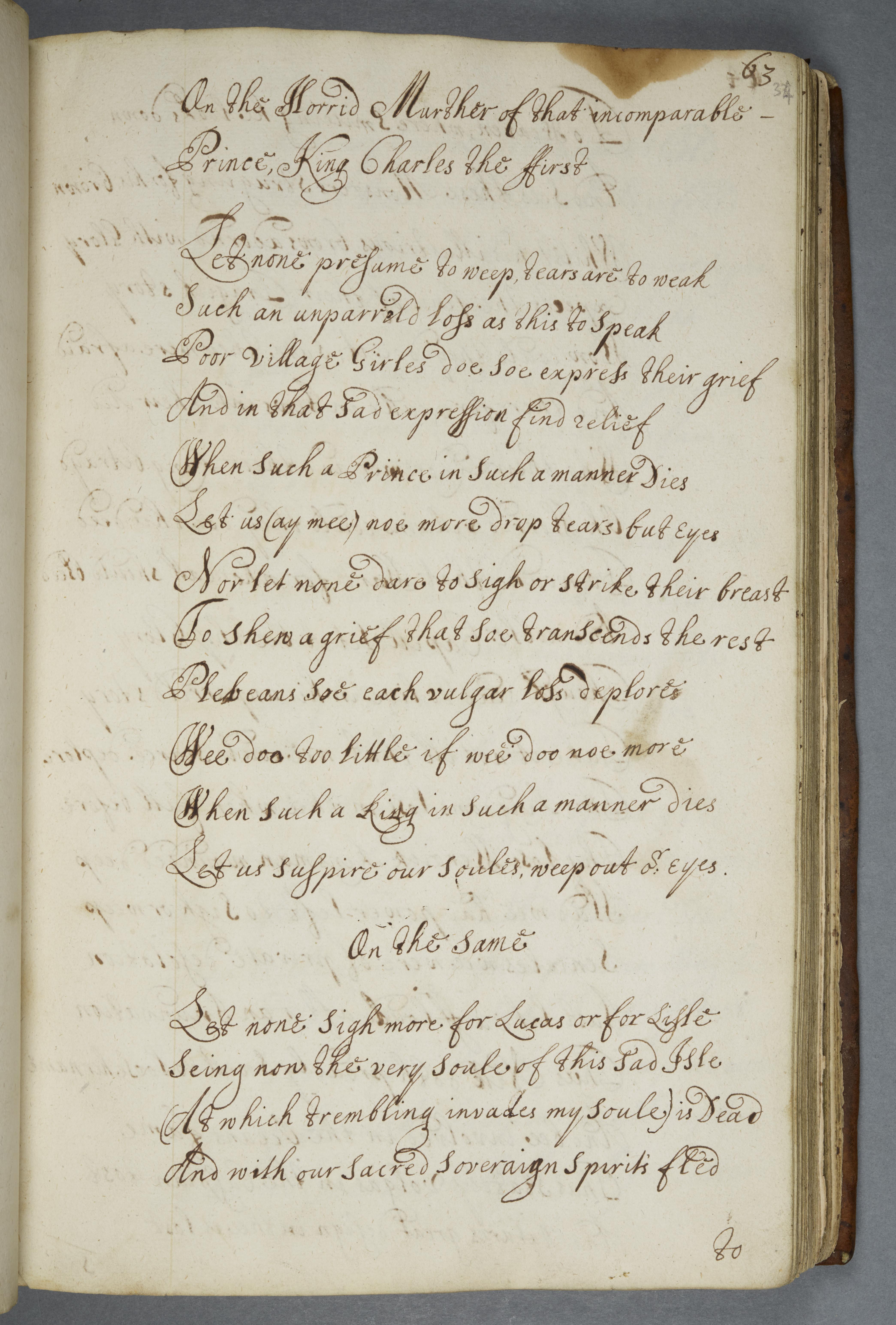
On the Horrid Murder of that Incomparable Prince

X (Close panel) Sources

On the Horrid Murder of that Incomparable Prince

Poem #14

Original Source

Hester Pulter, Poems breathed forth by the nobel Hadassas, University of Leeds Library, Brotherton Collection, MS Lt q 32

Versions

  • Facsimile of manuscript: Photographs provided by University of Leeds, Brotherton Collection

  • Transcription of manuscript: By Leah Knight and Wendy Wall.
  • Elemental edition: By Leah Knight and Wendy Wall.
  • Amplified edition: By David Norbrook.

How to cite these versions

Conventions for these editions

The Pulter Project: Poet in the Making

  • Created by Leah Knight and Wendy Wall
  • Encoded by Katherine Poland, Matthew Taylor, Elizabeth Chou, and Emily Andrey, Northwestern University
  • Website designed by Sergei Kalugin, Northwestern University
  • IT project consultation by Josh Honn, Northwestern University
  • Project sponsored by Northwestern University, Brock University, and University of Leeds
X (Close panel)Poem Index
Loading…
X (Close panel)Notes: Transcription

 Editorial note

In these transcriptions we preserve as many details of the original material, textual, and graphic properties of Hester Pulter’s manuscript verse as we have found practical. Whenever possible, for instance, original spelling, punctuation, capitalization, lineation, insertions, deletions, alterations, spacing between words and lines, and indentation are all maintained; abbreviations and brevigraphs are not expanded; and superscript and subscript representations are retained. See full conventions for the transcriptions here.
Line number 2

 Physical note

“e” written over “i” (with dot still visible)
Line number 9

 Physical note

“b” possibly written over an existing later, perhaps a “v”
Line number 9

 Physical note

“s” erased
Sorry, but there are no notes associated with any currently displayed witness.
X (Close panel)Transcription
Transcription

Facsimile Image Placeholder

Facsimile Image Placeholder

Facsimile Image Placeholder
On the Horrid Murther of that incomparable – Prince, King Charles the ffirst
On the Horrid Murder of that
Gloss Note
In the manuscript, the title specifies: “King Charles the First.” In the English civil war between royalists and parliamentarians, Charles I was sentenced to death and beheaded in 1649.
Incomparable Prince
On the Horrid Murder of that Incomparable Prince, King Charles the First
In these transcriptions we preserve as many details of the original material, textual, and graphic properties of Hester Pulter’s manuscript verse as we have found practical. Whenever possible, for instance, original spelling, punctuation, capitalization, lineation, insertions, deletions, alterations, spacing between words and lines, and indentation are all maintained; abbreviations and brevigraphs are not expanded; and superscript and subscript representations are retained. See full conventions for the transcriptions here.

— Leah Knight and Wendy Wall
The aim of the elemental edition is to make the poems accessible to the largest variety of readers, which involves modernizing spelling and punctuation as well as adding basic glosses. Spelling and punctuation reflect current standard American usage; punctuation highlights syntax which might otherwise be obscure. Outmoded but still familiar word forms (“thou,” “‘tis,” “hold’st”) are not modernized, and we do not modernize grammar when the sense remains legible. After a brief headnote aimed at offering a “way in” to the poem’s unique qualities and connections with other verse by Pulter or her contemporaries, the edition features a minimum of notes and interpretative framing to allow more immediate engagement with the poem. Glosses clarify synonyms or showcase various possible meanings in Pulter’s time. Other notes identify named people and places or clarify obscure material. We rely (without citation) primarily on the Oxford English Dictionary (OED), the Oxford Reference database, and the King James Version (KJV) of the Bible. When we rely on Alice Eardley’s edition of Pulter’s work, we cite her text generally (“Eardley”); other sources are cited in full. The result is an edition we consider a springboard for further work on Pulter’s poetry. See full conventions for this edition here.

— Leah Knight and Wendy Wall
The poem appears on p. 63 of the manuscript, the verso of the preceding page being blank apart from the number 62 in the scribe’s hand; p. 61 contains poem 13, Upon the Imprisonment of his Sacred Majesty, That Unparalleled Prince, King Charles the First [Poem 13]. This is the first blank page in the manuscript, and for the reader, turning the page moves us from the king’s captivity to the aftermath of his death. Let None Sigh More for Lucas or for Lisle [On the Same (2)] [Poem 15] is followed by another blank page. Whether this was an intentional effect cannot be determined–the political poems in the MS are not placed in chronological order, with poem 13 predating poems On those Two Unparalleled Friends, Sir George Lisle and Sir Charles Lucas, Who Were Shot to Death at Colchester [Poem 7] and On that Unparalleled Prince Charles the First, His Horrid Murder [Poem 8], and there are later blank spaces without clear significance; it does seem possible, however, that poems 14 and 15 had been written together on a folded sheet or “separate.” The text is unpunctuated except for brackets at “Ay mee” (l. 6). For the present text, punctuation has been inserted and spelling changed to modern usage. However, the page images are easily available and make it possible to understand the experience of early readers, with the page layout highlighting the structure of the couplets, and capitalization often highlighting balanced words: this is not just something said but something made.

— Leah Knight and Wendy Wall
This poem follows one Upon the Imprisonment of his Sacred Majesty, That Unparalleled Prince, King Charles the First [Poem 13]; it thus follows not only in the manuscript’s arrangement, but in chronology. Charles, jailed in 1647, was in 1649 beheaded by his opponents in England’s civil wars. The monstrous singularity of this event seems reflected in the volume’s preceding blank page, paired with another after the next poem, On the Same [Poem 15]: these two poems, in their efforts to grieve a beloved, murdered ruler, huddle together between visible, almost legible stretches of silence. Here, the speaker draws on the authority of conventional poetic claims of ineffability associated with praising monarchs. But now it is not just words that fail; now, even tears and sighs won’t serve — a devastating claim for a poet who figures much of her verse as tears and sighs. Instead, this poem insists the only fitting response to the king’s dismemberment is a kind of self-vivisection by mourners who are exhorted to weep not tears, but eyeballs, and to sigh not air, but their very souls: that is, to grieve themselves to death.

— Leah Knight and Wendy Wall
This poem is placed in the manuscript after Upon the Imprisonment of his Sacred Majesty, That Unparalleled Prince, King Charles the First [Poem 13], which may have been written in early 1647 (See Ruth Connolly’s Headnote to the Amplified Edition [Poem 13]). The juxtaposition, whether intentional or not, calls attention to the dramatic changes in the king’s fate (see further Exploration: Pulter and Political Revolution). If Pulter was shocked by the rebels who had thrown their sovereign in prison, she now had to find words for the outrage of their putting him on trial and sentencing him to death. He was beheaded on 30 January 1649. While some earlier English monarchs had been put to death, now not only the monarch but the monarchy was destroyed, with the declaration of a republic. As the editors of the Elemental Edition put it: “The monstrous singularity of this event seems reflected in the volume’s preceding blank page, paired with another after the next poem: these two poems, in their efforts to grieve a beloved, murdered ruler, huddle together between visible, almost legible stretches of silence.” The change is reflected in the imagery of tears: from “ask no more why I’m in tears dissolv’d” (Poem 13, line 16) to “Let none presume to weep; tears are too weak…” (Poem 14, line 1). The word ‘unparall[ell]ed’ — which Pulter often used to comprehend a period of such radical changes — is now transferred from the king to his death (Let None Sigh More for Lucas or for Lisle [On the Same (2)] [Poem 15], line 15). There was an outpouring of royalist rage and lament in poetry and prose, from women like Pulter and Katherine Philips writing in manuscript, to printed collections of verse rushed out in defiance of the republican government’s censorship, and above all the king’s own (ghost-written) testament, the Eikon Basilike, which compared his own fate to the crucifixion of Christ. After that extreme parallel, there was in effect nowhere for poets to go. Many of the elegies, especially a series of poems by John Quarles, reflected their authors’ grief in rambling and disjointed structures:
Where shall I run, to whom shall I address
My burthened self, or how shall I express
My uncontrouled sorrows, or relate
Th’ unhappy discord of my factious State?…
This is my want, and till I find relief,
I’le lie and tumble in the shades of grief,
And glut the ayr with sighs; my hideous cries
Shall roar like thunder in the troubled skies:
O that my eyes were Oceans, that I may
Drown all my sorrows in one stormy day;
Or would pleas’d Heaven, enable me to strain,
To gulp up Seas, and weep them out again,
Then should my briny streams gush forth so fast,
That every tear should strive to be the last;
So the swift current of my swelling eyes
Should overflow my heap’d up miseries.
An excerpt from John Quarles’ “Englands Complaint,” in Fons Lachrymarum, or, A Fountain of Tears from whence doth flow Englands Complaint…with Divine Meditations, and an Elegy upon that Son of Valor Sir Charles Lucas (London, 1648–9), pp. 3–5.
“On the Horrid Murder of that Incomparable Prince” reads as if Pulter has surveyed this material and decided to push in the opposite direction, towards extreme concentration, though her language remains hyperbolic. Two lines consist entirely of monosyllables. In this tightly structured poem, Pulter considers two forms of response, weeping and sighing, and in each half of the poem rejects them as too commonplace, with parallel final couplets offering an alternative; at the half-way point we are told to weep out our eyes, but the sighing “ay me” is immediately countered by a ban on sighing, and the second couplet-refrain adds that we should breathe out our souls. The “prince” of the earlier refrain becomes “king.” Comparable patterning is found within lines — “such a prince/king in such a manner,” “We do too little, if we do no more.” The concluding hyperboles gain new force from the constrained frame from which they emerge. Having forbidden sighs at line 7, in the final line Pulter calls on us to “suspire our souls.” The Latin-derived verb, which can mean both “sigh” and “breathe,” offers a reduplicated pattern of sibilants that reinforces the extreme sense: sighing so hard that breath leaves the body altogether. The image thus takes to an extreme a theme of the whole manuscript, whose title-page has the inscription “Poems Breathed forth By The Nobel Haddassas.” The line is then completed: “weep out our eyes.” Many Renaissance and baroque poems juxtaposed tears and eyes: Andrew Marvell would condense the tradition in “Eyes and Tears”:
Thus let your streams o’erflow your springs,
Till eyes and tears be the same things:
And each the other’s diff’rence bears;
These weeping eyes, those seeing tears.
But though Marvell rings the changes of eye imagery, he does not go to the extreme of having the weeper expel her own eyes. Some royalist elegies do link tears with the writing or publishing of elegies as a gesture of political defiance, and Pulter’s hyperbole takes on these connotations of resistance. Compare:
let every word invite
A tear; each tear, a sigh; that every Eye,
That reads, may melt into an Elegie.
An excerpt from John Quarles’ “Englands Complaint,” p.2; and see John McWilliams, “‘A Storm of Lamentations Writ’: Lachrymae Musarum and Royalist Culture after the Civil War,” The Yearbook of English Studies 33 (2003), 273–89 (282–3).
Strikingly, Pulter here opposes her own verse to that of village girls, plebeians, the vulgar. She often attacks the revolutionaries as plebeian monsters, but here, in her concern to cast her own poetry as rejecting stock responses, she seems to mark herself off from popular royalism. John Milton, attacking the people’s devotion to tyrants, complained that support for tyrannicide had to be “swett and labour’d out amidst the throng and noises of vulgar and irrationall men,” who “plead for him, pity him, extoll him, protest against those that talk of bringing him to the tryal of Justice, which is the Sword of God, superior to all mortal things, in whose hand soever by apparent signes his testified will is to put it” (The Tenure of Kings and Magistrates, London, 1649, p. 3). Pulter differentiates herself from vulgar royalism even as she tries to surpass it. She also rejects the uncontrolled emotionalism often associated with women, even though her conclusion also avoids a conventionally masculine stoicism.


— Leah Knight and Wendy Wall
1
Let none preſume to weep, tears are to weak
Let none presume to weep; tears are too weak
2
Such an
Physical Note
“e” written over “i” (with dot still visible)
unparreld
loſs as this to Speak
Gloss Note
of such
Such
an
Critical Note
Spelled “unparelled” (for “unparalleled”) in the manuscript, we have maintained an abbreviation for the sake of the meter.
unparall’d
loss as this to speak.
Gloss Note
of such.
Such
an
Critical Note
unparallelled (“unparelld” in manuscript): a word whose frequent use by Pulter reflects her sense of living in times of crisis.
unparall’d
loss as this to speak.
3
Poor village Girles doe Soe expreſs their grief
Poor village girls do so express their grief,
4
And in that Sad expreſſion find relief
And in that sad expression find relief.
5
When Such a Prince in Such a manner Dies
When such a
Physical Note
sovereign ruler
prince
in such a manner dies,
When such a
Gloss Note
sovereign ruler.
Prince
in such a manner dies,
6
Let us (ay mee) noe more drop tears but eyes
Let us (ay me!) no more drop tears, but eyes;
Let us (ay me!) no more
Gloss Note
exaggerates the common trope of weeping for the king by grotesquely literalizing “eyedrop.”
drop tears, but eyes
;
7
Nor let none dare to Sigh or Strike their breast
Nor let none dare to sigh or strike their breast
8
To Shew a grief that Soe tranſcends the rest
To show a grief that so transcends the rest.
9
Physical Note
“b” possibly written over an existing later, perhaps a “v”
Plebeans
Soe each vulgar loſs
Physical Note
“s” erased
deplores
Gloss Note
commoners
Plebeians
so each vulgar loss
Gloss Note
mourn
deplore
;
Gloss Note
commoners, a term borrowed from the Roman categories of plebeians and patricians: compare The Garden, or The Contention of Flowers [Poem 12], line 428.
Plebeians
so each
Gloss Note
“Of, relating to, or characteristic of ordinary or common people” (Oxford English Dictionary, II.8; compare Latin vulgus).
vulgar
loss
Gloss Note
weep for, mourn.
deplore
;
10
Wee doo too little if wee doo noe more
We do too little, if we do no more.
11
When Such a King in Such a manner Dies
When such a king in such a manner dies,
When such a King in such a manner dies,
12
Let us suſpire our Soules, weep out o:r eyes.
Let us
Gloss Note
sigh, breathe out
suspire
our souls, weep out our eyes.
Let us
Gloss Note
sigh, breathe out (from Latin suspirare).
suspire
our souls, weep out our eyes.
X (Close panel)Notes: Elemental Edition
Title note

 Gloss note

In the manuscript, the title specifies: “King Charles the First.” In the English civil war between royalists and parliamentarians, Charles I was sentenced to death and beheaded in 1649.

 Editorial note

The aim of the elemental edition is to make the poems accessible to the largest variety of readers, which involves modernizing spelling and punctuation as well as adding basic glosses. Spelling and punctuation reflect current standard American usage; punctuation highlights syntax which might otherwise be obscure. Outmoded but still familiar word forms (“thou,” “‘tis,” “hold’st”) are not modernized, and we do not modernize grammar when the sense remains legible. After a brief headnote aimed at offering a “way in” to the poem’s unique qualities and connections with other verse by Pulter or her contemporaries, the edition features a minimum of notes and interpretative framing to allow more immediate engagement with the poem. Glosses clarify synonyms or showcase various possible meanings in Pulter’s time. Other notes identify named people and places or clarify obscure material. We rely (without citation) primarily on the Oxford English Dictionary (OED), the Oxford Reference database, and the King James Version (KJV) of the Bible. When we rely on Alice Eardley’s edition of Pulter’s work, we cite her text generally (“Eardley”); other sources are cited in full. The result is an edition we consider a springboard for further work on Pulter’s poetry. See full conventions for this edition here.

 Headnote

This poem follows one Upon the Imprisonment of his Sacred Majesty, That Unparalleled Prince, King Charles the First [Poem 13]; it thus follows not only in the manuscript’s arrangement, but in chronology. Charles, jailed in 1647, was in 1649 beheaded by his opponents in England’s civil wars. The monstrous singularity of this event seems reflected in the volume’s preceding blank page, paired with another after the next poem, On the Same [Poem 15]: these two poems, in their efforts to grieve a beloved, murdered ruler, huddle together between visible, almost legible stretches of silence. Here, the speaker draws on the authority of conventional poetic claims of ineffability associated with praising monarchs. But now it is not just words that fail; now, even tears and sighs won’t serve — a devastating claim for a poet who figures much of her verse as tears and sighs. Instead, this poem insists the only fitting response to the king’s dismemberment is a kind of self-vivisection by mourners who are exhorted to weep not tears, but eyeballs, and to sigh not air, but their very souls: that is, to grieve themselves to death.
Line number 2

 Gloss note

of such
Line number 2

 Critical note

Spelled “unparelled” (for “unparalleled”) in the manuscript, we have maintained an abbreviation for the sake of the meter.
Line number 5

 Physical note

sovereign ruler
Line number 9

 Gloss note

commoners
Line number 9

 Gloss note

mourn
Line number 12

 Gloss note

sigh, breathe out
Sorry, but there are no notes associated with any currently displayed witness.
X (Close panel)Elemental Edition
Elemental Edition

Facsimile Image Placeholder

Facsimile Image Placeholder

Facsimile Image Placeholder
On the Horrid Murther of that incomparable – Prince, King Charles the ffirst
On the Horrid Murder of that
Gloss Note
In the manuscript, the title specifies: “King Charles the First.” In the English civil war between royalists and parliamentarians, Charles I was sentenced to death and beheaded in 1649.
Incomparable Prince
On the Horrid Murder of that Incomparable Prince, King Charles the First
In these transcriptions we preserve as many details of the original material, textual, and graphic properties of Hester Pulter’s manuscript verse as we have found practical. Whenever possible, for instance, original spelling, punctuation, capitalization, lineation, insertions, deletions, alterations, spacing between words and lines, and indentation are all maintained; abbreviations and brevigraphs are not expanded; and superscript and subscript representations are retained. See full conventions for the transcriptions here.

— Leah Knight and Wendy Wall
The aim of the elemental edition is to make the poems accessible to the largest variety of readers, which involves modernizing spelling and punctuation as well as adding basic glosses. Spelling and punctuation reflect current standard American usage; punctuation highlights syntax which might otherwise be obscure. Outmoded but still familiar word forms (“thou,” “‘tis,” “hold’st”) are not modernized, and we do not modernize grammar when the sense remains legible. After a brief headnote aimed at offering a “way in” to the poem’s unique qualities and connections with other verse by Pulter or her contemporaries, the edition features a minimum of notes and interpretative framing to allow more immediate engagement with the poem. Glosses clarify synonyms or showcase various possible meanings in Pulter’s time. Other notes identify named people and places or clarify obscure material. We rely (without citation) primarily on the Oxford English Dictionary (OED), the Oxford Reference database, and the King James Version (KJV) of the Bible. When we rely on Alice Eardley’s edition of Pulter’s work, we cite her text generally (“Eardley”); other sources are cited in full. The result is an edition we consider a springboard for further work on Pulter’s poetry. See full conventions for this edition here.

— Leah Knight and Wendy Wall
The poem appears on p. 63 of the manuscript, the verso of the preceding page being blank apart from the number 62 in the scribe’s hand; p. 61 contains poem 13, Upon the Imprisonment of his Sacred Majesty, That Unparalleled Prince, King Charles the First [Poem 13]. This is the first blank page in the manuscript, and for the reader, turning the page moves us from the king’s captivity to the aftermath of his death. Let None Sigh More for Lucas or for Lisle [On the Same (2)] [Poem 15] is followed by another blank page. Whether this was an intentional effect cannot be determined–the political poems in the MS are not placed in chronological order, with poem 13 predating poems On those Two Unparalleled Friends, Sir George Lisle and Sir Charles Lucas, Who Were Shot to Death at Colchester [Poem 7] and On that Unparalleled Prince Charles the First, His Horrid Murder [Poem 8], and there are later blank spaces without clear significance; it does seem possible, however, that poems 14 and 15 had been written together on a folded sheet or “separate.” The text is unpunctuated except for brackets at “Ay mee” (l. 6). For the present text, punctuation has been inserted and spelling changed to modern usage. However, the page images are easily available and make it possible to understand the experience of early readers, with the page layout highlighting the structure of the couplets, and capitalization often highlighting balanced words: this is not just something said but something made.

— Leah Knight and Wendy Wall
This poem follows one Upon the Imprisonment of his Sacred Majesty, That Unparalleled Prince, King Charles the First [Poem 13]; it thus follows not only in the manuscript’s arrangement, but in chronology. Charles, jailed in 1647, was in 1649 beheaded by his opponents in England’s civil wars. The monstrous singularity of this event seems reflected in the volume’s preceding blank page, paired with another after the next poem, On the Same [Poem 15]: these two poems, in their efforts to grieve a beloved, murdered ruler, huddle together between visible, almost legible stretches of silence. Here, the speaker draws on the authority of conventional poetic claims of ineffability associated with praising monarchs. But now it is not just words that fail; now, even tears and sighs won’t serve — a devastating claim for a poet who figures much of her verse as tears and sighs. Instead, this poem insists the only fitting response to the king’s dismemberment is a kind of self-vivisection by mourners who are exhorted to weep not tears, but eyeballs, and to sigh not air, but their very souls: that is, to grieve themselves to death.

— Leah Knight and Wendy Wall
This poem is placed in the manuscript after Upon the Imprisonment of his Sacred Majesty, That Unparalleled Prince, King Charles the First [Poem 13], which may have been written in early 1647 (See Ruth Connolly’s Headnote to the Amplified Edition [Poem 13]). The juxtaposition, whether intentional or not, calls attention to the dramatic changes in the king’s fate (see further Exploration: Pulter and Political Revolution). If Pulter was shocked by the rebels who had thrown their sovereign in prison, she now had to find words for the outrage of their putting him on trial and sentencing him to death. He was beheaded on 30 January 1649. While some earlier English monarchs had been put to death, now not only the monarch but the monarchy was destroyed, with the declaration of a republic. As the editors of the Elemental Edition put it: “The monstrous singularity of this event seems reflected in the volume’s preceding blank page, paired with another after the next poem: these two poems, in their efforts to grieve a beloved, murdered ruler, huddle together between visible, almost legible stretches of silence.” The change is reflected in the imagery of tears: from “ask no more why I’m in tears dissolv’d” (Poem 13, line 16) to “Let none presume to weep; tears are too weak…” (Poem 14, line 1). The word ‘unparall[ell]ed’ — which Pulter often used to comprehend a period of such radical changes — is now transferred from the king to his death (Let None Sigh More for Lucas or for Lisle [On the Same (2)] [Poem 15], line 15). There was an outpouring of royalist rage and lament in poetry and prose, from women like Pulter and Katherine Philips writing in manuscript, to printed collections of verse rushed out in defiance of the republican government’s censorship, and above all the king’s own (ghost-written) testament, the Eikon Basilike, which compared his own fate to the crucifixion of Christ. After that extreme parallel, there was in effect nowhere for poets to go. Many of the elegies, especially a series of poems by John Quarles, reflected their authors’ grief in rambling and disjointed structures:
Where shall I run, to whom shall I address
My burthened self, or how shall I express
My uncontrouled sorrows, or relate
Th’ unhappy discord of my factious State?…
This is my want, and till I find relief,
I’le lie and tumble in the shades of grief,
And glut the ayr with sighs; my hideous cries
Shall roar like thunder in the troubled skies:
O that my eyes were Oceans, that I may
Drown all my sorrows in one stormy day;
Or would pleas’d Heaven, enable me to strain,
To gulp up Seas, and weep them out again,
Then should my briny streams gush forth so fast,
That every tear should strive to be the last;
So the swift current of my swelling eyes
Should overflow my heap’d up miseries.
An excerpt from John Quarles’ “Englands Complaint,” in Fons Lachrymarum, or, A Fountain of Tears from whence doth flow Englands Complaint…with Divine Meditations, and an Elegy upon that Son of Valor Sir Charles Lucas (London, 1648–9), pp. 3–5.
“On the Horrid Murder of that Incomparable Prince” reads as if Pulter has surveyed this material and decided to push in the opposite direction, towards extreme concentration, though her language remains hyperbolic. Two lines consist entirely of monosyllables. In this tightly structured poem, Pulter considers two forms of response, weeping and sighing, and in each half of the poem rejects them as too commonplace, with parallel final couplets offering an alternative; at the half-way point we are told to weep out our eyes, but the sighing “ay me” is immediately countered by a ban on sighing, and the second couplet-refrain adds that we should breathe out our souls. The “prince” of the earlier refrain becomes “king.” Comparable patterning is found within lines — “such a prince/king in such a manner,” “We do too little, if we do no more.” The concluding hyperboles gain new force from the constrained frame from which they emerge. Having forbidden sighs at line 7, in the final line Pulter calls on us to “suspire our souls.” The Latin-derived verb, which can mean both “sigh” and “breathe,” offers a reduplicated pattern of sibilants that reinforces the extreme sense: sighing so hard that breath leaves the body altogether. The image thus takes to an extreme a theme of the whole manuscript, whose title-page has the inscription “Poems Breathed forth By The Nobel Haddassas.” The line is then completed: “weep out our eyes.” Many Renaissance and baroque poems juxtaposed tears and eyes: Andrew Marvell would condense the tradition in “Eyes and Tears”:
Thus let your streams o’erflow your springs,
Till eyes and tears be the same things:
And each the other’s diff’rence bears;
These weeping eyes, those seeing tears.
But though Marvell rings the changes of eye imagery, he does not go to the extreme of having the weeper expel her own eyes. Some royalist elegies do link tears with the writing or publishing of elegies as a gesture of political defiance, and Pulter’s hyperbole takes on these connotations of resistance. Compare:
let every word invite
A tear; each tear, a sigh; that every Eye,
That reads, may melt into an Elegie.
An excerpt from John Quarles’ “Englands Complaint,” p.2; and see John McWilliams, “‘A Storm of Lamentations Writ’: Lachrymae Musarum and Royalist Culture after the Civil War,” The Yearbook of English Studies 33 (2003), 273–89 (282–3).
Strikingly, Pulter here opposes her own verse to that of village girls, plebeians, the vulgar. She often attacks the revolutionaries as plebeian monsters, but here, in her concern to cast her own poetry as rejecting stock responses, she seems to mark herself off from popular royalism. John Milton, attacking the people’s devotion to tyrants, complained that support for tyrannicide had to be “swett and labour’d out amidst the throng and noises of vulgar and irrationall men,” who “plead for him, pity him, extoll him, protest against those that talk of bringing him to the tryal of Justice, which is the Sword of God, superior to all mortal things, in whose hand soever by apparent signes his testified will is to put it” (The Tenure of Kings and Magistrates, London, 1649, p. 3). Pulter differentiates herself from vulgar royalism even as she tries to surpass it. She also rejects the uncontrolled emotionalism often associated with women, even though her conclusion also avoids a conventionally masculine stoicism.


— Leah Knight and Wendy Wall
1
Let none preſume to weep, tears are to weak
Let none presume to weep; tears are too weak
2
Such an
Physical Note
“e” written over “i” (with dot still visible)
unparreld
loſs as this to Speak
Gloss Note
of such
Such
an
Critical Note
Spelled “unparelled” (for “unparalleled”) in the manuscript, we have maintained an abbreviation for the sake of the meter.
unparall’d
loss as this to speak.
Gloss Note
of such.
Such
an
Critical Note
unparallelled (“unparelld” in manuscript): a word whose frequent use by Pulter reflects her sense of living in times of crisis.
unparall’d
loss as this to speak.
3
Poor village Girles doe Soe expreſs their grief
Poor village girls do so express their grief,
4
And in that Sad expreſſion find relief
And in that sad expression find relief.
5
When Such a Prince in Such a manner Dies
When such a
Physical Note
sovereign ruler
prince
in such a manner dies,
When such a
Gloss Note
sovereign ruler.
Prince
in such a manner dies,
6
Let us (ay mee) noe more drop tears but eyes
Let us (ay me!) no more drop tears, but eyes;
Let us (ay me!) no more
Gloss Note
exaggerates the common trope of weeping for the king by grotesquely literalizing “eyedrop.”
drop tears, but eyes
;
7
Nor let none dare to Sigh or Strike their breast
Nor let none dare to sigh or strike their breast
8
To Shew a grief that Soe tranſcends the rest
To show a grief that so transcends the rest.
9
Physical Note
“b” possibly written over an existing later, perhaps a “v”
Plebeans
Soe each vulgar loſs
Physical Note
“s” erased
deplores
Gloss Note
commoners
Plebeians
so each vulgar loss
Gloss Note
mourn
deplore
;
Gloss Note
commoners, a term borrowed from the Roman categories of plebeians and patricians: compare The Garden, or The Contention of Flowers [Poem 12], line 428.
Plebeians
so each
Gloss Note
“Of, relating to, or characteristic of ordinary or common people” (Oxford English Dictionary, II.8; compare Latin vulgus).
vulgar
loss
Gloss Note
weep for, mourn.
deplore
;
10
Wee doo too little if wee doo noe more
We do too little, if we do no more.
11
When Such a King in Such a manner Dies
When such a king in such a manner dies,
When such a King in such a manner dies,
12
Let us suſpire our Soules, weep out o:r eyes.
Let us
Gloss Note
sigh, breathe out
suspire
our souls, weep out our eyes.
Let us
Gloss Note
sigh, breathe out (from Latin suspirare).
suspire
our souls, weep out our eyes.
X (Close panel)Notes: Amplified Edition

 Editorial note

The poem appears on p. 63 of the manuscript, the verso of the preceding page being blank apart from the number 62 in the scribe’s hand; p. 61 contains poem 13, Upon the Imprisonment of his Sacred Majesty, That Unparalleled Prince, King Charles the First [Poem 13]. This is the first blank page in the manuscript, and for the reader, turning the page moves us from the king’s captivity to the aftermath of his death. Let None Sigh More for Lucas or for Lisle [On the Same (2)] [Poem 15] is followed by another blank page. Whether this was an intentional effect cannot be determined–the political poems in the MS are not placed in chronological order, with poem 13 predating poems On those Two Unparalleled Friends, Sir George Lisle and Sir Charles Lucas, Who Were Shot to Death at Colchester [Poem 7] and On that Unparalleled Prince Charles the First, His Horrid Murder [Poem 8], and there are later blank spaces without clear significance; it does seem possible, however, that poems 14 and 15 had been written together on a folded sheet or “separate.” The text is unpunctuated except for brackets at “Ay mee” (l. 6). For the present text, punctuation has been inserted and spelling changed to modern usage. However, the page images are easily available and make it possible to understand the experience of early readers, with the page layout highlighting the structure of the couplets, and capitalization often highlighting balanced words: this is not just something said but something made.

 Headnote

This poem is placed in the manuscript after Upon the Imprisonment of his Sacred Majesty, That Unparalleled Prince, King Charles the First [Poem 13], which may have been written in early 1647 (See Ruth Connolly’s Headnote to the Amplified Edition [Poem 13]). The juxtaposition, whether intentional or not, calls attention to the dramatic changes in the king’s fate (see further Exploration: Pulter and Political Revolution). If Pulter was shocked by the rebels who had thrown their sovereign in prison, she now had to find words for the outrage of their putting him on trial and sentencing him to death. He was beheaded on 30 January 1649. While some earlier English monarchs had been put to death, now not only the monarch but the monarchy was destroyed, with the declaration of a republic. As the editors of the Elemental Edition put it: “The monstrous singularity of this event seems reflected in the volume’s preceding blank page, paired with another after the next poem: these two poems, in their efforts to grieve a beloved, murdered ruler, huddle together between visible, almost legible stretches of silence.” The change is reflected in the imagery of tears: from “ask no more why I’m in tears dissolv’d” (Poem 13, line 16) to “Let none presume to weep; tears are too weak…” (Poem 14, line 1). The word ‘unparall[ell]ed’ — which Pulter often used to comprehend a period of such radical changes — is now transferred from the king to his death (Let None Sigh More for Lucas or for Lisle [On the Same (2)] [Poem 15], line 15). There was an outpouring of royalist rage and lament in poetry and prose, from women like Pulter and Katherine Philips writing in manuscript, to printed collections of verse rushed out in defiance of the republican government’s censorship, and above all the king’s own (ghost-written) testament, the Eikon Basilike, which compared his own fate to the crucifixion of Christ. After that extreme parallel, there was in effect nowhere for poets to go. Many of the elegies, especially a series of poems by John Quarles, reflected their authors’ grief in rambling and disjointed structures:
Where shall I run, to whom shall I address
My burthened self, or how shall I express
My uncontrouled sorrows, or relate
Th’ unhappy discord of my factious State?…
This is my want, and till I find relief,
I’le lie and tumble in the shades of grief,
And glut the ayr with sighs; my hideous cries
Shall roar like thunder in the troubled skies:
O that my eyes were Oceans, that I may
Drown all my sorrows in one stormy day;
Or would pleas’d Heaven, enable me to strain,
To gulp up Seas, and weep them out again,
Then should my briny streams gush forth so fast,
That every tear should strive to be the last;
So the swift current of my swelling eyes
Should overflow my heap’d up miseries.
An excerpt from John Quarles’ “Englands Complaint,” in Fons Lachrymarum, or, A Fountain of Tears from whence doth flow Englands Complaint…with Divine Meditations, and an Elegy upon that Son of Valor Sir Charles Lucas (London, 1648–9), pp. 3–5.
“On the Horrid Murder of that Incomparable Prince” reads as if Pulter has surveyed this material and decided to push in the opposite direction, towards extreme concentration, though her language remains hyperbolic. Two lines consist entirely of monosyllables. In this tightly structured poem, Pulter considers two forms of response, weeping and sighing, and in each half of the poem rejects them as too commonplace, with parallel final couplets offering an alternative; at the half-way point we are told to weep out our eyes, but the sighing “ay me” is immediately countered by a ban on sighing, and the second couplet-refrain adds that we should breathe out our souls. The “prince” of the earlier refrain becomes “king.” Comparable patterning is found within lines — “such a prince/king in such a manner,” “We do too little, if we do no more.” The concluding hyperboles gain new force from the constrained frame from which they emerge. Having forbidden sighs at line 7, in the final line Pulter calls on us to “suspire our souls.” The Latin-derived verb, which can mean both “sigh” and “breathe,” offers a reduplicated pattern of sibilants that reinforces the extreme sense: sighing so hard that breath leaves the body altogether. The image thus takes to an extreme a theme of the whole manuscript, whose title-page has the inscription “Poems Breathed forth By The Nobel Haddassas.” The line is then completed: “weep out our eyes.” Many Renaissance and baroque poems juxtaposed tears and eyes: Andrew Marvell would condense the tradition in “Eyes and Tears”:
Thus let your streams o’erflow your springs,
Till eyes and tears be the same things:
And each the other’s diff’rence bears;
These weeping eyes, those seeing tears.
But though Marvell rings the changes of eye imagery, he does not go to the extreme of having the weeper expel her own eyes. Some royalist elegies do link tears with the writing or publishing of elegies as a gesture of political defiance, and Pulter’s hyperbole takes on these connotations of resistance. Compare:
let every word invite
A tear; each tear, a sigh; that every Eye,
That reads, may melt into an Elegie.
An excerpt from John Quarles’ “Englands Complaint,” p.2; and see John McWilliams, “‘A Storm of Lamentations Writ’: Lachrymae Musarum and Royalist Culture after the Civil War,” The Yearbook of English Studies 33 (2003), 273–89 (282–3).
Strikingly, Pulter here opposes her own verse to that of village girls, plebeians, the vulgar. She often attacks the revolutionaries as plebeian monsters, but here, in her concern to cast her own poetry as rejecting stock responses, she seems to mark herself off from popular royalism. John Milton, attacking the people’s devotion to tyrants, complained that support for tyrannicide had to be “swett and labour’d out amidst the throng and noises of vulgar and irrationall men,” who “plead for him, pity him, extoll him, protest against those that talk of bringing him to the tryal of Justice, which is the Sword of God, superior to all mortal things, in whose hand soever by apparent signes his testified will is to put it” (The Tenure of Kings and Magistrates, London, 1649, p. 3). Pulter differentiates herself from vulgar royalism even as she tries to surpass it. She also rejects the uncontrolled emotionalism often associated with women, even though her conclusion also avoids a conventionally masculine stoicism.
Line number 2

 Gloss note

of such.
Line number 2

 Critical note

unparallelled (“unparelld” in manuscript): a word whose frequent use by Pulter reflects her sense of living in times of crisis.
Line number 5

 Gloss note

sovereign ruler.
Line number 6

 Gloss note

exaggerates the common trope of weeping for the king by grotesquely literalizing “eyedrop.”
Line number 9

 Gloss note

commoners, a term borrowed from the Roman categories of plebeians and patricians: compare The Garden, or The Contention of Flowers [Poem 12], line 428.
Line number 9

 Gloss note

“Of, relating to, or characteristic of ordinary or common people” (Oxford English Dictionary, II.8; compare Latin vulgus).
Line number 9

 Gloss note

weep for, mourn.
Line number 12

 Gloss note

sigh, breathe out (from Latin suspirare).
Sorry, but there are no notes associated with any currently displayed witness.
X (Close panel)Amplified Edition
Amplified Edition

Facsimile Image Placeholder

Facsimile Image Placeholder

Facsimile Image Placeholder
On the Horrid Murther of that incomparable – Prince, King Charles the ffirst
On the Horrid Murder of that
Gloss Note
In the manuscript, the title specifies: “King Charles the First.” In the English civil war between royalists and parliamentarians, Charles I was sentenced to death and beheaded in 1649.
Incomparable Prince
On the Horrid Murder of that Incomparable Prince, King Charles the First
In these transcriptions we preserve as many details of the original material, textual, and graphic properties of Hester Pulter’s manuscript verse as we have found practical. Whenever possible, for instance, original spelling, punctuation, capitalization, lineation, insertions, deletions, alterations, spacing between words and lines, and indentation are all maintained; abbreviations and brevigraphs are not expanded; and superscript and subscript representations are retained. See full conventions for the transcriptions here.

— David Norbrook
The aim of the elemental edition is to make the poems accessible to the largest variety of readers, which involves modernizing spelling and punctuation as well as adding basic glosses. Spelling and punctuation reflect current standard American usage; punctuation highlights syntax which might otherwise be obscure. Outmoded but still familiar word forms (“thou,” “‘tis,” “hold’st”) are not modernized, and we do not modernize grammar when the sense remains legible. After a brief headnote aimed at offering a “way in” to the poem’s unique qualities and connections with other verse by Pulter or her contemporaries, the edition features a minimum of notes and interpretative framing to allow more immediate engagement with the poem. Glosses clarify synonyms or showcase various possible meanings in Pulter’s time. Other notes identify named people and places or clarify obscure material. We rely (without citation) primarily on the Oxford English Dictionary (OED), the Oxford Reference database, and the King James Version (KJV) of the Bible. When we rely on Alice Eardley’s edition of Pulter’s work, we cite her text generally (“Eardley”); other sources are cited in full. The result is an edition we consider a springboard for further work on Pulter’s poetry. See full conventions for this edition here.

— David Norbrook
The poem appears on p. 63 of the manuscript, the verso of the preceding page being blank apart from the number 62 in the scribe’s hand; p. 61 contains poem 13, Upon the Imprisonment of his Sacred Majesty, That Unparalleled Prince, King Charles the First [Poem 13]. This is the first blank page in the manuscript, and for the reader, turning the page moves us from the king’s captivity to the aftermath of his death. Let None Sigh More for Lucas or for Lisle [On the Same (2)] [Poem 15] is followed by another blank page. Whether this was an intentional effect cannot be determined–the political poems in the MS are not placed in chronological order, with poem 13 predating poems On those Two Unparalleled Friends, Sir George Lisle and Sir Charles Lucas, Who Were Shot to Death at Colchester [Poem 7] and On that Unparalleled Prince Charles the First, His Horrid Murder [Poem 8], and there are later blank spaces without clear significance; it does seem possible, however, that poems 14 and 15 had been written together on a folded sheet or “separate.” The text is unpunctuated except for brackets at “Ay mee” (l. 6). For the present text, punctuation has been inserted and spelling changed to modern usage. However, the page images are easily available and make it possible to understand the experience of early readers, with the page layout highlighting the structure of the couplets, and capitalization often highlighting balanced words: this is not just something said but something made.

— David Norbrook
This poem follows one Upon the Imprisonment of his Sacred Majesty, That Unparalleled Prince, King Charles the First [Poem 13]; it thus follows not only in the manuscript’s arrangement, but in chronology. Charles, jailed in 1647, was in 1649 beheaded by his opponents in England’s civil wars. The monstrous singularity of this event seems reflected in the volume’s preceding blank page, paired with another after the next poem, On the Same [Poem 15]: these two poems, in their efforts to grieve a beloved, murdered ruler, huddle together between visible, almost legible stretches of silence. Here, the speaker draws on the authority of conventional poetic claims of ineffability associated with praising monarchs. But now it is not just words that fail; now, even tears and sighs won’t serve — a devastating claim for a poet who figures much of her verse as tears and sighs. Instead, this poem insists the only fitting response to the king’s dismemberment is a kind of self-vivisection by mourners who are exhorted to weep not tears, but eyeballs, and to sigh not air, but their very souls: that is, to grieve themselves to death.

— David Norbrook
This poem is placed in the manuscript after Upon the Imprisonment of his Sacred Majesty, That Unparalleled Prince, King Charles the First [Poem 13], which may have been written in early 1647 (See Ruth Connolly’s Headnote to the Amplified Edition [Poem 13]). The juxtaposition, whether intentional or not, calls attention to the dramatic changes in the king’s fate (see further Exploration: Pulter and Political Revolution). If Pulter was shocked by the rebels who had thrown their sovereign in prison, she now had to find words for the outrage of their putting him on trial and sentencing him to death. He was beheaded on 30 January 1649. While some earlier English monarchs had been put to death, now not only the monarch but the monarchy was destroyed, with the declaration of a republic. As the editors of the Elemental Edition put it: “The monstrous singularity of this event seems reflected in the volume’s preceding blank page, paired with another after the next poem: these two poems, in their efforts to grieve a beloved, murdered ruler, huddle together between visible, almost legible stretches of silence.” The change is reflected in the imagery of tears: from “ask no more why I’m in tears dissolv’d” (Poem 13, line 16) to “Let none presume to weep; tears are too weak…” (Poem 14, line 1). The word ‘unparall[ell]ed’ — which Pulter often used to comprehend a period of such radical changes — is now transferred from the king to his death (Let None Sigh More for Lucas or for Lisle [On the Same (2)] [Poem 15], line 15). There was an outpouring of royalist rage and lament in poetry and prose, from women like Pulter and Katherine Philips writing in manuscript, to printed collections of verse rushed out in defiance of the republican government’s censorship, and above all the king’s own (ghost-written) testament, the Eikon Basilike, which compared his own fate to the crucifixion of Christ. After that extreme parallel, there was in effect nowhere for poets to go. Many of the elegies, especially a series of poems by John Quarles, reflected their authors’ grief in rambling and disjointed structures:
Where shall I run, to whom shall I address
My burthened self, or how shall I express
My uncontrouled sorrows, or relate
Th’ unhappy discord of my factious State?…
This is my want, and till I find relief,
I’le lie and tumble in the shades of grief,
And glut the ayr with sighs; my hideous cries
Shall roar like thunder in the troubled skies:
O that my eyes were Oceans, that I may
Drown all my sorrows in one stormy day;
Or would pleas’d Heaven, enable me to strain,
To gulp up Seas, and weep them out again,
Then should my briny streams gush forth so fast,
That every tear should strive to be the last;
So the swift current of my swelling eyes
Should overflow my heap’d up miseries.
An excerpt from John Quarles’ “Englands Complaint,” in Fons Lachrymarum, or, A Fountain of Tears from whence doth flow Englands Complaint…with Divine Meditations, and an Elegy upon that Son of Valor Sir Charles Lucas (London, 1648–9), pp. 3–5.
“On the Horrid Murder of that Incomparable Prince” reads as if Pulter has surveyed this material and decided to push in the opposite direction, towards extreme concentration, though her language remains hyperbolic. Two lines consist entirely of monosyllables. In this tightly structured poem, Pulter considers two forms of response, weeping and sighing, and in each half of the poem rejects them as too commonplace, with parallel final couplets offering an alternative; at the half-way point we are told to weep out our eyes, but the sighing “ay me” is immediately countered by a ban on sighing, and the second couplet-refrain adds that we should breathe out our souls. The “prince” of the earlier refrain becomes “king.” Comparable patterning is found within lines — “such a prince/king in such a manner,” “We do too little, if we do no more.” The concluding hyperboles gain new force from the constrained frame from which they emerge. Having forbidden sighs at line 7, in the final line Pulter calls on us to “suspire our souls.” The Latin-derived verb, which can mean both “sigh” and “breathe,” offers a reduplicated pattern of sibilants that reinforces the extreme sense: sighing so hard that breath leaves the body altogether. The image thus takes to an extreme a theme of the whole manuscript, whose title-page has the inscription “Poems Breathed forth By The Nobel Haddassas.” The line is then completed: “weep out our eyes.” Many Renaissance and baroque poems juxtaposed tears and eyes: Andrew Marvell would condense the tradition in “Eyes and Tears”:
Thus let your streams o’erflow your springs,
Till eyes and tears be the same things:
And each the other’s diff’rence bears;
These weeping eyes, those seeing tears.
But though Marvell rings the changes of eye imagery, he does not go to the extreme of having the weeper expel her own eyes. Some royalist elegies do link tears with the writing or publishing of elegies as a gesture of political defiance, and Pulter’s hyperbole takes on these connotations of resistance. Compare:
let every word invite
A tear; each tear, a sigh; that every Eye,
That reads, may melt into an Elegie.
An excerpt from John Quarles’ “Englands Complaint,” p.2; and see John McWilliams, “‘A Storm of Lamentations Writ’: Lachrymae Musarum and Royalist Culture after the Civil War,” The Yearbook of English Studies 33 (2003), 273–89 (282–3).
Strikingly, Pulter here opposes her own verse to that of village girls, plebeians, the vulgar. She often attacks the revolutionaries as plebeian monsters, but here, in her concern to cast her own poetry as rejecting stock responses, she seems to mark herself off from popular royalism. John Milton, attacking the people’s devotion to tyrants, complained that support for tyrannicide had to be “swett and labour’d out amidst the throng and noises of vulgar and irrationall men,” who “plead for him, pity him, extoll him, protest against those that talk of bringing him to the tryal of Justice, which is the Sword of God, superior to all mortal things, in whose hand soever by apparent signes his testified will is to put it” (The Tenure of Kings and Magistrates, London, 1649, p. 3). Pulter differentiates herself from vulgar royalism even as she tries to surpass it. She also rejects the uncontrolled emotionalism often associated with women, even though her conclusion also avoids a conventionally masculine stoicism.


— David Norbrook
1
Let none preſume to weep, tears are to weak
Let none presume to weep; tears are too weak
2
Such an
Physical Note
“e” written over “i” (with dot still visible)
unparreld
loſs as this to Speak
Gloss Note
of such
Such
an
Critical Note
Spelled “unparelled” (for “unparalleled”) in the manuscript, we have maintained an abbreviation for the sake of the meter.
unparall’d
loss as this to speak.
Gloss Note
of such.
Such
an
Critical Note
unparallelled (“unparelld” in manuscript): a word whose frequent use by Pulter reflects her sense of living in times of crisis.
unparall’d
loss as this to speak.
3
Poor village Girles doe Soe expreſs their grief
Poor village girls do so express their grief,
4
And in that Sad expreſſion find relief
And in that sad expression find relief.
5
When Such a Prince in Such a manner Dies
When such a
Physical Note
sovereign ruler
prince
in such a manner dies,
When such a
Gloss Note
sovereign ruler.
Prince
in such a manner dies,
6
Let us (ay mee) noe more drop tears but eyes
Let us (ay me!) no more drop tears, but eyes;
Let us (ay me!) no more
Gloss Note
exaggerates the common trope of weeping for the king by grotesquely literalizing “eyedrop.”
drop tears, but eyes
;
7
Nor let none dare to Sigh or Strike their breast
Nor let none dare to sigh or strike their breast
8
To Shew a grief that Soe tranſcends the rest
To show a grief that so transcends the rest.
9
Physical Note
“b” possibly written over an existing later, perhaps a “v”
Plebeans
Soe each vulgar loſs
Physical Note
“s” erased
deplores
Gloss Note
commoners
Plebeians
so each vulgar loss
Gloss Note
mourn
deplore
;
Gloss Note
commoners, a term borrowed from the Roman categories of plebeians and patricians: compare The Garden, or The Contention of Flowers [Poem 12], line 428.
Plebeians
so each
Gloss Note
“Of, relating to, or characteristic of ordinary or common people” (Oxford English Dictionary, II.8; compare Latin vulgus).
vulgar
loss
Gloss Note
weep for, mourn.
deplore
;
10
Wee doo too little if wee doo noe more
We do too little, if we do no more.
11
When Such a King in Such a manner Dies
When such a king in such a manner dies,
When such a King in such a manner dies,
12
Let us suſpire our Soules, weep out o:r eyes.
Let us
Gloss Note
sigh, breathe out
suspire
our souls, weep out our eyes.
Let us
Gloss Note
sigh, breathe out (from Latin suspirare).
suspire
our souls, weep out our eyes.
X (Close panel) All Notes
Elemental Edition
Title note

 Gloss note

In the manuscript, the title specifies: “King Charles the First.” In the English civil war between royalists and parliamentarians, Charles I was sentenced to death and beheaded in 1649.
Transcription

 Editorial note

In these transcriptions we preserve as many details of the original material, textual, and graphic properties of Hester Pulter’s manuscript verse as we have found practical. Whenever possible, for instance, original spelling, punctuation, capitalization, lineation, insertions, deletions, alterations, spacing between words and lines, and indentation are all maintained; abbreviations and brevigraphs are not expanded; and superscript and subscript representations are retained. See full conventions for the transcriptions here.
Elemental Edition

 Editorial note

The aim of the elemental edition is to make the poems accessible to the largest variety of readers, which involves modernizing spelling and punctuation as well as adding basic glosses. Spelling and punctuation reflect current standard American usage; punctuation highlights syntax which might otherwise be obscure. Outmoded but still familiar word forms (“thou,” “‘tis,” “hold’st”) are not modernized, and we do not modernize grammar when the sense remains legible. After a brief headnote aimed at offering a “way in” to the poem’s unique qualities and connections with other verse by Pulter or her contemporaries, the edition features a minimum of notes and interpretative framing to allow more immediate engagement with the poem. Glosses clarify synonyms or showcase various possible meanings in Pulter’s time. Other notes identify named people and places or clarify obscure material. We rely (without citation) primarily on the Oxford English Dictionary (OED), the Oxford Reference database, and the King James Version (KJV) of the Bible. When we rely on Alice Eardley’s edition of Pulter’s work, we cite her text generally (“Eardley”); other sources are cited in full. The result is an edition we consider a springboard for further work on Pulter’s poetry. See full conventions for this edition here.
Amplified Edition

 Editorial note

The poem appears on p. 63 of the manuscript, the verso of the preceding page being blank apart from the number 62 in the scribe’s hand; p. 61 contains poem 13, Upon the Imprisonment of his Sacred Majesty, That Unparalleled Prince, King Charles the First [Poem 13]. This is the first blank page in the manuscript, and for the reader, turning the page moves us from the king’s captivity to the aftermath of his death. Let None Sigh More for Lucas or for Lisle [On the Same (2)] [Poem 15] is followed by another blank page. Whether this was an intentional effect cannot be determined–the political poems in the MS are not placed in chronological order, with poem 13 predating poems On those Two Unparalleled Friends, Sir George Lisle and Sir Charles Lucas, Who Were Shot to Death at Colchester [Poem 7] and On that Unparalleled Prince Charles the First, His Horrid Murder [Poem 8], and there are later blank spaces without clear significance; it does seem possible, however, that poems 14 and 15 had been written together on a folded sheet or “separate.” The text is unpunctuated except for brackets at “Ay mee” (l. 6). For the present text, punctuation has been inserted and spelling changed to modern usage. However, the page images are easily available and make it possible to understand the experience of early readers, with the page layout highlighting the structure of the couplets, and capitalization often highlighting balanced words: this is not just something said but something made.
Elemental Edition

 Headnote

This poem follows one Upon the Imprisonment of his Sacred Majesty, That Unparalleled Prince, King Charles the First [Poem 13]; it thus follows not only in the manuscript’s arrangement, but in chronology. Charles, jailed in 1647, was in 1649 beheaded by his opponents in England’s civil wars. The monstrous singularity of this event seems reflected in the volume’s preceding blank page, paired with another after the next poem, On the Same [Poem 15]: these two poems, in their efforts to grieve a beloved, murdered ruler, huddle together between visible, almost legible stretches of silence. Here, the speaker draws on the authority of conventional poetic claims of ineffability associated with praising monarchs. But now it is not just words that fail; now, even tears and sighs won’t serve — a devastating claim for a poet who figures much of her verse as tears and sighs. Instead, this poem insists the only fitting response to the king’s dismemberment is a kind of self-vivisection by mourners who are exhorted to weep not tears, but eyeballs, and to sigh not air, but their very souls: that is, to grieve themselves to death.
Amplified Edition

 Headnote

This poem is placed in the manuscript after Upon the Imprisonment of his Sacred Majesty, That Unparalleled Prince, King Charles the First [Poem 13], which may have been written in early 1647 (See Ruth Connolly’s Headnote to the Amplified Edition [Poem 13]). The juxtaposition, whether intentional or not, calls attention to the dramatic changes in the king’s fate (see further Exploration: Pulter and Political Revolution). If Pulter was shocked by the rebels who had thrown their sovereign in prison, she now had to find words for the outrage of their putting him on trial and sentencing him to death. He was beheaded on 30 January 1649. While some earlier English monarchs had been put to death, now not only the monarch but the monarchy was destroyed, with the declaration of a republic. As the editors of the Elemental Edition put it: “The monstrous singularity of this event seems reflected in the volume’s preceding blank page, paired with another after the next poem: these two poems, in their efforts to grieve a beloved, murdered ruler, huddle together between visible, almost legible stretches of silence.” The change is reflected in the imagery of tears: from “ask no more why I’m in tears dissolv’d” (Poem 13, line 16) to “Let none presume to weep; tears are too weak…” (Poem 14, line 1). The word ‘unparall[ell]ed’ — which Pulter often used to comprehend a period of such radical changes — is now transferred from the king to his death (Let None Sigh More for Lucas or for Lisle [On the Same (2)] [Poem 15], line 15). There was an outpouring of royalist rage and lament in poetry and prose, from women like Pulter and Katherine Philips writing in manuscript, to printed collections of verse rushed out in defiance of the republican government’s censorship, and above all the king’s own (ghost-written) testament, the Eikon Basilike, which compared his own fate to the crucifixion of Christ. After that extreme parallel, there was in effect nowhere for poets to go. Many of the elegies, especially a series of poems by John Quarles, reflected their authors’ grief in rambling and disjointed structures:
Where shall I run, to whom shall I address
My burthened self, or how shall I express
My uncontrouled sorrows, or relate
Th’ unhappy discord of my factious State?…
This is my want, and till I find relief,
I’le lie and tumble in the shades of grief,
And glut the ayr with sighs; my hideous cries
Shall roar like thunder in the troubled skies:
O that my eyes were Oceans, that I may
Drown all my sorrows in one stormy day;
Or would pleas’d Heaven, enable me to strain,
To gulp up Seas, and weep them out again,
Then should my briny streams gush forth so fast,
That every tear should strive to be the last;
So the swift current of my swelling eyes
Should overflow my heap’d up miseries.
An excerpt from John Quarles’ “Englands Complaint,” in Fons Lachrymarum, or, A Fountain of Tears from whence doth flow Englands Complaint…with Divine Meditations, and an Elegy upon that Son of Valor Sir Charles Lucas (London, 1648–9), pp. 3–5.
“On the Horrid Murder of that Incomparable Prince” reads as if Pulter has surveyed this material and decided to push in the opposite direction, towards extreme concentration, though her language remains hyperbolic. Two lines consist entirely of monosyllables. In this tightly structured poem, Pulter considers two forms of response, weeping and sighing, and in each half of the poem rejects them as too commonplace, with parallel final couplets offering an alternative; at the half-way point we are told to weep out our eyes, but the sighing “ay me” is immediately countered by a ban on sighing, and the second couplet-refrain adds that we should breathe out our souls. The “prince” of the earlier refrain becomes “king.” Comparable patterning is found within lines — “such a prince/king in such a manner,” “We do too little, if we do no more.” The concluding hyperboles gain new force from the constrained frame from which they emerge. Having forbidden sighs at line 7, in the final line Pulter calls on us to “suspire our souls.” The Latin-derived verb, which can mean both “sigh” and “breathe,” offers a reduplicated pattern of sibilants that reinforces the extreme sense: sighing so hard that breath leaves the body altogether. The image thus takes to an extreme a theme of the whole manuscript, whose title-page has the inscription “Poems Breathed forth By The Nobel Haddassas.” The line is then completed: “weep out our eyes.” Many Renaissance and baroque poems juxtaposed tears and eyes: Andrew Marvell would condense the tradition in “Eyes and Tears”:
Thus let your streams o’erflow your springs,
Till eyes and tears be the same things:
And each the other’s diff’rence bears;
These weeping eyes, those seeing tears.
But though Marvell rings the changes of eye imagery, he does not go to the extreme of having the weeper expel her own eyes. Some royalist elegies do link tears with the writing or publishing of elegies as a gesture of political defiance, and Pulter’s hyperbole takes on these connotations of resistance. Compare:
let every word invite
A tear; each tear, a sigh; that every Eye,
That reads, may melt into an Elegie.
An excerpt from John Quarles’ “Englands Complaint,” p.2; and see John McWilliams, “‘A Storm of Lamentations Writ’: Lachrymae Musarum and Royalist Culture after the Civil War,” The Yearbook of English Studies 33 (2003), 273–89 (282–3).
Strikingly, Pulter here opposes her own verse to that of village girls, plebeians, the vulgar. She often attacks the revolutionaries as plebeian monsters, but here, in her concern to cast her own poetry as rejecting stock responses, she seems to mark herself off from popular royalism. John Milton, attacking the people’s devotion to tyrants, complained that support for tyrannicide had to be “swett and labour’d out amidst the throng and noises of vulgar and irrationall men,” who “plead for him, pity him, extoll him, protest against those that talk of bringing him to the tryal of Justice, which is the Sword of God, superior to all mortal things, in whose hand soever by apparent signes his testified will is to put it” (The Tenure of Kings and Magistrates, London, 1649, p. 3). Pulter differentiates herself from vulgar royalism even as she tries to surpass it. She also rejects the uncontrolled emotionalism often associated with women, even though her conclusion also avoids a conventionally masculine stoicism.
Transcription
Line number 2

 Physical note

“e” written over “i” (with dot still visible)
Elemental Edition
Line number 2

 Gloss note

of such
Elemental Edition
Line number 2

 Critical note

Spelled “unparelled” (for “unparalleled”) in the manuscript, we have maintained an abbreviation for the sake of the meter.
Amplified Edition
Line number 2

 Gloss note

of such.
Amplified Edition
Line number 2

 Critical note

unparallelled (“unparelld” in manuscript): a word whose frequent use by Pulter reflects her sense of living in times of crisis.
Elemental Edition
Line number 5

 Physical note

sovereign ruler
Amplified Edition
Line number 5

 Gloss note

sovereign ruler.
Amplified Edition
Line number 6

 Gloss note

exaggerates the common trope of weeping for the king by grotesquely literalizing “eyedrop.”
Transcription
Line number 9

 Physical note

“b” possibly written over an existing later, perhaps a “v”
Transcription
Line number 9

 Physical note

“s” erased
Elemental Edition
Line number 9

 Gloss note

commoners
Elemental Edition
Line number 9

 Gloss note

mourn
Amplified Edition
Line number 9

 Gloss note

commoners, a term borrowed from the Roman categories of plebeians and patricians: compare The Garden, or The Contention of Flowers [Poem 12], line 428.
Amplified Edition
Line number 9

 Gloss note

“Of, relating to, or characteristic of ordinary or common people” (Oxford English Dictionary, II.8; compare Latin vulgus).
Amplified Edition
Line number 9

 Gloss note

weep for, mourn.
Elemental Edition
Line number 12

 Gloss note

sigh, breathe out
Amplified Edition
Line number 12

 Gloss note

sigh, breathe out (from Latin suspirare).
Sorry, but there are no notes associated with any currently displayed witness.
ManuscriptX (Close panel)
image