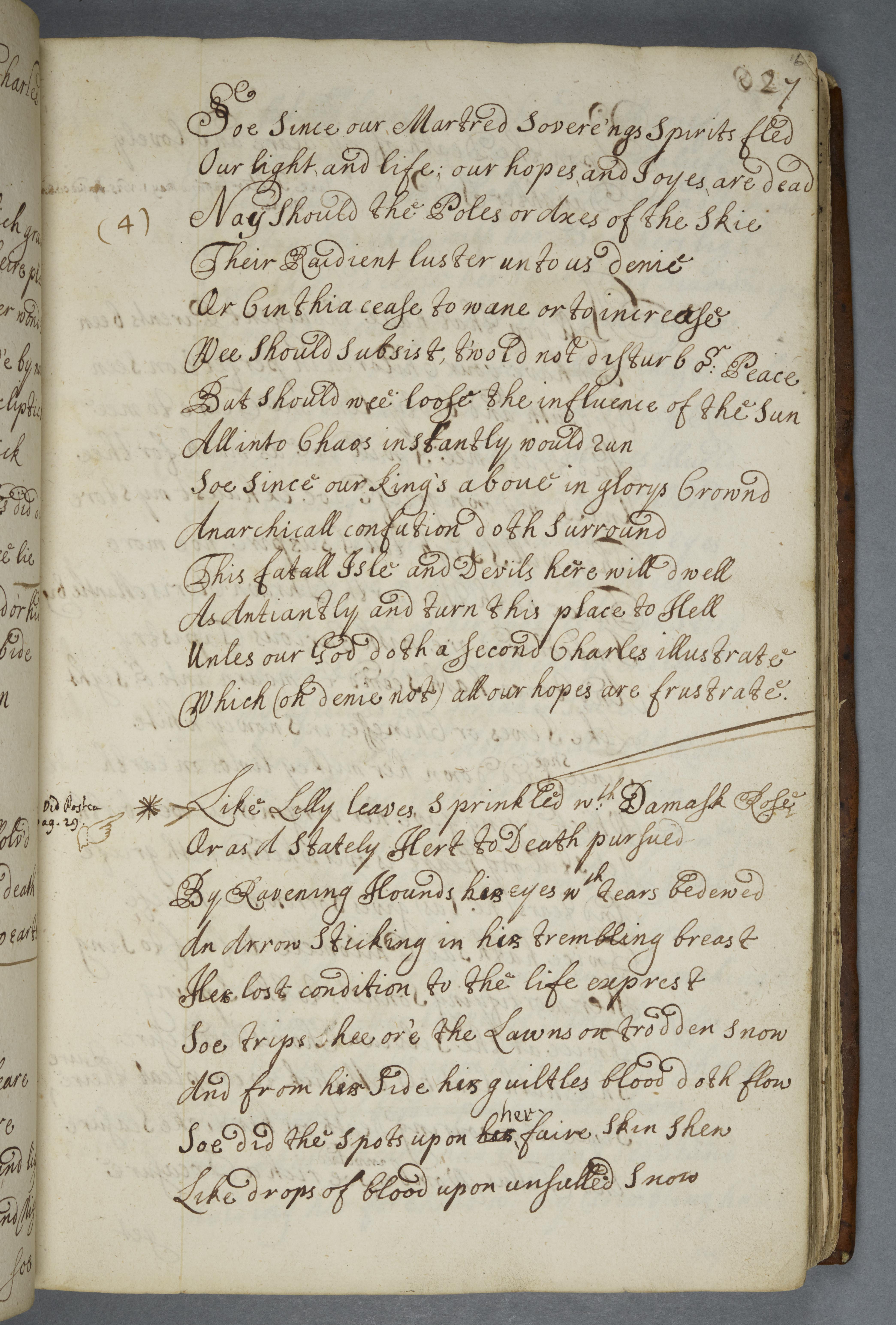
Like Lily Leaves

X (Close panel) Sources

Like Lily Leaves

Poem 9

Original Source

Hester Pulter, Poems breathed forth by the nobel Hadassas, University of Leeds Library, Brotherton Collection, MS Lt q 32

Versions

  • Facsimile of manuscript: Photographs provided by University of Leeds, Brotherton Collection

  • Transcription of manuscript: By Leah Knight and Wendy Wall.
  • Elemental edition: By Leah Knight and Wendy Wall.

How to cite these versions

Conventions for these editions

The Pulter Project: Poet in the Making

  • Created by Leah Knight and Wendy Wall
  • Encoded by Katherine Poland, Matthew Taylor, Elizabeth Chou, and Emily Andrey, Northwestern University
  • Website designed by Sergei Kalugin, Northwestern University
  • IT project consultation by Josh Honn, Northwestern University
  • Project sponsored by Northwestern University, Brock University, and University of Leeds
X (Close panel)Poem Index
Loading…
X (Close panel)Notes: Transcription

 Editorial note

In these transcriptions we preserve as many details of the original material, textual, and graphic properties of Hester Pulter’s manuscript verse as we have found practical. Whenever possible, for instance, original spelling, punctuation, capitalization, lineation, insertions, deletions, alterations, spacing between words and lines, and indentation are all maintained; abbreviations and brevigraphs are not expanded; and superscript and subscript representations are retained. See full conventions for the transcriptions here.
Line number 1

 Physical note

in left margin, beside first line: “Vid Postca pag. 29”; to right, in lighter ink, a manicule; to right of manicule, an asterisk; to right of asterisk, “>”: marginal note signals scribe’s instructions to insert these lines in next poem, “Upon the Death of my deare and lovly Daughter J. P.” Although these lines are transcribed here as a separate poem, we see them, in accordance with this marginal note, as part of the next poem.
Line number 3

 Physical note

“is” appears written over “er”
Line number 4

 Physical note

“is” appears written over “er”
Line number 5

 Physical note

“r” may be written over as “s”
Line number 6

 Physical note

“S” imperfectly erased
Line number 7

 Physical note

“is” appears written over “er”
Line number 7

 Physical note

“is” appears written over “er”
Line number 8

 Physical note

“his” struck through twice, horizontally; “her” in different hand from main scribe
Sorry, but there are no notes associated with any currently displayed witness.
X (Close panel)Transcription
Transcription

Facsimile Image Placeholder

Facsimile Image Placeholder
Like Lily Leaves
In these transcriptions we preserve as many details of the original material, textual, and graphic properties of Hester Pulter’s manuscript verse as we have found practical. Whenever possible, for instance, original spelling, punctuation, capitalization, lineation, insertions, deletions, alterations, spacing between words and lines, and indentation are all maintained; abbreviations and brevigraphs are not expanded; and superscript and subscript representations are retained. See full conventions for the transcriptions here.

— Leah Knight and Wendy Wall
The aim of the elemental edition to make the poems accessible to the largest variety of readers, which involves modernizing spelling and punctuation as well as adding basic glosses. Spelling and punctuation reflect current standard American usage; punctuation highlights syntax which might otherwise be obscure. Outmoded but still familiar word forms (“thou,” “‘tis,” “hold’st”) are not modernized, and we do not modernize grammar when the sense remains legible. After a brief headnote aimed at offering a “way in” to the poem’s unique qualities and connections with other verse by Pulter or her contemporaries, the edition features a minimum of notes and interpretative framing to allow more immediate engagement with the poem. Glosses clarify synonyms or showcase various possible meanings in Pulter’s time. Other notes identify named people and places or clarify obscure material. We rely (without citation) primarily on the Oxford English Dictionary (OED), the Oxford Reference database, and the King James Version (KJV) of the Bible. When we rely on Alice Eardley’s edition of Pulter’s work, we cite her text generally (“Eardley”); other sources are cited in full. The result is an edition we consider a springboard for further work on Pulter’s poetry. See full conventions for this edition here.

— Leah Knight and Wendy Wall


— Leah Knight and Wendy Wall
1
Physical Note
in left margin, beside first line: “Vid Postca pag. 29”; to right, in lighter ink, a manicule; to right of manicule, an asterisk; to right of asterisk, “>”: marginal note signals scribe’s instructions to insert these lines in next poem, “Upon the Death of my deare and lovly Daughter J. P.” Although these lines are transcribed here as a separate poem, we see them, in accordance with this marginal note, as part of the next poem.
Like
Lilly leaves Sprinkled w:th Damaſk Roſe
2
Or as A Stately Hert to Death purſue’d
3
By Ravening Hounds
Physical Note
“is” appears written over “er”
his
eyes wth tears bedewed
4
An Arrow Sticking in
Physical Note
“is” appears written over “er”
his
trembling breast
5
Physical Note
“r” may be written over as “s”
Her
lost condition to the life exprest
6
Soe trips
Physical Note
“S” imperfectly erased
Shee
or’e the Lawns on trodden Snow
7
And from
Physical Note
“is” appears written over “er”
his
Side
Physical Note
“is” appears written over “er”
his
guiltles blood doth flow
8
Soe did the Spots upon
Physical Note
“his” struck through twice, horizontally; “her” in different hand from main scribe
his\her \
faire Skin Shew
9
Like drops of blood upon unſulled Snow
Although presented as an independent poem in Alice Eardley’s edition, we do not consider the lines beginning (in our transcription of Poem 9) with
Like Lilly leaves Sprinkled w:th Damaſk Roſe
to be a separate poem. Instead, we read the notes in the left margin of the manuscript page next to these lines as indicators that these lines form an insertion in the next poem, Upon the Death of my deare and lovly Daughter J. P. [Poem 10] Marginal notes in both poems indicate where these lines should be inserted. We have therefore added them at that point in the next poem in this edition.
X (Close panel)Notes: Elemental Edition

 Editorial note

The aim of the elemental edition to make the poems accessible to the largest variety of readers, which involves modernizing spelling and punctuation as well as adding basic glosses. Spelling and punctuation reflect current standard American usage; punctuation highlights syntax which might otherwise be obscure. Outmoded but still familiar word forms (“thou,” “‘tis,” “hold’st”) are not modernized, and we do not modernize grammar when the sense remains legible. After a brief headnote aimed at offering a “way in” to the poem’s unique qualities and connections with other verse by Pulter or her contemporaries, the edition features a minimum of notes and interpretative framing to allow more immediate engagement with the poem. Glosses clarify synonyms or showcase various possible meanings in Pulter’s time. Other notes identify named people and places or clarify obscure material. We rely (without citation) primarily on the Oxford English Dictionary (OED), the Oxford Reference database, and the King James Version (KJV) of the Bible. When we rely on Alice Eardley’s edition of Pulter’s work, we cite her text generally (“Eardley”); other sources are cited in full. The result is an edition we consider a springboard for further work on Pulter’s poetry. See full conventions for this edition here.
Sorry, but there are no notes associated with any currently displayed witness.
X (Close panel)Elemental Edition
Elemental Edition

Facsimile Image Placeholder

Facsimile Image Placeholder
Like Lily Leaves
In these transcriptions we preserve as many details of the original material, textual, and graphic properties of Hester Pulter’s manuscript verse as we have found practical. Whenever possible, for instance, original spelling, punctuation, capitalization, lineation, insertions, deletions, alterations, spacing between words and lines, and indentation are all maintained; abbreviations and brevigraphs are not expanded; and superscript and subscript representations are retained. See full conventions for the transcriptions here.

— Leah Knight and Wendy Wall
The aim of the elemental edition to make the poems accessible to the largest variety of readers, which involves modernizing spelling and punctuation as well as adding basic glosses. Spelling and punctuation reflect current standard American usage; punctuation highlights syntax which might otherwise be obscure. Outmoded but still familiar word forms (“thou,” “‘tis,” “hold’st”) are not modernized, and we do not modernize grammar when the sense remains legible. After a brief headnote aimed at offering a “way in” to the poem’s unique qualities and connections with other verse by Pulter or her contemporaries, the edition features a minimum of notes and interpretative framing to allow more immediate engagement with the poem. Glosses clarify synonyms or showcase various possible meanings in Pulter’s time. Other notes identify named people and places or clarify obscure material. We rely (without citation) primarily on the Oxford English Dictionary (OED), the Oxford Reference database, and the King James Version (KJV) of the Bible. When we rely on Alice Eardley’s edition of Pulter’s work, we cite her text generally (“Eardley”); other sources are cited in full. The result is an edition we consider a springboard for further work on Pulter’s poetry. See full conventions for this edition here.

— Leah Knight and Wendy Wall


— Leah Knight and Wendy Wall
1
Physical Note
in left margin, beside first line: “Vid Postca pag. 29”; to right, in lighter ink, a manicule; to right of manicule, an asterisk; to right of asterisk, “>”: marginal note signals scribe’s instructions to insert these lines in next poem, “Upon the Death of my deare and lovly Daughter J. P.” Although these lines are transcribed here as a separate poem, we see them, in accordance with this marginal note, as part of the next poem.
Like
Lilly leaves Sprinkled w:th Damaſk Roſe
2
Or as A Stately Hert to Death purſue’d
3
By Ravening Hounds
Physical Note
“is” appears written over “er”
his
eyes wth tears bedewed
4
An Arrow Sticking in
Physical Note
“is” appears written over “er”
his
trembling breast
5
Physical Note
“r” may be written over as “s”
Her
lost condition to the life exprest
6
Soe trips
Physical Note
“S” imperfectly erased
Shee
or’e the Lawns on trodden Snow
7
And from
Physical Note
“is” appears written over “er”
his
Side
Physical Note
“is” appears written over “er”
his
guiltles blood doth flow
8
Soe did the Spots upon
Physical Note
“his” struck through twice, horizontally; “her” in different hand from main scribe
his\her \
faire Skin Shew
9
Like drops of blood upon unſulled Snow
Although presented as an independent poem in Alice Eardley’s edition, we do not consider the lines beginning (in our transcription of Poem 9) with
Like Lilly leaves Sprinkled w:th Damaſk Roſe
to be a separate poem. Instead, we read the notes in the left margin of the manuscript page next to these lines as indicators that these lines form an insertion in the next poem, Upon the Death of my deare and lovly Daughter J. P. [Poem 10] Marginal notes in both poems indicate where these lines should be inserted. We have therefore added them at that point in the next poem in this edition.
X (Close panel) All Notes
Transcription

 Editorial note

In these transcriptions we preserve as many details of the original material, textual, and graphic properties of Hester Pulter’s manuscript verse as we have found practical. Whenever possible, for instance, original spelling, punctuation, capitalization, lineation, insertions, deletions, alterations, spacing between words and lines, and indentation are all maintained; abbreviations and brevigraphs are not expanded; and superscript and subscript representations are retained. See full conventions for the transcriptions here.
Elemental Edition

 Editorial note

The aim of the elemental edition to make the poems accessible to the largest variety of readers, which involves modernizing spelling and punctuation as well as adding basic glosses. Spelling and punctuation reflect current standard American usage; punctuation highlights syntax which might otherwise be obscure. Outmoded but still familiar word forms (“thou,” “‘tis,” “hold’st”) are not modernized, and we do not modernize grammar when the sense remains legible. After a brief headnote aimed at offering a “way in” to the poem’s unique qualities and connections with other verse by Pulter or her contemporaries, the edition features a minimum of notes and interpretative framing to allow more immediate engagement with the poem. Glosses clarify synonyms or showcase various possible meanings in Pulter’s time. Other notes identify named people and places or clarify obscure material. We rely (without citation) primarily on the Oxford English Dictionary (OED), the Oxford Reference database, and the King James Version (KJV) of the Bible. When we rely on Alice Eardley’s edition of Pulter’s work, we cite her text generally (“Eardley”); other sources are cited in full. The result is an edition we consider a springboard for further work on Pulter’s poetry. See full conventions for this edition here.
Amplified Edition

 Editorial note

Transcription
Line number 1

 Physical note

in left margin, beside first line: “Vid Postca pag. 29”; to right, in lighter ink, a manicule; to right of manicule, an asterisk; to right of asterisk, “>”: marginal note signals scribe’s instructions to insert these lines in next poem, “Upon the Death of my deare and lovly Daughter J. P.” Although these lines are transcribed here as a separate poem, we see them, in accordance with this marginal note, as part of the next poem.
Transcription
Line number 3

 Physical note

“is” appears written over “er”
Transcription
Line number 4

 Physical note

“is” appears written over “er”
Transcription
Line number 5

 Physical note

“r” may be written over as “s”
Transcription
Line number 6

 Physical note

“S” imperfectly erased
Transcription
Line number 7

 Physical note

“is” appears written over “er”
Transcription
Line number 7

 Physical note

“is” appears written over “er”
Transcription
Line number 8

 Physical note

“his” struck through twice, horizontally; “her” in different hand from main scribe
Sorry, but there are no notes associated with any currently displayed witness.
ManuscriptX (Close panel)
image