Let None Sigh More for Lucas or for Lisle [On the Same (2)]

X (Close panel) Sources

Let None Sigh More for Lucas or for Lisle [On the Same (2)]

Poem #15

Original Source

Hester Pulter, Poems breathed forth by the nobel Hadassas, University of Leeds Library, Brotherton Collection, MS Lt q 32

Versions

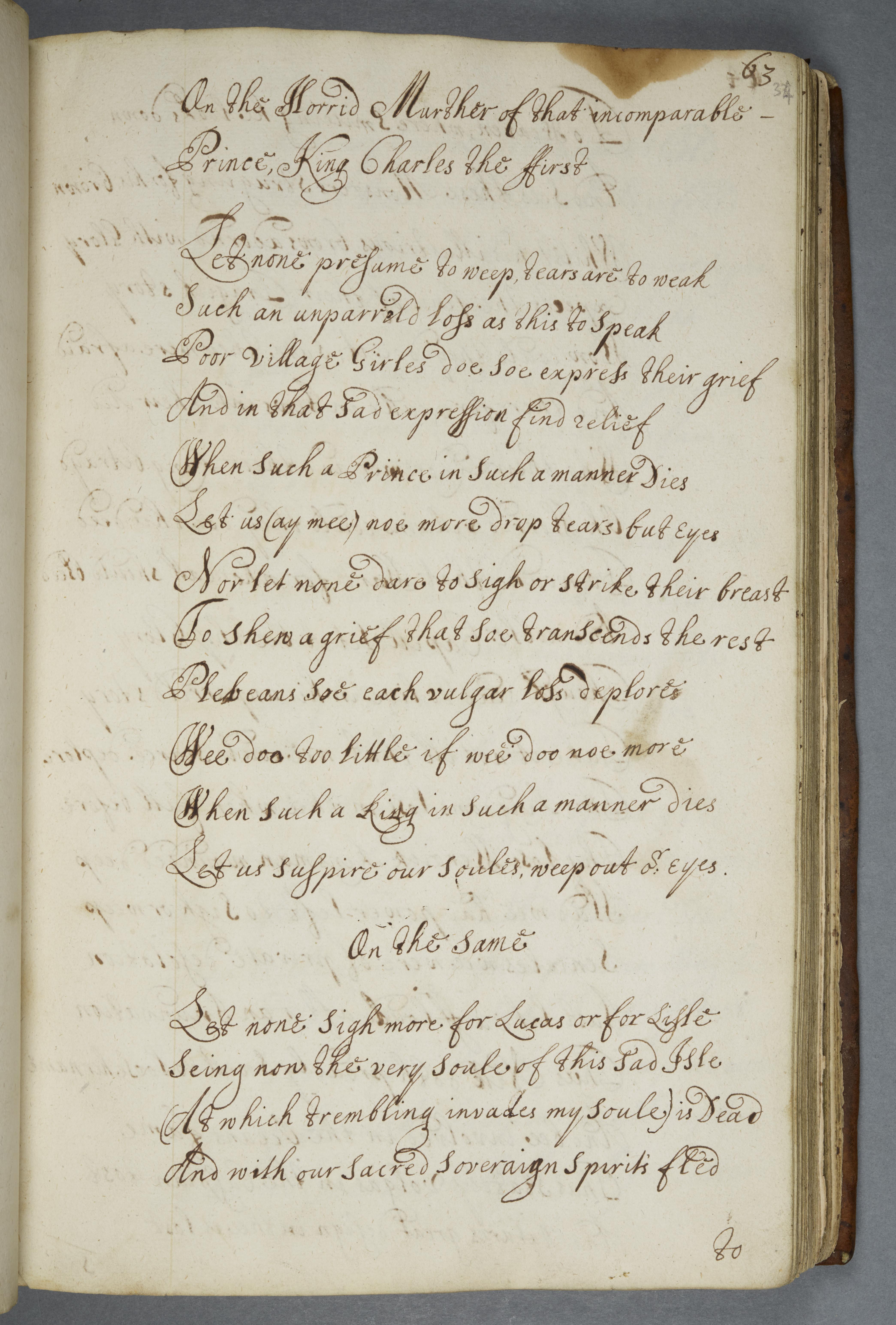
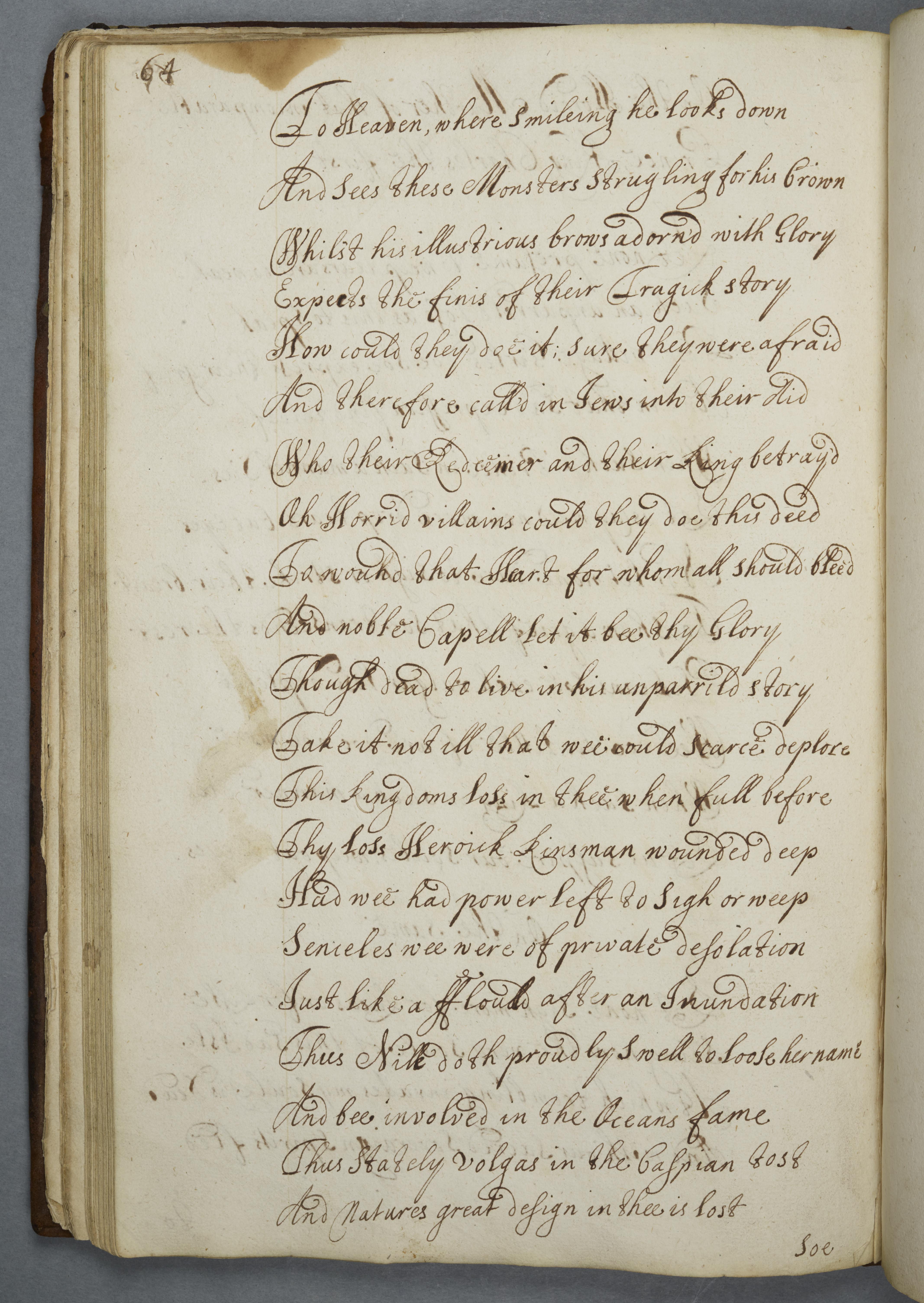
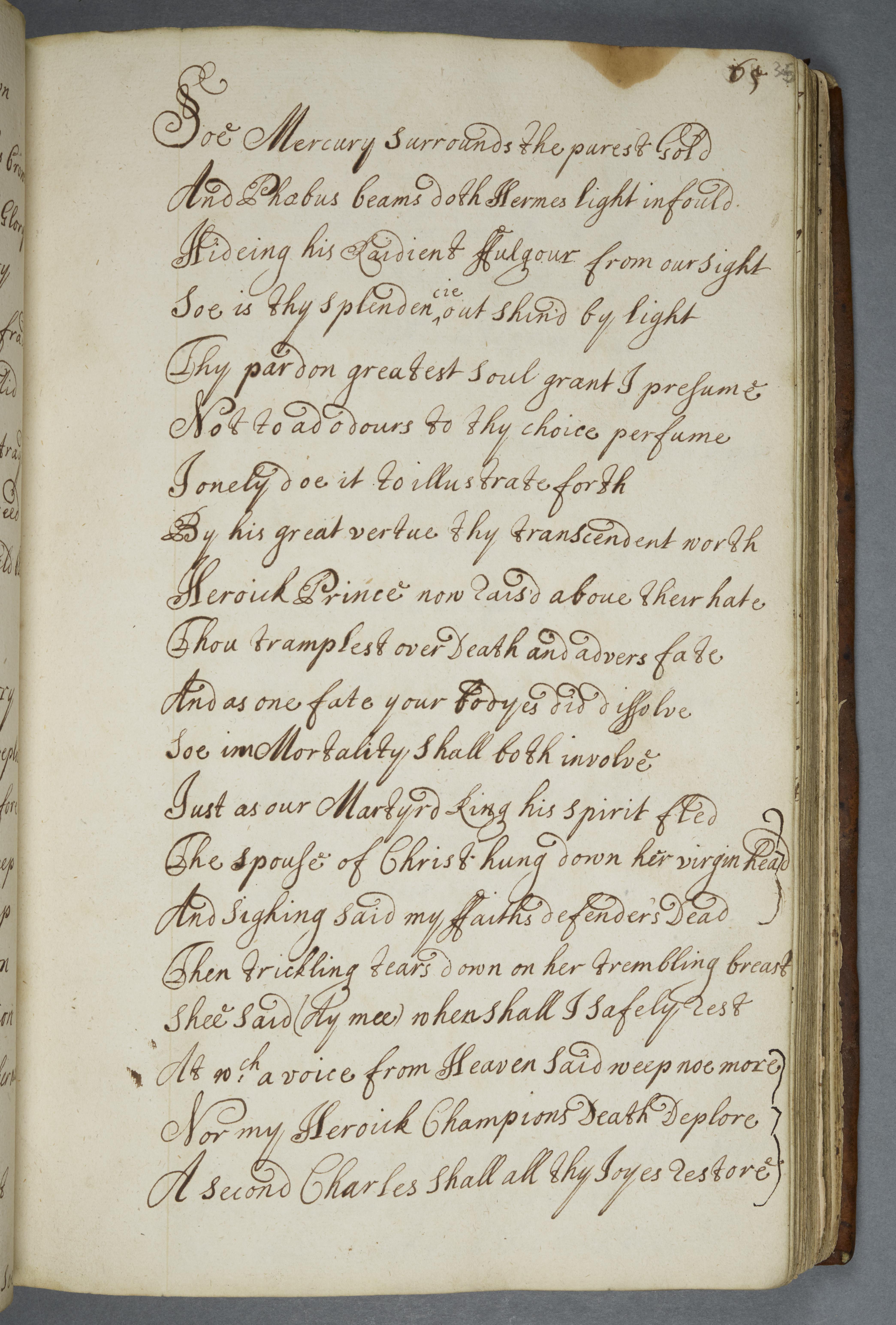
  • Facsimile of manuscript: Photographs provided by University of Leeds, Brotherton Collection

  • Transcription of manuscript: By Leah Knight and Wendy Wall.
  • Elemental edition: By Leah Knight and Wendy Wall.
  • Amplified edition: By David Norbrook.

How to cite these versions

Conventions for these editions

The Pulter Project: Poet in the Making

  • Created by Leah Knight and Wendy Wall
  • Encoded by Katherine Poland, Matthew Taylor, Elizabeth Chou, and Emily Andrey, Northwestern University
  • Website designed by Sergei Kalugin, Northwestern University
  • IT project consultation by Josh Honn, Northwestern University
  • Project sponsored by Northwestern University, Brock University, and University of Leeds
X (Close panel)Poem Index
Loading…
X (Close panel)Notes: Transcription
Title note

 Physical note

previous poem concludes immediately above on same page

 Editorial note

In these transcriptions we preserve as many details of the original material, textual, and graphic properties of Hester Pulter’s manuscript verse as we have found practical. Whenever possible, for instance, original spelling, punctuation, capitalization, lineation, insertions, deletions, alterations, spacing between words and lines, and indentation are all maintained; abbreviations and brevigraphs are not expanded; and superscript and subscript representations are retained. See full conventions for the transcriptions here.
Line number 13

 Physical note

imperfectly erased ascender (as for “l”) visible above “n”
Line number 13

 Physical note

“e” appears crowded between surrounding letters
Line number 21

 Physical note

letter with ascender (possibly “l”) blotted to cancel
Line number 22

 Physical note

“e” appears written over (possibly after) earlier second “l”
Line number 37

 Physical note

corrected from “in Mortality”
Line number 40

 Physical note

Curved bracket appears to right of this line and two above it (those ending “fled,” “head,” and “Dead”).
Line number 45

 Physical note

Curved bracket appears to right of this line and two above it (“more,” “Deplore,” and “ Restore”).The next page, marked “66”, is blank.
Sorry, but there are no notes associated with any currently displayed witness.
X (Close panel)Transcription
Transcription

Facsimile Image Placeholder

Facsimile Image Placeholder

Facsimile Image Placeholder
On the
Physical Note
previous poem concludes immediately above on same page
Same
[2]
Critical Note
In the manuscript, the title is “On the Same”: a reference to the previous poem in the manuscript, On the Horrid Murder of that Incomparable Prince, King Charles the First [Poem 14]; we have provided an alternate title for clarity. The number 2 in our title reflects the fact that Poem 11 is also titled On the Same [Poem 11] in the manuscript.
Let None Sigh More for Lucas or for Lisle [On the Same (2)]
Gloss Note
In the manuscript, the title is “On the Same,” a reference to the previous poem in the manuscript, On the Horrid Murder of that Incomparable Prince, King Charles the First [Poem 14]. The number 2 in this edition’s title reflects the fact that Poem 11 is also titled On the Same [Poem 11] in the manuscript.
Let None Sigh More for Lucas or for Lisle [On the Same (2)]
In these transcriptions we preserve as many details of the original material, textual, and graphic properties of Hester Pulter’s manuscript verse as we have found practical. Whenever possible, for instance, original spelling, punctuation, capitalization, lineation, insertions, deletions, alterations, spacing between words and lines, and indentation are all maintained; abbreviations and brevigraphs are not expanded; and superscript and subscript representations are retained. See full conventions for the transcriptions here.

— Leah Knight and Wendy Wall
The aim of the elemental edition is to make the poems accessible to the largest variety of readers, which involves modernizing spelling and punctuation as well as adding basic glosses. Spelling and punctuation reflect current standard American usage; punctuation highlights syntax which might otherwise be obscure. Outmoded but still familiar word forms (“thou,” “‘tis,” “hold’st”) are not modernized, and we do not modernize grammar when the sense remains legible. After a brief headnote aimed at offering a “way in” to the poem’s unique qualities and connections with other verse by Pulter or her contemporaries, the edition features a minimum of notes and interpretative framing to allow more immediate engagement with the poem. Glosses clarify synonyms or showcase various possible meanings in Pulter’s time. Other notes identify named people and places or clarify obscure material. We rely (without citation) primarily on the Oxford English Dictionary (OED), the Oxford Reference database, and the King James Version (KJV) of the Bible. When we rely on Alice Eardley’s edition of Pulter’s work, we cite her text generally (“Eardley”); other sources are cited in full. The result is an edition we consider a springboard for further work on Pulter’s poetry. See full conventions for this edition here.

— Leah Knight and Wendy Wall
The manuscript text is very sparsely punctuated. The only marker of syntax is a comma after “Heaven” (l. 5). There are brackets around “At which . . . soule” (l. 4) and “Ay mee” (l. 42), and they are also used to indicate the triple rhymes at lines 38–40, 43–5. An early modern form of the question mark appears in “How could they do it;” (l. 9). The scribe indicates a few omitted letters with inverted commas (“Spirit’s” (l. 4), “adorn’d” (l. 7), “outshin’d” (l. 29), “rais’d” (line 34), “defender’s” (l. 40)), and there is one contraction (“w:ch” for “which,” l. 43). There are slips of the pen in “splendenc^ie” (l. 29) and “imMortality” (l. 37). For the present text, punctuation has been inserted and spelling changed to modern usage. However, the page images are easily available and make it possible to understand the experience of early readers, with the page layout highlighting the structure of the couplets, and capitalization often highlighting balanced words: this is not just something said but something made.

— Leah Knight and Wendy Wall
Grief management in the face of public atrocities is a relatively new industry, but Pulter tried her hand at it in this poem, as well as the one before it in the manuscript; both were written as responses to the king’s execution by political opponents. Like the last poem, this one also begins with a ban on grieving wrongly—in this case, by continuing to mourn the executions of three royalist commanders: George Lisle; Charles Lucas (both lamented in an earlier poem, On Those Two Unparalleled Friends, Sir George Lisle and Sir Charles Lucas, Who Were Shot to Death at Colchester [Poem 7]); and Arthur Capel, Pulter’s cousin-in-law. The enormity of the king’s death monopolizes all possible sighs and tears, sparing none for even such remarkable, but still lesser, lights. Pulter allows herself, early on, an outburst of baffled rage at those she could only regard as assassins: “How could they do it?” But soon the poem grows boldly to encompass more than her isolated, frustrated voice, through her ventriloquy of a mourning national church answered by divine assurance of a “second Charles”: possibly a prophetic claim, depending when the poem was written.

— Leah Knight and Wendy Wall
The opening of this poem echoes the preceding one, and likewise refuses sighs as the poet struggles to find an appropriate language for her grief and shock at the execution of King Charles I. Here Pulter moves outward from the shock of the regicide to consider a poem she had recently written, On Those Two Unparalleled Friends, Sir George Lisle and Sir Charles Lucas, Who Were Shot to Death at Colchester [Poem 7]. A royalist rising in the spring of 1648 had erupted into the Second Civil War, which seemed likely for a time to restore the king to power in London. Instead it was crushed, and amongst the most bitter defeats was the capture of the royalist garrison at Colchester, where many prisoners were taken and Sir George Lisle and Sir Charles Lucas were executed by Sir Thomas Fairfax. This execution, unexpectedly harsh even if technically within the rules of war, had provoked many royalists into angry verse. When it seemed that they had exhausted their fury and frustration, the defeated royalists had to face a much greater calamity, the execution of their king on 30 January 1649. Immediately after a High Court had condemned the king, a new court tried Arthur, Lord Capel, who had been reprieved from Fairfax’s military justice at Colchester, and he was executed on 9 March. Old wounds were thus re-opened even as royalists were coping with the trauma of the king’s death, and several poets treated the deaths of Lucas and Lisle “as sacrificial prologues to the king’s execution.”
Gloss Note
Andrea Brady argues that the two men’s deaths were widely depicted as “sacrificial prologues to the king’s execution” (“Dying with Honour: Literary Propaganda and the Second English Civil War,” The Journal of Military History 70:1 (2006): 9–30, p. 11). See further Exploration: Pulter and Political Revolution.
1
Pulter wrote a series of poems on the regicide. We cannot be sure of their order since the manuscript does not run chronologically, and as the headnote to the Elemental Edition reminds us, we cannot even be certain that this poem was composed before 1660. It and its preceding poem are more disturbed than On That Unparalleled Prince Charles the First, His Horrid Murder [Poem 8], and may have been written later (for fuller discussion see Exploration: Pulter and Political Revolution). It is possible that Pulter returned to political poetry under the renewed shock of the execution on 9 March 1649 of her husband’s cousin, Arthur, Lord Capel (see further Curation: Arthur, first Baron Capel (1604–49)). This reopened the psychological wounds of the siege of Colchester, for Capel had been present at the siege. One elegist spoke of the three as a “Triumvirate” and a play on the deaths at Colchester ended with the Chorus pointing at the dead body of Capel, last of the martyrs.
In mourning both Charles and Capel, Pulter was joining a chorus of royalist poets who, unable to take up arms, could fight for their cause in verse. These broadsheets and pamphlets, readily available in Paul’s Churchyard, could easily have found their way to Broadfield. The contributors to Lachrymae Musarum, a collection of elegies in which Capel was praised by the influential journalist Marchamont Nedham, included several poets, Marvell included, who had links with the Stanley circle (see Exploration: Pulter and Political Revolution), and that volume formed both a tribute to Pulter’s relative by marriage and a kind of anthology of the leading poets of the day. Pulter’s gender, and her husband’s desire for neutrality, would have made it hard to join this company in print, but she responded to the combined political and poetic stimulus. Her poem does not seem to echo contemporary elegies directly, though further research may show otherwise. Her anger at the regicides, and the comparison of them to the Jews who handed over Christ to be condemned, is shared with some royal propaganda, culminating in the king’s ghosted testament, the Eikon Basilike. But there is no poem with a comparable structure, first turning from Lucas and Lisle because the king’s fate is so much more important, but before long turning to their ally at Colchester. It was common for elegies for Capel to be added to collections in praise of Charles, but they were kept separate. Some poets did call attention to the difficulty of going on writing when they were already exhausted by their mourning for the king (see Curation: Arthur, first Baron Capel (1604–49), poems by “F. H.” and Thomas Philipot), but Pulter is uniquely concerned with the questions of tact and literary decorum in praising two people of widely disparate ranks. (Contrast Hutchinson’s response to applying different standards to aristocrats and others (Exploration: Women Writers and the English Revolution)).
Why, then, has she created this problem for herself? It seems possible that she may have inserted the Capel material after initially writing on Charles alone: if one jumps from line 13 to line 34, the poem continues coherently, the “their” of line 34 taking up the “they” of line 12, and with further cuts it would continue as a poem on Charles as Christ-like martyr. But if she did insert the Capel lines, why did she choose this over writing a separate poem on him? She has created the problem which she proceeds to explore in the poem: how to keep praise proportionate. In a separate poem she could, like other elegists, have said more about the dramatic twists and turns of his recent life, and about his own conduct on the scaffold, where unlike Charles he explicitly stated his political and religious views. Instead, though she claims Capel as a kinsman, she has remarkably little to say about his life, his conduct on the scaffold, or his wife, all of which interested many contemporaries. One might say of this as Liza Blake says of The Invitation into the Country, to my D.D.M.P.P.P., 1647, when his Sacred Majesty was at Unhappy Home [Poem 2]: “this poem offers not only commentary on a specific historical moment, but also a meta-reflection on the relationship between poetry and political agency; its formal problems—the questions of poetic form and genre—also become political problems.” Since John Donne was a point of reference for many contemporaries, Pulter had perhaps been struck by the complex negotiations between different patrons found in his verse letters. She is also exploring her own favorite language of involution and dissolution, as the Capel section becomes involved (line 23) in the poem to the king and to some extent dissolved (“tossed,” line 24) into it. The resultant poem is balanced, with thirteen initial lines, sixteen addressed to Capel, and a further sixteen to Charles, recalling Pulter’s general preference for forms that are roughly of sonnet length (see Elizabeth Scott-Baumann, “Hester Pulter’s Well-Wrought Urns: Early Modern Women, Sonnets, and New Criticism,” Journal for Early Modern Cultural Studies 20: 2 (2020):120–43).
The sense of cosmic catastrophe found in On That Unparalleled Prince Charles the First, His Horrid Murder [Poem 8] is less evident here. Her soul is “trembling” (line 3), but this word is balanced by a vision of the monarch “smiling” as he looks down from heaven, confident that the struggles of the puny “monsters” will end. They could have prevailed only by calling the Jews to their aid (line 10). After contrasting the king’s ultimate glory with the regicides’ inevitable bad end, their “tragic story”, she uses the same rhyme to invoke Capel, who is nested in Charles’s “unparalled story” as in his rhyming couplet (lines 7–8, 14–15). Pulter proceeds to draw attention to the successive registers of grief by immediately apologizing to Capel for scarcely being capable of praising him because her poetic abilities had been exhausted in mourning Charles — a theme found in some contemporaries, such as John Quarles and Thomas Philipot (see Curation: Arthur, first Baron Capel (1604–49)). Recalling the previous poem, she regrets that the royalists have scarcely been able to sigh or weep for Capel, and this section of the poem then becomes a series of compensatory analogies, arguing that Capel’s apparently lesser standing is not really diminished by his tribute’s being enclosed within a tribute to Charles. As if this tribute has unbalanced the praise of Charles, she now turns from addressing Capel to asking Charles’s pardon for her praise of Capel, declaring that she did it to “illustrate forth…thy great worth.” Pulter takes up the final image of apology to Capel where she says that his “splendency” has been “outshined by light” (line 29). Her language is more positive than the end of “On That Unparalleled Prince”:
Unless our God doth a second Charles illustrate,
(Which, O deny not!) all our hopes are frustrate.
Here Charles I is safe in heaven, trampling over death. She returns to her familiar language of dissolution and involution, processes which bring Charles and Capel together (lines 36–7).
The poem now returns to recent events, attributing the nation’s sighs and tears to a personification of the Church of England, here identified as the spouse of Christ. Pulter places the emphasis on religious issues rather than on the constitutionalism that had appealed to the Leveller John Lilburne; this does square with his final days, when he told his wife and children, in the terms of patriarchalist political theory, that his obedience to the king came from the divine commandment to honor one’s father and mother. (Here there is a striking contrast with Pulter, whose manuscript is matriarchal in focus, with many references to her children and only one poem addressed to her husband — and that revealing “the poet’s tenuous investment in her relationship” (see Meg Heffernan’s Headnote to [Untitled] [Poem 42])). Pulter may have emphasized Capel’s orthodoxy the more strongly because critics had attacked him as a Catholic — a charge against which he felt it necessary to defend himself on the scaffold, insisting that he was a Calvinist in theology (Quarles would defend him by saying that he had been more like a Puritan, Regale Lectum, p. 55; see Curation: Arthur, first Baron Capel (1604–49)). The final triplet gives a note of confidence in turning from “my Heroick Champions Death” to prophesying the restoration of Charles II, then in Scotland. In seventeenth-century spelling, “Champions” could be read as “Champion’s” or as “Champions’”, perhaps leaving a last sense in which Capel is involved in the poem.


— Leah Knight and Wendy Wall
1
Let none Sigh more for Lucas or for Liſle
Let none sigh more
Gloss Note
George Lisle and Charles Lucas were Royalist commanders in the siege of Colchester during the English civil war, executed by firing squad without trial after their defeat and capture at Colchester in 1648. Pulter makes these two the subject of On those Two Unparalleled Friends, Sir George Lisle and Sir Charles Lucas [Poem 7].
for Lucas or for Lisle
,
Let none sigh more
Gloss Note
Sir Charles Lucas (1612/13–48) and Sir George Lisle (1615–48). Pulter had sighed for them in On those Two Unparalleled Friends, Sir George Lisle and Sir Charles Lucas, Who Were Shot to Death at Colchester [Poem 7]. Coming from different social backgrounds, the two had not in fact been close friends, but they were united when singled out by Sir Thomas Fairfax for execution after the surrender of the royalist garrison at Colchester in 1648.
for Lucas or for Lisle
,
2
Seing now the very Soule of this Sad Iſle
Seeing now the very soul of this
Gloss Note
Britain
sad isle
Seeing now the very
Gloss Note
Charles is the soul of Britain.
soul of this sad isle
3
(At which trembling invades my Soule) is Dead
Critical Note
This parenthetical phrase seems to be placed, unusually, in the middle of the clause it modifies: “the very soul of this sad isle / … is dead.” That is, the primary sense appears to be that the speaker’s soul trembles at the death of the king, who is cast as Britain’s soul. However, the placement of the parenthetical phrase immediately after the reference to the king might also suggest that the speaker (or her soul) trembles–perhaps from fearful respect or awe–at the mere thought of her king, alive or dead.
(At which trembling invades my soul)
is dead,
(At which trembling invades my
Critical Note
Pulter takes up the imagery of sighing souls from the previous poem, and by repetition she blurs distinctions between her own soul, the soul of the dead king, and the king metaphorically considered as soul of the realm. For the “spirit” of line 4 to be different from the “soul” of line 2, one might expect “sacred sovereign’s spirit”, though the sibilants would clash. Alternatively, Pulter may have meant us to read “our sacred sovereign spirits”, as if subjects too had sighed out their monarchist souls; but the scribe does insert an apostrophe at “spirit’s”. In any case, Pulter tries to universalize mourning.
soul
) is dead,
4
And with our Sacred Soveraign Spirit’s fled
And with our sacred sovereign spirit’s fled
to

Facsimile Image Placeholder

Facsimile Image Placeholder

Facsimile Image Placeholder
5
To Heaven, where Smileing he looks down
To Heaven, where, smiling, he looks down
Gloss Note
The ascent to heaven across a line-break is followed by a tetrameter (four-foot) line varying from the normal pentameter.
To Heaven, where, smiling, he looks down
6
And Sees these Monsters Strugling for his Crown
And sees
Gloss Note
the king’s opponents in the civil war
these monsters
struggling for his crown,
And sees
Gloss Note
the king’s opponents in the civil war, with overtones of the “many-headed monster,” the multitude — see On the Fall of that Grand Rebel the Earl of Essex’s Effigies in Harry the 7th’s Chapel in Westminster Abbey [Poem 62], line 1.
these monsters
Critical Note
The revolution is cast as a medieval rivalry for the crown rather than an attempt to found a new republic or at best a figurehead monarchy. Even after some pressure in the 1650s, Cromwell refused a crown.
struggling for his crown
,
7
Whils’t his illustrious brows adorn’d with Glory
Whils’t his illustrious brows, adorned with glory,
Whilst his illustrious brows, adorned with glory,
8
Expects the finis of their Tragick Story
Expects the
Gloss Note
conclusion (a word often placed at the end of a book)
finis
of their tragic story.
Gloss Note
waits for; archaic form of third person plural.
Expects
the
Gloss Note
conclusion (Latin; a word often placed at the end of a book).
finis
of their tragic story.
9
How could they doe it; Sure they were afraid
How could they do it? Sure they were afraid,
10
And therefore call’d in Jews into their Aid
And therefore called in
Critical Note
Citing Wilcher, Eardley indicates that it was common for Royalists to castigate their opponents as Jews, especially in the wake of the execution of Charles I, who was by analogy figured as Christ. See Robert Wilcher, Writing of Royalism, 1628–1660 (Cambridge: Cambridge University Press, 2001), 267–69. In On those Two Unparalleled Friends [Poem 7], Pulter draws on the period’s common bigoted rhetoric by labeling anti-Royalists as Jews, Turks and atheists; yet she interestingly chooses as her authorial moniker Haddassah or Esther, a Jewish heroine.
Jews
into their aid,
And therefore called in
Critical Note
Compare On Those Two Unparalleled Friends, Sir George Lisle and Sir Charles Lucas, Who Were Shot to Death at Colchester [Poem 7], line 23: “Jews, Turks, atheists, Independents, all.” Pulter may have been thinking particularly of a sermon by the Laudian bishop Richard Watson, preached a few days after the king’s death, which made detailed parallels between the Pharisees and the Puritans in bringing about the death of “Ch: the King”: The Devilish Conspiracy, Hellish Treason, Heathenish Condemnation, and Damnable Murder, Committed, and Executed by the Iewes, against the Anointed of The Lord, Christ Their King (London, 1649); see Andrew Lacey, The Cult of King Charles the Martyr (Woodbridge, UK: Boydell and Brewer, 2012), pp. 117ff. Though there were few Jews in England, Puritans were liable to attack for association with their un-Christian views, both because of elements of identification with the Jewish people and more particularly because of the belief that the Jews would soon be converted, which led to calls for their readmission to England: Christopher Hill, “Till the Conversion of the Jews,” in The Collected Essays of Christopher Hill, Vol. 2: Religion and Politics in Seventeenth-Century England (Amherst: University of Massachusetts Press, 1986), pp. 269–300.
Jews
into their aid,
11
Who their Redeemer and their King betray’d
Who
Gloss Note
These terms conflate references to King Charles and Jesus Christ or God.
their redeemer and their king
betrayed.
Who
Gloss Note
These terms conflate references to King Charles and to Jesus Christ or God.
their redeemer and their king
Gloss Note
triplet for heightened emphasis; the poem ends with another one..
betrayed
12
Oh Horrid villains could they doe this deed
O, horrid villains! Could they do this deed?
Oh, horrid villains! Could they do this deed,
13
To
Physical Note
imperfectly erased ascender (as for “l”) visible above “n”
wound
that
Physical Note
“e” appears crowded between surrounding letters
Heart
for whom all Should bleed
To wound that heart for whom all should bleed?
To wound that
Gloss Note
“a homonym for ‘hart,’ one of Pulter’s recurring images for the king” (Ross and Scott-Baumann, citing Upon the Death of my Dear and Lovely Daughter, Jane Pulter [Poem 10], The Weeping Wish [Poem 61], and The Hunted Hart (Emblem 22) [Poem 87]).
heart
for whom
Critical Note
Meter suggests the scribe may have omitted a word; “they” before “all” would fit the context. But Pulter did not change this passage.
all should bleed?
14
And noble Capell let it bee thy Glory
And noble
Gloss Note
Arthur Capel (1604–49), first cousin to Pulter’s husband and royalist commander, fought a losing battle at Colchester with Lisle and Lucas; he was imprisoned but escaped, only to be betrayed and then beheaded at the behest of parliament, two months after the king’s execution (ODNB).
Capel
, let it be thy glory,
And noble
Gloss Note
Arthur Capel, first Baron Capel of Hadham (1604–1649), first cousin to Pulter’s husband. After an effective career as a royalist commander, he joined Lucas and Lisle in defending Colchester. Imprisoned, he escaped, only to be betrayed and then beheaded at the behest of parliament, two months after the king’s execution (ODNB).
Capel
, let it be thy glory,
15
Though dead to live in his unparrild Story
Though dead, to live in
Gloss Note
the king’s
his
Critical Note
The manuscript has “unparrild,” for “unparalleled”; we maintain the abbreviation for the meter.
unparall’d
story.
Though dead, to live in
Gloss Note
the king’s.
his
Critical Note
the manuscript has “unparrild,” for “unparalleled;” the word also appears in the companion poem (On the Horrid Murder of that Incomparable Prince [Poem 14]). Contemporaries groped for words that would be adequate to the regicide; Pulter may have read Obsequies on That unexemplar Champion of Chivalrie, and Pattern of true Prowess, Arthur Lord Capel; compare “unexemplary” in the sense of “unprecedented,” first recorded in the Oxford English Dictionary 1 in a 1649 reference to the regicide.
unparall’d
story.
16
Take it not ill that wee could Scarce deplore
Take it not ill that we could scarce
Gloss Note
lament
deplore
Take it not ill that we could scarce
Gloss Note
lament.
deplore
17
This Kingdoms loſs in thee when full before
This kingdom’s loss in thee,
Gloss Note
The speaker asks Capel not to be offended that they could not mourn his death, when they were already full of grief owing to the king’s recent execution.
when full before
.
This kingdom’s loss in thee,
Gloss Note
when already full of grief owing to the king’s recent execution.
when full before
.
18
Thy loſs Heroick Kinsman wounded deep
Thy loss, heroic kinsman, wounded deep,
19
Had wee had power left to Sigh or weep
Had we had power left to sigh or weep;
Had
Gloss Note
either an authorial first person or Pulter is speaking for all royalists.
we
had power left to
Critical Note
returning to the language of the previous poem.
sigh or weep
;
20
Senceles wee were of private deſolation
Senseless we were of private desolation,
Gloss Note
“Without sense, awareness, or consciousness of something” (Oxford English Dictionary 2a).
Senseless
we were of private desolation,
21
Just like a
Physical Note
letter with ascender (possibly “l”) blotted to cancel
fflou[?]d
after an Inundation
Just like a flood after an
Gloss Note
overflow of water
inundation
.
Just like a
Gloss Note
Anglo-Saxon and Latinate terms for the same thing, the higher register for the King being reinforced by the ‘feminine’ rhymes on two four-syllable words.
flood after an inundation
.
22
Thus
Physical Note
“e” appears written over (possibly after) earlier second “l”
Nile
doth proudly Swell to looſe her name
Thus
Gloss Note
The Egyptian river “loses [its] name” when it joins the Mediterranean sea and ceases to be a river.
Nile doth proudly swell to lose her name
Thus
Gloss Note
The Egyptian river “loses [its] name” when it joins the Mediterranean sea.
Nile doth proudly swell to lose her name
23
And bee involved in the Oceans fame
And be
Gloss Note
enveloped
involved
in the ocean’s fame;
And be
Gloss Note
enveloped, swallowed up (OED 7). Liza Blake explains as “mixes into, and thereby loses itself in, the ocean,” a sense of involution as “destructive mixture” that is common in Pulter, and underlies lines 25 and 36–7: “Hester Pulter’s Particle Physics and the Poetics of Involution,” Journal for Early Modern Cultural Studies, 20:2 (2020), 71–98 (90).
involved
in the ocean’s fame;
24
Thus Stately Volgas in the Caſpian tost
Thus stately
Gloss Note
The Russian river Volga flows into the Caspian Sea.
Volga’s in the Caspian
tossed,
Thus stately
Gloss Note
The Russian river Volga, longest in Europe, flows into the Caspian Sea.
Volga’s in the Caspian
tossed,
25
And Natures great deſign in thee is lost
And
Gloss Note
The speaker suggests that Nature’s plan, in relation to Capel’s fate, cannot be perceived but is nonetheless present (like the rivers dissolved within the ocean or sea).
Nature’s great design in thee is lost
.
And Nature’s great design in thee is lost.
Soe

Facsimile Image Placeholder

Facsimile Image Placeholder

Facsimile Image Placeholder
26
Soe Mercury Surrounds the purest Gold
Gloss Note
The speaker suggests that mercury has a crucial relation to gold, as Capel does to Charles; the analogy is drawn from alchemy, in which mercury is a base element used to form the more valuable gold.
So Mercury surrounds the purest gold,
So
Gloss Note
The theme of mixing and loss is continued in an alchemical metaphor: mercury is an essential element without which gold cannot be created. Eardley compares The Circle [2] [Poem 21], lines, 1–7: “Those that the hidden chemic art profess / And visit Nature in her morning dress, / To mercury and sulphur philtres give / That they, consumed with love, may live / In their posterity and in them shine / Though they their being unto them resign; / Glorying to shine in silver and in gold.”
Mercury surrounds the purest gold
,
27
And Phœbus beams doth Hermes light infould
Gloss Note
The speaker carries on the analogy between more and less valuable forms of light (related to Charles and Capel): the sun’s beams (those of Phoebus, the sun god) enclose those of Hermes, a messenger god (also identified with Mercury).
And Phoebus’s beams doth Hermes’s light enfold,
Gloss Note
Through a kind of mythological pun on Mercury, both element and planet closest to the sun (Phoebus), Pulter now continues the analogy in the terms of Copernican cosmology: compare A Solitary Complaint [Poem 54], lines 4–5: “Thrice happy Hermes moves in endless day, Being underneath the sun’s illustrious ray.” The manuscript spelling “infould” highlights the parallel with “involved” at line 23.
And Phoebus’ beams doth Hermes’s light enfold
,
28
Hideing his Raidient ffulgour from our Sight
Hiding his radiant
Gloss Note
dazzling brightness
fulgor
from our sight;
Hiding his radiant
Gloss Note
dazzling brightness; a Latin word, not in common use in English in the seventeenth century.
fulgor
from our sight;
29
Soe is thy Splenden^cie out Shin’d by light
So is thy
Gloss Note
Capel’s splendor
splendency
outshined by light.
So is thy
Gloss Note
a word coined in the late sixteenth century and often associated with the divine or with heavenly bodies; Pulter can give Capel high praise before he dissolves into the divine simplicity of “light”.
splendency
outshined by light.
30
Thy pardon greatest Soul grant I preſume
Thy pardon,
Gloss Note
Charles I
greatest soul
, grant; I presume
Thy pardon,
Gloss Note
Pulter now returns to Charles I’s soul, apologizing in turn to him for the delicate balance she is striking between king and subject. She assigns 13 lines to the king at the start, 16 to Capel, and 16 to the king in the last part of the poem.
greatest soul
, grant; I presume
31
Not to ad odours to thy choice perfume
Gloss Note
The speaker assures Charles I that she is not trying to to improve his reputation through her praise of Capel.
Not to add odors to thy choice perfume.
Gloss Note
Her praise of Capel’s virtues cannot enhance the king’s.
Not to add odors to thy choice perfume
.
32
I onely doe it to illustrate forth
I only do it to illustrate forth,
I only do it to
Gloss Note
The OED lists a series of related early modern senses: “to make lustrous, luminous, or bright…to beautify, adorn…to shed light upon…to render illustrious, renowned, or famous.” The meter has the stress fall on the second syllable, as in On That Unparalleled Prince Charles the First, His Horrid Murder [Poem 8], line 35. See Andrea Crow’s commentary to Amplified Edition of On the King’s Most Excellent Majesty [Poem 27], line 2.
illustrate
forth,
33
By his great vertue thy tranſcendent worth
By
Gloss Note
Capel’s
his
great virtue,
Gloss Note
the king’s
thy
transcendent worth.
By
Gloss Note
Capel’s.
his
great virtue,
Gloss Note
In a swift transition, Pulter turns to addressing the king.
thy
transcendent worth.
34
Heroick Prince now Raiſ’d aboue their hate
Heroic prince, now raised above their hate,
35
Thou tramplest over Death and advers fate
Thou tramplest over death and adverse fate,
36
And as one fate your bodyes did diſſolve
And, as one fate
Gloss Note
the king’s two bodies, a legal principle which saw the king to unite, in his person, a mortal, natural body, and an immortal body politic (here treated as “dissolve[d]” through the dissolution of the monarchy through the execution of Charles I)
your bodies
did dissolve,
And, as one fate
Gloss Note
Capel’s and Charles’s.
your bodies
did dissolve,
37
Soe
Physical Note
corrected from “in Mortality”
imMortality
Shall both involve
So immortality shall both
Gloss Note
envelop
involve
.
So immortality shall both
Gloss Note
See note to line 23.
involve
.
38
Just as our Martyrd King his Spirit fled
Just
Gloss Note
when
as
our martyred king his spirit fled,
Just
Gloss Note
when.
as
our martyred
Gloss Note
older form of “king’s”.
king
his spirit fled, ]
39
The Spouſe of Christ hung down her virgin head
The
Gloss Note
a conventional term for the Christian church; see Ephesians, 5:22: “the husband is the head of the wife just as Christ is the head of the church.”
spouse of Christ
hung down her virgin head,
The
Critical Note
see Ephesians, 5:22: “the husband is the head of the wife, even as Christ is the head of the church.” Pulter strongly connects the church with the visible Church of England, destroyed by the Puritan Revolution; many Puritans like Lucy Hutchinson came to see that church as “whorish” and thought of Christ as heading an Invisible Church only partly instantiated in particular congregations, and the marriage with Christ more a matter of the individual soul: cf. Memoirs of the Life of Colonel Hutchinson, ed. N. H. Keeble (London: Everyman, 1995), p. 54, and the “Gospel Church” in Hutchinson, Order and Disorder, ed. David Norbrook (Oxford: Blackwell, 2001), p. 46 (3.468).
spouse of Christ
hung down her virgin head, ]
40
And Sighing Said my ffaiths defender’s
Physical Note
Curved bracket appears to right of this line and two above it (those ending “fled,” “head,” and “Dead”).
Dead
And, sighing, said: “
Gloss Note
“Defender of the Faith” was among the official titles assumed by the monarchs of England at this time.
My faith’s defender’s
dead.”
And, sighing, said: “
Gloss Note
after the break with Rome, Parliament had declared Henry VIII Supreme Governor of the English church and “Defender of the Faith.” The scribe indicates the triplet with brackets.
My faith’s defender’s dead
.” ]
41
Then trickling tears down on her trembling breast
Then trickling tears down on her trembling breast,
42
Shee Said (Ay mee) when Shall I Safely Rest
She said, “Ay me! When shall I safely rest?”
43
At w:ch a voice from Heaven Said weep noe more
At which
Gloss Note
the voice of God
a voice from Heaven
said: “Weep no more;
At which
Gloss Note
Eardley compares George Herbert’s poems, such as “The Collar” which ends with consoling voices from a divine “friend.” This turn may also echo the resolution of Milton’s Lycidas, lines 154, 165: “Ay me…Weep no more, woeful shepherds, weep no more;” though “Ay me” is itself common enough, and she had used it in the previous poem in the manuscript.
a voice from Heaven
said: “Weep no more; ]
44
Nor my Heroick Champions Death Deplore
Nor my heroic
Gloss Note
i.e., Charles I
champion’s
death
Gloss Note
lament
deplore
.
Nor my heroic
Gloss Note
Charles I; MS “Champions” could be understood as “Champion’s” or as “Champions’.”
champion’s
death
Gloss Note
lament.
deplore
. ]
45
A Second Charles Shall all thy Joyes
Physical Note
Curved bracket appears to right of this line and two above it (“more,” “Deplore,” and “ Restore”).The next page, marked “66”, is blank.
Restore
A second Charles shall all thy joys restore.”
A second Charles shall all thy joys
Critical Note
Charles’s son was proclaimed King Charles II in Scotland on 5 February 1649, but did not return to London until May 1660. This climactic triplet, again given brackets by the scribe, is a consolatory counterbalance to the bitterly satirical triplet at line 9–11.
restore
.” ]
X (Close panel)Notes: Elemental Edition
Title note

 Critical note

In the manuscript, the title is “On the Same”: a reference to the previous poem in the manuscript, On the Horrid Murder of that Incomparable Prince, King Charles the First [Poem 14]; we have provided an alternate title for clarity. The number 2 in our title reflects the fact that Poem 11 is also titled On the Same [Poem 11] in the manuscript.

 Editorial note

The aim of the elemental edition is to make the poems accessible to the largest variety of readers, which involves modernizing spelling and punctuation as well as adding basic glosses. Spelling and punctuation reflect current standard American usage; punctuation highlights syntax which might otherwise be obscure. Outmoded but still familiar word forms (“thou,” “‘tis,” “hold’st”) are not modernized, and we do not modernize grammar when the sense remains legible. After a brief headnote aimed at offering a “way in” to the poem’s unique qualities and connections with other verse by Pulter or her contemporaries, the edition features a minimum of notes and interpretative framing to allow more immediate engagement with the poem. Glosses clarify synonyms or showcase various possible meanings in Pulter’s time. Other notes identify named people and places or clarify obscure material. We rely (without citation) primarily on the Oxford English Dictionary (OED), the Oxford Reference database, and the King James Version (KJV) of the Bible. When we rely on Alice Eardley’s edition of Pulter’s work, we cite her text generally (“Eardley”); other sources are cited in full. The result is an edition we consider a springboard for further work on Pulter’s poetry. See full conventions for this edition here.

 Headnote

Grief management in the face of public atrocities is a relatively new industry, but Pulter tried her hand at it in this poem, as well as the one before it in the manuscript; both were written as responses to the king’s execution by political opponents. Like the last poem, this one also begins with a ban on grieving wrongly—in this case, by continuing to mourn the executions of three royalist commanders: George Lisle; Charles Lucas (both lamented in an earlier poem, On Those Two Unparalleled Friends, Sir George Lisle and Sir Charles Lucas, Who Were Shot to Death at Colchester [Poem 7]); and Arthur Capel, Pulter’s cousin-in-law. The enormity of the king’s death monopolizes all possible sighs and tears, sparing none for even such remarkable, but still lesser, lights. Pulter allows herself, early on, an outburst of baffled rage at those she could only regard as assassins: “How could they do it?” But soon the poem grows boldly to encompass more than her isolated, frustrated voice, through her ventriloquy of a mourning national church answered by divine assurance of a “second Charles”: possibly a prophetic claim, depending when the poem was written.
Line number 1

 Gloss note

George Lisle and Charles Lucas were Royalist commanders in the siege of Colchester during the English civil war, executed by firing squad without trial after their defeat and capture at Colchester in 1648. Pulter makes these two the subject of On those Two Unparalleled Friends, Sir George Lisle and Sir Charles Lucas [Poem 7].
Line number 2

 Gloss note

Britain
Line number 3

 Critical note

This parenthetical phrase seems to be placed, unusually, in the middle of the clause it modifies: “the very soul of this sad isle / … is dead.” That is, the primary sense appears to be that the speaker’s soul trembles at the death of the king, who is cast as Britain’s soul. However, the placement of the parenthetical phrase immediately after the reference to the king might also suggest that the speaker (or her soul) trembles–perhaps from fearful respect or awe–at the mere thought of her king, alive or dead.
Line number 6

 Gloss note

the king’s opponents in the civil war
Line number 8

 Gloss note

conclusion (a word often placed at the end of a book)
Line number 10

 Critical note

Citing Wilcher, Eardley indicates that it was common for Royalists to castigate their opponents as Jews, especially in the wake of the execution of Charles I, who was by analogy figured as Christ. See Robert Wilcher, Writing of Royalism, 1628–1660 (Cambridge: Cambridge University Press, 2001), 267–69. In On those Two Unparalleled Friends [Poem 7], Pulter draws on the period’s common bigoted rhetoric by labeling anti-Royalists as Jews, Turks and atheists; yet she interestingly chooses as her authorial moniker Haddassah or Esther, a Jewish heroine.
Line number 11

 Gloss note

These terms conflate references to King Charles and Jesus Christ or God.
Line number 14

 Gloss note

Arthur Capel (1604–49), first cousin to Pulter’s husband and royalist commander, fought a losing battle at Colchester with Lisle and Lucas; he was imprisoned but escaped, only to be betrayed and then beheaded at the behest of parliament, two months after the king’s execution (ODNB).
Line number 15

 Gloss note

the king’s
Line number 15

 Critical note

The manuscript has “unparrild,” for “unparalleled”; we maintain the abbreviation for the meter.
Line number 16

 Gloss note

lament
Line number 17

 Gloss note

The speaker asks Capel not to be offended that they could not mourn his death, when they were already full of grief owing to the king’s recent execution.
Line number 21

 Gloss note

overflow of water
Line number 22

 Gloss note

The Egyptian river “loses [its] name” when it joins the Mediterranean sea and ceases to be a river.
Line number 23

 Gloss note

enveloped
Line number 24

 Gloss note

The Russian river Volga flows into the Caspian Sea.
Line number 25

 Gloss note

The speaker suggests that Nature’s plan, in relation to Capel’s fate, cannot be perceived but is nonetheless present (like the rivers dissolved within the ocean or sea).
Line number 26

 Gloss note

The speaker suggests that mercury has a crucial relation to gold, as Capel does to Charles; the analogy is drawn from alchemy, in which mercury is a base element used to form the more valuable gold.
Line number 27

 Gloss note

The speaker carries on the analogy between more and less valuable forms of light (related to Charles and Capel): the sun’s beams (those of Phoebus, the sun god) enclose those of Hermes, a messenger god (also identified with Mercury).
Line number 28

 Gloss note

dazzling brightness
Line number 29

 Gloss note

Capel’s splendor
Line number 30

 Gloss note

Charles I
Line number 31

 Gloss note

The speaker assures Charles I that she is not trying to to improve his reputation through her praise of Capel.
Line number 33

 Gloss note

Capel’s
Line number 33

 Gloss note

the king’s
Line number 36

 Gloss note

the king’s two bodies, a legal principle which saw the king to unite, in his person, a mortal, natural body, and an immortal body politic (here treated as “dissolve[d]” through the dissolution of the monarchy through the execution of Charles I)
Line number 37

 Gloss note

envelop
Line number 38

 Gloss note

when
Line number 39

 Gloss note

a conventional term for the Christian church; see Ephesians, 5:22: “the husband is the head of the wife just as Christ is the head of the church.”
Line number 40

 Gloss note

“Defender of the Faith” was among the official titles assumed by the monarchs of England at this time.
Line number 43

 Gloss note

the voice of God
Line number 44

 Gloss note

i.e., Charles I
Line number 44

 Gloss note

lament
Sorry, but there are no notes associated with any currently displayed witness.
X (Close panel)Elemental Edition
Elemental Edition

Facsimile Image Placeholder

Facsimile Image Placeholder

Facsimile Image Placeholder
On the
Physical Note
previous poem concludes immediately above on same page
Same
[2]
Critical Note
In the manuscript, the title is “On the Same”: a reference to the previous poem in the manuscript, On the Horrid Murder of that Incomparable Prince, King Charles the First [Poem 14]; we have provided an alternate title for clarity. The number 2 in our title reflects the fact that Poem 11 is also titled On the Same [Poem 11] in the manuscript.
Let None Sigh More for Lucas or for Lisle [On the Same (2)]
Gloss Note
In the manuscript, the title is “On the Same,” a reference to the previous poem in the manuscript, On the Horrid Murder of that Incomparable Prince, King Charles the First [Poem 14]. The number 2 in this edition’s title reflects the fact that Poem 11 is also titled On the Same [Poem 11] in the manuscript.
Let None Sigh More for Lucas or for Lisle [On the Same (2)]
In these transcriptions we preserve as many details of the original material, textual, and graphic properties of Hester Pulter’s manuscript verse as we have found practical. Whenever possible, for instance, original spelling, punctuation, capitalization, lineation, insertions, deletions, alterations, spacing between words and lines, and indentation are all maintained; abbreviations and brevigraphs are not expanded; and superscript and subscript representations are retained. See full conventions for the transcriptions here.

— Leah Knight and Wendy Wall
The aim of the elemental edition is to make the poems accessible to the largest variety of readers, which involves modernizing spelling and punctuation as well as adding basic glosses. Spelling and punctuation reflect current standard American usage; punctuation highlights syntax which might otherwise be obscure. Outmoded but still familiar word forms (“thou,” “‘tis,” “hold’st”) are not modernized, and we do not modernize grammar when the sense remains legible. After a brief headnote aimed at offering a “way in” to the poem’s unique qualities and connections with other verse by Pulter or her contemporaries, the edition features a minimum of notes and interpretative framing to allow more immediate engagement with the poem. Glosses clarify synonyms or showcase various possible meanings in Pulter’s time. Other notes identify named people and places or clarify obscure material. We rely (without citation) primarily on the Oxford English Dictionary (OED), the Oxford Reference database, and the King James Version (KJV) of the Bible. When we rely on Alice Eardley’s edition of Pulter’s work, we cite her text generally (“Eardley”); other sources are cited in full. The result is an edition we consider a springboard for further work on Pulter’s poetry. See full conventions for this edition here.

— Leah Knight and Wendy Wall
The manuscript text is very sparsely punctuated. The only marker of syntax is a comma after “Heaven” (l. 5). There are brackets around “At which . . . soule” (l. 4) and “Ay mee” (l. 42), and they are also used to indicate the triple rhymes at lines 38–40, 43–5. An early modern form of the question mark appears in “How could they do it;” (l. 9). The scribe indicates a few omitted letters with inverted commas (“Spirit’s” (l. 4), “adorn’d” (l. 7), “outshin’d” (l. 29), “rais’d” (line 34), “defender’s” (l. 40)), and there is one contraction (“w:ch” for “which,” l. 43). There are slips of the pen in “splendenc^ie” (l. 29) and “imMortality” (l. 37). For the present text, punctuation has been inserted and spelling changed to modern usage. However, the page images are easily available and make it possible to understand the experience of early readers, with the page layout highlighting the structure of the couplets, and capitalization often highlighting balanced words: this is not just something said but something made.

— Leah Knight and Wendy Wall
Grief management in the face of public atrocities is a relatively new industry, but Pulter tried her hand at it in this poem, as well as the one before it in the manuscript; both were written as responses to the king’s execution by political opponents. Like the last poem, this one also begins with a ban on grieving wrongly—in this case, by continuing to mourn the executions of three royalist commanders: George Lisle; Charles Lucas (both lamented in an earlier poem, On Those Two Unparalleled Friends, Sir George Lisle and Sir Charles Lucas, Who Were Shot to Death at Colchester [Poem 7]); and Arthur Capel, Pulter’s cousin-in-law. The enormity of the king’s death monopolizes all possible sighs and tears, sparing none for even such remarkable, but still lesser, lights. Pulter allows herself, early on, an outburst of baffled rage at those she could only regard as assassins: “How could they do it?” But soon the poem grows boldly to encompass more than her isolated, frustrated voice, through her ventriloquy of a mourning national church answered by divine assurance of a “second Charles”: possibly a prophetic claim, depending when the poem was written.

— Leah Knight and Wendy Wall
The opening of this poem echoes the preceding one, and likewise refuses sighs as the poet struggles to find an appropriate language for her grief and shock at the execution of King Charles I. Here Pulter moves outward from the shock of the regicide to consider a poem she had recently written, On Those Two Unparalleled Friends, Sir George Lisle and Sir Charles Lucas, Who Were Shot to Death at Colchester [Poem 7]. A royalist rising in the spring of 1648 had erupted into the Second Civil War, which seemed likely for a time to restore the king to power in London. Instead it was crushed, and amongst the most bitter defeats was the capture of the royalist garrison at Colchester, where many prisoners were taken and Sir George Lisle and Sir Charles Lucas were executed by Sir Thomas Fairfax. This execution, unexpectedly harsh even if technically within the rules of war, had provoked many royalists into angry verse. When it seemed that they had exhausted their fury and frustration, the defeated royalists had to face a much greater calamity, the execution of their king on 30 January 1649. Immediately after a High Court had condemned the king, a new court tried Arthur, Lord Capel, who had been reprieved from Fairfax’s military justice at Colchester, and he was executed on 9 March. Old wounds were thus re-opened even as royalists were coping with the trauma of the king’s death, and several poets treated the deaths of Lucas and Lisle “as sacrificial prologues to the king’s execution.”
Gloss Note
Andrea Brady argues that the two men’s deaths were widely depicted as “sacrificial prologues to the king’s execution” (“Dying with Honour: Literary Propaganda and the Second English Civil War,” The Journal of Military History 70:1 (2006): 9–30, p. 11). See further Exploration: Pulter and Political Revolution.
1
Pulter wrote a series of poems on the regicide. We cannot be sure of their order since the manuscript does not run chronologically, and as the headnote to the Elemental Edition reminds us, we cannot even be certain that this poem was composed before 1660. It and its preceding poem are more disturbed than On That Unparalleled Prince Charles the First, His Horrid Murder [Poem 8], and may have been written later (for fuller discussion see Exploration: Pulter and Political Revolution). It is possible that Pulter returned to political poetry under the renewed shock of the execution on 9 March 1649 of her husband’s cousin, Arthur, Lord Capel (see further Curation: Arthur, first Baron Capel (1604–49)). This reopened the psychological wounds of the siege of Colchester, for Capel had been present at the siege. One elegist spoke of the three as a “Triumvirate” and a play on the deaths at Colchester ended with the Chorus pointing at the dead body of Capel, last of the martyrs.
In mourning both Charles and Capel, Pulter was joining a chorus of royalist poets who, unable to take up arms, could fight for their cause in verse. These broadsheets and pamphlets, readily available in Paul’s Churchyard, could easily have found their way to Broadfield. The contributors to Lachrymae Musarum, a collection of elegies in which Capel was praised by the influential journalist Marchamont Nedham, included several poets, Marvell included, who had links with the Stanley circle (see Exploration: Pulter and Political Revolution), and that volume formed both a tribute to Pulter’s relative by marriage and a kind of anthology of the leading poets of the day. Pulter’s gender, and her husband’s desire for neutrality, would have made it hard to join this company in print, but she responded to the combined political and poetic stimulus. Her poem does not seem to echo contemporary elegies directly, though further research may show otherwise. Her anger at the regicides, and the comparison of them to the Jews who handed over Christ to be condemned, is shared with some royal propaganda, culminating in the king’s ghosted testament, the Eikon Basilike. But there is no poem with a comparable structure, first turning from Lucas and Lisle because the king’s fate is so much more important, but before long turning to their ally at Colchester. It was common for elegies for Capel to be added to collections in praise of Charles, but they were kept separate. Some poets did call attention to the difficulty of going on writing when they were already exhausted by their mourning for the king (see Curation: Arthur, first Baron Capel (1604–49), poems by “F. H.” and Thomas Philipot), but Pulter is uniquely concerned with the questions of tact and literary decorum in praising two people of widely disparate ranks. (Contrast Hutchinson’s response to applying different standards to aristocrats and others (Exploration: Women Writers and the English Revolution)).
Why, then, has she created this problem for herself? It seems possible that she may have inserted the Capel material after initially writing on Charles alone: if one jumps from line 13 to line 34, the poem continues coherently, the “their” of line 34 taking up the “they” of line 12, and with further cuts it would continue as a poem on Charles as Christ-like martyr. But if she did insert the Capel lines, why did she choose this over writing a separate poem on him? She has created the problem which she proceeds to explore in the poem: how to keep praise proportionate. In a separate poem she could, like other elegists, have said more about the dramatic twists and turns of his recent life, and about his own conduct on the scaffold, where unlike Charles he explicitly stated his political and religious views. Instead, though she claims Capel as a kinsman, she has remarkably little to say about his life, his conduct on the scaffold, or his wife, all of which interested many contemporaries. One might say of this as Liza Blake says of The Invitation into the Country, to my D.D.M.P.P.P., 1647, when his Sacred Majesty was at Unhappy Home [Poem 2]: “this poem offers not only commentary on a specific historical moment, but also a meta-reflection on the relationship between poetry and political agency; its formal problems—the questions of poetic form and genre—also become political problems.” Since John Donne was a point of reference for many contemporaries, Pulter had perhaps been struck by the complex negotiations between different patrons found in his verse letters. She is also exploring her own favorite language of involution and dissolution, as the Capel section becomes involved (line 23) in the poem to the king and to some extent dissolved (“tossed,” line 24) into it. The resultant poem is balanced, with thirteen initial lines, sixteen addressed to Capel, and a further sixteen to Charles, recalling Pulter’s general preference for forms that are roughly of sonnet length (see Elizabeth Scott-Baumann, “Hester Pulter’s Well-Wrought Urns: Early Modern Women, Sonnets, and New Criticism,” Journal for Early Modern Cultural Studies 20: 2 (2020):120–43).
The sense of cosmic catastrophe found in On That Unparalleled Prince Charles the First, His Horrid Murder [Poem 8] is less evident here. Her soul is “trembling” (line 3), but this word is balanced by a vision of the monarch “smiling” as he looks down from heaven, confident that the struggles of the puny “monsters” will end. They could have prevailed only by calling the Jews to their aid (line 10). After contrasting the king’s ultimate glory with the regicides’ inevitable bad end, their “tragic story”, she uses the same rhyme to invoke Capel, who is nested in Charles’s “unparalled story” as in his rhyming couplet (lines 7–8, 14–15). Pulter proceeds to draw attention to the successive registers of grief by immediately apologizing to Capel for scarcely being capable of praising him because her poetic abilities had been exhausted in mourning Charles — a theme found in some contemporaries, such as John Quarles and Thomas Philipot (see Curation: Arthur, first Baron Capel (1604–49)). Recalling the previous poem, she regrets that the royalists have scarcely been able to sigh or weep for Capel, and this section of the poem then becomes a series of compensatory analogies, arguing that Capel’s apparently lesser standing is not really diminished by his tribute’s being enclosed within a tribute to Charles. As if this tribute has unbalanced the praise of Charles, she now turns from addressing Capel to asking Charles’s pardon for her praise of Capel, declaring that she did it to “illustrate forth…thy great worth.” Pulter takes up the final image of apology to Capel where she says that his “splendency” has been “outshined by light” (line 29). Her language is more positive than the end of “On That Unparalleled Prince”:
Unless our God doth a second Charles illustrate,
(Which, O deny not!) all our hopes are frustrate.
Here Charles I is safe in heaven, trampling over death. She returns to her familiar language of dissolution and involution, processes which bring Charles and Capel together (lines 36–7).
The poem now returns to recent events, attributing the nation’s sighs and tears to a personification of the Church of England, here identified as the spouse of Christ. Pulter places the emphasis on religious issues rather than on the constitutionalism that had appealed to the Leveller John Lilburne; this does square with his final days, when he told his wife and children, in the terms of patriarchalist political theory, that his obedience to the king came from the divine commandment to honor one’s father and mother. (Here there is a striking contrast with Pulter, whose manuscript is matriarchal in focus, with many references to her children and only one poem addressed to her husband — and that revealing “the poet’s tenuous investment in her relationship” (see Meg Heffernan’s Headnote to [Untitled] [Poem 42])). Pulter may have emphasized Capel’s orthodoxy the more strongly because critics had attacked him as a Catholic — a charge against which he felt it necessary to defend himself on the scaffold, insisting that he was a Calvinist in theology (Quarles would defend him by saying that he had been more like a Puritan, Regale Lectum, p. 55; see Curation: Arthur, first Baron Capel (1604–49)). The final triplet gives a note of confidence in turning from “my Heroick Champions Death” to prophesying the restoration of Charles II, then in Scotland. In seventeenth-century spelling, “Champions” could be read as “Champion’s” or as “Champions’”, perhaps leaving a last sense in which Capel is involved in the poem.


— Leah Knight and Wendy Wall
1
Let none Sigh more for Lucas or for Liſle
Let none sigh more
Gloss Note
George Lisle and Charles Lucas were Royalist commanders in the siege of Colchester during the English civil war, executed by firing squad without trial after their defeat and capture at Colchester in 1648. Pulter makes these two the subject of On those Two Unparalleled Friends, Sir George Lisle and Sir Charles Lucas [Poem 7].
for Lucas or for Lisle
,
Let none sigh more
Gloss Note
Sir Charles Lucas (1612/13–48) and Sir George Lisle (1615–48). Pulter had sighed for them in On those Two Unparalleled Friends, Sir George Lisle and Sir Charles Lucas, Who Were Shot to Death at Colchester [Poem 7]. Coming from different social backgrounds, the two had not in fact been close friends, but they were united when singled out by Sir Thomas Fairfax for execution after the surrender of the royalist garrison at Colchester in 1648.
for Lucas or for Lisle
,
2
Seing now the very Soule of this Sad Iſle
Seeing now the very soul of this
Gloss Note
Britain
sad isle
Seeing now the very
Gloss Note
Charles is the soul of Britain.
soul of this sad isle
3
(At which trembling invades my Soule) is Dead
Critical Note
This parenthetical phrase seems to be placed, unusually, in the middle of the clause it modifies: “the very soul of this sad isle / … is dead.” That is, the primary sense appears to be that the speaker’s soul trembles at the death of the king, who is cast as Britain’s soul. However, the placement of the parenthetical phrase immediately after the reference to the king might also suggest that the speaker (or her soul) trembles–perhaps from fearful respect or awe–at the mere thought of her king, alive or dead.
(At which trembling invades my soul)
is dead,
(At which trembling invades my
Critical Note
Pulter takes up the imagery of sighing souls from the previous poem, and by repetition she blurs distinctions between her own soul, the soul of the dead king, and the king metaphorically considered as soul of the realm. For the “spirit” of line 4 to be different from the “soul” of line 2, one might expect “sacred sovereign’s spirit”, though the sibilants would clash. Alternatively, Pulter may have meant us to read “our sacred sovereign spirits”, as if subjects too had sighed out their monarchist souls; but the scribe does insert an apostrophe at “spirit’s”. In any case, Pulter tries to universalize mourning.
soul
) is dead,
4
And with our Sacred Soveraign Spirit’s fled
And with our sacred sovereign spirit’s fled
to

Facsimile Image Placeholder

Facsimile Image Placeholder

Facsimile Image Placeholder
5
To Heaven, where Smileing he looks down
To Heaven, where, smiling, he looks down
Gloss Note
The ascent to heaven across a line-break is followed by a tetrameter (four-foot) line varying from the normal pentameter.
To Heaven, where, smiling, he looks down
6
And Sees these Monsters Strugling for his Crown
And sees
Gloss Note
the king’s opponents in the civil war
these monsters
struggling for his crown,
And sees
Gloss Note
the king’s opponents in the civil war, with overtones of the “many-headed monster,” the multitude — see On the Fall of that Grand Rebel the Earl of Essex’s Effigies in Harry the 7th’s Chapel in Westminster Abbey [Poem 62], line 1.
these monsters
Critical Note
The revolution is cast as a medieval rivalry for the crown rather than an attempt to found a new republic or at best a figurehead monarchy. Even after some pressure in the 1650s, Cromwell refused a crown.
struggling for his crown
,
7
Whils’t his illustrious brows adorn’d with Glory
Whils’t his illustrious brows, adorned with glory,
Whilst his illustrious brows, adorned with glory,
8
Expects the finis of their Tragick Story
Expects the
Gloss Note
conclusion (a word often placed at the end of a book)
finis
of their tragic story.
Gloss Note
waits for; archaic form of third person plural.
Expects
the
Gloss Note
conclusion (Latin; a word often placed at the end of a book).
finis
of their tragic story.
9
How could they doe it; Sure they were afraid
How could they do it? Sure they were afraid,
10
And therefore call’d in Jews into their Aid
And therefore called in
Critical Note
Citing Wilcher, Eardley indicates that it was common for Royalists to castigate their opponents as Jews, especially in the wake of the execution of Charles I, who was by analogy figured as Christ. See Robert Wilcher, Writing of Royalism, 1628–1660 (Cambridge: Cambridge University Press, 2001), 267–69. In On those Two Unparalleled Friends [Poem 7], Pulter draws on the period’s common bigoted rhetoric by labeling anti-Royalists as Jews, Turks and atheists; yet she interestingly chooses as her authorial moniker Haddassah or Esther, a Jewish heroine.
Jews
into their aid,
And therefore called in
Critical Note
Compare On Those Two Unparalleled Friends, Sir George Lisle and Sir Charles Lucas, Who Were Shot to Death at Colchester [Poem 7], line 23: “Jews, Turks, atheists, Independents, all.” Pulter may have been thinking particularly of a sermon by the Laudian bishop Richard Watson, preached a few days after the king’s death, which made detailed parallels between the Pharisees and the Puritans in bringing about the death of “Ch: the King”: The Devilish Conspiracy, Hellish Treason, Heathenish Condemnation, and Damnable Murder, Committed, and Executed by the Iewes, against the Anointed of The Lord, Christ Their King (London, 1649); see Andrew Lacey, The Cult of King Charles the Martyr (Woodbridge, UK: Boydell and Brewer, 2012), pp. 117ff. Though there were few Jews in England, Puritans were liable to attack for association with their un-Christian views, both because of elements of identification with the Jewish people and more particularly because of the belief that the Jews would soon be converted, which led to calls for their readmission to England: Christopher Hill, “Till the Conversion of the Jews,” in The Collected Essays of Christopher Hill, Vol. 2: Religion and Politics in Seventeenth-Century England (Amherst: University of Massachusetts Press, 1986), pp. 269–300.
Jews
into their aid,
11
Who their Redeemer and their King betray’d
Who
Gloss Note
These terms conflate references to King Charles and Jesus Christ or God.
their redeemer and their king
betrayed.
Who
Gloss Note
These terms conflate references to King Charles and to Jesus Christ or God.
their redeemer and their king
Gloss Note
triplet for heightened emphasis; the poem ends with another one..
betrayed
12
Oh Horrid villains could they doe this deed
O, horrid villains! Could they do this deed?
Oh, horrid villains! Could they do this deed,
13
To
Physical Note
imperfectly erased ascender (as for “l”) visible above “n”
wound
that
Physical Note
“e” appears crowded between surrounding letters
Heart
for whom all Should bleed
To wound that heart for whom all should bleed?
To wound that
Gloss Note
“a homonym for ‘hart,’ one of Pulter’s recurring images for the king” (Ross and Scott-Baumann, citing Upon the Death of my Dear and Lovely Daughter, Jane Pulter [Poem 10], The Weeping Wish [Poem 61], and The Hunted Hart (Emblem 22) [Poem 87]).
heart
for whom
Critical Note
Meter suggests the scribe may have omitted a word; “they” before “all” would fit the context. But Pulter did not change this passage.
all should bleed?
14
And noble Capell let it bee thy Glory
And noble
Gloss Note
Arthur Capel (1604–49), first cousin to Pulter’s husband and royalist commander, fought a losing battle at Colchester with Lisle and Lucas; he was imprisoned but escaped, only to be betrayed and then beheaded at the behest of parliament, two months after the king’s execution (ODNB).
Capel
, let it be thy glory,
And noble
Gloss Note
Arthur Capel, first Baron Capel of Hadham (1604–1649), first cousin to Pulter’s husband. After an effective career as a royalist commander, he joined Lucas and Lisle in defending Colchester. Imprisoned, he escaped, only to be betrayed and then beheaded at the behest of parliament, two months after the king’s execution (ODNB).
Capel
, let it be thy glory,
15
Though dead to live in his unparrild Story
Though dead, to live in
Gloss Note
the king’s
his
Critical Note
The manuscript has “unparrild,” for “unparalleled”; we maintain the abbreviation for the meter.
unparall’d
story.
Though dead, to live in
Gloss Note
the king’s.
his
Critical Note
the manuscript has “unparrild,” for “unparalleled;” the word also appears in the companion poem (On the Horrid Murder of that Incomparable Prince [Poem 14]). Contemporaries groped for words that would be adequate to the regicide; Pulter may have read Obsequies on That unexemplar Champion of Chivalrie, and Pattern of true Prowess, Arthur Lord Capel; compare “unexemplary” in the sense of “unprecedented,” first recorded in the Oxford English Dictionary 1 in a 1649 reference to the regicide.
unparall’d
story.
16
Take it not ill that wee could Scarce deplore
Take it not ill that we could scarce
Gloss Note
lament
deplore
Take it not ill that we could scarce
Gloss Note
lament.
deplore
17
This Kingdoms loſs in thee when full before
This kingdom’s loss in thee,
Gloss Note
The speaker asks Capel not to be offended that they could not mourn his death, when they were already full of grief owing to the king’s recent execution.
when full before
.
This kingdom’s loss in thee,
Gloss Note
when already full of grief owing to the king’s recent execution.
when full before
.
18
Thy loſs Heroick Kinsman wounded deep
Thy loss, heroic kinsman, wounded deep,
19
Had wee had power left to Sigh or weep
Had we had power left to sigh or weep;
Had
Gloss Note
either an authorial first person or Pulter is speaking for all royalists.
we
had power left to
Critical Note
returning to the language of the previous poem.
sigh or weep
;
20
Senceles wee were of private deſolation
Senseless we were of private desolation,
Gloss Note
“Without sense, awareness, or consciousness of something” (Oxford English Dictionary 2a).
Senseless
we were of private desolation,
21
Just like a
Physical Note
letter with ascender (possibly “l”) blotted to cancel
fflou[?]d
after an Inundation
Just like a flood after an
Gloss Note
overflow of water
inundation
.
Just like a
Gloss Note
Anglo-Saxon and Latinate terms for the same thing, the higher register for the King being reinforced by the ‘feminine’ rhymes on two four-syllable words.
flood after an inundation
.
22
Thus
Physical Note
“e” appears written over (possibly after) earlier second “l”
Nile
doth proudly Swell to looſe her name
Thus
Gloss Note
The Egyptian river “loses [its] name” when it joins the Mediterranean sea and ceases to be a river.
Nile doth proudly swell to lose her name
Thus
Gloss Note
The Egyptian river “loses [its] name” when it joins the Mediterranean sea.
Nile doth proudly swell to lose her name
23
And bee involved in the Oceans fame
And be
Gloss Note
enveloped
involved
in the ocean’s fame;
And be
Gloss Note
enveloped, swallowed up (OED 7). Liza Blake explains as “mixes into, and thereby loses itself in, the ocean,” a sense of involution as “destructive mixture” that is common in Pulter, and underlies lines 25 and 36–7: “Hester Pulter’s Particle Physics and the Poetics of Involution,” Journal for Early Modern Cultural Studies, 20:2 (2020), 71–98 (90).
involved
in the ocean’s fame;
24
Thus Stately Volgas in the Caſpian tost
Thus stately
Gloss Note
The Russian river Volga flows into the Caspian Sea.
Volga’s in the Caspian
tossed,
Thus stately
Gloss Note
The Russian river Volga, longest in Europe, flows into the Caspian Sea.
Volga’s in the Caspian
tossed,
25
And Natures great deſign in thee is lost
And
Gloss Note
The speaker suggests that Nature’s plan, in relation to Capel’s fate, cannot be perceived but is nonetheless present (like the rivers dissolved within the ocean or sea).
Nature’s great design in thee is lost
.
And Nature’s great design in thee is lost.
Soe

Facsimile Image Placeholder

Facsimile Image Placeholder

Facsimile Image Placeholder
26
Soe Mercury Surrounds the purest Gold
Gloss Note
The speaker suggests that mercury has a crucial relation to gold, as Capel does to Charles; the analogy is drawn from alchemy, in which mercury is a base element used to form the more valuable gold.
So Mercury surrounds the purest gold,
So
Gloss Note
The theme of mixing and loss is continued in an alchemical metaphor: mercury is an essential element without which gold cannot be created. Eardley compares The Circle [2] [Poem 21], lines, 1–7: “Those that the hidden chemic art profess / And visit Nature in her morning dress, / To mercury and sulphur philtres give / That they, consumed with love, may live / In their posterity and in them shine / Though they their being unto them resign; / Glorying to shine in silver and in gold.”
Mercury surrounds the purest gold
,
27
And Phœbus beams doth Hermes light infould
Gloss Note
The speaker carries on the analogy between more and less valuable forms of light (related to Charles and Capel): the sun’s beams (those of Phoebus, the sun god) enclose those of Hermes, a messenger god (also identified with Mercury).
And Phoebus’s beams doth Hermes’s light enfold,
Gloss Note
Through a kind of mythological pun on Mercury, both element and planet closest to the sun (Phoebus), Pulter now continues the analogy in the terms of Copernican cosmology: compare A Solitary Complaint [Poem 54], lines 4–5: “Thrice happy Hermes moves in endless day, Being underneath the sun’s illustrious ray.” The manuscript spelling “infould” highlights the parallel with “involved” at line 23.
And Phoebus’ beams doth Hermes’s light enfold
,
28
Hideing his Raidient ffulgour from our Sight
Hiding his radiant
Gloss Note
dazzling brightness
fulgor
from our sight;
Hiding his radiant
Gloss Note
dazzling brightness; a Latin word, not in common use in English in the seventeenth century.
fulgor
from our sight;
29
Soe is thy Splenden^cie out Shin’d by light
So is thy
Gloss Note
Capel’s splendor
splendency
outshined by light.
So is thy
Gloss Note
a word coined in the late sixteenth century and often associated with the divine or with heavenly bodies; Pulter can give Capel high praise before he dissolves into the divine simplicity of “light”.
splendency
outshined by light.
30
Thy pardon greatest Soul grant I preſume
Thy pardon,
Gloss Note
Charles I
greatest soul
, grant; I presume
Thy pardon,
Gloss Note
Pulter now returns to Charles I’s soul, apologizing in turn to him for the delicate balance she is striking between king and subject. She assigns 13 lines to the king at the start, 16 to Capel, and 16 to the king in the last part of the poem.
greatest soul
, grant; I presume
31
Not to ad odours to thy choice perfume
Gloss Note
The speaker assures Charles I that she is not trying to to improve his reputation through her praise of Capel.
Not to add odors to thy choice perfume.
Gloss Note
Her praise of Capel’s virtues cannot enhance the king’s.
Not to add odors to thy choice perfume
.
32
I onely doe it to illustrate forth
I only do it to illustrate forth,
I only do it to
Gloss Note
The OED lists a series of related early modern senses: “to make lustrous, luminous, or bright…to beautify, adorn…to shed light upon…to render illustrious, renowned, or famous.” The meter has the stress fall on the second syllable, as in On That Unparalleled Prince Charles the First, His Horrid Murder [Poem 8], line 35. See Andrea Crow’s commentary to Amplified Edition of On the King’s Most Excellent Majesty [Poem 27], line 2.
illustrate
forth,
33
By his great vertue thy tranſcendent worth
By
Gloss Note
Capel’s
his
great virtue,
Gloss Note
the king’s
thy
transcendent worth.
By
Gloss Note
Capel’s.
his
great virtue,
Gloss Note
In a swift transition, Pulter turns to addressing the king.
thy
transcendent worth.
34
Heroick Prince now Raiſ’d aboue their hate
Heroic prince, now raised above their hate,
35
Thou tramplest over Death and advers fate
Thou tramplest over death and adverse fate,
36
And as one fate your bodyes did diſſolve
And, as one fate
Gloss Note
the king’s two bodies, a legal principle which saw the king to unite, in his person, a mortal, natural body, and an immortal body politic (here treated as “dissolve[d]” through the dissolution of the monarchy through the execution of Charles I)
your bodies
did dissolve,
And, as one fate
Gloss Note
Capel’s and Charles’s.
your bodies
did dissolve,
37
Soe
Physical Note
corrected from “in Mortality”
imMortality
Shall both involve
So immortality shall both
Gloss Note
envelop
involve
.
So immortality shall both
Gloss Note
See note to line 23.
involve
.
38
Just as our Martyrd King his Spirit fled
Just
Gloss Note
when
as
our martyred king his spirit fled,
Just
Gloss Note
when.
as
our martyred
Gloss Note
older form of “king’s”.
king
his spirit fled, ]
39
The Spouſe of Christ hung down her virgin head
The
Gloss Note
a conventional term for the Christian church; see Ephesians, 5:22: “the husband is the head of the wife just as Christ is the head of the church.”
spouse of Christ
hung down her virgin head,
The
Critical Note
see Ephesians, 5:22: “the husband is the head of the wife, even as Christ is the head of the church.” Pulter strongly connects the church with the visible Church of England, destroyed by the Puritan Revolution; many Puritans like Lucy Hutchinson came to see that church as “whorish” and thought of Christ as heading an Invisible Church only partly instantiated in particular congregations, and the marriage with Christ more a matter of the individual soul: cf. Memoirs of the Life of Colonel Hutchinson, ed. N. H. Keeble (London: Everyman, 1995), p. 54, and the “Gospel Church” in Hutchinson, Order and Disorder, ed. David Norbrook (Oxford: Blackwell, 2001), p. 46 (3.468).
spouse of Christ
hung down her virgin head, ]
40
And Sighing Said my ffaiths defender’s
Physical Note
Curved bracket appears to right of this line and two above it (those ending “fled,” “head,” and “Dead”).
Dead
And, sighing, said: “
Gloss Note
“Defender of the Faith” was among the official titles assumed by the monarchs of England at this time.
My faith’s defender’s
dead.”
And, sighing, said: “
Gloss Note
after the break with Rome, Parliament had declared Henry VIII Supreme Governor of the English church and “Defender of the Faith.” The scribe indicates the triplet with brackets.
My faith’s defender’s dead
.” ]
41
Then trickling tears down on her trembling breast
Then trickling tears down on her trembling breast,
42
Shee Said (Ay mee) when Shall I Safely Rest
She said, “Ay me! When shall I safely rest?”
43
At w:ch a voice from Heaven Said weep noe more
At which
Gloss Note
the voice of God
a voice from Heaven
said: “Weep no more;
At which
Gloss Note
Eardley compares George Herbert’s poems, such as “The Collar” which ends with consoling voices from a divine “friend.” This turn may also echo the resolution of Milton’s Lycidas, lines 154, 165: “Ay me…Weep no more, woeful shepherds, weep no more;” though “Ay me” is itself common enough, and she had used it in the previous poem in the manuscript.
a voice from Heaven
said: “Weep no more; ]
44
Nor my Heroick Champions Death Deplore
Nor my heroic
Gloss Note
i.e., Charles I
champion’s
death
Gloss Note
lament
deplore
.
Nor my heroic
Gloss Note
Charles I; MS “Champions” could be understood as “Champion’s” or as “Champions’.”
champion’s
death
Gloss Note
lament.
deplore
. ]
45
A Second Charles Shall all thy Joyes
Physical Note
Curved bracket appears to right of this line and two above it (“more,” “Deplore,” and “ Restore”).The next page, marked “66”, is blank.
Restore
A second Charles shall all thy joys restore.”
A second Charles shall all thy joys
Critical Note
Charles’s son was proclaimed King Charles II in Scotland on 5 February 1649, but did not return to London until May 1660. This climactic triplet, again given brackets by the scribe, is a consolatory counterbalance to the bitterly satirical triplet at line 9–11.
restore
.” ]
X (Close panel)Notes: Amplified Edition
Title note

 Gloss note

In the manuscript, the title is “On the Same,” a reference to the previous poem in the manuscript, On the Horrid Murder of that Incomparable Prince, King Charles the First [Poem 14]. The number 2 in this edition’s title reflects the fact that Poem 11 is also titled On the Same [Poem 11] in the manuscript.

 Editorial note

The manuscript text is very sparsely punctuated. The only marker of syntax is a comma after “Heaven” (l. 5). There are brackets around “At which . . . soule” (l. 4) and “Ay mee” (l. 42), and they are also used to indicate the triple rhymes at lines 38–40, 43–5. An early modern form of the question mark appears in “How could they do it;” (l. 9). The scribe indicates a few omitted letters with inverted commas (“Spirit’s” (l. 4), “adorn’d” (l. 7), “outshin’d” (l. 29), “rais’d” (line 34), “defender’s” (l. 40)), and there is one contraction (“w:ch” for “which,” l. 43). There are slips of the pen in “splendenc^ie” (l. 29) and “imMortality” (l. 37). For the present text, punctuation has been inserted and spelling changed to modern usage. However, the page images are easily available and make it possible to understand the experience of early readers, with the page layout highlighting the structure of the couplets, and capitalization often highlighting balanced words: this is not just something said but something made.

 Headnote

The opening of this poem echoes the preceding one, and likewise refuses sighs as the poet struggles to find an appropriate language for her grief and shock at the execution of King Charles I. Here Pulter moves outward from the shock of the regicide to consider a poem she had recently written, On Those Two Unparalleled Friends, Sir George Lisle and Sir Charles Lucas, Who Were Shot to Death at Colchester [Poem 7]. A royalist rising in the spring of 1648 had erupted into the Second Civil War, which seemed likely for a time to restore the king to power in London. Instead it was crushed, and amongst the most bitter defeats was the capture of the royalist garrison at Colchester, where many prisoners were taken and Sir George Lisle and Sir Charles Lucas were executed by Sir Thomas Fairfax. This execution, unexpectedly harsh even if technically within the rules of war, had provoked many royalists into angry verse. When it seemed that they had exhausted their fury and frustration, the defeated royalists had to face a much greater calamity, the execution of their king on 30 January 1649. Immediately after a High Court had condemned the king, a new court tried Arthur, Lord Capel, who had been reprieved from Fairfax’s military justice at Colchester, and he was executed on 9 March. Old wounds were thus re-opened even as royalists were coping with the trauma of the king’s death, and several poets treated the deaths of Lucas and Lisle “as sacrificial prologues to the king’s execution.”
Gloss Note
Andrea Brady argues that the two men’s deaths were widely depicted as “sacrificial prologues to the king’s execution” (“Dying with Honour: Literary Propaganda and the Second English Civil War,” The Journal of Military History 70:1 (2006): 9–30, p. 11). See further Exploration: Pulter and Political Revolution.
1
Pulter wrote a series of poems on the regicide. We cannot be sure of their order since the manuscript does not run chronologically, and as the headnote to the Elemental Edition reminds us, we cannot even be certain that this poem was composed before 1660. It and its preceding poem are more disturbed than On That Unparalleled Prince Charles the First, His Horrid Murder [Poem 8], and may have been written later (for fuller discussion see Exploration: Pulter and Political Revolution). It is possible that Pulter returned to political poetry under the renewed shock of the execution on 9 March 1649 of her husband’s cousin, Arthur, Lord Capel (see further Curation: Arthur, first Baron Capel (1604–49)). This reopened the psychological wounds of the siege of Colchester, for Capel had been present at the siege. One elegist spoke of the three as a “Triumvirate” and a play on the deaths at Colchester ended with the Chorus pointing at the dead body of Capel, last of the martyrs.
In mourning both Charles and Capel, Pulter was joining a chorus of royalist poets who, unable to take up arms, could fight for their cause in verse. These broadsheets and pamphlets, readily available in Paul’s Churchyard, could easily have found their way to Broadfield. The contributors to Lachrymae Musarum, a collection of elegies in which Capel was praised by the influential journalist Marchamont Nedham, included several poets, Marvell included, who had links with the Stanley circle (see Exploration: Pulter and Political Revolution), and that volume formed both a tribute to Pulter’s relative by marriage and a kind of anthology of the leading poets of the day. Pulter’s gender, and her husband’s desire for neutrality, would have made it hard to join this company in print, but she responded to the combined political and poetic stimulus. Her poem does not seem to echo contemporary elegies directly, though further research may show otherwise. Her anger at the regicides, and the comparison of them to the Jews who handed over Christ to be condemned, is shared with some royal propaganda, culminating in the king’s ghosted testament, the Eikon Basilike. But there is no poem with a comparable structure, first turning from Lucas and Lisle because the king’s fate is so much more important, but before long turning to their ally at Colchester. It was common for elegies for Capel to be added to collections in praise of Charles, but they were kept separate. Some poets did call attention to the difficulty of going on writing when they were already exhausted by their mourning for the king (see Curation: Arthur, first Baron Capel (1604–49), poems by “F. H.” and Thomas Philipot), but Pulter is uniquely concerned with the questions of tact and literary decorum in praising two people of widely disparate ranks. (Contrast Hutchinson’s response to applying different standards to aristocrats and others (Exploration: Women Writers and the English Revolution)).
Why, then, has she created this problem for herself? It seems possible that she may have inserted the Capel material after initially writing on Charles alone: if one jumps from line 13 to line 34, the poem continues coherently, the “their” of line 34 taking up the “they” of line 12, and with further cuts it would continue as a poem on Charles as Christ-like martyr. But if she did insert the Capel lines, why did she choose this over writing a separate poem on him? She has created the problem which she proceeds to explore in the poem: how to keep praise proportionate. In a separate poem she could, like other elegists, have said more about the dramatic twists and turns of his recent life, and about his own conduct on the scaffold, where unlike Charles he explicitly stated his political and religious views. Instead, though she claims Capel as a kinsman, she has remarkably little to say about his life, his conduct on the scaffold, or his wife, all of which interested many contemporaries. One might say of this as Liza Blake says of The Invitation into the Country, to my D.D.M.P.P.P., 1647, when his Sacred Majesty was at Unhappy Home [Poem 2]: “this poem offers not only commentary on a specific historical moment, but also a meta-reflection on the relationship between poetry and political agency; its formal problems—the questions of poetic form and genre—also become political problems.” Since John Donne was a point of reference for many contemporaries, Pulter had perhaps been struck by the complex negotiations between different patrons found in his verse letters. She is also exploring her own favorite language of involution and dissolution, as the Capel section becomes involved (line 23) in the poem to the king and to some extent dissolved (“tossed,” line 24) into it. The resultant poem is balanced, with thirteen initial lines, sixteen addressed to Capel, and a further sixteen to Charles, recalling Pulter’s general preference for forms that are roughly of sonnet length (see Elizabeth Scott-Baumann, “Hester Pulter’s Well-Wrought Urns: Early Modern Women, Sonnets, and New Criticism,” Journal for Early Modern Cultural Studies 20: 2 (2020):120–43).
The sense of cosmic catastrophe found in On That Unparalleled Prince Charles the First, His Horrid Murder [Poem 8] is less evident here. Her soul is “trembling” (line 3), but this word is balanced by a vision of the monarch “smiling” as he looks down from heaven, confident that the struggles of the puny “monsters” will end. They could have prevailed only by calling the Jews to their aid (line 10). After contrasting the king’s ultimate glory with the regicides’ inevitable bad end, their “tragic story”, she uses the same rhyme to invoke Capel, who is nested in Charles’s “unparalled story” as in his rhyming couplet (lines 7–8, 14–15). Pulter proceeds to draw attention to the successive registers of grief by immediately apologizing to Capel for scarcely being capable of praising him because her poetic abilities had been exhausted in mourning Charles — a theme found in some contemporaries, such as John Quarles and Thomas Philipot (see Curation: Arthur, first Baron Capel (1604–49)). Recalling the previous poem, she regrets that the royalists have scarcely been able to sigh or weep for Capel, and this section of the poem then becomes a series of compensatory analogies, arguing that Capel’s apparently lesser standing is not really diminished by his tribute’s being enclosed within a tribute to Charles. As if this tribute has unbalanced the praise of Charles, she now turns from addressing Capel to asking Charles’s pardon for her praise of Capel, declaring that she did it to “illustrate forth…thy great worth.” Pulter takes up the final image of apology to Capel where she says that his “splendency” has been “outshined by light” (line 29). Her language is more positive than the end of “On That Unparalleled Prince”:
Unless our God doth a second Charles illustrate,
(Which, O deny not!) all our hopes are frustrate.
Here Charles I is safe in heaven, trampling over death. She returns to her familiar language of dissolution and involution, processes which bring Charles and Capel together (lines 36–7).
The poem now returns to recent events, attributing the nation’s sighs and tears to a personification of the Church of England, here identified as the spouse of Christ. Pulter places the emphasis on religious issues rather than on the constitutionalism that had appealed to the Leveller John Lilburne; this does square with his final days, when he told his wife and children, in the terms of patriarchalist political theory, that his obedience to the king came from the divine commandment to honor one’s father and mother. (Here there is a striking contrast with Pulter, whose manuscript is matriarchal in focus, with many references to her children and only one poem addressed to her husband — and that revealing “the poet’s tenuous investment in her relationship” (see Meg Heffernan’s Headnote to [Untitled] [Poem 42])). Pulter may have emphasized Capel’s orthodoxy the more strongly because critics had attacked him as a Catholic — a charge against which he felt it necessary to defend himself on the scaffold, insisting that he was a Calvinist in theology (Quarles would defend him by saying that he had been more like a Puritan, Regale Lectum, p. 55; see Curation: Arthur, first Baron Capel (1604–49)). The final triplet gives a note of confidence in turning from “my Heroick Champions Death” to prophesying the restoration of Charles II, then in Scotland. In seventeenth-century spelling, “Champions” could be read as “Champion’s” or as “Champions’”, perhaps leaving a last sense in which Capel is involved in the poem.
Line number 1

 Gloss note

Sir Charles Lucas (1612/13–48) and Sir George Lisle (1615–48). Pulter had sighed for them in On those Two Unparalleled Friends, Sir George Lisle and Sir Charles Lucas, Who Were Shot to Death at Colchester [Poem 7]. Coming from different social backgrounds, the two had not in fact been close friends, but they were united when singled out by Sir Thomas Fairfax for execution after the surrender of the royalist garrison at Colchester in 1648.
Line number 2

 Gloss note

Charles is the soul of Britain.
Line number 3

 Critical note

Pulter takes up the imagery of sighing souls from the previous poem, and by repetition she blurs distinctions between her own soul, the soul of the dead king, and the king metaphorically considered as soul of the realm. For the “spirit” of line 4 to be different from the “soul” of line 2, one might expect “sacred sovereign’s spirit”, though the sibilants would clash. Alternatively, Pulter may have meant us to read “our sacred sovereign spirits”, as if subjects too had sighed out their monarchist souls; but the scribe does insert an apostrophe at “spirit’s”. In any case, Pulter tries to universalize mourning.
Line number 5

 Gloss note

The ascent to heaven across a line-break is followed by a tetrameter (four-foot) line varying from the normal pentameter.
Line number 6

 Gloss note

the king’s opponents in the civil war, with overtones of the “many-headed monster,” the multitude — see On the Fall of that Grand Rebel the Earl of Essex’s Effigies in Harry the 7th’s Chapel in Westminster Abbey [Poem 62], line 1.
Line number 6

 Critical note

The revolution is cast as a medieval rivalry for the crown rather than an attempt to found a new republic or at best a figurehead monarchy. Even after some pressure in the 1650s, Cromwell refused a crown.
Line number 8

 Gloss note

waits for; archaic form of third person plural.
Line number 8

 Gloss note

conclusion (Latin; a word often placed at the end of a book).
Line number 10

 Critical note

Compare On Those Two Unparalleled Friends, Sir George Lisle and Sir Charles Lucas, Who Were Shot to Death at Colchester [Poem 7], line 23: “Jews, Turks, atheists, Independents, all.” Pulter may have been thinking particularly of a sermon by the Laudian bishop Richard Watson, preached a few days after the king’s death, which made detailed parallels between the Pharisees and the Puritans in bringing about the death of “Ch: the King”: The Devilish Conspiracy, Hellish Treason, Heathenish Condemnation, and Damnable Murder, Committed, and Executed by the Iewes, against the Anointed of The Lord, Christ Their King (London, 1649); see Andrew Lacey, The Cult of King Charles the Martyr (Woodbridge, UK: Boydell and Brewer, 2012), pp. 117ff. Though there were few Jews in England, Puritans were liable to attack for association with their un-Christian views, both because of elements of identification with the Jewish people and more particularly because of the belief that the Jews would soon be converted, which led to calls for their readmission to England: Christopher Hill, “Till the Conversion of the Jews,” in The Collected Essays of Christopher Hill, Vol. 2: Religion and Politics in Seventeenth-Century England (Amherst: University of Massachusetts Press, 1986), pp. 269–300.
Line number 11

 Gloss note

These terms conflate references to King Charles and to Jesus Christ or God.
Line number 11

 Gloss note

triplet for heightened emphasis; the poem ends with another one..
Line number 13

 Gloss note

“a homonym for ‘hart,’ one of Pulter’s recurring images for the king” (Ross and Scott-Baumann, citing Upon the Death of my Dear and Lovely Daughter, Jane Pulter [Poem 10], The Weeping Wish [Poem 61], and The Hunted Hart (Emblem 22) [Poem 87]).
Line number 13

 Critical note

Meter suggests the scribe may have omitted a word; “they” before “all” would fit the context. But Pulter did not change this passage.
Line number 14

 Gloss note

Arthur Capel, first Baron Capel of Hadham (1604–1649), first cousin to Pulter’s husband. After an effective career as a royalist commander, he joined Lucas and Lisle in defending Colchester. Imprisoned, he escaped, only to be betrayed and then beheaded at the behest of parliament, two months after the king’s execution (ODNB).
Line number 15

 Gloss note

the king’s.
Line number 15

 Critical note

the manuscript has “unparrild,” for “unparalleled;” the word also appears in the companion poem (On the Horrid Murder of that Incomparable Prince [Poem 14]). Contemporaries groped for words that would be adequate to the regicide; Pulter may have read Obsequies on That unexemplar Champion of Chivalrie, and Pattern of true Prowess, Arthur Lord Capel; compare “unexemplary” in the sense of “unprecedented,” first recorded in the Oxford English Dictionary 1 in a 1649 reference to the regicide.
Line number 16

 Gloss note

lament.
Line number 17

 Gloss note

when already full of grief owing to the king’s recent execution.
Line number 19

 Gloss note

either an authorial first person or Pulter is speaking for all royalists.
Line number 19

 Critical note

returning to the language of the previous poem.
Line number 20

 Gloss note

“Without sense, awareness, or consciousness of something” (Oxford English Dictionary 2a).
Line number 21

 Gloss note

Anglo-Saxon and Latinate terms for the same thing, the higher register for the King being reinforced by the ‘feminine’ rhymes on two four-syllable words.
Line number 22

 Gloss note

The Egyptian river “loses [its] name” when it joins the Mediterranean sea.
Line number 23

 Gloss note

enveloped, swallowed up (OED 7). Liza Blake explains as “mixes into, and thereby loses itself in, the ocean,” a sense of involution as “destructive mixture” that is common in Pulter, and underlies lines 25 and 36–7: “Hester Pulter’s Particle Physics and the Poetics of Involution,” Journal for Early Modern Cultural Studies, 20:2 (2020), 71–98 (90).
Line number 24

 Gloss note

The Russian river Volga, longest in Europe, flows into the Caspian Sea.
Line number 26

 Gloss note

The theme of mixing and loss is continued in an alchemical metaphor: mercury is an essential element without which gold cannot be created. Eardley compares The Circle [2] [Poem 21], lines, 1–7: “Those that the hidden chemic art profess / And visit Nature in her morning dress, / To mercury and sulphur philtres give / That they, consumed with love, may live / In their posterity and in them shine / Though they their being unto them resign; / Glorying to shine in silver and in gold.”
Line number 27

 Gloss note

Through a kind of mythological pun on Mercury, both element and planet closest to the sun (Phoebus), Pulter now continues the analogy in the terms of Copernican cosmology: compare A Solitary Complaint [Poem 54], lines 4–5: “Thrice happy Hermes moves in endless day, Being underneath the sun’s illustrious ray.” The manuscript spelling “infould” highlights the parallel with “involved” at line 23.
Line number 28

 Gloss note

dazzling brightness; a Latin word, not in common use in English in the seventeenth century.
Line number 29

 Gloss note

a word coined in the late sixteenth century and often associated with the divine or with heavenly bodies; Pulter can give Capel high praise before he dissolves into the divine simplicity of “light”.
Line number 30

 Gloss note

Pulter now returns to Charles I’s soul, apologizing in turn to him for the delicate balance she is striking between king and subject. She assigns 13 lines to the king at the start, 16 to Capel, and 16 to the king in the last part of the poem.
Line number 31

 Gloss note

Her praise of Capel’s virtues cannot enhance the king’s.
Line number 32

 Gloss note

The OED lists a series of related early modern senses: “to make lustrous, luminous, or bright…to beautify, adorn…to shed light upon…to render illustrious, renowned, or famous.” The meter has the stress fall on the second syllable, as in On That Unparalleled Prince Charles the First, His Horrid Murder [Poem 8], line 35. See Andrea Crow’s commentary to Amplified Edition of On the King’s Most Excellent Majesty [Poem 27], line 2.
Line number 33

 Gloss note

Capel’s.
Line number 33

 Gloss note

In a swift transition, Pulter turns to addressing the king.
Line number 36

 Gloss note

Capel’s and Charles’s.
Line number 37

 Gloss note

See note to line 23.
Line number 38

 Gloss note

when.
Line number 38

 Gloss note

older form of “king’s”.
Line number 39

 Critical note

see Ephesians, 5:22: “the husband is the head of the wife, even as Christ is the head of the church.” Pulter strongly connects the church with the visible Church of England, destroyed by the Puritan Revolution; many Puritans like Lucy Hutchinson came to see that church as “whorish” and thought of Christ as heading an Invisible Church only partly instantiated in particular congregations, and the marriage with Christ more a matter of the individual soul: cf. Memoirs of the Life of Colonel Hutchinson, ed. N. H. Keeble (London: Everyman, 1995), p. 54, and the “Gospel Church” in Hutchinson, Order and Disorder, ed. David Norbrook (Oxford: Blackwell, 2001), p. 46 (3.468).
Line number 40

 Gloss note

after the break with Rome, Parliament had declared Henry VIII Supreme Governor of the English church and “Defender of the Faith.” The scribe indicates the triplet with brackets.
Line number 43

 Gloss note

Eardley compares George Herbert’s poems, such as “The Collar” which ends with consoling voices from a divine “friend.” This turn may also echo the resolution of Milton’s Lycidas, lines 154, 165: “Ay me…Weep no more, woeful shepherds, weep no more;” though “Ay me” is itself common enough, and she had used it in the previous poem in the manuscript.
Line number 44

 Gloss note

Charles I; MS “Champions” could be understood as “Champion’s” or as “Champions’.”
Line number 44

 Gloss note

lament.
Line number 45

 Critical note

Charles’s son was proclaimed King Charles II in Scotland on 5 February 1649, but did not return to London until May 1660. This climactic triplet, again given brackets by the scribe, is a consolatory counterbalance to the bitterly satirical triplet at line 9–11.
Sorry, but there are no notes associated with any currently displayed witness.
X (Close panel)Amplified Edition
Amplified Edition

Facsimile Image Placeholder

Facsimile Image Placeholder

Facsimile Image Placeholder
On the
Physical Note
previous poem concludes immediately above on same page
Same
[2]
Critical Note
In the manuscript, the title is “On the Same”: a reference to the previous poem in the manuscript, On the Horrid Murder of that Incomparable Prince, King Charles the First [Poem 14]; we have provided an alternate title for clarity. The number 2 in our title reflects the fact that Poem 11 is also titled On the Same [Poem 11] in the manuscript.
Let None Sigh More for Lucas or for Lisle [On the Same (2)]
Gloss Note
In the manuscript, the title is “On the Same,” a reference to the previous poem in the manuscript, On the Horrid Murder of that Incomparable Prince, King Charles the First [Poem 14]. The number 2 in this edition’s title reflects the fact that Poem 11 is also titled On the Same [Poem 11] in the manuscript.
Let None Sigh More for Lucas or for Lisle [On the Same (2)]
In these transcriptions we preserve as many details of the original material, textual, and graphic properties of Hester Pulter’s manuscript verse as we have found practical. Whenever possible, for instance, original spelling, punctuation, capitalization, lineation, insertions, deletions, alterations, spacing between words and lines, and indentation are all maintained; abbreviations and brevigraphs are not expanded; and superscript and subscript representations are retained. See full conventions for the transcriptions here.

— David Norbrook
The aim of the elemental edition is to make the poems accessible to the largest variety of readers, which involves modernizing spelling and punctuation as well as adding basic glosses. Spelling and punctuation reflect current standard American usage; punctuation highlights syntax which might otherwise be obscure. Outmoded but still familiar word forms (“thou,” “‘tis,” “hold’st”) are not modernized, and we do not modernize grammar when the sense remains legible. After a brief headnote aimed at offering a “way in” to the poem’s unique qualities and connections with other verse by Pulter or her contemporaries, the edition features a minimum of notes and interpretative framing to allow more immediate engagement with the poem. Glosses clarify synonyms or showcase various possible meanings in Pulter’s time. Other notes identify named people and places or clarify obscure material. We rely (without citation) primarily on the Oxford English Dictionary (OED), the Oxford Reference database, and the King James Version (KJV) of the Bible. When we rely on Alice Eardley’s edition of Pulter’s work, we cite her text generally (“Eardley”); other sources are cited in full. The result is an edition we consider a springboard for further work on Pulter’s poetry. See full conventions for this edition here.

— David Norbrook
The manuscript text is very sparsely punctuated. The only marker of syntax is a comma after “Heaven” (l. 5). There are brackets around “At which . . . soule” (l. 4) and “Ay mee” (l. 42), and they are also used to indicate the triple rhymes at lines 38–40, 43–5. An early modern form of the question mark appears in “How could they do it;” (l. 9). The scribe indicates a few omitted letters with inverted commas (“Spirit’s” (l. 4), “adorn’d” (l. 7), “outshin’d” (l. 29), “rais’d” (line 34), “defender’s” (l. 40)), and there is one contraction (“w:ch” for “which,” l. 43). There are slips of the pen in “splendenc^ie” (l. 29) and “imMortality” (l. 37). For the present text, punctuation has been inserted and spelling changed to modern usage. However, the page images are easily available and make it possible to understand the experience of early readers, with the page layout highlighting the structure of the couplets, and capitalization often highlighting balanced words: this is not just something said but something made.

— David Norbrook
Grief management in the face of public atrocities is a relatively new industry, but Pulter tried her hand at it in this poem, as well as the one before it in the manuscript; both were written as responses to the king’s execution by political opponents. Like the last poem, this one also begins with a ban on grieving wrongly—in this case, by continuing to mourn the executions of three royalist commanders: George Lisle; Charles Lucas (both lamented in an earlier poem, On Those Two Unparalleled Friends, Sir George Lisle and Sir Charles Lucas, Who Were Shot to Death at Colchester [Poem 7]); and Arthur Capel, Pulter’s cousin-in-law. The enormity of the king’s death monopolizes all possible sighs and tears, sparing none for even such remarkable, but still lesser, lights. Pulter allows herself, early on, an outburst of baffled rage at those she could only regard as assassins: “How could they do it?” But soon the poem grows boldly to encompass more than her isolated, frustrated voice, through her ventriloquy of a mourning national church answered by divine assurance of a “second Charles”: possibly a prophetic claim, depending when the poem was written.

— David Norbrook
The opening of this poem echoes the preceding one, and likewise refuses sighs as the poet struggles to find an appropriate language for her grief and shock at the execution of King Charles I. Here Pulter moves outward from the shock of the regicide to consider a poem she had recently written, On Those Two Unparalleled Friends, Sir George Lisle and Sir Charles Lucas, Who Were Shot to Death at Colchester [Poem 7]. A royalist rising in the spring of 1648 had erupted into the Second Civil War, which seemed likely for a time to restore the king to power in London. Instead it was crushed, and amongst the most bitter defeats was the capture of the royalist garrison at Colchester, where many prisoners were taken and Sir George Lisle and Sir Charles Lucas were executed by Sir Thomas Fairfax. This execution, unexpectedly harsh even if technically within the rules of war, had provoked many royalists into angry verse. When it seemed that they had exhausted their fury and frustration, the defeated royalists had to face a much greater calamity, the execution of their king on 30 January 1649. Immediately after a High Court had condemned the king, a new court tried Arthur, Lord Capel, who had been reprieved from Fairfax’s military justice at Colchester, and he was executed on 9 March. Old wounds were thus re-opened even as royalists were coping with the trauma of the king’s death, and several poets treated the deaths of Lucas and Lisle “as sacrificial prologues to the king’s execution.”
Gloss Note
Andrea Brady argues that the two men’s deaths were widely depicted as “sacrificial prologues to the king’s execution” (“Dying with Honour: Literary Propaganda and the Second English Civil War,” The Journal of Military History 70:1 (2006): 9–30, p. 11). See further Exploration: Pulter and Political Revolution.
1
Pulter wrote a series of poems on the regicide. We cannot be sure of their order since the manuscript does not run chronologically, and as the headnote to the Elemental Edition reminds us, we cannot even be certain that this poem was composed before 1660. It and its preceding poem are more disturbed than On That Unparalleled Prince Charles the First, His Horrid Murder [Poem 8], and may have been written later (for fuller discussion see Exploration: Pulter and Political Revolution). It is possible that Pulter returned to political poetry under the renewed shock of the execution on 9 March 1649 of her husband’s cousin, Arthur, Lord Capel (see further Curation: Arthur, first Baron Capel (1604–49)). This reopened the psychological wounds of the siege of Colchester, for Capel had been present at the siege. One elegist spoke of the three as a “Triumvirate” and a play on the deaths at Colchester ended with the Chorus pointing at the dead body of Capel, last of the martyrs.
In mourning both Charles and Capel, Pulter was joining a chorus of royalist poets who, unable to take up arms, could fight for their cause in verse. These broadsheets and pamphlets, readily available in Paul’s Churchyard, could easily have found their way to Broadfield. The contributors to Lachrymae Musarum, a collection of elegies in which Capel was praised by the influential journalist Marchamont Nedham, included several poets, Marvell included, who had links with the Stanley circle (see Exploration: Pulter and Political Revolution), and that volume formed both a tribute to Pulter’s relative by marriage and a kind of anthology of the leading poets of the day. Pulter’s gender, and her husband’s desire for neutrality, would have made it hard to join this company in print, but she responded to the combined political and poetic stimulus. Her poem does not seem to echo contemporary elegies directly, though further research may show otherwise. Her anger at the regicides, and the comparison of them to the Jews who handed over Christ to be condemned, is shared with some royal propaganda, culminating in the king’s ghosted testament, the Eikon Basilike. But there is no poem with a comparable structure, first turning from Lucas and Lisle because the king’s fate is so much more important, but before long turning to their ally at Colchester. It was common for elegies for Capel to be added to collections in praise of Charles, but they were kept separate. Some poets did call attention to the difficulty of going on writing when they were already exhausted by their mourning for the king (see Curation: Arthur, first Baron Capel (1604–49), poems by “F. H.” and Thomas Philipot), but Pulter is uniquely concerned with the questions of tact and literary decorum in praising two people of widely disparate ranks. (Contrast Hutchinson’s response to applying different standards to aristocrats and others (Exploration: Women Writers and the English Revolution)).
Why, then, has she created this problem for herself? It seems possible that she may have inserted the Capel material after initially writing on Charles alone: if one jumps from line 13 to line 34, the poem continues coherently, the “their” of line 34 taking up the “they” of line 12, and with further cuts it would continue as a poem on Charles as Christ-like martyr. But if she did insert the Capel lines, why did she choose this over writing a separate poem on him? She has created the problem which she proceeds to explore in the poem: how to keep praise proportionate. In a separate poem she could, like other elegists, have said more about the dramatic twists and turns of his recent life, and about his own conduct on the scaffold, where unlike Charles he explicitly stated his political and religious views. Instead, though she claims Capel as a kinsman, she has remarkably little to say about his life, his conduct on the scaffold, or his wife, all of which interested many contemporaries. One might say of this as Liza Blake says of The Invitation into the Country, to my D.D.M.P.P.P., 1647, when his Sacred Majesty was at Unhappy Home [Poem 2]: “this poem offers not only commentary on a specific historical moment, but also a meta-reflection on the relationship between poetry and political agency; its formal problems—the questions of poetic form and genre—also become political problems.” Since John Donne was a point of reference for many contemporaries, Pulter had perhaps been struck by the complex negotiations between different patrons found in his verse letters. She is also exploring her own favorite language of involution and dissolution, as the Capel section becomes involved (line 23) in the poem to the king and to some extent dissolved (“tossed,” line 24) into it. The resultant poem is balanced, with thirteen initial lines, sixteen addressed to Capel, and a further sixteen to Charles, recalling Pulter’s general preference for forms that are roughly of sonnet length (see Elizabeth Scott-Baumann, “Hester Pulter’s Well-Wrought Urns: Early Modern Women, Sonnets, and New Criticism,” Journal for Early Modern Cultural Studies 20: 2 (2020):120–43).
The sense of cosmic catastrophe found in On That Unparalleled Prince Charles the First, His Horrid Murder [Poem 8] is less evident here. Her soul is “trembling” (line 3), but this word is balanced by a vision of the monarch “smiling” as he looks down from heaven, confident that the struggles of the puny “monsters” will end. They could have prevailed only by calling the Jews to their aid (line 10). After contrasting the king’s ultimate glory with the regicides’ inevitable bad end, their “tragic story”, she uses the same rhyme to invoke Capel, who is nested in Charles’s “unparalled story” as in his rhyming couplet (lines 7–8, 14–15). Pulter proceeds to draw attention to the successive registers of grief by immediately apologizing to Capel for scarcely being capable of praising him because her poetic abilities had been exhausted in mourning Charles — a theme found in some contemporaries, such as John Quarles and Thomas Philipot (see Curation: Arthur, first Baron Capel (1604–49)). Recalling the previous poem, she regrets that the royalists have scarcely been able to sigh or weep for Capel, and this section of the poem then becomes a series of compensatory analogies, arguing that Capel’s apparently lesser standing is not really diminished by his tribute’s being enclosed within a tribute to Charles. As if this tribute has unbalanced the praise of Charles, she now turns from addressing Capel to asking Charles’s pardon for her praise of Capel, declaring that she did it to “illustrate forth…thy great worth.” Pulter takes up the final image of apology to Capel where she says that his “splendency” has been “outshined by light” (line 29). Her language is more positive than the end of “On That Unparalleled Prince”:
Unless our God doth a second Charles illustrate,
(Which, O deny not!) all our hopes are frustrate.
Here Charles I is safe in heaven, trampling over death. She returns to her familiar language of dissolution and involution, processes which bring Charles and Capel together (lines 36–7).
The poem now returns to recent events, attributing the nation’s sighs and tears to a personification of the Church of England, here identified as the spouse of Christ. Pulter places the emphasis on religious issues rather than on the constitutionalism that had appealed to the Leveller John Lilburne; this does square with his final days, when he told his wife and children, in the terms of patriarchalist political theory, that his obedience to the king came from the divine commandment to honor one’s father and mother. (Here there is a striking contrast with Pulter, whose manuscript is matriarchal in focus, with many references to her children and only one poem addressed to her husband — and that revealing “the poet’s tenuous investment in her relationship” (see Meg Heffernan’s Headnote to [Untitled] [Poem 42])). Pulter may have emphasized Capel’s orthodoxy the more strongly because critics had attacked him as a Catholic — a charge against which he felt it necessary to defend himself on the scaffold, insisting that he was a Calvinist in theology (Quarles would defend him by saying that he had been more like a Puritan, Regale Lectum, p. 55; see Curation: Arthur, first Baron Capel (1604–49)). The final triplet gives a note of confidence in turning from “my Heroick Champions Death” to prophesying the restoration of Charles II, then in Scotland. In seventeenth-century spelling, “Champions” could be read as “Champion’s” or as “Champions’”, perhaps leaving a last sense in which Capel is involved in the poem.


— David Norbrook
1
Let none Sigh more for Lucas or for Liſle
Let none sigh more
Gloss Note
George Lisle and Charles Lucas were Royalist commanders in the siege of Colchester during the English civil war, executed by firing squad without trial after their defeat and capture at Colchester in 1648. Pulter makes these two the subject of On those Two Unparalleled Friends, Sir George Lisle and Sir Charles Lucas [Poem 7].
for Lucas or for Lisle
,
Let none sigh more
Gloss Note
Sir Charles Lucas (1612/13–48) and Sir George Lisle (1615–48). Pulter had sighed for them in On those Two Unparalleled Friends, Sir George Lisle and Sir Charles Lucas, Who Were Shot to Death at Colchester [Poem 7]. Coming from different social backgrounds, the two had not in fact been close friends, but they were united when singled out by Sir Thomas Fairfax for execution after the surrender of the royalist garrison at Colchester in 1648.
for Lucas or for Lisle
,
2
Seing now the very Soule of this Sad Iſle
Seeing now the very soul of this
Gloss Note
Britain
sad isle
Seeing now the very
Gloss Note
Charles is the soul of Britain.
soul of this sad isle
3
(At which trembling invades my Soule) is Dead
Critical Note
This parenthetical phrase seems to be placed, unusually, in the middle of the clause it modifies: “the very soul of this sad isle / … is dead.” That is, the primary sense appears to be that the speaker’s soul trembles at the death of the king, who is cast as Britain’s soul. However, the placement of the parenthetical phrase immediately after the reference to the king might also suggest that the speaker (or her soul) trembles–perhaps from fearful respect or awe–at the mere thought of her king, alive or dead.
(At which trembling invades my soul)
is dead,
(At which trembling invades my
Critical Note
Pulter takes up the imagery of sighing souls from the previous poem, and by repetition she blurs distinctions between her own soul, the soul of the dead king, and the king metaphorically considered as soul of the realm. For the “spirit” of line 4 to be different from the “soul” of line 2, one might expect “sacred sovereign’s spirit”, though the sibilants would clash. Alternatively, Pulter may have meant us to read “our sacred sovereign spirits”, as if subjects too had sighed out their monarchist souls; but the scribe does insert an apostrophe at “spirit’s”. In any case, Pulter tries to universalize mourning.
soul
) is dead,
4
And with our Sacred Soveraign Spirit’s fled
And with our sacred sovereign spirit’s fled
to

Facsimile Image Placeholder

Facsimile Image Placeholder

Facsimile Image Placeholder
5
To Heaven, where Smileing he looks down
To Heaven, where, smiling, he looks down
Gloss Note
The ascent to heaven across a line-break is followed by a tetrameter (four-foot) line varying from the normal pentameter.
To Heaven, where, smiling, he looks down
6
And Sees these Monsters Strugling for his Crown
And sees
Gloss Note
the king’s opponents in the civil war
these monsters
struggling for his crown,
And sees
Gloss Note
the king’s opponents in the civil war, with overtones of the “many-headed monster,” the multitude — see On the Fall of that Grand Rebel the Earl of Essex’s Effigies in Harry the 7th’s Chapel in Westminster Abbey [Poem 62], line 1.
these monsters
Critical Note
The revolution is cast as a medieval rivalry for the crown rather than an attempt to found a new republic or at best a figurehead monarchy. Even after some pressure in the 1650s, Cromwell refused a crown.
struggling for his crown
,
7
Whils’t his illustrious brows adorn’d with Glory
Whils’t his illustrious brows, adorned with glory,
Whilst his illustrious brows, adorned with glory,
8
Expects the finis of their Tragick Story
Expects the
Gloss Note
conclusion (a word often placed at the end of a book)
finis
of their tragic story.
Gloss Note
waits for; archaic form of third person plural.
Expects
the
Gloss Note
conclusion (Latin; a word often placed at the end of a book).
finis
of their tragic story.
9
How could they doe it; Sure they were afraid
How could they do it? Sure they were afraid,
10
And therefore call’d in Jews into their Aid
And therefore called in
Critical Note
Citing Wilcher, Eardley indicates that it was common for Royalists to castigate their opponents as Jews, especially in the wake of the execution of Charles I, who was by analogy figured as Christ. See Robert Wilcher, Writing of Royalism, 1628–1660 (Cambridge: Cambridge University Press, 2001), 267–69. In On those Two Unparalleled Friends [Poem 7], Pulter draws on the period’s common bigoted rhetoric by labeling anti-Royalists as Jews, Turks and atheists; yet she interestingly chooses as her authorial moniker Haddassah or Esther, a Jewish heroine.
Jews
into their aid,
And therefore called in
Critical Note
Compare On Those Two Unparalleled Friends, Sir George Lisle and Sir Charles Lucas, Who Were Shot to Death at Colchester [Poem 7], line 23: “Jews, Turks, atheists, Independents, all.” Pulter may have been thinking particularly of a sermon by the Laudian bishop Richard Watson, preached a few days after the king’s death, which made detailed parallels between the Pharisees and the Puritans in bringing about the death of “Ch: the King”: The Devilish Conspiracy, Hellish Treason, Heathenish Condemnation, and Damnable Murder, Committed, and Executed by the Iewes, against the Anointed of The Lord, Christ Their King (London, 1649); see Andrew Lacey, The Cult of King Charles the Martyr (Woodbridge, UK: Boydell and Brewer, 2012), pp. 117ff. Though there were few Jews in England, Puritans were liable to attack for association with their un-Christian views, both because of elements of identification with the Jewish people and more particularly because of the belief that the Jews would soon be converted, which led to calls for their readmission to England: Christopher Hill, “Till the Conversion of the Jews,” in The Collected Essays of Christopher Hill, Vol. 2: Religion and Politics in Seventeenth-Century England (Amherst: University of Massachusetts Press, 1986), pp. 269–300.
Jews
into their aid,
11
Who their Redeemer and their King betray’d
Who
Gloss Note
These terms conflate references to King Charles and Jesus Christ or God.
their redeemer and their king
betrayed.
Who
Gloss Note
These terms conflate references to King Charles and to Jesus Christ or God.
their redeemer and their king
Gloss Note
triplet for heightened emphasis; the poem ends with another one..
betrayed
12
Oh Horrid villains could they doe this deed
O, horrid villains! Could they do this deed?
Oh, horrid villains! Could they do this deed,
13
To
Physical Note
imperfectly erased ascender (as for “l”) visible above “n”
wound
that
Physical Note
“e” appears crowded between surrounding letters
Heart
for whom all Should bleed
To wound that heart for whom all should bleed?
To wound that
Gloss Note
“a homonym for ‘hart,’ one of Pulter’s recurring images for the king” (Ross and Scott-Baumann, citing Upon the Death of my Dear and Lovely Daughter, Jane Pulter [Poem 10], The Weeping Wish [Poem 61], and The Hunted Hart (Emblem 22) [Poem 87]).
heart
for whom
Critical Note
Meter suggests the scribe may have omitted a word; “they” before “all” would fit the context. But Pulter did not change this passage.
all should bleed?
14
And noble Capell let it bee thy Glory
And noble
Gloss Note
Arthur Capel (1604–49), first cousin to Pulter’s husband and royalist commander, fought a losing battle at Colchester with Lisle and Lucas; he was imprisoned but escaped, only to be betrayed and then beheaded at the behest of parliament, two months after the king’s execution (ODNB).
Capel
, let it be thy glory,
And noble
Gloss Note
Arthur Capel, first Baron Capel of Hadham (1604–1649), first cousin to Pulter’s husband. After an effective career as a royalist commander, he joined Lucas and Lisle in defending Colchester. Imprisoned, he escaped, only to be betrayed and then beheaded at the behest of parliament, two months after the king’s execution (ODNB).
Capel
, let it be thy glory,
15
Though dead to live in his unparrild Story
Though dead, to live in
Gloss Note
the king’s
his
Critical Note
The manuscript has “unparrild,” for “unparalleled”; we maintain the abbreviation for the meter.
unparall’d
story.
Though dead, to live in
Gloss Note
the king’s.
his
Critical Note
the manuscript has “unparrild,” for “unparalleled;” the word also appears in the companion poem (On the Horrid Murder of that Incomparable Prince [Poem 14]). Contemporaries groped for words that would be adequate to the regicide; Pulter may have read Obsequies on That unexemplar Champion of Chivalrie, and Pattern of true Prowess, Arthur Lord Capel; compare “unexemplary” in the sense of “unprecedented,” first recorded in the Oxford English Dictionary 1 in a 1649 reference to the regicide.
unparall’d
story.
16
Take it not ill that wee could Scarce deplore
Take it not ill that we could scarce
Gloss Note
lament
deplore
Take it not ill that we could scarce
Gloss Note
lament.
deplore
17
This Kingdoms loſs in thee when full before
This kingdom’s loss in thee,
Gloss Note
The speaker asks Capel not to be offended that they could not mourn his death, when they were already full of grief owing to the king’s recent execution.
when full before
.
This kingdom’s loss in thee,
Gloss Note
when already full of grief owing to the king’s recent execution.
when full before
.
18
Thy loſs Heroick Kinsman wounded deep
Thy loss, heroic kinsman, wounded deep,
19
Had wee had power left to Sigh or weep
Had we had power left to sigh or weep;
Had
Gloss Note
either an authorial first person or Pulter is speaking for all royalists.
we
had power left to
Critical Note
returning to the language of the previous poem.
sigh or weep
;
20
Senceles wee were of private deſolation
Senseless we were of private desolation,
Gloss Note
“Without sense, awareness, or consciousness of something” (Oxford English Dictionary 2a).
Senseless
we were of private desolation,
21
Just like a
Physical Note
letter with ascender (possibly “l”) blotted to cancel
fflou[?]d
after an Inundation
Just like a flood after an
Gloss Note
overflow of water
inundation
.
Just like a
Gloss Note
Anglo-Saxon and Latinate terms for the same thing, the higher register for the King being reinforced by the ‘feminine’ rhymes on two four-syllable words.
flood after an inundation
.
22
Thus
Physical Note
“e” appears written over (possibly after) earlier second “l”
Nile
doth proudly Swell to looſe her name
Thus
Gloss Note
The Egyptian river “loses [its] name” when it joins the Mediterranean sea and ceases to be a river.
Nile doth proudly swell to lose her name
Thus
Gloss Note
The Egyptian river “loses [its] name” when it joins the Mediterranean sea.
Nile doth proudly swell to lose her name
23
And bee involved in the Oceans fame
And be
Gloss Note
enveloped
involved
in the ocean’s fame;
And be
Gloss Note
enveloped, swallowed up (OED 7). Liza Blake explains as “mixes into, and thereby loses itself in, the ocean,” a sense of involution as “destructive mixture” that is common in Pulter, and underlies lines 25 and 36–7: “Hester Pulter’s Particle Physics and the Poetics of Involution,” Journal for Early Modern Cultural Studies, 20:2 (2020), 71–98 (90).
involved
in the ocean’s fame;
24
Thus Stately Volgas in the Caſpian tost
Thus stately
Gloss Note
The Russian river Volga flows into the Caspian Sea.
Volga’s in the Caspian
tossed,
Thus stately
Gloss Note
The Russian river Volga, longest in Europe, flows into the Caspian Sea.
Volga’s in the Caspian
tossed,
25
And Natures great deſign in thee is lost
And
Gloss Note
The speaker suggests that Nature’s plan, in relation to Capel’s fate, cannot be perceived but is nonetheless present (like the rivers dissolved within the ocean or sea).
Nature’s great design in thee is lost
.
And Nature’s great design in thee is lost.
Soe

Facsimile Image Placeholder

Facsimile Image Placeholder

Facsimile Image Placeholder
26
Soe Mercury Surrounds the purest Gold
Gloss Note
The speaker suggests that mercury has a crucial relation to gold, as Capel does to Charles; the analogy is drawn from alchemy, in which mercury is a base element used to form the more valuable gold.
So Mercury surrounds the purest gold,
So
Gloss Note
The theme of mixing and loss is continued in an alchemical metaphor: mercury is an essential element without which gold cannot be created. Eardley compares The Circle [2] [Poem 21], lines, 1–7: “Those that the hidden chemic art profess / And visit Nature in her morning dress, / To mercury and sulphur philtres give / That they, consumed with love, may live / In their posterity and in them shine / Though they their being unto them resign; / Glorying to shine in silver and in gold.”
Mercury surrounds the purest gold
,
27
And Phœbus beams doth Hermes light infould
Gloss Note
The speaker carries on the analogy between more and less valuable forms of light (related to Charles and Capel): the sun’s beams (those of Phoebus, the sun god) enclose those of Hermes, a messenger god (also identified with Mercury).
And Phoebus’s beams doth Hermes’s light enfold,
Gloss Note
Through a kind of mythological pun on Mercury, both element and planet closest to the sun (Phoebus), Pulter now continues the analogy in the terms of Copernican cosmology: compare A Solitary Complaint [Poem 54], lines 4–5: “Thrice happy Hermes moves in endless day, Being underneath the sun’s illustrious ray.” The manuscript spelling “infould” highlights the parallel with “involved” at line 23.
And Phoebus’ beams doth Hermes’s light enfold
,
28
Hideing his Raidient ffulgour from our Sight
Hiding his radiant
Gloss Note
dazzling brightness
fulgor
from our sight;
Hiding his radiant
Gloss Note
dazzling brightness; a Latin word, not in common use in English in the seventeenth century.
fulgor
from our sight;
29
Soe is thy Splenden^cie out Shin’d by light
So is thy
Gloss Note
Capel’s splendor
splendency
outshined by light.
So is thy
Gloss Note
a word coined in the late sixteenth century and often associated with the divine or with heavenly bodies; Pulter can give Capel high praise before he dissolves into the divine simplicity of “light”.
splendency
outshined by light.
30
Thy pardon greatest Soul grant I preſume
Thy pardon,
Gloss Note
Charles I
greatest soul
, grant; I presume
Thy pardon,
Gloss Note
Pulter now returns to Charles I’s soul, apologizing in turn to him for the delicate balance she is striking between king and subject. She assigns 13 lines to the king at the start, 16 to Capel, and 16 to the king in the last part of the poem.
greatest soul
, grant; I presume
31
Not to ad odours to thy choice perfume
Gloss Note
The speaker assures Charles I that she is not trying to to improve his reputation through her praise of Capel.
Not to add odors to thy choice perfume.
Gloss Note
Her praise of Capel’s virtues cannot enhance the king’s.
Not to add odors to thy choice perfume
.
32
I onely doe it to illustrate forth
I only do it to illustrate forth,
I only do it to
Gloss Note
The OED lists a series of related early modern senses: “to make lustrous, luminous, or bright…to beautify, adorn…to shed light upon…to render illustrious, renowned, or famous.” The meter has the stress fall on the second syllable, as in On That Unparalleled Prince Charles the First, His Horrid Murder [Poem 8], line 35. See Andrea Crow’s commentary to Amplified Edition of On the King’s Most Excellent Majesty [Poem 27], line 2.
illustrate
forth,
33
By his great vertue thy tranſcendent worth
By
Gloss Note
Capel’s
his
great virtue,
Gloss Note
the king’s
thy
transcendent worth.
By
Gloss Note
Capel’s.
his
great virtue,
Gloss Note
In a swift transition, Pulter turns to addressing the king.
thy
transcendent worth.
34
Heroick Prince now Raiſ’d aboue their hate
Heroic prince, now raised above their hate,
35
Thou tramplest over Death and advers fate
Thou tramplest over death and adverse fate,
36
And as one fate your bodyes did diſſolve
And, as one fate
Gloss Note
the king’s two bodies, a legal principle which saw the king to unite, in his person, a mortal, natural body, and an immortal body politic (here treated as “dissolve[d]” through the dissolution of the monarchy through the execution of Charles I)
your bodies
did dissolve,
And, as one fate
Gloss Note
Capel’s and Charles’s.
your bodies
did dissolve,
37
Soe
Physical Note
corrected from “in Mortality”
imMortality
Shall both involve
So immortality shall both
Gloss Note
envelop
involve
.
So immortality shall both
Gloss Note
See note to line 23.
involve
.
38
Just as our Martyrd King his Spirit fled
Just
Gloss Note
when
as
our martyred king his spirit fled,
Just
Gloss Note
when.
as
our martyred
Gloss Note
older form of “king’s”.
king
his spirit fled, ]
39
The Spouſe of Christ hung down her virgin head
The
Gloss Note
a conventional term for the Christian church; see Ephesians, 5:22: “the husband is the head of the wife just as Christ is the head of the church.”
spouse of Christ
hung down her virgin head,
The
Critical Note
see Ephesians, 5:22: “the husband is the head of the wife, even as Christ is the head of the church.” Pulter strongly connects the church with the visible Church of England, destroyed by the Puritan Revolution; many Puritans like Lucy Hutchinson came to see that church as “whorish” and thought of Christ as heading an Invisible Church only partly instantiated in particular congregations, and the marriage with Christ more a matter of the individual soul: cf. Memoirs of the Life of Colonel Hutchinson, ed. N. H. Keeble (London: Everyman, 1995), p. 54, and the “Gospel Church” in Hutchinson, Order and Disorder, ed. David Norbrook (Oxford: Blackwell, 2001), p. 46 (3.468).
spouse of Christ
hung down her virgin head, ]
40
And Sighing Said my ffaiths defender’s
Physical Note
Curved bracket appears to right of this line and two above it (those ending “fled,” “head,” and “Dead”).
Dead
And, sighing, said: “
Gloss Note
“Defender of the Faith” was among the official titles assumed by the monarchs of England at this time.
My faith’s defender’s
dead.”
And, sighing, said: “
Gloss Note
after the break with Rome, Parliament had declared Henry VIII Supreme Governor of the English church and “Defender of the Faith.” The scribe indicates the triplet with brackets.
My faith’s defender’s dead
.” ]
41
Then trickling tears down on her trembling breast
Then trickling tears down on her trembling breast,
42
Shee Said (Ay mee) when Shall I Safely Rest
She said, “Ay me! When shall I safely rest?”
43
At w:ch a voice from Heaven Said weep noe more
At which
Gloss Note
the voice of God
a voice from Heaven
said: “Weep no more;
At which
Gloss Note
Eardley compares George Herbert’s poems, such as “The Collar” which ends with consoling voices from a divine “friend.” This turn may also echo the resolution of Milton’s Lycidas, lines 154, 165: “Ay me…Weep no more, woeful shepherds, weep no more;” though “Ay me” is itself common enough, and she had used it in the previous poem in the manuscript.
a voice from Heaven
said: “Weep no more; ]
44
Nor my Heroick Champions Death Deplore
Nor my heroic
Gloss Note
i.e., Charles I
champion’s
death
Gloss Note
lament
deplore
.
Nor my heroic
Gloss Note
Charles I; MS “Champions” could be understood as “Champion’s” or as “Champions’.”
champion’s
death
Gloss Note
lament.
deplore
. ]
45
A Second Charles Shall all thy Joyes
Physical Note
Curved bracket appears to right of this line and two above it (“more,” “Deplore,” and “ Restore”).The next page, marked “66”, is blank.
Restore
A second Charles shall all thy joys restore.”
A second Charles shall all thy joys
Critical Note
Charles’s son was proclaimed King Charles II in Scotland on 5 February 1649, but did not return to London until May 1660. This climactic triplet, again given brackets by the scribe, is a consolatory counterbalance to the bitterly satirical triplet at line 9–11.
restore
.” ]
X (Close panel) All Notes
Transcription
Title note

 Physical note

previous poem concludes immediately above on same page
Elemental Edition
Title note

 Critical note

In the manuscript, the title is “On the Same”: a reference to the previous poem in the manuscript, On the Horrid Murder of that Incomparable Prince, King Charles the First [Poem 14]; we have provided an alternate title for clarity. The number 2 in our title reflects the fact that Poem 11 is also titled On the Same [Poem 11] in the manuscript.
Amplified Edition
Title note

 Gloss note

In the manuscript, the title is “On the Same,” a reference to the previous poem in the manuscript, On the Horrid Murder of that Incomparable Prince, King Charles the First [Poem 14]. The number 2 in this edition’s title reflects the fact that Poem 11 is also titled On the Same [Poem 11] in the manuscript.
Transcription

 Editorial note

In these transcriptions we preserve as many details of the original material, textual, and graphic properties of Hester Pulter’s manuscript verse as we have found practical. Whenever possible, for instance, original spelling, punctuation, capitalization, lineation, insertions, deletions, alterations, spacing between words and lines, and indentation are all maintained; abbreviations and brevigraphs are not expanded; and superscript and subscript representations are retained. See full conventions for the transcriptions here.
Elemental Edition

 Editorial note

The aim of the elemental edition is to make the poems accessible to the largest variety of readers, which involves modernizing spelling and punctuation as well as adding basic glosses. Spelling and punctuation reflect current standard American usage; punctuation highlights syntax which might otherwise be obscure. Outmoded but still familiar word forms (“thou,” “‘tis,” “hold’st”) are not modernized, and we do not modernize grammar when the sense remains legible. After a brief headnote aimed at offering a “way in” to the poem’s unique qualities and connections with other verse by Pulter or her contemporaries, the edition features a minimum of notes and interpretative framing to allow more immediate engagement with the poem. Glosses clarify synonyms or showcase various possible meanings in Pulter’s time. Other notes identify named people and places or clarify obscure material. We rely (without citation) primarily on the Oxford English Dictionary (OED), the Oxford Reference database, and the King James Version (KJV) of the Bible. When we rely on Alice Eardley’s edition of Pulter’s work, we cite her text generally (“Eardley”); other sources are cited in full. The result is an edition we consider a springboard for further work on Pulter’s poetry. See full conventions for this edition here.
Amplified Edition

 Editorial note

The manuscript text is very sparsely punctuated. The only marker of syntax is a comma after “Heaven” (l. 5). There are brackets around “At which . . . soule” (l. 4) and “Ay mee” (l. 42), and they are also used to indicate the triple rhymes at lines 38–40, 43–5. An early modern form of the question mark appears in “How could they do it;” (l. 9). The scribe indicates a few omitted letters with inverted commas (“Spirit’s” (l. 4), “adorn’d” (l. 7), “outshin’d” (l. 29), “rais’d” (line 34), “defender’s” (l. 40)), and there is one contraction (“w:ch” for “which,” l. 43). There are slips of the pen in “splendenc^ie” (l. 29) and “imMortality” (l. 37). For the present text, punctuation has been inserted and spelling changed to modern usage. However, the page images are easily available and make it possible to understand the experience of early readers, with the page layout highlighting the structure of the couplets, and capitalization often highlighting balanced words: this is not just something said but something made.
Elemental Edition

 Headnote

Grief management in the face of public atrocities is a relatively new industry, but Pulter tried her hand at it in this poem, as well as the one before it in the manuscript; both were written as responses to the king’s execution by political opponents. Like the last poem, this one also begins with a ban on grieving wrongly—in this case, by continuing to mourn the executions of three royalist commanders: George Lisle; Charles Lucas (both lamented in an earlier poem, On Those Two Unparalleled Friends, Sir George Lisle and Sir Charles Lucas, Who Were Shot to Death at Colchester [Poem 7]); and Arthur Capel, Pulter’s cousin-in-law. The enormity of the king’s death monopolizes all possible sighs and tears, sparing none for even such remarkable, but still lesser, lights. Pulter allows herself, early on, an outburst of baffled rage at those she could only regard as assassins: “How could they do it?” But soon the poem grows boldly to encompass more than her isolated, frustrated voice, through her ventriloquy of a mourning national church answered by divine assurance of a “second Charles”: possibly a prophetic claim, depending when the poem was written.
Amplified Edition

 Headnote

The opening of this poem echoes the preceding one, and likewise refuses sighs as the poet struggles to find an appropriate language for her grief and shock at the execution of King Charles I. Here Pulter moves outward from the shock of the regicide to consider a poem she had recently written, On Those Two Unparalleled Friends, Sir George Lisle and Sir Charles Lucas, Who Were Shot to Death at Colchester [Poem 7]. A royalist rising in the spring of 1648 had erupted into the Second Civil War, which seemed likely for a time to restore the king to power in London. Instead it was crushed, and amongst the most bitter defeats was the capture of the royalist garrison at Colchester, where many prisoners were taken and Sir George Lisle and Sir Charles Lucas were executed by Sir Thomas Fairfax. This execution, unexpectedly harsh even if technically within the rules of war, had provoked many royalists into angry verse. When it seemed that they had exhausted their fury and frustration, the defeated royalists had to face a much greater calamity, the execution of their king on 30 January 1649. Immediately after a High Court had condemned the king, a new court tried Arthur, Lord Capel, who had been reprieved from Fairfax’s military justice at Colchester, and he was executed on 9 March. Old wounds were thus re-opened even as royalists were coping with the trauma of the king’s death, and several poets treated the deaths of Lucas and Lisle “as sacrificial prologues to the king’s execution.”
Gloss Note
Andrea Brady argues that the two men’s deaths were widely depicted as “sacrificial prologues to the king’s execution” (“Dying with Honour: Literary Propaganda and the Second English Civil War,” The Journal of Military History 70:1 (2006): 9–30, p. 11). See further Exploration: Pulter and Political Revolution.
1
Pulter wrote a series of poems on the regicide. We cannot be sure of their order since the manuscript does not run chronologically, and as the headnote to the Elemental Edition reminds us, we cannot even be certain that this poem was composed before 1660. It and its preceding poem are more disturbed than On That Unparalleled Prince Charles the First, His Horrid Murder [Poem 8], and may have been written later (for fuller discussion see Exploration: Pulter and Political Revolution). It is possible that Pulter returned to political poetry under the renewed shock of the execution on 9 March 1649 of her husband’s cousin, Arthur, Lord Capel (see further Curation: Arthur, first Baron Capel (1604–49)). This reopened the psychological wounds of the siege of Colchester, for Capel had been present at the siege. One elegist spoke of the three as a “Triumvirate” and a play on the deaths at Colchester ended with the Chorus pointing at the dead body of Capel, last of the martyrs.
In mourning both Charles and Capel, Pulter was joining a chorus of royalist poets who, unable to take up arms, could fight for their cause in verse. These broadsheets and pamphlets, readily available in Paul’s Churchyard, could easily have found their way to Broadfield. The contributors to Lachrymae Musarum, a collection of elegies in which Capel was praised by the influential journalist Marchamont Nedham, included several poets, Marvell included, who had links with the Stanley circle (see Exploration: Pulter and Political Revolution), and that volume formed both a tribute to Pulter’s relative by marriage and a kind of anthology of the leading poets of the day. Pulter’s gender, and her husband’s desire for neutrality, would have made it hard to join this company in print, but she responded to the combined political and poetic stimulus. Her poem does not seem to echo contemporary elegies directly, though further research may show otherwise. Her anger at the regicides, and the comparison of them to the Jews who handed over Christ to be condemned, is shared with some royal propaganda, culminating in the king’s ghosted testament, the Eikon Basilike. But there is no poem with a comparable structure, first turning from Lucas and Lisle because the king’s fate is so much more important, but before long turning to their ally at Colchester. It was common for elegies for Capel to be added to collections in praise of Charles, but they were kept separate. Some poets did call attention to the difficulty of going on writing when they were already exhausted by their mourning for the king (see Curation: Arthur, first Baron Capel (1604–49), poems by “F. H.” and Thomas Philipot), but Pulter is uniquely concerned with the questions of tact and literary decorum in praising two people of widely disparate ranks. (Contrast Hutchinson’s response to applying different standards to aristocrats and others (Exploration: Women Writers and the English Revolution)).
Why, then, has she created this problem for herself? It seems possible that she may have inserted the Capel material after initially writing on Charles alone: if one jumps from line 13 to line 34, the poem continues coherently, the “their” of line 34 taking up the “they” of line 12, and with further cuts it would continue as a poem on Charles as Christ-like martyr. But if she did insert the Capel lines, why did she choose this over writing a separate poem on him? She has created the problem which she proceeds to explore in the poem: how to keep praise proportionate. In a separate poem she could, like other elegists, have said more about the dramatic twists and turns of his recent life, and about his own conduct on the scaffold, where unlike Charles he explicitly stated his political and religious views. Instead, though she claims Capel as a kinsman, she has remarkably little to say about his life, his conduct on the scaffold, or his wife, all of which interested many contemporaries. One might say of this as Liza Blake says of The Invitation into the Country, to my D.D.M.P.P.P., 1647, when his Sacred Majesty was at Unhappy Home [Poem 2]: “this poem offers not only commentary on a specific historical moment, but also a meta-reflection on the relationship between poetry and political agency; its formal problems—the questions of poetic form and genre—also become political problems.” Since John Donne was a point of reference for many contemporaries, Pulter had perhaps been struck by the complex negotiations between different patrons found in his verse letters. She is also exploring her own favorite language of involution and dissolution, as the Capel section becomes involved (line 23) in the poem to the king and to some extent dissolved (“tossed,” line 24) into it. The resultant poem is balanced, with thirteen initial lines, sixteen addressed to Capel, and a further sixteen to Charles, recalling Pulter’s general preference for forms that are roughly of sonnet length (see Elizabeth Scott-Baumann, “Hester Pulter’s Well-Wrought Urns: Early Modern Women, Sonnets, and New Criticism,” Journal for Early Modern Cultural Studies 20: 2 (2020):120–43).
The sense of cosmic catastrophe found in On That Unparalleled Prince Charles the First, His Horrid Murder [Poem 8] is less evident here. Her soul is “trembling” (line 3), but this word is balanced by a vision of the monarch “smiling” as he looks down from heaven, confident that the struggles of the puny “monsters” will end. They could have prevailed only by calling the Jews to their aid (line 10). After contrasting the king’s ultimate glory with the regicides’ inevitable bad end, their “tragic story”, she uses the same rhyme to invoke Capel, who is nested in Charles’s “unparalled story” as in his rhyming couplet (lines 7–8, 14–15). Pulter proceeds to draw attention to the successive registers of grief by immediately apologizing to Capel for scarcely being capable of praising him because her poetic abilities had been exhausted in mourning Charles — a theme found in some contemporaries, such as John Quarles and Thomas Philipot (see Curation: Arthur, first Baron Capel (1604–49)). Recalling the previous poem, she regrets that the royalists have scarcely been able to sigh or weep for Capel, and this section of the poem then becomes a series of compensatory analogies, arguing that Capel’s apparently lesser standing is not really diminished by his tribute’s being enclosed within a tribute to Charles. As if this tribute has unbalanced the praise of Charles, she now turns from addressing Capel to asking Charles’s pardon for her praise of Capel, declaring that she did it to “illustrate forth…thy great worth.” Pulter takes up the final image of apology to Capel where she says that his “splendency” has been “outshined by light” (line 29). Her language is more positive than the end of “On That Unparalleled Prince”:
Unless our God doth a second Charles illustrate,
(Which, O deny not!) all our hopes are frustrate.
Here Charles I is safe in heaven, trampling over death. She returns to her familiar language of dissolution and involution, processes which bring Charles and Capel together (lines 36–7).
The poem now returns to recent events, attributing the nation’s sighs and tears to a personification of the Church of England, here identified as the spouse of Christ. Pulter places the emphasis on religious issues rather than on the constitutionalism that had appealed to the Leveller John Lilburne; this does square with his final days, when he told his wife and children, in the terms of patriarchalist political theory, that his obedience to the king came from the divine commandment to honor one’s father and mother. (Here there is a striking contrast with Pulter, whose manuscript is matriarchal in focus, with many references to her children and only one poem addressed to her husband — and that revealing “the poet’s tenuous investment in her relationship” (see Meg Heffernan’s Headnote to [Untitled] [Poem 42])). Pulter may have emphasized Capel’s orthodoxy the more strongly because critics had attacked him as a Catholic — a charge against which he felt it necessary to defend himself on the scaffold, insisting that he was a Calvinist in theology (Quarles would defend him by saying that he had been more like a Puritan, Regale Lectum, p. 55; see Curation: Arthur, first Baron Capel (1604–49)). The final triplet gives a note of confidence in turning from “my Heroick Champions Death” to prophesying the restoration of Charles II, then in Scotland. In seventeenth-century spelling, “Champions” could be read as “Champion’s” or as “Champions’”, perhaps leaving a last sense in which Capel is involved in the poem.
Elemental Edition
Line number 1

 Gloss note

George Lisle and Charles Lucas were Royalist commanders in the siege of Colchester during the English civil war, executed by firing squad without trial after their defeat and capture at Colchester in 1648. Pulter makes these two the subject of On those Two Unparalleled Friends, Sir George Lisle and Sir Charles Lucas [Poem 7].
Amplified Edition
Line number 1

 Gloss note

Sir Charles Lucas (1612/13–48) and Sir George Lisle (1615–48). Pulter had sighed for them in On those Two Unparalleled Friends, Sir George Lisle and Sir Charles Lucas, Who Were Shot to Death at Colchester [Poem 7]. Coming from different social backgrounds, the two had not in fact been close friends, but they were united when singled out by Sir Thomas Fairfax for execution after the surrender of the royalist garrison at Colchester in 1648.
Elemental Edition
Line number 2

 Gloss note

Britain
Amplified Edition
Line number 2

 Gloss note

Charles is the soul of Britain.
Elemental Edition
Line number 3

 Critical note

This parenthetical phrase seems to be placed, unusually, in the middle of the clause it modifies: “the very soul of this sad isle / … is dead.” That is, the primary sense appears to be that the speaker’s soul trembles at the death of the king, who is cast as Britain’s soul. However, the placement of the parenthetical phrase immediately after the reference to the king might also suggest that the speaker (or her soul) trembles–perhaps from fearful respect or awe–at the mere thought of her king, alive or dead.
Amplified Edition
Line number 3

 Critical note

Pulter takes up the imagery of sighing souls from the previous poem, and by repetition she blurs distinctions between her own soul, the soul of the dead king, and the king metaphorically considered as soul of the realm. For the “spirit” of line 4 to be different from the “soul” of line 2, one might expect “sacred sovereign’s spirit”, though the sibilants would clash. Alternatively, Pulter may have meant us to read “our sacred sovereign spirits”, as if subjects too had sighed out their monarchist souls; but the scribe does insert an apostrophe at “spirit’s”. In any case, Pulter tries to universalize mourning.
Amplified Edition
Line number 5

 Gloss note

The ascent to heaven across a line-break is followed by a tetrameter (four-foot) line varying from the normal pentameter.
Elemental Edition
Line number 6

 Gloss note

the king’s opponents in the civil war
Amplified Edition
Line number 6

 Gloss note

the king’s opponents in the civil war, with overtones of the “many-headed monster,” the multitude — see On the Fall of that Grand Rebel the Earl of Essex’s Effigies in Harry the 7th’s Chapel in Westminster Abbey [Poem 62], line 1.
Amplified Edition
Line number 6

 Critical note

The revolution is cast as a medieval rivalry for the crown rather than an attempt to found a new republic or at best a figurehead monarchy. Even after some pressure in the 1650s, Cromwell refused a crown.
Elemental Edition
Line number 8

 Gloss note

conclusion (a word often placed at the end of a book)
Amplified Edition
Line number 8

 Gloss note

waits for; archaic form of third person plural.
Amplified Edition
Line number 8

 Gloss note

conclusion (Latin; a word often placed at the end of a book).
Elemental Edition
Line number 10

 Critical note

Citing Wilcher, Eardley indicates that it was common for Royalists to castigate their opponents as Jews, especially in the wake of the execution of Charles I, who was by analogy figured as Christ. See Robert Wilcher, Writing of Royalism, 1628–1660 (Cambridge: Cambridge University Press, 2001), 267–69. In On those Two Unparalleled Friends [Poem 7], Pulter draws on the period’s common bigoted rhetoric by labeling anti-Royalists as Jews, Turks and atheists; yet she interestingly chooses as her authorial moniker Haddassah or Esther, a Jewish heroine.
Amplified Edition
Line number 10

 Critical note

Compare On Those Two Unparalleled Friends, Sir George Lisle and Sir Charles Lucas, Who Were Shot to Death at Colchester [Poem 7], line 23: “Jews, Turks, atheists, Independents, all.” Pulter may have been thinking particularly of a sermon by the Laudian bishop Richard Watson, preached a few days after the king’s death, which made detailed parallels between the Pharisees and the Puritans in bringing about the death of “Ch: the King”: The Devilish Conspiracy, Hellish Treason, Heathenish Condemnation, and Damnable Murder, Committed, and Executed by the Iewes, against the Anointed of The Lord, Christ Their King (London, 1649); see Andrew Lacey, The Cult of King Charles the Martyr (Woodbridge, UK: Boydell and Brewer, 2012), pp. 117ff. Though there were few Jews in England, Puritans were liable to attack for association with their un-Christian views, both because of elements of identification with the Jewish people and more particularly because of the belief that the Jews would soon be converted, which led to calls for their readmission to England: Christopher Hill, “Till the Conversion of the Jews,” in The Collected Essays of Christopher Hill, Vol. 2: Religion and Politics in Seventeenth-Century England (Amherst: University of Massachusetts Press, 1986), pp. 269–300.
Elemental Edition
Line number 11

 Gloss note

These terms conflate references to King Charles and Jesus Christ or God.
Amplified Edition
Line number 11

 Gloss note

These terms conflate references to King Charles and to Jesus Christ or God.
Amplified Edition
Line number 11

 Gloss note

triplet for heightened emphasis; the poem ends with another one..
Transcription
Line number 13

 Physical note

imperfectly erased ascender (as for “l”) visible above “n”
Transcription
Line number 13

 Physical note

“e” appears crowded between surrounding letters
Amplified Edition
Line number 13

 Gloss note

“a homonym for ‘hart,’ one of Pulter’s recurring images for the king” (Ross and Scott-Baumann, citing Upon the Death of my Dear and Lovely Daughter, Jane Pulter [Poem 10], The Weeping Wish [Poem 61], and The Hunted Hart (Emblem 22) [Poem 87]).
Amplified Edition
Line number 13

 Critical note

Meter suggests the scribe may have omitted a word; “they” before “all” would fit the context. But Pulter did not change this passage.
Elemental Edition
Line number 14

 Gloss note

Arthur Capel (1604–49), first cousin to Pulter’s husband and royalist commander, fought a losing battle at Colchester with Lisle and Lucas; he was imprisoned but escaped, only to be betrayed and then beheaded at the behest of parliament, two months after the king’s execution (ODNB).
Amplified Edition
Line number 14

 Gloss note

Arthur Capel, first Baron Capel of Hadham (1604–1649), first cousin to Pulter’s husband. After an effective career as a royalist commander, he joined Lucas and Lisle in defending Colchester. Imprisoned, he escaped, only to be betrayed and then beheaded at the behest of parliament, two months after the king’s execution (ODNB).
Elemental Edition
Line number 15

 Gloss note

the king’s
Elemental Edition
Line number 15

 Critical note

The manuscript has “unparrild,” for “unparalleled”; we maintain the abbreviation for the meter.
Amplified Edition
Line number 15

 Gloss note

the king’s.
Amplified Edition
Line number 15

 Critical note

the manuscript has “unparrild,” for “unparalleled;” the word also appears in the companion poem (On the Horrid Murder of that Incomparable Prince [Poem 14]). Contemporaries groped for words that would be adequate to the regicide; Pulter may have read Obsequies on That unexemplar Champion of Chivalrie, and Pattern of true Prowess, Arthur Lord Capel; compare “unexemplary” in the sense of “unprecedented,” first recorded in the Oxford English Dictionary 1 in a 1649 reference to the regicide.
Elemental Edition
Line number 16

 Gloss note

lament
Amplified Edition
Line number 16

 Gloss note

lament.
Elemental Edition
Line number 17

 Gloss note

The speaker asks Capel not to be offended that they could not mourn his death, when they were already full of grief owing to the king’s recent execution.
Amplified Edition
Line number 17

 Gloss note

when already full of grief owing to the king’s recent execution.
Amplified Edition
Line number 19

 Gloss note

either an authorial first person or Pulter is speaking for all royalists.
Amplified Edition
Line number 19

 Critical note

returning to the language of the previous poem.
Amplified Edition
Line number 20

 Gloss note

“Without sense, awareness, or consciousness of something” (Oxford English Dictionary 2a).
Transcription
Line number 21

 Physical note

letter with ascender (possibly “l”) blotted to cancel
Elemental Edition
Line number 21

 Gloss note

overflow of water
Amplified Edition
Line number 21

 Gloss note

Anglo-Saxon and Latinate terms for the same thing, the higher register for the King being reinforced by the ‘feminine’ rhymes on two four-syllable words.
Transcription
Line number 22

 Physical note

“e” appears written over (possibly after) earlier second “l”
Elemental Edition
Line number 22

 Gloss note

The Egyptian river “loses [its] name” when it joins the Mediterranean sea and ceases to be a river.
Amplified Edition
Line number 22

 Gloss note

The Egyptian river “loses [its] name” when it joins the Mediterranean sea.
Elemental Edition
Line number 23

 Gloss note

enveloped
Amplified Edition
Line number 23

 Gloss note

enveloped, swallowed up (OED 7). Liza Blake explains as “mixes into, and thereby loses itself in, the ocean,” a sense of involution as “destructive mixture” that is common in Pulter, and underlies lines 25 and 36–7: “Hester Pulter’s Particle Physics and the Poetics of Involution,” Journal for Early Modern Cultural Studies, 20:2 (2020), 71–98 (90).
Elemental Edition
Line number 24

 Gloss note

The Russian river Volga flows into the Caspian Sea.
Amplified Edition
Line number 24

 Gloss note

The Russian river Volga, longest in Europe, flows into the Caspian Sea.
Elemental Edition
Line number 25

 Gloss note

The speaker suggests that Nature’s plan, in relation to Capel’s fate, cannot be perceived but is nonetheless present (like the rivers dissolved within the ocean or sea).
Elemental Edition
Line number 26

 Gloss note

The speaker suggests that mercury has a crucial relation to gold, as Capel does to Charles; the analogy is drawn from alchemy, in which mercury is a base element used to form the more valuable gold.
Amplified Edition
Line number 26

 Gloss note

The theme of mixing and loss is continued in an alchemical metaphor: mercury is an essential element without which gold cannot be created. Eardley compares The Circle [2] [Poem 21], lines, 1–7: “Those that the hidden chemic art profess / And visit Nature in her morning dress, / To mercury and sulphur philtres give / That they, consumed with love, may live / In their posterity and in them shine / Though they their being unto them resign; / Glorying to shine in silver and in gold.”
Elemental Edition
Line number 27

 Gloss note

The speaker carries on the analogy between more and less valuable forms of light (related to Charles and Capel): the sun’s beams (those of Phoebus, the sun god) enclose those of Hermes, a messenger god (also identified with Mercury).
Amplified Edition
Line number 27

 Gloss note

Through a kind of mythological pun on Mercury, both element and planet closest to the sun (Phoebus), Pulter now continues the analogy in the terms of Copernican cosmology: compare A Solitary Complaint [Poem 54], lines 4–5: “Thrice happy Hermes moves in endless day, Being underneath the sun’s illustrious ray.” The manuscript spelling “infould” highlights the parallel with “involved” at line 23.
Elemental Edition
Line number 28

 Gloss note

dazzling brightness
Amplified Edition
Line number 28

 Gloss note

dazzling brightness; a Latin word, not in common use in English in the seventeenth century.
Elemental Edition
Line number 29

 Gloss note

Capel’s splendor
Amplified Edition
Line number 29

 Gloss note

a word coined in the late sixteenth century and often associated with the divine or with heavenly bodies; Pulter can give Capel high praise before he dissolves into the divine simplicity of “light”.
Elemental Edition
Line number 30

 Gloss note

Charles I
Amplified Edition
Line number 30

 Gloss note

Pulter now returns to Charles I’s soul, apologizing in turn to him for the delicate balance she is striking between king and subject. She assigns 13 lines to the king at the start, 16 to Capel, and 16 to the king in the last part of the poem.
Elemental Edition
Line number 31

 Gloss note

The speaker assures Charles I that she is not trying to to improve his reputation through her praise of Capel.
Amplified Edition
Line number 31

 Gloss note

Her praise of Capel’s virtues cannot enhance the king’s.
Amplified Edition
Line number 32

 Gloss note

The OED lists a series of related early modern senses: “to make lustrous, luminous, or bright…to beautify, adorn…to shed light upon…to render illustrious, renowned, or famous.” The meter has the stress fall on the second syllable, as in On That Unparalleled Prince Charles the First, His Horrid Murder [Poem 8], line 35. See Andrea Crow’s commentary to Amplified Edition of On the King’s Most Excellent Majesty [Poem 27], line 2.
Elemental Edition
Line number 33

 Gloss note

Capel’s
Elemental Edition
Line number 33

 Gloss note

the king’s
Amplified Edition
Line number 33

 Gloss note

Capel’s.
Amplified Edition
Line number 33

 Gloss note

In a swift transition, Pulter turns to addressing the king.
Elemental Edition
Line number 36

 Gloss note

the king’s two bodies, a legal principle which saw the king to unite, in his person, a mortal, natural body, and an immortal body politic (here treated as “dissolve[d]” through the dissolution of the monarchy through the execution of Charles I)
Amplified Edition
Line number 36

 Gloss note

Capel’s and Charles’s.
Transcription
Line number 37

 Physical note

corrected from “in Mortality”
Elemental Edition
Line number 37

 Gloss note

envelop
Amplified Edition
Line number 37

 Gloss note

See note to line 23.
Elemental Edition
Line number 38

 Gloss note

when
Amplified Edition
Line number 38

 Gloss note

when.
Amplified Edition
Line number 38

 Gloss note

older form of “king’s”.
Elemental Edition
Line number 39

 Gloss note

a conventional term for the Christian church; see Ephesians, 5:22: “the husband is the head of the wife just as Christ is the head of the church.”
Amplified Edition
Line number 39

 Critical note

see Ephesians, 5:22: “the husband is the head of the wife, even as Christ is the head of the church.” Pulter strongly connects the church with the visible Church of England, destroyed by the Puritan Revolution; many Puritans like Lucy Hutchinson came to see that church as “whorish” and thought of Christ as heading an Invisible Church only partly instantiated in particular congregations, and the marriage with Christ more a matter of the individual soul: cf. Memoirs of the Life of Colonel Hutchinson, ed. N. H. Keeble (London: Everyman, 1995), p. 54, and the “Gospel Church” in Hutchinson, Order and Disorder, ed. David Norbrook (Oxford: Blackwell, 2001), p. 46 (3.468).
Transcription
Line number 40

 Physical note

Curved bracket appears to right of this line and two above it (those ending “fled,” “head,” and “Dead”).
Elemental Edition
Line number 40

 Gloss note

“Defender of the Faith” was among the official titles assumed by the monarchs of England at this time.
Amplified Edition
Line number 40

 Gloss note

after the break with Rome, Parliament had declared Henry VIII Supreme Governor of the English church and “Defender of the Faith.” The scribe indicates the triplet with brackets.
Elemental Edition
Line number 43

 Gloss note

the voice of God
Amplified Edition
Line number 43

 Gloss note

Eardley compares George Herbert’s poems, such as “The Collar” which ends with consoling voices from a divine “friend.” This turn may also echo the resolution of Milton’s Lycidas, lines 154, 165: “Ay me…Weep no more, woeful shepherds, weep no more;” though “Ay me” is itself common enough, and she had used it in the previous poem in the manuscript.
Elemental Edition
Line number 44

 Gloss note

i.e., Charles I
Elemental Edition
Line number 44

 Gloss note

lament
Amplified Edition
Line number 44

 Gloss note

Charles I; MS “Champions” could be understood as “Champion’s” or as “Champions’.”
Amplified Edition
Line number 44

 Gloss note

lament.
Transcription
Line number 45

 Physical note

Curved bracket appears to right of this line and two above it (“more,” “Deplore,” and “ Restore”).The next page, marked “66”, is blank.
Amplified Edition
Line number 45

 Critical note

Charles’s son was proclaimed King Charles II in Scotland on 5 February 1649, but did not return to London until May 1660. This climactic triplet, again given brackets by the scribe, is a consolatory counterbalance to the bitterly satirical triplet at line 9–11.
Sorry, but there are no notes associated with any currently displayed witness.
ManuscriptX (Close panel)
image
ManuscriptX (Close panel)
image
ManuscriptX (Close panel)
image