Ambitious Apes (Emblem 26)

X (Close panel) Sources

Ambitious Apes (Emblem 26)

Poem #91

Original Source

Hester Pulter, Poems breathed forth by the nobel Hadassas, University of Leeds Library, Brotherton Collection, MS Lt q 32

Versions

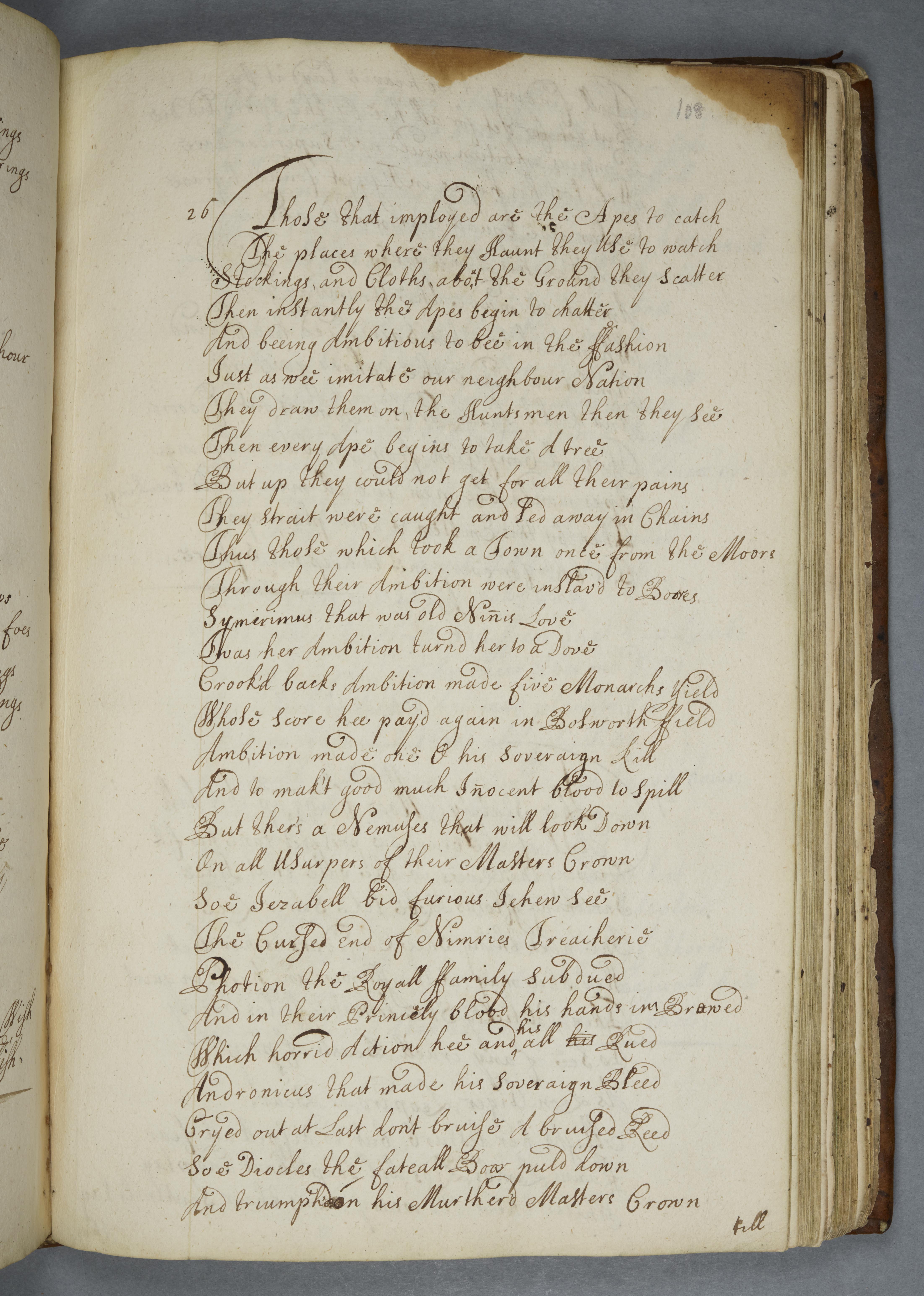
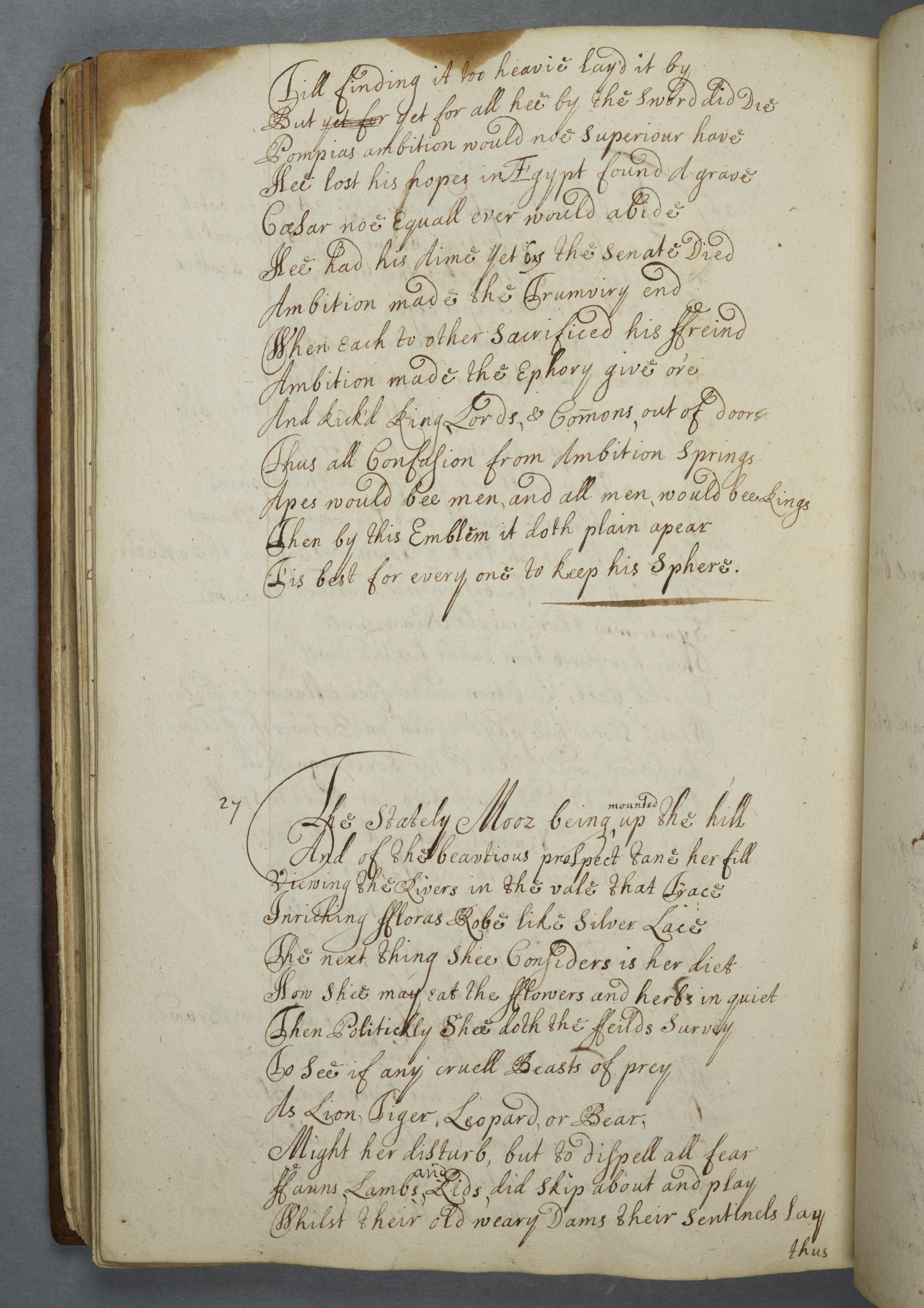
  • Facsimile of manuscript: Photographs provided by University of Leeds, Brotherton Collection

  • Transcription of manuscript: By Leah Knight and Wendy Wall.
  • Elemental edition: By Leah Knight and Wendy Wall.
  • Amplified edition: By Scott Maisano.

How to cite these versions

Conventions for these editions

The Pulter Project: Poet in the Making

  • Created by Leah Knight and Wendy Wall
  • Encoded by Katherine Poland, Matthew Taylor, Elizabeth Chou, and Emily Andrey, Northwestern University
  • Website designed by Sergei Kalugin, Northwestern University
  • IT project consultation by Josh Honn, Northwestern University
  • Project sponsored by Northwestern University, Brock University, and University of Leeds
X (Close panel)Poem Index
Loading…
X (Close panel)Notes: Transcription

 Editorial note

In these transcriptions we preserve as many details of the original material, textual, and graphic properties of Hester Pulter’s manuscript verse as we have found practical. Whenever possible, for instance, original spelling, punctuation, capitalization, lineation, insertions, deletions, alterations, spacing between words and lines, and indentation are all maintained; abbreviations and brevigraphs are not expanded; and superscript and subscript representations are retained. See full conventions for the transcriptions here.
Line number 24

 Physical note

part of “m” appears added later (changing “in” to “im”); “u” appears written over an earlier letter
Line number 25

 Physical note

struck-through with multiple horizontal lines
Line number 29

 Physical note

“d” partly blotted, as is letter that follows, possibly “o”; above latter is ascending slash
Line number 31

 Physical note

struck-through with multiple horizontal lines
Line number 35

 Physical note

in different hand from main scribe
Sorry, but there are no notes associated with any currently displayed witness.
X (Close panel)Transcription
Transcription

Facsimile Image Placeholder

Facsimile Image Placeholder

Facsimile Image Placeholder
[Emblem 26]
Ambitious Apes
(Emblem 26)
Ambitious Apes
In these transcriptions we preserve as many details of the original material, textual, and graphic properties of Hester Pulter’s manuscript verse as we have found practical. Whenever possible, for instance, original spelling, punctuation, capitalization, lineation, insertions, deletions, alterations, spacing between words and lines, and indentation are all maintained; abbreviations and brevigraphs are not expanded; and superscript and subscript representations are retained. See full conventions for the transcriptions here.

— Leah Knight and Wendy Wall
The aim of the elemental edition is to make the poems accessible to the largest variety of readers, which involves modernizing spelling and punctuation as well as adding basic glosses. Spelling and punctuation reflect current standard American usage; punctuation highlights syntax which might otherwise be obscure. Outmoded but still familiar word forms (“thou,” “‘tis,” “hold’st”) are not modernized, and we do not modernize grammar when the sense remains legible. After a brief headnote aimed at offering a “way in” to the poem’s unique qualities and connections with other verse by Pulter or her contemporaries, the edition features a minimum of notes and interpretative framing to allow more immediate engagement with the poem. Glosses clarify synonyms or showcase various possible meanings in Pulter’s time. Other notes identify named people and places or clarify obscure material. We rely (without citation) primarily on the Oxford English Dictionary (OED), the Oxford Reference database, and the King James Version (KJV) of the Bible. When we rely on Alice Eardley’s edition of Pulter’s work, we cite her text generally (“Eardley”); other sources are cited in full. The result is an edition we consider a springboard for further work on Pulter’s poetry. See full conventions for this edition here.

— Leah Knight and Wendy Wall
I love this poem and don’t think any other poem from the seventeenth century is more relevant or resonant for our own time. Since 2023, when Merriam-Webster made “authentic” its word of the year, the rise of artificial intelligence and the proliferation of deep-fakes and “fake news” has precipitated an epistemological crisis. Is this poem some kind of joke? Or trick? Some kind of travesty? The word “travesty,” which literally means “dressed in disguise,” fits this poem about monkeys dressed in human clothes, even if the word was not used to describe a “literary burlesque of a serious work” until the 1670s. Is this poem a burlesque of the emblem genre? A travesty avant la lettre? Is Pulter being playful and subversive? I kept asking myself these questions while preparing this Amplified Edition of “Ambitious Apes.” My glosses and headnote, therefore, do not aim to be authoritative, let alone to insist upon a singular orientation to—or interpretation of—Pulter’s work. My editorial apparatus aims, instead, to engage and interest readers in the poem and maybe to leave readers, as this emblem has left me, wondering whether the text before them contains any “monkey business” (and, if so, how much). Pulter’s original spelling and punctuation have been retained—as a result, my text is nearly identical to the University of Warwick’s online edition—and the Elemental Edition’s modern title removed (if I were to give this poem a title, it would be “Ambiguous Apes”). I have made one small change to Pulter’s text: in place of the word “bruise” in line 27 I have substituted “break.” My reasoning for this change appears below. In the spirit of the poem they serve, my headnote and glosses are sometimes ambitious, and therefore probably doomed to end in ignominy.

— Leah Knight and Wendy Wall
A dreadful fate awaits those who try to move above their station, this emblem warns. Demonstrating her familiarity with an array of historical, biblical, mythological, and sources, Pulter shows how this lesson applies across space and time: from overly ambitious Roman emperors to powerful Assyrian queens; from Old Testament Israelite rulers to apes who inappropriately dress in human clothes. To see how all overly zealous ascents to power will necessarily be crushed, one simply needs to look at imperial conquests (like Spain’s conquest of Muslim territories) that lead to defeat. Pulter also directs her vision of the cycling of authority and its vanquishing to contemporary politics, mourning the loss of the pre-war English government and condemning “one O” (implicitly, Oliver Cromwell) for wreaking death and destruction on England in the civil war. Written during the Protectorate, the poem seems to ask with bitter glee: what nemesis awaits the horrific political overreaching of our own day?

— Leah Knight and Wendy Wall
Have you ever suspected someone of pretending to be something they’re not? Have you ever felt like an impostor yourself? Have you ever actually been one? This Amplified Edition situates “Ambitious Apes” in the context of a seventeenth-century vogue for paintings of monkeys and invites us to understand and appreciate the poem as an imitation of an imitation, in which the poet pretends to be a monkey pretending to be the poet.
At first glance, “Ambitious Apes” looks like little more than the sequel to This Flying Fish (Emblem 25) [Poem 90], which immediately precedes it among Pulter’s emblems. Both poems appear to caution readers against aspiring too high, lest, like Nimrod, the tyrant who commissioned the Tower of Babel (and the subject of Pulter’s first emblem), they bring destruction on themselves. But the apes in this poem never get off the ground, fool no one, and accomplish nothing: “… up they could not get for all their pains; / They straight [immediately] were caught and led away in chains.” If only Richard III or Oliver Cromwell, both of whom the poem posits as tokens of this type, had been so easily defeated and effortlessly fettered. Indeed, the titular apes so little resemble the two bloody regicides—the vehicle is so remarkably unlike its tenors—that this opening epic simile becomes upon close examination an epic fail. Richard III, whom Pulter calls “Crook-Back,” and Cromwell, whom she refers to as “one O,” seem like diabolical and demonic superhumans, while the apes to which they’re likened seem more like The Stately Moose (Emblem 27) [Poem 92], the emblem which immediately follows in Pulter’s manuscript: powerless and unsuspecting victims wandering into a predator’s trap. These monkeys are endangered rather than dangerous. These monkeys are tricked and deceived by means of the human garments they try on; they do not, however, trick or deceive anyone, much less rise to positions of authority themselves. Or do they?
Unlike the eponymous apes of the poem which are easily identified and apprehended in their human clothes, and thus create no confusion whatsoever for the huntsmen, Pulter’s verse often makes it difficult for the reader to discern human from ape. This animal emblem begins unusually by first describing not the apes themselves but humans who are paid (by other, unseen humans) to capture them. Grammatically, the ape-catchers are the subject of the first three lines: it is they who “catch” and “watch” and “scatter” clothes on the ground; the apes, meanwhile, are mere objects (grammatically and otherwise), defenseless and unsuspecting prey, first watched and then caught by means of a trap. From its very first couplet, this poem complicates perspectives and confounds expectations: the first word of the poem, “Those,” is a demonstrative pronoun, which points something out, but in this case points away from the apes and toward the unseen hunters, who are hiding, watching, and waiting to ambush the apes; this initial confusion is only compounded in the second line where the selfsame pronoun, “they,” refers alternately to apes and humans with only one word between them. The Elemental Edition inserts a gloss to clarify the respective antecedent for each “they,” but Pulter’s verse purposefully blurs the boundaries between monkeys and mankind, leaving the unguided, first-time reader to wonder several times: “Which is the ape-catcher and which the ape?”
The Elemental Edition inserts another helpful gloss at the start of line 7 to explain that “They draw them on” means “The apes pull on the clothes.” In Pulter’s day, as in our own, “To draw on” might refer to two distinct activities: (1) “To pull on (a boot, glove, or other item of clothing”); and (2) “To induce or influence (a person) to come to a place or join in a venture; to lead on.”
Gloss Note
OED Online v. “to draw on” def. 3 and 4.
1
Given the scenario established in the first six lines, especially given how the grammatical subject switches from the human hunters in lines 1–3 to the hunted apes in lines 4–6, “They draw them on” at the start of the seventh line does indeed refer to the apes pulling on the clothes, as the Elemental Edition suggests, but it also glancingly acknowledges the ape-catchers who draw the monkeys on by means of a ruse. Likewise, the poem’s phrasing of “those which took a town once from the Moors” in line 11, complete with the demonstrative pronoun, exactly parallels “Those that employed are the apes to catch” in line 1, which would seem to indicate that the apes are analogous to the dispossessed Moors, while the ape-catchers more closely resemble the ambitious Spanish invaders. While the headnote to the Elemental Edition is correct when it states that “apes who inappropriately dress in human clothes” are equated with “imperial conquests (like Spain’s conquest of Muslim territories),” the editors’ clear account belies Pulter’s own confusing wording and obscures the fact that the apes did not dispossess anyone when seizing the human clothes (used for the express purpose of catching them), while the ape-catchers did dispossess the apes when they displaced them from their natural habitat. Thus, the apes’ attempt to scale trees, far from being a metaphor for ambitious upward mobility, is an act of self-defense and indigenous resistance to discovery and domination.
If the hapless bunch of simians described in the poem’s first 10 lines bears no resemblance to “Crook’d-Back” (Richard III) and Cromwell (“one O”), and only a slight resemblance to “those which took a town once from the Moors,” then perhaps they bear a stronger resemblance to the only other figure they are said to resemble: Semiramis. There is a potentially interesting connection between the apes dressing in human clothes and an anecdote Lodowick Lloyd recounts in The Pilgrimage of Princes, Penned out of Sundry Greeke and Latine Aucthours:
Semiramis Quéene of Babilon … perceiuing her yong sonne Ninus, to bee too tender to gouerne the stoute Babilonians and Assirians, [and] knowyng the nature of the people to bée impaciente of a womans gouernemente, … became in apparell like a man, and rule[d] the kyngdome, vntill her sonne came vnto ripe age. Lodowick Lloyd, The Pilgrimage of Princes, Penned out of Sundry Greeke and Latine Aucthours (London, 1573).
But Pulter’s poem never mentions Semiramis donning “apparel like a man” and, even if it did, there would still be a big difference between vehicle and tenor because for Semiramis the ruse succeeds: she reigns long enough for her son to become king. Again, the monkeys described in the first ten lines fool no one with their clothes; to the contrary, the clothes are used to fool them. Meanwhile, what Pulter chooses to mention about Semiramis is odd, and seemingly off the mark, given the likening of this Assyrian queen to apes that could not get up a tree: ambition, we are told, “turned [Semiramis] to a dove.” A dove? In what sense is a dove, which can fly, like an ape unable to get up a tree? Why does the simile spanning the first 18 lines of the poem break down repeatedly?
At line 19 the poem swaps its stalled vehicle of easily apprehended apes for a new one:
But there’s a Nemesis that will look down
On all usurpers of their masters’ crown.
So Jezebel bid furious Jehu see
The curséd end of Zimri’s treachery.
Nemesis, the Greek goddess of retribution, was a familiar figure in Renaissance emblem books, having appeared in Andrea Alciati’s Emblemata (1531) and Geffrey Whitney’s A Choice of Emblemes (1586). But here Nemesis herself is not emblematized, not described in any detail; indeed, the indefinite article, “a,” indicates that, despite its capitalization in the manuscript, Pulter uses “Nemuses” as a common rather than a proper noun. This nemesis figure serves as the start of a new simile: in just the same way that it “will look down / On all usurpers of their masters’ crown,” even “So Jezebel bid furious Jehu see / The curséd end of Zimri’s treachery.” The clipped tone of this couplet leaves much to be filled in by the reader (see Jezebel), but most important for our purposes here is the fact that Jehu, unlike Zimri, was never captured or killed. Instead, he literally got away with murder, with regicide.
Another of Pulter’s examples, Diocles, was also never captured or killed: the marginal note in the Elemental Edition informs readers that “Diocletian was the first Roman emperor to abdicate his position voluntarily.” What is going on here? How can this emblem effectively warn readers that “a dreadful fate awaits those who try to move above their station,” in the words of the headnote to the Elemental Edition, when several of its examples show the opposite? Now is a good time to return to several questions already raised: why does Pulter blur the line between apes and humans by describing each in terms that evoke the other? Why does the epic simile that begins the poem fail—that is, why does it liken monkeys who get captured because they are unable to climb a tree to social climbers who install themselves in positions of high authority? Finally, why does the poem several times allude to impostors, regicides, and usurpers who profited from their ambition rather than being punished for it?
To answer these questions, I would like to draw the reader’s attention to the only triplet in a poem otherwise comprising twenty couplets:
Phocion the royal family subdued,
And in their princely blood his hands imbrued,
Which horrid action he and his all rued.
Both the Elemental Edition and Alice Eardley call attention in their notes to the fact that Pulter’s allusion to Phocion here is completely at odds with her presumable source, Plutarch’s Lives. Indeed, it would be hard to overstate the degree of revisionism involved in Pulter’s altered account because Plutarch celebrates Phocion not merely as a “just and moral leader,” as the gloss in the Elemental Edition states, but as the antithesis of ambition. If the first definition for “ambitio” in the Oxford Latin Dictionary is “Canvassing for votes,” then it is worth noting that although Phocion “held the office of general more frequently than any man,” never, not once, Plutarch tells us, did Phocion “seek the office or canvass for it.”
Gloss Note
For the Oxford Latin Dictionary’s definition of “ambitio,” see William Casey King, Ambition, A History from Virtue to Vice (New Haven: Yale UP, 2013), 15; the English quotation from Plutarch on Phocion comes from Bernadotte Perrin’s translation in the Loeb Classical Library edition, vol. VIII (Cambridge, MA: 1919) of The Parallel Lives and is accessible here.
2
While Phocion might not be much of a name to reckon with in the twenty-first century, in 1648 the French artist Nicolas Poussin painted two masterpieces—Landscape with the Ashes of Phocion and The Funeral of Phocion—memorializing the Athenian statesman who had been unjustly exiled and executed before having his reputation posthumously restored. There were, moreover, readymade exemplars of ambition on offer in Plutarch’s Lives. John Dryden in his translation of Plutarch writes of Alcibiades, “the one most prevailing of all [his passions] was his ambition and his desire for superiority.”
Gloss Note
For the quotation from Dryden’s translation of Plutarch on Alcibiades, see William Casey King, Ambition, A History from Virtue to Vice (New Haven: Yale UP, 2013), 12.
3
Why, then, does Pulter choose Phocion? Is there any connection between the egregious form of this triplet and its equally egregious content, rewriting the legacy of “Phocion the Good,” as he came to be known, to suggest that he was caught red-handed in the act of murder?
Is it significant that the only triplet in the poem also creates the poem’s only acrostic? If one reads vertically the first letter of each line in succession, these rhyming lines on Phocion spell “PAW.” This acrostic, consisting of only three letters, could of course be an accident, sheer happenstance, what Andrew Sofer calls a “nonce acrostic,” in which “a random series of adjacent letters throws up an English word or phrase.”
Gloss Note
Andrew Sofer, “All’s I-L-L that Starts ‘I’le’: Acrostic Space and Ludic Reading in the Margins of the Early Modern Play-Text,” Renaissance Drama 48, no. 2 (2020): 276.
4
Is this acrostic worth noticing? Should this “PAW” give the reader pause? According to the Oxford English Dictionary, the noun “paw” refers to “The foot of an animal having claws and pads. Also: the hand of a monkey or ape.”
Gloss Note
OED Online n. “paw” def. 1b.
5
The verb “paw,” according to the OED, means “to touch or handle roughly, awkwardly… [and] clumsily.”
Gloss Note
OED Online v. “paw” def. 1a.
6
As we have seen, this poem maladroitly mishandles more than its allusion to Phocion. Did a monkey have a hand—or paw—in writing this poem?
According to the Oxford English Dictionary, the word “ape” became a verb in the 1640s, meaning “to imitate, mimic” most often “pretentiously, irrationally, or absurdly,” but sometimes “in a good or neutral sense” too. In 1658, the verb phrase “to ape it,” meaning “to play the ape, mimic the reality” entered the language and it did so in the specific context of a Royalist poet satirizing Oliver Cromwell: “What’s a Protector?” James Cleveland asks, before answering, “He’s a stately Thing, that Apes it in the Non-Age of a King.”
Gloss Note
OED Online v. “to ape it”
7
A few years prior to Cleveland coining the phrase, “to ape it,” Hester Pulter, another royalist poet, also wrote a poem satirizing Oliver Cromwell. But Pulter, I suspect, also “apes”—that is, imitates “pretentiously, irrationally, or absurdly”—the emblem genre itself.
Gloss Note
OED Online v. “ape” def. 1a.
8
Does this emblem about dissembling thus double as a dissembling emblem?
The more one studies it, the more Emblem 26 reads like a “monkey trick,” which, according to the OED, is a phrase dating back to 1653, most likely the year before Pulter composed this poem, and meaning “a mischievous, foolish, or underhand trick or act, an antic.”
Gloss Note
OED Online n. “monkey trick.”
9
According to H.W. Janson, apes were regarded as “the most laughable of animals,” especially once they were caught and brought into closer contact with humans: “the ape as domestic pet,” Janson explains, “was the exact counterpart of the fool or jester,” adding that both “were kept, not for their beauty or utility but as sources of amusement, and thus enjoyed a license not permitted to other members of the household.”
Gloss Note
Janson, Apes and Ape Lore, 29, 211.
10
The association of monkeys with court jesters is most evident in a painting by the artist Anthony Van Dyck of Queen Henrietta Maria in 1633: here, Pulter’s queen appears in a vibrant blue hunting dress made of silk and a wide-brimmed hat with a feather protruding from it, but more striking than the image of Henrietta Maria herself are two additional figures to her left, Jeffrey Hudson, the court dwarf, and Pug, the queen’s monkey, who is positioned on Hudson’s shoulder and being petted by the queen. While Henrietta Maria was not the first English queen to be painted with a pet monkey—see Apes and Art: From Bruegel to Banksy and Beyond—Pulter’s lifetime did coincide with an increasing artistic awareness of and interest in such “apes.”
It is worth noting that an “ape” for Pulter would not have meant one of the great apes—chimpanzees, gorillas, or orangutans—because with very few exceptions, Europeans had not seen “apes” of this sort, nor was the word was applied to them until 1699 when Edward Tyson published Anatomy of a Pygmy, which described his dissection of a chimpanzee. What Pulter meant by “apes” were what we would describe as monkeys: Barbary macaques, a tailless North African species common in ancient Greece and Rome, or Capuchin monkeys, native to Central and South America and thus living emblems of England’s global commerce and conquest. Barbary apes and Capuchin monkeys were caught and imported to England as exotic pets for wealthy women and as trained performers. In Shakespeare’s The Winter’s Tale, Autolycus, the peddler-turned-pickpocket, was also once “an ape-bearer,” which means “One who carried a monkey about for exhibition.”
Gloss Note
OED Online n. “ape-bearer.”
11
Like Autolycus, monkeys had a reputation in the seventeenth century for being scheming pranksters.
Is Pulter a prankster in this poem? Is the poem written from the perspective of the one (monkey) that got away? That would explain the “paw print” in the poem and its egregious mishandling of the Phocion legend. That would explain the poem paying homage to ambitious figures in whom the vice was either never detected or only punished long after they prospered. That would explain the epic simile at the poem’s start, which turns out not to be an epic fail: after all, an ambitious ape did climb to freedom and became the poem’s ultimate authority, the author. If, as the poem says, all apes “would be men,” this ape (like Cromwell and Crookback) got its wish. And, for the most part, the monkey-author gets away with its ruse. Only the reader who dwells with the emblem, lavishing time meditating with and puzzling over it, reading it vertically (which makes sense, given how the apes aim to climb up a tree while a “Nemuses” looks down) as well as from left to right, will have the satisfaction of seeing a “PAW” hiding in plain sight.
But where would Pulter get the idea that a monkey could write a poem? As it turns out, the seventeenth century saw an explosion of engravings and paintings that depicted monkeys engaged in all manner of human activities, from alchemy to ice skating to investing in the tulip market. This genre of the visual arts, known as singerie (French for “monkey trick”), frequently made much of the monkey’s paw, its human-like hand, complete with an opposable thumb, which enables the animal to use tools, once thought (and still sometimes believed) to be a uniquely human capacity. As the first Curation (“Apes and Art”) in this Amplified Edition demonstrates, the artists who created these scenes of monkeys acting like humans—including David Teniers the Younger who painted a monkey at an easel painting—enjoyed plugging monkeys into a wide variety of human scenarios, from the everyday to the extraordinary.
Does Pulter’s naked emblem poem belong to the early modern singerie genre? Is Hester Pulter one of those early modern artists who, in the words of Simona Cohen, “demonstrated their identification with a pet monkey or domesticated ape?"
Gloss Note
Simona Cohen, “Ars Simia Naturae: The Animal as Mediator and Alter Ego of the Artist in the Renaissance,” Explorations in Renaissance Culture 43 (2017), 227. For more on apes and monkeys in the early modern period, see the following (far from exhaustive list): James Knowles, “Can ye not tell a man from a marmoset?: Apes and Others on the Early Modern Stage” in Renaissance Beasts: Of Animals, Humans, and Other Wonderful Creatures, ed. Erica Fudge (Urbana-Champaign: University of Illinois Press, 2004), 138–163; Ken Gouwens, “Erasmus, Apes of Cicero, and Conceptual Blending,” Journal of the History of Ideas 71:4 (2010): 523–545; Scott Maisano, “Shakespearean primatology: A diptych,” Postmedieval 1 (2010): 115–123; Holly Dugan, “To Bark with Judgement: Playing Baboon in Early Modern London,” Shakespeare Studies 41 (2013): 77–93; Scott Maisano, “Rise of the Poet of the Apes,” Shakespeare Studies 41 (2013), 64–76; Holly Dugan and Scott Maisano, “Ape,” in Veer Ecology, eds. Jeffrey Jerome Cohen and Lowell Duckert (Minneapolis: University of Minnesota Press, 2018), 355–376; and Theresa Grant, Apes and Monkeys on the Early Modern Stage, 1603–1659 (New York: Palgrave, 2024).
12
It is noteworthy that Pulter’s long lament, Why Must I Thus Forever Be Confined [Poem 57], in which the poet envies the freedom and liberty of countless creatures—from moths, flies, bees, and beetles through dolphins, whales and “every sort of fish” to “lion, tiger, elephant and bear”—makes no mention of “apes” or “monkeys.” That is because apes and monkeys in seventeenth-century England were, like Pulter, domesticated and confined. These creatures were often, if not always, fettered in clogs and chains. Perhaps this accounts for why Pulter chose the emblem on ambition to go ape. Or maybe the playfulness Pulter exhibits here is not confined to this one emblem. Should we assume the tone of Pulter’s other emblem poems—many of which also contain a clear moral supplemented by confusing allusions that subtly undercut their ostensible moral clarity—is earnest rather than irreverent? Should we assume her poetic persona is always autobiographical and not sometimes that of an animal avatar? Rather than faithfully following the emblem tradition she had inherited, might Hester Pulter have chosen, instead, to monkey with it?
Gloss Note
It has been nearly a decade since Rachel Dunn Zhang demonstrated that Pulter wrote at a time when the emblem book was undergoing a “generic existential crisis … after the deposition and regicide of Charles I.” Rachel Dunn Zhang, “Breaking a Tradition: Hester Pulter and the English Emblem Book,” The Seventeenth Century 30:1 (2015), 55–73.
13


— Leah Knight and Wendy Wall
1
26Thoſe that imployed are the Apes to catch
Those
Gloss Note
who
that
employéd are the apes to catch,
Those that imployed are the Apes to catch
2
The places where they Haunt they Uſe to watch
The places
Gloss Note
Ape-catchers routinely keep an eye on the apes’ usual habitation (“haunt”)
where they haunt they use to watch
;
Gloss Note
On the potential confusion and misdirection created by this first couplet see the headnote.
The places where they Haunt they Use to watch
3
Stockings, and Cloths, abo^ut the Ground they Scatter
Stockings and clothes about the ground they scatter.
Critical Note
This method for catching apes, or monkeys, is an old one and attested to by Edward Topsell’s History of Four-Footed Beasts and Serpents (the two parts of which had been published separately in 1607 and 1608 but were published together for the first time in 1658, within a few years of Pulter writing this poem): “They are taken by laying for them shoos and other things… If [the hunters] lay shoos, they are leaden ones, too heavy for [the apes] to wear… [so] that when once the Ape hath put them on, they cannot be gotten off without the help of man: So likewise for little bags made like breeches, wherewithal they are deceived and taken.”
Stockings, and Cloths about the Ground they scatter
4
Then inſtantly the Apes begin to chatter
Then instantly the apes begin to chatter;
Then
Critical Note
The word “instantly” implies a mechanical reflex or imitative instinct that bypasses cognition or even the briefest consideration about why these clothes have been strewn on the ground. Thus, although they resemble humans outwardly in their physical appearance, apes could be said to lack any semblance of the rational soul, or imago Dei, which separated humanity from animals. Likewise, “chatter” is distinct from human conversation: originally deriving from the sharp, shrill sounds of birds, “chattering” was applied to other animal vocalizations and to humans indulging in thoughtless gossip, in the latter case abbreviated to “chat” or “chatting.”
instantly the apes begin to chatter
5
And beeing Ambitious to bee in the ffaſhion
And being ambitious to be in the fashion
And beeing ambitious to bee in the Fashion
6
Just as wee imitate our neighbour Nation
(Just as we imitate
Gloss Note
France, commonly known as setting fashion trends at the time
our neighbor nation
),
Just as wee immitate our neighbour Nation
7
They draw them on, the Huntsmen then they See
Gloss Note
The apes pull on the clothes
They draw them on
. The huntsmen then they see;
Gloss Note
For the ambiguity involved in this phrase, see the headnote.
They draw them on
, the Huntsmen then they see
8
Then every Ape begins to take A tree
Then every ape begins to
Gloss Note
climb
take
a tree.
Then every ape begins to take a tree
9
But up they could not get for all their pains
But up they could not get for all their
Gloss Note
efforts
pains
;
But up they could not get for all their pains
10
They Strait were caught and led away in Chains
They straight were caught and led away in chains.
They
Gloss Note
immediately
strait
were caught and led away in Chains
11
Thus thoſe which took a Town once from the Moors
Thus those which took a town once from the Moors
Gloss Note
meaning “in such a way” or “that’s how,” is the equivalent of “like” or “as” and thereby creates a comparison or equivalence (an epic simile) between the apes described in the first ten lines and the various historical figures described in the next eight. For the complication created by “those which took a Town once from the Moors” mirroring in its phrasing not the apes but the hunters—“Those that imployed are the Apes to catch”—in the poem’s opening line, see the headnote. The implicit suggestion here that Cromwell’s Protectorate was imitating and aspiring to the kind of colonial conquests associated with the Spanish empire leads me to believe that this poem was composed in 1654, the year of Cromwell’s so-called “Western Design,” which “aimed to conquer all of Spanish America… but ultimately captured only Jamaica.” See Carla Gardina Pestana, The English Conquest of Jamaica: Oliver Cromwell’s Bid for Empire (Cambridge: Harvard University Press, 2017), 1–2.
Thus
those which took a Town once from the Moors
12
Through their Ambition were inſlav’d to Boores
Through their ambition were enslaved to
Gloss Note
peasants, especially Dutch or German; sometimes used pejoratively. This couplet possibly alludes to the Dutch conquest of Gibraltar from Spain in 1607; the Spanish (“those which took a town” in the preceding line) had overthrown Moorish (North African Muslim) rule of Gilbraltar in 1492 (Eardley).
boors
.
Through their ambition were inslav’d to Boores
13
Symirimus that was old Ninis Love
Gloss Note
In Assyrian mythology, Semiramis is a goddess and queen to Ninus, founder of Nineveh, after whose death she founded Babylon and led victorious armies until, opposed by her son, she took the form of a dove and flew away.
Semiramis, that was old Ninus’s love
,
Symirimus that was old Ninnis Love
14
T’was her Ambition turnd her to a Dove
’Twas her ambition turned her to a dove.
T’was her ambition turnd her to a Dove
15
Crook’d backs Ambition made five Monarchs Yield
Gloss Note
Crook’d-Back, or crookback, was a nickname applied to Richard III, who overcame five monarchs in his rise to power.
Crook’d-Back’s ambition made five monarchs yield
,
Crook’d backs ambition made five Monarchs Yield
16
Whose Score hee pay’d again in Boſworth ffield
Gloss Note
At the Battle of Bosworth (1485), Richard III was killed by Henry Tudor, the future Henry VII.
Whose score he paid again in Bosworth field
.
Whose score he pay’d again in Bosworth Field
17
Ambition made one O his Soveraign Kill
Ambition made one
Gloss Note
What seems like an emotional exclamation can also signify Oliver Cromwell’s first initial; Cromwell led the Parliamentarians who killed King Charles I during the English Civil War.
O
his sovereign kill,
Ambition made one
Critical Note
There are several ways one might explain referring to Oliver Cromwell as “one O” here. First, critiques of Cromwell were often couched in clever anagrams, such as the one James Cleveland appends to his poem “The Definition of a Protector.” Cleveland rearranges the letters from “Protector” to spell “Oportet C.R.” (suggesting in the Latin “Charles is the rightful king”). Interestingly, in the context of Pulter’s apes, Cleveland’s poem, written after Pulter’s, begins “What’s a Protector? He’s a stately Thing, / That Apes it in the Non-age of a King.” Given the inconsistent capitalization in Pulter’s manuscript poem, one wonders if it too contains an anagram. A second way to explain “one O” is in relation to the figure of Richard III or “Crook-back,” which immediately precedes it. Whereas we ordinarily think of an O as circular, and circles themselves as signs or symbols of perfection, wholeness and integrity, it’s possible that this reference to Cromwell as “O” is meant to suggest that Cromwell is even more twisted and crooked than the notorious, child-killing hunchback himself: in Shakespeare’s The Tempest, Prospero says “The foul witch Sycorax with age and envy / Was grown into a hoop,” suggesting that crookedness at its most extreme creates a kind of circular person, a moral monster, whose nose touches its toes. The third—and simplest—explanation, is that “O” here signifies a cipher, a zero, thereby effectively calling Cromwell a “nothing.”
O
his soveraign Kill
18
And to mak’t good much Inocent blood to Spill
And to
Gloss Note
make it
mak’t
good, much innocent blood to spill.
And to mak’t good much Innocent blood to spill
19
But ther’s a Nemuſes that will look Down
But there’s a
Gloss Note
In Greek mythology, personification of the gods’ disapproval, jealousy, and retribution.
Nemesis
that will look down
But ther’s a Nemuses that will look Down
20
On all Uſurpers of their Maſters Crown
On all usurpers of their masters’
Gloss Note
crowns
crown
.
On all Usurpers of their Masters Crown
21
Soe Jezabell bid furious Jehew See
So
Gloss Note
Jezebel, as the widow of Israel’s King Ahab, was killed by Jehu, who became king; before her death, Jezebel says to Jehu, “Had Zimri peace, who slew his master?” (2 Kings 9:31).
Jezebel bid furious Jehu
see
Soe
Gloss Note
For the dramatic irony underpinning this couplet on Jezebel and Jehu, see Jezebel.
Jezabell
bid furious Jehew see
22
The Curſed end of Nimries Treacherie
The curséd end of
Gloss Note
In the Bible, Zimri is a captain who kills the king of Israel and makes himself king; he himself in turn is defeated and killed (2 Kings 9:30–31).
Zimri’s treachery
.
The Cursed End of Nimries Treacherie
23
Photion the Royall ffamily Subdued
Gloss Note
One faction of the Athenian leadership accused Phocion (an Athenian general and statesman, 402–318 BCE) of enabling the death of Antipater (the Macedonian statesman); Phocion was put to death for treason. Pulter alters her likely source (Plutarch) by crediting Phocion’s guilt, when Phocion was generally remembered as a just and moral leader. See Plutarch, The Lives of the Noble Grecians and Romans, trans. Thomas North (London, 1579), pp. 797–814.
Phocion the royal family subdued
,
Gloss Note
a variant spelling of Phocion, a key figure in Plutarch’s Parallel Lives. For the stark differences between Plutarch’s Phocion and Pulter’s, see the headnote.
Photion
the Royall Family subdued
24
And in their Princely blood his hands
Physical Note
part of “m” appears added later (changing “in” to “im”); “u” appears written over an earlier letter
imBruwed
And in their princely blood his hands
Gloss Note
Phocion’s hands are stained or steeped in the royal family’s blood, or (in another sense) infected by it.
imbrued
,
And in their Princely blood his hands imBrewed
25
Which horrid Action hee and ^his all
Physical Note
struck-through with multiple horizontal lines
his
Rued
Which horrid action
Gloss Note
Phocion and his supporters/family
he and his
all rued.
Gloss Note
On the poem’s only rhyming triplet, which forms its only vertical acrostic, see the headnote.
Which horrid action hee and his all Rued
26
Andronicus that made his Soveraign Bleed
Gloss Note
After defeating the Goths, the Roman general Titus Andronicus gave permission to sacrifice the eldest son of Tamora, queen of the Goths, to appease the souls of his dead sons, and thereby unleashed a series of horrific acts of revenge.
Andronicus
, that made his sovereign bleed,
Critical Note
The reference here is not to Shakespeare’s Titus Andronicus (as suggested by the Elemental Edition) but to Thomas Fuller’s Andronicus, or, The unfortunate politician shewing sin stoutly punished, right surely rescued (1646). Indeed, the quotation in the next line, which echoes Isaiah 42:3 and Matthew 12:20, is spoken by Andronicus in Fuller’s history but not spoken at all in Shakespeare’s tragedy. Near the end of the book, after Andronicus has been fettered, insulted (being called “Religion’s ape” amongst other things), had his hair pulled, one eye and most of his teeth knocked out, his right hand cut off, his body burnt with torches, tortured with pinchers, covered in excrement, hung up by his heels between two pillars, and “his Back and Belly” run through with a sword “so that his very Entralls were seen,” he finally breaks the silence with which he has endured these abuses by exclaiming, “Lord have mercy upon me: And, Why breake yee a bruised Reed!” Initially, Fuller comments on the deposed tyrant’s scriptural citation as part of his plea for divine mercy by observing “How improperly did he [Andronicus] usurp that Expression,” adding, “Allow Andronicus for a Saint; and we shall people Heaven with a new Plantation of Whores and Theeves.” Shortly thereafter, however, Fuller reconsiders: “On the other side, we must be wary, how, in our Censures, wee shut Heaven-doore against any Penitents. Farre bee it from us to distrust the power of Gods mercy, or to deny the efficacie of true (though late) Repentance.” For Fuller, the fate of Andronicus’s eternal soul depends on the authenticity of his dying repentance. Ultimately, Fuller moralizes the history thus: “if Andronicus his soule went to Heaven, it is pitty that any should know of it, lest they bee encouraged to imitate the wicked Premises of his life, hoping by his Example to obtaine the same happy Conclusion after death.”
Andronicus
that made his soveraign Bleed
27
Cryed out at Last don’t bruiſe A bruiſed Reed
Cried out at last, “Don’t bruise a bruiséd reed.”
Cryed out at Last don’t
Critical Note
This line contains, I suspect, another scribal error (see line 5 above). Therefore, I have amended “bruise” to “break.” Not only is Pulter echoing a line from Fuller, which itself echoes verses from both the Old and New Testaments (Isaiah 42:3 and Matthew 12:20), but the publication of Richard Sibbes’ The Bruised Reed in 1630 further popularized these verses and their exegesis. Having “break” in line 27 also picks up the vowel sound of “made” in line 26, making the couplet more mellifluous (see, for example, how “Cursed” in line 22 picks up the vowel sound of “furious” from line 21). It is certainly possible, on the other hand, that the clunky redundancy of “Don’t bruise a bruiséd reed” is intentional and yet another sign of the poem’s travestying or aping its genre.
break
a bruised Reed
28
Soe Diocles the fateall Boar puld down
So
Gloss Note
Diocletian (also known as Diocles) was Roman emperor from 284 to 305, a position he achieved in part by killing Aper (Latin for “boar”), thus fulfilling the prediction that he would become emperor only after he killed a boar. See, for example, Fletcher and Massinger, The Prophetess, in Francis Beaumont and John Fletcher, Comedies and Tragedies [London, 1647]). Diocletian was the first Roman emperor to abdicate his position voluntarily. Thanks to Sam Nguyen for information in this note.
Diocles the fatal boar pulled down
Soe Diocles
Critical Note
According to a popular legend, made even more popular by Beaumont and Massinger’s seventeenth-century play, The Prophetess (see note in Elemental Edition), Diocletian was told he would become emperor by a druidess who said the event would occur “When thou hast kill’d a mighty Boar.” With this prophecy in mind, the young Diocletian, according to the Druidess herself in the first act of The Prophetess, “imploy’d / Much of his time in hunting. Many Boars / Hideous and fierce, with his own hands he has kill’d too, / But not yet lighted on the fatal one.” The fatal boar turns out to be a man whose name is Aper, which means wild boar in Latin. Is it a coincidence that the name “Aper” figures as an absent presence in a poem about “apes” who attempt to disguise themselves and conceal their appearances? The English word “aper,” meaning “a ridiculous imitator or mimick,” does not appear in print until the publication of Samuel Johnson’s Dictionary in 1755.
the fateall Boar
puld down
29
And
Physical Note
“d” partly blotted, as is letter that follows, possibly “o”; above latter is ascending slash
triump’h’d[?]n
his Murther’d Maſters Crown
And triumphed in his murdered master’s crown,
And triumph’d in his Murther’d Masters Crown
till

Facsimile Image Placeholder

Facsimile Image Placeholder

Facsimile Image Placeholder
30
Till finding it too heavie lay’d it by
Till, finding it too heavy, laid it by;
Till finding it too heavie lay’d it by
31
But
Physical Note
struck-through with multiple horizontal lines
yet for
yet for all hee by the Sword did Die
But yet,
Gloss Note
even though he set aside the crown; or possibly, for his crimes
for all
, he by the sword did die.
But yet for all hee by the sword did Die
32
Pompias ambition would noe Superiour have
Gloss Note
Gnaeus Pompeius Magnus, known as Pompey the Great, formed the First Triumvirate with Caesar and Crassus, but disagreement with Caesar resulted in civil war.
Pompey’s ambition
would no superior have;
Gloss Note
Pompey, like Caesar mentioned two lines later, is associated with the gradual transformation of the Roman republic into an empire.
Pompias
ambition would noe superiour have
33
Hee lost his hopes in Ægypt found A grave
Gloss Note
Pompey, defeated at the battle of Pharsalus, fled to Egypt, where he was murdered.
He lost his hopes, in Egypt found a grave
.
Hee lost his hopes in Ægypt found a grave
34
Cæſar noe Equall ever would abide
Gloss Note
Julius Caesar, Roman dictator, was murdered (as the next line indicates) in a conspiracy led by his senators.
Cæsar no equal ever would abide
;
Critical Note
In On that Unparalleled Prince Charles the First, His Horrid Murder [Poem 8], Pulter refers to Charles as “Caesar.” In Upon the Imprisonment of his Sacred Majesty, That Unparalled Prince,
King Charles the First [Poem 13]
, she not only refers to Charles as “Caesar” but also says that his political enemies, the revolutionaries, “pretend to adore” Nemesis, the same goddess of revenge to whom the poet looks for justice here.
Cæsar
noe Equall ever would abide
35
Hee had his Aime Yet
Physical Note
in different hand from main scribe
by
the Senate Died
He had his aim, yet by the senate died.
Hee had his aime yet by the senate Died
36
Ambition made the Trumviry end
Ambition made
Gloss Note
an association of three magistrates for joint administration; here, the First Triumvirate (see note above on “Pompey’s ambition”)
the trumviri
end
Ambition made the Trumviry end
37
When each to other Sacrificed his ffreind
When each to other sacrificed his friend.
When each to other sacrificed his Freind
38
Ambition made the Ephory give or’e
Ambition made the
Gloss Note
In ancient Greek, “ephor” refers to a board of magistrates in some divisions of ancient Greece (Dorian states).
ephory
give o’er
Critical Note
This is the fourth appearance of the collocation “Ambition made” in the poem. In the first instance, it is Richard III’s ambition that makes other monarchs yield to him; in the remaining three instances, however, “ambition” seems to have agency and to operate independently, akin to demonic possession, as when “Ambition made one O his soveraign Kill.”
Ambition made
the Ephory give or’e
39
And kick’d King, Lords, & Comons, out of doors
Gloss Note
After the civil war ended, Parliamentarians in England restructured the government and abolished the titles designating kingship and the representative bodies of the House of Lords and House of Commons.
And kicked king, lords, and commons, out of doors
.
And kick’d
Critical Note
could refer to Thomas Hobbes’s taxonomy in Leviathan (1651) of three types of representative government: “When the Representative is One man, then is the Common-wealth a MONARCHY: when an Assembly of All that will come together, then it is a DEMOCRACY, or Popular Common-wealth: when an Assembly of a Part onely, then it is called an ARISTOCRACY.” In the absence of all three, humans live in a state of nature or anarchy.
King, Lords, and Commons
out of doors
40
Thus all Confuſion from Ambition Springs
Thus all confusion from ambition springs:
Thus all
Critical Note
In his satire “Of Ambition” in Abuses stript, and whipt (1613), George Wither, who wrote his own Collection of Emblemes, Ancient and Moderne (1635), similarly sees ambition as the root of social anarchy or “confusion.” Wither writes of ambitious people, “They haue such flinty breasts they can out-beard, / Danger it selfe, and be no whit afeard; / Proud daring Spirits; yet we see, confusion, / Of such high minds doth prooue the sad couclusion” (emphasis mine). If Pulter knew Wither’s poem, she does not appear to have taken much else from it. Unlike her diverse cast of ambitious exempla, Wither’s only personification of ambition in his satire is “the devil.”
Confusion
from ambition springs
41
Apes would bee men, and all men, would bee Kings
Apes would be men, and all men would be kings.
Critical Note
If, as is often said, monosyllabic phrases slow the reader of poetry down and give greater emphasis to what is expressed, then this line comprising ten monosyllables would make a wonderful conclusion. Why, then, does Pulter append another couplet?
Apes would bee men, and all men, would bee Kings
42
Then by this Emblem it doth plain apear
Then, by this emblem it doth plain appear,
Then by this
Critical Note
If “Emblem” here refers to the pictura, or woodcut illustration, which would ordinarily accompany a poem of this sort, then the absence of any such visual complement to the verbal structure of the poem makes this line ironic: nothing “doth plain apear” because nothing appears. Period. Note, too, the appearance of an “ape” in the original spelling of “apear.” The spelling is not unique to this poem—it occurs elsewhere in Pulter’s manuscript—but it takes on added significance in a poem about apes who attempt to disguise themselves and conceal their presence. It is also possible that “Emblem” here refers, as it does throughout Edmund Spenser’s Shepheardes Calender, to the final reduction of the didactic poem to an overt moral statement, equivalent to “the motto” in other emblem poems. In that case, “this Emblem” refers proleptically to the poem’s final line.
Emblem
it doth plain apear
43
T’is best for every one to keep his Sphere.
’Tis best for every one to keep his
Gloss Note
social station, place, or position; domain in which one’s activities or faculties find scope
sphere
.
T’is best for every one to
Critical Note
When read aloud the final “s” in “his” and the first “s” in “sphere” are elided, making it possible to hear (or impossible not to hear) the line as “Tis best for every one to keep his fear.” If read in this way, Pulter’s poem echoes or anticipates Thomas Hobbes’s Leviathan (1651), which posits fear itself as the foundation for all social contracts and civic order.
keep his Sphere
.
horizontal straight line
X (Close panel)Notes: Elemental Edition

 Editorial note

The aim of the elemental edition is to make the poems accessible to the largest variety of readers, which involves modernizing spelling and punctuation as well as adding basic glosses. Spelling and punctuation reflect current standard American usage; punctuation highlights syntax which might otherwise be obscure. Outmoded but still familiar word forms (“thou,” “‘tis,” “hold’st”) are not modernized, and we do not modernize grammar when the sense remains legible. After a brief headnote aimed at offering a “way in” to the poem’s unique qualities and connections with other verse by Pulter or her contemporaries, the edition features a minimum of notes and interpretative framing to allow more immediate engagement with the poem. Glosses clarify synonyms or showcase various possible meanings in Pulter’s time. Other notes identify named people and places or clarify obscure material. We rely (without citation) primarily on the Oxford English Dictionary (OED), the Oxford Reference database, and the King James Version (KJV) of the Bible. When we rely on Alice Eardley’s edition of Pulter’s work, we cite her text generally (“Eardley”); other sources are cited in full. The result is an edition we consider a springboard for further work on Pulter’s poetry. See full conventions for this edition here.

 Headnote

A dreadful fate awaits those who try to move above their station, this emblem warns. Demonstrating her familiarity with an array of historical, biblical, mythological, and sources, Pulter shows how this lesson applies across space and time: from overly ambitious Roman emperors to powerful Assyrian queens; from Old Testament Israelite rulers to apes who inappropriately dress in human clothes. To see how all overly zealous ascents to power will necessarily be crushed, one simply needs to look at imperial conquests (like Spain’s conquest of Muslim territories) that lead to defeat. Pulter also directs her vision of the cycling of authority and its vanquishing to contemporary politics, mourning the loss of the pre-war English government and condemning “one O” (implicitly, Oliver Cromwell) for wreaking death and destruction on England in the civil war. Written during the Protectorate, the poem seems to ask with bitter glee: what nemesis awaits the horrific political overreaching of our own day?
Line number 1

 Gloss note

who
Line number 2

 Gloss note

Ape-catchers routinely keep an eye on the apes’ usual habitation (“haunt”)
Line number 6

 Gloss note

France, commonly known as setting fashion trends at the time
Line number 7

 Gloss note

The apes pull on the clothes
Line number 8

 Gloss note

climb
Line number 9

 Gloss note

efforts
Line number 12

 Gloss note

peasants, especially Dutch or German; sometimes used pejoratively. This couplet possibly alludes to the Dutch conquest of Gibraltar from Spain in 1607; the Spanish (“those which took a town” in the preceding line) had overthrown Moorish (North African Muslim) rule of Gilbraltar in 1492 (Eardley).
Line number 13

 Gloss note

In Assyrian mythology, Semiramis is a goddess and queen to Ninus, founder of Nineveh, after whose death she founded Babylon and led victorious armies until, opposed by her son, she took the form of a dove and flew away.
Line number 15

 Gloss note

Crook’d-Back, or crookback, was a nickname applied to Richard III, who overcame five monarchs in his rise to power.
Line number 16

 Gloss note

At the Battle of Bosworth (1485), Richard III was killed by Henry Tudor, the future Henry VII.
Line number 17

 Gloss note

What seems like an emotional exclamation can also signify Oliver Cromwell’s first initial; Cromwell led the Parliamentarians who killed King Charles I during the English Civil War.
Line number 18

 Gloss note

make it
Line number 19

 Gloss note

In Greek mythology, personification of the gods’ disapproval, jealousy, and retribution.
Line number 20

 Gloss note

crowns
Line number 21

 Gloss note

Jezebel, as the widow of Israel’s King Ahab, was killed by Jehu, who became king; before her death, Jezebel says to Jehu, “Had Zimri peace, who slew his master?” (2 Kings 9:31).
Line number 22

 Gloss note

In the Bible, Zimri is a captain who kills the king of Israel and makes himself king; he himself in turn is defeated and killed (2 Kings 9:30–31).
Line number 23

 Gloss note

One faction of the Athenian leadership accused Phocion (an Athenian general and statesman, 402–318 BCE) of enabling the death of Antipater (the Macedonian statesman); Phocion was put to death for treason. Pulter alters her likely source (Plutarch) by crediting Phocion’s guilt, when Phocion was generally remembered as a just and moral leader. See Plutarch, The Lives of the Noble Grecians and Romans, trans. Thomas North (London, 1579), pp. 797–814.
Line number 24

 Gloss note

Phocion’s hands are stained or steeped in the royal family’s blood, or (in another sense) infected by it.
Line number 25

 Gloss note

Phocion and his supporters/family
Line number 26

 Gloss note

After defeating the Goths, the Roman general Titus Andronicus gave permission to sacrifice the eldest son of Tamora, queen of the Goths, to appease the souls of his dead sons, and thereby unleashed a series of horrific acts of revenge.
Line number 28

 Gloss note

Diocletian (also known as Diocles) was Roman emperor from 284 to 305, a position he achieved in part by killing Aper (Latin for “boar”), thus fulfilling the prediction that he would become emperor only after he killed a boar. See, for example, Fletcher and Massinger, The Prophetess, in Francis Beaumont and John Fletcher, Comedies and Tragedies [London, 1647]). Diocletian was the first Roman emperor to abdicate his position voluntarily. Thanks to Sam Nguyen for information in this note.
Line number 31

 Gloss note

even though he set aside the crown; or possibly, for his crimes
Line number 32

 Gloss note

Gnaeus Pompeius Magnus, known as Pompey the Great, formed the First Triumvirate with Caesar and Crassus, but disagreement with Caesar resulted in civil war.
Line number 33

 Gloss note

Pompey, defeated at the battle of Pharsalus, fled to Egypt, where he was murdered.
Line number 34

 Gloss note

Julius Caesar, Roman dictator, was murdered (as the next line indicates) in a conspiracy led by his senators.
Line number 36

 Gloss note

an association of three magistrates for joint administration; here, the First Triumvirate (see note above on “Pompey’s ambition”)
Line number 38

 Gloss note

In ancient Greek, “ephor” refers to a board of magistrates in some divisions of ancient Greece (Dorian states).
Line number 39

 Gloss note

After the civil war ended, Parliamentarians in England restructured the government and abolished the titles designating kingship and the representative bodies of the House of Lords and House of Commons.
Line number 43

 Gloss note

social station, place, or position; domain in which one’s activities or faculties find scope
Sorry, but there are no notes associated with any currently displayed witness.
X (Close panel)Elemental Edition
Elemental Edition

Facsimile Image Placeholder

Facsimile Image Placeholder

Facsimile Image Placeholder
[Emblem 26]
Ambitious Apes
(Emblem 26)
Ambitious Apes
In these transcriptions we preserve as many details of the original material, textual, and graphic properties of Hester Pulter’s manuscript verse as we have found practical. Whenever possible, for instance, original spelling, punctuation, capitalization, lineation, insertions, deletions, alterations, spacing between words and lines, and indentation are all maintained; abbreviations and brevigraphs are not expanded; and superscript and subscript representations are retained. See full conventions for the transcriptions here.

— Leah Knight and Wendy Wall
The aim of the elemental edition is to make the poems accessible to the largest variety of readers, which involves modernizing spelling and punctuation as well as adding basic glosses. Spelling and punctuation reflect current standard American usage; punctuation highlights syntax which might otherwise be obscure. Outmoded but still familiar word forms (“thou,” “‘tis,” “hold’st”) are not modernized, and we do not modernize grammar when the sense remains legible. After a brief headnote aimed at offering a “way in” to the poem’s unique qualities and connections with other verse by Pulter or her contemporaries, the edition features a minimum of notes and interpretative framing to allow more immediate engagement with the poem. Glosses clarify synonyms or showcase various possible meanings in Pulter’s time. Other notes identify named people and places or clarify obscure material. We rely (without citation) primarily on the Oxford English Dictionary (OED), the Oxford Reference database, and the King James Version (KJV) of the Bible. When we rely on Alice Eardley’s edition of Pulter’s work, we cite her text generally (“Eardley”); other sources are cited in full. The result is an edition we consider a springboard for further work on Pulter’s poetry. See full conventions for this edition here.

— Leah Knight and Wendy Wall
I love this poem and don’t think any other poem from the seventeenth century is more relevant or resonant for our own time. Since 2023, when Merriam-Webster made “authentic” its word of the year, the rise of artificial intelligence and the proliferation of deep-fakes and “fake news” has precipitated an epistemological crisis. Is this poem some kind of joke? Or trick? Some kind of travesty? The word “travesty,” which literally means “dressed in disguise,” fits this poem about monkeys dressed in human clothes, even if the word was not used to describe a “literary burlesque of a serious work” until the 1670s. Is this poem a burlesque of the emblem genre? A travesty avant la lettre? Is Pulter being playful and subversive? I kept asking myself these questions while preparing this Amplified Edition of “Ambitious Apes.” My glosses and headnote, therefore, do not aim to be authoritative, let alone to insist upon a singular orientation to—or interpretation of—Pulter’s work. My editorial apparatus aims, instead, to engage and interest readers in the poem and maybe to leave readers, as this emblem has left me, wondering whether the text before them contains any “monkey business” (and, if so, how much). Pulter’s original spelling and punctuation have been retained—as a result, my text is nearly identical to the University of Warwick’s online edition—and the Elemental Edition’s modern title removed (if I were to give this poem a title, it would be “Ambiguous Apes”). I have made one small change to Pulter’s text: in place of the word “bruise” in line 27 I have substituted “break.” My reasoning for this change appears below. In the spirit of the poem they serve, my headnote and glosses are sometimes ambitious, and therefore probably doomed to end in ignominy.

— Leah Knight and Wendy Wall
A dreadful fate awaits those who try to move above their station, this emblem warns. Demonstrating her familiarity with an array of historical, biblical, mythological, and sources, Pulter shows how this lesson applies across space and time: from overly ambitious Roman emperors to powerful Assyrian queens; from Old Testament Israelite rulers to apes who inappropriately dress in human clothes. To see how all overly zealous ascents to power will necessarily be crushed, one simply needs to look at imperial conquests (like Spain’s conquest of Muslim territories) that lead to defeat. Pulter also directs her vision of the cycling of authority and its vanquishing to contemporary politics, mourning the loss of the pre-war English government and condemning “one O” (implicitly, Oliver Cromwell) for wreaking death and destruction on England in the civil war. Written during the Protectorate, the poem seems to ask with bitter glee: what nemesis awaits the horrific political overreaching of our own day?

— Leah Knight and Wendy Wall
Have you ever suspected someone of pretending to be something they’re not? Have you ever felt like an impostor yourself? Have you ever actually been one? This Amplified Edition situates “Ambitious Apes” in the context of a seventeenth-century vogue for paintings of monkeys and invites us to understand and appreciate the poem as an imitation of an imitation, in which the poet pretends to be a monkey pretending to be the poet.
At first glance, “Ambitious Apes” looks like little more than the sequel to This Flying Fish (Emblem 25) [Poem 90], which immediately precedes it among Pulter’s emblems. Both poems appear to caution readers against aspiring too high, lest, like Nimrod, the tyrant who commissioned the Tower of Babel (and the subject of Pulter’s first emblem), they bring destruction on themselves. But the apes in this poem never get off the ground, fool no one, and accomplish nothing: “… up they could not get for all their pains; / They straight [immediately] were caught and led away in chains.” If only Richard III or Oliver Cromwell, both of whom the poem posits as tokens of this type, had been so easily defeated and effortlessly fettered. Indeed, the titular apes so little resemble the two bloody regicides—the vehicle is so remarkably unlike its tenors—that this opening epic simile becomes upon close examination an epic fail. Richard III, whom Pulter calls “Crook-Back,” and Cromwell, whom she refers to as “one O,” seem like diabolical and demonic superhumans, while the apes to which they’re likened seem more like The Stately Moose (Emblem 27) [Poem 92], the emblem which immediately follows in Pulter’s manuscript: powerless and unsuspecting victims wandering into a predator’s trap. These monkeys are endangered rather than dangerous. These monkeys are tricked and deceived by means of the human garments they try on; they do not, however, trick or deceive anyone, much less rise to positions of authority themselves. Or do they?
Unlike the eponymous apes of the poem which are easily identified and apprehended in their human clothes, and thus create no confusion whatsoever for the huntsmen, Pulter’s verse often makes it difficult for the reader to discern human from ape. This animal emblem begins unusually by first describing not the apes themselves but humans who are paid (by other, unseen humans) to capture them. Grammatically, the ape-catchers are the subject of the first three lines: it is they who “catch” and “watch” and “scatter” clothes on the ground; the apes, meanwhile, are mere objects (grammatically and otherwise), defenseless and unsuspecting prey, first watched and then caught by means of a trap. From its very first couplet, this poem complicates perspectives and confounds expectations: the first word of the poem, “Those,” is a demonstrative pronoun, which points something out, but in this case points away from the apes and toward the unseen hunters, who are hiding, watching, and waiting to ambush the apes; this initial confusion is only compounded in the second line where the selfsame pronoun, “they,” refers alternately to apes and humans with only one word between them. The Elemental Edition inserts a gloss to clarify the respective antecedent for each “they,” but Pulter’s verse purposefully blurs the boundaries between monkeys and mankind, leaving the unguided, first-time reader to wonder several times: “Which is the ape-catcher and which the ape?”
The Elemental Edition inserts another helpful gloss at the start of line 7 to explain that “They draw them on” means “The apes pull on the clothes.” In Pulter’s day, as in our own, “To draw on” might refer to two distinct activities: (1) “To pull on (a boot, glove, or other item of clothing”); and (2) “To induce or influence (a person) to come to a place or join in a venture; to lead on.”
Gloss Note
OED Online v. “to draw on” def. 3 and 4.
1
Given the scenario established in the first six lines, especially given how the grammatical subject switches from the human hunters in lines 1–3 to the hunted apes in lines 4–6, “They draw them on” at the start of the seventh line does indeed refer to the apes pulling on the clothes, as the Elemental Edition suggests, but it also glancingly acknowledges the ape-catchers who draw the monkeys on by means of a ruse. Likewise, the poem’s phrasing of “those which took a town once from the Moors” in line 11, complete with the demonstrative pronoun, exactly parallels “Those that employed are the apes to catch” in line 1, which would seem to indicate that the apes are analogous to the dispossessed Moors, while the ape-catchers more closely resemble the ambitious Spanish invaders. While the headnote to the Elemental Edition is correct when it states that “apes who inappropriately dress in human clothes” are equated with “imperial conquests (like Spain’s conquest of Muslim territories),” the editors’ clear account belies Pulter’s own confusing wording and obscures the fact that the apes did not dispossess anyone when seizing the human clothes (used for the express purpose of catching them), while the ape-catchers did dispossess the apes when they displaced them from their natural habitat. Thus, the apes’ attempt to scale trees, far from being a metaphor for ambitious upward mobility, is an act of self-defense and indigenous resistance to discovery and domination.
If the hapless bunch of simians described in the poem’s first 10 lines bears no resemblance to “Crook’d-Back” (Richard III) and Cromwell (“one O”), and only a slight resemblance to “those which took a town once from the Moors,” then perhaps they bear a stronger resemblance to the only other figure they are said to resemble: Semiramis. There is a potentially interesting connection between the apes dressing in human clothes and an anecdote Lodowick Lloyd recounts in The Pilgrimage of Princes, Penned out of Sundry Greeke and Latine Aucthours:
Semiramis Quéene of Babilon … perceiuing her yong sonne Ninus, to bee too tender to gouerne the stoute Babilonians and Assirians, [and] knowyng the nature of the people to bée impaciente of a womans gouernemente, … became in apparell like a man, and rule[d] the kyngdome, vntill her sonne came vnto ripe age. Lodowick Lloyd, The Pilgrimage of Princes, Penned out of Sundry Greeke and Latine Aucthours (London, 1573).
But Pulter’s poem never mentions Semiramis donning “apparel like a man” and, even if it did, there would still be a big difference between vehicle and tenor because for Semiramis the ruse succeeds: she reigns long enough for her son to become king. Again, the monkeys described in the first ten lines fool no one with their clothes; to the contrary, the clothes are used to fool them. Meanwhile, what Pulter chooses to mention about Semiramis is odd, and seemingly off the mark, given the likening of this Assyrian queen to apes that could not get up a tree: ambition, we are told, “turned [Semiramis] to a dove.” A dove? In what sense is a dove, which can fly, like an ape unable to get up a tree? Why does the simile spanning the first 18 lines of the poem break down repeatedly?
At line 19 the poem swaps its stalled vehicle of easily apprehended apes for a new one:
But there’s a Nemesis that will look down
On all usurpers of their masters’ crown.
So Jezebel bid furious Jehu see
The curséd end of Zimri’s treachery.
Nemesis, the Greek goddess of retribution, was a familiar figure in Renaissance emblem books, having appeared in Andrea Alciati’s Emblemata (1531) and Geffrey Whitney’s A Choice of Emblemes (1586). But here Nemesis herself is not emblematized, not described in any detail; indeed, the indefinite article, “a,” indicates that, despite its capitalization in the manuscript, Pulter uses “Nemuses” as a common rather than a proper noun. This nemesis figure serves as the start of a new simile: in just the same way that it “will look down / On all usurpers of their masters’ crown,” even “So Jezebel bid furious Jehu see / The curséd end of Zimri’s treachery.” The clipped tone of this couplet leaves much to be filled in by the reader (see Jezebel), but most important for our purposes here is the fact that Jehu, unlike Zimri, was never captured or killed. Instead, he literally got away with murder, with regicide.
Another of Pulter’s examples, Diocles, was also never captured or killed: the marginal note in the Elemental Edition informs readers that “Diocletian was the first Roman emperor to abdicate his position voluntarily.” What is going on here? How can this emblem effectively warn readers that “a dreadful fate awaits those who try to move above their station,” in the words of the headnote to the Elemental Edition, when several of its examples show the opposite? Now is a good time to return to several questions already raised: why does Pulter blur the line between apes and humans by describing each in terms that evoke the other? Why does the epic simile that begins the poem fail—that is, why does it liken monkeys who get captured because they are unable to climb a tree to social climbers who install themselves in positions of high authority? Finally, why does the poem several times allude to impostors, regicides, and usurpers who profited from their ambition rather than being punished for it?
To answer these questions, I would like to draw the reader’s attention to the only triplet in a poem otherwise comprising twenty couplets:
Phocion the royal family subdued,
And in their princely blood his hands imbrued,
Which horrid action he and his all rued.
Both the Elemental Edition and Alice Eardley call attention in their notes to the fact that Pulter’s allusion to Phocion here is completely at odds with her presumable source, Plutarch’s Lives. Indeed, it would be hard to overstate the degree of revisionism involved in Pulter’s altered account because Plutarch celebrates Phocion not merely as a “just and moral leader,” as the gloss in the Elemental Edition states, but as the antithesis of ambition. If the first definition for “ambitio” in the Oxford Latin Dictionary is “Canvassing for votes,” then it is worth noting that although Phocion “held the office of general more frequently than any man,” never, not once, Plutarch tells us, did Phocion “seek the office or canvass for it.”
Gloss Note
For the Oxford Latin Dictionary’s definition of “ambitio,” see William Casey King, Ambition, A History from Virtue to Vice (New Haven: Yale UP, 2013), 15; the English quotation from Plutarch on Phocion comes from Bernadotte Perrin’s translation in the Loeb Classical Library edition, vol. VIII (Cambridge, MA: 1919) of The Parallel Lives and is accessible here.
2
While Phocion might not be much of a name to reckon with in the twenty-first century, in 1648 the French artist Nicolas Poussin painted two masterpieces—Landscape with the Ashes of Phocion and The Funeral of Phocion—memorializing the Athenian statesman who had been unjustly exiled and executed before having his reputation posthumously restored. There were, moreover, readymade exemplars of ambition on offer in Plutarch’s Lives. John Dryden in his translation of Plutarch writes of Alcibiades, “the one most prevailing of all [his passions] was his ambition and his desire for superiority.”
Gloss Note
For the quotation from Dryden’s translation of Plutarch on Alcibiades, see William Casey King, Ambition, A History from Virtue to Vice (New Haven: Yale UP, 2013), 12.
3
Why, then, does Pulter choose Phocion? Is there any connection between the egregious form of this triplet and its equally egregious content, rewriting the legacy of “Phocion the Good,” as he came to be known, to suggest that he was caught red-handed in the act of murder?
Is it significant that the only triplet in the poem also creates the poem’s only acrostic? If one reads vertically the first letter of each line in succession, these rhyming lines on Phocion spell “PAW.” This acrostic, consisting of only three letters, could of course be an accident, sheer happenstance, what Andrew Sofer calls a “nonce acrostic,” in which “a random series of adjacent letters throws up an English word or phrase.”
Gloss Note
Andrew Sofer, “All’s I-L-L that Starts ‘I’le’: Acrostic Space and Ludic Reading in the Margins of the Early Modern Play-Text,” Renaissance Drama 48, no. 2 (2020): 276.
4
Is this acrostic worth noticing? Should this “PAW” give the reader pause? According to the Oxford English Dictionary, the noun “paw” refers to “The foot of an animal having claws and pads. Also: the hand of a monkey or ape.”
Gloss Note
OED Online n. “paw” def. 1b.
5
The verb “paw,” according to the OED, means “to touch or handle roughly, awkwardly… [and] clumsily.”
Gloss Note
OED Online v. “paw” def. 1a.
6
As we have seen, this poem maladroitly mishandles more than its allusion to Phocion. Did a monkey have a hand—or paw—in writing this poem?
According to the Oxford English Dictionary, the word “ape” became a verb in the 1640s, meaning “to imitate, mimic” most often “pretentiously, irrationally, or absurdly,” but sometimes “in a good or neutral sense” too. In 1658, the verb phrase “to ape it,” meaning “to play the ape, mimic the reality” entered the language and it did so in the specific context of a Royalist poet satirizing Oliver Cromwell: “What’s a Protector?” James Cleveland asks, before answering, “He’s a stately Thing, that Apes it in the Non-Age of a King.”
Gloss Note
OED Online v. “to ape it”
7
A few years prior to Cleveland coining the phrase, “to ape it,” Hester Pulter, another royalist poet, also wrote a poem satirizing Oliver Cromwell. But Pulter, I suspect, also “apes”—that is, imitates “pretentiously, irrationally, or absurdly”—the emblem genre itself.
Gloss Note
OED Online v. “ape” def. 1a.
8
Does this emblem about dissembling thus double as a dissembling emblem?
The more one studies it, the more Emblem 26 reads like a “monkey trick,” which, according to the OED, is a phrase dating back to 1653, most likely the year before Pulter composed this poem, and meaning “a mischievous, foolish, or underhand trick or act, an antic.”
Gloss Note
OED Online n. “monkey trick.”
9
According to H.W. Janson, apes were regarded as “the most laughable of animals,” especially once they were caught and brought into closer contact with humans: “the ape as domestic pet,” Janson explains, “was the exact counterpart of the fool or jester,” adding that both “were kept, not for their beauty or utility but as sources of amusement, and thus enjoyed a license not permitted to other members of the household.”
Gloss Note
Janson, Apes and Ape Lore, 29, 211.
10
The association of monkeys with court jesters is most evident in a painting by the artist Anthony Van Dyck of Queen Henrietta Maria in 1633: here, Pulter’s queen appears in a vibrant blue hunting dress made of silk and a wide-brimmed hat with a feather protruding from it, but more striking than the image of Henrietta Maria herself are two additional figures to her left, Jeffrey Hudson, the court dwarf, and Pug, the queen’s monkey, who is positioned on Hudson’s shoulder and being petted by the queen. While Henrietta Maria was not the first English queen to be painted with a pet monkey—see Apes and Art: From Bruegel to Banksy and Beyond—Pulter’s lifetime did coincide with an increasing artistic awareness of and interest in such “apes.”
It is worth noting that an “ape” for Pulter would not have meant one of the great apes—chimpanzees, gorillas, or orangutans—because with very few exceptions, Europeans had not seen “apes” of this sort, nor was the word was applied to them until 1699 when Edward Tyson published Anatomy of a Pygmy, which described his dissection of a chimpanzee. What Pulter meant by “apes” were what we would describe as monkeys: Barbary macaques, a tailless North African species common in ancient Greece and Rome, or Capuchin monkeys, native to Central and South America and thus living emblems of England’s global commerce and conquest. Barbary apes and Capuchin monkeys were caught and imported to England as exotic pets for wealthy women and as trained performers. In Shakespeare’s The Winter’s Tale, Autolycus, the peddler-turned-pickpocket, was also once “an ape-bearer,” which means “One who carried a monkey about for exhibition.”
Gloss Note
OED Online n. “ape-bearer.”
11
Like Autolycus, monkeys had a reputation in the seventeenth century for being scheming pranksters.
Is Pulter a prankster in this poem? Is the poem written from the perspective of the one (monkey) that got away? That would explain the “paw print” in the poem and its egregious mishandling of the Phocion legend. That would explain the poem paying homage to ambitious figures in whom the vice was either never detected or only punished long after they prospered. That would explain the epic simile at the poem’s start, which turns out not to be an epic fail: after all, an ambitious ape did climb to freedom and became the poem’s ultimate authority, the author. If, as the poem says, all apes “would be men,” this ape (like Cromwell and Crookback) got its wish. And, for the most part, the monkey-author gets away with its ruse. Only the reader who dwells with the emblem, lavishing time meditating with and puzzling over it, reading it vertically (which makes sense, given how the apes aim to climb up a tree while a “Nemuses” looks down) as well as from left to right, will have the satisfaction of seeing a “PAW” hiding in plain sight.
But where would Pulter get the idea that a monkey could write a poem? As it turns out, the seventeenth century saw an explosion of engravings and paintings that depicted monkeys engaged in all manner of human activities, from alchemy to ice skating to investing in the tulip market. This genre of the visual arts, known as singerie (French for “monkey trick”), frequently made much of the monkey’s paw, its human-like hand, complete with an opposable thumb, which enables the animal to use tools, once thought (and still sometimes believed) to be a uniquely human capacity. As the first Curation (“Apes and Art”) in this Amplified Edition demonstrates, the artists who created these scenes of monkeys acting like humans—including David Teniers the Younger who painted a monkey at an easel painting—enjoyed plugging monkeys into a wide variety of human scenarios, from the everyday to the extraordinary.
Does Pulter’s naked emblem poem belong to the early modern singerie genre? Is Hester Pulter one of those early modern artists who, in the words of Simona Cohen, “demonstrated their identification with a pet monkey or domesticated ape?"
Gloss Note
Simona Cohen, “Ars Simia Naturae: The Animal as Mediator and Alter Ego of the Artist in the Renaissance,” Explorations in Renaissance Culture 43 (2017), 227. For more on apes and monkeys in the early modern period, see the following (far from exhaustive list): James Knowles, “Can ye not tell a man from a marmoset?: Apes and Others on the Early Modern Stage” in Renaissance Beasts: Of Animals, Humans, and Other Wonderful Creatures, ed. Erica Fudge (Urbana-Champaign: University of Illinois Press, 2004), 138–163; Ken Gouwens, “Erasmus, Apes of Cicero, and Conceptual Blending,” Journal of the History of Ideas 71:4 (2010): 523–545; Scott Maisano, “Shakespearean primatology: A diptych,” Postmedieval 1 (2010): 115–123; Holly Dugan, “To Bark with Judgement: Playing Baboon in Early Modern London,” Shakespeare Studies 41 (2013): 77–93; Scott Maisano, “Rise of the Poet of the Apes,” Shakespeare Studies 41 (2013), 64–76; Holly Dugan and Scott Maisano, “Ape,” in Veer Ecology, eds. Jeffrey Jerome Cohen and Lowell Duckert (Minneapolis: University of Minnesota Press, 2018), 355–376; and Theresa Grant, Apes and Monkeys on the Early Modern Stage, 1603–1659 (New York: Palgrave, 2024).
12
It is noteworthy that Pulter’s long lament, Why Must I Thus Forever Be Confined [Poem 57], in which the poet envies the freedom and liberty of countless creatures—from moths, flies, bees, and beetles through dolphins, whales and “every sort of fish” to “lion, tiger, elephant and bear”—makes no mention of “apes” or “monkeys.” That is because apes and monkeys in seventeenth-century England were, like Pulter, domesticated and confined. These creatures were often, if not always, fettered in clogs and chains. Perhaps this accounts for why Pulter chose the emblem on ambition to go ape. Or maybe the playfulness Pulter exhibits here is not confined to this one emblem. Should we assume the tone of Pulter’s other emblem poems—many of which also contain a clear moral supplemented by confusing allusions that subtly undercut their ostensible moral clarity—is earnest rather than irreverent? Should we assume her poetic persona is always autobiographical and not sometimes that of an animal avatar? Rather than faithfully following the emblem tradition she had inherited, might Hester Pulter have chosen, instead, to monkey with it?
Gloss Note
It has been nearly a decade since Rachel Dunn Zhang demonstrated that Pulter wrote at a time when the emblem book was undergoing a “generic existential crisis … after the deposition and regicide of Charles I.” Rachel Dunn Zhang, “Breaking a Tradition: Hester Pulter and the English Emblem Book,” The Seventeenth Century 30:1 (2015), 55–73.
13


— Leah Knight and Wendy Wall
1
26Thoſe that imployed are the Apes to catch
Those
Gloss Note
who
that
employéd are the apes to catch,
Those that imployed are the Apes to catch
2
The places where they Haunt they Uſe to watch
The places
Gloss Note
Ape-catchers routinely keep an eye on the apes’ usual habitation (“haunt”)
where they haunt they use to watch
;
Gloss Note
On the potential confusion and misdirection created by this first couplet see the headnote.
The places where they Haunt they Use to watch
3
Stockings, and Cloths, abo^ut the Ground they Scatter
Stockings and clothes about the ground they scatter.
Critical Note
This method for catching apes, or monkeys, is an old one and attested to by Edward Topsell’s History of Four-Footed Beasts and Serpents (the two parts of which had been published separately in 1607 and 1608 but were published together for the first time in 1658, within a few years of Pulter writing this poem): “They are taken by laying for them shoos and other things… If [the hunters] lay shoos, they are leaden ones, too heavy for [the apes] to wear… [so] that when once the Ape hath put them on, they cannot be gotten off without the help of man: So likewise for little bags made like breeches, wherewithal they are deceived and taken.”
Stockings, and Cloths about the Ground they scatter
4
Then inſtantly the Apes begin to chatter
Then instantly the apes begin to chatter;
Then
Critical Note
The word “instantly” implies a mechanical reflex or imitative instinct that bypasses cognition or even the briefest consideration about why these clothes have been strewn on the ground. Thus, although they resemble humans outwardly in their physical appearance, apes could be said to lack any semblance of the rational soul, or imago Dei, which separated humanity from animals. Likewise, “chatter” is distinct from human conversation: originally deriving from the sharp, shrill sounds of birds, “chattering” was applied to other animal vocalizations and to humans indulging in thoughtless gossip, in the latter case abbreviated to “chat” or “chatting.”
instantly the apes begin to chatter
5
And beeing Ambitious to bee in the ffaſhion
And being ambitious to be in the fashion
And beeing ambitious to bee in the Fashion
6
Just as wee imitate our neighbour Nation
(Just as we imitate
Gloss Note
France, commonly known as setting fashion trends at the time
our neighbor nation
),
Just as wee immitate our neighbour Nation
7
They draw them on, the Huntsmen then they See
Gloss Note
The apes pull on the clothes
They draw them on
. The huntsmen then they see;
Gloss Note
For the ambiguity involved in this phrase, see the headnote.
They draw them on
, the Huntsmen then they see
8
Then every Ape begins to take A tree
Then every ape begins to
Gloss Note
climb
take
a tree.
Then every ape begins to take a tree
9
But up they could not get for all their pains
But up they could not get for all their
Gloss Note
efforts
pains
;
But up they could not get for all their pains
10
They Strait were caught and led away in Chains
They straight were caught and led away in chains.
They
Gloss Note
immediately
strait
were caught and led away in Chains
11
Thus thoſe which took a Town once from the Moors
Thus those which took a town once from the Moors
Gloss Note
meaning “in such a way” or “that’s how,” is the equivalent of “like” or “as” and thereby creates a comparison or equivalence (an epic simile) between the apes described in the first ten lines and the various historical figures described in the next eight. For the complication created by “those which took a Town once from the Moors” mirroring in its phrasing not the apes but the hunters—“Those that imployed are the Apes to catch”—in the poem’s opening line, see the headnote. The implicit suggestion here that Cromwell’s Protectorate was imitating and aspiring to the kind of colonial conquests associated with the Spanish empire leads me to believe that this poem was composed in 1654, the year of Cromwell’s so-called “Western Design,” which “aimed to conquer all of Spanish America… but ultimately captured only Jamaica.” See Carla Gardina Pestana, The English Conquest of Jamaica: Oliver Cromwell’s Bid for Empire (Cambridge: Harvard University Press, 2017), 1–2.
Thus
those which took a Town once from the Moors
12
Through their Ambition were inſlav’d to Boores
Through their ambition were enslaved to
Gloss Note
peasants, especially Dutch or German; sometimes used pejoratively. This couplet possibly alludes to the Dutch conquest of Gibraltar from Spain in 1607; the Spanish (“those which took a town” in the preceding line) had overthrown Moorish (North African Muslim) rule of Gilbraltar in 1492 (Eardley).
boors
.
Through their ambition were inslav’d to Boores
13
Symirimus that was old Ninis Love
Gloss Note
In Assyrian mythology, Semiramis is a goddess and queen to Ninus, founder of Nineveh, after whose death she founded Babylon and led victorious armies until, opposed by her son, she took the form of a dove and flew away.
Semiramis, that was old Ninus’s love
,
Symirimus that was old Ninnis Love
14
T’was her Ambition turnd her to a Dove
’Twas her ambition turned her to a dove.
T’was her ambition turnd her to a Dove
15
Crook’d backs Ambition made five Monarchs Yield
Gloss Note
Crook’d-Back, or crookback, was a nickname applied to Richard III, who overcame five monarchs in his rise to power.
Crook’d-Back’s ambition made five monarchs yield
,
Crook’d backs ambition made five Monarchs Yield
16
Whose Score hee pay’d again in Boſworth ffield
Gloss Note
At the Battle of Bosworth (1485), Richard III was killed by Henry Tudor, the future Henry VII.
Whose score he paid again in Bosworth field
.
Whose score he pay’d again in Bosworth Field
17
Ambition made one O his Soveraign Kill
Ambition made one
Gloss Note
What seems like an emotional exclamation can also signify Oliver Cromwell’s first initial; Cromwell led the Parliamentarians who killed King Charles I during the English Civil War.
O
his sovereign kill,
Ambition made one
Critical Note
There are several ways one might explain referring to Oliver Cromwell as “one O” here. First, critiques of Cromwell were often couched in clever anagrams, such as the one James Cleveland appends to his poem “The Definition of a Protector.” Cleveland rearranges the letters from “Protector” to spell “Oportet C.R.” (suggesting in the Latin “Charles is the rightful king”). Interestingly, in the context of Pulter’s apes, Cleveland’s poem, written after Pulter’s, begins “What’s a Protector? He’s a stately Thing, / That Apes it in the Non-age of a King.” Given the inconsistent capitalization in Pulter’s manuscript poem, one wonders if it too contains an anagram. A second way to explain “one O” is in relation to the figure of Richard III or “Crook-back,” which immediately precedes it. Whereas we ordinarily think of an O as circular, and circles themselves as signs or symbols of perfection, wholeness and integrity, it’s possible that this reference to Cromwell as “O” is meant to suggest that Cromwell is even more twisted and crooked than the notorious, child-killing hunchback himself: in Shakespeare’s The Tempest, Prospero says “The foul witch Sycorax with age and envy / Was grown into a hoop,” suggesting that crookedness at its most extreme creates a kind of circular person, a moral monster, whose nose touches its toes. The third—and simplest—explanation, is that “O” here signifies a cipher, a zero, thereby effectively calling Cromwell a “nothing.”
O
his soveraign Kill
18
And to mak’t good much Inocent blood to Spill
And to
Gloss Note
make it
mak’t
good, much innocent blood to spill.
And to mak’t good much Innocent blood to spill
19
But ther’s a Nemuſes that will look Down
But there’s a
Gloss Note
In Greek mythology, personification of the gods’ disapproval, jealousy, and retribution.
Nemesis
that will look down
But ther’s a Nemuses that will look Down
20
On all Uſurpers of their Maſters Crown
On all usurpers of their masters’
Gloss Note
crowns
crown
.
On all Usurpers of their Masters Crown
21
Soe Jezabell bid furious Jehew See
So
Gloss Note
Jezebel, as the widow of Israel’s King Ahab, was killed by Jehu, who became king; before her death, Jezebel says to Jehu, “Had Zimri peace, who slew his master?” (2 Kings 9:31).
Jezebel bid furious Jehu
see
Soe
Gloss Note
For the dramatic irony underpinning this couplet on Jezebel and Jehu, see Jezebel.
Jezabell
bid furious Jehew see
22
The Curſed end of Nimries Treacherie
The curséd end of
Gloss Note
In the Bible, Zimri is a captain who kills the king of Israel and makes himself king; he himself in turn is defeated and killed (2 Kings 9:30–31).
Zimri’s treachery
.
The Cursed End of Nimries Treacherie
23
Photion the Royall ffamily Subdued
Gloss Note
One faction of the Athenian leadership accused Phocion (an Athenian general and statesman, 402–318 BCE) of enabling the death of Antipater (the Macedonian statesman); Phocion was put to death for treason. Pulter alters her likely source (Plutarch) by crediting Phocion’s guilt, when Phocion was generally remembered as a just and moral leader. See Plutarch, The Lives of the Noble Grecians and Romans, trans. Thomas North (London, 1579), pp. 797–814.
Phocion the royal family subdued
,
Gloss Note
a variant spelling of Phocion, a key figure in Plutarch’s Parallel Lives. For the stark differences between Plutarch’s Phocion and Pulter’s, see the headnote.
Photion
the Royall Family subdued
24
And in their Princely blood his hands
Physical Note
part of “m” appears added later (changing “in” to “im”); “u” appears written over an earlier letter
imBruwed
And in their princely blood his hands
Gloss Note
Phocion’s hands are stained or steeped in the royal family’s blood, or (in another sense) infected by it.
imbrued
,
And in their Princely blood his hands imBrewed
25
Which horrid Action hee and ^his all
Physical Note
struck-through with multiple horizontal lines
his
Rued
Which horrid action
Gloss Note
Phocion and his supporters/family
he and his
all rued.
Gloss Note
On the poem’s only rhyming triplet, which forms its only vertical acrostic, see the headnote.
Which horrid action hee and his all Rued
26
Andronicus that made his Soveraign Bleed
Gloss Note
After defeating the Goths, the Roman general Titus Andronicus gave permission to sacrifice the eldest son of Tamora, queen of the Goths, to appease the souls of his dead sons, and thereby unleashed a series of horrific acts of revenge.
Andronicus
, that made his sovereign bleed,
Critical Note
The reference here is not to Shakespeare’s Titus Andronicus (as suggested by the Elemental Edition) but to Thomas Fuller’s Andronicus, or, The unfortunate politician shewing sin stoutly punished, right surely rescued (1646). Indeed, the quotation in the next line, which echoes Isaiah 42:3 and Matthew 12:20, is spoken by Andronicus in Fuller’s history but not spoken at all in Shakespeare’s tragedy. Near the end of the book, after Andronicus has been fettered, insulted (being called “Religion’s ape” amongst other things), had his hair pulled, one eye and most of his teeth knocked out, his right hand cut off, his body burnt with torches, tortured with pinchers, covered in excrement, hung up by his heels between two pillars, and “his Back and Belly” run through with a sword “so that his very Entralls were seen,” he finally breaks the silence with which he has endured these abuses by exclaiming, “Lord have mercy upon me: And, Why breake yee a bruised Reed!” Initially, Fuller comments on the deposed tyrant’s scriptural citation as part of his plea for divine mercy by observing “How improperly did he [Andronicus] usurp that Expression,” adding, “Allow Andronicus for a Saint; and we shall people Heaven with a new Plantation of Whores and Theeves.” Shortly thereafter, however, Fuller reconsiders: “On the other side, we must be wary, how, in our Censures, wee shut Heaven-doore against any Penitents. Farre bee it from us to distrust the power of Gods mercy, or to deny the efficacie of true (though late) Repentance.” For Fuller, the fate of Andronicus’s eternal soul depends on the authenticity of his dying repentance. Ultimately, Fuller moralizes the history thus: “if Andronicus his soule went to Heaven, it is pitty that any should know of it, lest they bee encouraged to imitate the wicked Premises of his life, hoping by his Example to obtaine the same happy Conclusion after death.”
Andronicus
that made his soveraign Bleed
27
Cryed out at Last don’t bruiſe A bruiſed Reed
Cried out at last, “Don’t bruise a bruiséd reed.”
Cryed out at Last don’t
Critical Note
This line contains, I suspect, another scribal error (see line 5 above). Therefore, I have amended “bruise” to “break.” Not only is Pulter echoing a line from Fuller, which itself echoes verses from both the Old and New Testaments (Isaiah 42:3 and Matthew 12:20), but the publication of Richard Sibbes’ The Bruised Reed in 1630 further popularized these verses and their exegesis. Having “break” in line 27 also picks up the vowel sound of “made” in line 26, making the couplet more mellifluous (see, for example, how “Cursed” in line 22 picks up the vowel sound of “furious” from line 21). It is certainly possible, on the other hand, that the clunky redundancy of “Don’t bruise a bruiséd reed” is intentional and yet another sign of the poem’s travestying or aping its genre.
break
a bruised Reed
28
Soe Diocles the fateall Boar puld down
So
Gloss Note
Diocletian (also known as Diocles) was Roman emperor from 284 to 305, a position he achieved in part by killing Aper (Latin for “boar”), thus fulfilling the prediction that he would become emperor only after he killed a boar. See, for example, Fletcher and Massinger, The Prophetess, in Francis Beaumont and John Fletcher, Comedies and Tragedies [London, 1647]). Diocletian was the first Roman emperor to abdicate his position voluntarily. Thanks to Sam Nguyen for information in this note.
Diocles the fatal boar pulled down
Soe Diocles
Critical Note
According to a popular legend, made even more popular by Beaumont and Massinger’s seventeenth-century play, The Prophetess (see note in Elemental Edition), Diocletian was told he would become emperor by a druidess who said the event would occur “When thou hast kill’d a mighty Boar.” With this prophecy in mind, the young Diocletian, according to the Druidess herself in the first act of The Prophetess, “imploy’d / Much of his time in hunting. Many Boars / Hideous and fierce, with his own hands he has kill’d too, / But not yet lighted on the fatal one.” The fatal boar turns out to be a man whose name is Aper, which means wild boar in Latin. Is it a coincidence that the name “Aper” figures as an absent presence in a poem about “apes” who attempt to disguise themselves and conceal their appearances? The English word “aper,” meaning “a ridiculous imitator or mimick,” does not appear in print until the publication of Samuel Johnson’s Dictionary in 1755.
the fateall Boar
puld down
29
And
Physical Note
“d” partly blotted, as is letter that follows, possibly “o”; above latter is ascending slash
triump’h’d[?]n
his Murther’d Maſters Crown
And triumphed in his murdered master’s crown,
And triumph’d in his Murther’d Masters Crown
till

Facsimile Image Placeholder

Facsimile Image Placeholder

Facsimile Image Placeholder
30
Till finding it too heavie lay’d it by
Till, finding it too heavy, laid it by;
Till finding it too heavie lay’d it by
31
But
Physical Note
struck-through with multiple horizontal lines
yet for
yet for all hee by the Sword did Die
But yet,
Gloss Note
even though he set aside the crown; or possibly, for his crimes
for all
, he by the sword did die.
But yet for all hee by the sword did Die
32
Pompias ambition would noe Superiour have
Gloss Note
Gnaeus Pompeius Magnus, known as Pompey the Great, formed the First Triumvirate with Caesar and Crassus, but disagreement with Caesar resulted in civil war.
Pompey’s ambition
would no superior have;
Gloss Note
Pompey, like Caesar mentioned two lines later, is associated with the gradual transformation of the Roman republic into an empire.
Pompias
ambition would noe superiour have
33
Hee lost his hopes in Ægypt found A grave
Gloss Note
Pompey, defeated at the battle of Pharsalus, fled to Egypt, where he was murdered.
He lost his hopes, in Egypt found a grave
.
Hee lost his hopes in Ægypt found a grave
34
Cæſar noe Equall ever would abide
Gloss Note
Julius Caesar, Roman dictator, was murdered (as the next line indicates) in a conspiracy led by his senators.
Cæsar no equal ever would abide
;
Critical Note
In On that Unparalleled Prince Charles the First, His Horrid Murder [Poem 8], Pulter refers to Charles as “Caesar.” In Upon the Imprisonment of his Sacred Majesty, That Unparalled Prince,
King Charles the First [Poem 13]
, she not only refers to Charles as “Caesar” but also says that his political enemies, the revolutionaries, “pretend to adore” Nemesis, the same goddess of revenge to whom the poet looks for justice here.
Cæsar
noe Equall ever would abide
35
Hee had his Aime Yet
Physical Note
in different hand from main scribe
by
the Senate Died
He had his aim, yet by the senate died.
Hee had his aime yet by the senate Died
36
Ambition made the Trumviry end
Ambition made
Gloss Note
an association of three magistrates for joint administration; here, the First Triumvirate (see note above on “Pompey’s ambition”)
the trumviri
end
Ambition made the Trumviry end
37
When each to other Sacrificed his ffreind
When each to other sacrificed his friend.
When each to other sacrificed his Freind
38
Ambition made the Ephory give or’e
Ambition made the
Gloss Note
In ancient Greek, “ephor” refers to a board of magistrates in some divisions of ancient Greece (Dorian states).
ephory
give o’er
Critical Note
This is the fourth appearance of the collocation “Ambition made” in the poem. In the first instance, it is Richard III’s ambition that makes other monarchs yield to him; in the remaining three instances, however, “ambition” seems to have agency and to operate independently, akin to demonic possession, as when “Ambition made one O his soveraign Kill.”
Ambition made
the Ephory give or’e
39
And kick’d King, Lords, & Comons, out of doors
Gloss Note
After the civil war ended, Parliamentarians in England restructured the government and abolished the titles designating kingship and the representative bodies of the House of Lords and House of Commons.
And kicked king, lords, and commons, out of doors
.
And kick’d
Critical Note
could refer to Thomas Hobbes’s taxonomy in Leviathan (1651) of three types of representative government: “When the Representative is One man, then is the Common-wealth a MONARCHY: when an Assembly of All that will come together, then it is a DEMOCRACY, or Popular Common-wealth: when an Assembly of a Part onely, then it is called an ARISTOCRACY.” In the absence of all three, humans live in a state of nature or anarchy.
King, Lords, and Commons
out of doors
40
Thus all Confuſion from Ambition Springs
Thus all confusion from ambition springs:
Thus all
Critical Note
In his satire “Of Ambition” in Abuses stript, and whipt (1613), George Wither, who wrote his own Collection of Emblemes, Ancient and Moderne (1635), similarly sees ambition as the root of social anarchy or “confusion.” Wither writes of ambitious people, “They haue such flinty breasts they can out-beard, / Danger it selfe, and be no whit afeard; / Proud daring Spirits; yet we see, confusion, / Of such high minds doth prooue the sad couclusion” (emphasis mine). If Pulter knew Wither’s poem, she does not appear to have taken much else from it. Unlike her diverse cast of ambitious exempla, Wither’s only personification of ambition in his satire is “the devil.”
Confusion
from ambition springs
41
Apes would bee men, and all men, would bee Kings
Apes would be men, and all men would be kings.
Critical Note
If, as is often said, monosyllabic phrases slow the reader of poetry down and give greater emphasis to what is expressed, then this line comprising ten monosyllables would make a wonderful conclusion. Why, then, does Pulter append another couplet?
Apes would bee men, and all men, would bee Kings
42
Then by this Emblem it doth plain apear
Then, by this emblem it doth plain appear,
Then by this
Critical Note
If “Emblem” here refers to the pictura, or woodcut illustration, which would ordinarily accompany a poem of this sort, then the absence of any such visual complement to the verbal structure of the poem makes this line ironic: nothing “doth plain apear” because nothing appears. Period. Note, too, the appearance of an “ape” in the original spelling of “apear.” The spelling is not unique to this poem—it occurs elsewhere in Pulter’s manuscript—but it takes on added significance in a poem about apes who attempt to disguise themselves and conceal their presence. It is also possible that “Emblem” here refers, as it does throughout Edmund Spenser’s Shepheardes Calender, to the final reduction of the didactic poem to an overt moral statement, equivalent to “the motto” in other emblem poems. In that case, “this Emblem” refers proleptically to the poem’s final line.
Emblem
it doth plain apear
43
T’is best for every one to keep his Sphere.
’Tis best for every one to keep his
Gloss Note
social station, place, or position; domain in which one’s activities or faculties find scope
sphere
.
T’is best for every one to
Critical Note
When read aloud the final “s” in “his” and the first “s” in “sphere” are elided, making it possible to hear (or impossible not to hear) the line as “Tis best for every one to keep his fear.” If read in this way, Pulter’s poem echoes or anticipates Thomas Hobbes’s Leviathan (1651), which posits fear itself as the foundation for all social contracts and civic order.
keep his Sphere
.
horizontal straight line
X (Close panel)Notes: Amplified Edition

 Editorial note

I love this poem and don’t think any other poem from the seventeenth century is more relevant or resonant for our own time. Since 2023, when Merriam-Webster made “authentic” its word of the year, the rise of artificial intelligence and the proliferation of deep-fakes and “fake news” has precipitated an epistemological crisis. Is this poem some kind of joke? Or trick? Some kind of travesty? The word “travesty,” which literally means “dressed in disguise,” fits this poem about monkeys dressed in human clothes, even if the word was not used to describe a “literary burlesque of a serious work” until the 1670s. Is this poem a burlesque of the emblem genre? A travesty avant la lettre? Is Pulter being playful and subversive? I kept asking myself these questions while preparing this Amplified Edition of “Ambitious Apes.” My glosses and headnote, therefore, do not aim to be authoritative, let alone to insist upon a singular orientation to—or interpretation of—Pulter’s work. My editorial apparatus aims, instead, to engage and interest readers in the poem and maybe to leave readers, as this emblem has left me, wondering whether the text before them contains any “monkey business” (and, if so, how much). Pulter’s original spelling and punctuation have been retained—as a result, my text is nearly identical to the University of Warwick’s online edition—and the Elemental Edition’s modern title removed (if I were to give this poem a title, it would be “Ambiguous Apes”). I have made one small change to Pulter’s text: in place of the word “bruise” in line 27 I have substituted “break.” My reasoning for this change appears below. In the spirit of the poem they serve, my headnote and glosses are sometimes ambitious, and therefore probably doomed to end in ignominy.

 Headnote

Have you ever suspected someone of pretending to be something they’re not? Have you ever felt like an impostor yourself? Have you ever actually been one? This Amplified Edition situates “Ambitious Apes” in the context of a seventeenth-century vogue for paintings of monkeys and invites us to understand and appreciate the poem as an imitation of an imitation, in which the poet pretends to be a monkey pretending to be the poet.
At first glance, “Ambitious Apes” looks like little more than the sequel to This Flying Fish (Emblem 25) [Poem 90], which immediately precedes it among Pulter’s emblems. Both poems appear to caution readers against aspiring too high, lest, like Nimrod, the tyrant who commissioned the Tower of Babel (and the subject of Pulter’s first emblem), they bring destruction on themselves. But the apes in this poem never get off the ground, fool no one, and accomplish nothing: “… up they could not get for all their pains; / They straight [immediately] were caught and led away in chains.” If only Richard III or Oliver Cromwell, both of whom the poem posits as tokens of this type, had been so easily defeated and effortlessly fettered. Indeed, the titular apes so little resemble the two bloody regicides—the vehicle is so remarkably unlike its tenors—that this opening epic simile becomes upon close examination an epic fail. Richard III, whom Pulter calls “Crook-Back,” and Cromwell, whom she refers to as “one O,” seem like diabolical and demonic superhumans, while the apes to which they’re likened seem more like The Stately Moose (Emblem 27) [Poem 92], the emblem which immediately follows in Pulter’s manuscript: powerless and unsuspecting victims wandering into a predator’s trap. These monkeys are endangered rather than dangerous. These monkeys are tricked and deceived by means of the human garments they try on; they do not, however, trick or deceive anyone, much less rise to positions of authority themselves. Or do they?
Unlike the eponymous apes of the poem which are easily identified and apprehended in their human clothes, and thus create no confusion whatsoever for the huntsmen, Pulter’s verse often makes it difficult for the reader to discern human from ape. This animal emblem begins unusually by first describing not the apes themselves but humans who are paid (by other, unseen humans) to capture them. Grammatically, the ape-catchers are the subject of the first three lines: it is they who “catch” and “watch” and “scatter” clothes on the ground; the apes, meanwhile, are mere objects (grammatically and otherwise), defenseless and unsuspecting prey, first watched and then caught by means of a trap. From its very first couplet, this poem complicates perspectives and confounds expectations: the first word of the poem, “Those,” is a demonstrative pronoun, which points something out, but in this case points away from the apes and toward the unseen hunters, who are hiding, watching, and waiting to ambush the apes; this initial confusion is only compounded in the second line where the selfsame pronoun, “they,” refers alternately to apes and humans with only one word between them. The Elemental Edition inserts a gloss to clarify the respective antecedent for each “they,” but Pulter’s verse purposefully blurs the boundaries between monkeys and mankind, leaving the unguided, first-time reader to wonder several times: “Which is the ape-catcher and which the ape?”
The Elemental Edition inserts another helpful gloss at the start of line 7 to explain that “They draw them on” means “The apes pull on the clothes.” In Pulter’s day, as in our own, “To draw on” might refer to two distinct activities: (1) “To pull on (a boot, glove, or other item of clothing”); and (2) “To induce or influence (a person) to come to a place or join in a venture; to lead on.”
Gloss Note
OED Online v. “to draw on” def. 3 and 4.
1
Given the scenario established in the first six lines, especially given how the grammatical subject switches from the human hunters in lines 1–3 to the hunted apes in lines 4–6, “They draw them on” at the start of the seventh line does indeed refer to the apes pulling on the clothes, as the Elemental Edition suggests, but it also glancingly acknowledges the ape-catchers who draw the monkeys on by means of a ruse. Likewise, the poem’s phrasing of “those which took a town once from the Moors” in line 11, complete with the demonstrative pronoun, exactly parallels “Those that employed are the apes to catch” in line 1, which would seem to indicate that the apes are analogous to the dispossessed Moors, while the ape-catchers more closely resemble the ambitious Spanish invaders. While the headnote to the Elemental Edition is correct when it states that “apes who inappropriately dress in human clothes” are equated with “imperial conquests (like Spain’s conquest of Muslim territories),” the editors’ clear account belies Pulter’s own confusing wording and obscures the fact that the apes did not dispossess anyone when seizing the human clothes (used for the express purpose of catching them), while the ape-catchers did dispossess the apes when they displaced them from their natural habitat. Thus, the apes’ attempt to scale trees, far from being a metaphor for ambitious upward mobility, is an act of self-defense and indigenous resistance to discovery and domination.
If the hapless bunch of simians described in the poem’s first 10 lines bears no resemblance to “Crook’d-Back” (Richard III) and Cromwell (“one O”), and only a slight resemblance to “those which took a town once from the Moors,” then perhaps they bear a stronger resemblance to the only other figure they are said to resemble: Semiramis. There is a potentially interesting connection between the apes dressing in human clothes and an anecdote Lodowick Lloyd recounts in The Pilgrimage of Princes, Penned out of Sundry Greeke and Latine Aucthours:
Semiramis Quéene of Babilon … perceiuing her yong sonne Ninus, to bee too tender to gouerne the stoute Babilonians and Assirians, [and] knowyng the nature of the people to bée impaciente of a womans gouernemente, … became in apparell like a man, and rule[d] the kyngdome, vntill her sonne came vnto ripe age. Lodowick Lloyd, The Pilgrimage of Princes, Penned out of Sundry Greeke and Latine Aucthours (London, 1573).
But Pulter’s poem never mentions Semiramis donning “apparel like a man” and, even if it did, there would still be a big difference between vehicle and tenor because for Semiramis the ruse succeeds: she reigns long enough for her son to become king. Again, the monkeys described in the first ten lines fool no one with their clothes; to the contrary, the clothes are used to fool them. Meanwhile, what Pulter chooses to mention about Semiramis is odd, and seemingly off the mark, given the likening of this Assyrian queen to apes that could not get up a tree: ambition, we are told, “turned [Semiramis] to a dove.” A dove? In what sense is a dove, which can fly, like an ape unable to get up a tree? Why does the simile spanning the first 18 lines of the poem break down repeatedly?
At line 19 the poem swaps its stalled vehicle of easily apprehended apes for a new one:
But there’s a Nemesis that will look down
On all usurpers of their masters’ crown.
So Jezebel bid furious Jehu see
The curséd end of Zimri’s treachery.
Nemesis, the Greek goddess of retribution, was a familiar figure in Renaissance emblem books, having appeared in Andrea Alciati’s Emblemata (1531) and Geffrey Whitney’s A Choice of Emblemes (1586). But here Nemesis herself is not emblematized, not described in any detail; indeed, the indefinite article, “a,” indicates that, despite its capitalization in the manuscript, Pulter uses “Nemuses” as a common rather than a proper noun. This nemesis figure serves as the start of a new simile: in just the same way that it “will look down / On all usurpers of their masters’ crown,” even “So Jezebel bid furious Jehu see / The curséd end of Zimri’s treachery.” The clipped tone of this couplet leaves much to be filled in by the reader (see Jezebel), but most important for our purposes here is the fact that Jehu, unlike Zimri, was never captured or killed. Instead, he literally got away with murder, with regicide.
Another of Pulter’s examples, Diocles, was also never captured or killed: the marginal note in the Elemental Edition informs readers that “Diocletian was the first Roman emperor to abdicate his position voluntarily.” What is going on here? How can this emblem effectively warn readers that “a dreadful fate awaits those who try to move above their station,” in the words of the headnote to the Elemental Edition, when several of its examples show the opposite? Now is a good time to return to several questions already raised: why does Pulter blur the line between apes and humans by describing each in terms that evoke the other? Why does the epic simile that begins the poem fail—that is, why does it liken monkeys who get captured because they are unable to climb a tree to social climbers who install themselves in positions of high authority? Finally, why does the poem several times allude to impostors, regicides, and usurpers who profited from their ambition rather than being punished for it?
To answer these questions, I would like to draw the reader’s attention to the only triplet in a poem otherwise comprising twenty couplets:
Phocion the royal family subdued,
And in their princely blood his hands imbrued,
Which horrid action he and his all rued.
Both the Elemental Edition and Alice Eardley call attention in their notes to the fact that Pulter’s allusion to Phocion here is completely at odds with her presumable source, Plutarch’s Lives. Indeed, it would be hard to overstate the degree of revisionism involved in Pulter’s altered account because Plutarch celebrates Phocion not merely as a “just and moral leader,” as the gloss in the Elemental Edition states, but as the antithesis of ambition. If the first definition for “ambitio” in the Oxford Latin Dictionary is “Canvassing for votes,” then it is worth noting that although Phocion “held the office of general more frequently than any man,” never, not once, Plutarch tells us, did Phocion “seek the office or canvass for it.”
Gloss Note
For the Oxford Latin Dictionary’s definition of “ambitio,” see William Casey King, Ambition, A History from Virtue to Vice (New Haven: Yale UP, 2013), 15; the English quotation from Plutarch on Phocion comes from Bernadotte Perrin’s translation in the Loeb Classical Library edition, vol. VIII (Cambridge, MA: 1919) of The Parallel Lives and is accessible here.
2
While Phocion might not be much of a name to reckon with in the twenty-first century, in 1648 the French artist Nicolas Poussin painted two masterpieces—Landscape with the Ashes of Phocion and The Funeral of Phocion—memorializing the Athenian statesman who had been unjustly exiled and executed before having his reputation posthumously restored. There were, moreover, readymade exemplars of ambition on offer in Plutarch’s Lives. John Dryden in his translation of Plutarch writes of Alcibiades, “the one most prevailing of all [his passions] was his ambition and his desire for superiority.”
Gloss Note
For the quotation from Dryden’s translation of Plutarch on Alcibiades, see William Casey King, Ambition, A History from Virtue to Vice (New Haven: Yale UP, 2013), 12.
3
Why, then, does Pulter choose Phocion? Is there any connection between the egregious form of this triplet and its equally egregious content, rewriting the legacy of “Phocion the Good,” as he came to be known, to suggest that he was caught red-handed in the act of murder?
Is it significant that the only triplet in the poem also creates the poem’s only acrostic? If one reads vertically the first letter of each line in succession, these rhyming lines on Phocion spell “PAW.” This acrostic, consisting of only three letters, could of course be an accident, sheer happenstance, what Andrew Sofer calls a “nonce acrostic,” in which “a random series of adjacent letters throws up an English word or phrase.”
Gloss Note
Andrew Sofer, “All’s I-L-L that Starts ‘I’le’: Acrostic Space and Ludic Reading in the Margins of the Early Modern Play-Text,” Renaissance Drama 48, no. 2 (2020): 276.
4
Is this acrostic worth noticing? Should this “PAW” give the reader pause? According to the Oxford English Dictionary, the noun “paw” refers to “The foot of an animal having claws and pads. Also: the hand of a monkey or ape.”
Gloss Note
OED Online n. “paw” def. 1b.
5
The verb “paw,” according to the OED, means “to touch or handle roughly, awkwardly… [and] clumsily.”
Gloss Note
OED Online v. “paw” def. 1a.
6
As we have seen, this poem maladroitly mishandles more than its allusion to Phocion. Did a monkey have a hand—or paw—in writing this poem?
According to the Oxford English Dictionary, the word “ape” became a verb in the 1640s, meaning “to imitate, mimic” most often “pretentiously, irrationally, or absurdly,” but sometimes “in a good or neutral sense” too. In 1658, the verb phrase “to ape it,” meaning “to play the ape, mimic the reality” entered the language and it did so in the specific context of a Royalist poet satirizing Oliver Cromwell: “What’s a Protector?” James Cleveland asks, before answering, “He’s a stately Thing, that Apes it in the Non-Age of a King.”
Gloss Note
OED Online v. “to ape it”
7
A few years prior to Cleveland coining the phrase, “to ape it,” Hester Pulter, another royalist poet, also wrote a poem satirizing Oliver Cromwell. But Pulter, I suspect, also “apes”—that is, imitates “pretentiously, irrationally, or absurdly”—the emblem genre itself.
Gloss Note
OED Online v. “ape” def. 1a.
8
Does this emblem about dissembling thus double as a dissembling emblem?
The more one studies it, the more Emblem 26 reads like a “monkey trick,” which, according to the OED, is a phrase dating back to 1653, most likely the year before Pulter composed this poem, and meaning “a mischievous, foolish, or underhand trick or act, an antic.”
Gloss Note
OED Online n. “monkey trick.”
9
According to H.W. Janson, apes were regarded as “the most laughable of animals,” especially once they were caught and brought into closer contact with humans: “the ape as domestic pet,” Janson explains, “was the exact counterpart of the fool or jester,” adding that both “were kept, not for their beauty or utility but as sources of amusement, and thus enjoyed a license not permitted to other members of the household.”
Gloss Note
Janson, Apes and Ape Lore, 29, 211.
10
The association of monkeys with court jesters is most evident in a painting by the artist Anthony Van Dyck of Queen Henrietta Maria in 1633: here, Pulter’s queen appears in a vibrant blue hunting dress made of silk and a wide-brimmed hat with a feather protruding from it, but more striking than the image of Henrietta Maria herself are two additional figures to her left, Jeffrey Hudson, the court dwarf, and Pug, the queen’s monkey, who is positioned on Hudson’s shoulder and being petted by the queen. While Henrietta Maria was not the first English queen to be painted with a pet monkey—see Apes and Art: From Bruegel to Banksy and Beyond—Pulter’s lifetime did coincide with an increasing artistic awareness of and interest in such “apes.”
It is worth noting that an “ape” for Pulter would not have meant one of the great apes—chimpanzees, gorillas, or orangutans—because with very few exceptions, Europeans had not seen “apes” of this sort, nor was the word was applied to them until 1699 when Edward Tyson published Anatomy of a Pygmy, which described his dissection of a chimpanzee. What Pulter meant by “apes” were what we would describe as monkeys: Barbary macaques, a tailless North African species common in ancient Greece and Rome, or Capuchin monkeys, native to Central and South America and thus living emblems of England’s global commerce and conquest. Barbary apes and Capuchin monkeys were caught and imported to England as exotic pets for wealthy women and as trained performers. In Shakespeare’s The Winter’s Tale, Autolycus, the peddler-turned-pickpocket, was also once “an ape-bearer,” which means “One who carried a monkey about for exhibition.”
Gloss Note
OED Online n. “ape-bearer.”
11
Like Autolycus, monkeys had a reputation in the seventeenth century for being scheming pranksters.
Is Pulter a prankster in this poem? Is the poem written from the perspective of the one (monkey) that got away? That would explain the “paw print” in the poem and its egregious mishandling of the Phocion legend. That would explain the poem paying homage to ambitious figures in whom the vice was either never detected or only punished long after they prospered. That would explain the epic simile at the poem’s start, which turns out not to be an epic fail: after all, an ambitious ape did climb to freedom and became the poem’s ultimate authority, the author. If, as the poem says, all apes “would be men,” this ape (like Cromwell and Crookback) got its wish. And, for the most part, the monkey-author gets away with its ruse. Only the reader who dwells with the emblem, lavishing time meditating with and puzzling over it, reading it vertically (which makes sense, given how the apes aim to climb up a tree while a “Nemuses” looks down) as well as from left to right, will have the satisfaction of seeing a “PAW” hiding in plain sight.
But where would Pulter get the idea that a monkey could write a poem? As it turns out, the seventeenth century saw an explosion of engravings and paintings that depicted monkeys engaged in all manner of human activities, from alchemy to ice skating to investing in the tulip market. This genre of the visual arts, known as singerie (French for “monkey trick”), frequently made much of the monkey’s paw, its human-like hand, complete with an opposable thumb, which enables the animal to use tools, once thought (and still sometimes believed) to be a uniquely human capacity. As the first Curation (“Apes and Art”) in this Amplified Edition demonstrates, the artists who created these scenes of monkeys acting like humans—including David Teniers the Younger who painted a monkey at an easel painting—enjoyed plugging monkeys into a wide variety of human scenarios, from the everyday to the extraordinary.
Does Pulter’s naked emblem poem belong to the early modern singerie genre? Is Hester Pulter one of those early modern artists who, in the words of Simona Cohen, “demonstrated their identification with a pet monkey or domesticated ape?"
Gloss Note
Simona Cohen, “Ars Simia Naturae: The Animal as Mediator and Alter Ego of the Artist in the Renaissance,” Explorations in Renaissance Culture 43 (2017), 227. For more on apes and monkeys in the early modern period, see the following (far from exhaustive list): James Knowles, “Can ye not tell a man from a marmoset?: Apes and Others on the Early Modern Stage” in Renaissance Beasts: Of Animals, Humans, and Other Wonderful Creatures, ed. Erica Fudge (Urbana-Champaign: University of Illinois Press, 2004), 138–163; Ken Gouwens, “Erasmus, Apes of Cicero, and Conceptual Blending,” Journal of the History of Ideas 71:4 (2010): 523–545; Scott Maisano, “Shakespearean primatology: A diptych,” Postmedieval 1 (2010): 115–123; Holly Dugan, “To Bark with Judgement: Playing Baboon in Early Modern London,” Shakespeare Studies 41 (2013): 77–93; Scott Maisano, “Rise of the Poet of the Apes,” Shakespeare Studies 41 (2013), 64–76; Holly Dugan and Scott Maisano, “Ape,” in Veer Ecology, eds. Jeffrey Jerome Cohen and Lowell Duckert (Minneapolis: University of Minnesota Press, 2018), 355–376; and Theresa Grant, Apes and Monkeys on the Early Modern Stage, 1603–1659 (New York: Palgrave, 2024).
12
It is noteworthy that Pulter’s long lament, Why Must I Thus Forever Be Confined [Poem 57], in which the poet envies the freedom and liberty of countless creatures—from moths, flies, bees, and beetles through dolphins, whales and “every sort of fish” to “lion, tiger, elephant and bear”—makes no mention of “apes” or “monkeys.” That is because apes and monkeys in seventeenth-century England were, like Pulter, domesticated and confined. These creatures were often, if not always, fettered in clogs and chains. Perhaps this accounts for why Pulter chose the emblem on ambition to go ape. Or maybe the playfulness Pulter exhibits here is not confined to this one emblem. Should we assume the tone of Pulter’s other emblem poems—many of which also contain a clear moral supplemented by confusing allusions that subtly undercut their ostensible moral clarity—is earnest rather than irreverent? Should we assume her poetic persona is always autobiographical and not sometimes that of an animal avatar? Rather than faithfully following the emblem tradition she had inherited, might Hester Pulter have chosen, instead, to monkey with it?
Gloss Note
It has been nearly a decade since Rachel Dunn Zhang demonstrated that Pulter wrote at a time when the emblem book was undergoing a “generic existential crisis … after the deposition and regicide of Charles I.” Rachel Dunn Zhang, “Breaking a Tradition: Hester Pulter and the English Emblem Book,” The Seventeenth Century 30:1 (2015), 55–73.
13
Line number 2

 Gloss note

On the potential confusion and misdirection created by this first couplet see the headnote.
Line number 3

 Critical note

This method for catching apes, or monkeys, is an old one and attested to by Edward Topsell’s History of Four-Footed Beasts and Serpents (the two parts of which had been published separately in 1607 and 1608 but were published together for the first time in 1658, within a few years of Pulter writing this poem): “They are taken by laying for them shoos and other things… If [the hunters] lay shoos, they are leaden ones, too heavy for [the apes] to wear… [so] that when once the Ape hath put them on, they cannot be gotten off without the help of man: So likewise for little bags made like breeches, wherewithal they are deceived and taken.”
Line number 4

 Critical note

The word “instantly” implies a mechanical reflex or imitative instinct that bypasses cognition or even the briefest consideration about why these clothes have been strewn on the ground. Thus, although they resemble humans outwardly in their physical appearance, apes could be said to lack any semblance of the rational soul, or imago Dei, which separated humanity from animals. Likewise, “chatter” is distinct from human conversation: originally deriving from the sharp, shrill sounds of birds, “chattering” was applied to other animal vocalizations and to humans indulging in thoughtless gossip, in the latter case abbreviated to “chat” or “chatting.”
Line number 7

 Gloss note

For the ambiguity involved in this phrase, see the headnote.
Line number 10

 Gloss note

immediately
Line number 11

 Gloss note

meaning “in such a way” or “that’s how,” is the equivalent of “like” or “as” and thereby creates a comparison or equivalence (an epic simile) between the apes described in the first ten lines and the various historical figures described in the next eight. For the complication created by “those which took a Town once from the Moors” mirroring in its phrasing not the apes but the hunters—“Those that imployed are the Apes to catch”—in the poem’s opening line, see the headnote. The implicit suggestion here that Cromwell’s Protectorate was imitating and aspiring to the kind of colonial conquests associated with the Spanish empire leads me to believe that this poem was composed in 1654, the year of Cromwell’s so-called “Western Design,” which “aimed to conquer all of Spanish America… but ultimately captured only Jamaica.” See Carla Gardina Pestana, The English Conquest of Jamaica: Oliver Cromwell’s Bid for Empire (Cambridge: Harvard University Press, 2017), 1–2.
Line number 17

 Critical note

There are several ways one might explain referring to Oliver Cromwell as “one O” here. First, critiques of Cromwell were often couched in clever anagrams, such as the one James Cleveland appends to his poem “The Definition of a Protector.” Cleveland rearranges the letters from “Protector” to spell “Oportet C.R.” (suggesting in the Latin “Charles is the rightful king”). Interestingly, in the context of Pulter’s apes, Cleveland’s poem, written after Pulter’s, begins “What’s a Protector? He’s a stately Thing, / That Apes it in the Non-age of a King.” Given the inconsistent capitalization in Pulter’s manuscript poem, one wonders if it too contains an anagram. A second way to explain “one O” is in relation to the figure of Richard III or “Crook-back,” which immediately precedes it. Whereas we ordinarily think of an O as circular, and circles themselves as signs or symbols of perfection, wholeness and integrity, it’s possible that this reference to Cromwell as “O” is meant to suggest that Cromwell is even more twisted and crooked than the notorious, child-killing hunchback himself: in Shakespeare’s The Tempest, Prospero says “The foul witch Sycorax with age and envy / Was grown into a hoop,” suggesting that crookedness at its most extreme creates a kind of circular person, a moral monster, whose nose touches its toes. The third—and simplest—explanation, is that “O” here signifies a cipher, a zero, thereby effectively calling Cromwell a “nothing.”
Line number 21

 Gloss note

For the dramatic irony underpinning this couplet on Jezebel and Jehu, see Jezebel.
Line number 23

 Gloss note

a variant spelling of Phocion, a key figure in Plutarch’s Parallel Lives. For the stark differences between Plutarch’s Phocion and Pulter’s, see the headnote.
Line number 25

 Gloss note

On the poem’s only rhyming triplet, which forms its only vertical acrostic, see the headnote.
Line number 26

 Critical note

The reference here is not to Shakespeare’s Titus Andronicus (as suggested by the Elemental Edition) but to Thomas Fuller’s Andronicus, or, The unfortunate politician shewing sin stoutly punished, right surely rescued (1646). Indeed, the quotation in the next line, which echoes Isaiah 42:3 and Matthew 12:20, is spoken by Andronicus in Fuller’s history but not spoken at all in Shakespeare’s tragedy. Near the end of the book, after Andronicus has been fettered, insulted (being called “Religion’s ape” amongst other things), had his hair pulled, one eye and most of his teeth knocked out, his right hand cut off, his body burnt with torches, tortured with pinchers, covered in excrement, hung up by his heels between two pillars, and “his Back and Belly” run through with a sword “so that his very Entralls were seen,” he finally breaks the silence with which he has endured these abuses by exclaiming, “Lord have mercy upon me: And, Why breake yee a bruised Reed!” Initially, Fuller comments on the deposed tyrant’s scriptural citation as part of his plea for divine mercy by observing “How improperly did he [Andronicus] usurp that Expression,” adding, “Allow Andronicus for a Saint; and we shall people Heaven with a new Plantation of Whores and Theeves.” Shortly thereafter, however, Fuller reconsiders: “On the other side, we must be wary, how, in our Censures, wee shut Heaven-doore against any Penitents. Farre bee it from us to distrust the power of Gods mercy, or to deny the efficacie of true (though late) Repentance.” For Fuller, the fate of Andronicus’s eternal soul depends on the authenticity of his dying repentance. Ultimately, Fuller moralizes the history thus: “if Andronicus his soule went to Heaven, it is pitty that any should know of it, lest they bee encouraged to imitate the wicked Premises of his life, hoping by his Example to obtaine the same happy Conclusion after death.”
Line number 27

 Critical note

This line contains, I suspect, another scribal error (see line 5 above). Therefore, I have amended “bruise” to “break.” Not only is Pulter echoing a line from Fuller, which itself echoes verses from both the Old and New Testaments (Isaiah 42:3 and Matthew 12:20), but the publication of Richard Sibbes’ The Bruised Reed in 1630 further popularized these verses and their exegesis. Having “break” in line 27 also picks up the vowel sound of “made” in line 26, making the couplet more mellifluous (see, for example, how “Cursed” in line 22 picks up the vowel sound of “furious” from line 21). It is certainly possible, on the other hand, that the clunky redundancy of “Don’t bruise a bruiséd reed” is intentional and yet another sign of the poem’s travestying or aping its genre.
Line number 28

 Critical note

According to a popular legend, made even more popular by Beaumont and Massinger’s seventeenth-century play, The Prophetess (see note in Elemental Edition), Diocletian was told he would become emperor by a druidess who said the event would occur “When thou hast kill’d a mighty Boar.” With this prophecy in mind, the young Diocletian, according to the Druidess herself in the first act of The Prophetess, “imploy’d / Much of his time in hunting. Many Boars / Hideous and fierce, with his own hands he has kill’d too, / But not yet lighted on the fatal one.” The fatal boar turns out to be a man whose name is Aper, which means wild boar in Latin. Is it a coincidence that the name “Aper” figures as an absent presence in a poem about “apes” who attempt to disguise themselves and conceal their appearances? The English word “aper,” meaning “a ridiculous imitator or mimick,” does not appear in print until the publication of Samuel Johnson’s Dictionary in 1755.
Line number 32

 Gloss note

Pompey, like Caesar mentioned two lines later, is associated with the gradual transformation of the Roman republic into an empire.
Line number 34

 Critical note

In On that Unparalleled Prince Charles the First, His Horrid Murder [Poem 8], Pulter refers to Charles as “Caesar.” In Upon the Imprisonment of his Sacred Majesty, That Unparalled Prince,
King Charles the First [Poem 13]
, she not only refers to Charles as “Caesar” but also says that his political enemies, the revolutionaries, “pretend to adore” Nemesis, the same goddess of revenge to whom the poet looks for justice here.
Line number 38

 Critical note

This is the fourth appearance of the collocation “Ambition made” in the poem. In the first instance, it is Richard III’s ambition that makes other monarchs yield to him; in the remaining three instances, however, “ambition” seems to have agency and to operate independently, akin to demonic possession, as when “Ambition made one O his soveraign Kill.”
Line number 39

 Critical note

could refer to Thomas Hobbes’s taxonomy in Leviathan (1651) of three types of representative government: “When the Representative is One man, then is the Common-wealth a MONARCHY: when an Assembly of All that will come together, then it is a DEMOCRACY, or Popular Common-wealth: when an Assembly of a Part onely, then it is called an ARISTOCRACY.” In the absence of all three, humans live in a state of nature or anarchy.
Line number 40

 Critical note

In his satire “Of Ambition” in Abuses stript, and whipt (1613), George Wither, who wrote his own Collection of Emblemes, Ancient and Moderne (1635), similarly sees ambition as the root of social anarchy or “confusion.” Wither writes of ambitious people, “They haue such flinty breasts they can out-beard, / Danger it selfe, and be no whit afeard; / Proud daring Spirits; yet we see, confusion, / Of such high minds doth prooue the sad couclusion” (emphasis mine). If Pulter knew Wither’s poem, she does not appear to have taken much else from it. Unlike her diverse cast of ambitious exempla, Wither’s only personification of ambition in his satire is “the devil.”
Line number 41

 Critical note

If, as is often said, monosyllabic phrases slow the reader of poetry down and give greater emphasis to what is expressed, then this line comprising ten monosyllables would make a wonderful conclusion. Why, then, does Pulter append another couplet?
Line number 42

 Critical note

If “Emblem” here refers to the pictura, or woodcut illustration, which would ordinarily accompany a poem of this sort, then the absence of any such visual complement to the verbal structure of the poem makes this line ironic: nothing “doth plain apear” because nothing appears. Period. Note, too, the appearance of an “ape” in the original spelling of “apear.” The spelling is not unique to this poem—it occurs elsewhere in Pulter’s manuscript—but it takes on added significance in a poem about apes who attempt to disguise themselves and conceal their presence. It is also possible that “Emblem” here refers, as it does throughout Edmund Spenser’s Shepheardes Calender, to the final reduction of the didactic poem to an overt moral statement, equivalent to “the motto” in other emblem poems. In that case, “this Emblem” refers proleptically to the poem’s final line.
Line number 43

 Critical note

When read aloud the final “s” in “his” and the first “s” in “sphere” are elided, making it possible to hear (or impossible not to hear) the line as “Tis best for every one to keep his fear.” If read in this way, Pulter’s poem echoes or anticipates Thomas Hobbes’s Leviathan (1651), which posits fear itself as the foundation for all social contracts and civic order.
Sorry, but there are no notes associated with any currently displayed witness.
X (Close panel)Amplified Edition
Amplified Edition

Facsimile Image Placeholder

Facsimile Image Placeholder

Facsimile Image Placeholder
[Emblem 26]
Ambitious Apes
(Emblem 26)
Ambitious Apes
In these transcriptions we preserve as many details of the original material, textual, and graphic properties of Hester Pulter’s manuscript verse as we have found practical. Whenever possible, for instance, original spelling, punctuation, capitalization, lineation, insertions, deletions, alterations, spacing between words and lines, and indentation are all maintained; abbreviations and brevigraphs are not expanded; and superscript and subscript representations are retained. See full conventions for the transcriptions here.

— Scott Maisano
The aim of the elemental edition is to make the poems accessible to the largest variety of readers, which involves modernizing spelling and punctuation as well as adding basic glosses. Spelling and punctuation reflect current standard American usage; punctuation highlights syntax which might otherwise be obscure. Outmoded but still familiar word forms (“thou,” “‘tis,” “hold’st”) are not modernized, and we do not modernize grammar when the sense remains legible. After a brief headnote aimed at offering a “way in” to the poem’s unique qualities and connections with other verse by Pulter or her contemporaries, the edition features a minimum of notes and interpretative framing to allow more immediate engagement with the poem. Glosses clarify synonyms or showcase various possible meanings in Pulter’s time. Other notes identify named people and places or clarify obscure material. We rely (without citation) primarily on the Oxford English Dictionary (OED), the Oxford Reference database, and the King James Version (KJV) of the Bible. When we rely on Alice Eardley’s edition of Pulter’s work, we cite her text generally (“Eardley”); other sources are cited in full. The result is an edition we consider a springboard for further work on Pulter’s poetry. See full conventions for this edition here.

— Scott Maisano
I love this poem and don’t think any other poem from the seventeenth century is more relevant or resonant for our own time. Since 2023, when Merriam-Webster made “authentic” its word of the year, the rise of artificial intelligence and the proliferation of deep-fakes and “fake news” has precipitated an epistemological crisis. Is this poem some kind of joke? Or trick? Some kind of travesty? The word “travesty,” which literally means “dressed in disguise,” fits this poem about monkeys dressed in human clothes, even if the word was not used to describe a “literary burlesque of a serious work” until the 1670s. Is this poem a burlesque of the emblem genre? A travesty avant la lettre? Is Pulter being playful and subversive? I kept asking myself these questions while preparing this Amplified Edition of “Ambitious Apes.” My glosses and headnote, therefore, do not aim to be authoritative, let alone to insist upon a singular orientation to—or interpretation of—Pulter’s work. My editorial apparatus aims, instead, to engage and interest readers in the poem and maybe to leave readers, as this emblem has left me, wondering whether the text before them contains any “monkey business” (and, if so, how much). Pulter’s original spelling and punctuation have been retained—as a result, my text is nearly identical to the University of Warwick’s online edition—and the Elemental Edition’s modern title removed (if I were to give this poem a title, it would be “Ambiguous Apes”). I have made one small change to Pulter’s text: in place of the word “bruise” in line 27 I have substituted “break.” My reasoning for this change appears below. In the spirit of the poem they serve, my headnote and glosses are sometimes ambitious, and therefore probably doomed to end in ignominy.

— Scott Maisano
A dreadful fate awaits those who try to move above their station, this emblem warns. Demonstrating her familiarity with an array of historical, biblical, mythological, and sources, Pulter shows how this lesson applies across space and time: from overly ambitious Roman emperors to powerful Assyrian queens; from Old Testament Israelite rulers to apes who inappropriately dress in human clothes. To see how all overly zealous ascents to power will necessarily be crushed, one simply needs to look at imperial conquests (like Spain’s conquest of Muslim territories) that lead to defeat. Pulter also directs her vision of the cycling of authority and its vanquishing to contemporary politics, mourning the loss of the pre-war English government and condemning “one O” (implicitly, Oliver Cromwell) for wreaking death and destruction on England in the civil war. Written during the Protectorate, the poem seems to ask with bitter glee: what nemesis awaits the horrific political overreaching of our own day?

— Scott Maisano
Have you ever suspected someone of pretending to be something they’re not? Have you ever felt like an impostor yourself? Have you ever actually been one? This Amplified Edition situates “Ambitious Apes” in the context of a seventeenth-century vogue for paintings of monkeys and invites us to understand and appreciate the poem as an imitation of an imitation, in which the poet pretends to be a monkey pretending to be the poet.
At first glance, “Ambitious Apes” looks like little more than the sequel to This Flying Fish (Emblem 25) [Poem 90], which immediately precedes it among Pulter’s emblems. Both poems appear to caution readers against aspiring too high, lest, like Nimrod, the tyrant who commissioned the Tower of Babel (and the subject of Pulter’s first emblem), they bring destruction on themselves. But the apes in this poem never get off the ground, fool no one, and accomplish nothing: “… up they could not get for all their pains; / They straight [immediately] were caught and led away in chains.” If only Richard III or Oliver Cromwell, both of whom the poem posits as tokens of this type, had been so easily defeated and effortlessly fettered. Indeed, the titular apes so little resemble the two bloody regicides—the vehicle is so remarkably unlike its tenors—that this opening epic simile becomes upon close examination an epic fail. Richard III, whom Pulter calls “Crook-Back,” and Cromwell, whom she refers to as “one O,” seem like diabolical and demonic superhumans, while the apes to which they’re likened seem more like The Stately Moose (Emblem 27) [Poem 92], the emblem which immediately follows in Pulter’s manuscript: powerless and unsuspecting victims wandering into a predator’s trap. These monkeys are endangered rather than dangerous. These monkeys are tricked and deceived by means of the human garments they try on; they do not, however, trick or deceive anyone, much less rise to positions of authority themselves. Or do they?
Unlike the eponymous apes of the poem which are easily identified and apprehended in their human clothes, and thus create no confusion whatsoever for the huntsmen, Pulter’s verse often makes it difficult for the reader to discern human from ape. This animal emblem begins unusually by first describing not the apes themselves but humans who are paid (by other, unseen humans) to capture them. Grammatically, the ape-catchers are the subject of the first three lines: it is they who “catch” and “watch” and “scatter” clothes on the ground; the apes, meanwhile, are mere objects (grammatically and otherwise), defenseless and unsuspecting prey, first watched and then caught by means of a trap. From its very first couplet, this poem complicates perspectives and confounds expectations: the first word of the poem, “Those,” is a demonstrative pronoun, which points something out, but in this case points away from the apes and toward the unseen hunters, who are hiding, watching, and waiting to ambush the apes; this initial confusion is only compounded in the second line where the selfsame pronoun, “they,” refers alternately to apes and humans with only one word between them. The Elemental Edition inserts a gloss to clarify the respective antecedent for each “they,” but Pulter’s verse purposefully blurs the boundaries between monkeys and mankind, leaving the unguided, first-time reader to wonder several times: “Which is the ape-catcher and which the ape?”
The Elemental Edition inserts another helpful gloss at the start of line 7 to explain that “They draw them on” means “The apes pull on the clothes.” In Pulter’s day, as in our own, “To draw on” might refer to two distinct activities: (1) “To pull on (a boot, glove, or other item of clothing”); and (2) “To induce or influence (a person) to come to a place or join in a venture; to lead on.”
Gloss Note
OED Online v. “to draw on” def. 3 and 4.
1
Given the scenario established in the first six lines, especially given how the grammatical subject switches from the human hunters in lines 1–3 to the hunted apes in lines 4–6, “They draw them on” at the start of the seventh line does indeed refer to the apes pulling on the clothes, as the Elemental Edition suggests, but it also glancingly acknowledges the ape-catchers who draw the monkeys on by means of a ruse. Likewise, the poem’s phrasing of “those which took a town once from the Moors” in line 11, complete with the demonstrative pronoun, exactly parallels “Those that employed are the apes to catch” in line 1, which would seem to indicate that the apes are analogous to the dispossessed Moors, while the ape-catchers more closely resemble the ambitious Spanish invaders. While the headnote to the Elemental Edition is correct when it states that “apes who inappropriately dress in human clothes” are equated with “imperial conquests (like Spain’s conquest of Muslim territories),” the editors’ clear account belies Pulter’s own confusing wording and obscures the fact that the apes did not dispossess anyone when seizing the human clothes (used for the express purpose of catching them), while the ape-catchers did dispossess the apes when they displaced them from their natural habitat. Thus, the apes’ attempt to scale trees, far from being a metaphor for ambitious upward mobility, is an act of self-defense and indigenous resistance to discovery and domination.
If the hapless bunch of simians described in the poem’s first 10 lines bears no resemblance to “Crook’d-Back” (Richard III) and Cromwell (“one O”), and only a slight resemblance to “those which took a town once from the Moors,” then perhaps they bear a stronger resemblance to the only other figure they are said to resemble: Semiramis. There is a potentially interesting connection between the apes dressing in human clothes and an anecdote Lodowick Lloyd recounts in The Pilgrimage of Princes, Penned out of Sundry Greeke and Latine Aucthours:
Semiramis Quéene of Babilon … perceiuing her yong sonne Ninus, to bee too tender to gouerne the stoute Babilonians and Assirians, [and] knowyng the nature of the people to bée impaciente of a womans gouernemente, … became in apparell like a man, and rule[d] the kyngdome, vntill her sonne came vnto ripe age. Lodowick Lloyd, The Pilgrimage of Princes, Penned out of Sundry Greeke and Latine Aucthours (London, 1573).
But Pulter’s poem never mentions Semiramis donning “apparel like a man” and, even if it did, there would still be a big difference between vehicle and tenor because for Semiramis the ruse succeeds: she reigns long enough for her son to become king. Again, the monkeys described in the first ten lines fool no one with their clothes; to the contrary, the clothes are used to fool them. Meanwhile, what Pulter chooses to mention about Semiramis is odd, and seemingly off the mark, given the likening of this Assyrian queen to apes that could not get up a tree: ambition, we are told, “turned [Semiramis] to a dove.” A dove? In what sense is a dove, which can fly, like an ape unable to get up a tree? Why does the simile spanning the first 18 lines of the poem break down repeatedly?
At line 19 the poem swaps its stalled vehicle of easily apprehended apes for a new one:
But there’s a Nemesis that will look down
On all usurpers of their masters’ crown.
So Jezebel bid furious Jehu see
The curséd end of Zimri’s treachery.
Nemesis, the Greek goddess of retribution, was a familiar figure in Renaissance emblem books, having appeared in Andrea Alciati’s Emblemata (1531) and Geffrey Whitney’s A Choice of Emblemes (1586). But here Nemesis herself is not emblematized, not described in any detail; indeed, the indefinite article, “a,” indicates that, despite its capitalization in the manuscript, Pulter uses “Nemuses” as a common rather than a proper noun. This nemesis figure serves as the start of a new simile: in just the same way that it “will look down / On all usurpers of their masters’ crown,” even “So Jezebel bid furious Jehu see / The curséd end of Zimri’s treachery.” The clipped tone of this couplet leaves much to be filled in by the reader (see Jezebel), but most important for our purposes here is the fact that Jehu, unlike Zimri, was never captured or killed. Instead, he literally got away with murder, with regicide.
Another of Pulter’s examples, Diocles, was also never captured or killed: the marginal note in the Elemental Edition informs readers that “Diocletian was the first Roman emperor to abdicate his position voluntarily.” What is going on here? How can this emblem effectively warn readers that “a dreadful fate awaits those who try to move above their station,” in the words of the headnote to the Elemental Edition, when several of its examples show the opposite? Now is a good time to return to several questions already raised: why does Pulter blur the line between apes and humans by describing each in terms that evoke the other? Why does the epic simile that begins the poem fail—that is, why does it liken monkeys who get captured because they are unable to climb a tree to social climbers who install themselves in positions of high authority? Finally, why does the poem several times allude to impostors, regicides, and usurpers who profited from their ambition rather than being punished for it?
To answer these questions, I would like to draw the reader’s attention to the only triplet in a poem otherwise comprising twenty couplets:
Phocion the royal family subdued,
And in their princely blood his hands imbrued,
Which horrid action he and his all rued.
Both the Elemental Edition and Alice Eardley call attention in their notes to the fact that Pulter’s allusion to Phocion here is completely at odds with her presumable source, Plutarch’s Lives. Indeed, it would be hard to overstate the degree of revisionism involved in Pulter’s altered account because Plutarch celebrates Phocion not merely as a “just and moral leader,” as the gloss in the Elemental Edition states, but as the antithesis of ambition. If the first definition for “ambitio” in the Oxford Latin Dictionary is “Canvassing for votes,” then it is worth noting that although Phocion “held the office of general more frequently than any man,” never, not once, Plutarch tells us, did Phocion “seek the office or canvass for it.”
Gloss Note
For the Oxford Latin Dictionary’s definition of “ambitio,” see William Casey King, Ambition, A History from Virtue to Vice (New Haven: Yale UP, 2013), 15; the English quotation from Plutarch on Phocion comes from Bernadotte Perrin’s translation in the Loeb Classical Library edition, vol. VIII (Cambridge, MA: 1919) of The Parallel Lives and is accessible here.
2
While Phocion might not be much of a name to reckon with in the twenty-first century, in 1648 the French artist Nicolas Poussin painted two masterpieces—Landscape with the Ashes of Phocion and The Funeral of Phocion—memorializing the Athenian statesman who had been unjustly exiled and executed before having his reputation posthumously restored. There were, moreover, readymade exemplars of ambition on offer in Plutarch’s Lives. John Dryden in his translation of Plutarch writes of Alcibiades, “the one most prevailing of all [his passions] was his ambition and his desire for superiority.”
Gloss Note
For the quotation from Dryden’s translation of Plutarch on Alcibiades, see William Casey King, Ambition, A History from Virtue to Vice (New Haven: Yale UP, 2013), 12.
3
Why, then, does Pulter choose Phocion? Is there any connection between the egregious form of this triplet and its equally egregious content, rewriting the legacy of “Phocion the Good,” as he came to be known, to suggest that he was caught red-handed in the act of murder?
Is it significant that the only triplet in the poem also creates the poem’s only acrostic? If one reads vertically the first letter of each line in succession, these rhyming lines on Phocion spell “PAW.” This acrostic, consisting of only three letters, could of course be an accident, sheer happenstance, what Andrew Sofer calls a “nonce acrostic,” in which “a random series of adjacent letters throws up an English word or phrase.”
Gloss Note
Andrew Sofer, “All’s I-L-L that Starts ‘I’le’: Acrostic Space and Ludic Reading in the Margins of the Early Modern Play-Text,” Renaissance Drama 48, no. 2 (2020): 276.
4
Is this acrostic worth noticing? Should this “PAW” give the reader pause? According to the Oxford English Dictionary, the noun “paw” refers to “The foot of an animal having claws and pads. Also: the hand of a monkey or ape.”
Gloss Note
OED Online n. “paw” def. 1b.
5
The verb “paw,” according to the OED, means “to touch or handle roughly, awkwardly… [and] clumsily.”
Gloss Note
OED Online v. “paw” def. 1a.
6
As we have seen, this poem maladroitly mishandles more than its allusion to Phocion. Did a monkey have a hand—or paw—in writing this poem?
According to the Oxford English Dictionary, the word “ape” became a verb in the 1640s, meaning “to imitate, mimic” most often “pretentiously, irrationally, or absurdly,” but sometimes “in a good or neutral sense” too. In 1658, the verb phrase “to ape it,” meaning “to play the ape, mimic the reality” entered the language and it did so in the specific context of a Royalist poet satirizing Oliver Cromwell: “What’s a Protector?” James Cleveland asks, before answering, “He’s a stately Thing, that Apes it in the Non-Age of a King.”
Gloss Note
OED Online v. “to ape it”
7
A few years prior to Cleveland coining the phrase, “to ape it,” Hester Pulter, another royalist poet, also wrote a poem satirizing Oliver Cromwell. But Pulter, I suspect, also “apes”—that is, imitates “pretentiously, irrationally, or absurdly”—the emblem genre itself.
Gloss Note
OED Online v. “ape” def. 1a.
8
Does this emblem about dissembling thus double as a dissembling emblem?
The more one studies it, the more Emblem 26 reads like a “monkey trick,” which, according to the OED, is a phrase dating back to 1653, most likely the year before Pulter composed this poem, and meaning “a mischievous, foolish, or underhand trick or act, an antic.”
Gloss Note
OED Online n. “monkey trick.”
9
According to H.W. Janson, apes were regarded as “the most laughable of animals,” especially once they were caught and brought into closer contact with humans: “the ape as domestic pet,” Janson explains, “was the exact counterpart of the fool or jester,” adding that both “were kept, not for their beauty or utility but as sources of amusement, and thus enjoyed a license not permitted to other members of the household.”
Gloss Note
Janson, Apes and Ape Lore, 29, 211.
10
The association of monkeys with court jesters is most evident in a painting by the artist Anthony Van Dyck of Queen Henrietta Maria in 1633: here, Pulter’s queen appears in a vibrant blue hunting dress made of silk and a wide-brimmed hat with a feather protruding from it, but more striking than the image of Henrietta Maria herself are two additional figures to her left, Jeffrey Hudson, the court dwarf, and Pug, the queen’s monkey, who is positioned on Hudson’s shoulder and being petted by the queen. While Henrietta Maria was not the first English queen to be painted with a pet monkey—see Apes and Art: From Bruegel to Banksy and Beyond—Pulter’s lifetime did coincide with an increasing artistic awareness of and interest in such “apes.”
It is worth noting that an “ape” for Pulter would not have meant one of the great apes—chimpanzees, gorillas, or orangutans—because with very few exceptions, Europeans had not seen “apes” of this sort, nor was the word was applied to them until 1699 when Edward Tyson published Anatomy of a Pygmy, which described his dissection of a chimpanzee. What Pulter meant by “apes” were what we would describe as monkeys: Barbary macaques, a tailless North African species common in ancient Greece and Rome, or Capuchin monkeys, native to Central and South America and thus living emblems of England’s global commerce and conquest. Barbary apes and Capuchin monkeys were caught and imported to England as exotic pets for wealthy women and as trained performers. In Shakespeare’s The Winter’s Tale, Autolycus, the peddler-turned-pickpocket, was also once “an ape-bearer,” which means “One who carried a monkey about for exhibition.”
Gloss Note
OED Online n. “ape-bearer.”
11
Like Autolycus, monkeys had a reputation in the seventeenth century for being scheming pranksters.
Is Pulter a prankster in this poem? Is the poem written from the perspective of the one (monkey) that got away? That would explain the “paw print” in the poem and its egregious mishandling of the Phocion legend. That would explain the poem paying homage to ambitious figures in whom the vice was either never detected or only punished long after they prospered. That would explain the epic simile at the poem’s start, which turns out not to be an epic fail: after all, an ambitious ape did climb to freedom and became the poem’s ultimate authority, the author. If, as the poem says, all apes “would be men,” this ape (like Cromwell and Crookback) got its wish. And, for the most part, the monkey-author gets away with its ruse. Only the reader who dwells with the emblem, lavishing time meditating with and puzzling over it, reading it vertically (which makes sense, given how the apes aim to climb up a tree while a “Nemuses” looks down) as well as from left to right, will have the satisfaction of seeing a “PAW” hiding in plain sight.
But where would Pulter get the idea that a monkey could write a poem? As it turns out, the seventeenth century saw an explosion of engravings and paintings that depicted monkeys engaged in all manner of human activities, from alchemy to ice skating to investing in the tulip market. This genre of the visual arts, known as singerie (French for “monkey trick”), frequently made much of the monkey’s paw, its human-like hand, complete with an opposable thumb, which enables the animal to use tools, once thought (and still sometimes believed) to be a uniquely human capacity. As the first Curation (“Apes and Art”) in this Amplified Edition demonstrates, the artists who created these scenes of monkeys acting like humans—including David Teniers the Younger who painted a monkey at an easel painting—enjoyed plugging monkeys into a wide variety of human scenarios, from the everyday to the extraordinary.
Does Pulter’s naked emblem poem belong to the early modern singerie genre? Is Hester Pulter one of those early modern artists who, in the words of Simona Cohen, “demonstrated their identification with a pet monkey or domesticated ape?"
Gloss Note
Simona Cohen, “Ars Simia Naturae: The Animal as Mediator and Alter Ego of the Artist in the Renaissance,” Explorations in Renaissance Culture 43 (2017), 227. For more on apes and monkeys in the early modern period, see the following (far from exhaustive list): James Knowles, “Can ye not tell a man from a marmoset?: Apes and Others on the Early Modern Stage” in Renaissance Beasts: Of Animals, Humans, and Other Wonderful Creatures, ed. Erica Fudge (Urbana-Champaign: University of Illinois Press, 2004), 138–163; Ken Gouwens, “Erasmus, Apes of Cicero, and Conceptual Blending,” Journal of the History of Ideas 71:4 (2010): 523–545; Scott Maisano, “Shakespearean primatology: A diptych,” Postmedieval 1 (2010): 115–123; Holly Dugan, “To Bark with Judgement: Playing Baboon in Early Modern London,” Shakespeare Studies 41 (2013): 77–93; Scott Maisano, “Rise of the Poet of the Apes,” Shakespeare Studies 41 (2013), 64–76; Holly Dugan and Scott Maisano, “Ape,” in Veer Ecology, eds. Jeffrey Jerome Cohen and Lowell Duckert (Minneapolis: University of Minnesota Press, 2018), 355–376; and Theresa Grant, Apes and Monkeys on the Early Modern Stage, 1603–1659 (New York: Palgrave, 2024).
12
It is noteworthy that Pulter’s long lament, Why Must I Thus Forever Be Confined [Poem 57], in which the poet envies the freedom and liberty of countless creatures—from moths, flies, bees, and beetles through dolphins, whales and “every sort of fish” to “lion, tiger, elephant and bear”—makes no mention of “apes” or “monkeys.” That is because apes and monkeys in seventeenth-century England were, like Pulter, domesticated and confined. These creatures were often, if not always, fettered in clogs and chains. Perhaps this accounts for why Pulter chose the emblem on ambition to go ape. Or maybe the playfulness Pulter exhibits here is not confined to this one emblem. Should we assume the tone of Pulter’s other emblem poems—many of which also contain a clear moral supplemented by confusing allusions that subtly undercut their ostensible moral clarity—is earnest rather than irreverent? Should we assume her poetic persona is always autobiographical and not sometimes that of an animal avatar? Rather than faithfully following the emblem tradition she had inherited, might Hester Pulter have chosen, instead, to monkey with it?
Gloss Note
It has been nearly a decade since Rachel Dunn Zhang demonstrated that Pulter wrote at a time when the emblem book was undergoing a “generic existential crisis … after the deposition and regicide of Charles I.” Rachel Dunn Zhang, “Breaking a Tradition: Hester Pulter and the English Emblem Book,” The Seventeenth Century 30:1 (2015), 55–73.
13


— Scott Maisano
1
26Thoſe that imployed are the Apes to catch
Those
Gloss Note
who
that
employéd are the apes to catch,
Those that imployed are the Apes to catch
2
The places where they Haunt they Uſe to watch
The places
Gloss Note
Ape-catchers routinely keep an eye on the apes’ usual habitation (“haunt”)
where they haunt they use to watch
;
Gloss Note
On the potential confusion and misdirection created by this first couplet see the headnote.
The places where they Haunt they Use to watch
3
Stockings, and Cloths, abo^ut the Ground they Scatter
Stockings and clothes about the ground they scatter.
Critical Note
This method for catching apes, or monkeys, is an old one and attested to by Edward Topsell’s History of Four-Footed Beasts and Serpents (the two parts of which had been published separately in 1607 and 1608 but were published together for the first time in 1658, within a few years of Pulter writing this poem): “They are taken by laying for them shoos and other things… If [the hunters] lay shoos, they are leaden ones, too heavy for [the apes] to wear… [so] that when once the Ape hath put them on, they cannot be gotten off without the help of man: So likewise for little bags made like breeches, wherewithal they are deceived and taken.”
Stockings, and Cloths about the Ground they scatter
4
Then inſtantly the Apes begin to chatter
Then instantly the apes begin to chatter;
Then
Critical Note
The word “instantly” implies a mechanical reflex or imitative instinct that bypasses cognition or even the briefest consideration about why these clothes have been strewn on the ground. Thus, although they resemble humans outwardly in their physical appearance, apes could be said to lack any semblance of the rational soul, or imago Dei, which separated humanity from animals. Likewise, “chatter” is distinct from human conversation: originally deriving from the sharp, shrill sounds of birds, “chattering” was applied to other animal vocalizations and to humans indulging in thoughtless gossip, in the latter case abbreviated to “chat” or “chatting.”
instantly the apes begin to chatter
5
And beeing Ambitious to bee in the ffaſhion
And being ambitious to be in the fashion
And beeing ambitious to bee in the Fashion
6
Just as wee imitate our neighbour Nation
(Just as we imitate
Gloss Note
France, commonly known as setting fashion trends at the time
our neighbor nation
),
Just as wee immitate our neighbour Nation
7
They draw them on, the Huntsmen then they See
Gloss Note
The apes pull on the clothes
They draw them on
. The huntsmen then they see;
Gloss Note
For the ambiguity involved in this phrase, see the headnote.
They draw them on
, the Huntsmen then they see
8
Then every Ape begins to take A tree
Then every ape begins to
Gloss Note
climb
take
a tree.
Then every ape begins to take a tree
9
But up they could not get for all their pains
But up they could not get for all their
Gloss Note
efforts
pains
;
But up they could not get for all their pains
10
They Strait were caught and led away in Chains
They straight were caught and led away in chains.
They
Gloss Note
immediately
strait
were caught and led away in Chains
11
Thus thoſe which took a Town once from the Moors
Thus those which took a town once from the Moors
Gloss Note
meaning “in such a way” or “that’s how,” is the equivalent of “like” or “as” and thereby creates a comparison or equivalence (an epic simile) between the apes described in the first ten lines and the various historical figures described in the next eight. For the complication created by “those which took a Town once from the Moors” mirroring in its phrasing not the apes but the hunters—“Those that imployed are the Apes to catch”—in the poem’s opening line, see the headnote. The implicit suggestion here that Cromwell’s Protectorate was imitating and aspiring to the kind of colonial conquests associated with the Spanish empire leads me to believe that this poem was composed in 1654, the year of Cromwell’s so-called “Western Design,” which “aimed to conquer all of Spanish America… but ultimately captured only Jamaica.” See Carla Gardina Pestana, The English Conquest of Jamaica: Oliver Cromwell’s Bid for Empire (Cambridge: Harvard University Press, 2017), 1–2.
Thus
those which took a Town once from the Moors
12
Through their Ambition were inſlav’d to Boores
Through their ambition were enslaved to
Gloss Note
peasants, especially Dutch or German; sometimes used pejoratively. This couplet possibly alludes to the Dutch conquest of Gibraltar from Spain in 1607; the Spanish (“those which took a town” in the preceding line) had overthrown Moorish (North African Muslim) rule of Gilbraltar in 1492 (Eardley).
boors
.
Through their ambition were inslav’d to Boores
13
Symirimus that was old Ninis Love
Gloss Note
In Assyrian mythology, Semiramis is a goddess and queen to Ninus, founder of Nineveh, after whose death she founded Babylon and led victorious armies until, opposed by her son, she took the form of a dove and flew away.
Semiramis, that was old Ninus’s love
,
Symirimus that was old Ninnis Love
14
T’was her Ambition turnd her to a Dove
’Twas her ambition turned her to a dove.
T’was her ambition turnd her to a Dove
15
Crook’d backs Ambition made five Monarchs Yield
Gloss Note
Crook’d-Back, or crookback, was a nickname applied to Richard III, who overcame five monarchs in his rise to power.
Crook’d-Back’s ambition made five monarchs yield
,
Crook’d backs ambition made five Monarchs Yield
16
Whose Score hee pay’d again in Boſworth ffield
Gloss Note
At the Battle of Bosworth (1485), Richard III was killed by Henry Tudor, the future Henry VII.
Whose score he paid again in Bosworth field
.
Whose score he pay’d again in Bosworth Field
17
Ambition made one O his Soveraign Kill
Ambition made one
Gloss Note
What seems like an emotional exclamation can also signify Oliver Cromwell’s first initial; Cromwell led the Parliamentarians who killed King Charles I during the English Civil War.
O
his sovereign kill,
Ambition made one
Critical Note
There are several ways one might explain referring to Oliver Cromwell as “one O” here. First, critiques of Cromwell were often couched in clever anagrams, such as the one James Cleveland appends to his poem “The Definition of a Protector.” Cleveland rearranges the letters from “Protector” to spell “Oportet C.R.” (suggesting in the Latin “Charles is the rightful king”). Interestingly, in the context of Pulter’s apes, Cleveland’s poem, written after Pulter’s, begins “What’s a Protector? He’s a stately Thing, / That Apes it in the Non-age of a King.” Given the inconsistent capitalization in Pulter’s manuscript poem, one wonders if it too contains an anagram. A second way to explain “one O” is in relation to the figure of Richard III or “Crook-back,” which immediately precedes it. Whereas we ordinarily think of an O as circular, and circles themselves as signs or symbols of perfection, wholeness and integrity, it’s possible that this reference to Cromwell as “O” is meant to suggest that Cromwell is even more twisted and crooked than the notorious, child-killing hunchback himself: in Shakespeare’s The Tempest, Prospero says “The foul witch Sycorax with age and envy / Was grown into a hoop,” suggesting that crookedness at its most extreme creates a kind of circular person, a moral monster, whose nose touches its toes. The third—and simplest—explanation, is that “O” here signifies a cipher, a zero, thereby effectively calling Cromwell a “nothing.”
O
his soveraign Kill
18
And to mak’t good much Inocent blood to Spill
And to
Gloss Note
make it
mak’t
good, much innocent blood to spill.
And to mak’t good much Innocent blood to spill
19
But ther’s a Nemuſes that will look Down
But there’s a
Gloss Note
In Greek mythology, personification of the gods’ disapproval, jealousy, and retribution.
Nemesis
that will look down
But ther’s a Nemuses that will look Down
20
On all Uſurpers of their Maſters Crown
On all usurpers of their masters’
Gloss Note
crowns
crown
.
On all Usurpers of their Masters Crown
21
Soe Jezabell bid furious Jehew See
So
Gloss Note
Jezebel, as the widow of Israel’s King Ahab, was killed by Jehu, who became king; before her death, Jezebel says to Jehu, “Had Zimri peace, who slew his master?” (2 Kings 9:31).
Jezebel bid furious Jehu
see
Soe
Gloss Note
For the dramatic irony underpinning this couplet on Jezebel and Jehu, see Jezebel.
Jezabell
bid furious Jehew see
22
The Curſed end of Nimries Treacherie
The curséd end of
Gloss Note
In the Bible, Zimri is a captain who kills the king of Israel and makes himself king; he himself in turn is defeated and killed (2 Kings 9:30–31).
Zimri’s treachery
.
The Cursed End of Nimries Treacherie
23
Photion the Royall ffamily Subdued
Gloss Note
One faction of the Athenian leadership accused Phocion (an Athenian general and statesman, 402–318 BCE) of enabling the death of Antipater (the Macedonian statesman); Phocion was put to death for treason. Pulter alters her likely source (Plutarch) by crediting Phocion’s guilt, when Phocion was generally remembered as a just and moral leader. See Plutarch, The Lives of the Noble Grecians and Romans, trans. Thomas North (London, 1579), pp. 797–814.
Phocion the royal family subdued
,
Gloss Note
a variant spelling of Phocion, a key figure in Plutarch’s Parallel Lives. For the stark differences between Plutarch’s Phocion and Pulter’s, see the headnote.
Photion
the Royall Family subdued
24
And in their Princely blood his hands
Physical Note
part of “m” appears added later (changing “in” to “im”); “u” appears written over an earlier letter
imBruwed
And in their princely blood his hands
Gloss Note
Phocion’s hands are stained or steeped in the royal family’s blood, or (in another sense) infected by it.
imbrued
,
And in their Princely blood his hands imBrewed
25
Which horrid Action hee and ^his all
Physical Note
struck-through with multiple horizontal lines
his
Rued
Which horrid action
Gloss Note
Phocion and his supporters/family
he and his
all rued.
Gloss Note
On the poem’s only rhyming triplet, which forms its only vertical acrostic, see the headnote.
Which horrid action hee and his all Rued
26
Andronicus that made his Soveraign Bleed
Gloss Note
After defeating the Goths, the Roman general Titus Andronicus gave permission to sacrifice the eldest son of Tamora, queen of the Goths, to appease the souls of his dead sons, and thereby unleashed a series of horrific acts of revenge.
Andronicus
, that made his sovereign bleed,
Critical Note
The reference here is not to Shakespeare’s Titus Andronicus (as suggested by the Elemental Edition) but to Thomas Fuller’s Andronicus, or, The unfortunate politician shewing sin stoutly punished, right surely rescued (1646). Indeed, the quotation in the next line, which echoes Isaiah 42:3 and Matthew 12:20, is spoken by Andronicus in Fuller’s history but not spoken at all in Shakespeare’s tragedy. Near the end of the book, after Andronicus has been fettered, insulted (being called “Religion’s ape” amongst other things), had his hair pulled, one eye and most of his teeth knocked out, his right hand cut off, his body burnt with torches, tortured with pinchers, covered in excrement, hung up by his heels between two pillars, and “his Back and Belly” run through with a sword “so that his very Entralls were seen,” he finally breaks the silence with which he has endured these abuses by exclaiming, “Lord have mercy upon me: And, Why breake yee a bruised Reed!” Initially, Fuller comments on the deposed tyrant’s scriptural citation as part of his plea for divine mercy by observing “How improperly did he [Andronicus] usurp that Expression,” adding, “Allow Andronicus for a Saint; and we shall people Heaven with a new Plantation of Whores and Theeves.” Shortly thereafter, however, Fuller reconsiders: “On the other side, we must be wary, how, in our Censures, wee shut Heaven-doore against any Penitents. Farre bee it from us to distrust the power of Gods mercy, or to deny the efficacie of true (though late) Repentance.” For Fuller, the fate of Andronicus’s eternal soul depends on the authenticity of his dying repentance. Ultimately, Fuller moralizes the history thus: “if Andronicus his soule went to Heaven, it is pitty that any should know of it, lest they bee encouraged to imitate the wicked Premises of his life, hoping by his Example to obtaine the same happy Conclusion after death.”
Andronicus
that made his soveraign Bleed
27
Cryed out at Last don’t bruiſe A bruiſed Reed
Cried out at last, “Don’t bruise a bruiséd reed.”
Cryed out at Last don’t
Critical Note
This line contains, I suspect, another scribal error (see line 5 above). Therefore, I have amended “bruise” to “break.” Not only is Pulter echoing a line from Fuller, which itself echoes verses from both the Old and New Testaments (Isaiah 42:3 and Matthew 12:20), but the publication of Richard Sibbes’ The Bruised Reed in 1630 further popularized these verses and their exegesis. Having “break” in line 27 also picks up the vowel sound of “made” in line 26, making the couplet more mellifluous (see, for example, how “Cursed” in line 22 picks up the vowel sound of “furious” from line 21). It is certainly possible, on the other hand, that the clunky redundancy of “Don’t bruise a bruiséd reed” is intentional and yet another sign of the poem’s travestying or aping its genre.
break
a bruised Reed
28
Soe Diocles the fateall Boar puld down
So
Gloss Note
Diocletian (also known as Diocles) was Roman emperor from 284 to 305, a position he achieved in part by killing Aper (Latin for “boar”), thus fulfilling the prediction that he would become emperor only after he killed a boar. See, for example, Fletcher and Massinger, The Prophetess, in Francis Beaumont and John Fletcher, Comedies and Tragedies [London, 1647]). Diocletian was the first Roman emperor to abdicate his position voluntarily. Thanks to Sam Nguyen for information in this note.
Diocles the fatal boar pulled down
Soe Diocles
Critical Note
According to a popular legend, made even more popular by Beaumont and Massinger’s seventeenth-century play, The Prophetess (see note in Elemental Edition), Diocletian was told he would become emperor by a druidess who said the event would occur “When thou hast kill’d a mighty Boar.” With this prophecy in mind, the young Diocletian, according to the Druidess herself in the first act of The Prophetess, “imploy’d / Much of his time in hunting. Many Boars / Hideous and fierce, with his own hands he has kill’d too, / But not yet lighted on the fatal one.” The fatal boar turns out to be a man whose name is Aper, which means wild boar in Latin. Is it a coincidence that the name “Aper” figures as an absent presence in a poem about “apes” who attempt to disguise themselves and conceal their appearances? The English word “aper,” meaning “a ridiculous imitator or mimick,” does not appear in print until the publication of Samuel Johnson’s Dictionary in 1755.
the fateall Boar
puld down
29
And
Physical Note
“d” partly blotted, as is letter that follows, possibly “o”; above latter is ascending slash
triump’h’d[?]n
his Murther’d Maſters Crown
And triumphed in his murdered master’s crown,
And triumph’d in his Murther’d Masters Crown
till

Facsimile Image Placeholder

Facsimile Image Placeholder

Facsimile Image Placeholder
30
Till finding it too heavie lay’d it by
Till, finding it too heavy, laid it by;
Till finding it too heavie lay’d it by
31
But
Physical Note
struck-through with multiple horizontal lines
yet for
yet for all hee by the Sword did Die
But yet,
Gloss Note
even though he set aside the crown; or possibly, for his crimes
for all
, he by the sword did die.
But yet for all hee by the sword did Die
32
Pompias ambition would noe Superiour have
Gloss Note
Gnaeus Pompeius Magnus, known as Pompey the Great, formed the First Triumvirate with Caesar and Crassus, but disagreement with Caesar resulted in civil war.
Pompey’s ambition
would no superior have;
Gloss Note
Pompey, like Caesar mentioned two lines later, is associated with the gradual transformation of the Roman republic into an empire.
Pompias
ambition would noe superiour have
33
Hee lost his hopes in Ægypt found A grave
Gloss Note
Pompey, defeated at the battle of Pharsalus, fled to Egypt, where he was murdered.
He lost his hopes, in Egypt found a grave
.
Hee lost his hopes in Ægypt found a grave
34
Cæſar noe Equall ever would abide
Gloss Note
Julius Caesar, Roman dictator, was murdered (as the next line indicates) in a conspiracy led by his senators.
Cæsar no equal ever would abide
;
Critical Note
In On that Unparalleled Prince Charles the First, His Horrid Murder [Poem 8], Pulter refers to Charles as “Caesar.” In Upon the Imprisonment of his Sacred Majesty, That Unparalled Prince,
King Charles the First [Poem 13]
, she not only refers to Charles as “Caesar” but also says that his political enemies, the revolutionaries, “pretend to adore” Nemesis, the same goddess of revenge to whom the poet looks for justice here.
Cæsar
noe Equall ever would abide
35
Hee had his Aime Yet
Physical Note
in different hand from main scribe
by
the Senate Died
He had his aim, yet by the senate died.
Hee had his aime yet by the senate Died
36
Ambition made the Trumviry end
Ambition made
Gloss Note
an association of three magistrates for joint administration; here, the First Triumvirate (see note above on “Pompey’s ambition”)
the trumviri
end
Ambition made the Trumviry end
37
When each to other Sacrificed his ffreind
When each to other sacrificed his friend.
When each to other sacrificed his Freind
38
Ambition made the Ephory give or’e
Ambition made the
Gloss Note
In ancient Greek, “ephor” refers to a board of magistrates in some divisions of ancient Greece (Dorian states).
ephory
give o’er
Critical Note
This is the fourth appearance of the collocation “Ambition made” in the poem. In the first instance, it is Richard III’s ambition that makes other monarchs yield to him; in the remaining three instances, however, “ambition” seems to have agency and to operate independently, akin to demonic possession, as when “Ambition made one O his soveraign Kill.”
Ambition made
the Ephory give or’e
39
And kick’d King, Lords, & Comons, out of doors
Gloss Note
After the civil war ended, Parliamentarians in England restructured the government and abolished the titles designating kingship and the representative bodies of the House of Lords and House of Commons.
And kicked king, lords, and commons, out of doors
.
And kick’d
Critical Note
could refer to Thomas Hobbes’s taxonomy in Leviathan (1651) of three types of representative government: “When the Representative is One man, then is the Common-wealth a MONARCHY: when an Assembly of All that will come together, then it is a DEMOCRACY, or Popular Common-wealth: when an Assembly of a Part onely, then it is called an ARISTOCRACY.” In the absence of all three, humans live in a state of nature or anarchy.
King, Lords, and Commons
out of doors
40
Thus all Confuſion from Ambition Springs
Thus all confusion from ambition springs:
Thus all
Critical Note
In his satire “Of Ambition” in Abuses stript, and whipt (1613), George Wither, who wrote his own Collection of Emblemes, Ancient and Moderne (1635), similarly sees ambition as the root of social anarchy or “confusion.” Wither writes of ambitious people, “They haue such flinty breasts they can out-beard, / Danger it selfe, and be no whit afeard; / Proud daring Spirits; yet we see, confusion, / Of such high minds doth prooue the sad couclusion” (emphasis mine). If Pulter knew Wither’s poem, she does not appear to have taken much else from it. Unlike her diverse cast of ambitious exempla, Wither’s only personification of ambition in his satire is “the devil.”
Confusion
from ambition springs
41
Apes would bee men, and all men, would bee Kings
Apes would be men, and all men would be kings.
Critical Note
If, as is often said, monosyllabic phrases slow the reader of poetry down and give greater emphasis to what is expressed, then this line comprising ten monosyllables would make a wonderful conclusion. Why, then, does Pulter append another couplet?
Apes would bee men, and all men, would bee Kings
42
Then by this Emblem it doth plain apear
Then, by this emblem it doth plain appear,
Then by this
Critical Note
If “Emblem” here refers to the pictura, or woodcut illustration, which would ordinarily accompany a poem of this sort, then the absence of any such visual complement to the verbal structure of the poem makes this line ironic: nothing “doth plain apear” because nothing appears. Period. Note, too, the appearance of an “ape” in the original spelling of “apear.” The spelling is not unique to this poem—it occurs elsewhere in Pulter’s manuscript—but it takes on added significance in a poem about apes who attempt to disguise themselves and conceal their presence. It is also possible that “Emblem” here refers, as it does throughout Edmund Spenser’s Shepheardes Calender, to the final reduction of the didactic poem to an overt moral statement, equivalent to “the motto” in other emblem poems. In that case, “this Emblem” refers proleptically to the poem’s final line.
Emblem
it doth plain apear
43
T’is best for every one to keep his Sphere.
’Tis best for every one to keep his
Gloss Note
social station, place, or position; domain in which one’s activities or faculties find scope
sphere
.
T’is best for every one to
Critical Note
When read aloud the final “s” in “his” and the first “s” in “sphere” are elided, making it possible to hear (or impossible not to hear) the line as “Tis best for every one to keep his fear.” If read in this way, Pulter’s poem echoes or anticipates Thomas Hobbes’s Leviathan (1651), which posits fear itself as the foundation for all social contracts and civic order.
keep his Sphere
.
horizontal straight line
X (Close panel) All Notes
Transcription

 Editorial note

In these transcriptions we preserve as many details of the original material, textual, and graphic properties of Hester Pulter’s manuscript verse as we have found practical. Whenever possible, for instance, original spelling, punctuation, capitalization, lineation, insertions, deletions, alterations, spacing between words and lines, and indentation are all maintained; abbreviations and brevigraphs are not expanded; and superscript and subscript representations are retained. See full conventions for the transcriptions here.
Elemental Edition

 Editorial note

The aim of the elemental edition is to make the poems accessible to the largest variety of readers, which involves modernizing spelling and punctuation as well as adding basic glosses. Spelling and punctuation reflect current standard American usage; punctuation highlights syntax which might otherwise be obscure. Outmoded but still familiar word forms (“thou,” “‘tis,” “hold’st”) are not modernized, and we do not modernize grammar when the sense remains legible. After a brief headnote aimed at offering a “way in” to the poem’s unique qualities and connections with other verse by Pulter or her contemporaries, the edition features a minimum of notes and interpretative framing to allow more immediate engagement with the poem. Glosses clarify synonyms or showcase various possible meanings in Pulter’s time. Other notes identify named people and places or clarify obscure material. We rely (without citation) primarily on the Oxford English Dictionary (OED), the Oxford Reference database, and the King James Version (KJV) of the Bible. When we rely on Alice Eardley’s edition of Pulter’s work, we cite her text generally (“Eardley”); other sources are cited in full. The result is an edition we consider a springboard for further work on Pulter’s poetry. See full conventions for this edition here.
Amplified Edition

 Editorial note

I love this poem and don’t think any other poem from the seventeenth century is more relevant or resonant for our own time. Since 2023, when Merriam-Webster made “authentic” its word of the year, the rise of artificial intelligence and the proliferation of deep-fakes and “fake news” has precipitated an epistemological crisis. Is this poem some kind of joke? Or trick? Some kind of travesty? The word “travesty,” which literally means “dressed in disguise,” fits this poem about monkeys dressed in human clothes, even if the word was not used to describe a “literary burlesque of a serious work” until the 1670s. Is this poem a burlesque of the emblem genre? A travesty avant la lettre? Is Pulter being playful and subversive? I kept asking myself these questions while preparing this Amplified Edition of “Ambitious Apes.” My glosses and headnote, therefore, do not aim to be authoritative, let alone to insist upon a singular orientation to—or interpretation of—Pulter’s work. My editorial apparatus aims, instead, to engage and interest readers in the poem and maybe to leave readers, as this emblem has left me, wondering whether the text before them contains any “monkey business” (and, if so, how much). Pulter’s original spelling and punctuation have been retained—as a result, my text is nearly identical to the University of Warwick’s online edition—and the Elemental Edition’s modern title removed (if I were to give this poem a title, it would be “Ambiguous Apes”). I have made one small change to Pulter’s text: in place of the word “bruise” in line 27 I have substituted “break.” My reasoning for this change appears below. In the spirit of the poem they serve, my headnote and glosses are sometimes ambitious, and therefore probably doomed to end in ignominy.
Elemental Edition

 Headnote

A dreadful fate awaits those who try to move above their station, this emblem warns. Demonstrating her familiarity with an array of historical, biblical, mythological, and sources, Pulter shows how this lesson applies across space and time: from overly ambitious Roman emperors to powerful Assyrian queens; from Old Testament Israelite rulers to apes who inappropriately dress in human clothes. To see how all overly zealous ascents to power will necessarily be crushed, one simply needs to look at imperial conquests (like Spain’s conquest of Muslim territories) that lead to defeat. Pulter also directs her vision of the cycling of authority and its vanquishing to contemporary politics, mourning the loss of the pre-war English government and condemning “one O” (implicitly, Oliver Cromwell) for wreaking death and destruction on England in the civil war. Written during the Protectorate, the poem seems to ask with bitter glee: what nemesis awaits the horrific political overreaching of our own day?
Amplified Edition

 Headnote

Have you ever suspected someone of pretending to be something they’re not? Have you ever felt like an impostor yourself? Have you ever actually been one? This Amplified Edition situates “Ambitious Apes” in the context of a seventeenth-century vogue for paintings of monkeys and invites us to understand and appreciate the poem as an imitation of an imitation, in which the poet pretends to be a monkey pretending to be the poet.
At first glance, “Ambitious Apes” looks like little more than the sequel to This Flying Fish (Emblem 25) [Poem 90], which immediately precedes it among Pulter’s emblems. Both poems appear to caution readers against aspiring too high, lest, like Nimrod, the tyrant who commissioned the Tower of Babel (and the subject of Pulter’s first emblem), they bring destruction on themselves. But the apes in this poem never get off the ground, fool no one, and accomplish nothing: “… up they could not get for all their pains; / They straight [immediately] were caught and led away in chains.” If only Richard III or Oliver Cromwell, both of whom the poem posits as tokens of this type, had been so easily defeated and effortlessly fettered. Indeed, the titular apes so little resemble the two bloody regicides—the vehicle is so remarkably unlike its tenors—that this opening epic simile becomes upon close examination an epic fail. Richard III, whom Pulter calls “Crook-Back,” and Cromwell, whom she refers to as “one O,” seem like diabolical and demonic superhumans, while the apes to which they’re likened seem more like The Stately Moose (Emblem 27) [Poem 92], the emblem which immediately follows in Pulter’s manuscript: powerless and unsuspecting victims wandering into a predator’s trap. These monkeys are endangered rather than dangerous. These monkeys are tricked and deceived by means of the human garments they try on; they do not, however, trick or deceive anyone, much less rise to positions of authority themselves. Or do they?
Unlike the eponymous apes of the poem which are easily identified and apprehended in their human clothes, and thus create no confusion whatsoever for the huntsmen, Pulter’s verse often makes it difficult for the reader to discern human from ape. This animal emblem begins unusually by first describing not the apes themselves but humans who are paid (by other, unseen humans) to capture them. Grammatically, the ape-catchers are the subject of the first three lines: it is they who “catch” and “watch” and “scatter” clothes on the ground; the apes, meanwhile, are mere objects (grammatically and otherwise), defenseless and unsuspecting prey, first watched and then caught by means of a trap. From its very first couplet, this poem complicates perspectives and confounds expectations: the first word of the poem, “Those,” is a demonstrative pronoun, which points something out, but in this case points away from the apes and toward the unseen hunters, who are hiding, watching, and waiting to ambush the apes; this initial confusion is only compounded in the second line where the selfsame pronoun, “they,” refers alternately to apes and humans with only one word between them. The Elemental Edition inserts a gloss to clarify the respective antecedent for each “they,” but Pulter’s verse purposefully blurs the boundaries between monkeys and mankind, leaving the unguided, first-time reader to wonder several times: “Which is the ape-catcher and which the ape?”
The Elemental Edition inserts another helpful gloss at the start of line 7 to explain that “They draw them on” means “The apes pull on the clothes.” In Pulter’s day, as in our own, “To draw on” might refer to two distinct activities: (1) “To pull on (a boot, glove, or other item of clothing”); and (2) “To induce or influence (a person) to come to a place or join in a venture; to lead on.”
Gloss Note
OED Online v. “to draw on” def. 3 and 4.
1
Given the scenario established in the first six lines, especially given how the grammatical subject switches from the human hunters in lines 1–3 to the hunted apes in lines 4–6, “They draw them on” at the start of the seventh line does indeed refer to the apes pulling on the clothes, as the Elemental Edition suggests, but it also glancingly acknowledges the ape-catchers who draw the monkeys on by means of a ruse. Likewise, the poem’s phrasing of “those which took a town once from the Moors” in line 11, complete with the demonstrative pronoun, exactly parallels “Those that employed are the apes to catch” in line 1, which would seem to indicate that the apes are analogous to the dispossessed Moors, while the ape-catchers more closely resemble the ambitious Spanish invaders. While the headnote to the Elemental Edition is correct when it states that “apes who inappropriately dress in human clothes” are equated with “imperial conquests (like Spain’s conquest of Muslim territories),” the editors’ clear account belies Pulter’s own confusing wording and obscures the fact that the apes did not dispossess anyone when seizing the human clothes (used for the express purpose of catching them), while the ape-catchers did dispossess the apes when they displaced them from their natural habitat. Thus, the apes’ attempt to scale trees, far from being a metaphor for ambitious upward mobility, is an act of self-defense and indigenous resistance to discovery and domination.
If the hapless bunch of simians described in the poem’s first 10 lines bears no resemblance to “Crook’d-Back” (Richard III) and Cromwell (“one O”), and only a slight resemblance to “those which took a town once from the Moors,” then perhaps they bear a stronger resemblance to the only other figure they are said to resemble: Semiramis. There is a potentially interesting connection between the apes dressing in human clothes and an anecdote Lodowick Lloyd recounts in The Pilgrimage of Princes, Penned out of Sundry Greeke and Latine Aucthours:
Semiramis Quéene of Babilon … perceiuing her yong sonne Ninus, to bee too tender to gouerne the stoute Babilonians and Assirians, [and] knowyng the nature of the people to bée impaciente of a womans gouernemente, … became in apparell like a man, and rule[d] the kyngdome, vntill her sonne came vnto ripe age. Lodowick Lloyd, The Pilgrimage of Princes, Penned out of Sundry Greeke and Latine Aucthours (London, 1573).
But Pulter’s poem never mentions Semiramis donning “apparel like a man” and, even if it did, there would still be a big difference between vehicle and tenor because for Semiramis the ruse succeeds: she reigns long enough for her son to become king. Again, the monkeys described in the first ten lines fool no one with their clothes; to the contrary, the clothes are used to fool them. Meanwhile, what Pulter chooses to mention about Semiramis is odd, and seemingly off the mark, given the likening of this Assyrian queen to apes that could not get up a tree: ambition, we are told, “turned [Semiramis] to a dove.” A dove? In what sense is a dove, which can fly, like an ape unable to get up a tree? Why does the simile spanning the first 18 lines of the poem break down repeatedly?
At line 19 the poem swaps its stalled vehicle of easily apprehended apes for a new one:
But there’s a Nemesis that will look down
On all usurpers of their masters’ crown.
So Jezebel bid furious Jehu see
The curséd end of Zimri’s treachery.
Nemesis, the Greek goddess of retribution, was a familiar figure in Renaissance emblem books, having appeared in Andrea Alciati’s Emblemata (1531) and Geffrey Whitney’s A Choice of Emblemes (1586). But here Nemesis herself is not emblematized, not described in any detail; indeed, the indefinite article, “a,” indicates that, despite its capitalization in the manuscript, Pulter uses “Nemuses” as a common rather than a proper noun. This nemesis figure serves as the start of a new simile: in just the same way that it “will look down / On all usurpers of their masters’ crown,” even “So Jezebel bid furious Jehu see / The curséd end of Zimri’s treachery.” The clipped tone of this couplet leaves much to be filled in by the reader (see Jezebel), but most important for our purposes here is the fact that Jehu, unlike Zimri, was never captured or killed. Instead, he literally got away with murder, with regicide.
Another of Pulter’s examples, Diocles, was also never captured or killed: the marginal note in the Elemental Edition informs readers that “Diocletian was the first Roman emperor to abdicate his position voluntarily.” What is going on here? How can this emblem effectively warn readers that “a dreadful fate awaits those who try to move above their station,” in the words of the headnote to the Elemental Edition, when several of its examples show the opposite? Now is a good time to return to several questions already raised: why does Pulter blur the line between apes and humans by describing each in terms that evoke the other? Why does the epic simile that begins the poem fail—that is, why does it liken monkeys who get captured because they are unable to climb a tree to social climbers who install themselves in positions of high authority? Finally, why does the poem several times allude to impostors, regicides, and usurpers who profited from their ambition rather than being punished for it?
To answer these questions, I would like to draw the reader’s attention to the only triplet in a poem otherwise comprising twenty couplets:
Phocion the royal family subdued,
And in their princely blood his hands imbrued,
Which horrid action he and his all rued.
Both the Elemental Edition and Alice Eardley call attention in their notes to the fact that Pulter’s allusion to Phocion here is completely at odds with her presumable source, Plutarch’s Lives. Indeed, it would be hard to overstate the degree of revisionism involved in Pulter’s altered account because Plutarch celebrates Phocion not merely as a “just and moral leader,” as the gloss in the Elemental Edition states, but as the antithesis of ambition. If the first definition for “ambitio” in the Oxford Latin Dictionary is “Canvassing for votes,” then it is worth noting that although Phocion “held the office of general more frequently than any man,” never, not once, Plutarch tells us, did Phocion “seek the office or canvass for it.”
Gloss Note
For the Oxford Latin Dictionary’s definition of “ambitio,” see William Casey King, Ambition, A History from Virtue to Vice (New Haven: Yale UP, 2013), 15; the English quotation from Plutarch on Phocion comes from Bernadotte Perrin’s translation in the Loeb Classical Library edition, vol. VIII (Cambridge, MA: 1919) of The Parallel Lives and is accessible here.
2
While Phocion might not be much of a name to reckon with in the twenty-first century, in 1648 the French artist Nicolas Poussin painted two masterpieces—Landscape with the Ashes of Phocion and The Funeral of Phocion—memorializing the Athenian statesman who had been unjustly exiled and executed before having his reputation posthumously restored. There were, moreover, readymade exemplars of ambition on offer in Plutarch’s Lives. John Dryden in his translation of Plutarch writes of Alcibiades, “the one most prevailing of all [his passions] was his ambition and his desire for superiority.”
Gloss Note
For the quotation from Dryden’s translation of Plutarch on Alcibiades, see William Casey King, Ambition, A History from Virtue to Vice (New Haven: Yale UP, 2013), 12.
3
Why, then, does Pulter choose Phocion? Is there any connection between the egregious form of this triplet and its equally egregious content, rewriting the legacy of “Phocion the Good,” as he came to be known, to suggest that he was caught red-handed in the act of murder?
Is it significant that the only triplet in the poem also creates the poem’s only acrostic? If one reads vertically the first letter of each line in succession, these rhyming lines on Phocion spell “PAW.” This acrostic, consisting of only three letters, could of course be an accident, sheer happenstance, what Andrew Sofer calls a “nonce acrostic,” in which “a random series of adjacent letters throws up an English word or phrase.”
Gloss Note
Andrew Sofer, “All’s I-L-L that Starts ‘I’le’: Acrostic Space and Ludic Reading in the Margins of the Early Modern Play-Text,” Renaissance Drama 48, no. 2 (2020): 276.
4
Is this acrostic worth noticing? Should this “PAW” give the reader pause? According to the Oxford English Dictionary, the noun “paw” refers to “The foot of an animal having claws and pads. Also: the hand of a monkey or ape.”
Gloss Note
OED Online n. “paw” def. 1b.
5
The verb “paw,” according to the OED, means “to touch or handle roughly, awkwardly… [and] clumsily.”
Gloss Note
OED Online v. “paw” def. 1a.
6
As we have seen, this poem maladroitly mishandles more than its allusion to Phocion. Did a monkey have a hand—or paw—in writing this poem?
According to the Oxford English Dictionary, the word “ape” became a verb in the 1640s, meaning “to imitate, mimic” most often “pretentiously, irrationally, or absurdly,” but sometimes “in a good or neutral sense” too. In 1658, the verb phrase “to ape it,” meaning “to play the ape, mimic the reality” entered the language and it did so in the specific context of a Royalist poet satirizing Oliver Cromwell: “What’s a Protector?” James Cleveland asks, before answering, “He’s a stately Thing, that Apes it in the Non-Age of a King.”
Gloss Note
OED Online v. “to ape it”
7
A few years prior to Cleveland coining the phrase, “to ape it,” Hester Pulter, another royalist poet, also wrote a poem satirizing Oliver Cromwell. But Pulter, I suspect, also “apes”—that is, imitates “pretentiously, irrationally, or absurdly”—the emblem genre itself.
Gloss Note
OED Online v. “ape” def. 1a.
8
Does this emblem about dissembling thus double as a dissembling emblem?
The more one studies it, the more Emblem 26 reads like a “monkey trick,” which, according to the OED, is a phrase dating back to 1653, most likely the year before Pulter composed this poem, and meaning “a mischievous, foolish, or underhand trick or act, an antic.”
Gloss Note
OED Online n. “monkey trick.”
9
According to H.W. Janson, apes were regarded as “the most laughable of animals,” especially once they were caught and brought into closer contact with humans: “the ape as domestic pet,” Janson explains, “was the exact counterpart of the fool or jester,” adding that both “were kept, not for their beauty or utility but as sources of amusement, and thus enjoyed a license not permitted to other members of the household.”
Gloss Note
Janson, Apes and Ape Lore, 29, 211.
10
The association of monkeys with court jesters is most evident in a painting by the artist Anthony Van Dyck of Queen Henrietta Maria in 1633: here, Pulter’s queen appears in a vibrant blue hunting dress made of silk and a wide-brimmed hat with a feather protruding from it, but more striking than the image of Henrietta Maria herself are two additional figures to her left, Jeffrey Hudson, the court dwarf, and Pug, the queen’s monkey, who is positioned on Hudson’s shoulder and being petted by the queen. While Henrietta Maria was not the first English queen to be painted with a pet monkey—see Apes and Art: From Bruegel to Banksy and Beyond—Pulter’s lifetime did coincide with an increasing artistic awareness of and interest in such “apes.”
It is worth noting that an “ape” for Pulter would not have meant one of the great apes—chimpanzees, gorillas, or orangutans—because with very few exceptions, Europeans had not seen “apes” of this sort, nor was the word was applied to them until 1699 when Edward Tyson published Anatomy of a Pygmy, which described his dissection of a chimpanzee. What Pulter meant by “apes” were what we would describe as monkeys: Barbary macaques, a tailless North African species common in ancient Greece and Rome, or Capuchin monkeys, native to Central and South America and thus living emblems of England’s global commerce and conquest. Barbary apes and Capuchin monkeys were caught and imported to England as exotic pets for wealthy women and as trained performers. In Shakespeare’s The Winter’s Tale, Autolycus, the peddler-turned-pickpocket, was also once “an ape-bearer,” which means “One who carried a monkey about for exhibition.”
Gloss Note
OED Online n. “ape-bearer.”
11
Like Autolycus, monkeys had a reputation in the seventeenth century for being scheming pranksters.
Is Pulter a prankster in this poem? Is the poem written from the perspective of the one (monkey) that got away? That would explain the “paw print” in the poem and its egregious mishandling of the Phocion legend. That would explain the poem paying homage to ambitious figures in whom the vice was either never detected or only punished long after they prospered. That would explain the epic simile at the poem’s start, which turns out not to be an epic fail: after all, an ambitious ape did climb to freedom and became the poem’s ultimate authority, the author. If, as the poem says, all apes “would be men,” this ape (like Cromwell and Crookback) got its wish. And, for the most part, the monkey-author gets away with its ruse. Only the reader who dwells with the emblem, lavishing time meditating with and puzzling over it, reading it vertically (which makes sense, given how the apes aim to climb up a tree while a “Nemuses” looks down) as well as from left to right, will have the satisfaction of seeing a “PAW” hiding in plain sight.
But where would Pulter get the idea that a monkey could write a poem? As it turns out, the seventeenth century saw an explosion of engravings and paintings that depicted monkeys engaged in all manner of human activities, from alchemy to ice skating to investing in the tulip market. This genre of the visual arts, known as singerie (French for “monkey trick”), frequently made much of the monkey’s paw, its human-like hand, complete with an opposable thumb, which enables the animal to use tools, once thought (and still sometimes believed) to be a uniquely human capacity. As the first Curation (“Apes and Art”) in this Amplified Edition demonstrates, the artists who created these scenes of monkeys acting like humans—including David Teniers the Younger who painted a monkey at an easel painting—enjoyed plugging monkeys into a wide variety of human scenarios, from the everyday to the extraordinary.
Does Pulter’s naked emblem poem belong to the early modern singerie genre? Is Hester Pulter one of those early modern artists who, in the words of Simona Cohen, “demonstrated their identification with a pet monkey or domesticated ape?"
Gloss Note
Simona Cohen, “Ars Simia Naturae: The Animal as Mediator and Alter Ego of the Artist in the Renaissance,” Explorations in Renaissance Culture 43 (2017), 227. For more on apes and monkeys in the early modern period, see the following (far from exhaustive list): James Knowles, “Can ye not tell a man from a marmoset?: Apes and Others on the Early Modern Stage” in Renaissance Beasts: Of Animals, Humans, and Other Wonderful Creatures, ed. Erica Fudge (Urbana-Champaign: University of Illinois Press, 2004), 138–163; Ken Gouwens, “Erasmus, Apes of Cicero, and Conceptual Blending,” Journal of the History of Ideas 71:4 (2010): 523–545; Scott Maisano, “Shakespearean primatology: A diptych,” Postmedieval 1 (2010): 115–123; Holly Dugan, “To Bark with Judgement: Playing Baboon in Early Modern London,” Shakespeare Studies 41 (2013): 77–93; Scott Maisano, “Rise of the Poet of the Apes,” Shakespeare Studies 41 (2013), 64–76; Holly Dugan and Scott Maisano, “Ape,” in Veer Ecology, eds. Jeffrey Jerome Cohen and Lowell Duckert (Minneapolis: University of Minnesota Press, 2018), 355–376; and Theresa Grant, Apes and Monkeys on the Early Modern Stage, 1603–1659 (New York: Palgrave, 2024).
12
It is noteworthy that Pulter’s long lament, Why Must I Thus Forever Be Confined [Poem 57], in which the poet envies the freedom and liberty of countless creatures—from moths, flies, bees, and beetles through dolphins, whales and “every sort of fish” to “lion, tiger, elephant and bear”—makes no mention of “apes” or “monkeys.” That is because apes and monkeys in seventeenth-century England were, like Pulter, domesticated and confined. These creatures were often, if not always, fettered in clogs and chains. Perhaps this accounts for why Pulter chose the emblem on ambition to go ape. Or maybe the playfulness Pulter exhibits here is not confined to this one emblem. Should we assume the tone of Pulter’s other emblem poems—many of which also contain a clear moral supplemented by confusing allusions that subtly undercut their ostensible moral clarity—is earnest rather than irreverent? Should we assume her poetic persona is always autobiographical and not sometimes that of an animal avatar? Rather than faithfully following the emblem tradition she had inherited, might Hester Pulter have chosen, instead, to monkey with it?
Gloss Note
It has been nearly a decade since Rachel Dunn Zhang demonstrated that Pulter wrote at a time when the emblem book was undergoing a “generic existential crisis … after the deposition and regicide of Charles I.” Rachel Dunn Zhang, “Breaking a Tradition: Hester Pulter and the English Emblem Book,” The Seventeenth Century 30:1 (2015), 55–73.
13
Elemental Edition
Line number 1

 Gloss note

who
Elemental Edition
Line number 2

 Gloss note

Ape-catchers routinely keep an eye on the apes’ usual habitation (“haunt”)
Amplified Edition
Line number 2

 Gloss note

On the potential confusion and misdirection created by this first couplet see the headnote.
Amplified Edition
Line number 3

 Critical note

This method for catching apes, or monkeys, is an old one and attested to by Edward Topsell’s History of Four-Footed Beasts and Serpents (the two parts of which had been published separately in 1607 and 1608 but were published together for the first time in 1658, within a few years of Pulter writing this poem): “They are taken by laying for them shoos and other things… If [the hunters] lay shoos, they are leaden ones, too heavy for [the apes] to wear… [so] that when once the Ape hath put them on, they cannot be gotten off without the help of man: So likewise for little bags made like breeches, wherewithal they are deceived and taken.”
Amplified Edition
Line number 4

 Critical note

The word “instantly” implies a mechanical reflex or imitative instinct that bypasses cognition or even the briefest consideration about why these clothes have been strewn on the ground. Thus, although they resemble humans outwardly in their physical appearance, apes could be said to lack any semblance of the rational soul, or imago Dei, which separated humanity from animals. Likewise, “chatter” is distinct from human conversation: originally deriving from the sharp, shrill sounds of birds, “chattering” was applied to other animal vocalizations and to humans indulging in thoughtless gossip, in the latter case abbreviated to “chat” or “chatting.”
Elemental Edition
Line number 6

 Gloss note

France, commonly known as setting fashion trends at the time
Elemental Edition
Line number 7

 Gloss note

The apes pull on the clothes
Amplified Edition
Line number 7

 Gloss note

For the ambiguity involved in this phrase, see the headnote.
Elemental Edition
Line number 8

 Gloss note

climb
Elemental Edition
Line number 9

 Gloss note

efforts
Amplified Edition
Line number 10

 Gloss note

immediately
Amplified Edition
Line number 11

 Gloss note

meaning “in such a way” or “that’s how,” is the equivalent of “like” or “as” and thereby creates a comparison or equivalence (an epic simile) between the apes described in the first ten lines and the various historical figures described in the next eight. For the complication created by “those which took a Town once from the Moors” mirroring in its phrasing not the apes but the hunters—“Those that imployed are the Apes to catch”—in the poem’s opening line, see the headnote. The implicit suggestion here that Cromwell’s Protectorate was imitating and aspiring to the kind of colonial conquests associated with the Spanish empire leads me to believe that this poem was composed in 1654, the year of Cromwell’s so-called “Western Design,” which “aimed to conquer all of Spanish America… but ultimately captured only Jamaica.” See Carla Gardina Pestana, The English Conquest of Jamaica: Oliver Cromwell’s Bid for Empire (Cambridge: Harvard University Press, 2017), 1–2.
Elemental Edition
Line number 12

 Gloss note

peasants, especially Dutch or German; sometimes used pejoratively. This couplet possibly alludes to the Dutch conquest of Gibraltar from Spain in 1607; the Spanish (“those which took a town” in the preceding line) had overthrown Moorish (North African Muslim) rule of Gilbraltar in 1492 (Eardley).
Elemental Edition
Line number 13

 Gloss note

In Assyrian mythology, Semiramis is a goddess and queen to Ninus, founder of Nineveh, after whose death she founded Babylon and led victorious armies until, opposed by her son, she took the form of a dove and flew away.
Elemental Edition
Line number 15

 Gloss note

Crook’d-Back, or crookback, was a nickname applied to Richard III, who overcame five monarchs in his rise to power.
Elemental Edition
Line number 16

 Gloss note

At the Battle of Bosworth (1485), Richard III was killed by Henry Tudor, the future Henry VII.
Elemental Edition
Line number 17

 Gloss note

What seems like an emotional exclamation can also signify Oliver Cromwell’s first initial; Cromwell led the Parliamentarians who killed King Charles I during the English Civil War.
Amplified Edition
Line number 17

 Critical note

There are several ways one might explain referring to Oliver Cromwell as “one O” here. First, critiques of Cromwell were often couched in clever anagrams, such as the one James Cleveland appends to his poem “The Definition of a Protector.” Cleveland rearranges the letters from “Protector” to spell “Oportet C.R.” (suggesting in the Latin “Charles is the rightful king”). Interestingly, in the context of Pulter’s apes, Cleveland’s poem, written after Pulter’s, begins “What’s a Protector? He’s a stately Thing, / That Apes it in the Non-age of a King.” Given the inconsistent capitalization in Pulter’s manuscript poem, one wonders if it too contains an anagram. A second way to explain “one O” is in relation to the figure of Richard III or “Crook-back,” which immediately precedes it. Whereas we ordinarily think of an O as circular, and circles themselves as signs or symbols of perfection, wholeness and integrity, it’s possible that this reference to Cromwell as “O” is meant to suggest that Cromwell is even more twisted and crooked than the notorious, child-killing hunchback himself: in Shakespeare’s The Tempest, Prospero says “The foul witch Sycorax with age and envy / Was grown into a hoop,” suggesting that crookedness at its most extreme creates a kind of circular person, a moral monster, whose nose touches its toes. The third—and simplest—explanation, is that “O” here signifies a cipher, a zero, thereby effectively calling Cromwell a “nothing.”
Elemental Edition
Line number 18

 Gloss note

make it
Elemental Edition
Line number 19

 Gloss note

In Greek mythology, personification of the gods’ disapproval, jealousy, and retribution.
Elemental Edition
Line number 20

 Gloss note

crowns
Elemental Edition
Line number 21

 Gloss note

Jezebel, as the widow of Israel’s King Ahab, was killed by Jehu, who became king; before her death, Jezebel says to Jehu, “Had Zimri peace, who slew his master?” (2 Kings 9:31).
Amplified Edition
Line number 21

 Gloss note

For the dramatic irony underpinning this couplet on Jezebel and Jehu, see Jezebel.
Elemental Edition
Line number 22

 Gloss note

In the Bible, Zimri is a captain who kills the king of Israel and makes himself king; he himself in turn is defeated and killed (2 Kings 9:30–31).
Elemental Edition
Line number 23

 Gloss note

One faction of the Athenian leadership accused Phocion (an Athenian general and statesman, 402–318 BCE) of enabling the death of Antipater (the Macedonian statesman); Phocion was put to death for treason. Pulter alters her likely source (Plutarch) by crediting Phocion’s guilt, when Phocion was generally remembered as a just and moral leader. See Plutarch, The Lives of the Noble Grecians and Romans, trans. Thomas North (London, 1579), pp. 797–814.
Amplified Edition
Line number 23

 Gloss note

a variant spelling of Phocion, a key figure in Plutarch’s Parallel Lives. For the stark differences between Plutarch’s Phocion and Pulter’s, see the headnote.
Transcription
Line number 24

 Physical note

part of “m” appears added later (changing “in” to “im”); “u” appears written over an earlier letter
Elemental Edition
Line number 24

 Gloss note

Phocion’s hands are stained or steeped in the royal family’s blood, or (in another sense) infected by it.
Transcription
Line number 25

 Physical note

struck-through with multiple horizontal lines
Elemental Edition
Line number 25

 Gloss note

Phocion and his supporters/family
Amplified Edition
Line number 25

 Gloss note

On the poem’s only rhyming triplet, which forms its only vertical acrostic, see the headnote.
Elemental Edition
Line number 26

 Gloss note

After defeating the Goths, the Roman general Titus Andronicus gave permission to sacrifice the eldest son of Tamora, queen of the Goths, to appease the souls of his dead sons, and thereby unleashed a series of horrific acts of revenge.
Amplified Edition
Line number 26

 Critical note

The reference here is not to Shakespeare’s Titus Andronicus (as suggested by the Elemental Edition) but to Thomas Fuller’s Andronicus, or, The unfortunate politician shewing sin stoutly punished, right surely rescued (1646). Indeed, the quotation in the next line, which echoes Isaiah 42:3 and Matthew 12:20, is spoken by Andronicus in Fuller’s history but not spoken at all in Shakespeare’s tragedy. Near the end of the book, after Andronicus has been fettered, insulted (being called “Religion’s ape” amongst other things), had his hair pulled, one eye and most of his teeth knocked out, his right hand cut off, his body burnt with torches, tortured with pinchers, covered in excrement, hung up by his heels between two pillars, and “his Back and Belly” run through with a sword “so that his very Entralls were seen,” he finally breaks the silence with which he has endured these abuses by exclaiming, “Lord have mercy upon me: And, Why breake yee a bruised Reed!” Initially, Fuller comments on the deposed tyrant’s scriptural citation as part of his plea for divine mercy by observing “How improperly did he [Andronicus] usurp that Expression,” adding, “Allow Andronicus for a Saint; and we shall people Heaven with a new Plantation of Whores and Theeves.” Shortly thereafter, however, Fuller reconsiders: “On the other side, we must be wary, how, in our Censures, wee shut Heaven-doore against any Penitents. Farre bee it from us to distrust the power of Gods mercy, or to deny the efficacie of true (though late) Repentance.” For Fuller, the fate of Andronicus’s eternal soul depends on the authenticity of his dying repentance. Ultimately, Fuller moralizes the history thus: “if Andronicus his soule went to Heaven, it is pitty that any should know of it, lest they bee encouraged to imitate the wicked Premises of his life, hoping by his Example to obtaine the same happy Conclusion after death.”
Amplified Edition
Line number 27

 Critical note

This line contains, I suspect, another scribal error (see line 5 above). Therefore, I have amended “bruise” to “break.” Not only is Pulter echoing a line from Fuller, which itself echoes verses from both the Old and New Testaments (Isaiah 42:3 and Matthew 12:20), but the publication of Richard Sibbes’ The Bruised Reed in 1630 further popularized these verses and their exegesis. Having “break” in line 27 also picks up the vowel sound of “made” in line 26, making the couplet more mellifluous (see, for example, how “Cursed” in line 22 picks up the vowel sound of “furious” from line 21). It is certainly possible, on the other hand, that the clunky redundancy of “Don’t bruise a bruiséd reed” is intentional and yet another sign of the poem’s travestying or aping its genre.
Elemental Edition
Line number 28

 Gloss note

Diocletian (also known as Diocles) was Roman emperor from 284 to 305, a position he achieved in part by killing Aper (Latin for “boar”), thus fulfilling the prediction that he would become emperor only after he killed a boar. See, for example, Fletcher and Massinger, The Prophetess, in Francis Beaumont and John Fletcher, Comedies and Tragedies [London, 1647]). Diocletian was the first Roman emperor to abdicate his position voluntarily. Thanks to Sam Nguyen for information in this note.
Amplified Edition
Line number 28

 Critical note

According to a popular legend, made even more popular by Beaumont and Massinger’s seventeenth-century play, The Prophetess (see note in Elemental Edition), Diocletian was told he would become emperor by a druidess who said the event would occur “When thou hast kill’d a mighty Boar.” With this prophecy in mind, the young Diocletian, according to the Druidess herself in the first act of The Prophetess, “imploy’d / Much of his time in hunting. Many Boars / Hideous and fierce, with his own hands he has kill’d too, / But not yet lighted on the fatal one.” The fatal boar turns out to be a man whose name is Aper, which means wild boar in Latin. Is it a coincidence that the name “Aper” figures as an absent presence in a poem about “apes” who attempt to disguise themselves and conceal their appearances? The English word “aper,” meaning “a ridiculous imitator or mimick,” does not appear in print until the publication of Samuel Johnson’s Dictionary in 1755.
Transcription
Line number 29

 Physical note

“d” partly blotted, as is letter that follows, possibly “o”; above latter is ascending slash
Transcription
Line number 31

 Physical note

struck-through with multiple horizontal lines
Elemental Edition
Line number 31

 Gloss note

even though he set aside the crown; or possibly, for his crimes
Elemental Edition
Line number 32

 Gloss note

Gnaeus Pompeius Magnus, known as Pompey the Great, formed the First Triumvirate with Caesar and Crassus, but disagreement with Caesar resulted in civil war.
Amplified Edition
Line number 32

 Gloss note

Pompey, like Caesar mentioned two lines later, is associated with the gradual transformation of the Roman republic into an empire.
Elemental Edition
Line number 33

 Gloss note

Pompey, defeated at the battle of Pharsalus, fled to Egypt, where he was murdered.
Elemental Edition
Line number 34

 Gloss note

Julius Caesar, Roman dictator, was murdered (as the next line indicates) in a conspiracy led by his senators.
Amplified Edition
Line number 34

 Critical note

In On that Unparalleled Prince Charles the First, His Horrid Murder [Poem 8], Pulter refers to Charles as “Caesar.” In Upon the Imprisonment of his Sacred Majesty, That Unparalled Prince,
King Charles the First [Poem 13]
, she not only refers to Charles as “Caesar” but also says that his political enemies, the revolutionaries, “pretend to adore” Nemesis, the same goddess of revenge to whom the poet looks for justice here.
Transcription
Line number 35

 Physical note

in different hand from main scribe
Elemental Edition
Line number 36

 Gloss note

an association of three magistrates for joint administration; here, the First Triumvirate (see note above on “Pompey’s ambition”)
Elemental Edition
Line number 38

 Gloss note

In ancient Greek, “ephor” refers to a board of magistrates in some divisions of ancient Greece (Dorian states).
Amplified Edition
Line number 38

 Critical note

This is the fourth appearance of the collocation “Ambition made” in the poem. In the first instance, it is Richard III’s ambition that makes other monarchs yield to him; in the remaining three instances, however, “ambition” seems to have agency and to operate independently, akin to demonic possession, as when “Ambition made one O his soveraign Kill.”
Elemental Edition
Line number 39

 Gloss note

After the civil war ended, Parliamentarians in England restructured the government and abolished the titles designating kingship and the representative bodies of the House of Lords and House of Commons.
Amplified Edition
Line number 39

 Critical note

could refer to Thomas Hobbes’s taxonomy in Leviathan (1651) of three types of representative government: “When the Representative is One man, then is the Common-wealth a MONARCHY: when an Assembly of All that will come together, then it is a DEMOCRACY, or Popular Common-wealth: when an Assembly of a Part onely, then it is called an ARISTOCRACY.” In the absence of all three, humans live in a state of nature or anarchy.
Amplified Edition
Line number 40

 Critical note

In his satire “Of Ambition” in Abuses stript, and whipt (1613), George Wither, who wrote his own Collection of Emblemes, Ancient and Moderne (1635), similarly sees ambition as the root of social anarchy or “confusion.” Wither writes of ambitious people, “They haue such flinty breasts they can out-beard, / Danger it selfe, and be no whit afeard; / Proud daring Spirits; yet we see, confusion, / Of such high minds doth prooue the sad couclusion” (emphasis mine). If Pulter knew Wither’s poem, she does not appear to have taken much else from it. Unlike her diverse cast of ambitious exempla, Wither’s only personification of ambition in his satire is “the devil.”
Amplified Edition
Line number 41

 Critical note

If, as is often said, monosyllabic phrases slow the reader of poetry down and give greater emphasis to what is expressed, then this line comprising ten monosyllables would make a wonderful conclusion. Why, then, does Pulter append another couplet?
Amplified Edition
Line number 42

 Critical note

If “Emblem” here refers to the pictura, or woodcut illustration, which would ordinarily accompany a poem of this sort, then the absence of any such visual complement to the verbal structure of the poem makes this line ironic: nothing “doth plain apear” because nothing appears. Period. Note, too, the appearance of an “ape” in the original spelling of “apear.” The spelling is not unique to this poem—it occurs elsewhere in Pulter’s manuscript—but it takes on added significance in a poem about apes who attempt to disguise themselves and conceal their presence. It is also possible that “Emblem” here refers, as it does throughout Edmund Spenser’s Shepheardes Calender, to the final reduction of the didactic poem to an overt moral statement, equivalent to “the motto” in other emblem poems. In that case, “this Emblem” refers proleptically to the poem’s final line.
Elemental Edition
Line number 43

 Gloss note

social station, place, or position; domain in which one’s activities or faculties find scope
Amplified Edition
Line number 43

 Critical note

When read aloud the final “s” in “his” and the first “s” in “sphere” are elided, making it possible to hear (or impossible not to hear) the line as “Tis best for every one to keep his fear.” If read in this way, Pulter’s poem echoes or anticipates Thomas Hobbes’s Leviathan (1651), which posits fear itself as the foundation for all social contracts and civic order.
Sorry, but there are no notes associated with any currently displayed witness.
ManuscriptX (Close panel)
image
ManuscriptX (Close panel)
image