Women Writers and the English Revolution
Hester Pulter was a pioneer amongst women poets in addressing polemical political subjects, but in revolutionary times she was not unique. The excerpts below give a sampling of some female contemporaries. How far she was aware of their work is hard to say. Most women poets confined themselves as she did to manuscript circulation; but so, for the most part, did Marvell, whose work she may have known. Catharine Gray has pointed out that Katherine Philips managed to gain a significant place in literary coteries in the early 1650s, and Margaret Cavendish and Lucy Hutchinson also had contact with these coteries. But the three case studies below are presented not as likely influences but as writers responding to the same political upheavals.
Katherine Philips, aged only seventeen in 1649, when Charles II was executed, ran the risk of public male censure by taking sides in her verse. She wrote a fiery refutation of a poem by the Puritan minister Vavasour Powell which took issue with defenses of the late king. Philips began with a disclaimer acknowledging a traditional view that subjects, and still less women, should not take up positions on high politics. But she went on to compare herself to the mute son of Croesus who, seeing an assassin advancing on his father, regained the power of speech to warn him, and so the disclaimer is “wittily and wonderfully ironic” (Hageman and Sununu, 160). A colleague of Powell’s, encountering the poem, threatened to publish it to discredit her husband, a Parliamentarian who, in J. Jones’s view, should have made his wife suppress her subversive defense of the royal “cause.” This is a reminder of the political constraints that would have encouraged Pulter to be very careful about the circulation of her poems.
- I think not on the State, nor am concern’d
- Which way soever the great Helm is turn’d:
- But as that son whose father’s danger nigh
- Did force his native dumbness, and untie
- The fetter’d organs; so this is a cause
- That will excuse the breach of Nature’s laws.
- Silence were now a sin, nay Passion now
- Wise men themselves for Merit would allow.
- What noble eye could see (and careless pass)
- The dying Lion kick’d by every Ass?
- Has Charles so broke God’s Laws, he must not have
- A quiet Crown, nor yet a quiet Grave?
- Tombs have been Sanctuaries; Thieves lie there
- Secure from all their penalty and fear.
- Great Charles his double misery was this,
- Unfaithful Friends, ignoble Enemies.
- Had any Heathen been this Prince’s foe,
- He would have wept to see him injur’d so.
- His Title was his Crime, they’d reason good
- To quarrel at the Right they had withstood.
- He broke God’s Laws, and therefore he must die;
- And what shall then become of thee and I?
- Slander must follow Treason; but yet stay,
- Take not our Reason with our King away.
- Though you have seiz’d upon all our defence,
- Yet do not sequester our common Sense.
- Christ will be King, but I ne’re understood
- His Subjects built his Kingdom up with blood,
- Except their own; or that he would dispence
- With his commands, though for his own defence.
- Oh! to what height of horrour are they come
- Who dare pull down a crown, tear up a Tomb?
Philips brings into poetry the politico-legal language of Civil War — sequestering common sense rather than royalist estates. The incident reveals the tangle of constraints around a woman’s agency as writer, as wife, and as loyal subject. If seventeenth-century patriarchal political thought emphasized parallels between loyalty to the king and to the head of the household, the revolution potentially opened up conflicts between them. Despite these pressures, Philips did publish a poem at the head of a large volume of tributes to the royalist poet William Cartwright.
For the household of the leading royalist commander William Cavendish, Duke of Newcastle, political and poetic loyalties went together. He encouraged women writers in his family including his daughter Jane, whom he left in charge of his household at Welbeck in Nottinghamshire. She followed reports of his military campaigns and celebrated his victory at Adwalton Moor in 1643:
- This day I will my thankes sure now declare
- By Sermons, Bounties of each harty prayer
- To thee great God, who gaue thy bounty large
- Saueing my Father from the Enemyes charge
- Not onely soe, but made him victour lead
- Chargeing his Enemyes with linckes of lead
- To let them now thy workes plaine see
- Sayeing my litle Flock shall Conquerors bee
- And it was true Fairfax was then more great
- But yet Newcastle made him sure retreat
- Therefore I’le keepe this thy victoryes day
- If not in publique by some private way
- In spite of Rebells who thy lawes deface
- And blot the footsteps of thy sonns blood trace
- Thus will my soules devotion to thee send
- And all my life in thankes a votery spend
Thomas Lord Fairfax, leader of Parliamentarian forces in the north, had mustered formidable troops and met a severe setback, along with his son Sir Thomas. Jane Cavendish stresses the religious dimension of the conflict, equating support of the king with support of God and Christ. In a garrison surrounded by Parliamentarians, she has to keep her thanksgiving poem private.
Two years later, when royalist defeats had brought him to exile in Paris, William Cavendish would marry Margaret Lucas, a lady in waiting to Queen Henrietta Maria, who would later narrate his victory at Adwalton Moor in prose. Her brother Charles was a royalist commander whose death at Colchester affected Pulter deeply (see On those Two Unparalleled Friends, Sir George Lisle and Sir Charles Lucas, Who Were Shot to Death at Colchester7 and Let None Sigh More for Lucas or for Lisle [On the Same (2)]15). Margaret Cavendish was involved at a more intimate level, and her two elegies for him, while lamenting his treatment by his enemies, are also introspective. The first elegy has Lucas (not identified in the first, 1653 publication) speak in his own voice, lamenting his death and burial amongst his enemies, and pleading that his tomb should be free from the desecration which soldiers had recently inflicted on the family tombs. The poem’s final words echo Lucas’s own words just before his execution: “I would have a decent buriall, and that I might be buried by my ancestours, and where they are. Their monuments are not only defac’t, but their dead bodies remov’d. Let us from henceforth lye in quiet” (The Clarke Papers, vol. 2, ed. C. H. Firth (London: Royal Historical Society, 1894), p. 39, with thanks to David Appleby).
- ALas, who shall condole my Funerall,
- Since none is neere that doth my life concern?
- Or who shall drop a sacrificing tear,
- If none but enemies my hearse shall bear?
- For here’s no mourner to lament my fall,
- But all rejoyced in my fate, though sad;
- And think my heavie ruine far too light,
- So cruell is their malice, and their spight.
- For men no pitty, nor compassion have,
- But all in savage wildernesse doe delight,
- To wash, and bathe themselves in my pure bloud,
- As if they health receiv’d from that red floud.
- Yet will the Winds ring out my knell,
- And shouring raine fall on my hearse,
- And Birds as Mourners sit thereon,
- And Grasse a covering grow upon.
- Rough stones, as Scutchions, shall adorne my Tombe,
- And Glow worm burning Tapers stand thereby;
- Night[s] sable covering shall me over-spread,
- Elegies of Man-drakes groans shall write me dead.
- Then let no Spade, nor Pick-axe dig me up,
- But let my bones lye quietly in peace.
- For who the dead dislodges from their grave,
- Shall neither blessednesse, nor honour have.
The fourth stanza opens up a different note of elegiac pathos, signaled by a shift in meter. The whole poem is remarkable for its unprecedented metrical boldness, with the two first lines in each stanza unrhymed and the second two rhymed: perhaps a signal of the death’s disharmony (the rhymes were regularized when the poem was republished in 1664, see Margaret Cavendish’s Poems and Fancies: A digital critical edition, edited by Liza Blake). Perhaps Cavendish wished to emphasize the impact of her brother’s death, by making even the poem’s calmer resolution discordant. The poem contrasts sharply with many elegies for Lucas and other royalists killed in 1648–9 (see Curation: Arthur, first Baron Capel (1604–49)) in failing to call for action in defense of the royal cause. And in strong contrast to Jane Cavendish, neither in this nor in the other elegy does she say anything about God, or Lucas’s immortal destiny (apart from the fact that his soul is “gone”). Lucy Hutchinson and her allies claimed during the Civil War that the Duke of Newcastle was an atheist (Memoirs of the Life of Colonel Hutchinson, ed. James Sutherland (London: Oxford University Press, 1989), p. 73), and she might from reading this poem have applied the label to his wife — though it has been questioned whether the label fitted her; see Justin Begley, “Margaret Cavendish Reads Josuah Sylvester: Epicurus, Atheism, and Atomic Skepticism in Poems, and Fancies,” English Literary Renaissance, 53:3 (2023), 376–400.
Certainly Hutchinson, as will be seen, had a very different view of Lucas, who attacked the garrison at Nottingham which her husband commanded, and the Duke of Newcastle also threatened the city. Despite these political differences, Lucy Hutchinson’s writing life often parallelled that of Margaret Cavendish, from writing chronicles of their husbands’ activities in the Civil War to an interest in new theories of the atom. It has often been argued that royalism, with its openness to female patronage at court, offered a more favorable climate for women writers than the Puritan emphasis on subordination in the household, and certainly Lucy Hutchinson did not openly champion women as writers in print as Cavendish did. However, in the Hutchinsons’ exploratory household, as part of a classic Puritan “companionate marriage,” patriarchal authority was combined with encouragement of women’s writing and other artistic activities, without any reliance on kings or courts. If Arthur, Lord Capel could invoke a patriarchal theory by which obedience to the king was part of a divinely ordained duty to the father, the Hutchinson household affirmed the father without the king. Though John Hutchinson was first drawn to his future wife by encountering her fine poetry, with the outbreak of war in 1642 she found herself turning her verbal skills to a very different use as his secretary and propagandist, composing a defense of his actions against enemies on the local Parliamentary committee. This work may, Anna Wall argues, have been intended as a print pamphlet, part of the escalating literature of conflict which Pulter so deplored. The Hutchinsons were on diametrically opposite sides to their Nottinghamshire neighbor William Cavendish, who in 1643 led troops close to the city and tried to persuade Colonel Hutchinson to surrender. The following year Sir Charles Lucas led a force into Nottingham. Hutchinson offers a very different image of him from the royalists, and shows the agency of women amongst the citizens:
The Commander in cheife of all the forces that came against this Towne was Sr Charles Lucas. there were aboue a thousand that came into Towne with him and as many more that stayed in a body without the Towne, to haue fought with Derby force if they had come to our reliefe. Hastings, with all his owne Belvoir and Wiverton force, faced the Trent Bridges on the other side themselues, & others report that all the force they had about the Towne was betweene 2 and 3000. Sr Charles Lucas had written a letter to the Governor to demand of him the Castle, or if he would not deliuer it that he should send downe the Mayer & Aldermen or elce threatned that he would sacke and burne the Towne: & when he could find none that durst venture to bring vp this letter, he tooke Mrs Mayresse prisoner and with threats would haue compelled her to carrie it to the Castle, but iust as she was out of doores they cried out the roundheads were salliing forth, whereupon she flung away the letter and ranne away from them, and they ran as fast out of Towne from 400 souldiers that furiously came vpon them out of the Castle.
If Hutchinson wrote any poems about Civil War campaigns they have not survived, but one passage in her later biography of her husband reads like a republican response to the genre of royalist poetry about the Second Civil War and regicide (1648–9) to which Cavendish, Philips and Pulter had contributed. She had probably read some of the elegies for Colonel Thomas Rainsborough, who had been at Colchester and was blamed by some for the deaths of Lucas and Lisle. A group of royalists captured him, unarmed, in his lodgings and killed him, an act which provoked Parliamentarian outrage and a wave of elegies. Writing after the Restoration — though perhaps following an earlier draft — Lucy Hutchinson commemorated a less well-known death of 1648, when John Hutchinson’s close friend and ally Francis Thornhagh was killed in a skirmish with Scottish royalists who were moving southwards. Cromwell’s forces stopped them, thus preventing them from relieving Colchester; Lucas’s execution came ten days after Thornhagh’s death on 18 August, and Hamilton would be executed on the same day as Capel.
[I]n the beginning of this battle the Valliant Collonell Thornhagh was wounded to death. Being at the beginning of the charge upon a horse as couragious as became such a master, he made such furious speed to sett upon a company of Scotch Lanciers that he was singly engaged and mortally wounded before it was possible for his regiment, though as brave men as euer drew sword and too afectionate to their Collonell to be slack in following him, to come time enough to breake the furie of that body, which sham’d not to unite all their force against one man; who yet fell not among them, but being faint and all cover’d with blood, as well of his enemies as his owne, was carried off by some of his owne men, while the rest, enrag’d for the losse of their deare Collonell, fought not that day like men of humane race. Deafe to the cries of euery coward that askt mercy, they kill’d all, and would not a captive [should] live to see their Collonell die, but sayd the whole kingdome of Scotland was too meane a sacrifice for that brave man, whose soule was hovering to take her flight out of his body, but that an eager desire to know the successe of that battle kept it within till the end of the day; when, the newes being brought him, he clear’d his dying countenance, and sayd, “I now rejoyce to die, since God hath lett me see the overthrow of this perfidious enemie; I could not loose my life in a better cause, and I have the favour from the Lord to see my blood aveng’d.” So he died, with a large testimony of love to his souldiers, but more to the cause, and was by mercy remoov’d, that the temptations of future times might not prevaile to corrupt his pure soule. A man of greater courage and integritie fought not, nor fell not in this glorious cause. He had alsoe an excellent good nature, but easie to be wrought upon by flatterers, yett as flexible to the admonitions of his friends; and this vertue he had, that if sometimes a cunning insinuation prevail’d upon his easie faith, when his error was made knowne to him, notwithstanding all his greate courage, he was readier to acknowledge and repaire than to persue his mistakes.
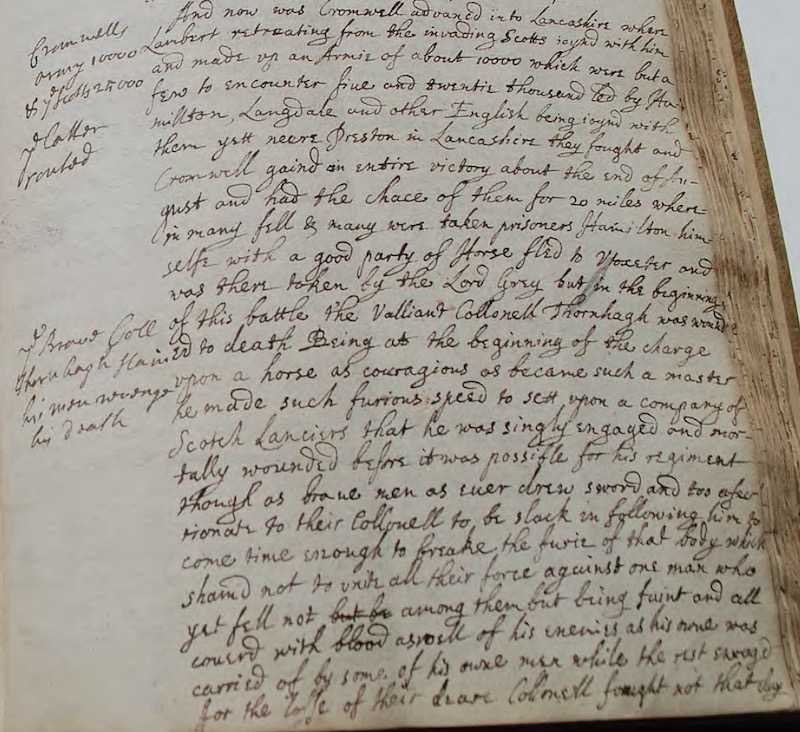
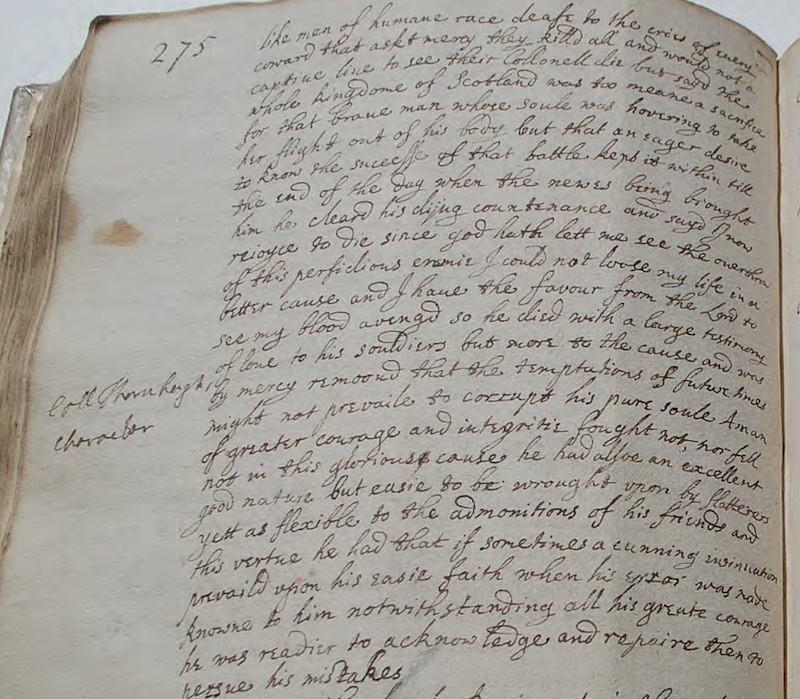
The manuscript of the Memoirs: image by permission of Nottingham City Museums & Galleries (NCM1922–71). The annotations are by Julius Hutchinson (1679–1738).
This episode brings out the savagery of the Second Civil War, with Parliamentarians furious at the royalists for taking up arms after pledging to lay them down, as well as the strong anti-Scots feelings of many English soldiers. It also evokes the intense culture of news, with Thornhagh’s soul reluctant to leave his body until he hears news of the battle’s outcome. Three times the word “cause” appears: for Parliamentarians, allegiance is to an abstract cause, a set of principles, rather than a personal monarch (contrast Philips above on cause and king). Hutchinson’s truth-telling aesthetic leads her to qualify the rhetoric of praise with criticisms of Thornhagh, even though they are modulated by the serpentine syntax.
Of these writers, Hutchinson was for a time closest in sympathy to the Leveller movement of political reform. From the start of the Civil War, some women had started to present petitions, and in 1649 a petition from Leveller women, rallying support for a previous manifesto, began with a ringing declaration of women’s equality before God and their at least “proportionable” share of liberty in the state. Women were appointed to get signatures for such petitions from each ward in London. The combination of practical organization with large claims of principle marked a truly revolutionary step. By the spring of 1649 Lilburne was organizing against the republic and the Hutchinsons had turned against the Levellers, while Pulter had been shocked by such petitions from the start — compare her reference to Essex as "the first who had the bold commission / From cannon’s mouth to thunder out petitions"? ("On the Fall of that Grand Rebel" [Poem 62], lines 17–18). And yet the growing polarization of the culture, with demands for broader public participation from both sides, brought in poets as well as petitioners.
The Humble Petition of divers well-affected WOMEN, of the Cities of London and Westminster, the Borough of Southwark, Hamblets, and Parts Adjacent. Affecters and Approvers of the Petition of Sept. 11. 1648.
Sheweth,
THat since we are assured of our Creation in the image of God, and of an interest in Christ, equal unto men, as also of a proportionable share in the Freedoms of this Common wealth, we cannot but wonder and grieve that we should appear so despicable in your eyes, as to be thought unworthy to Petition or represent our Grievances to this Honourable House.
Have we not an equal interest with the men of this Nation, in those liberties and securities, contained in the Petition of Right, and other the good Laws of the Land? are any of our lives, limbs, liberties or goods to be taken from us more then from Men, but by due processe of Law and conviction of twelve sworn men of the Neighbourhood?
And can you imagine us to be so sottish or stupid, as not to perceive, or not to be sencible when dayly those strong defences of our Peace and wellfare are broken down, and trod under-foot by force and arbitrary power.
Further Reading
- Andrea Brady, “Dying with Honour: Literary Propaganda and the Second English Civil War.” The Journal of Military History 70:1 (2006): 9–30.
- Claire Gheeraert-Graffeuille, Lucy Hutchinson and the English Revolution. Gender, Genre, and History Writing. Oxford: Oxford University Press, 2022.
- Katharine Gillespie, Women Writing the English Republic, 1625–1681. Cambridge: Cambridge University Press, 2017.
- Catharine Gray, Women Writers and Public Debate in 17th-century Britain. New York: Palgrave Macmillan, 2007.
- Elizabeth H. Hageman and Andrea Sununu, “‘More copies of it abroad than I could have imagind’: Further Manuscript Texts of Katherine Philips, ‘the “Matchless Orinda,’”’ English Manuscript Studies 1100–1700 5 (1993), 127–69.
- Ann Hughes, Gender and the English Revolution. London and New York: Routledge, 2012.
- Stuart B. Jennings, A Very Gallant Gentleman: Colonel Francis Thornhagh (1617–1648) and the Nottinghamshire Horse. Warwick: Helion & Company, 2022.
- David Norbrook, “Lucy Hutchinson in her Fifth Century” and “The Memoirs in Cultural Memory and Historiography: Lucy Hutchinson and the People,” The Seventeenth Century 38:3 (2023), 369–83, 555–74 (introduction and afterword to special issue with many essays on the Memoirs).
- Sarah C. E. Ross, Women, Poetry, and Politics in Seventeenth-century Britain. Oxford: Oxford University Press, 2015.
- Sarah C. E. Ross and Elizabeth Scott-Baumann (eds.), Women Poets of the English Civil War. Manchester: Manchester University Press, 2018.
- Anna Wall, “‘Not so much open professed enemies as close hypocritical false-hearted people’: Lucy Hutchinson’s manuscript account of the services of John Hutchinson and mid-seventeenth-century factionalism,” The Seventeenth Century 36:4 (2021): 623–651.
- Susan Wiseman, Conspiracy and Virtue Women, Writing, and Politics in Seventeenth-century England. Oxford: Oxford University Press, 2006.