What Else Is In the Manuscript?
Or, Where Did Pulter’s Poems Live?
When readers today encounter early modern poems in edited anthologies, we lose a sense of how their original physical format shaped their meanings. The poems presented in The Pulter Project survive in only one known manuscript, a bound volume of 167 leaves in folio, catalogued as MS Lt q 32 in the Brotherton Collection, University of Leeds Library. There are several loose sheets catalogued along with the volume. In 1975, the University of Leeds Library purchased the manuscript at a Christie’s auction from Sir Gilbert Inglefield, an architect, book collector, and former mayor of London. No records exist indicating how the manuscript made its way from Hertfordshire to London, or who owned it between the eighteenth century (when Pulter’s great-grandson signed it and an unknown hand added comments) and 1975.
This Exploration invites you to understand more about the volume as a material artifact by exhibiting:
- what is called the front matter, including title pages and inscriptions of material. In this book, which can be read (inverted) from either end, there is “front matter” at both ends; and
- writings added to the volume after the book’s production, including loose sheets catalogued with the volume.
To see facsimiles of the pages on which specific Pulter poems are written, see individual poem pages in The Pulter Project, the University of Leeds Library site, or the poem facsimiles in the database Perdita Manuscripts: Women Writers, 1500–1700.
This Exploration moves beyond the display of individual poems on manuscript pages in order to enable readers to get a sense of the material book object, including pages in which annotators have added poems, fragments of songs, accounts, practice writing, sayings, family genealogies, and historical information. Unless otherwise specified, all images are provided courtesy of the University of Leeds Library.
About the Book
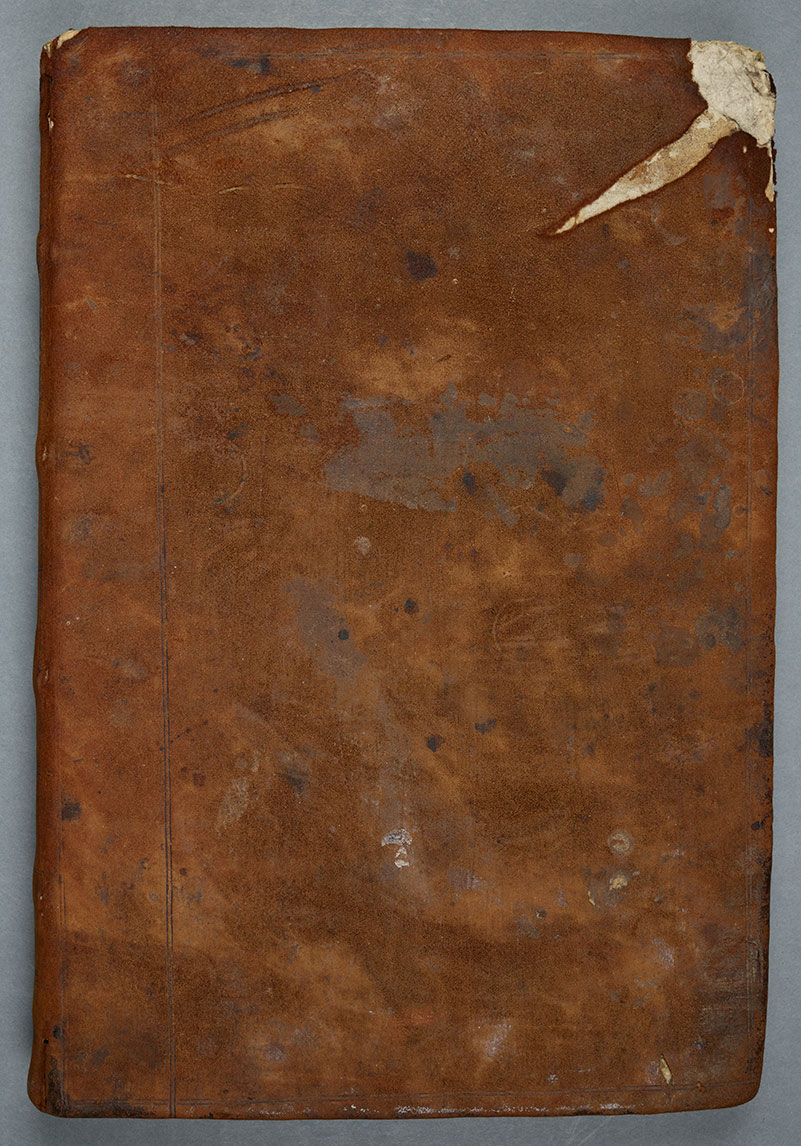
Bound in calf-skin which has the feel of suede, this 7 ¾" x 11" book is embossed with minimal blind-tooled lining (decorative impressions made with heated finishing tools) on the covers and spine. The binding is consistent with other seventeenth-century texts, and the cover, shown below, displays signs of deterioration:
The gilt lettering on the spine of the volume, “Lady Hesther Pulter’s Poems,” was probably added after the book’s original binding, perhaps in the eighteenth century.
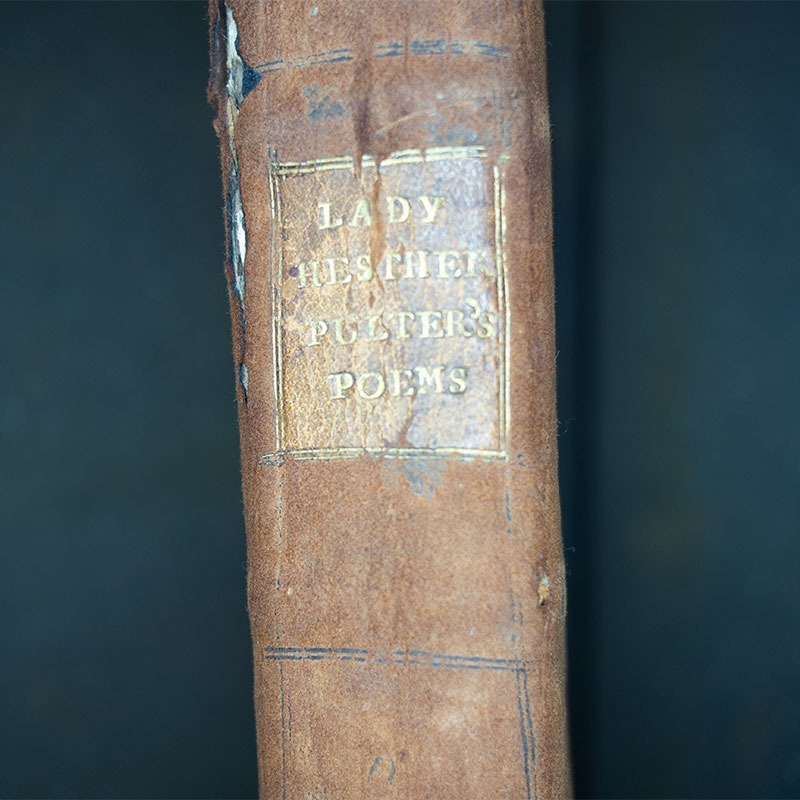
Image by Leah Knight
At one end of the book, the reader finds three folios bearing titles and inscriptions, followed by over a hundred poems, almost all of which are written in the italic and decorative hand of a single (unidentified) scribe. Although The Pulter Project identifies a total of 117 poems, other editors offer a different determination based on varying assessments of whether passages that appear as fragments are discrete poems or lines to be inserted into proximate poems. The poems are divided into two sections:
- The first group of 64 poems (fol. 3r-88v) are variously titled “Poems Breathed forth By the Nobel Hadaſsas,” “Poems Breathed forth by the Hadaſsas Rt. Hon:,” and “Noble Hadassah Poems Wrighten By ye Rt Honerable H.P.”;
- The next group of 52 poems (fol. 91r-130v) is preceded by an internal title page. “Emblemes,” written in the scribal hand, is centered on fol. 90r in large script. In the top left corner, in what we take to be Pulter’s hand, there is a supplement to the title: “The ſighes of a ſad ſoule Emblimatically breath’d forth by the noble Hadaſsah.” Readers can see all of these pages below in this Exploration.
One poem in Pulter’s handwriting, as I discuss below in the section “Pulter’s Unfinished Poem,” was not included in either of these sections but instead exists as a loose paper accompanying the bound book.
At the other end of the book (inverted or upside down) is an unfinished prose romance, “The Unfortunate Florinda Written by the Noble Hadaſsah.” Readers may consult the pages of the romance, which are not included here, on the University of Leeds Library site. While some manuscripts from this time period accreted new material added by many different people over a number of generations, Pulter’s poems were consciously and neatly gathered for presentation and are attributed almost entirely to one source.
The experience of reading the book at the University of Leeds Library can be visualized here:
Video by Chad Austin Davis
Reading the physical volume provides information that is not readily legible from facsimile photographs. For instance, there are several blank pages in the volume providing spacing between some poems found on the following folios (the word for the book leaf that contains both the front of the page or recto [r] and the back of the page, or verso [v]): 1v, 2v, 33v, 35v, 76v, 78v, 81, 86v, 87v, 90v, 129v, 131r, and 131v. Three leaves (fols. 85, 86, and 87) are from a thicker paper source and were “tipped in,” or glued in, after the book was bound. These leaves contain three poems: “On the Fall of that Grand Rebel the Earl of Eſsex his Effigies in harry the 7th’s Chappel in Westminster Abby” (On the Fall…62), an untitled poem with the first line, “Dear God from thy high Throne look down” Dear God, From…63), and an untitled poem with the first line, “And must the ſword this controverce deſide” (And Must the Sword…64). Someone has torn leaves from the volume at various points (between fols. 6v and 7r; 34v and 35r; 50v and 51r; 56v and 57r), though no text appears to be missing.
By using special lighting to make visible watermarks (designs or logos instilled during the papermaking process), Elizabeth Zeman Kolkovich has found that there are at least three different types of paper used in the volume (personal correspondence, July 5, 2019). Some pages have no discernible watermark. Numerous pages bear a watermark representing an urn with a flower, as shown here on fol. 1r:
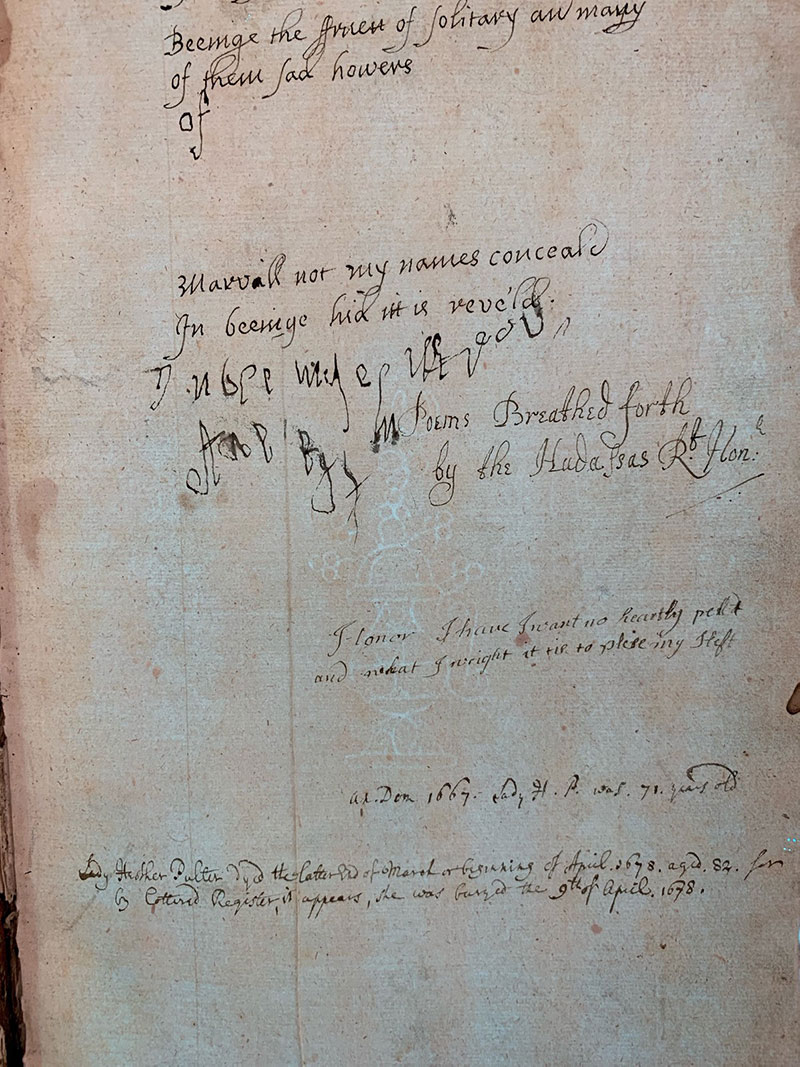
Image by Elizabeth Zeman Kolkovich
Kolkovich observes that a different watermark, a hand with a star emerging from the middle finger, appears on fols. 86–87. Below is fol. 86r:
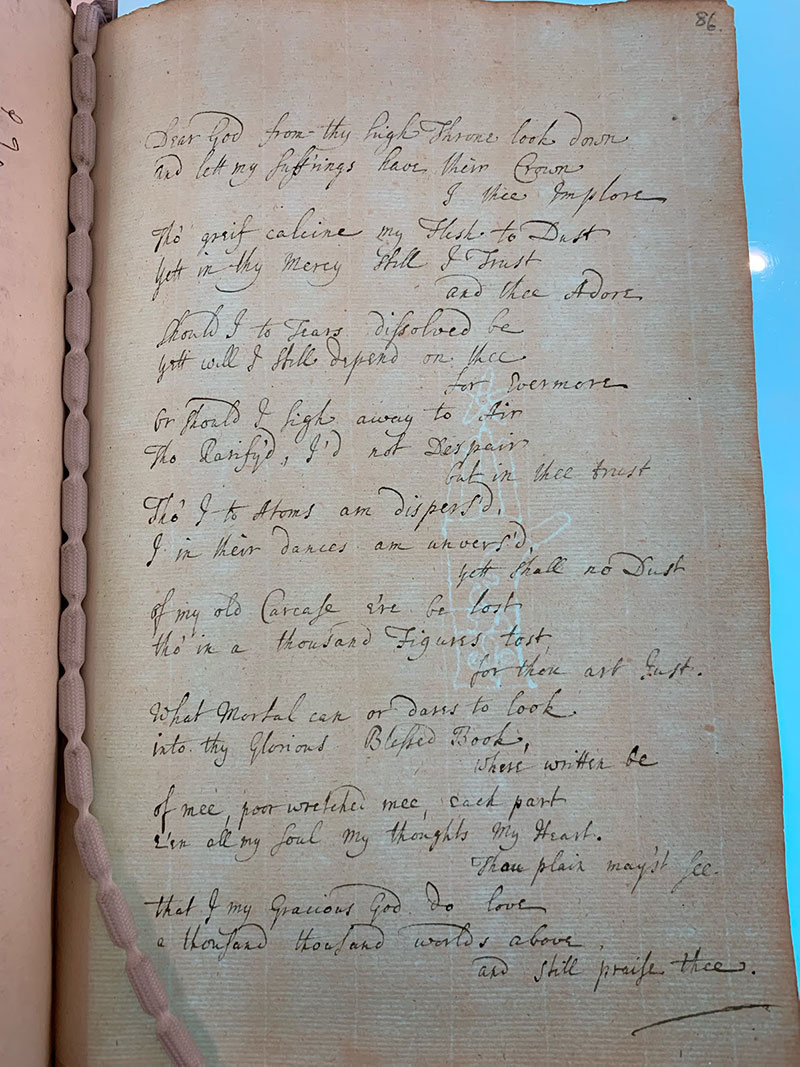
Image by Elizabeth Zeman Kolkovich
Dates appended to individual poems suggest that Pulter composed much of her verse at intervals in the 1640s and 1650s, with a few poems added (probably in her own handwriting) in the late 1660s. The poems are not arranged chronologically in the manuscript, which was compiled between 1655 and 1662. The emblems seem to have been composed in the 1650s. The romance seems to have been written in the 1650s, after the composition of most of the poems. Both Alice Eardley and Sarah C. E. Ross argue that the main scribe’s transcription of the poems in this manuscript seems to have taken place in 1661 or 1662 (Alice Eardley, “An Edition of Lady Hester Pulter’s Book of ‘Emblemes.’” PhD diss., University of Warwick, 2008. ProQuest Dissertations Publishing [U519295] pp. 86–96; Ross, “Women and Religious Verse in English Manuscript Culture c1600–1688: Lady Anne Southwell, Lady Hester Pulter and Katherine Austen.” PhD diss., University of Oxford, 2000. ProQuest Dissertations Publishing [U140819], pp. 146–56). Emendations indicate that Pulter supervised the book’s production. Years after the book was created, she seems to have added two new poems, “The weepeinge wishe” (fol. 84v) (The Weeping Wish61) and “The Hope” (fol. 88r) (The Hope65); both are dated 1665.
Front Matter and Subtitle Pages for the Poems
Opening the book from the end that presents the poems, the reader discovers a paste-down page that bears the ink imprint from the page facing it. Paste-down pages typically were glued to the inner boards to cover the inside edges of the book’s binding and provide structure for the book. The page below, which can be magnified, also bears the University of Leeds, Brotherton Collection library stamp and bookplate:
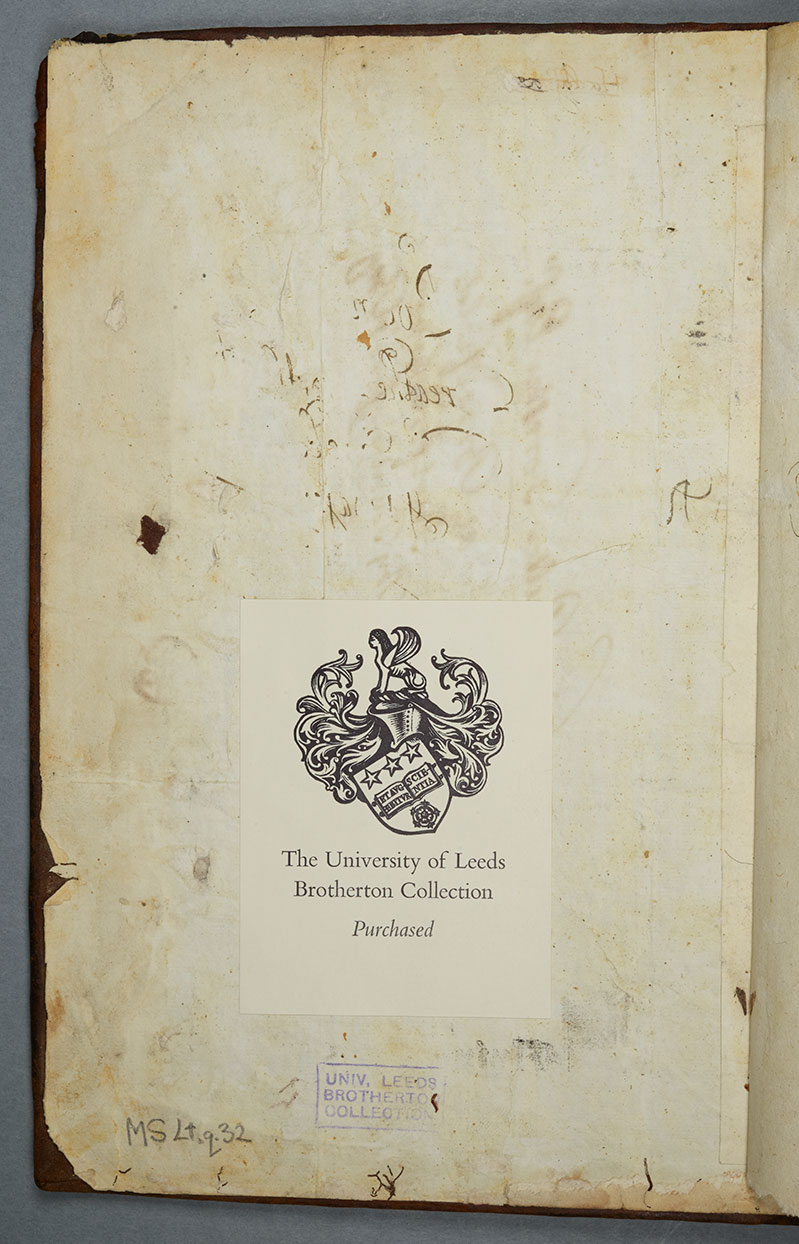
Aaron Pratt (Carl and Lily Pforzheimer Curator of Early Books and Manuscripts at the Harry Ransom Library at the University of Texas) advised us to create a light-enhanced version of the paste-down page (shown above), which allows us to see the faint inscription of a name on the other side of the glued-down page that has bled through the leaf and left an inverted ghost trace (Pratt, private correspondence, July 24, 2018):
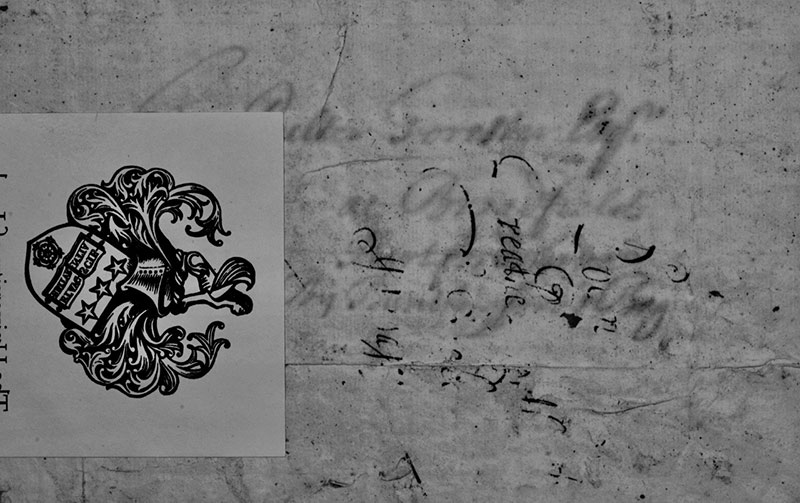
University of Leeds Library image, enhanced by Matthew Taylor
The name on this paste-down (above) was presumably written before the page was glued to the cover, or the page was unfixed from the cover, signed, and then subsequently pasted back down. A signature, which appears vertically, reads “Pulter Forester, Esq. at Broadfield” followed by two lines of now illegible writing. It is likely that this name refers to Pulter Forester (1690–1753) who was Pulter’s great-grandson and heir to her estate, Broadfield, which stood near Cottered in Hertfordshire, England. Owners often signed their books. Given that the bookplate obscures some writing including a visible ascender before the name, these words could conceivably refer to James Pulter Forester (1660–1696), Hester Pulter’s grandson, who was previously heir to the estate (the concealed marks might be the initial “J” or a compressed version of “James”). It is less likely but possible that this inscription refers to Pulter Forester’s son, who bore the same name but who did not inherit the estate (c. 1721–1778).
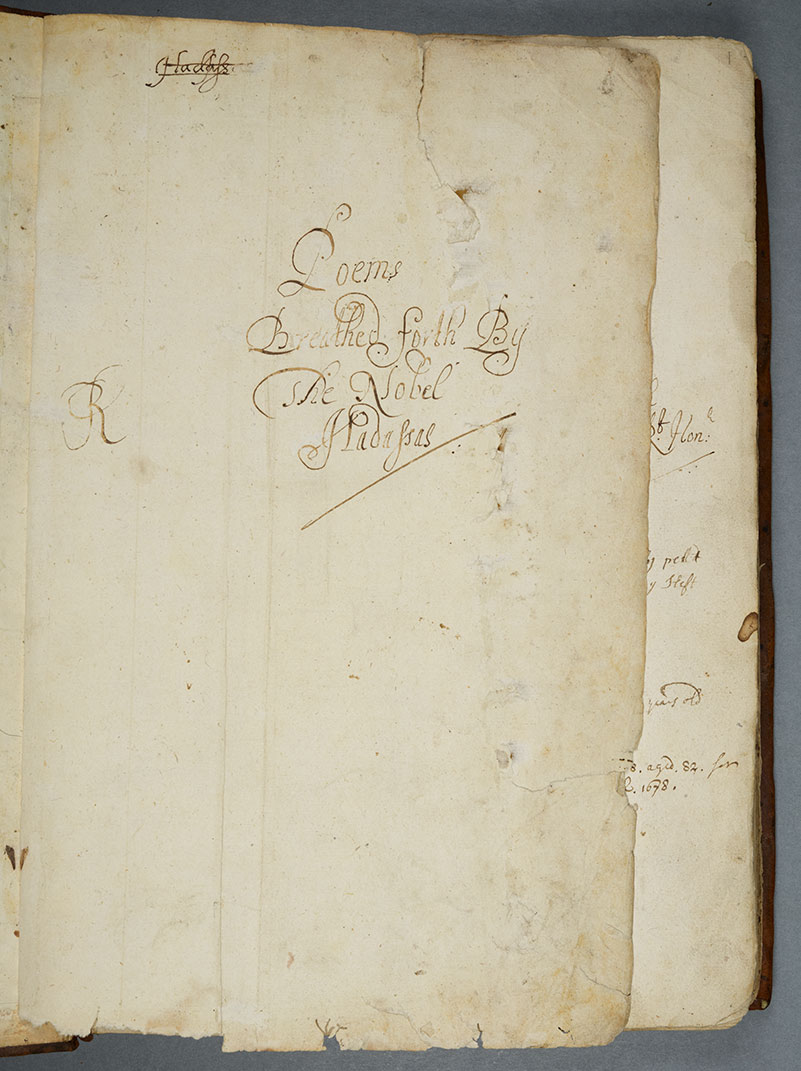
The next page in the volume is a free endleaf (a leaf affixed to the beginning or end of a book, separate from the sewn gatherings). It offers a title that does not appear to be written by the main scribe: “Poems Breathed forth By the Nobel Hadaſsas” (fol. 0r). This page is a recto (the front of a single sheet of paper or right-hand page of an open book). The crossed-out portion of the word “Hadaſsas” located at the top of the page seems to be in Pulter’s handwriting. Hadassah—the Hebrew counterpart for the name Esther—refers to the biblical Queen Esther. Our assessment that this is Pulter’s handwriting is made on the basis of examining loose papers, catalogued with the volume, that include drafts of the romance. There is practice writing on the page as well (a capital “R”), which can be seen more clearly by magnifying the image below:
This page, as well as one on the inverted side of the book, is connected to the book in a manner not typically used for book bindings of the period. Pages glued directly to the pasteboard were usually fully glued down to strengthen the cover boards, but this leaf is glued only along the edge of the page. It is not sewn into the spine or even glued directly by the gutter but remains offset from the page gatherings. It could have originally been glued down and subsequently pulled free and then inscribed, or it could have been glued into the book after it was bound (using the same paper stock). See a close-up of the leaf below:
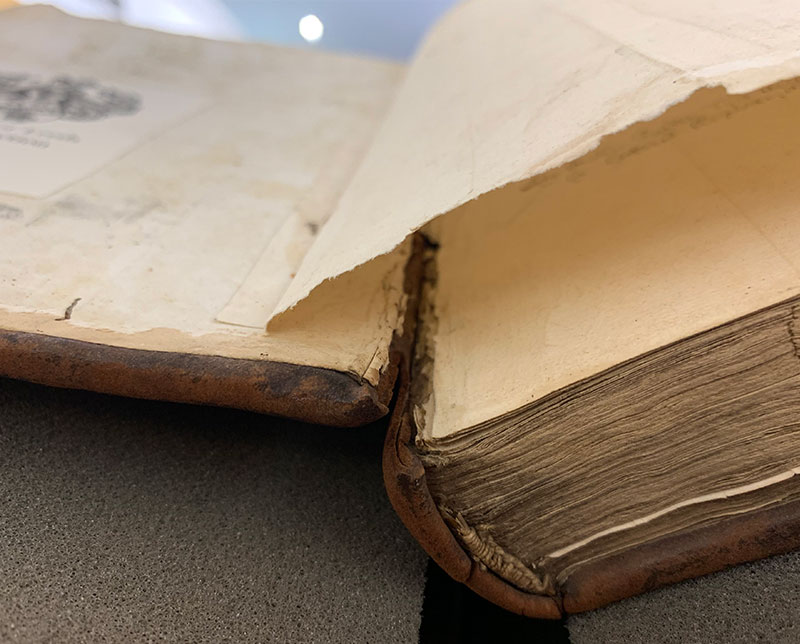
Photograph by Elizabeth Zeman Kolkovich
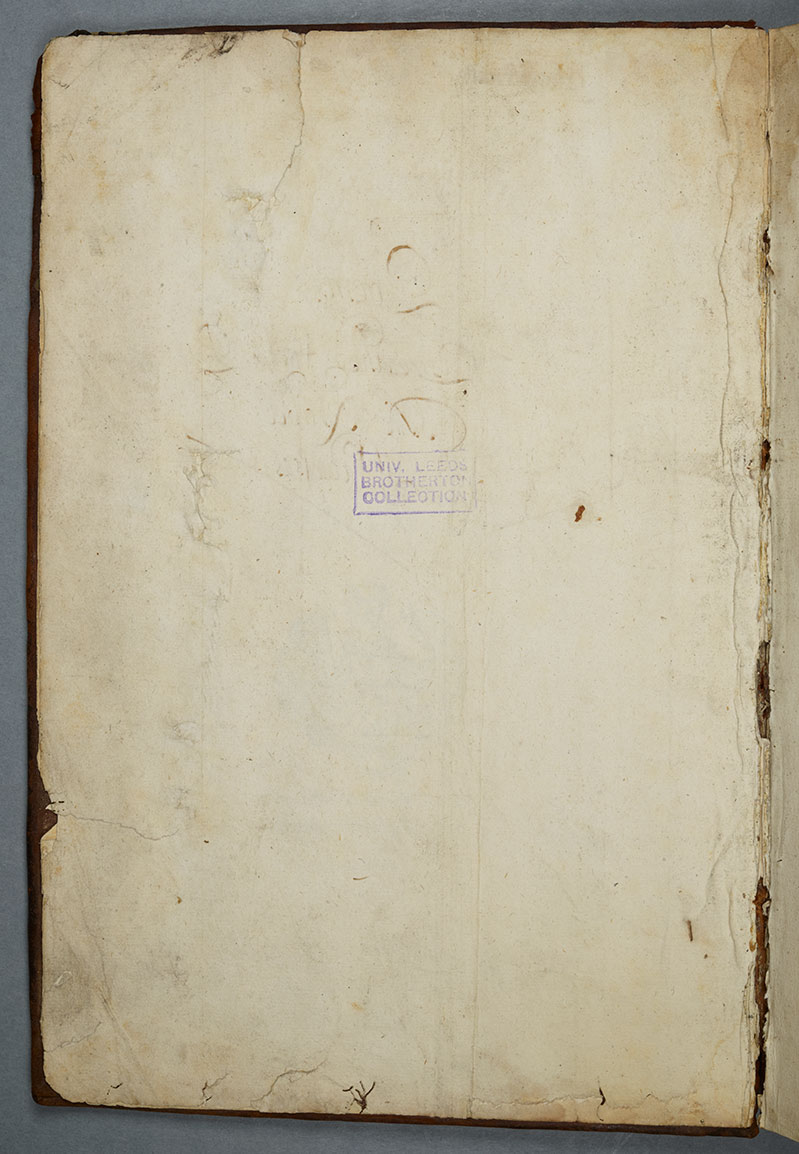
Turning the page, the reader sees the reverse side of the endleaf (fol. 0v), called a verso. The writing from the title bleeds through the page, and the materials used to sew the spine are visible. The page shows creasing on the left side. The small stamp in purple ink was added by librarians working with the Brotherton Collection at the University of Leeds Library:
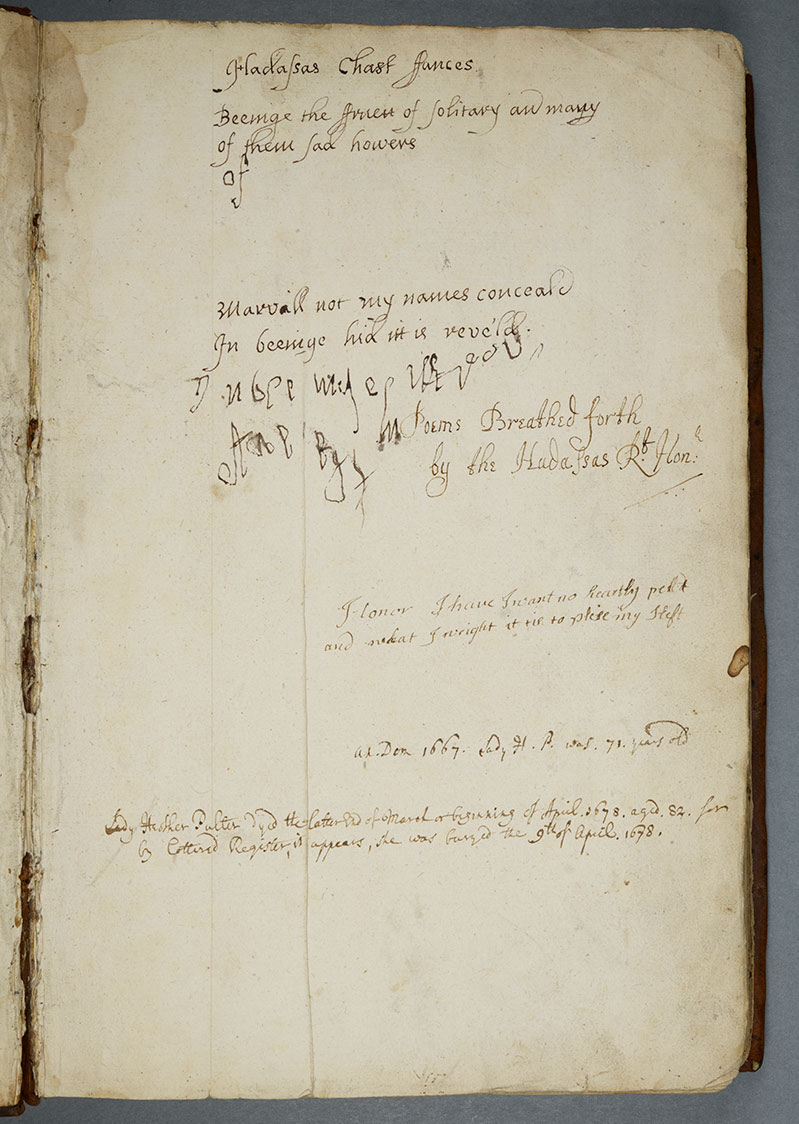
The recto of the next leaf (fol. 1r, which can be magnified) presents a conventionally-placed title, “Poems Breathed forth by the Hadaſsas Rt. Hon:,” along with various inscriptions in different hands:
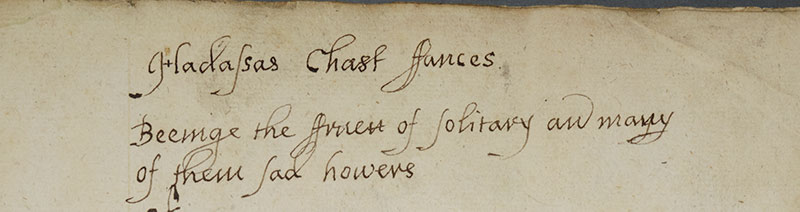
Based on handwriting comparisons, it seems likely that Pulter inscribed a phrase that serves as another kind of title: “Hadaſsas Chast ffances. / Beeinge the ffruett of ſolitary and many of them ſad howers.” See a close-up of fol. 1r below:
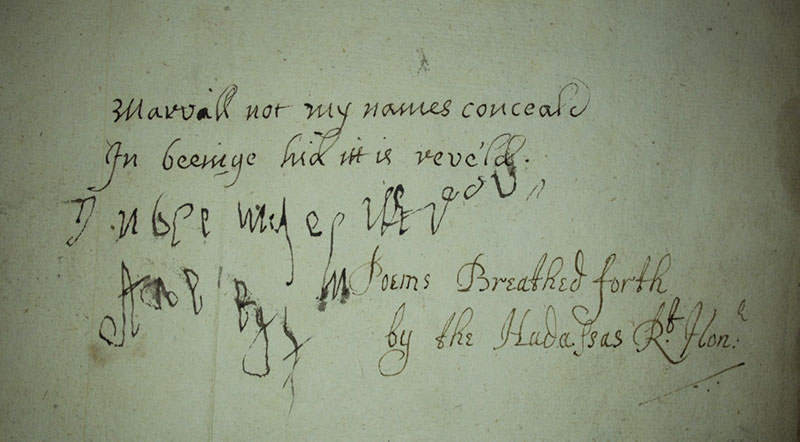
Another close-up image of the same page, shown below, indicates that Pulter seems to have inscribed another phrase below her first inscription: “Marvall not my names conceald / In beeinge hid itt is reve’ld.” (The correction of the first word’s second vowel makes it possible that the word is “Marvill”). We do not know who began to copy some words from this page (“In beeing”) and to practice other handwriting skills (fol. 1r):
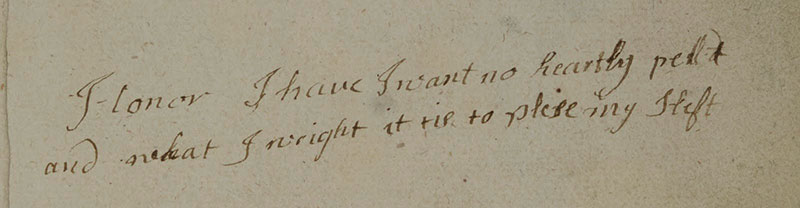
Another unknown hand has penned a saying below the title, “Honor I have I want no heartly [or hearthy] pelf / and what I wright it tis to plese my Sleft”:
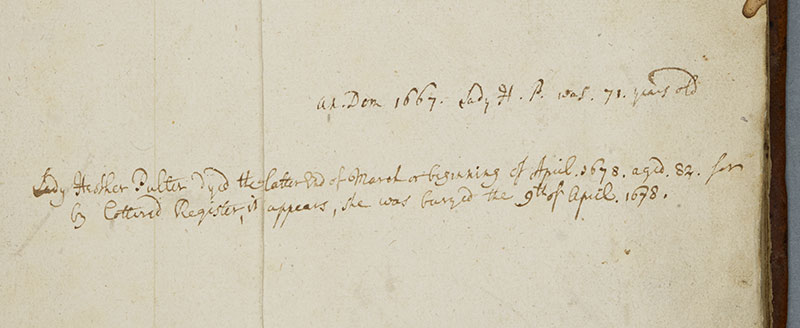
The last three lines inscribed on this page (fol. 1r, which can be magnified) are written by an annotator who provides information about dates in Pulter’s life:
Detail of fol. 1r
This same handwriting is found interspersed in the poems, often offering regional or biographical information; for instance, this annotator supplements the title, “Vpon the Death of my deare and lovely Daughter JP” (Upon the Death…10), with information that Jane was “baptized May 1. 1625. Buried Oct. 8. 1645.” This writer also recorded, on loose papers catalogued with the volume, a summary of James Ley’s life as well as diagrams of the Ley and Pulter family trees. Because this writer was clearly writing after 1734 in some parts of the manuscript (based on a date on a family tree, shown later in this Exploration), I refer to this hand as “the eighteenth-century annotator.”
The first note by the eighteenth-century annotator on this page, “an. Dom 1667. Lady H.P. was. 71. years old,” offers what we now see as inaccurate information about Pulter’s age at the time of her death. (On dates for Pulter’s birth, see Alice Eardley, “Lady Hester Pulter’s Date of Birth.” Notes and Queries, 57: 4 [December 2010]: 498–501.) Presumably this mistaken dating relied on the full title of “Made when my Spirits were ſunk very low with ſickneſs and ſorrow. May 1667 I being ſeventy one years old” (Made When My…66). The annotator then offers two lines that provide the correct date of Pulter’s burial (but still mistake her age): “Lady Hesther Pulter dyed the latter end of March or beginning of April. 1678. Aged. 82. for by Cottered Register, it appears, she was buryed the 9th of April. 1678.” Cottered was the parish in which Pulter’s estate was located.
Ross refers to this annotator’s writing as the “antiquarian hand” (p. 147) and she attributes Jonathan Gibson with devising this term in personal correspondence. Ross further argues that Angel Chauncy, rector of Cottered parish and grandson of Hertfordshire antiquarian Sir Henry Chauncy, is the eighteenth-century annotator (pp. 161–69).
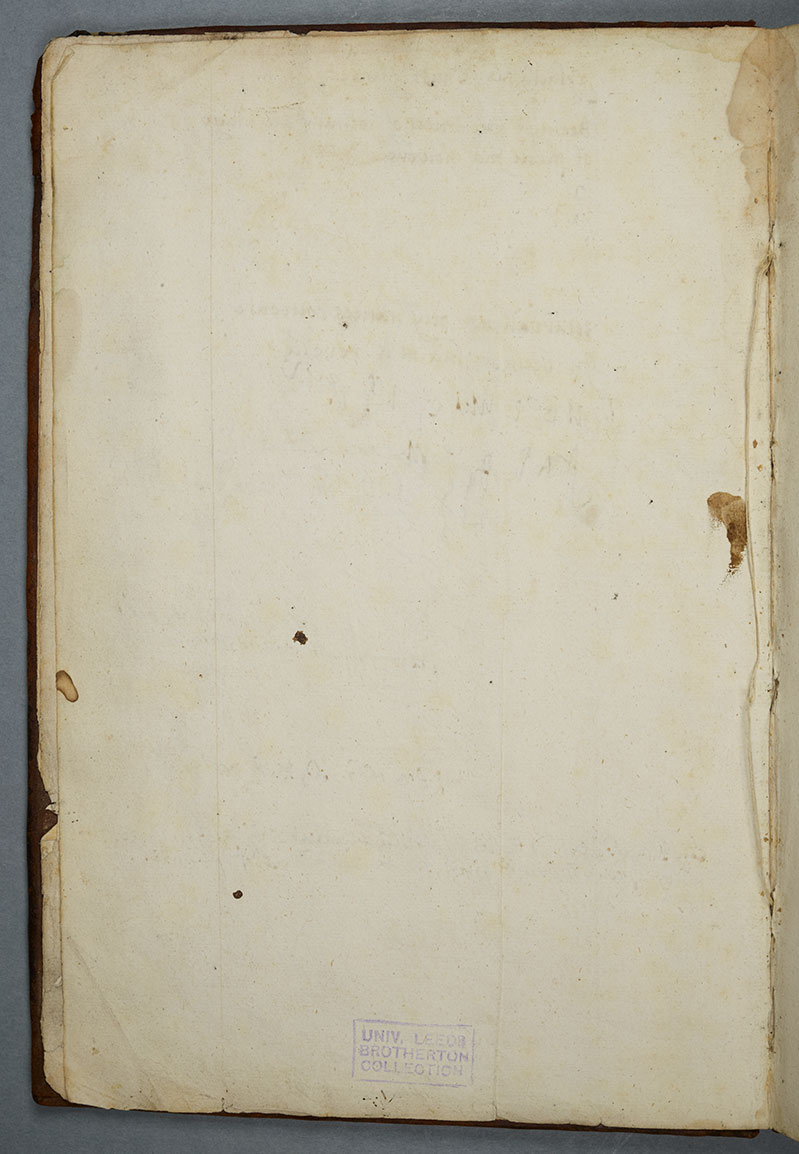
This image (fol. 1v) shows the verso of the page shown above, which is stamped with the University of Leeds’ ownership mark (Brotherton Collection). It also shows faint bleed-through of the writing on the reverse page and signs of the book’s mild deterioration:
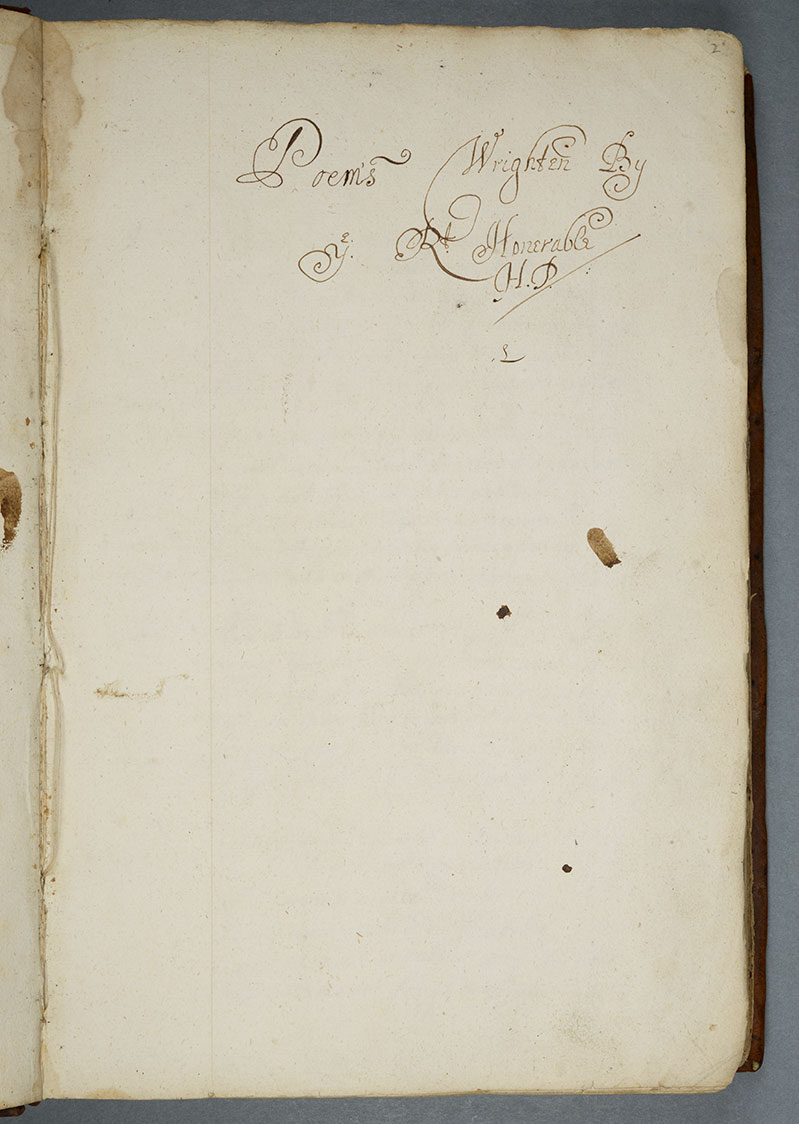
The reader next discovers what seems to be (because of the calligraphic style) a variant and more “official” title page in the italic hand of the (unidentified) main scribe: “Poem’s Wrighten By ye Rt Honerable H.P.” (fol. 2r, which can be magnified):
This image shows two facing pages: the verso of the “official” title page, which is the final page in the front matter for the poems on this side of the book (fol. 2v) and the first page of Pulter’s poems, beginning with the opening stanzas of “The Eclips” (fol. 3r) (The Eclipse1). The title from the opposite side of fol. 2v has faintly bled through the page. The poems continue through fol. 88v:
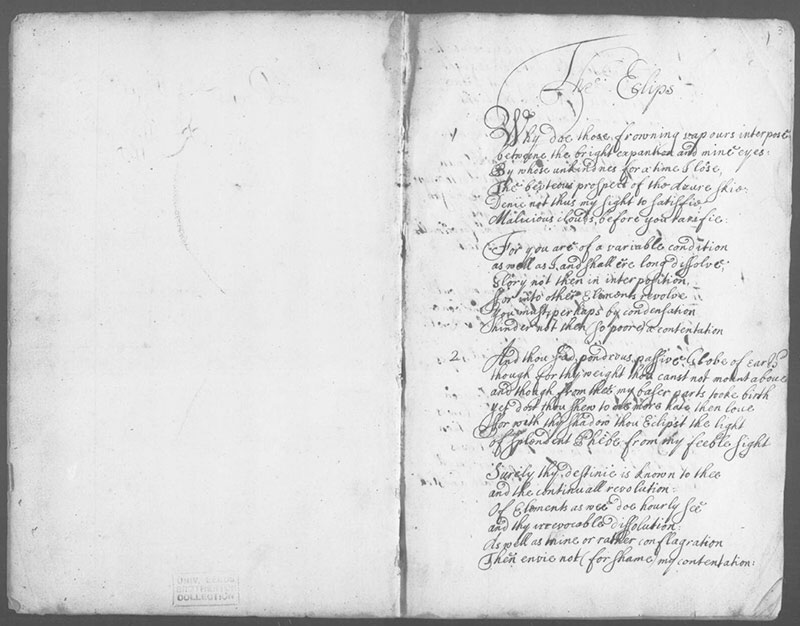
Image from the University of Leeds, reproduced by the Perdita Manuscripts: Women Writers, 1500–1700, Image 4.
After the first group of sixty-six poems, the reader finds a subtitle page for the next section of verse (fol. 90r):
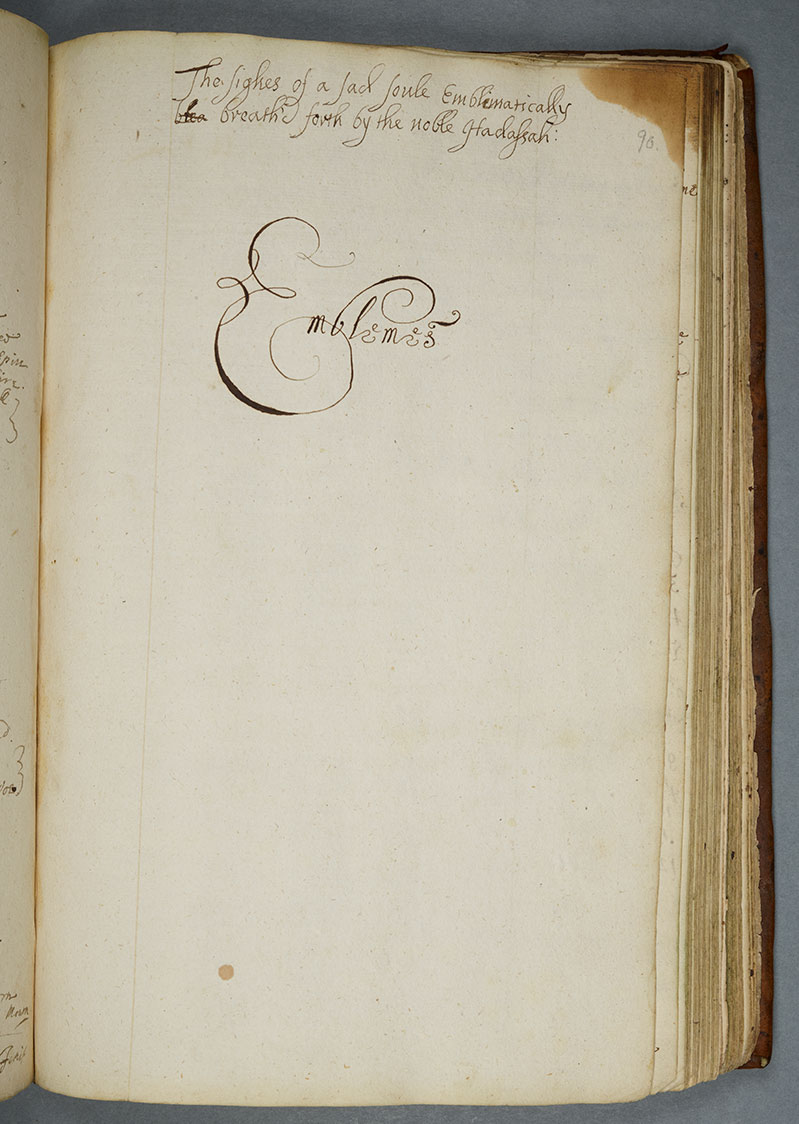
The word “Emblemes,” written by the main scribe, introduces 53 emblem poems (there appear to be 54 poems in this section, but, because of an error in numbering, there is no Emblem 18). An inscription at the top of this page, in what seems to be Pulter’s handwriting, forms another kind of title, “The ſighes of a ſad ſoule Emblimatically breath’d forth by the noble Hadaſsah.” On the details of the physical appearance of the emblems, see Eardley, “An Edition of Lady Hester Pulter’s Book of ‘Emblemes,” pp. 85–86.
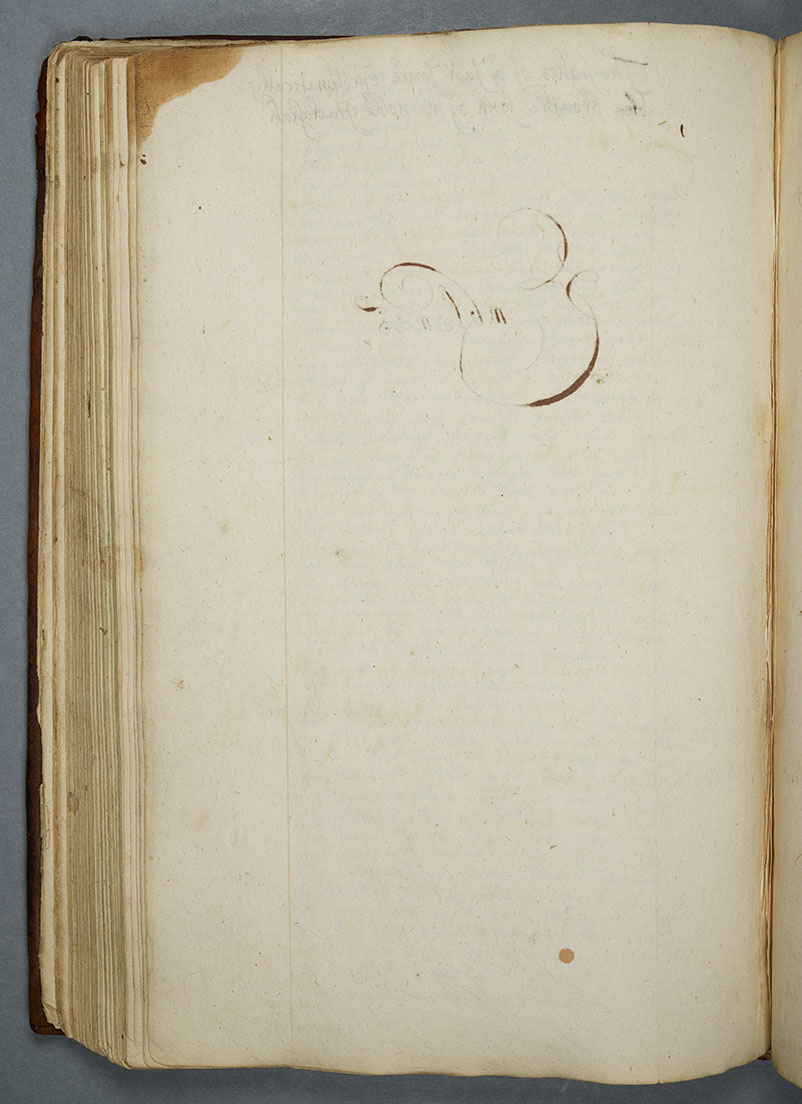
The reverse side of the “Emblemes” title page shows that the inscriptions have bled through to show on the recto page (fol. 90v):
Later Additions to the Book
After the poems were transcribed into the book by the main scribe, two different writers went through the text, making corrections and additions to specific poems. To see emendations of words and lines in particular poems, consult the individual poem transcriptions in The Pulter Project comparison view. In this section of the Exploration, we exhibit writing added to the manuscript after the initial production of the volume, writing not in the front matter and not meant to be an emendation of particular words or lines in any poems.
Song Verse
A stanza of a popular song found in several eighteenth-century songbooks and manuscripts is scribbled into Pulter’s manuscript three times. At the bottom of fol. 84r, following the conclusion of “To S:r W:m D: Upon the unſpeakable Loſs of the most conspicous and chief Ornament of his ffrontispiece” (To Sir William…60), a later (unidentified) annotator of the manuscript has added this four-line stanza (see image below, which can be magnified):
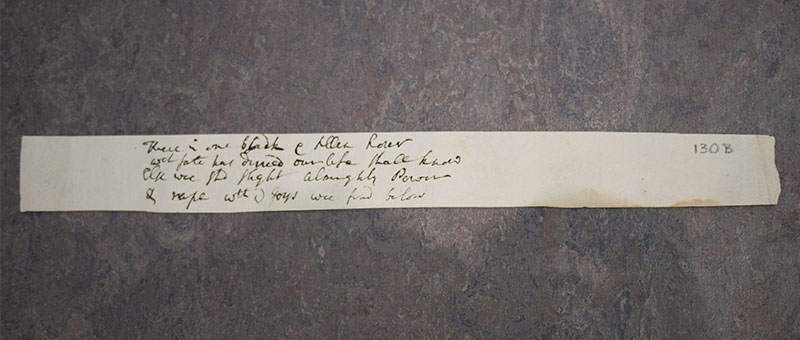
- There is one black & Sullen hour
- Fate has decreed our Life shall know
- Elſe wee should slight Almighty Pow’r
- Bewitch’t by Joys wee find below.
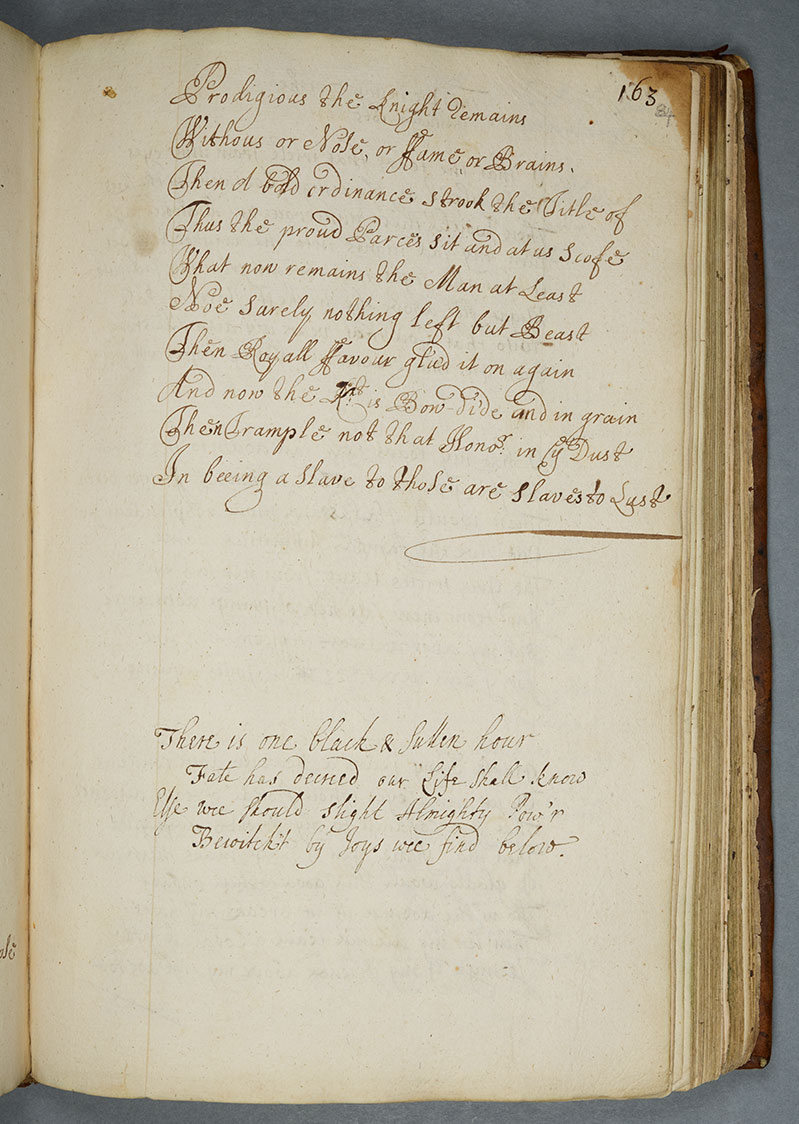
When this refrain appeared in a play by Thomas D’Urfey (The Banditti, Or, A Ladies Distress [1686], p. 9), it pertained to the sadness of earthly love. On the significance of this verse to Pulter’s volume as a whole, see Sarah C. E. Ross, who argues that later readers might have found this song an “apt epigram for Pulter’s volume” (p. 146), and Stefan Christian, who sees the verse as memorializing Pulter and her work in crucial ways (“The Poems of Lady Hester Pulter [1605?–1678]: An Annotated Edition.” PhD diss., University of Massachusetts Amherst, 2012, p. 390).
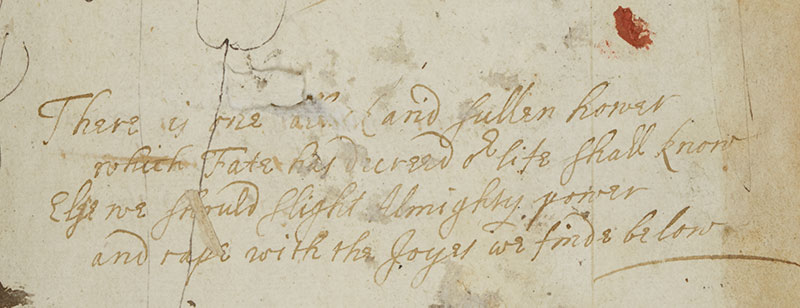
This same song stanza is scribbled into Pulter’s manuscript two other times, in variant forms and in various hands. When it appears on the title page to “The Unfortunate Florinda” (the romance written on the inverted side of the book), it has an altered final line (fol. 0r reversed, which can be magnified).
- There is one [bl]ack and ſullen hower
- which Fate has decreed or life ſhall know
- Elſe wee ſhould ſlight Almighty power
- and rape with the Joyes we finde below
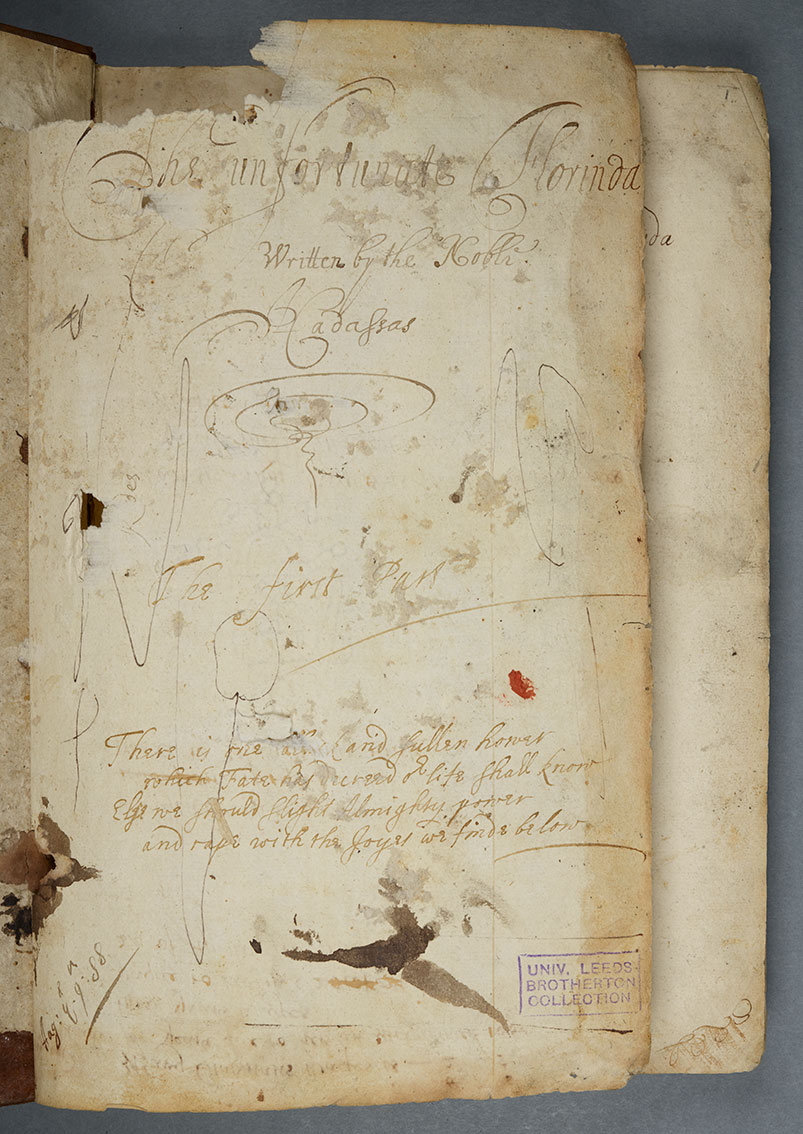
It is not clear who has added this inscription (see close-up below):
The song stanza appears for a third time inscribed on a loose paper found with the bound manuscript (above). Its size (see magnifiable image below) might suggest its function as a bookmark:
Pastoral Elegy
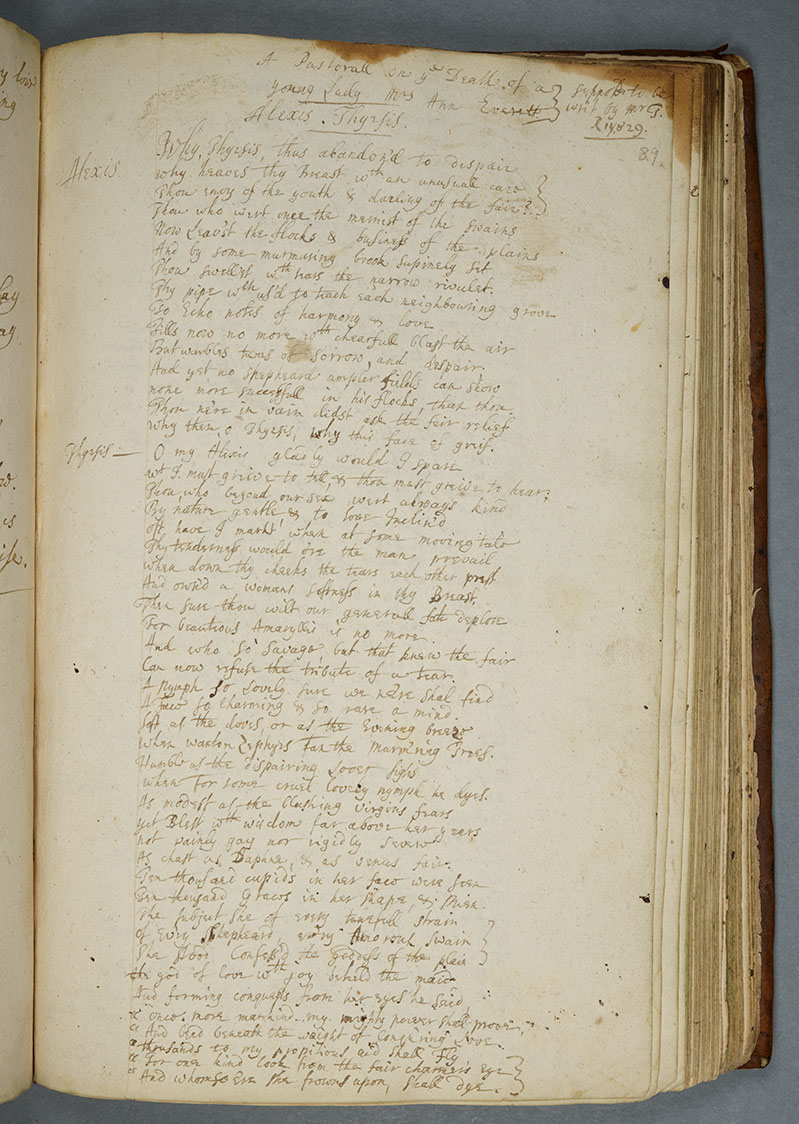
Between the first section of poems and the “Emblemes” section (fol. 89r-89v), an unidentified writer has inscribed a poem entitled “A Pastorall on ye Death of a young lady Mrs Ann Everett” on a blank page, at a time after the scribe copied Pulter’s poems. All the pages below can be magnified:
Fol. 89r
We cannot determine with any certainty whether this verse is in a new hand, a variant of the hand that inscribed two poems in the middle of the volume (“On the Fall of that Grand Rebel the Earl of Essex” and “Dear God from thy high Throne look down”), or a variant of the main scribe’s writing. This elegy to an otherwise unknown person immediately follows Pulter’s poem, “Made when my Spirits were ſunk very low …” (Made When My Spirits Were Sunk Very Low66). The pastoral elegy is identified as being “writ by Mr P” or, perhaps, “Mr T” (penned beside the title). “Script AD 1708” is noted at the poem’s conclusion.
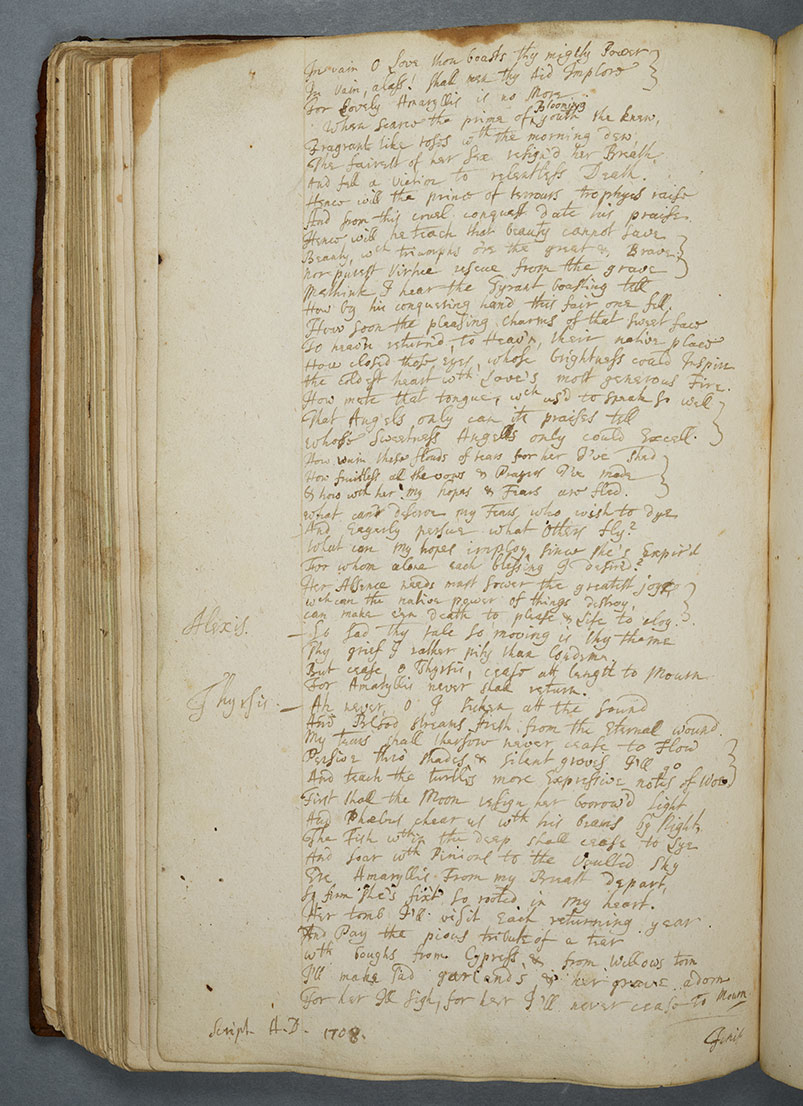
Fol. 89v
Loose Pages Catalogued with the Book
Madan’s Poem
Loose sheets found alongside the Pulter volume feature five pages that offer a fragmentary manuscript copy of Judith Madan’s eighteenth-century poem “Abelard to Eloisa” (first printed in The Poetical Works of Mr. William Pattison, late of Sidney College Cambridge [as] by William Pattison [London, 1727], pp. 67–77, but existing in manuscripts as early as 1720):
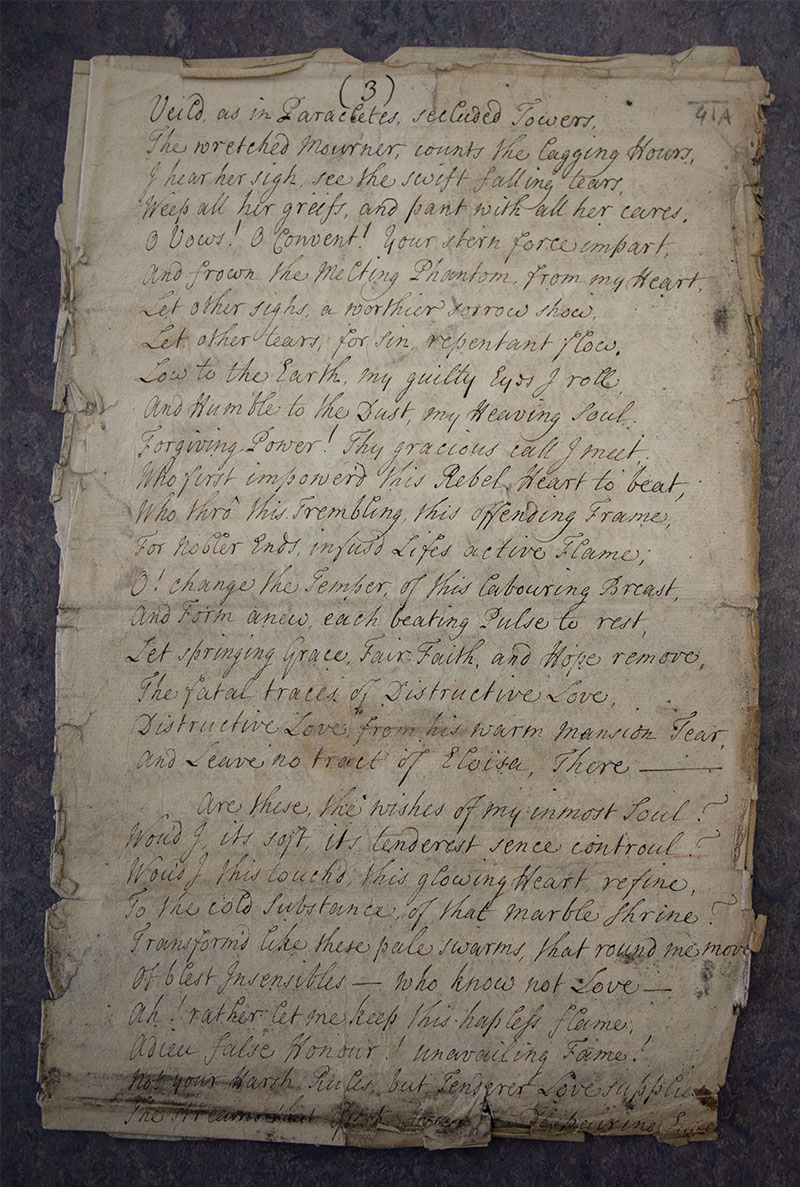
First surviving page of Madan’s poem, catalogued by the University of Leeds Library as 41A.
Written in an unidentified hand, this fragment begins with line 55 of the verse and continues on conjugate pages (loosely sewn together). Madan was the granddaughter and niece, respectively, of the Hertfordshire diarists Sarah and Mary Cowper. As Ross writes, “it is striking that one Hertfordshire gentlewoman’s poem is preserved in a transcription with the bound clean copy of another’s poetic works. … Its presence associates [Pulter] with another female poet of a considerable Hertfordshire pedigree and—in Madan’s case—of some poetic reputation” (p. 164). Perhaps, Ross suggests, the manuscript did not lie entirely in obscurity but was read in the context of some eighteenth-century writers; that is, this poem might evidence a readership history in Hertfordshire’s aristocratic and literary families (p. 101).
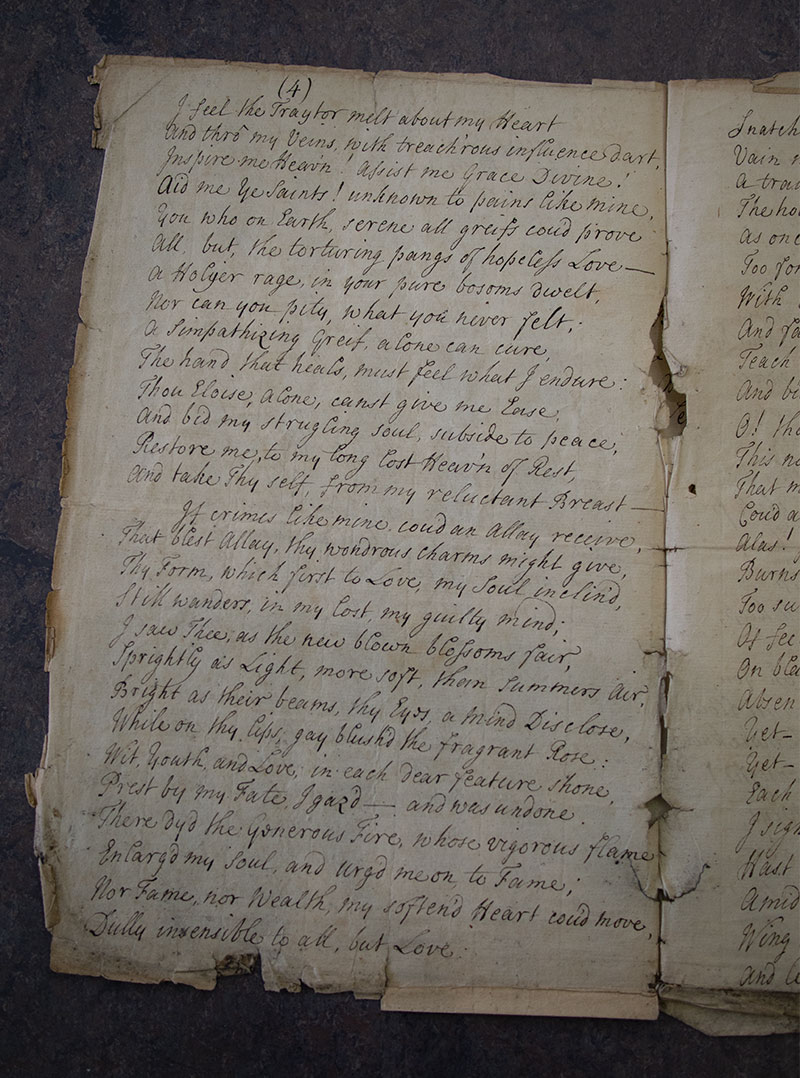
The second surviving page of the fragmentary manuscript copy of Madan’s “Abelard to Eloisa” (41Av).
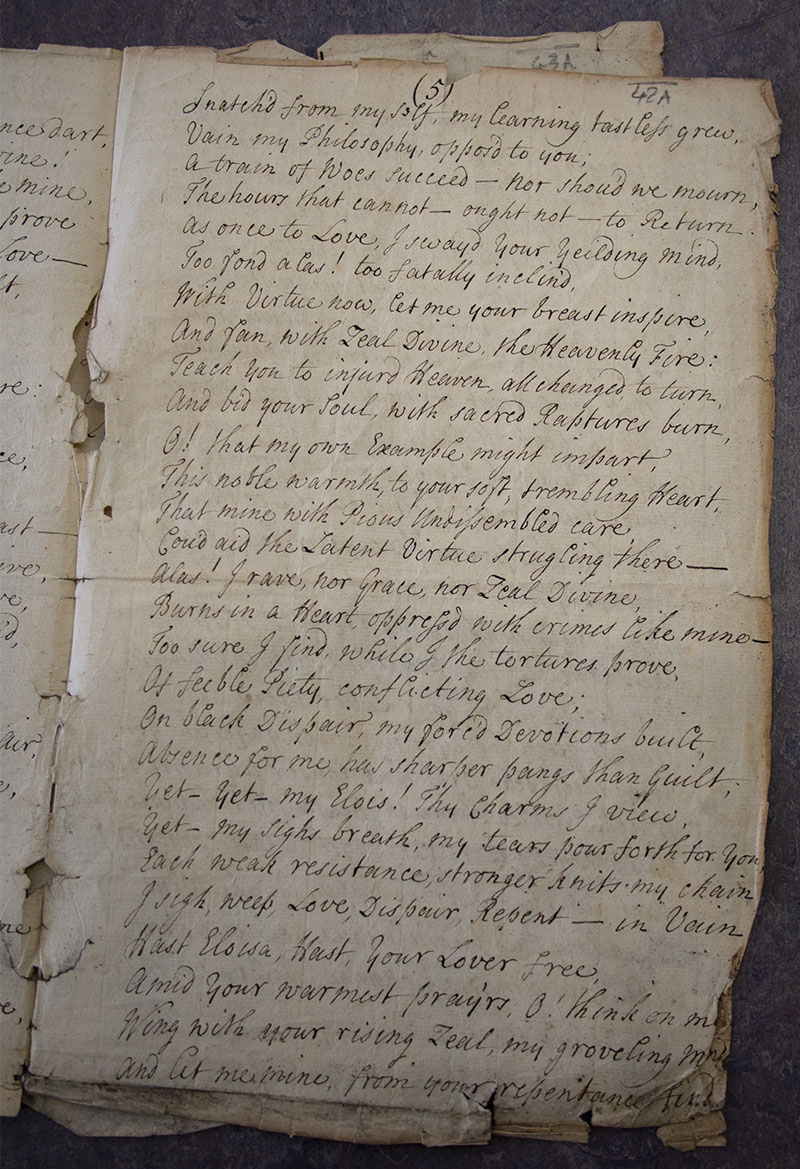
The third surviving page of “Abelard to Eloisa” (42A).
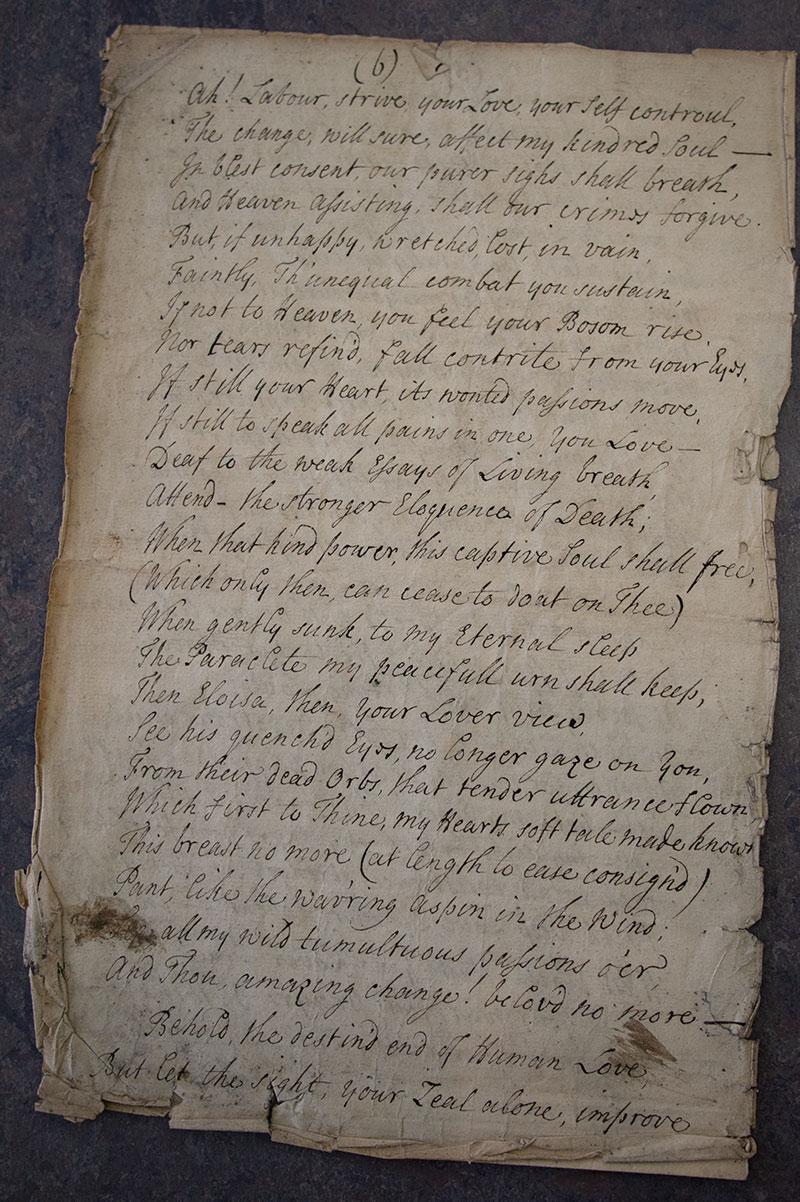
The fourth surviving page of Madan’s “Abelard to Eloisa” (42Av).
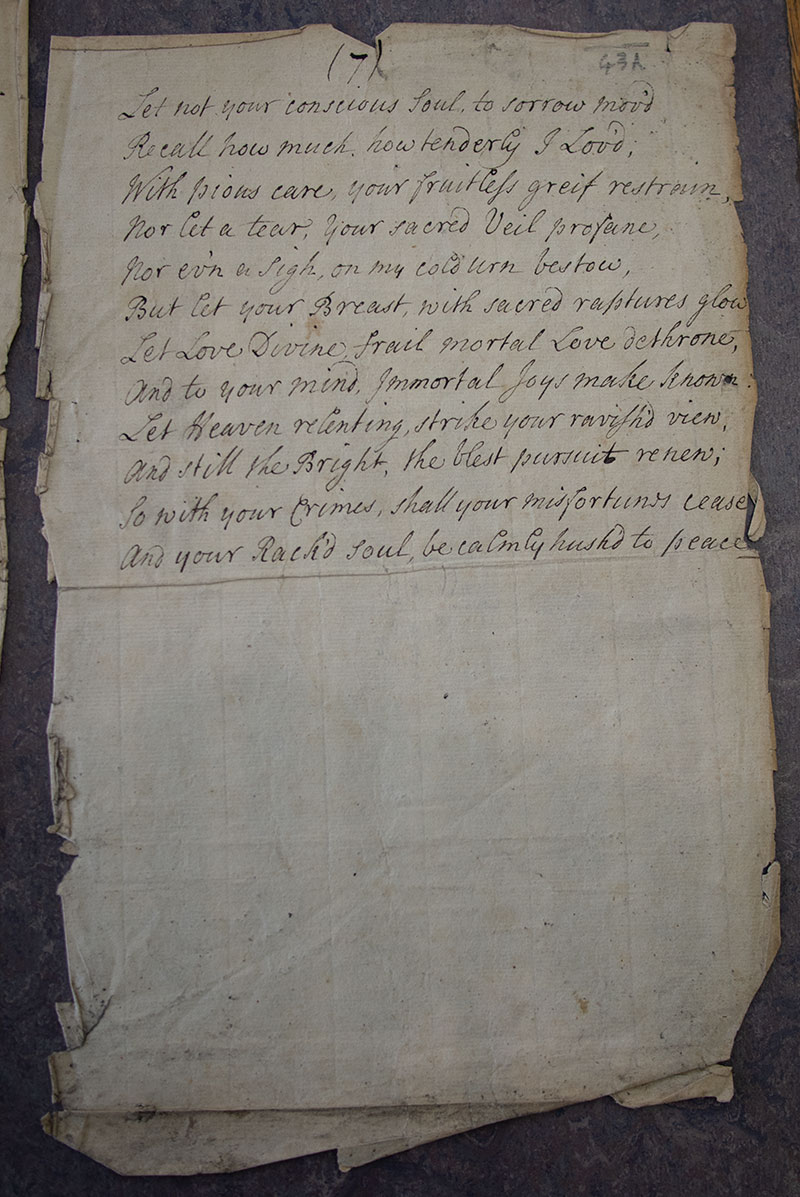
This loose sheet features the fifth and final surviving page of the fragmentary manuscript copy of Madan’s “Abelard to Eloisa” (43A).
Information about Pulter’s Family
Catalogued with the bound volume of Pulter’s writing is a group of leaves stitched together. This first recto is blank:
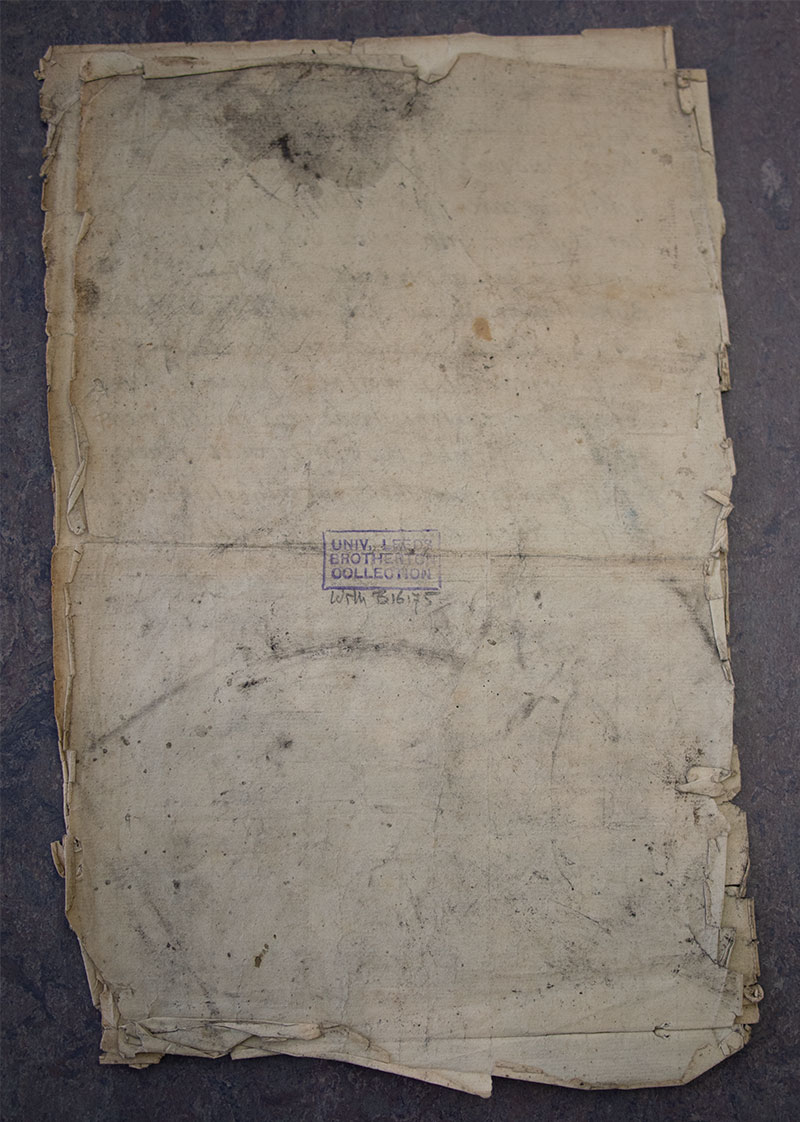
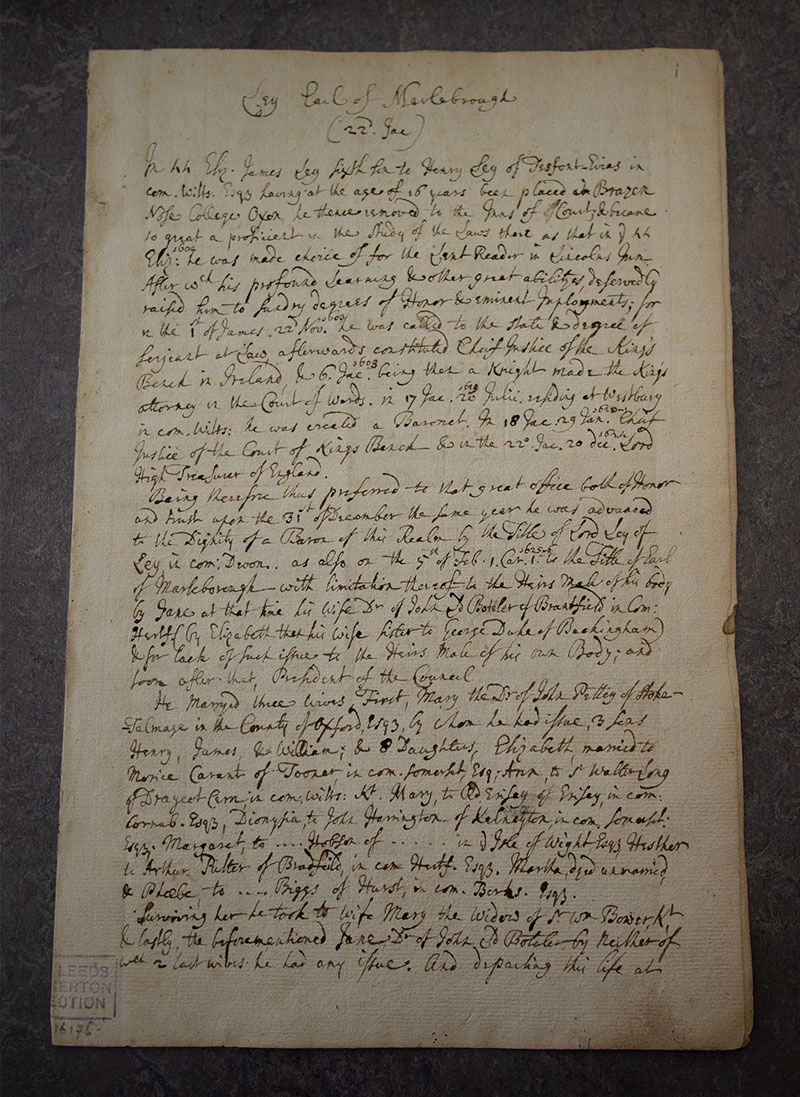
On the next pages in the stitched gathering, the eighteenth-century annotator offers information about the Ley family and summarizes the life of Pulter’s father, James Ley, Earl of Marlborough. Because these leaves are not attached to the book, they have no foliation (all of the images in this gathering can be magnified):
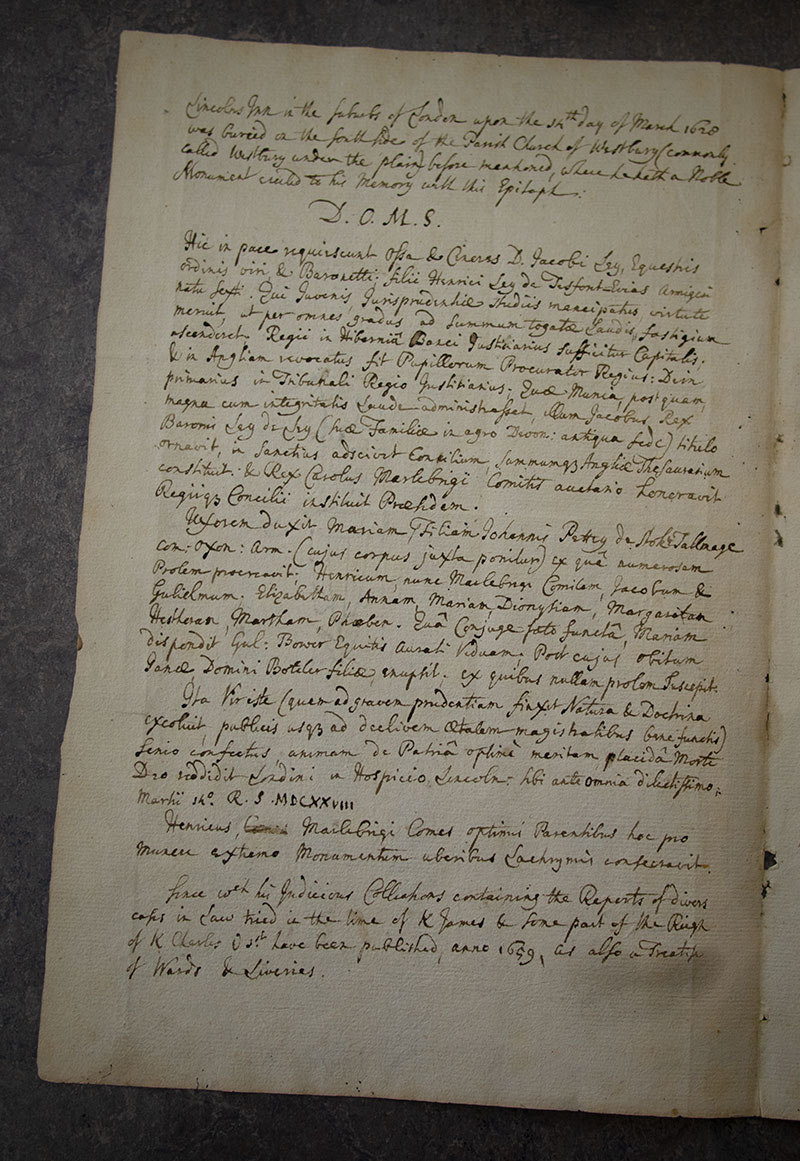
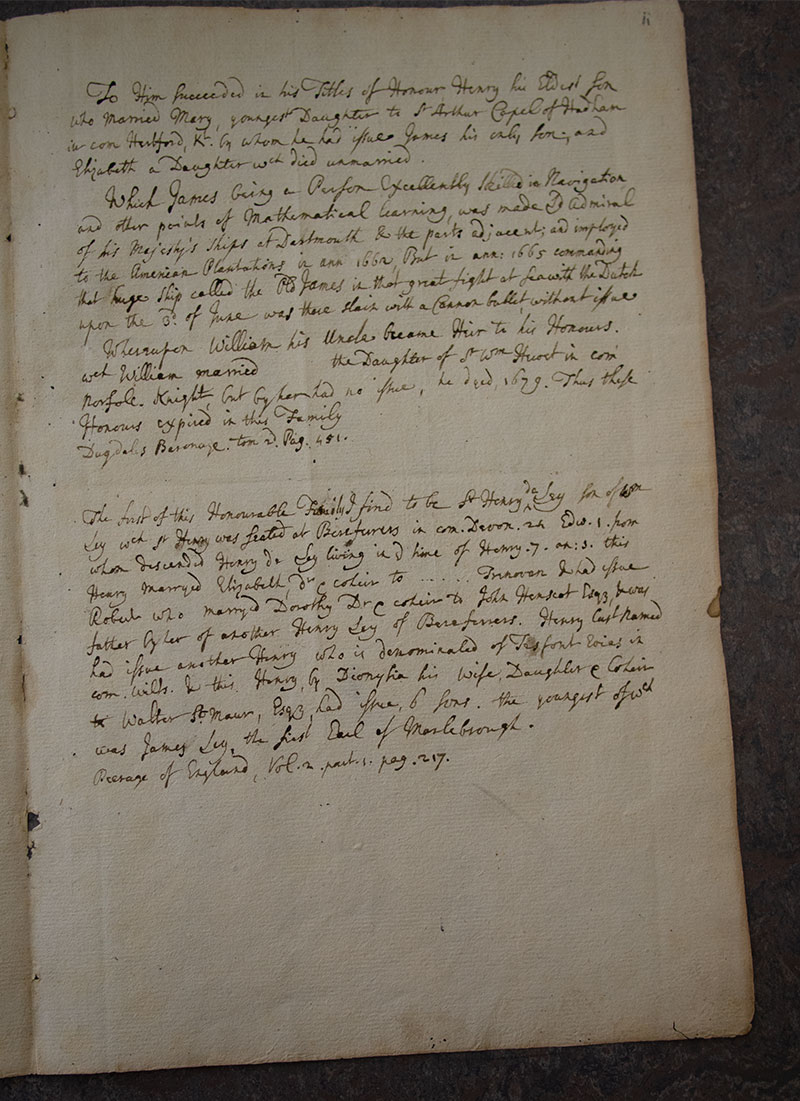
On the last page of this group of stitched leaves, the eighteenth-century annotator has provided a drawing of the Ley family tree, which divides the children by gender and frames the male descendants who inherited the title of Earl in ornamented crowned circles:
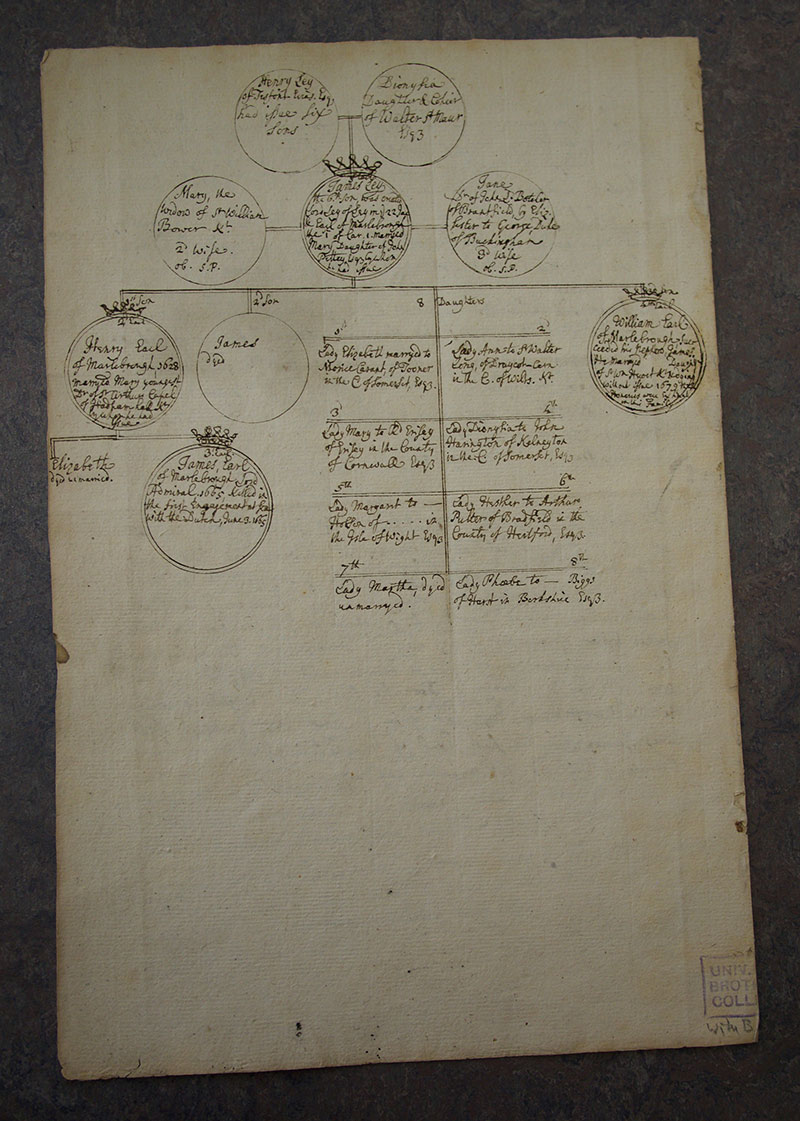
Under the column labeled “Daughters” on this page, the writer provides information about the marriages of Hester and her seven sisters, including the places where they settled:
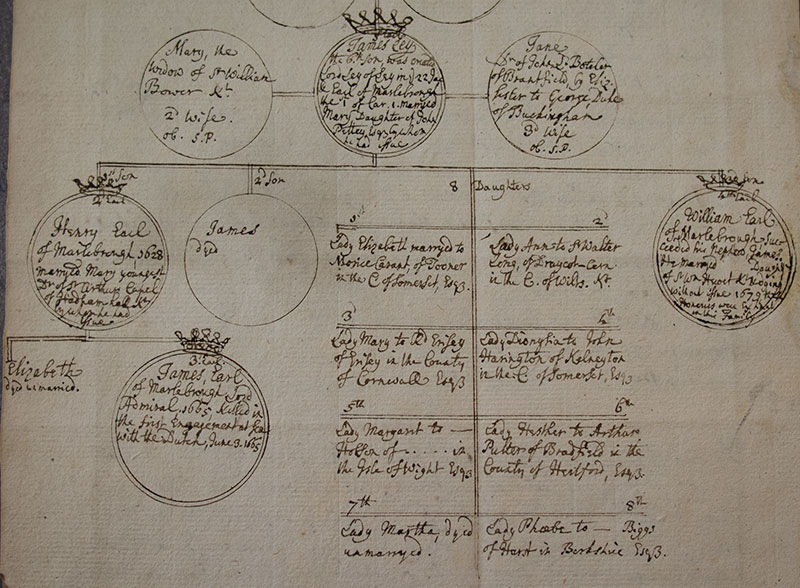
Close-up image of the last page of this group of stitched leaves, catalogued with the bound volume.
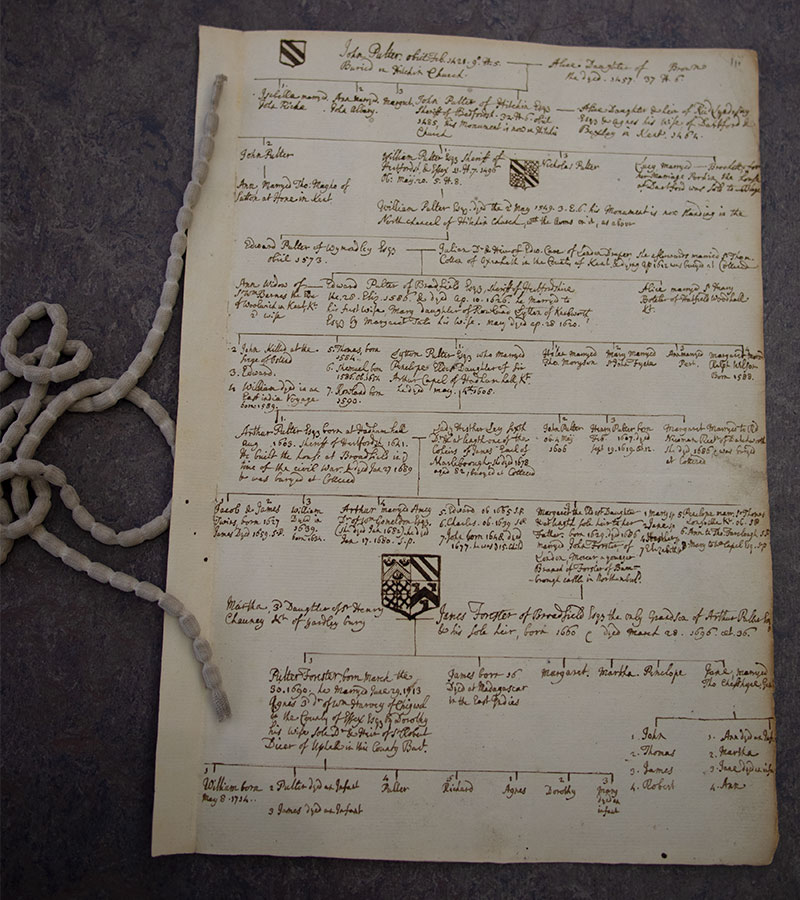
One loose sheet in the volume is thematically tied to the stitched group of pages presenting the Ley family: this page depicts the Pulter family tree, beginning with fifteenth-century ancestors. The eighteenth-century annotator has ornamented the diagram with three family crests. This page offers information about Pulter’s husband’s family as well as the births, marriages, and deaths of her fifteen children, grandchildren and great-grandchildren:
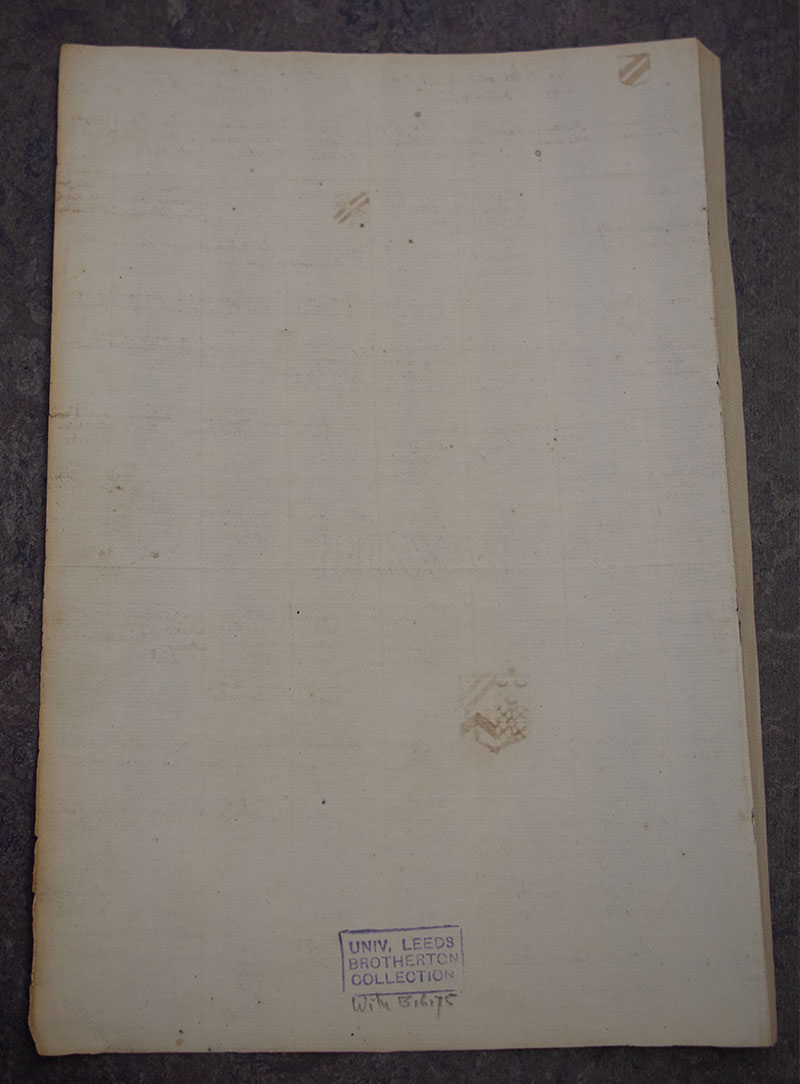
The verso of this loose sheet shows a faint ink-bleed of the family crests:
Pulter’s Unfinished Poem
Among the loose papers and written in what seems to be Pulter’s hand, is a fragmentary untitled poem bearing the first line “Somnus why art thou ſtill to mee unkinde” (Somnus, Why Art…120) (the first page is labeled 130Ar):
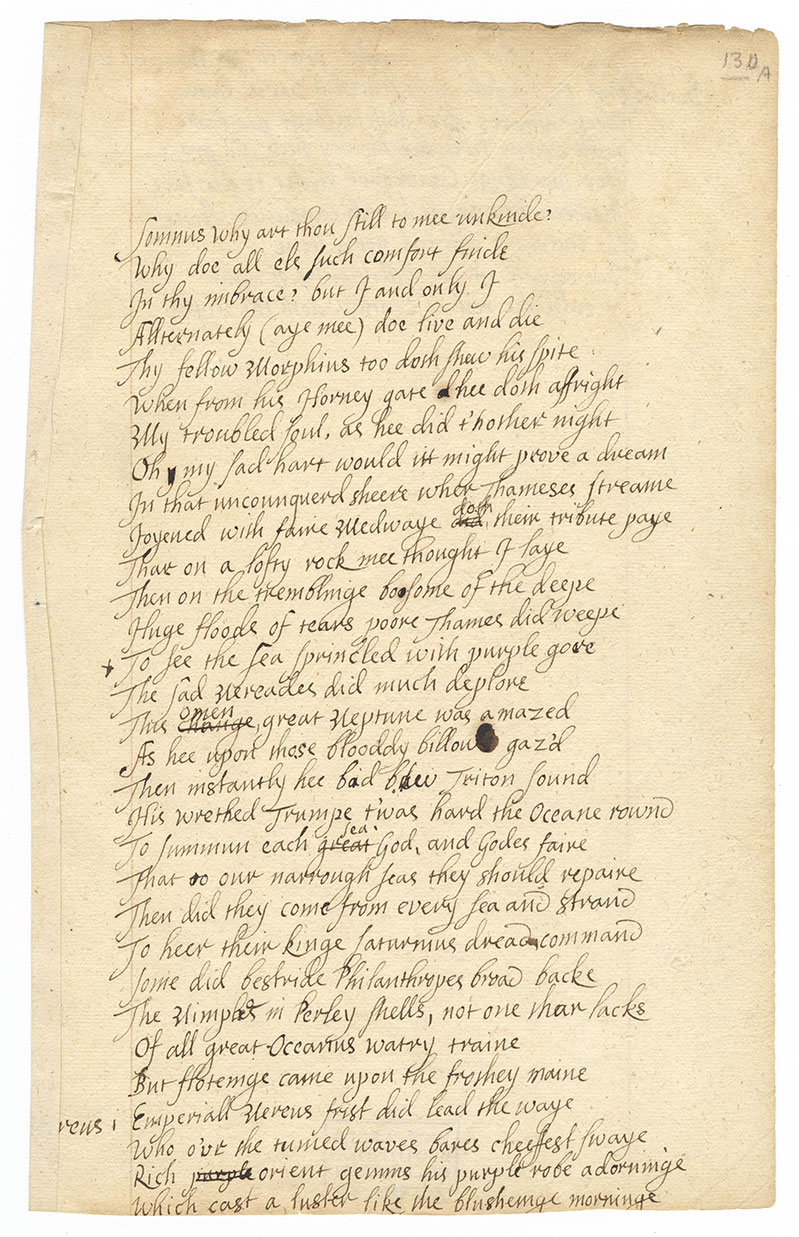
Because this poem appears to be in Pulter’s handwriting and reveals similarities to her other poems, it is included in The Pulter Project (where readers will be able to zoom in on the manuscript facsimile, see a transcription, and compare edited versions). We redisplay it here to show its unusual placement in relation to the manuscript volume, that is, as a loose sheet:
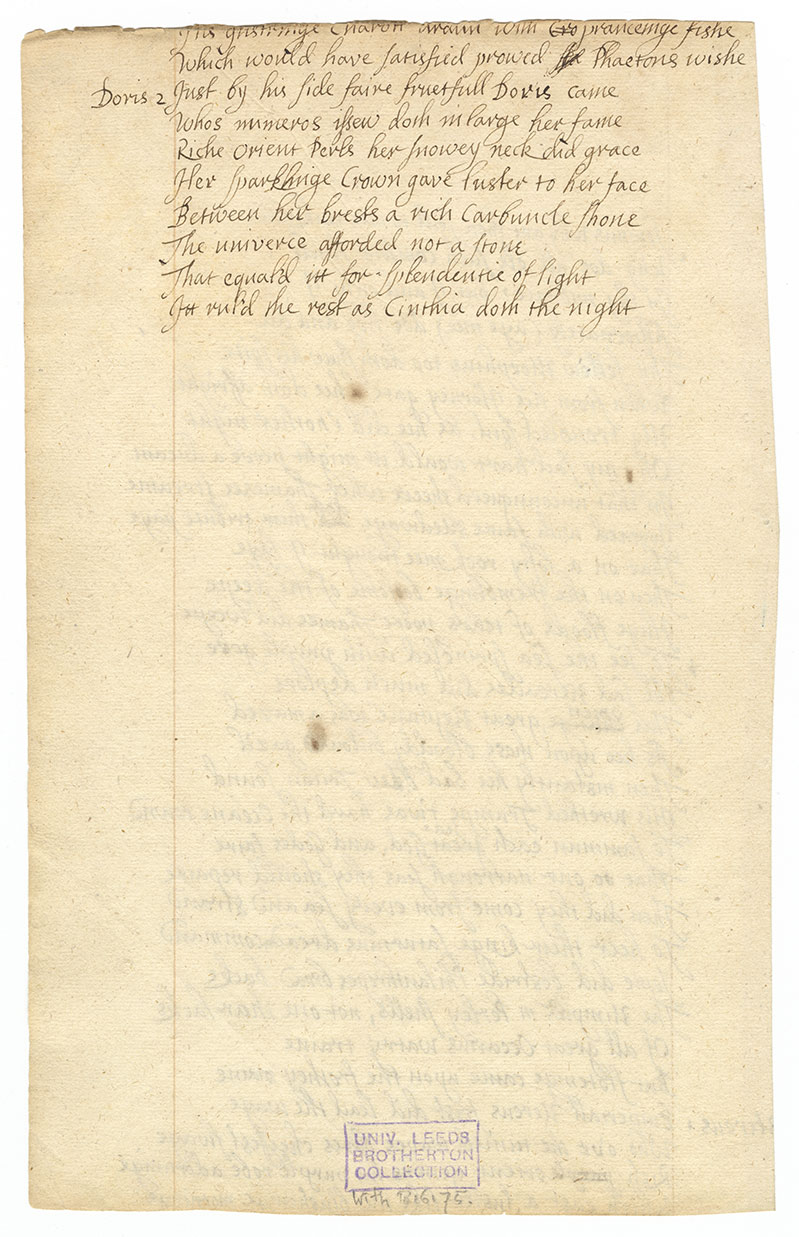
Pulter’s poem “Somnus… ” continuing on 130Av
Florinda-Related Loose Pages
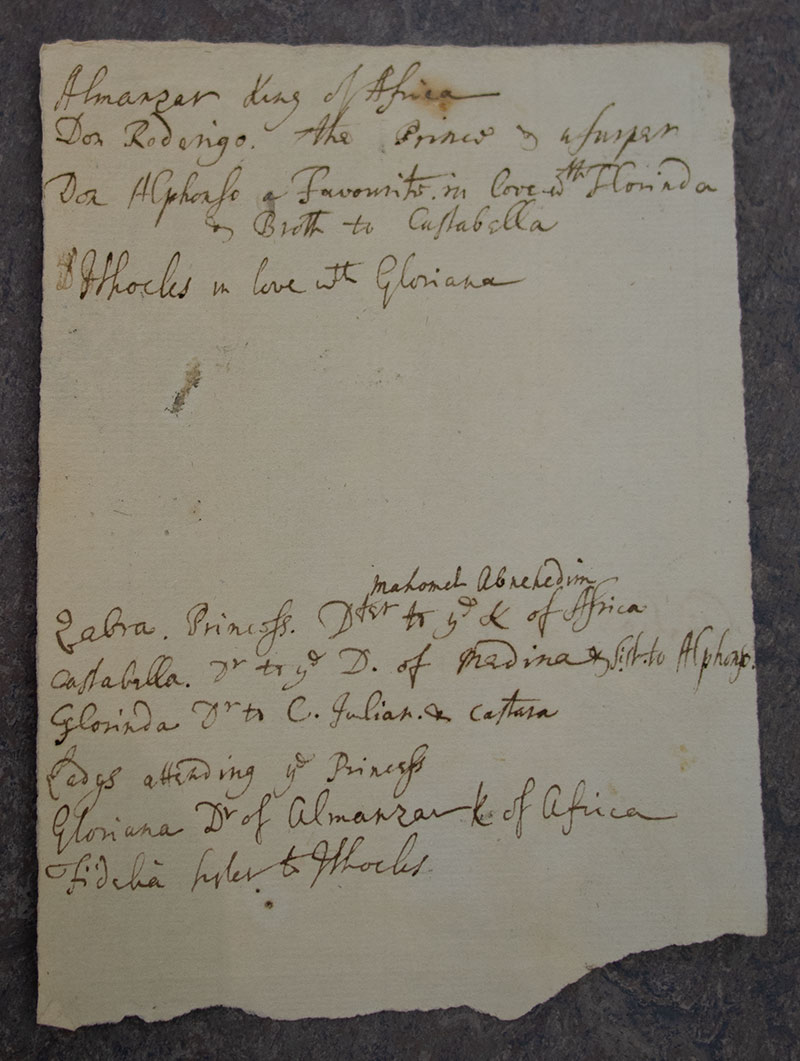
Other loose sheets catalogued with the manuscript (above and below) list characters’ names and descriptions from Pulter’s romance, “The Unfortunate Florinda.”
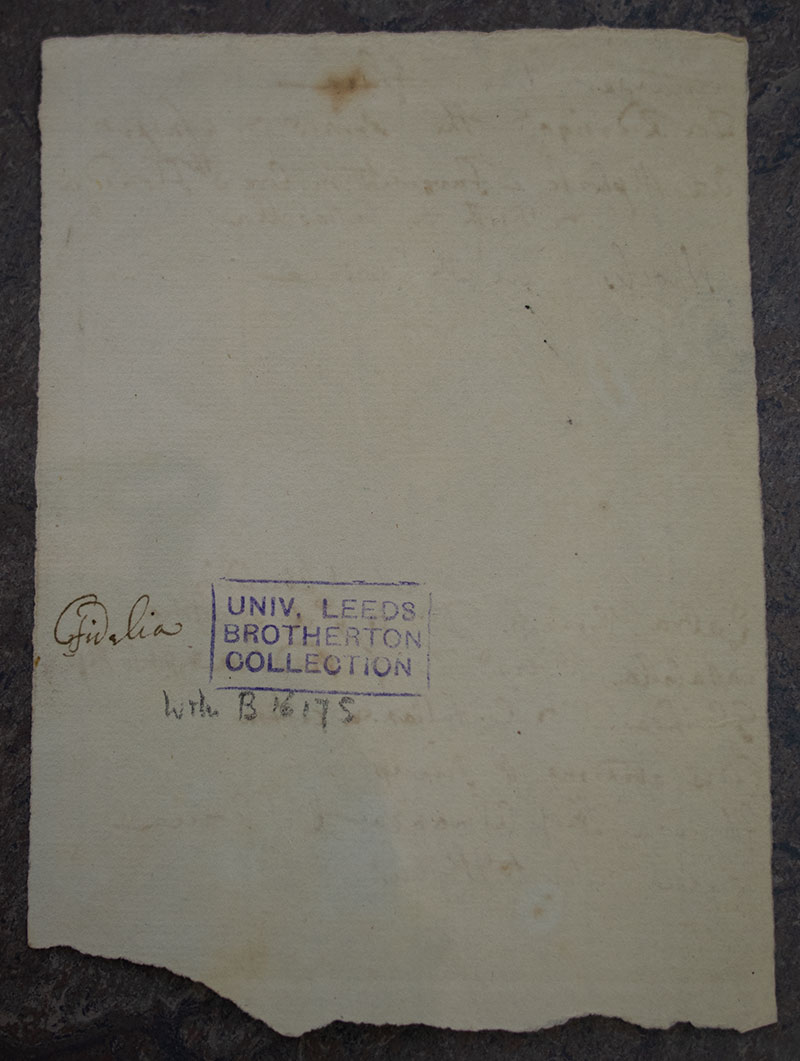
The list below is written by the eighteenth-century annotator:
An incomplete draft, titled “The ſeconde Part of The unfortunate fflorinda,” in what seems to be Pulter’s handwriting, is included among the loose sheets accompanying the volume. Below is a sample page, marked 32A by the University of Leeds Library:
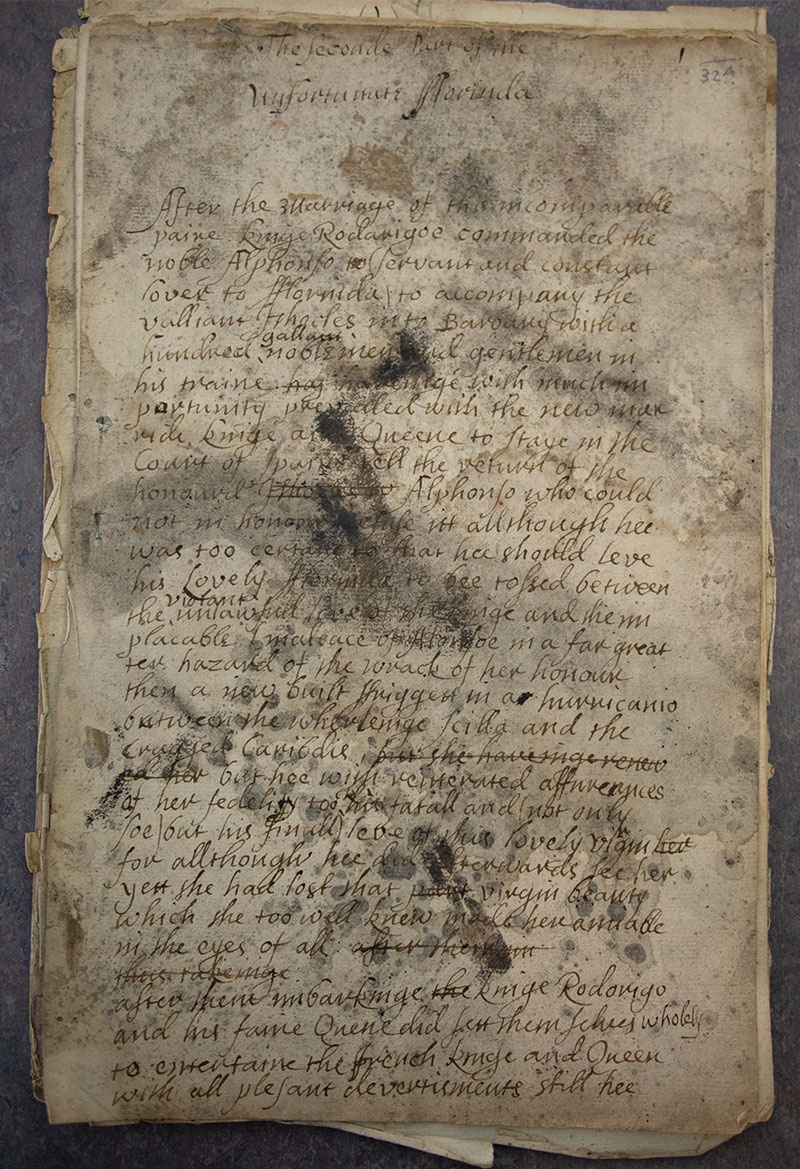
The eighteenth-century annotator of the volume made a clean copy of this draft, which appears on leaves added to the volume on the inverted side of the book.
The Reverse, Inverted Side of the Bound Book
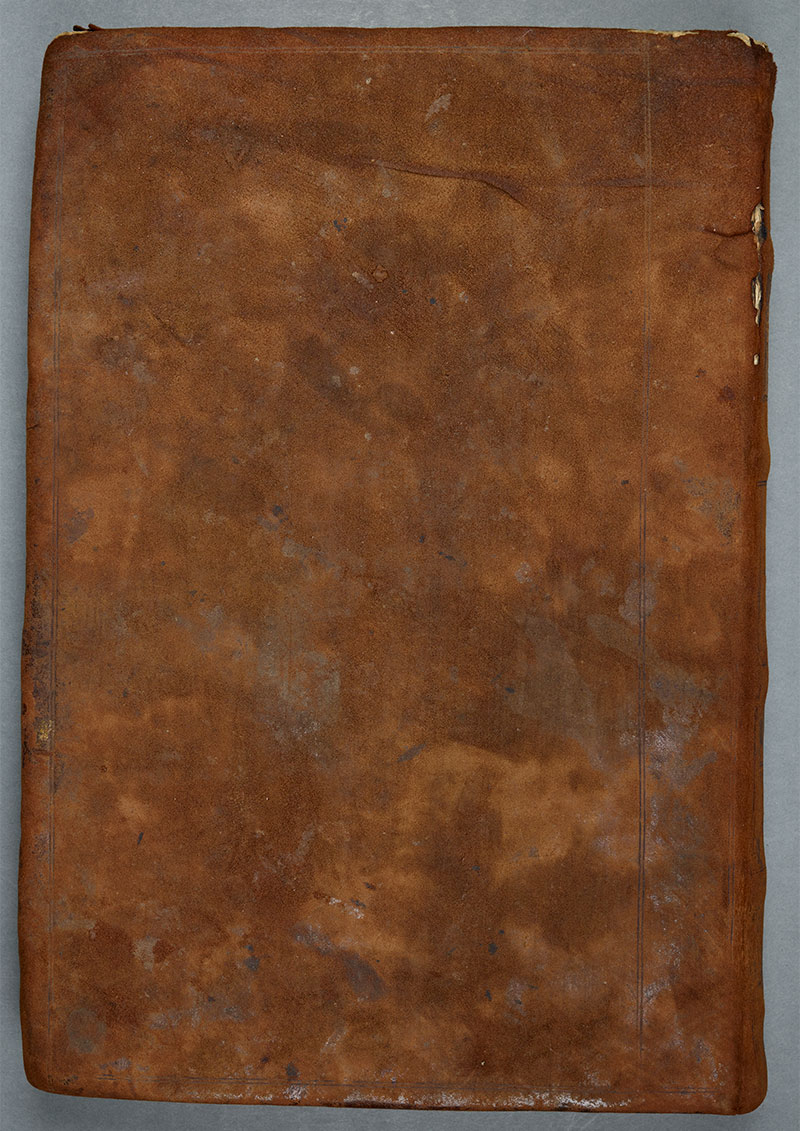
The reverse and inverted side of the bound book offers a second pathway into the manuscript. This image shows the rear cover:
Below is the inside, rear-cover paste-down sheet (see image below which can be magnified):
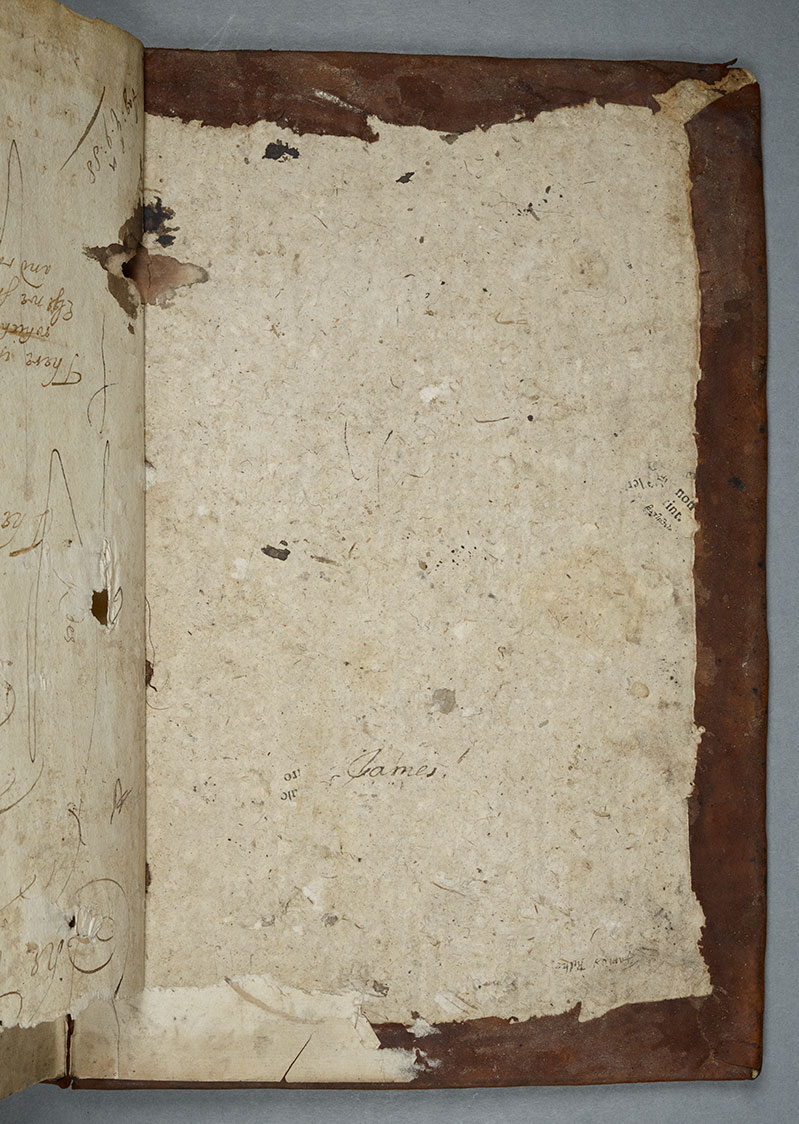
The name “James,” inscribed on the leaf in an unknown hand, may refer to Hester Pulter’s grandson James Forester, the heir of Broadfield (1660–1696, the son of Margaret). Often libraries were transferred to heirs, and it was common for owners to sign their names in books or practice handwriting on blank leaves. But “James” was a common name in this family (and indeed is the name of one of Pulter’s sons, her great grandson, great-great grandson, and her father). Traces of the prior printed texts used to make the pasteboard also show through the pasted-down endleaf.
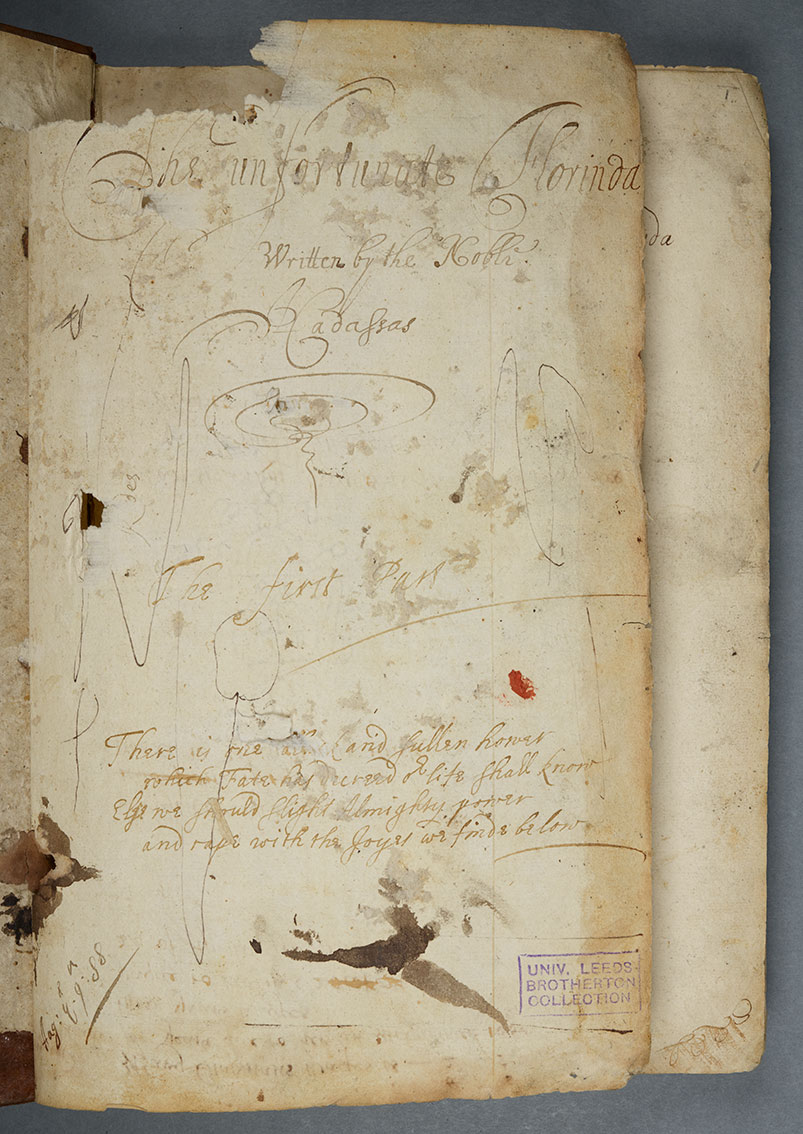
The first leaf of the inverted side of the book (fol. 0r reversed) presents the title to the first part of the romance, “The Unfortunate Florinda Written by the Noble Hadaſsah” in an unknown hand. Below the title, an unidentified writer has added “The First Part” and the song stanza described previously in the Exploration. Faint traces of the writing on the reverse side have bled through the page near the bottom. This leaf shows signs of wear and deterioration, as this image below, which can be magnified, shows:
As is the first leaf on the poetry side of the book, this leaf is glued to the pasteboard only along the edge of the leaf (an unusual practice since pages are usually glued flat against the cover board). Below we see the manner in which this page (fol. 0r inverted) is affixed:
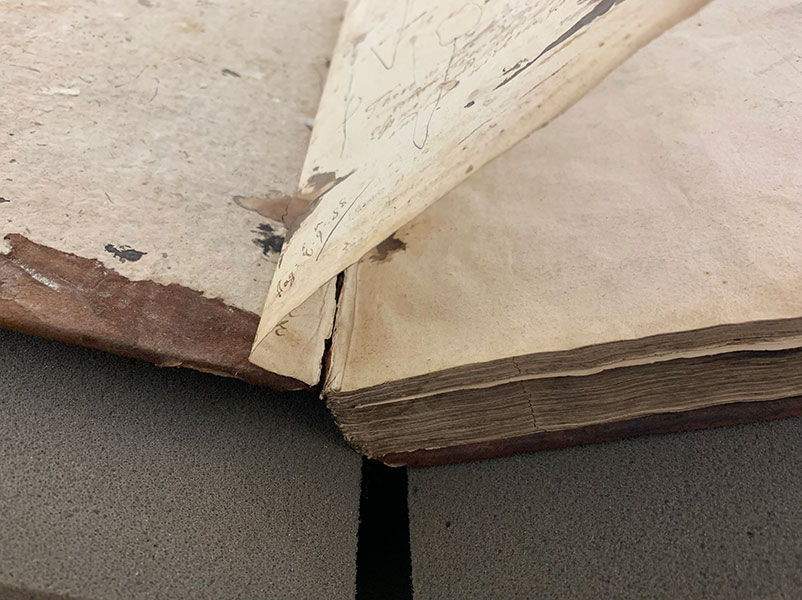
Image by Elizabeth Zeman Kolkovich
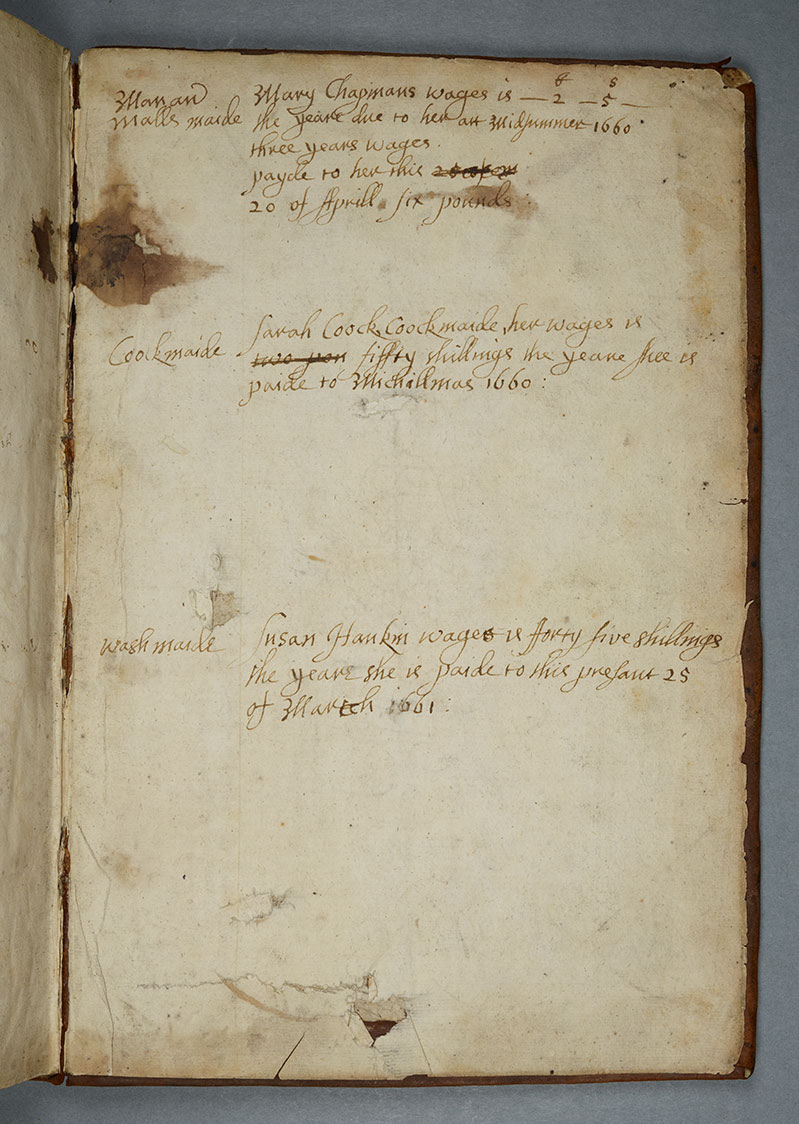
On fol. 0v reversed, the hand that seems to be Pulter’s has inscribed three household accounts, payments to three female maids in 1660 and 1661. Since the records of payment are not inverted (as is the romance at this end of the book), it seems that their entry precedes the decision to use the book’s blank pages to record the romance (see magnifiable image below). The romance thus seems to have been copied into the volume after the poems:
Seeing facing pages (fol. 0v and fol 1r reversed) displays the relationship of the payment accounts and the page bearing the title “The Unfortunate Florinda Written by the Right Hon: ble &c.”:
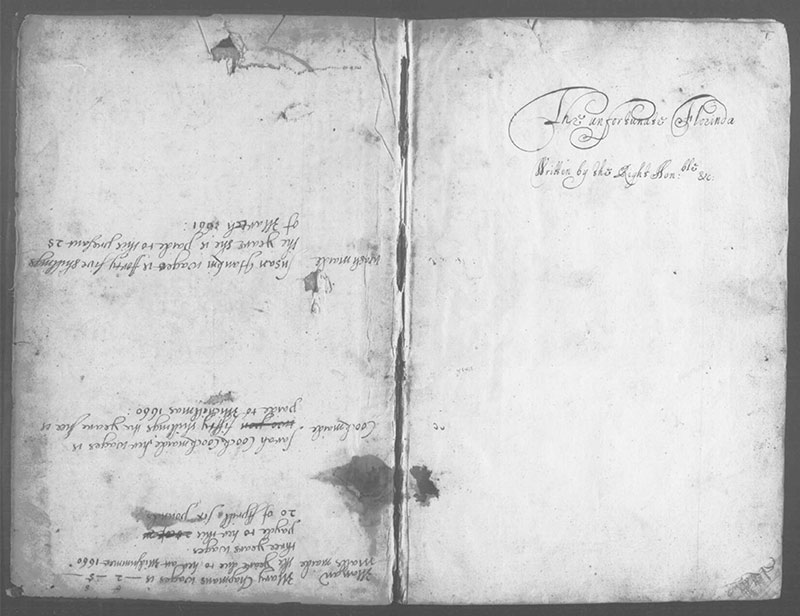
Image from the University of Leeds Library, reproduced on the database Perdita Manuscripts: Women Writers, 1500–1700, Image 37.
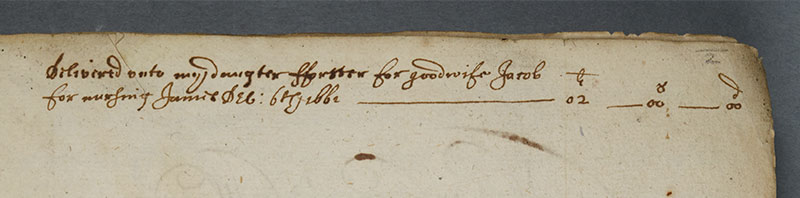
Next, the reader discovers fol. 1v, where someone has inscribed an account of payment for a wet-nurse, a debt paid to “>my daughter Forster for goodwife Jacob for nursing James Dec. 6th 1662”:
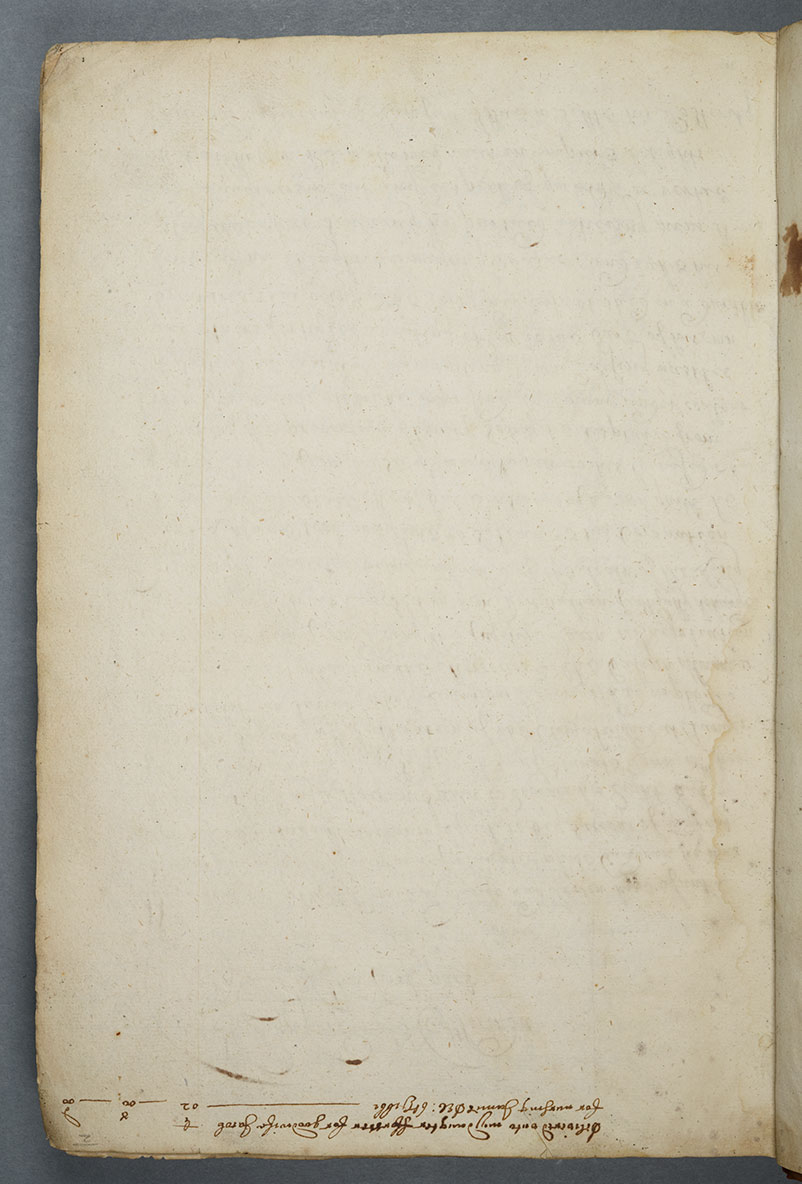
Hester and Arthur’s daughter Margaret had married James Forester and had a son named James in 1660. Eardley suggests that this was possibly written by Arthur Pulter, as payment to his daughter for hiring a nurse for her son (Introduction, Lady Hester Pulter: Poems, Emblems, and “The Unfortunate Florinda,” [Toronto: Iter and Centre for Reformation and Renaissance Studies, 2014], p. 34). The fact that this account notation is inverted, unlike the ones on the previous page, suggests that it was recorded after the romance was inscribed into the book.
Below is a close-up of the account payment on fol. 1v inverted:
The next page begins the prose romance with the title “The unfortunate Florinda The first part” (fol. 2v reversed). The first part of the romance continues from this page to fol. 31v in the main scribe’s hand:
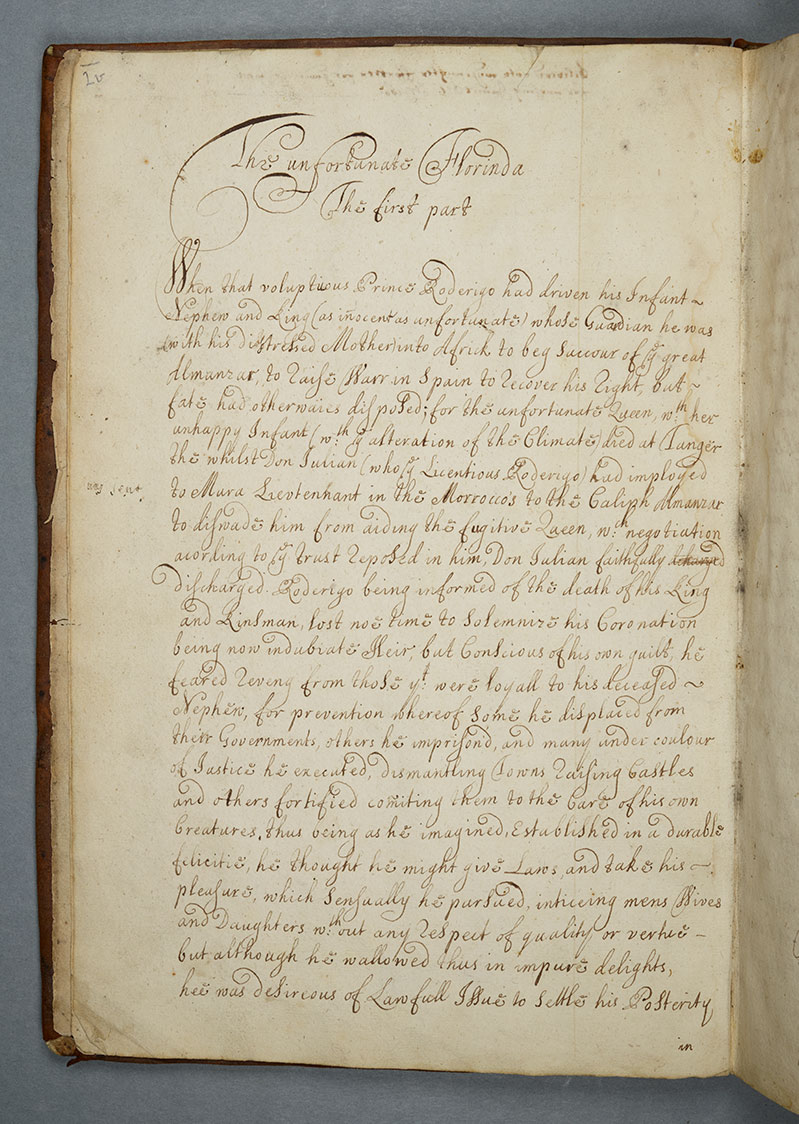
The second part of the (unfinished) romance appears from fol 31r-36v in the eighteenth-century annotator’s hand. Images of all pages of the romance can be seen on the University of Leeds Library site.
Conclusion
The digital manifestation of Pulter’s poems in The Pulter Project remediates her verse, allowing a user to compare the appearance of individual poems in manuscript page facsimiles and various modern editions. The site is based on a firm commitment that the materialization of a poem matters to its meanings. “What Else Is In the Manuscript?” invites you to consider the early physical location for Pulter’s poems and to contemplate what interpretations are possible from an understanding of their material habitat.