Pulter’s Splendent Fame
With its transitional adverb of consequence, Pulter’s line “Then let me ever have a splendent fame” registers the argumentative turn in Vain Herostratus (Emblem 28)93 toward the author’s personal circumstances. In the line, Pulter places tremendous weight on the easily overlooked word “splendent,” an earlier form of “splendid,” for this modifier distinguishes her intended fame from that of Herostratus, who burned down the Artemision, the Temple of Diana, one of the seven wonders of the ancient world. Generally meaning “shining brightly by virtue of inherent light” (first signification, OED), “splendent” has a history of being used figuratively to describe human qualities of brilliance—beauty and greatness (third signification, OED).
Pulter chooses the word deliberately since it holds special significance in her wider poetic lexicon. She has recourse to it eight other times in seven different poems, besides “Vain Herostratus.” Half those times, it describes celestial bodies: the sun in The Center30 and Apollo’s face in A Solitary Discourse44, as well as the moon in The Garden12 and Phoebe in The Eclipse1. Along with its Latin ancestor, “splendidus,” splendent signifies the bright, shining, and glittering rays of the sun. But the Latin word was also used in a tropical or figurative sense to characterize individuals as “brilliant, illustrious, distinguished, or noble” (Lewis and Short). Celestial light’s longstanding associations with public illumination, illustrious recognition, explains why Pulter gravitates toward the noteworthy phrase “splendent fame,” which occurs also in her poem The Dolphin (Emblem 39)39 to describe lovely Amphritrite and in The Garden12 as part of the Wallflower’s discourse. The passage from “The Garden” is worth quoting in full:
- For beauty never yet made woman sainted;
- ’Tis virtue doth immortalize their name,
- And makes an aromatic, splendent fame.
Here Pulter is careful to separate splendent fame from the Petrarchan tradition, in which the beloved, like Philip Sidney’s Stella, receives acclaim for her dazzling physical attributes. Pulter privileges a kind of fame more conceptually aligned with Senecan claritas, a figurative term based upon “light, splendour, efflugence” and “tied to virtue, truth, and justice” (Piero Boitani, Chaucer and the Imaginary World of Fame 38)1. As in “The Garden,” “Vain Herostratus” draws together name and fame into a rhyming couplet, conveying the binding commemorative force between the two ideas: “Then let me ever have a splendent fame, / Or let me lose Hadassah, my loved name,” that is, the biblical pseudonym that Pulter establishes through titles and poems in her manuscript. As in “The Garden,” too, Pulter expresses a desire for a splendent fame that immortalizes her name by means of the light emanating from within—self-generated, internalized virtue, which, elsewhere, she enjoins her children to cultivate. See the poem Doves and Pearls (Emblem 36)101, where she advises them to store “sacred truths within [their] heart” so that their “graces, like these pearls, will shine more bright.”
Pulter’s desire for splendent fame contrasts the case of Herostratus, whose act of arson created false splendor, fiery and destructive. Through his example of impiety, Pulter denounces the profanation of sacred places as a means of immortalizing one’s name and thus shrewdly condemns the religious iconoclasm and vandalism perpetrated by the Parliamentarians during the civil wars. Her splendent fame, instead, depends upon serving royalist commemoration, building up and preserving, rather than destroying, monarchical and high-church values. Although it is her poetry—even this very poem itself—that will potentially confer upon her the fame she seeks, Pulter does not court secularity, let alone sacrilege. She seeks “immortalization for “Haddassah””, rather than “Hester.” The idea of light shining from within herself does not contradict Pulter’s theological commitment to giving God the glory for the goodness found in the world. Among the parabolic lessons prompted by Herostratus’s desecration of the Artemision lies Paul’s imperious question, “Know ye not that ye are the temple of God, and the Spirit of God dwelleth in you? If any man defile the temple of God, him shall God destroy; for the temple of God is holy, which temple ye are” (KJV, 1 Cor. 3: 16–17). Pulter knows that she incarnates such a divine temple, and so her desire for fame derives less from her own self-aggrandizement than from her soul’s submission to and celebration of the holy spirit: “O, let Thy Spirit my sad soul sustain” (Must I Thus Ever Indicted Be55). Her craft also erects for her readers a rhetorical or poetical “fane”—diction, which, by the way, visually puns on “fame” and resonates homophonically with “prophane”—bearing witness to her inner, God-inspired light. In this regard, Pulter’s poetry offers a verse temple redolent of George Herbert, whose famous collection, organized around church architecture, enshrines his “private ejaculations” and devotions.
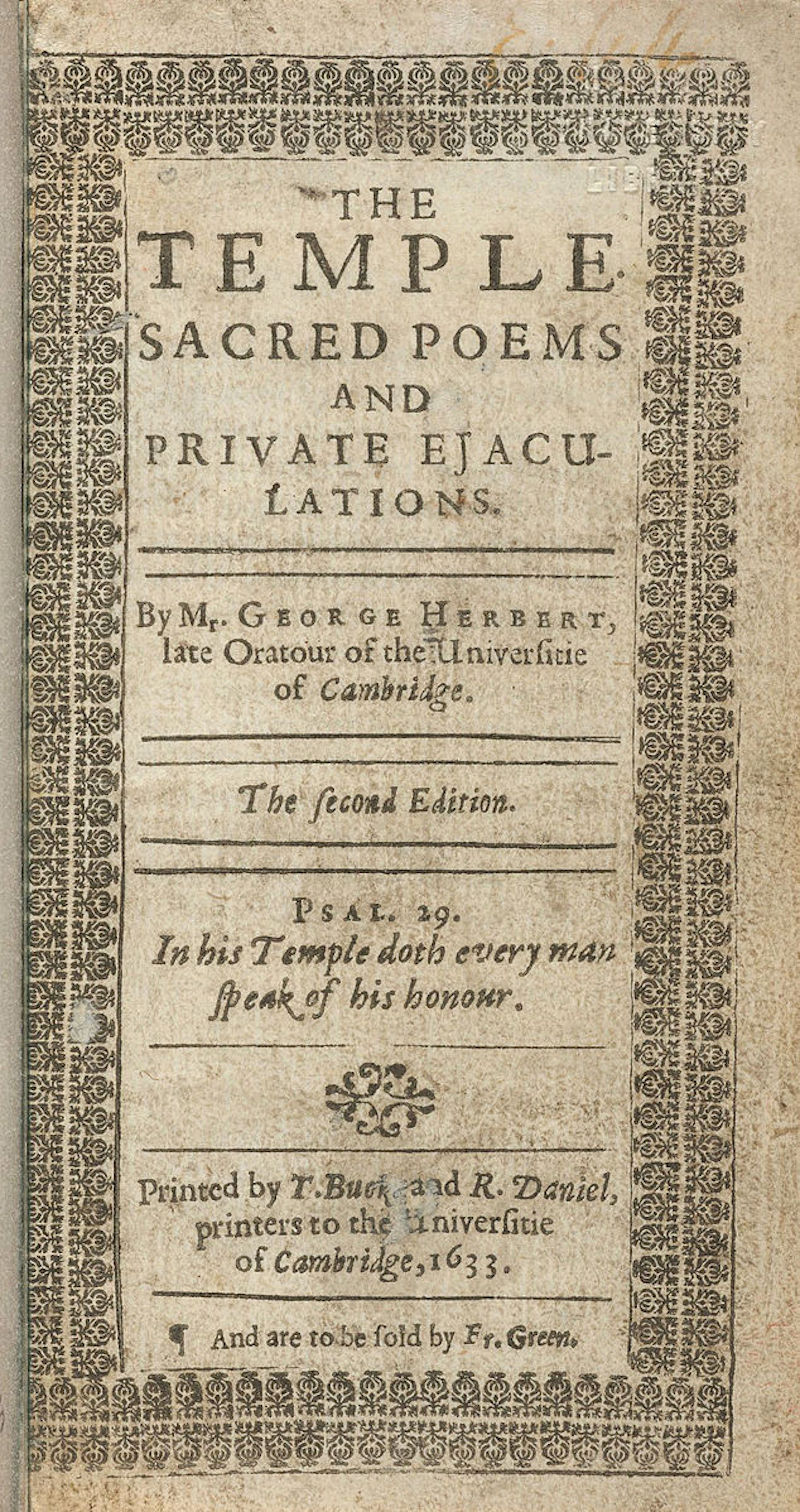
Wikipedia: Public Domain, STC 13185, Houghton Library, Harvard University
Footnotes
1. Piero Boitani, Chaucer and the Imaginary World of Fame, Chaucer Studies 10 (Cambridge [Cambridgeshire]; Totowa, N.J.: D.S. Brewer; Barnes & Noble, 1984).