Jezebel
Jehu Commanding Jezebel’s Death and the Dogs Eating Her Flesh
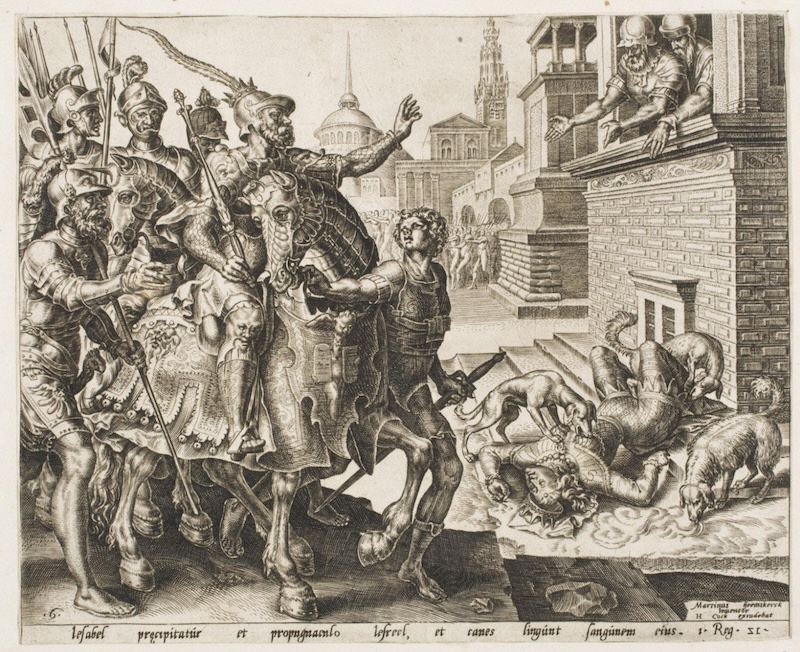
Philadelphia Museum of Art. Jehu Commanding Jezebel’s Death and the Dogs Eating Her Flesh, Plate 6 from the series The Story of Ahab, Jezebel and Naboth, c. 1561. Engraving by Philips Galle (Flemish, 1537–1612). After a drawing of 1561 by Maarten van Heemskerck (Netherlandish (active Haarlem and Rome), 1498–1574). Published by Hieronymus Cock (Netherlandish, c. 1510–1570).
The Muriel and Philip Berman Gift, acquired from the John S. Phillips bequest of 1876 to the Pennsylvania Academy of the Fine Arts, with funds contributed by Muriel and Philip Berman, gifts (by exchange) of Lisa Norris Elkins, Bryant W. Langston, Samuel S. White 3rd and Vera White, with additional funds contributed by John Howard McFadden, Jr., Thomas Skelton Harrison, and the Philip H. and A.S.W. Rosenbach Foundation, 1985. Accession Number: 1985-52-3918.
The clipped tone of Pulter’s couplet on Jezebel and Jehu leaves much to be filled in by the reader, but one thing is clear from the context: Jezebel is likened to Nemesis, “the agent of divine justice [and] the enemy of hybris,”1 and Jehu to prideful, arrogant “usurpers,” like Zimri, who had met a miserable fate (being incinerated in a fire) before him. The reader familiar with the confrontation between Jezebel and Jehu in 2 Kings will applaud Pulter’s seamless transition from Nemesis who “will look down” to Jezebel, who literally looks down, from an open window, at Jehu as she asks him (in the words of the Authorized King James Version): “Had Zimri peace, who slew his master?” In The Political Bible in Early Modern England, Kevin Killeen refers to this as a “dictum often tossed in the direction of rebels and Protector, to remind them in their upstart state that justice would eventually be meted out.”2 Killeen also notes, however, that those royalists who deployed this adage at their adversaries had to remove the rhetorical question from its scriptural context before doing so because in context justice is immediately meted out not to Jehu, but to Jezebel.
Indeed, the reader familiar with this Biblical tale will note the irony of Jezebel admonishing Jehu and threatening him with his comeuppance. What Pulter does not mention is that directly after Jezebel taunts Jehu with the prospect of an agonizing death, like that which befell Zimri, Jezebel herself falls out the window—or rather is thrown out by her attendants—and lands on the ground at Jehu’s feet. Her blood splatters against the castle; her bones are trampled to dust by Jehu’s horses; her unburied corpse is consumed by stray dogs; and, finally, her remains are turned to fertilizer. After which, “Jehu reigned over Israel in Samaria… twenty and eight years”: his comeuppance does not come for another four generations, when his great-great-grandchildren ceased to prosper because Jehu himself had long ago been guilty of backsliding, of not uprooting Jezebel’s idolatry thoroughly enough. Commenting on this Bible story in The Complaint of England (1587), William Lightfoot states: “the difference to be noted betwene Iehu and Zimri is apparant inough,” adding that “Iezebel [not knowing of Jehu’s anointing] were in deede ignorant.” By the time Pulter was writing, after the overthrow and beheading of an English king, there were indeed sermons suggesting, in the words of John Ramsey, Minister of East Rudham, that “a wicked person,” like Jezebel, “may sometimes speak well.” Ramsey’s sermon, printed after the Restoration in 1661, under the title Zimri’s peace: or, The traytor’s doom & downfall, goes to great lengths to distinguish the “Idolatrous and bloud-thirsty” speaker from her “sound and wholsome” speech. Considering the lengthy sermons that Lightfoot, Ramsey, and many others composed in an attempt to elucidate what turn out to be the last words Jezebel ever spoke, Pulter’s brevity and compression, her refusal to comment or moralize beyond the facts, is fascinating. Where preachers and polemicists had dilated the story and drawn explicit lessons from it, Pulter radically reduces it to an enigmatic fragment, a frozen instant in time, which gives Jezebel the last word and grants her a stay of execution.