Apes and Art: From Bruegel to Banksy and Beyond
While Ambitious Apes (Emblem 26)91 is a naked emblem, there was no shortage of—indeed, there was a “veritable craze”1 for—monkey engravings and paintings around the time Pulter wrote her poem. The vogue for singerie (French for “monkey trick”), a visual arts genre in which monkeys ape human activities and manners, peaked in the eighteenth century but had its roots in the sixteenth and seventeenth centuries. This Curation showcases some examples of apes (or monkeys) in art in the years leading up to and around the time Pulter was composing “Ambitious Apes.” It also includes some more recent intersections of apes and art.
Like Pulter’s emblem poems, the first early modern emblem book, Andrea Alciato’s Emblematum Liber (1531), circulated without woodcut illustrations while it was still in manuscript (prior to publication). With each printing of Alciato’s emblems, however, pictures were added: “Different printers in different countries using different artists”2 meant that over time a single emblem poem would be paired with many different images. Now, imagine the effects of adding a visual image to Pulter’s emblem poem, “Ambitious Apes.” Consider choosing one of the following images to serve as the illustration. How might the addition of this visual image complement and/or complicate Pulter’s verbal art? Could the added picture change our perspective on the poem, or vice versa, producing new insights, making new meanings or knowledges possible?
Lucas Horenbout’s Catherine of Aragon with a Monkey
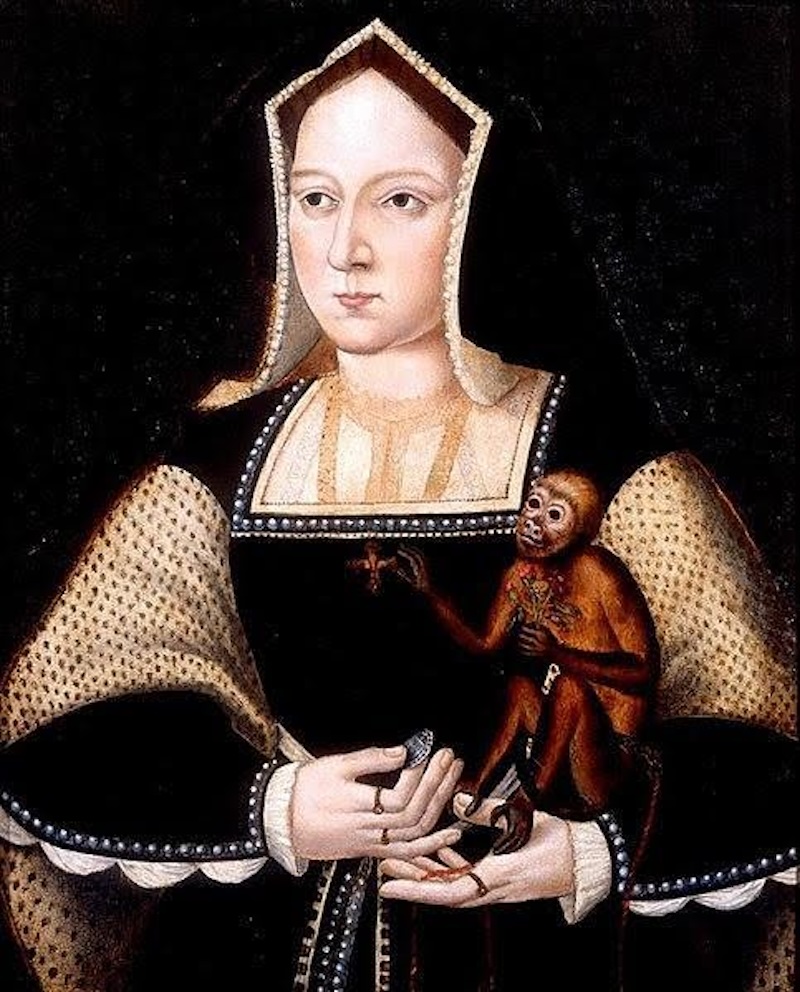
Lucas Horenbout. Katharine of Aragon with a Monkey. 1525. Miniature. Wikimedia Commons.
As the headnote to the Amplified Edition of “Ambitious Apes” explains, a 1633 portrait of Queen Henrietta Maria included her monkey, Pug (see below). But Henrietta Maria was not the first English monarch to have her pet monkey included in a royal portrait: more than a century earlier Catherine of Aragon, first wife to King Henry VIII, was depicted holding her monkey.3 The monkey holds a small bouquet of assorted flowers in one hand (or paw) and reaches with its other for the cross hanging from Catherine’s necklace. This domesticated monkey has learned to value faith (represented by the cross) above worldly temptations (symbolized by the coin Catherine offers him). This depiction draws viewers’ attention to the monkey’s paws, which, like human hands, and unlike the paws of most other nonhuman animals, have opposable thumbs, one of them, like the cross itself, occupying the center of this portrait.
Pieter Bruegel the Elder’s Two Monkeys
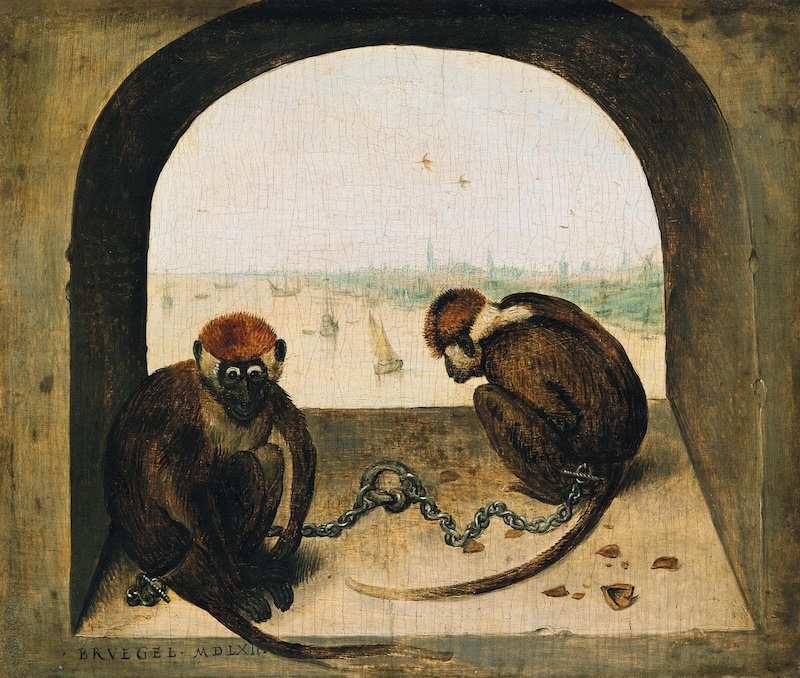
Pieter Bruegel the Elder, Two Chained Monkeys. 1562. Oil on oak wood. Gemäldegalerie. Wikimedia Commons.
Called “one of the most riddling paintings” ever made, Pieter Bruegel the Elder’s Two Monkeys (1562) proves that monkeys not only exhibit curiosity but elicit it from human observers too.4 What are these monkeys thinking? What is each one looking at? Why are they chained in a window overlooking Antwerp?
Niccolo Boldrini’s Caricature of the Laocoön
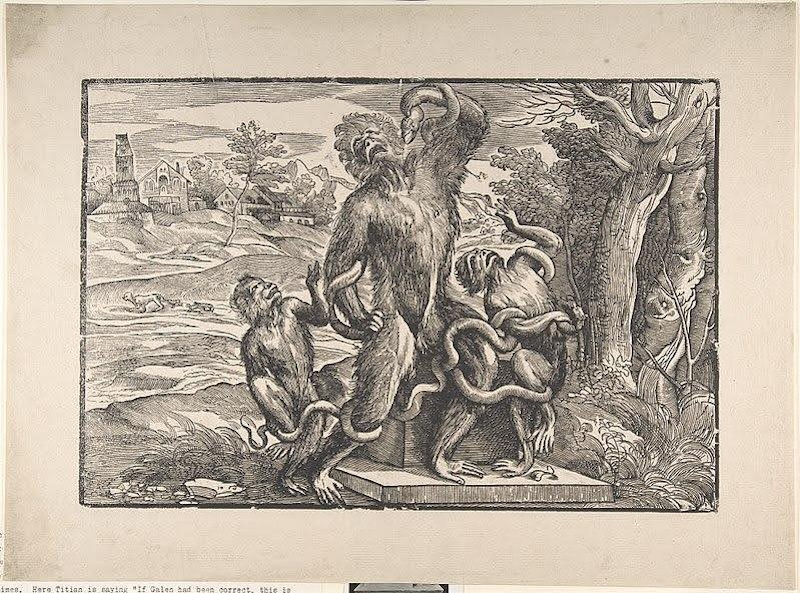
Niccolò Boldrini. Caricature of the Laocoön. c.1520–60. Woodcut print, after a drawing by Titian. Wikimedia Commons.
In 1506, an ancient sculpture, once described by Pliny the Elder, was unearthed in Rome and put on display. The statue depicted the Trojan priest, Laocoön, along with his two sons being strangled by serpents which the Greek gods sent as divine punishment for Laocoön’s attempt to warn the citizens of Troy against accepting the giant wooden horse left by the Greeks as a gift. The dynamism and taut musculature of the white marble men struggling to defend themselves from massive snakes so impressed sixteenth-century sculptors, including Michelangelo, that many of them aspired to emulate this recent discovery of classical art. Titian, who is believed to have first drawn this caricature of the Laocoön group with monkeys substituted for its human figures, might have been making fun of artists who “aped” or imitated classical models too closely. Does Pulter’s poem, which likens biblical and classical characters, such as Jehu and Julius Caesar respectively, to “ambitious apes,” invite readers to imagine these men similarly translated to monkeys? If so, does it strip these ancient figures of their antique glamor and sacred grandeur?
Pieter van der Heyden’s The Sleeping Peddler Robbed by Monkeys
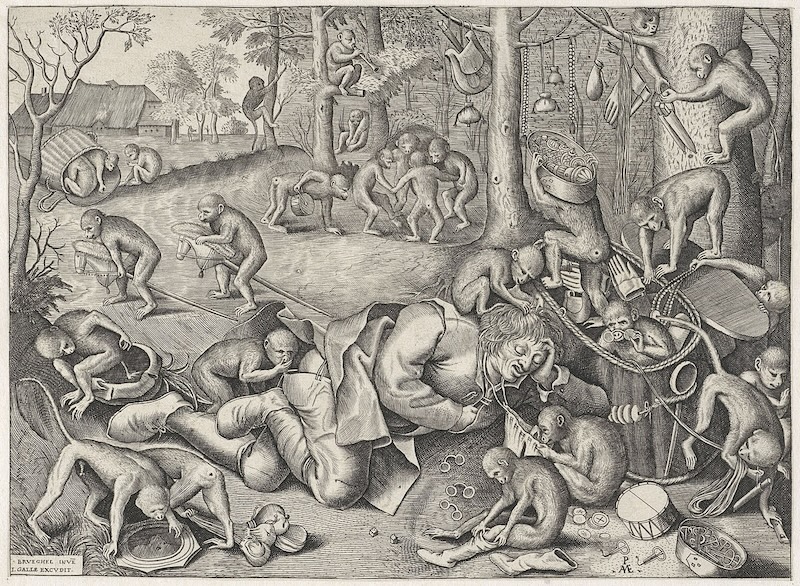
Pieter van der Heyden. The Sleeping Peddler Robbed by Monkeys. 1562. Engraving after a drawing by Pieter Bruegel the Elder. Rijksmuseum. Wikimedia Commons.
With roughly two dozen monkeys depicted festooning the trees with a merchant’s wares, pulling down his pants, and more, this image, based on a popular folk tale of a sleeping peddler beset and robbed by monkeys, plays up apes’ reputation for mischief as well as for curiosity. A subsequent seventeenth-century variation on this engraving by Pieter van Harlingen has the monkey closest to the center holding a mirror in which we see the peddler’s bare buttocks.
Pieter van der Borcht’s The Nursery
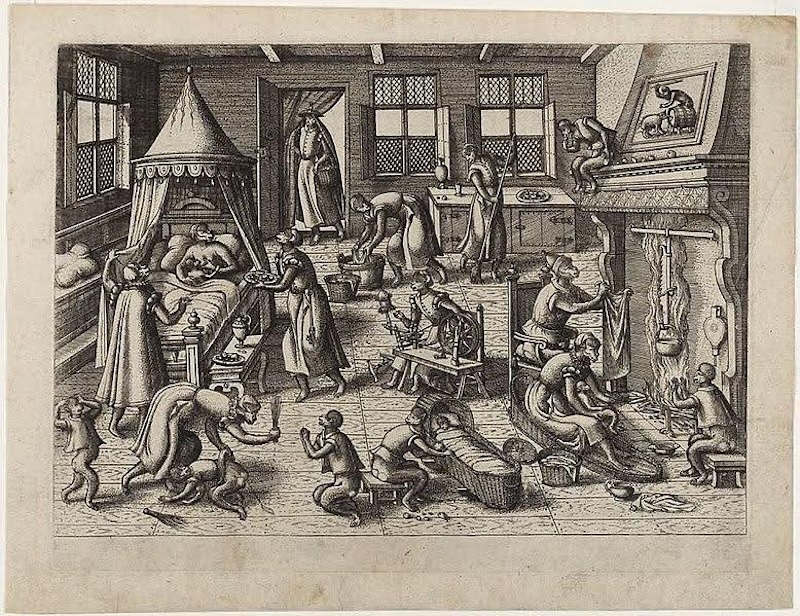
Pieter van der Borcht. The Nursery. c.1585. Etching print on paper. Harvard Art Museums. Wikimedia Commons.
In the late sixteenth century, Pieter van der Borcht made a series of engravings depicting monkeys engaged in a variety of human activities and amusements, ranging from alchemy to ice skating to warring on land and at sea. The Nursery depicts the lying-in period of a mother monkey with her suckling infant in the birthing chamber attended to by a monkey midwife and monkey nurse, with other monkey attendants and monkey children, some being scolded while others tend to the fireplace. I encourage readers to find more of van der Borcht’s monkey engravings, any one of which might make an apt picture for Pulter’s “Ambitious Apes.”
David Teniers the Younger’s Guardroom with Monkeys
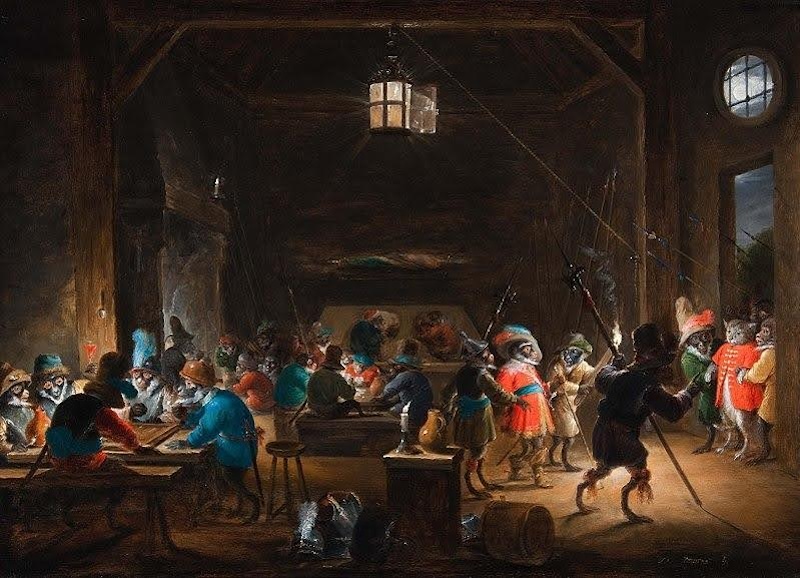
David Teniers the Younger. Guardroom with Monkeys. c.1633. Oil on panel. Wikimedia Commons.
David Teniers the Younger’s painting, Guardroom with Monkeys, picks up where van der Borcht’s engravings left off more than half a century earlier. The monkeys are fully humanized, playing what looks like backgammon at candle-lit tables, sitting in chairs, wearing brightly plumed hats and coats with sashes, drinking from jugs, and carrying weapons. A slight disruption to the evening’s festivities appears in the form of a cat, also dressed in a coat and standing erect on its hind legs, who has been arrested and taken to the guardroom for questioning. As unusual as this subject matter might seem to us now, Teniers was not eccentric. Indeed, Sebastiaen Vrancx, another Antwerp-based artist working in the 1630s, painted an elaborate battle scene depicting armed, flag-waving, and horse-riding cats and monkeys warring with one another.
Sir Anthony Van Dyck’s Queen Henrietta Maria with Sir Jeffrey Hudson
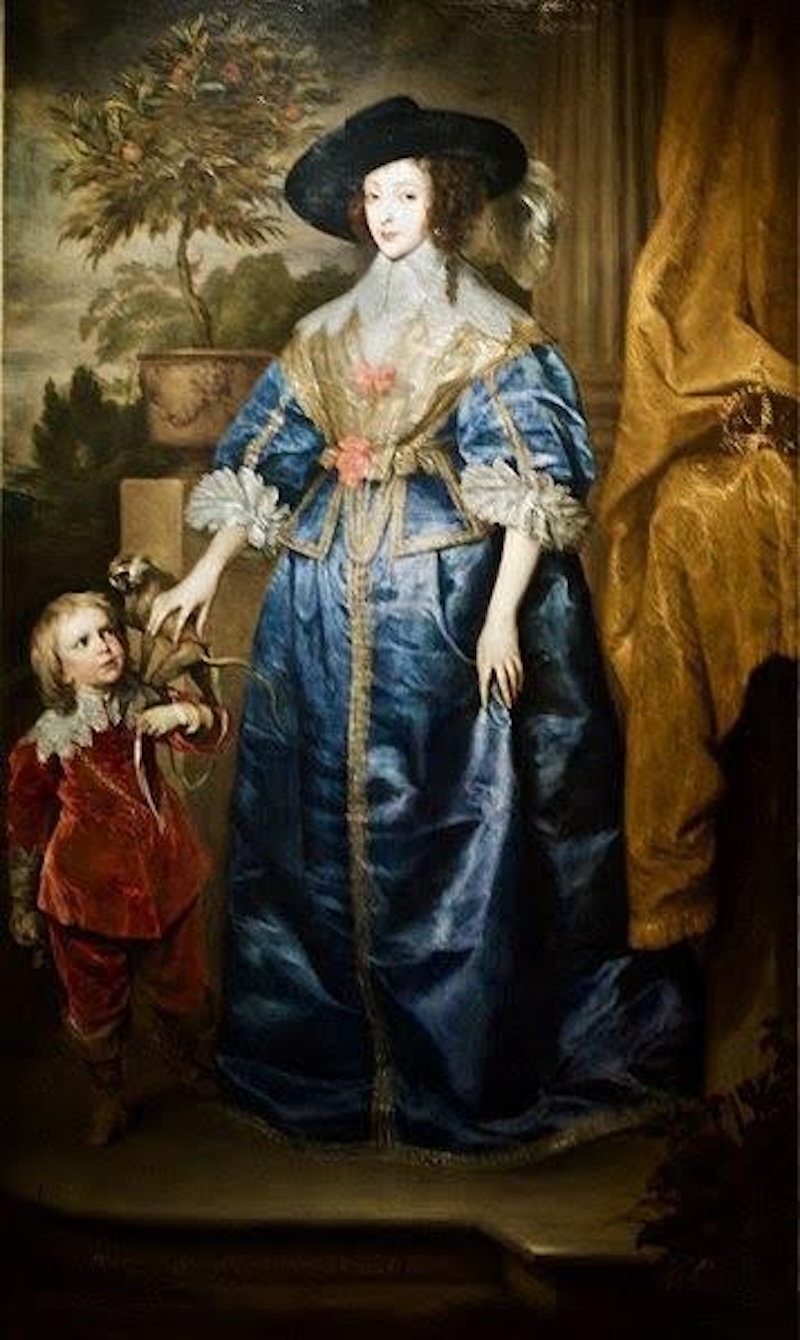
Anthony van Dyck. Queen Henrietta Maria with Sir Jeffrey Hudson. 1633. Oil on canvas. Samuel H. Kress Collection of the National Gallery of Art. Wikimedia Commons.
Queen Henrietta Maria, who reigned with King Charles I prior to his overthrow and execution, lived in exile in France, “our neighbor nation,” at the time Pulter wrote “Ambitious Apes.” While queen of England, she was known to be fond of games and pastimes. This portrait shows the queen wearing a blue silk riding dress and wide-brimmed hunting hat alongside Jeffery Hudson, her court dwarf, and Pug, her pet monkey. Monkeys, or “apes,” not being native to continental Europe or England, were living signs (or singes, the French word for “monkey”) of global commerce and conquest. Note the contrast with the previous royal portrait: whereas Catherine of Aragon’s monkey reaches for the crucifix, Queen Henrietta Maria here reaches for the monkey.
Jan Brueghel the Younger’s A Satire of Tulip Mania
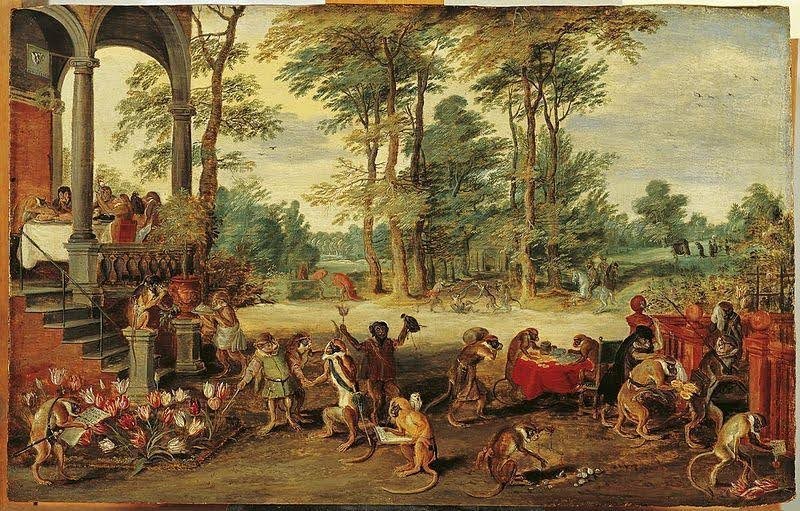
Jan Brueghel the Younger. Satire on Tulip Mania. c.1640. Oil on panel. Frans Hals Museum. Wikimedia Commons.
This painting combines monkeys with another exotic and imported life-form that doubled as a status symbol for wealthy collectors. In the 1630s, Tulip Mania swept through the Netherlands. Perhaps the earliest market bubble—and bust—resulted from greedy investors driving up the price of tulips until a single bulb cost several times more than the average annual salary. The use of monkeys, embodiments of both imitation and overreaching, underscores the mimetic desire—Rene Girard’s phrase for explaining that we often want something only because others want it—that fuels the seemingly abstract, mathematical, and rational sphere of economics.
Abraham Teniers’s Barbershop with Monkeys and Cats
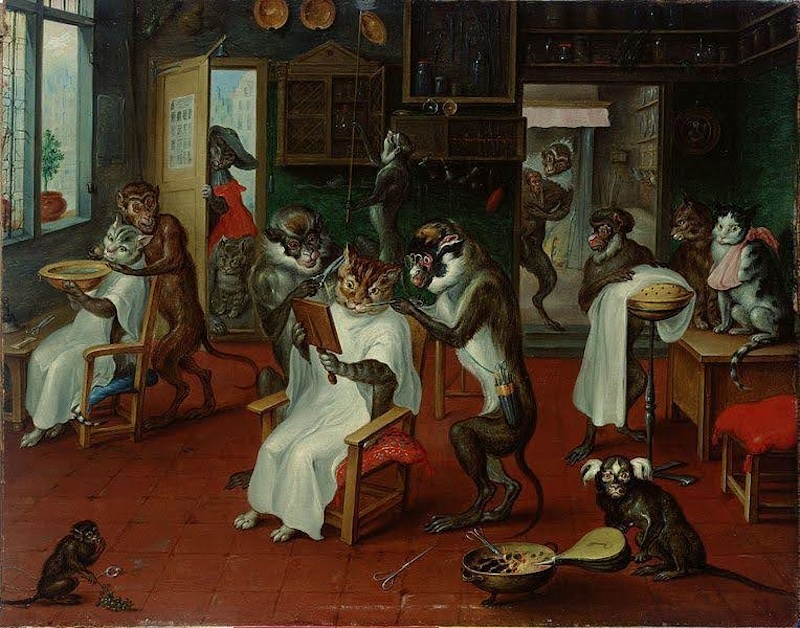
Abraham Teniers. Barbershop with Monkeys and Cats. c.1633–1667. Oil on copper. Kunsthistorisches Museum. Wikimedia Commons.
Singerie (paintings depicting monkeys acting like humans) was so popular in the seventeenth century that Abraham Teniers, younger brother of David Teniers the Younger, also produced works involving monkeys and cats. Here, cats are not the enemies but the clientele of monkeys who shave their whiskers and clip their hair at a bustling barbershop. Presumably, the use of scissors and the dangerous as well as delicate act of handling a razor call attention to the monkeys’ manual dexterity. And yet the cats’ paws prove dexterous here, too, as they can open doors, hold basins, and even adjust and angle a large mirror to monitor the progress of a haircut.
David Teniers the Younger’s Monkey Painter
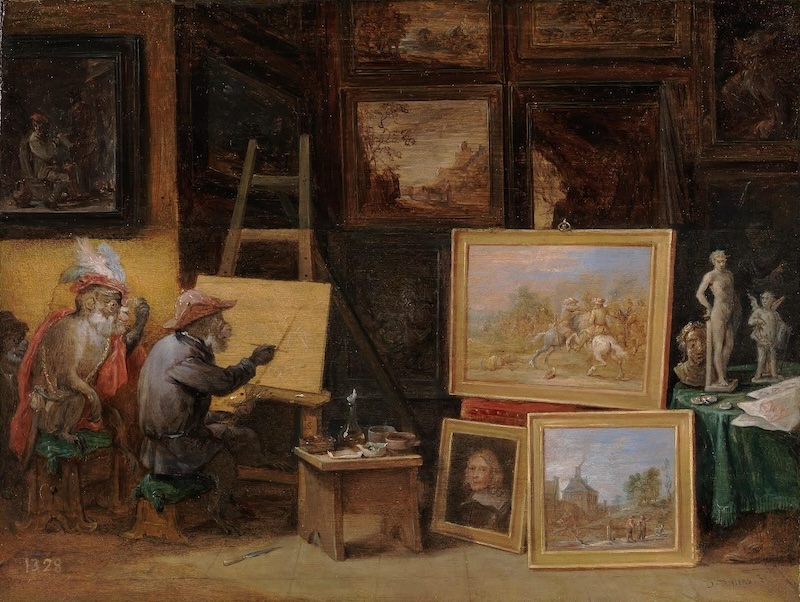
David Teniers the Younger. Monkey Painter. c.1660. Oil on panel. Museo del Prado. Wikimedia Commons.
Is this a case of sibling rivalry? Was David Teniers the Younger attempting to outdo his younger brother, Abraham? Few things are more delicate and difficult for a monkey’s paw than handling scissors and razors in a barbershop but painting a series of masterpieces is surely one of them. Is this painting, as art historians have suggested, Teniers’ way, like Titian before him (see above), of poking fun at fellow artists who merely mimic or ape the talents and techniques of their predecessors? Or is Teniers one of those seventeenth-century artists who, according to Simona Cohen, “tends not only to empathize with animals but also to identify with them”?5 It is not obvious to me that the monkey painter (or the monkey connoisseur gazing at the work in progress through spectacles) is a figure of ridicule for viewers to laugh at. Like Bruegel’s two monkeys and the caricature of Laocoön from a century earlier, Tenier’s depiction of the ape as artist retains a puzzling and enigmatic quality. But the self-referential dimension of this painting exceeds everything preceding it in this Curation. When looking at a lifelike and realistic painting of a monkey making lifelike and realistic paintings, we must wonder whether a monkey made the painting we’re looking at. If not an actual ape, then perhaps an artist who for whatever reason identifies as one. If Pulter’s poem involves, as the headnote to my Amplified Edition of “Ambitious Apes” argues, an imitation of an imitation, a poet pretending to be an ape pretending to be a poet, then Teniers’ painting may be its closest visual equivalent. Teniers made many paintings of monkeys engaged in human activities and he seems to have owned a pet monkey because the animal appears in a self-portrait of the artist with his family.
Banksy, from Devolved Parliament (2009) to Three Monkeys (2024), and Beyond
There is no reason for those of us reading Hester Pulter in the twenty-first century to limit the images that might complement, complicate, or otherwise complete her emblem poem, “Ambitious Apes,” to visual art from the sixteenth and seventeenth centuries. While it is impossible to review five centuries of “Apes & Art” here, we can at least consider one prominent living artist who has made monkeys an integral part of his oeuvre for at least the past fifteen years. That artist is England-based graffiti and street artist, Banksy. Indeed, Banksy’s Three Monkeys, painted in silhouette on the side of a London bridge in August 2024, has proven the enigmatic equal of Bruegel’s Two Monkeys, painted nearly five centuries earlier. In the words of one commentator and fan: “I don’t know what they mean, but I do know that everyone around here has been talking about them.”6 Three Monkeys is only the most recent of Banksy’s many paintings of apes and monkeys. According to Erin Argun, these images of nonhuman primates have allowed Banksy “to carry out activism and make astute political commentary” in addition to making art for decades.7 What connections and contrasts might be made when considering Banksy’s art, activism, and commentary alongside Pulter’s? What other classical or contemporary painters have turned to apes or monkeys to make their art and political statements?
Could you tell if a painting was made by an ape? In the mid-1960s, three-hundred years after David Teniers the Younger painted a monkey-turned-artist sitting at his easel, a new artist by the name of Pierre Brassau debuted his abstract paintings as part of a larger avant-garde exhibition at the Gallerie Christinae in Göteborg, Sweden. Brassau’s paintings captured the imagination of critics who praised them above the rest of the competition. But as it turns out Pierre Brassau was really a 4-year-old chimpanzee, named Peter, living in a local zoo.8
Could you tell if a poem was made by an ape? Or made to look as though it was made by an ape? Could you tell if an allusive and seemingly edifying seventeenth-century emblem poem were really a “monkey trick,” an elaborate ruse? If so, how could you tell? And how could you prove it to others? These questions arise when reading and rereading Hester Pulter’s “Ambitious Apes.”
Footnotes
1. Lee, Alexander. “A History of Monkeys.” History Today, Vol. 70, Issue 2. February 2020. [accessed 26 August 2024].
2. Bregman, Alvin. Emblemata: The Emblem Books of Andrea Alciato. Newtown: Bird & Bull Press (2007), 8.
3. For more on these two paintings, see Donna Seger’s blog post “Monarchs and Monkeys.”
4. Grovier, Kelly. “Bruegel’s Two Monkeys: One of art’s most enduring puzzles?” 5 October 2018. [accessed 28 August 2024].
5. Cohen, Simona. “Ars Simia Naturae: The Animal as Mediator and Alter Ego of the Artist in the Renaissance.” Explorations in Renaissance Culture 43 (2017), 218.
6. Warren, Jess. “Three Monkeys is Third Banksy Artwork in Three Days.” 7 August 2024. [accessed 24 September 2024].
7. Argun, Erin. “A Guide to Banksy’s Monkeys.” 18 October 2023. [accessed 24 September 2024]
8. “Pierre Brassau, Monkey Artist,” Museum of Hoaxes. [accessed January 15, 2025].