Spiders
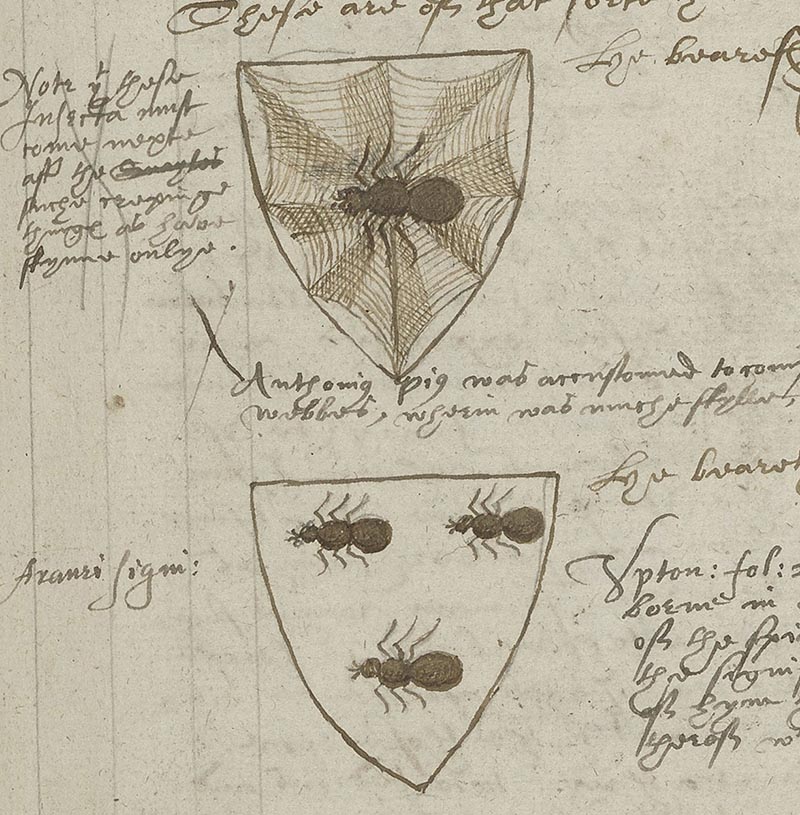
John Guillim, A Display of Heraldry [manuscript], ca. 1610. Folger Shakespeare Library.
A Display of Heraldry
[This coat of arms] bears a cobweb, in the center thereof, a spider proper. The spider is born free of the weavers’ company [or guild]; she studies not the weavers’ art, neither has she the stuff whereof she makes her thread from anywhere else than out of her own womb from whence she draws it, whereof, through the agility and nimbleness of her feet, she weaves gins [traps], and dilates, contracts, and knits them in form of a net. And with the threads that she draws out of her body, she repairs all rents and wracks of the same. Not unaptly is man’s life resembled [compared] to a spider’s web, which is wrought with much care and diligence, and is suddenly marred with the least occurrence that may befall it: for that it is protracted with much care and diligence, and suddenly ended by swallowing of a crumb, or hair, or some other lesser accident (if less may be.) In like manner, sophistical arguments are likened to spiders’ webs, for that they are framed with much artificial cunning, and yet are fit for no use but to intangle flies and weak capacities. And to like purpose doth the poet [Anarchis] compare the execution of laws to cobwebs, saying,
- Laws like spiders’ webs are wrought;
- Great flies escape and small are caught.
… By the spider, we may understand a painful [painstaking] and industrious person, occupied in some honest and necessary business; a man careful of his private estate, and of good foresight in repairing of small decays, and preventing of wracks. The spider herself is poisonful and deadly, yet is her web reckoned an antidote against poison, notwithstanding the same is extracted out of her womb. In like sort (says Aelianus) out of the poisonful contagion and infectious venom of sin and transgression, the sovereign powers do take occasion to extract and establish wholesome and profitable laws against such notorious crimes. Of the spider, Solomon writes in this manner: “The spider takes hold with her hands, and is in kings’ palaces” [Proverbs 30:28]. A very remarkable note does Farnesius [an authority on heraldry Guillim often cites] propose unto us, taken from this poor despised creature the spider, touching the procreation of children: it is a matter of great consequence of what parents a man is descended. If we desire (says he) to have a good race of horses, a litter of special good hounds for game, choice plants and stocks to plant our orchards and gardens with delectable fruits, do we not use our uttermost endeavor to affect them? How much greater should our care and providence be in the procreation of our children? The first instruction that the children receive is in the veins and bowels of their Parents, whereof we may take an example from spiders, which are no sooner hatched and excluded out of their eggs but forthwith they practice to make webs, as if they had brought with them (even out of their mother’s womb), together with their life, the artificial skill of webbing. Holy and reverent is that piety that we owe to our parents: parens enim est genitor, parens patria, parens denique est ipse Deus (For he that begot us is our parent, our country is our parent, and lastly God himself is our parent).
- The spider’s housewifery no webs doth spin,
- To make her cloth, but ropes to hang flies in.
- Her bowels are the shop where flax is found;
- Her body is the wheel that goeth round.
- A wall her distaff, where she sticks thread on;
- The fingers are the feet that pull it long
- And wheresoever she goes, ne’er idle sits,
- Nor wants a house––builds one with ropes and nets.
- Though it be not so strong as brick and stone,
- Yet strong enough to bear light bodies on.
- Within this house the female spider lies,
- The whilst the male doth hunt abroad for flies.
- Ne’er leaves, till he the flies gets in, and there
- Intangles him within his subtle snare,
- Like treacherous host, which doth much welcome make,
- Yet watches how his guest’s life he may take.