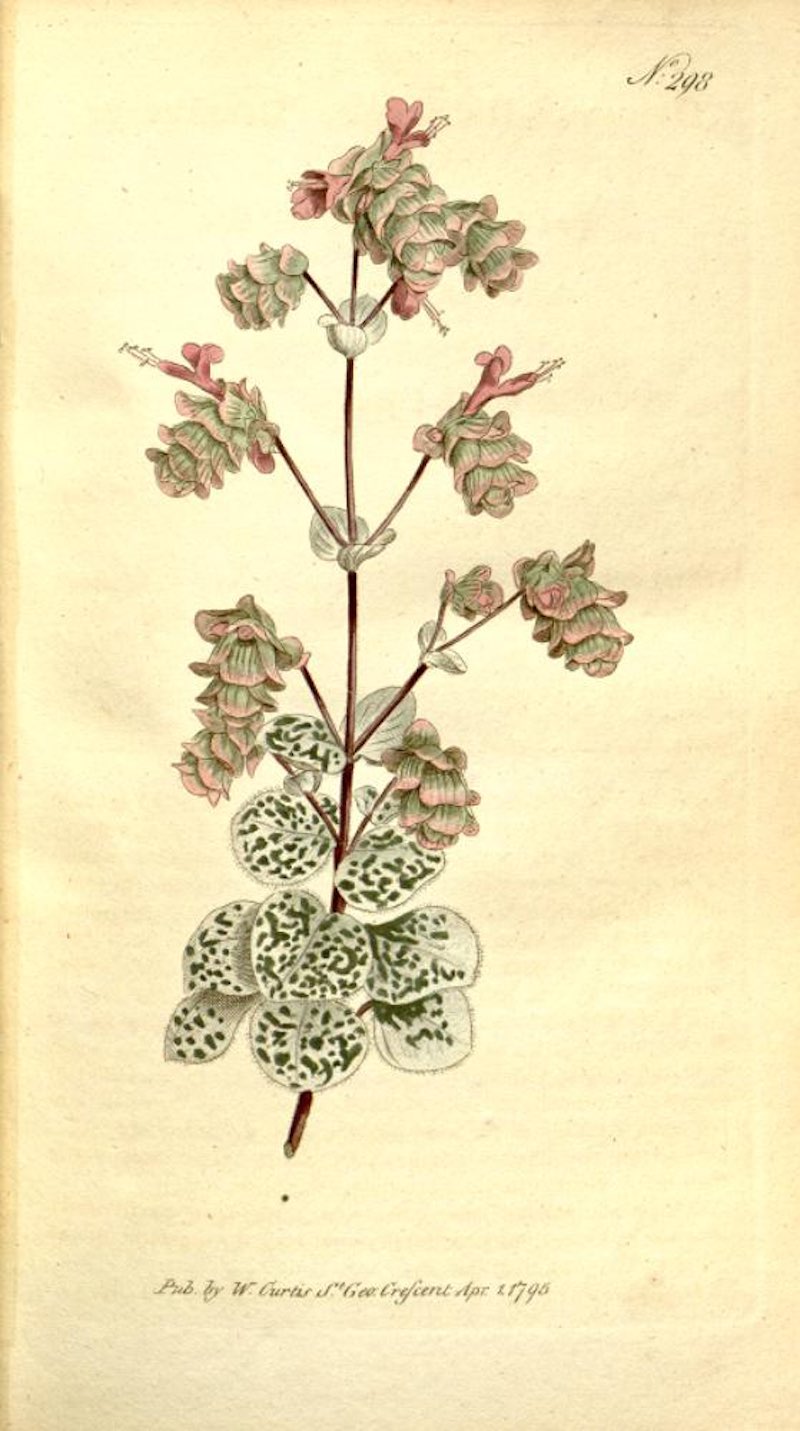
Seeking Dittany
Dittany is an aromatic shrub with tiny pink flowers, native to Greece, that has long been thought to have medicinal properties. It is described as a healing herb in texts written as long ago as ancient Rome and as recently as J. K. Rowling’s Harry Potter series. The specific trope of a wounded hart seeking dittany appears in many seventeenth-century texts.
For the harts first showed us the virtue of the herb dictamnus or dittany, to draw out arrows forth of the body. Perceiving themselves shot with a shaft, they have recourse presently to that herb, and with eating thereof, it is driven out again.
There are but few poets and rhetoricians that have not made use of the virtues of the dittany, and of the hart’s instinct in seeking it after he is wounded, by which to make some rich comparison; for we must acknowledge that it is an admirable plant in its effects, since there is attributed to it that of attracting and driving the strange bodies out of wounds, of being a great counter-poison, of hastening the difficult delivery in childbirth, and being a remedy against the insultations of the womb.
A book purporting to feature Charles I’s divine meditations uses the dittany-seeking hart as Pulter does: a metaphor for a Christian seeking spiritual comfort.
In every part of scripture, I find usefully something, but in the book of Psalms, I find a storehouse of all things. A rich storehouse of all spiritual provision: cordials for the afflicted, corrosives for the impenitent, salves for all sores, cures for all griefs, balms for all wounds, solaces for all souls, medicines for all maladies, receipts [recipes or remedies] for all infirmities. […] No wonder if the wounded hart fly to dittany, having such virtue to cure him. Seeing Psalms minister such variety of spiritual solace, no marvel if our afflicted king used them.
Rosicrucianism was a spiritual movement that combined mystical Christianity, Kabbalah, astrology, and alchemy. A work by occult philosopher John Heydon that engages with these ideas argues that humans can learn from animals’ innate (and God-given) knowledge about healing. He mentions several medicinal herbs: plantain leaves, rue, celandine, euphrasia, asplenium, and cinquefoil. The passage ends with dittany, which he claims cures all wounds.
Beasts have knowledge in the virtue of plants as well as men, for the toad being overcharged with the poison of the spider (as is well known) hath recourse to the plantain leaf. The weasel, when she is to encounter the serpent, arms herself with eating of rue. The dog, when he is sick at the stomach, knows his cure, falls to his grass, vomits, and is well. The swallows make use of celandine, the linnet [small bird, like a finch] of euphrasia for the repairing of their sight. And the ass, when he is oppressed with melancholy, eats of the herb asplenium or miltwaste and so eases himself of the swelling of the spleen. The raven makes use of cinquefoil for the prolongation of his life to sometimes six or seven hundred years. And therefore I think it is that the Rosicrucians prescribe the oil of ravens, swallows, and harts for the use of man to annoint himself, to continue his flesh and well-complexioned body from wrinkles and lameness, and dictamnum Cretense is much used, as I told you in my wise man’s crown. Cretan dittany cures wounds of what nature soever.