The Devoted Turtledove
Where might Pulter have gotten her ideas about the turtledove? Some possibilities include the Bible, books about natural history, and works of literature. The many references to turtledoves in the Bible associate the bird with peacefulness and escape in times of mourning and transition. In the Song of Solomon, verses identify “the voice of the turtle,” or the song of the turtledove, as a sign of spring:
My beloved spake, and said unto me, Rise up, my love, my fair one, and come away. For, lo, the winter is past, the rain is over and gone; The flowers appear on the earth; the time of the singing of birds is come, and the voice of the turtle is heard in our land; The fig tree putteth forth her green figs, and the vines with the tender grape give a good smell. Arise, my love, my fair one, and come away.
In Psalm 55, the fearful speaker laments being surrounded by enemies and imagines turning into a turtledove to escape:
Oh that I had wings like I dove! for then would I fly away, and be at rest. Lo, then would I wander far off, and remain in the wilderness.
Other verses use phrases such as “mourn as a dove” (Isaiah 38:14, KJV) and “harmless as doves” (Matt 10:16).
Readers in Pulter’s time could also have learned about doves from The History of the World (1634), a popular English translation of Pliny’s Natural History, by Philemon Holland:
Next after Partridges, the nature of Doves would be considered, since that they have in a manner the same qualities in that respect: howbeit, they be passing chaste, and neither male nor female change their mate, but keep together one true unto the other. They live (I say) as coupled by the bond of marriage: never play they false one by the other, but keep home still, and never visit the holes of others. They abandon not their own nests, unless they be in state of single life or widow head by the death of their fellow. The females are very meek and patient; they will endure and abide their imperious males, notwithstanding otherwhiles they be very churlish unto them, offering them wrong and hard measure; so jealous be they of the hens, and suspicious, though without any cause and occasion given: for passing chaste and continent by nature they are. Then shall ye hear the cocks grumble in the throat, quarrell and complain, and all to rate the hens: then shall ye see them peck and job at them cruelly with their beaks; and yet soon after, by way of satisfaction and to make amends again for their curst usage, they will fall to billing and kissing them lovingly, they will make court unto them and woo them kindly, they will turn round many times together by way of flattery, and as it were by prayers seek unto them for their love. As well the male as the female be careful of their young pigeons, and love them alike; nay ye shall have the cock oftentimes to rebuke, yea chastise the hen, if she keep not the nest well; or having been abroad, for coming no sooner home again to her young. And yet, kind they be to them, when they are about to build, lay, and sit. A man shall see how ready they be, to help, to comfort and minister unto them unto them in this case. So soon as the eggs be hatched, ye shall see them at the very first, spit into the mouths of the young pigeons salt brackish earth, which they have gathered in their throat, thereby to prepare their appetite to meat, and to season their stomachs against the time that they should eat. Doves and Turtles have this property, in their drinking not to hold up their bills between-whiles, and draw their necks back, but to take a large draught at once, as horses and kine do.
Turtledoves appear frequently in contemporary poetry. Compare Pulter’s turtledove to the birds in the following two poems, both of which represent the turtledove as a male lover:
- Let the bird of loudest lay
- On the sole Arabian tree
- Herald sad and trumpet be,
- To whose sound chaste wings obey.
- But thou shrieking harbinger,
- Foul precurrer of the fiend,
- Augur of the fever’s end,
- To this troop come thou not near.
- From this session interdict
- Every fowl of tyrant wing,
- Save the eagle, feather’d king;
- Keep the obsequy so strict.
- Let the priest in surplice white,
- That defunctive music can,
- Be the death-divining swan,
- Lest the requiem lack his right.
- And thou treble-dated crow,
- That thy sable gender mak’st
- With the breath thou giv’st and tak’st,
- ’Mongst our mourners shalt thou go.
- Here the anthem doth commence:
- Love and constancy is dead;
- Phoenix and the Turtle fled
- In a mutual flame from hence.
- So they lov’d, as love in twain
- Had the essence but in one;
- Two distincts, division none:
- Number there in love was slain.
- Hearts remote, yet not asunder;
- Distance and no space was seen
- ’Twixt this Turtle and his queen:
- But in them it were a wonder.
- So between them love did shine
- That the Turtle saw his right
- Flaming in the Phoenix’ sight:
- Either was the other's mine.
- Property was thus appalled
- That the self was not the same;
- Single nature’s double name
- Neither two nor one was called.
- Reason, in itself confounded,
- Saw division grow together,
- To themselves yet either neither,
- Simple were so well compounded;
- That it cried, “How true a twain
- Seemeth this concordant one!
- Love has reason, reason none,
- If what parts can so remain.”
- Whereupon it made this threne
- To the Phoenix and the Dove,
- Co-supremes and stars of love,
- As chorus to their tragic scene:
- Threnos
- Beauty, truth, and rarity,
- Grace in all simplicity,
- Here enclos’d, in cinders lie.
- Death is now the Phoenix’ nest,
- And the Turtle’s loyal breast
- To eternity doth rest,
- Leaving no posterity:
- ’Twas not their infirmity,
- It was married chastity.
- Truth may seem but cannot be;
- Beauty brag but ’tis not she;
- Truth and beauty buried be.
- To this urn let those repair
- That are either true or fair;
- For these dead birds sigh a prayer.
- Mild, gracious, modest, comely, constant, wise,
- Matchless for piety and spotless fame:
- All words want force, her merit to comprise,
- Complete in all Grace, Art, or Nature claim.
- An honor of her Sex: blest virtue’s pride,
- True beauty’s pattern, mighty nature’s wonder:
- In Her, Pandora-like, there did reside:
- All Graces others do possess asunder.
- Great Jove, resolving that this lustrous star
- Should hence unto its proper Orb ascend,
- Caused nature first to wage untimely war:
- The Parca then her thread of time to end.
- One Bird of paradise this Phoenix left,
- To consolate Her Turtle mourning mate,
- Whereof stern Death Him hastily bereft:
- To Test his faith, and show the world of fate.
- Great is His loss, yet may he not repine
- That these the death of all the world have died,
- Since they are best, more they are now divine:
- He happy that enjoyed so blest a bride.
- Fr. Smith, Cambridge
If Pulter had included images with her emblems, the text of Emblem 20 might have accompanied an illustration that looked something like the turtledove on the right in this Flemish engraving of three birds.
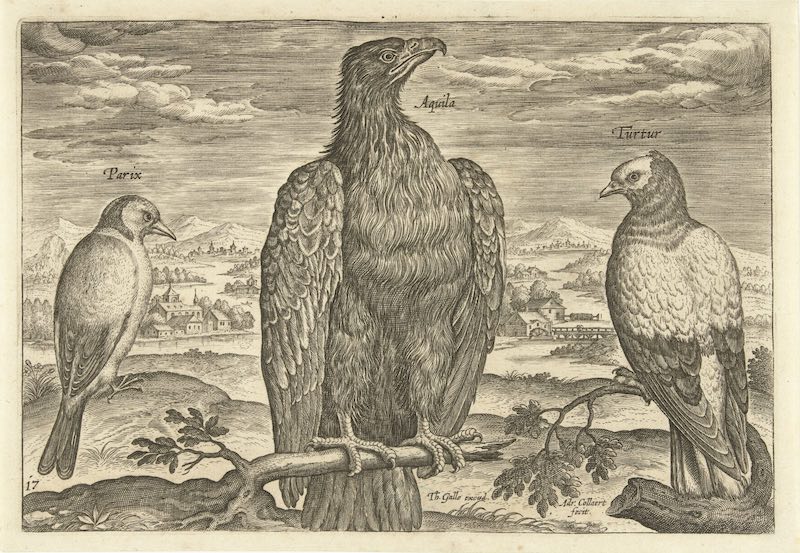
Adriaen Collaert, Drie vogels in een landschapp, 1598–1618, Rijksmuseum, Amsterdam.
