Chaste Animals?
How unusual is the elephant’s commitment to chastity? Pulter sets it in opposition to the “beastly” sexual promiscuity of humans, suggesting a division within the animal kingdom over sexual behavior.
Edward Topsell in his History of Four-Footed Beasts describes elephant chastity:
They are most chaste and keep true unto their mates without all inconstant love or separation, admitting no adulteries amongst them, and like men which taste of Venus not for any corporal lust, but for desire of heirs and successors in their families, so do elephants without all unchaste and unlawful lust, take their venereal complements, for the continuation of their kinds, and never above thrice in all their days, either male or female suffer carnal copulation (but the females only twice).
Topsell’s description of elephant restraint analogizes elephant chastity to that of married humans who engage in sexual congress only to produce (legitimate) “heirs and successors,” as if elephants, like humans, were concerned with matters of legal inheritance and primogeniture.
Part of the elephant’s reputation for sexual restraint may have come from commentaries that claimed female elephants could carry their young for ten years. Pliny mentions this lengthy gestation, but also notes that Aristotle believed it was only two years (in fact, elephants do indeed remain pregnant for a very long time, between 18 and 22 months).
Topsell also claims that elephants will even punish adultery in others:
They moreover have not only an observation of chastity among themselves, but also are revengers of whoredom and adulterers in other, as many appear by these examples in history: A certain elephant seeing his master absent, and another man in bed with his mistress, he went until the bed and slew them both. The like was done a Rome, where the elephant having slain both the adulterer and adulteress, he covered them with the bed-clothes until his keeper returned home and then by signs drew him into his lodging place, where he uncovered the adulterers and showed him his bloody tooth that took revenge upon them both for such a villainy: whereat the master wondering was the more pacified because of the manifest-committed iniquity. And not only thus deal they against the woman, but they also spare not to revenge the adultery of men; yea of their own keeper: for these was a rich man which had married a wife not very amiable or lovely, but like himself for wealth, riches, and possessions, which he having gained, first of all set his heart to love another, more fitting his lustful fancy, and being desirous to marry her, strangled his rich ill-favored wife and buried her not far from the elephant’s stable, and so married with the other and brought her home to his house: the elephant abhorring such detestable murder, brought the new married wife to the place where the other was buried; and with his teeth digged up the ground and shewed her the naked body of her predecessor, intimating thereby unto her secretly how unworthily she had married with a man, murderer of his former wife.
Most animals, however, served in the Renaissance as examples of unchecked desire. While individual animals might mate for life, most did not and were imagined to indulge in lustful congress at will. Topsell, for instance, not surprisingly singles out the goat, a creature with a terrible reputation for sexual promiscuity, as the most lustful animal:
There is no beast that is more prone and given to lust than is a goat, for he joyneth in copulatin before all other beasts. Seven days after it is weaned and kiddened [born] it beginneth and holdeth seed, although without proof. At seven months old it engendeereth to procreation […].
Topsell claims that the lioness is lustful as well, and that it might even copulate with other species like leopards. He uses the language of human morality—adultery—to describe the lioness’s actions and her mate’s judgment on her:
The lioness (as we have shewed already) committeth adultery by lying with the libbard [leopard], for which thing she is punished by her male if she wash not her self before she come at him; but when she is ready to be delivered, she flyeth to the lodgings of the libbards, and there among them hideth her young ones (which for the most part are males) for if the male lion find them he knoweth them and destroyeth them as a bastard and adulterous issue, and when she goes to give them suck she feigneth as though she went to hunting.
Animal comparisons, as Topsell’s language suggests throughout his treatise, were a two-way street, potentially undermining the supposed gulf between humans and nonhuman creatures.
Many poems about unrequited love authored by male writers use animals to express frustration or imagined erotic encounters. Philip Sidney, for example, has his speaker complain that his beloved’s dog is better treated and given more intimate access to his beloved than he is:
- Deere, why make you more of a dog then me?
- If he doe loue, I burne, I burne in loue;
- If he waite well, I neuer thence would moue;
- If he be faire, yet but a dog can be;
- Little he is, so little worth is he;
- He barks, my songs thine owne voyce oft doth proue;
- Bidden, perhaps he fetched thee a gloue,
- But I, vnbid, fetch euen my soule to thee.
- Yet, while I languish, him that bosome clips,
- That lap doth lap, nay lets, in spite of spite,
- This sowre-breath’d mate taste of those sugred lips.
- Alas, if you graunt onely such delight
- To witlesse things, then Loue, I hope (since wit
- Becomes a clog) will soone ease me of it.
Sidney also uses the horse as a means to articulate his passion for a woman:
- I on my horse, and Loue on me, doth trie
- Our horsemanships, while by strange worke I proue
- A horsman to my horse, a horse to Loue,
- And now mans wrongs in me, poor beast! descrie.
- The raines wherewith my rider doth me tie
- Are humbled thoughts, which bit of reuerence moue,
- Curb’d-in with feare, but with gilt bosse aboue
- Of hope, which makes it seem fair to the eye:
- The wand is will; thou, Fancie, saddle art,
- Girt fast by Memorie; and while I spurre
- My horse, he spurres with sharpe desire my hart.
- He sits me fast, howeuer I do sturre,
- And now hath made me to his hand so right,
- That in the manage my selfe take delight.
But Pulter’s emblem turns away from the consequences of exactly this kind of courtly eroticism, which she imagines leads to the bestialization of men and women rather than their elevation through chaste—i.e. married—love.
Natural histories, literary works, and classical lore gave the elephant only a very few equally chaste peers in the animal kingdom. Topsell’s account of bees includes specific comparison to elephant chastity:
For whereas all other creatures do couple in the open sight of men, the elephant only excepted […] yet bees were never yet seen so to join together, but either within their hives very modestly they apply themselves to that business, or else abroad do it without any witnesses.
The turtledove was associated with the kind of restraint Pulter advises, and appears elsewhere in her own canon (see This Poor Turtledove85). In Shakespeare’s The Phoenix and the Turtle, both birds represent the perfect and chaste union of souls, and with their deaths become signs of moral decay in the world:
- ….Here the anthem doth commence:
- Love and constancy is dead;
- Phoenix and the Turtle fled,
- In a mutual flame from hence.
- So they lov’d as love in twain
- Had the essence but in one;
- Two distincts, division none:
- Number there in love was slain.
- Hearts remote, yet not asunder;
- Distance and no space was seen
- ‘Twixt this Turtle and his queen:
- But in them it were a wonder.
- So between them love did shine
- That the Turtle saw his right
- Flaming in the Phoenix’ sight:
- Either was the other’s mine.
- Property was thus appalled
- That the self was not the same;
- Single nature’s double name
- Neither two nor one was called.
- Reason, in itself confounded,
- Saw division grow together,
- To themselves yet either neither,
- Simple were so well compounded;
- That it cried, “How true a twain
- Seemeth this concordant one!
- Love hath reason, reason none,
- If what parts can so remain.”
- Whereupon it made this threne
- To the Phoenix and the Dove,
- Co-supremes and stars of love,
- As chorus to their tragic scene:
- THRENOS
- Beauty, truth, and rarity,
- Grace in all simplicity,
- Here enclos’d in cinders lie.
- Death is now the Phoenix’ nest,
- And the Turtle’s loyal breast
- To eternity doth rest,
- Leaving no posterity:
- ‘Twas not their infirmity,
- It was married chastity.
- Truth may seem but cannot be;
- Beauty brag but ‘tis not she;
- Truth and beauty buried be.
- To this urn let those repair
- That are either true or fair;
- For these dead birds sigh a prayer.
The swan could also be associated with chaste love, although its reputation was mixed: the myth of Leda, raped by Zeus in the form of a swan and bore him children, was eroticized in much art and literature, linking the bird to sexual pleasure. But its white color and monogamous pair-bonding also positioned it as an image for marital chastity. Shakespeare uses Juno’s swans (Juno is the goddess of love and marriage whose chariot is pulled by swans) in As You Like It to express Celia’s affection for Rosalind: “Wheresoe’er we went, like Juno’s swans, / Still we went coupled and inseparable” (1.3.72–3). In a sixteenth-century painting illustrating one of Petrarch’s poems concerning the triumph of love over lust, two swans pull the chariot of Venus (the goddess of desire), while Cupid (representing lustful desire) sits blindfolded and restrained before her.
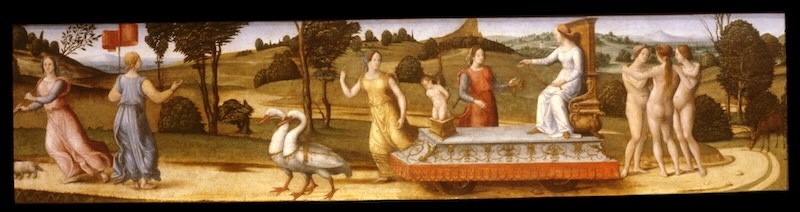
Pseudo-Granacci, The Triumph of Venus, Walters Art Museum, Baltimore.
Late in the seventeenth century, Thomas Tryon credits animals with what he sees as naturally restrained sexual lives. Writing in favor of a vegetarian diet, Tryon criticizes humans for consuming meat and celebrates animals for being driven not by artificial appetites, but by the rhythms of seasons.
Representing “The Complaint of Cows and Oxen,” Tryon speaks in the voice of a beast of burden:
We observe our times and seasons of generation … Nor are we tempted with beauty, honor, riches or any other thing to act contrary to the law of nature. That troublesome passion called love, as it is a fond, foolish excess of desire of dotage, over us has no power. Yet we love and are tender of our little ones till they can provide for themselves.
Tryon’s implicit condemnation of humans who are “tempted” into sinful excess and violate the law of nature resonates with Pulter’s condemnation at the conclusion of Emblem 19 of the drinking, gambling, shameless “wittols” who indulge in sinful activities and become less than beasts.