What about Narcissus?
Ovid’s story of Narcissus, the man who fell deeply in love with his own image, has been a popular subject in Western art and literature. Pulter frequently draws on Ovidian myth in other poems, and the well-known story of Narcissus lurks in her mirror-gazing tiger. However, Pulter’s emblem never mentions Narcissus. What might be the effect of the poem’s focus on natural and Biblical examples rather than classical ones? Below are excerpts from the Narcissus story in George Sandys’s contemporary English translation of Ovid’s Metamorphoses. It begins with Echo’s pursuit of and rejection by Narcissus and continues when Narcissus spies himself in a spring. The third and final section picks up at the moment when Narcissus understands it is his reflection and commits suicide:
- Flattering herself, out of the woods she sprung,
- And would about his struggling neck have hung.
- Thrust back, he said. Life shall this breast forsake,
- Ere thou, light nymph, on me thy pleasure take.
- On me thy pleasure take, the nymph replies
- To that disdainful boy who from her flies.
- Despised, the wood her sad retreat receives,
- Who covers her ashamed face with leaves
- And skulks in desert caves. Love still possessed
- Her soul; through grief of her repulse, increased.
- Her wretched body pines with sleepless care;
- Her skin contracts; her blood converts to air.
- Nothing was left her now but voice and bones:
- The voice remains; the other turned to stones.
- Concealed in woods, in mountains never found,
- Yet heard in all: and all is but a sound.
- Thus her, thus other nymphs, in mountains born,
- And sedgy brooks, the boy had killed with scorn.
- […]
- A spring there was, whose silver waters were
- As smooth as any mirror, nor less clear,
- Which neither herdsmen, tame, nor savage beast,
- Nor wandering fowl, nor scattered leaves molest;
- Girt round with grass, by neighboring moisture fed,
- And woods against the sun’s invasion spread.
- He, tired with heat and hunting, with the place
- And spring delighted, lies upon his face.
- Quenching his thirst, another thirst doth rise,
- Raised by the form which in that glass he spies.
- The hope of nothing doth his powers invade,
- And for a body he mistakes a shade.
- Himself, himself distracts, who pours thereon
- So fixedly, as if of Parian stone.
- Beholds his eyes, two stars! His dangling hair,
- Which with unshorn Apollo’s might compare!
- His fingers worthy Bacchus! His smooth chin!
- His ivory neck! His heavenly face! Wherein
- The linked deities their graces fix!
- Where roses with unsullied lillies mix!
- Admireth all; for which, to be admired
- And inconsiderately himself desired.
- […]
- Ah, he is I! Now, now I plainly see:
- Nor is’t my shadow that bewitcheth me.
- Love of my self me burns (O too too sure!)
- And suffer in those flames which I procure.
- Shall I be woo'd, or woo? What shall I crave?
- Since what I covet, I already have.
- Too much hath made me poor! O, you divine
- And favoring powers, me from myself disjoin!
- Of what I love, I would be dispossessed.
- This, in a lover, is a strange request!
- Now, strength through grief decays: short is the time
- I have to live, extinguished in my prime.
- Nor grieves it me to part with well-missed breath,
- For grief will find a perfect cure in death.
- Would he I love might longer life enjoy!
- Now two ill-fated lovers, in one, die.
- This said, again upon his image gazed;
- Tears on the troubled water circles raised.
- The motion much obscured the fleeting shade.
- With that, he cried (perceiving it to fade),
- O, whither wilt thou! Stay, nor cruel prove
- In leaving me, who infinitely love;
- Yet let me see what cannot be possessed,
- And, with that empty food, my fury feast.
- Complaining thus, himself he disarrays,
- And to remorseless hands his breast displays
- The blows that solid snow with crimson stripe,
- Like apples part[l]y red or grapes scarce ripe.
- But, in the water when the same appear,
- He could no longer such a sorrow bear.
- As virgin wax dissolves with fervent heat,
- Or morning frost whereon the sunbeams beat
- So thaws he with the ardor of desire;
- And by degrees consumes in unseen fire.
- His meager cheeks now lost their red and white;
- That life that favor lost, which did delight;
- Nor those divine proportions now remain,
- So much by Echo lately loved in vain,
- Which when she saw, although she angry were,
- And still in mind her late repulse did bear,
- As often as the miserable cried
- Alas! Alas, the woeful Nymph replied.
- And ever when he struck his sounding breast,
- Like sounds of mutual sufferance expressed.
- His last words were, still hanging o’er his shade:
- Ah, boy, beloved in vain! So Echo said.
- Farewell. Farewell, sighed she. Then down he lies.
- Death’s cold hand shuts his self-admiring eyes,
- Which now eternally their gazes fix
- Upon the waters of infernal Styx.
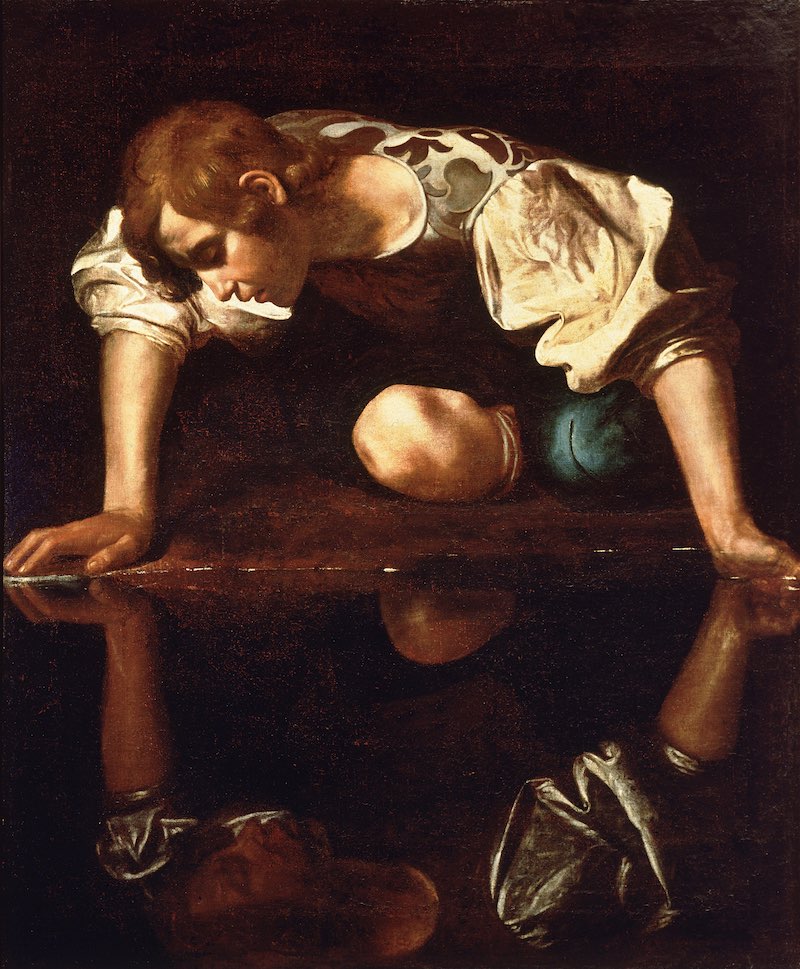
Caravaggio, Narcissus, 1594-96. Wikimedia Commons. Public Domain.
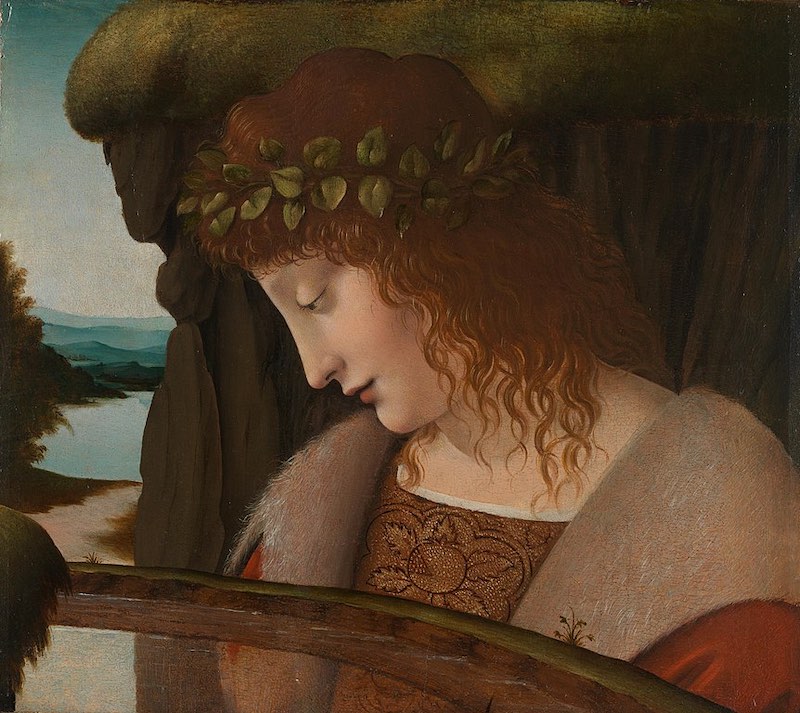
Leonardo da Vinci, Narcissus, ca. 1490. Wikimedia Commons. Public Domain.
This passage from John Milton’s Paradise Lost is in the voice of Eve, who describes to Adam her Narcissus-like experience of first gazing at her own reflection:
- That day I oft remember, when from sleep
- I first awak’d and found myself repos’d,
- Under a shade, on flow’rs, much wond’ring where
- And what I was, whence thither brought, and how.
- Not distant far from thence a murmuring sound
- Of waters issu’d from a cave, and spread
- Into a liquid plain, then stood unmov’d,
- Pure as th’ expanse of heav’n. I thither went
- With unexperienc’d thought, and laid me down
- On the green bank, to look into the clear
- Smooth lake, that to me seem’d another sky.
- As I bent down to look, just opposite
- A shape within the wat’ry gleam appear’d,
- Bending to look on me. I started back,
- It started back; but pleas’d I soon return’d
- Pleas’d it return’d as soon with answering looks
- Of sympathy and love. There I had fix’d
- Mine eyes till now, and pin’d with vain desire,
- Had not a voice thus warn’d me: ‘What thou seest
- What there thou seest, fair creature, is thyself:
- With thee it came and goes; but follow me,
- And I will bring thee where no shadow stays
- Thy coming and thy soft embraces–he
- Whose image thou art; him thou shalt enjoy
- Inseparably thine; to him shalt bear
- Multitudes like thyself, and thence be call’d
- Mother of human race.’ What could I do
- But follow straight, invisibly thus led?
- Till I espied thee, fair indeed and tall,
- Under a platan [plane tree]; yet methought less fair,
- Less winning soft, less amiably mild,
- Than that smooth wat’ry image. Back I turn’d;
- Thou, following, cried’st aloud, ‘Return, fair Eve;
- Whom fliest thou? Whom thou fliest, of him thou art,
- His flesh, his bone; to give thee being I lent
- Out of my side to thee, nearest my heart,
- Substantial life, to have thee by my side
- Henceforth an individual solace dear:
- Part of my soul I seek thee, and thee claim
- My other half.’ With that thy gentle hand
- Seiz’d mine: I yielded, and from that time see
- How beauty is excell’d by manly grace
- And wisdom, which alone is truly fair.