Early Modern Tortoises
Pulter has gendered her tortoise female. In one of the natural histories of the period, Edward Topsell’s The historie of serpents, the tortoise is typically male, with the exception of three stories below which appear together in the middle of his section on the tortoise. The third source that Topsell mentions, Alciato’s emblem of the tortoise, is described and illustrated below. The final extract in this section is from an early seventeenth-century woman reader and poet, Anne Southwell, who transcribed some of Topsell’s animals into her own manuscript. She changed the gender of tortoise in the myth told by Topsell from female to male. The effect of this change is to take away the female tortoise’s association with domesticity (since Jupiter’s punishment is that she will never be separated from her house); instead, Southwell’s male tortoise is confined to this fate.
Edward Topsell’s three stories of the tortoise as female:
The Poets giue a fabulous reasons, why the Tortoyce doth euer carry his House vppon his back, which is this: They say, that on a time Iupiter badde all liuing Creatures to a banquet or Marriage feast, and thether they all came at the time appointed, except the Tortoyce: and shee at last also appeared at the end of the feast when the mea[l]e was all spent: whereat Iupiter wondred, and asked her why shee came no sooner? The [she] answeared him, Oikos philos, oikos aristos; at which answere Iupiter being angry, adiudged her perpetually to carry her house on her back, and for this cause they fable, that the Tortoyce is neuer seperated from her house.
Flaminius the Roman diswading the Achaeans from attempting the Island of Zacynthii, vsed this Argument; and so afterward T. Liuius. [omitted Latin passage] Thus farre Pliny. That is to say, Euen as when the Tortoyce is gathered within the compasse of her shell, then is it safe and free from all stroakes, and feeleth no violence, but whensoeuer shee putteth foorth a Limbe or part, then is it naked, infirme, and easie to be harmed: So is it with you Achaeans, for by reason of the enclosed seate of Peloponnesus within the straights of the Sea, you may well wind all that together, and beeing conioyned, as well defend it: But if once your auidious and couetous mindes to gette more, appeare and stretch it selfe beyond those limits, you shall lay open your naked infirmitie and weaknesse, to all force, blowes, and violence whatsoeuer. Wherefore, the Torteyse careth not for flyes, and men with good armour care not much for light and easie aduersaries.
Alciatus hath a witty Emblem of a Torteyse to expresse a good huswife, and that the fame of her vertues, spreadeth much further then eyther beautie or riches.
- [omitted Latin poem]
- Which may be englished thus;
- Loues holy God, what meanes that vgly face?
- What doth that Torteyse signifie in deede?
- Which thou o Goddesse vnder soft foote dooest pace,
- Declare what meanes the same to me with speede?
- Such is the shape that Phidias did me frame,
- And bade me goe resemble women kind,
- To teach them silence, and in house remaine,
- Such pictures vnderneath my feete you find.
The “Alciato at Glasgow” project has digitized 22 emblem books of Alciato published between 1531 and 1621. The emblem referred to by Topsell, above, appears in 20 of the volumes. Most often the emblem is an image of Venus, either naked or clothed, with the heading in Latin, “Mulieris famam, non formam, vulgatam esse oportere.” The Glasgow project translates this as, “A woman’s reputation, not her beauty, should be known to the world.” In most editions, as in the 1615 Spanish edition from which this is copied, a poem in Latin follows, which has been translated as follows: “Kindly Venus, what form is this, what does that tortoise mean, on which, o goddess, your soft feet rest? Phidias fashioned me like this. He intended the female sex to be represented by this image of me. Girls should stay at home and keep silence, and so he put such symbols under my feet.”
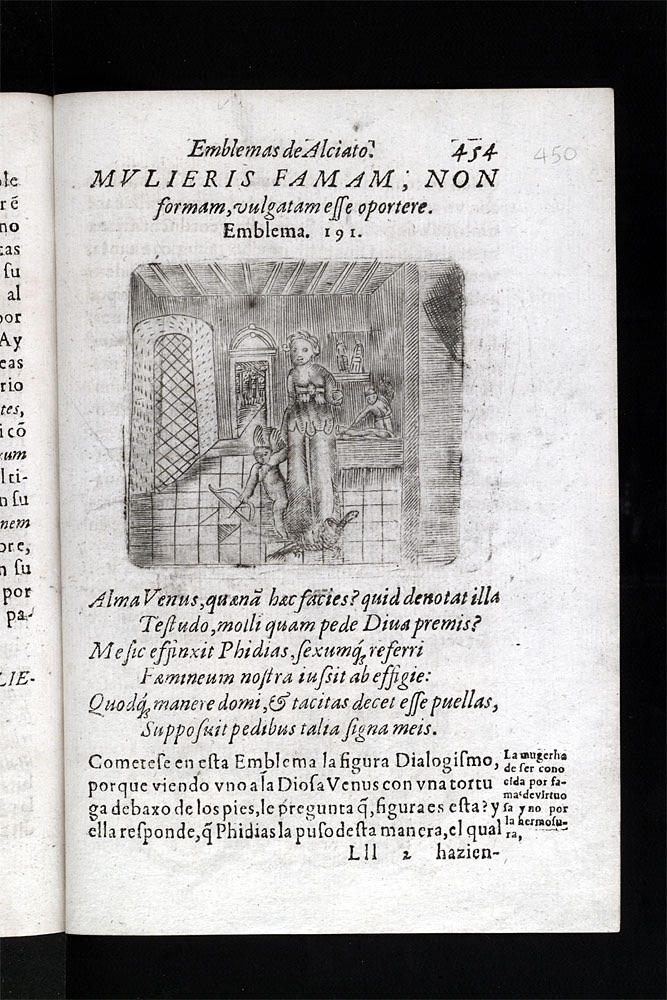
Andrea Alciato’s emblem incorporating a tortoise.
Source: Image of Venus, Cupid, and a tortoise in Andrea Alciato and Diego Lopez, Declaracion magistral sobre las Emblemas de Andres Alciato (Najera, 1615), p. 454 (sig. Lll2r). By permission of University of Glasgow Library, Special Collections.
Anne Southwell’s adaptation of Topsell’s tortoise:
- of the land Tortiss or Turtle:
This beast carieth allwayes his shell vpon his back; it is reported by the Poet that Iupiter bidding all the foure footted beasts to dinn[er] all assembled but the Tortiss at last when dinner was donn the Tortiss came in, Iupiter asking him why he stayed so long, he reply[ed] his owne house gaue him most honnor, Iupiter being angrie a’iudged him that he should still carrie his house vpon his back.