A Creature Called a Cannibal?
What kind of animal is Pulter’s cannibal? She appears to be describing a marsupial, a pouch-bearing mammal native to North America and Australia. What might she have been reading to know of these creatures? A marginal note in her manuscript alerts us to one of her sources: Simon Goulart’s published commentary on Guillaume de Salluste du Bartas’s Semaines (1621), a poem about the creation of the world. Goulart describes this creature as a rabbit-sized, chicken-eating animal. Another contemporary source to which Pulter might have had access is Edward Topsell’s 1607 bestiary, The History of Four-Footed Beasts, which features detailed descriptions and illustrations of real and mythical animals. Although it includes nothing called a “cannibal,” it describes several animals with similar features to Pulter’s creature: the “simivulpa” (or apish fox), the “chiurca” (also known as an opossum, which Topsell assumes is the same animal as a simivulpa), a “cynocephalus” (which has the head of a dog or jackal and the body of a human), and a “su” (who carries young ones on her back and destroys them with her teeth instead of letting them be captured). I have excerpted Topsell’s descriptions of the two most closely related to Pulter’s cannibal: the simivulpa and su. In Why Must I Thus Forever Be Confined57, Pulter mentions the cannibal and the su as distinct animals that share an ability to protect young ones from predators.
These are they of whom we have spoken heretofore, in whose country this beast is found, of which the poet speaketh, called Chiurca [maybe the island of Curaçao]. Gonzalo de Oviedo, in the seven and twentieth chapter of his Summary of the West Indies, sayeth that this is a beast of the bigness of a conny [a rabbit], of a tawny color, having short hair, a sharp nose, the teeth of a dog, the tail and ears like a rat, which rangeth by night upon the firm land and eateth the poultry as the wood-marten [a small mammal also known as a pine marten] doth. She carrieth her young with her: for along her belly she openeth a bag made of skin, like the head of a mariner’s cloak, where she hideth them, shutting and opening this skin as pleaseth her, and in killing chickens, she giveth them their pittance; then hearing a noise, shutteth up her little ones and saveth herself. Oviedo reporteth that he hath taken one of them which was hidden in a hen’s nest because she could not escape in time, and that he found that to be true, which is reported hereof.
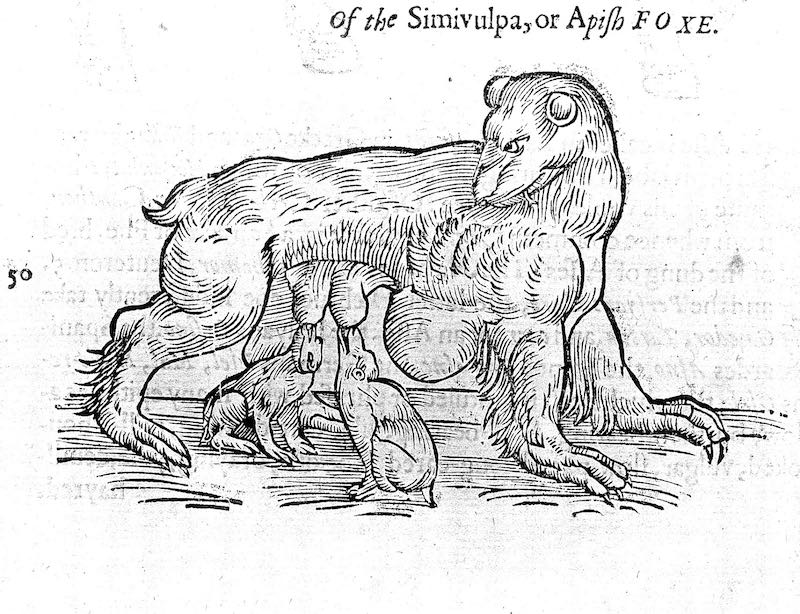
Edward Topsell, The History of Four-Footed Beasts (London, 1607), Wellcome Collection, Wikimedia Commons.
[…] in the forepart like a fox, and in the hinder part like an ape, except that it had man’s feet and ears like a bat, and underneath the common belly, there was a skin like a bag or scrip [pouch], wherein she keepeth, lodgeth, and carrieth her young ones until they are able to provide for themselves without the help of their dam. Neither do they come forth of that receptacle, except it be to suck milk or sport themselves, so that the same underbelly is her best remedy against the furious hunters and other ravening beasts, to preserve her young ones, for she is incredibly swift, running with that carriage as if she had no burden. It hath a tail like a monkey.
Of a Wild Beast in the New-Found World Called Su
[…] it is of a very deformed shape and monstrous presence, a great ravener [glutton or destroyer] and an untamable wild beast. When the hunters that desire her skin set upon her, she flyeth very swift, carrying her young ones upon her back, and covering them with her broad tail. Now for so much as no dog or man dareth to approach near unto her (because such is the wrath thereof, that in the pursuit she killeth all that cometh near her) the hunters dig several pits or great holes in the earth, which they cover with boughs, sticks, and earth, so weakly that if the beast chance at any time to come upon it, she and her young ones fall down into the pit and are taken.
This cruel, untamable, impatient, violent, ravening, and bloody beast, perceiving that her natural strength cannot deliver her from the wit and policy of men, her hunters (for being enclosed, she can never get out again) the hunters being at hand to watch her downfall and work her overthrow, first of all to save her young ones from taking and taming, she destroyeth them all with her own teeth; for there was never any of them taken alive, and when she seeth the hunters come about her, she roareth, cryeth, bawleth, brayeth, and uttereth such a fearful, noisome, and terrible clamor, that the men which watch to kill her, are not thereby a little amazed, but at last being animated, because there can be no resistance, they approach, and with their darts and spears wound her to death, and then take off her skin and leave the carcass in the earth. And this is all that I find recorded of this most savage beast.