War Memorials
A stone slab in the floor of the north aisle of St. Giles’s church in Colchester covers and commemorates the remains of the two men, buried together. Now privately owned, this building can now be rented for weddings and other functions, conjuring the picture of dancing on this grave. The slab engraves in stone the royalist interpretation of their deaths as murder.
Under this marble ly the bodies of the two most valiant captains Sr Charles Lucas and Sr George Lisle Knights who for their eminent loyalty to their soverain were on the 28th day of August 1648 by the command of Sr Thomas Fairfax, then general of the Parliament Army, in cold bloud barbarously murderd.
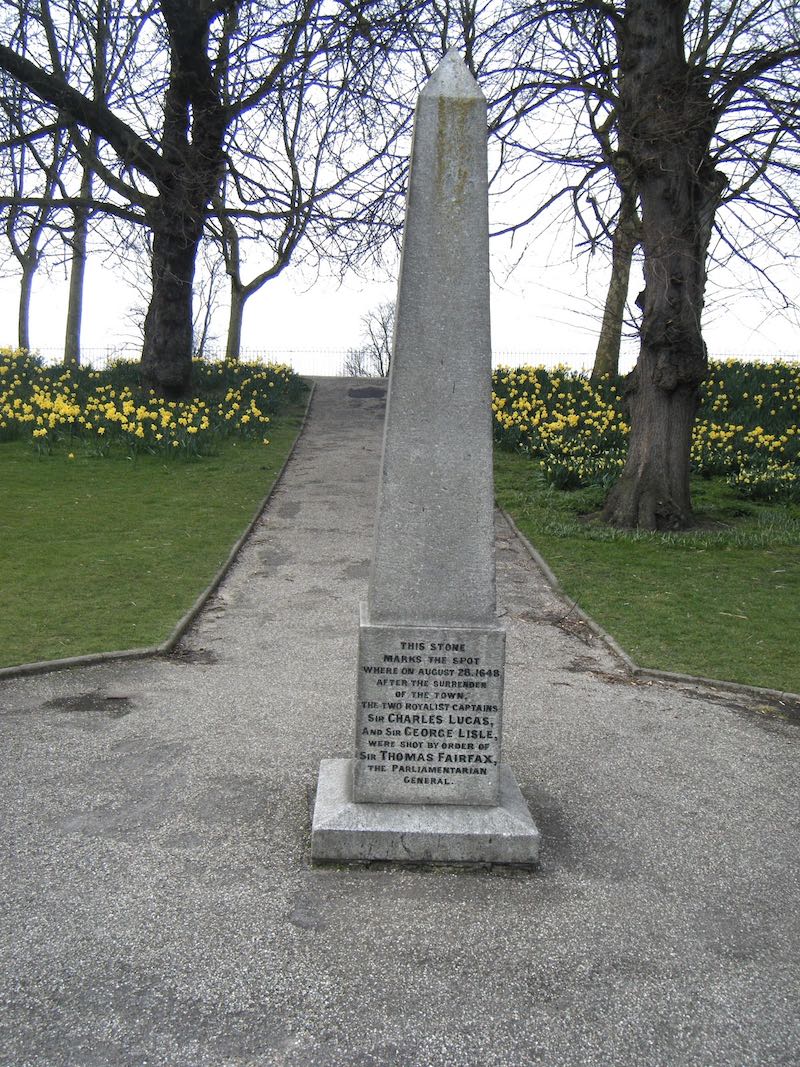
The monument to Lucas and Lisle at Colchester Castle. The inscription reads: “This stone marks the spot where on August 28.1648, after the surrender of the town, the two Royalist Captains Sir Charles Lucas and Sir George Lisle, were shot by order of Sir Thomas Fairfax, the Parliamentarian General.”
Wikiain, Wikimedia, Creative Commons Attribution-Share Alike 3.0 Unported license.
This obelisk was erected not at the time of the execution, or even shortly thereafter, but in the late nineteenth century. In an essay published in 1894, J. H. Round refers to the revival of the controversy over the execution “within the last few years,” in part because of “the erection of a memorial on the scene of the execution by a local enthusiast” (1). Round refutes the claim that Fairfax was justified in executing Lucas and Lisle, stating that the persistence of this claim “shows us how, even in these latter days, it is possible to start an historical theory which is not only absolutely without foundation, but at direct variance with all the evidence in the case, and to secure for that theory, by inventing and garbling evidence, unhesitating acceptance at the hands of one of the leading historians of the day” (J. H. Round, “The Case of Lucas and Lisle,” Transactions of the Royal Historical Society, New Series 8 [1894]: 157-80, esp. 157-58).
On continuing debates about monuments, history, and memory, see the American Historical Association Statement on Confederate Monuments:
Statement on Confederate Monuments
A monument is not history itself; a monument commemorates an aspect of history, representing a moment in the past when a public or private decision defined who would be honored in a community’s public spaces.