Manuscript Ambiguities
Pulter’s manuscript went through waves of correction and revision, and there is evidence to suggest that Pulter herself revised the manuscript after it had been copied out by another hand. The majority of Pulter’s manuscript has been written in a neat (and likely professional/scribal) roundhand, but “The Hope” (Poem 65) and a few others are written in what is likely Pulter’s own handwriting, a spiky italic hand that also has made frequent corrections to other poems in the manuscript (see the Headnotes to Poem 65, Amplified Editions B, C, and D for more detail on these two different hands). In most poems in the manuscript, the contrast between the main scribal hand and the correcting hand is quite stark (see, for instance, the edits to The Perfection of Patience and Knowledge39), but because “The Hope” was written by Pulter herself, any corrections may be harder to spot.
This Curation is about an interesting moment of ambiguity in the manuscript: a single word that looks like it may have been corrected at some point in the composition process. The ambiguity comes in part from the fact that the correction—if there is a correction—is Pulter correcting her own handwriting, which makes the change very subtle. But the edit, the transformation of one word into another, opens up the larger questions of the poem’s fundamental ambiguity (as discussed in Amplified Editions B, C, and D), and may for that reason be relevant for a reader or editor attempting to interpret whether “The Hope” hopes for resurrection or for a final death.
Lines 11–12 of “The Hope” make reference to (as the lines are usually read and transcribed) “that God that can anihillate / This all, and itt of nothinge recreate.” While Pulter does elsewhere spell the word “it” as “itt” (twice in a row in The Weeping Wish61, line 22), the word “itt” in line 12 of “The Hope” looks like it was perhaps initially written as “us,” and then corrected to “itt” with the addition of a horizontal line and a dot above the line (to transform the first minim or vertical stroke from the start of a “u” into an “i”). In the following table, the word in question is in the third row; above it are two “itt”s in Pulter’s hand, and below it are the two letters “us” (taken from the end of a longer word), also in Pulter’s hand. The word in line 12 of “The Hope,” whatever it is, is composed of three connected downstrokes; that the first two have no loop at the top and no curve, while the third has both a small loop at the top and a curve to the left at the bottom, makes the word in question look more like “us” than like “itt”. A comparison of other moments in her handwriting shows that her minuscule “t”s are usually straight rather than curved, and her minuscule, final “s”s usually have a loop at the top.
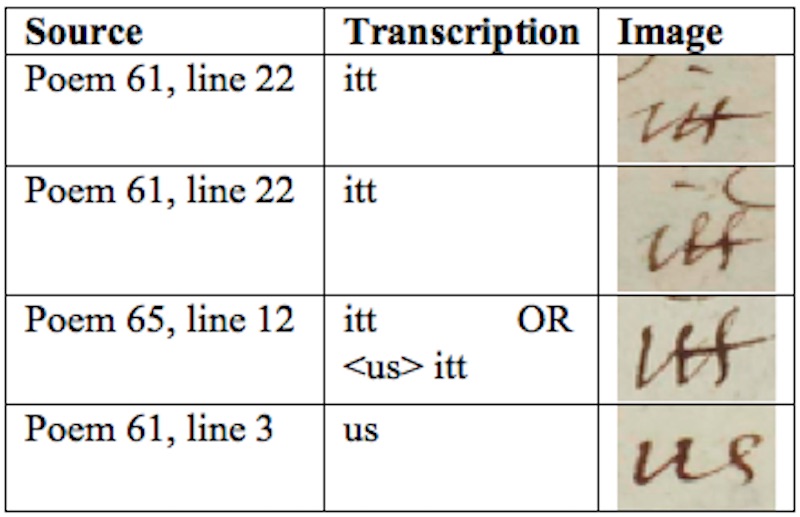
It is, ultimately, impossible to establish absolutely whether this word started its life as “us” and then was altered to “itt,” or whether it is simply an “itt” that happens to look a bit like an “us” with a line through the last two graphs. But if it were an “us” that was altered to become an “itt,” then it further illustrates how this poem shows her thinking and rethinking resurrection. If we see this word as an altered “us,” then she initially wrote that “God [. . .] can anihillate / This all, and us of nothinge recreate”—that God could annihilate everything but then recreate us humans following that annihilation—and then modifies it in a way that both magnifies God’s power (he can recreate it all, not just us humans), and depersonalizes or departicularizes God’s potential recreation of the world (even as God has the power to recreate it, the universe, he will not necessarily, in the process, also re-create or resurrect us, specific humans). Even at the level of how individual words are formed, then, the poem is shot through with ambiguity, making it difficult for an editor to decide with complete confidence what reading, and therefore what punctuation, to favor.
The explanatory notes on line 12 of Amplified Edition C and Amplified Edition D also explore the consequences of the ambiguity of this manuscript word.