Who’s Fair? Race and Praise of the Beloved
These two poems draw our attention to the racialized implications of Pulter’s key word in Poem 59: “fair.” In the “Song of Songs” from the Old Testament, one of the oldest and most influential blazons of a beloved’s attributes, the word “fair” seems to mean simply “beautiful.” In the lines excerpted here, a male lover praises the fairness of his beloved. In the first chapter of the “Song of Songs,” she refers to herself as “black, but comely”; she also praises her lover as “fair.” In the Old Testament, then, and the seventeenth-century English translation of it (the King James Version), fairness can correspond to blackness and can be used in praise of men or women. But, beginning in the mid-sixteenth century in English, fair emerges as a word for a light complexion, thus tying whiteness and beauty “just at the moment of intensified English interest in colonial travel and African trade;” increasingly, it is also applied only to women. As a consequence, English women’s “fairness” was set off by contrasting it to “blackness,” both through figurations and in portraits that paired white sitters with their black servants and slaves (Kim F. Hall, Things of Darkness: Economies of Race and Gender in Early Modern England [Cornell University Press, 1995], p. 3). Thus we find an emphasis on the white skin of the female beloved in Pulter’s various blazons and in Edward Phillips’ poem below, which returns repeatedly to his mistress’s white skin and refers disparagingly to “savages” and “Indians” by contrast.
- Behold, thou art fair, my love; behold, thou art fair; thou hast doves’ eyes within thy locks: thy hair is as a flock of goats, that appear from mount Gilead.
- Thy teeth are like a flock of sheep that are even shorn, which came up from the washing; whereof every one bear twins, and none is barren among them.
- Thy lips are like a thread of scarlet, and thy speech is comely: thy temples are like a piece of a pomegranate within thy locks.
- Thy neck is like the tower of David builded for an armory, whereon there hang a thousand bucklers, all shields of mighty men.
- Thy two breasts are like two young roes that are twins, which feed among the lilies.
- Until the day break, and the shadows flee away, I will get me to the mountain of myrrh, and to the hill of frankincense.
- Thou art all fair, my love; there is no spot in thee.
- Come with me from Lebanon, my spouse, with me from Lebanon: look from the top of Amana, from the top of Shenir and Hermon, from the lions' dens, from the mountains of the leopards.
- Thou hast ravished my heart, my sister, my spouse; thou hast ravished my heart with one of thine eyes, with one chain of thy neck.
- How fair is thy love, my sister, my spouse! how much better is thy love than wine! and the smell of thine ointments than all spices!
- Thy lips, O my spouse, drop as the honeycomb: honey and milk are under thy tongue; and the smell of thy garments is like the smell of Lebanon.
- A garden enclosed is my sister, my spouse; a spring shut up, a fountain sealed.
- Thy plants are an orchard of pomegranates, with pleasant fruits; camphire, with spikenard,
- Spikenard and saffron; calamus and cinnamon, with all trees of frankincense; myrrh and aloes, with all the chief spices:
- A fountain of gardens, a well of living waters, and streams from Lebanon.
- Awake, O north wind; and come, thou south; blow upon my garden, that the spices thereof may flow out. Let my beloved come into his garden, and eat his pleasant fruits.
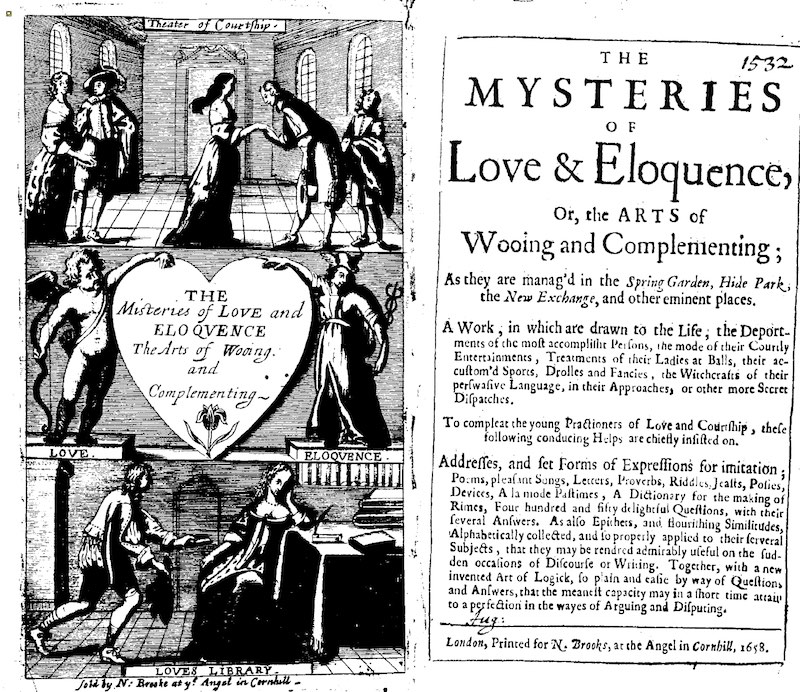
Title page, The Mysteries of Love & Eloquence.
"On the Perfections of his Mistress"
- Her looks are streams of liquid amber,
- Curtains fit for beauty’s chamber,
- Of which slender golden sleeve,
- Love his wanton nets did weave.
- Her forehead, that is beauty’s sphere.
- A thousand graces moving there.
- Venus triumpheth on her brow,
- That comely arch of silver snow.
- The savages that worship the sunrise,
- Would hate their god, if they beheld her eyes;
- All heavenly beauties join themselves in one,
- To show their glory in her eye alone,
- Which when it turneth its celestial ball,
- A thousand sweet stars rise, a thousand fall.
- Her nose is beauty’s splendid port,
- Where Zephyrus* delights to sport.
Greek god of the west wind
- Her breath is such, whose native smell
- All Indian odors doth excel.
- If all the pleasures were distilled
- Of every flower in every field,
- And all that Hybla’s* hives do yield,
Sicilian town famous for honey
- Were into one broad mazer* filled;
goblet, head, amazing person
- If thereto added all the gums
- And spice that from Panchaia* comes;
in Persia
- The odors that Hydaspes* lends,
in India
- And Phoenix proves before she ends;
- If all the air that Flora* drew,
Roman goddess of flowers and spring
- Or spirit that Zephyrus ever blew
- Were put therein, and all the dew
- That ever rosy morning knew;
- Yet all diffused could not compare
- With her breath—delicious air!
- The melting rubies on her lip,
- Are of such power to hold, as on one day
- Cupid flew thirsty by, and stooped to sip,
- And fasten[ed] there, could never get away.
- Have you seen carnation grow,
- Fresh blushing through new flakes of snow?
- Have you seen with more delight,
- A red rose growing through a white?
- Have you seen the pretty gleam
- That the strawberry leaves in cream?
- Or morning blushes when day breaks?
- Such is the tincture of her cheeks.
- Her silver neck is whiter far
- Than towers of polished ivory are;
- And now behold her double breast,
- Of Venus’s Babe* the wanton nest,
Cupid
- Like pommels* round of marble clear,
knobs
- Where azure veins well-mixed appear;
- With dearest top of porphyry,
- Betwixt which two a way doth lie—
- A way more worthy beauty’s fame
- Than that which bears the Milky name,*
the Milky way
- That leads unto the joyous field,
- Which doth unspotted lilies yield;
- But lilies such, whose native smell,
- All Indian odors doth excel.
- Her hands would make a Tiger meek,
- So soft, so delicate, and sleek,
- That we from hence might justly prove,
- Nature wore lilies for a glove.
- Where whiteness doth forever sit,
- Nature herself enameled it,
- Wherewith a strange compact doth lie,
- Warm snow, moist pearl, soft ivory.
- There fall those sapphire-colored brooks,
- Which conduit-like with curious crooks,
- Sweet islands make in that sweet land;
- As for the fingers of that hand,
- (The bloody shafts of Cupid’s war)
- With amethyst they headed are.