Dolphins as Friends to Man or “Philanthropos”
Pulter’s reference to the dolphin as “philanthropos” participates in a long tradition of depicting the dolphin, in visual art, natural history, mythology, and literature, as particularly devoted to humans, especially young men, carrying, rescuing, and assisting them.
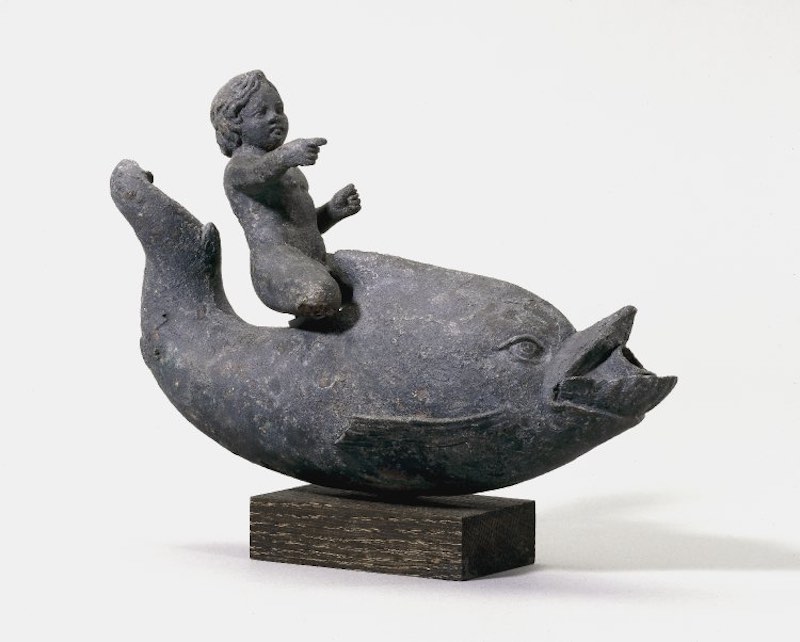
Bronze lamp in the form of Eros riding a dolphin (1st-2nd c.), excavated from a tomb in Smyrna.
British Museum number 1756,0101.3821756,0101.382 ⓒ Trustees of the British Museum.
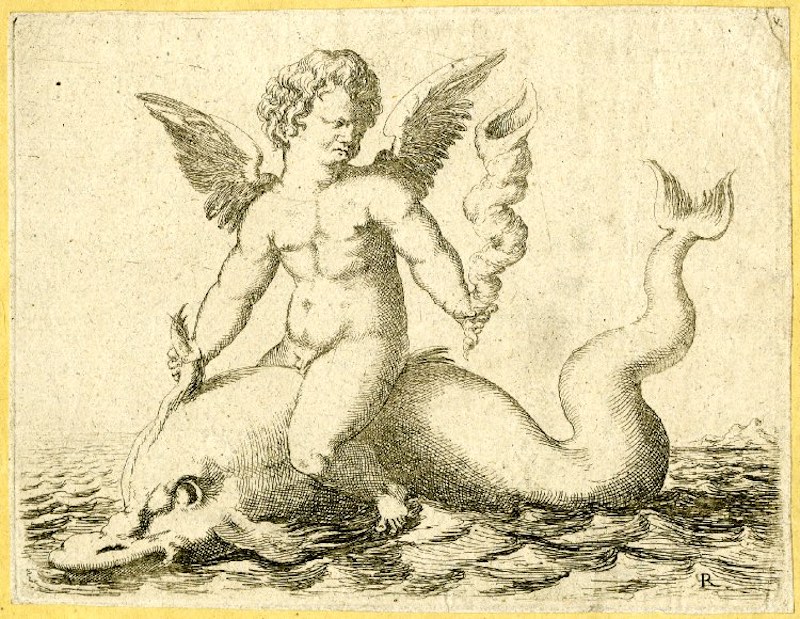
A naked winged cupid riding a dolphin, Italian (c. 1510-1550).
British Museum number 1867, 0309.653 ⓒ Trustees of the British Museum.
Probable it is, therefore, that the god Apollo carried an affection to this dolphin, for that it loves music so well: whereupon the poet Pindar, comparing himself unto the dolphin, says that he was provoked and stirred up to music by the leaping and dancing of this fish, … or rather we are to think that the god [Apollo] is well affected unto him, because he is so kind and loving unto man: for the only creature it is, that loveth man for his own sake, and in regard that he is a man. Whereas of land-beasts, some you shall have that love none at all; others, and those that be of the tamest kind, make much of those only of whom they have some use and benefit-namely, such as feed them or converse with them familiarly, as the dog, the horse, and the elephant. And as for swallows, received though they be into our houses, where they have entertainment and whatsoever they need, to wit, shade, harbor and a necessary retreat for their safety, yet they be afraid of man, and shun him as if he were some savage beast. Whereas the dolphin alone of all other creatures in the world, by a certain instinct of nature, carries that sincere affection unto man, which is so much sought for and desired by our best philosophers, even without any respect at all of commodity. For having no need at all of man’s help, yet is he nevertheless friendly and courteous unto all, and has succored many in their distress, as the story of Arion will testify, which is so famous, as no man is ignorant thereof. …
About the city Nemium, the dolphins meeting with the dead corpse of a man floating up and down upon the sea, took it up and laid it on their backs, shifting it from one to another by turns, as any of them were weary with the carriage, and very willingly, yea, and as it should seem, with great affection, they conveyed it as far as to the port Rhium, where they laid it down upon the shore, and so made it known that there was a man murdered. Myrtilus the Lesbian writes, that Aenalus the Acolian, being fallen in fancy with a daughter of Phineus, who according to the oracle of Amphitrite, was by the daughters of Pentheus cast down headlong into the sea, threw himself after her. But there was a dolphin [who] took him up and brought him safe unto the isle Lesbos. Over and besides, the affection and good will which a dolphin bore unto a young lad of the city Iasos, was so hot and vehement, in the highest degree, that if ever one creature was in love with another, it was he, for there was not a day went over his head, but he would disport, play and swim with him, yea, and suffer himself to be handled and tickled by him upon his bare skin. And if the boy were disposed to mount aloft upon his back, he would not refuse, nor seem to avoid him. Nay, he was very well content with such a carriage, turning what way soever he reined him, or seemed to incline. And thus would he do in the presence of the Iasians, who oftentimes would all run forth to the seaside on purpose to behold this sight. Well, on a day above the rest, when this lad was upon the dolphin’s back, there fell an exceeding great shower of rain, together with a monstrous storm of hail, by reason whereof the poor boy fell into the sea, and there died. But the dolphin took up his body, dead as it was, and together with it shut himself upon the land. Neither would he depart from the corpse so long as there was any life in him, and so died, judging it great reason to take part with him of his death, who seemed partly to be the cause thereof. In remembrance of which memorable accident, the Iasians represent the history thereof stamped and printed upon their coin, to wit, a boy riding upon a dolphin; which story has caused that the fable or tale that goes of Caeranus is believed for a truth.
For this Caeranus, as they say, born in Paros, chanced to be upon a time at Byzantium, where seeing a great draught of dolphins taken up in a casting-net by the fishers, whom they meant to kill and cut into pieces, bought them all alive, and let them go again into the sea. Not long after, it happened that he sailed homeward in a foist [a light galley ship] of fifty oars, which had aboard (by report) a number of pirates and rovers. But in the straits between Naxos and Paros the vessel was cast away, and swallowed up in a gust, in which shipwreck, when all the rest perished, he only was saved, by means, as they say, of a dolphin, which, coming under his body as he was newly plunged into the sea, bore him up, took him upon his back, and carried him as far as to a certain cave about Zacynthus, and there landed him; which place is shown for a monument at this day, and after his name, is called Caeranium …
Afterwards the said Caeranus himself died. And when his kinsfolk and friends burned his corps near to the seaside in a funeral fire, many dolphins were discovered along the coast hard by the shore, showing (as it were) themselves how they were come to honor his obsequies. For depart they would not before the whole solemnity of this last duty was performed.
That the scutcheon or shield of Ulysses had for the badge or ensign a dolphin, Stesichorus has testified, but the occasion and cause thereof, the Zacynthians report in this manner, as Criteus the historian bears witness. Telemachus his son, being yet an infant, chanced to slip with his feet, as men say, to fall into a place of the sea, where it was very deep. But by the means of certain dolphins who took him as he fell, saved he was and carried out of the water. Whereupon his father, in a thankful regard and honor to this creature, engraved within the collet of his signet [along the edge of his seal], wherewith he sealed, the portrait of a dolphin, and likewise carried it as his arms upon his shield. But forasmuch as I protested in the beginning that I would relate to you no fables, and yet (I know not how) in speaking of dolphins, I am carried farther than I was aware, and fallen upon Ulysses and Caeranus, somewhat beyond the bounds of likelihood and probability. I will set a fine upon mine owne head, and even here for amends lay a straw and make an end.