Good and Bad Animal Parents
Pulter was evidently interested in natural historians’ depictions of parents in the animal world. According to Simon Goulart, the male bird of paradise (or manucode) had a hollow back in which the female bird placed her eggs. He also used a thread in his tail to fasten the female protectively to him. John Swan discusses the consequences of the cruelty of ravens towards their offspring: when the elderly parents can no longer fend for themselves, sometimes their young attack them. The cuckoo deposits its egg in another bird’s nest, according to Pliny, leading to a dreadful fate for that foster parent, who nurtures it at the expense of its own children. The cuckoo then eats its foster siblings and mother. Swan tells another version of this same story about the cuckoo’s ability to beguile, leading to terrible consequences for the deceived foster parent, and adds another link of the bird with the cuckold, the adulterous man who seduces other men’s wives. Topsell describes the animal called the su, who carries its offspring on its back, but he includes a detail about its savagery and its maternal devotion: if hunters trap her and her children she will kill them rather than allow them to be taken and tamed. The rabbit-sized canibal, according to Goulart, carries and protects its offspring in its pouch.
There is found (saith Cardan) in the Moluques, both vpon the Sea, and on the Land, a dead bird, which the Ilanders call Manucodiata, and neuer was he seene liuing, because he hath no feete. I haue seene such a dead bird three times, and I suppose that the cause why he hath no feete, is for that he liueth very high in the ayre, and far seuered from the sight of men. He hath a body and beake almost like a Swallow: his wings, and taile containe more widenesse then those of the Hawke, and almost equall those of the Eagle. His plumes are very soft, and very much resemble the feathers of a Pea-Hen. The backe of the Male Manucodiata is hollow, and within the same, the female, which hath a hollow belly, hatcheth and layeth her Egges, which by this meanes are kept as it were in a Box. The Male hath in his tayle a long thred, more then three hands breadth in length, blacke; neither square, nor round, nor thicke: but small, and resembling a Coblers grosse thred: which seemeth to serue to tye and ioyne the Male with the female when she sitteth, to the end to defend her from the winde and other accidents. So likewise it seemeth to serue them for a grapple, or counterpoize, according to the changes of the aire. It is not to be wondred at, that this bird remaineth alwaies in the aire: for his tayle and wings are spred so properly in a round, that this maketh an equall counterpoize, which sustaineth the bird perpetually. I suppose that hee liueth on no other thing but on dew.
And again, she is noted for an unkinde bird to her young ones, expelling them out of their nest before their full and compleat time, leaving them to their selves before they are able to shift; and so crying for food, God by his providence provideth for them: whereupon it is said, that the young ravens crie unto God: or, which feedeth the young ravens that call upon him, Psal. 147.9. And in this act, these and the like birds are emblemes of such as want naturall affection. And indeed the young ones afterwards prove as cruell to their dammes: for when they be old, and have their bills overgrown, they die of famine, not sharpning their bills again, by beating them on a stone, as the eagle doth: neither will their young ones help them, but rather sometimes set upon them, when they are not able to resist. It is not good therefore to use children too harshly in their minoritie, lest when Senes [i.e., old people] come to Pueri [i.e., children] again, they finde as little favour at their hands as they shewed before. And of this, parents, masters, tutours, and guardians should be carefull; learning their lesson from these unnaturall birds.
These lay alwaies in other birds neasts, and most of all in the Stockdoues, commonly one egge and no more (which no other bird doth besides) and seldom twain. The reason why they would haue other birds to sit vpon their eggs and hatch them, is because they know how all birds hate them: for euen the very little birds are readie to war with them: for feare therefore that the whole race of them should be vtterly be destroied by the furie of others of the same kind, they make no nest of their owne (being otherwise timorous and fearefull naturally of themselues) and so are forced by this craftie shift to auoid the danger. The Titling therefore that sitteth, being thus deceiued, hatcheth the egge & bringeth vp the chick of another bird. And this yong Cuckow being greedy by kind, beguiling the other yong birds and intercepting the meat from them, groweth hereby fat and faire-liking: whereby it comes into speciall grace and fauour with the dam of the rest, and nource to it. She joieth to see so goodly a bird toward: and wonders at her selfe that she hath hatched & reared so trim a chick. The rest, which are her owne indeed, she sets no store by, as if they werr changelings: but in regard of that one, counteth them all bastards and misbegotten: yea, and suffereth them to be eaten and deuoured of the other euen before her face: and this she doth so long, vntill the yong cuckow being once fledge & readie to flie abroad, is so bold as to seize on the old Titling, and to eat her vp that hatched her. And by that time there is not another bird againe for goodnesse and sweetnesse of meat, comparable to the yong Cuckow.
Neither is she very fruitfull; for one at a time is enough for her: neither is this one hatched but by some other of a differing kinde; for she doth not build any nest, but layeth her egge in the nest of another, which hatcheth it up as her own. Nay it so falleth out, that the poore, sillie, and deceived bird thus beguiled, neglects her nearer brood, as being better pleased with the beautie of the Cuckoes young, untill at the last this stranger thus brought forth and being ready to fly, destroy his nurse, and kill her for her kindenesse. So have I heard of some, no better rewarded for their good entertainment and watchfull care. For benefits received are little remembred: and where men sometimes look for love, they are wickedly repayed with hate and harm.
Also there appeares from hence another embleme. For in the Cuckoe is deciphered the wicked practise of adulterous men, who are not ashamed filthily to defile their neighbours bed: From whence we call them cuckolds, who suffer this wrong and yet are innocent; whereas indeed the lustfull Goat that acteth all, and performs the villanie, is the very cuckold; and the other (poore honest man) wronged not onely in his bed, but in his name, is the harmlesse patient of what he cannot help.
OF A WILDE BEAST IN THE new-found world called Su.
THere is a region in the new-found world, called Gigantes, and the inhabitants thereof are called Pantagones; now becaus their countrey is cold, being far in the South, they cloath themselues with the skins of a beast called in theyr owne toong Su, for by reason that this beast liueth for the most part neere the waters, therefore they cal it by the name of Su which signifieth water. The true image therof as it was taken by Theuetus, I haue heere inserted, for it is of a very deformed shape, and monstrous presence, a great rauener and an vntamable wilde beast When the hunters that desire her skinne set vpon her, she flyeth very swift, carrying her yong ones vpon her back, and couering them with her broad taile: now forsomuch as no Dogge or man dareth to approach neere vnto her, (because such is the wrath therof, that in the pursuit she killeth all that commeth neare hir) the hunters digge seuerall pittes or great holes in the earth, which they couer with boughes sticks, and earth, so weakly[?] that if the beast chance at any time to come vpon it, she and her young ones fall down into the pit and are taken.
This cruell, vntamable, impatient, violent, rauening, and bloody beast, perceiuing that her naturall strength cannot deliuer her from the wit and policy of men her hunters, (for being inclosed, shee can neuer get out againe,) the hunters being at hande to watch her downfall, and worke her ouerthrow, first of all to saue her young ones from taking & taming, she destroyeth them all with her owne teeth; for there was neuer any of them taken aliue, and when she seeth the hunters come about her, she roareth, cryeth, bowleth, brayeth, and vttereth such a fearefull, noysome, and terrible clamor, that the men which watch to kill her, are not thereby a little amazed, but at last being animated, because there can be no resistance, they approch, and with their darts and speares wound her to death, and then take off her skin, and leaue the carcasse in the earth. And this is all that I finde recorded of this most sauage beast.
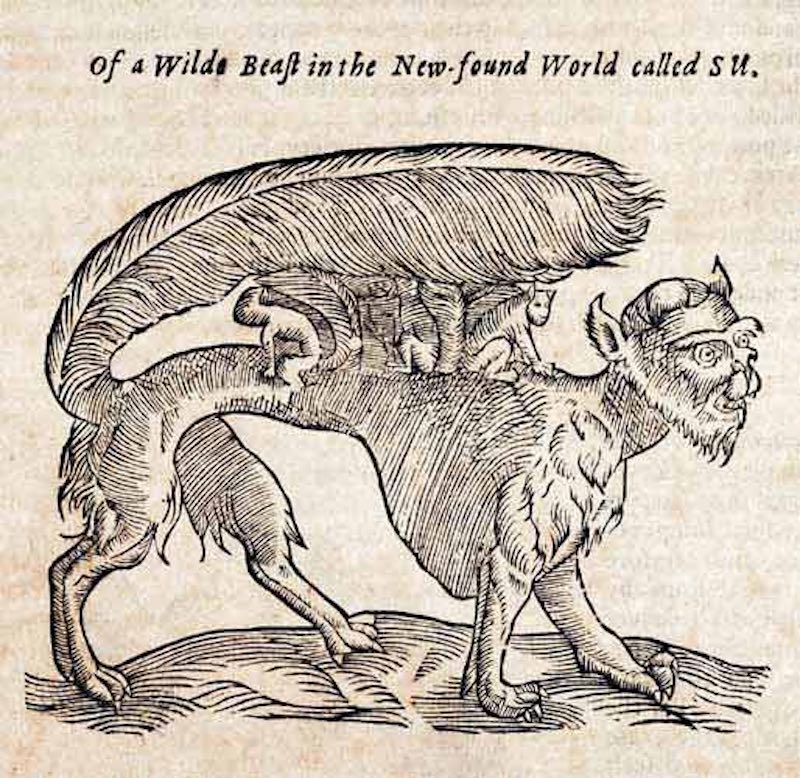
Image of the su from Edward Topsell, The historie of foure-footed beastes (London, 1607), p. 660, University of Houston Libraries.
These are they of whom we haue spoken heretofore, in whose Country this beast is found, of which the Poet speaketh, called Chiurca [possibly the island of Curaçao]. Gonzala d’Ouiede in the seuen and twentieth Chapter of his Summary of the West Indies, saith, that this is a beast of the bignesse of a Conny [i.e., a rabbit], of a tawny colour, hauing short haire, a sharpe nose, the teeth of a Dogge, the tayle and eares like a Rat, which rangeth by night vpon the firme land, and eateth the Poultry as the Wood-Martin doth. She carrieth her yong with her: for along her belly she openeth a bagge made of skinne, like the head of a Mariners Cloake, where shee hideth them, shutting and opening this skinne as pleaseth her, and in killing Chickens, shee giueth them their pittance; then hearing a noise, shutteth vp her little ones, and saueth her selfe.