Erra Pater and the Sibyl
by Frances E. Dolan
These were both figures popularly associated with age, wisdom—and error.
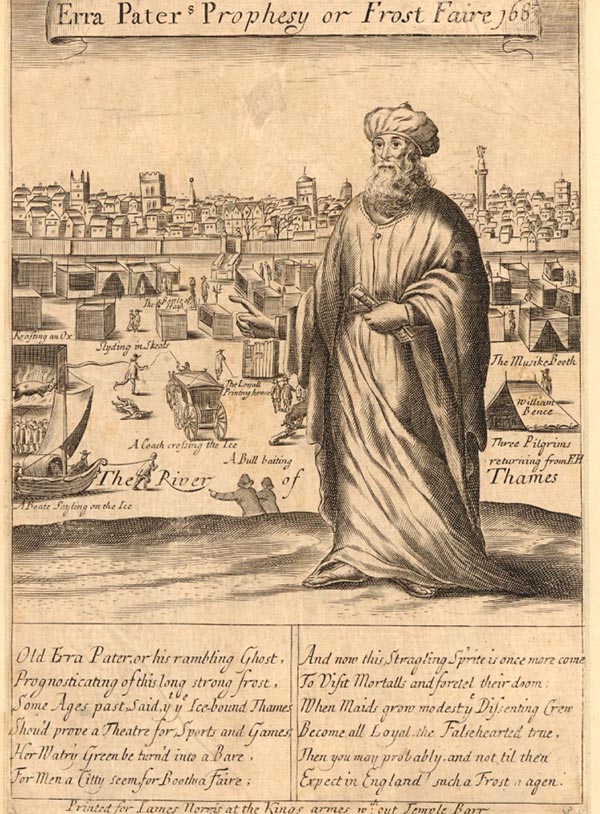
Source: Erra Paters Prophesy or Frost Faire (1683/4), British Museum number 1880, 1113.1776, ⓒ Trustees of the British Museum.
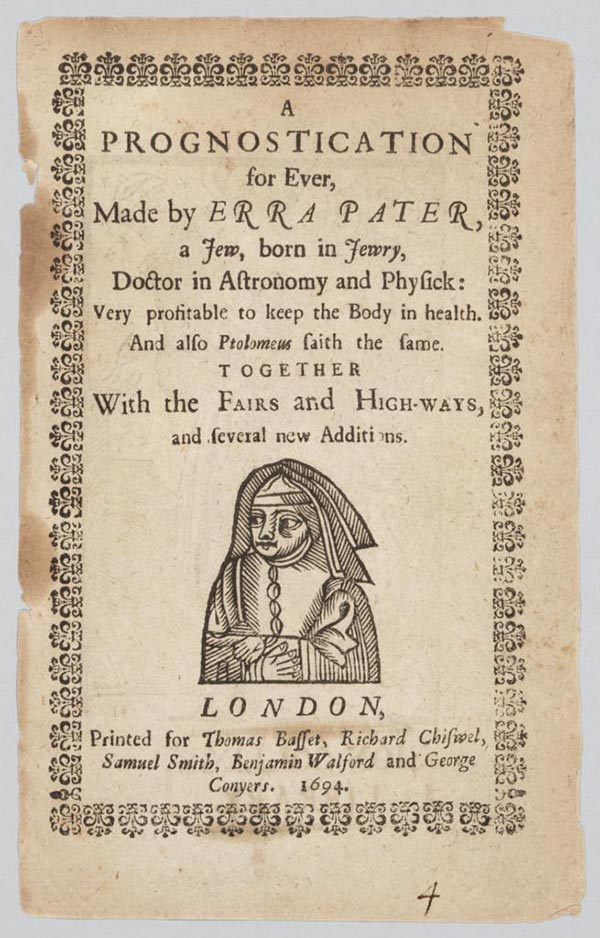
Source: A Prognostication for Ever, Made by Erra Pater (London, 1694), Columbia University Libraries Online Exhibitions, accessed June 15, 2018.
Ovid, Aeneas meets the Cumaean Sybil
- The prophetess did cast
- Her eye upon Aeneas’ back, and sighing said at last:
- I am no goddess. Neither think thou canst with conscience right,
- With holy incense honor give to any mortal wight.
- But to th’intent through ignorance thou err not. I had been
- Eternal and of worldly life; I should none end have seen,
- If that I would my maidenhood on Phoebus have bestowed.
- Howbeit while he stood in hope to have the same, and trowed* *trusted, was confident
- To overcome me with his gifts: ‘Thou maid of Cumes’ (quoth he)
- ‘Choose what thou wilt, and of thy wish the owner thou shalt bee.’
- I taking full my hand of dust, and showing it him there,
- Desired like a fool to live as many years as were
- Small grains of cinder in that heap. I quite forgot to crave
- Immediately the race of all those years in youth to have.
- Yet did he grant me also that, upon condition I
- Would let him have my maidenhood, which thing I did deny.
- And so rejecting Phoebus’ gift, a single life I led.
- But now the blissful time of youth is altogether fled,
- And irksome age with trembling pace is stolen upon my head,
- Which long I must endure. For now already as you see
- Seven hundred years are come and gone and that the number be
- Full matched of the grains of dust, three hundred harvests mo,
- I must three hundred vintages see more before I go.
- The day will come that length of time shall make my body small,
- And little of my withered limbs shall leave or naught at all.
- And none shall think that ever God was ta’en in love with me.
- Even out of Phoebus’ knowledge then perchance I grown shall bee,
- Or at the least that ever he me loved he shall deny,
- So sore I shall be altered. And then shall no man’s eye
- Discern me. Only by my voice I shall be known. For why?
- The fates shall leave me still my voice for folk to know me by.
Source: The Fifteen Books of P. Ovidius Naso, Entitled Metamorphosis. Translated out of Latin into English Meter, by Arthur Golding (London, 1612), Book 14, sigs. Z3v-Z4, modernized.