Aging Women
Today, the social phenomenon by which middle-aged women disappear from public view is called “invisible woman syndrome.” In the sixteenth and seventeenth centuries, aging women were not invisible. Instead, they often stood for vanity and mortality more generally. The face of moral corruption and the inevitable ravages of time was often a female one. But aging women were not only allegories. Elizabeth I ruled until her death at age 69 in 1603. In the passage excerpted below, the French ambassador tries to reconcile his acute observations of her authority, her wrinkles and missing teeth, her flamboyant dress, and her charm. Women’s aging might even be criminalized; most of those convicted of witchcraft were older women. While aging women were visible—indeed, the focus of unflinching observation and obsessive fantasy—that visibility was not necessarily an asset. As a consequence, then as now, cosmetics promised to help women reverse or disguise the effects of aging.
This passage describes the French ambassador’s meeting with Queen Elizabeth I in 1597, when she was 65. It has been much cited, perhaps because of our continuing combination of interest in and disgust at the aging female body.
He led me along a passage somewhat dark, into a chamber that they call the Privy Chamber, at the head of which was the Queen seated in a low chair, by herself, and withdrawn from all the Lords and Ladies that were present, they being in one place and she in another. After I had made her my reverence at the entry of the chamber, she rose and came five or six paces towards me, almost into the middle of the chamber. I kissed the fringe of her robe and she embraced me with both hands. She looked at me kindly, and began to excuse herself that she had not sooner given me audience, saying that the day before she had been very ill with a gathering on the right side of her face, which I should never have thought seeing her eyes and face: but she did not remember ever to have been so ill before.
She was strangely attired in a dress of silver cloth, white and crimson, or silver ‘gauze’, as they call it. This dress had slashed sleeves lined with red taffeta, and was girt about with other little sleeves that hung down to the ground, which she was forever twisting and untwisting. She kept the front of her dress open, and one could see the whole of her bosom, and passing low, and often she would open the front of this robe with her hands as if she was too hot. The collar of the robe was very high, and the lining of the inner part all adorned with little pendants of rubies and pearls, very many, but quite small. She had also a chain of rubies and pearls about her neck. On her head she wore a garland of the same material and beneath it a great reddish-colored wig, with a great number of spangles of gold and silver, and hanging down over her forehead some pearls, but of no great worth. On either side of her ears hung two great curls of hair, almost down to her shoulders and within the collar of her robe, spangled as the top of her head. Her bosom is somewhat wrinkled as well as one can see for the collar that she wears round her neck, but lower down her flesh is exceeding white and delicate, so far as one could see.
As for her face, it is and appears to be very aged. It is long and thin, and her teeth are very yellow and unequal, compared with what they were formerly, so they say, and on the left side less than on the right. Many of them are missing so that one cannot understand her easily when she speaks quickly. Her figure is fair and tall and graceful in whatever she does; so far as may be she keeps her dignity, yet humbly and graciously withal.
The following portrait, showing “wrinkles and aging,” provoked comment when it was included in an exhibit at the Folger Shakespeare Library because it is so different from the more idealizing portraits of the queen, including the famous Ditchley portrait of an apparently ageless Elizabeth (c. 1592), by the same painter at around the same time. Hannah Betts asks of the two portraits: “I wonder which came first: the euphemistically young, or the uncompromisingly aged Gheeraerts? Did the wrinkled image represent a version of his initial representation of the monarch, later reworked to eliminate all signs of age in the Ditchley? Or was the elderly queen a corrective to the Ditchley, a reminder to himself and others of the reality behind the mask? Or perhaps they were simultaneous, two sides of the same coin?” (Hannah Betts, “Age has withered Elizabeth I, after all,” The Telegraph [12 Feb 2013], accessed online).
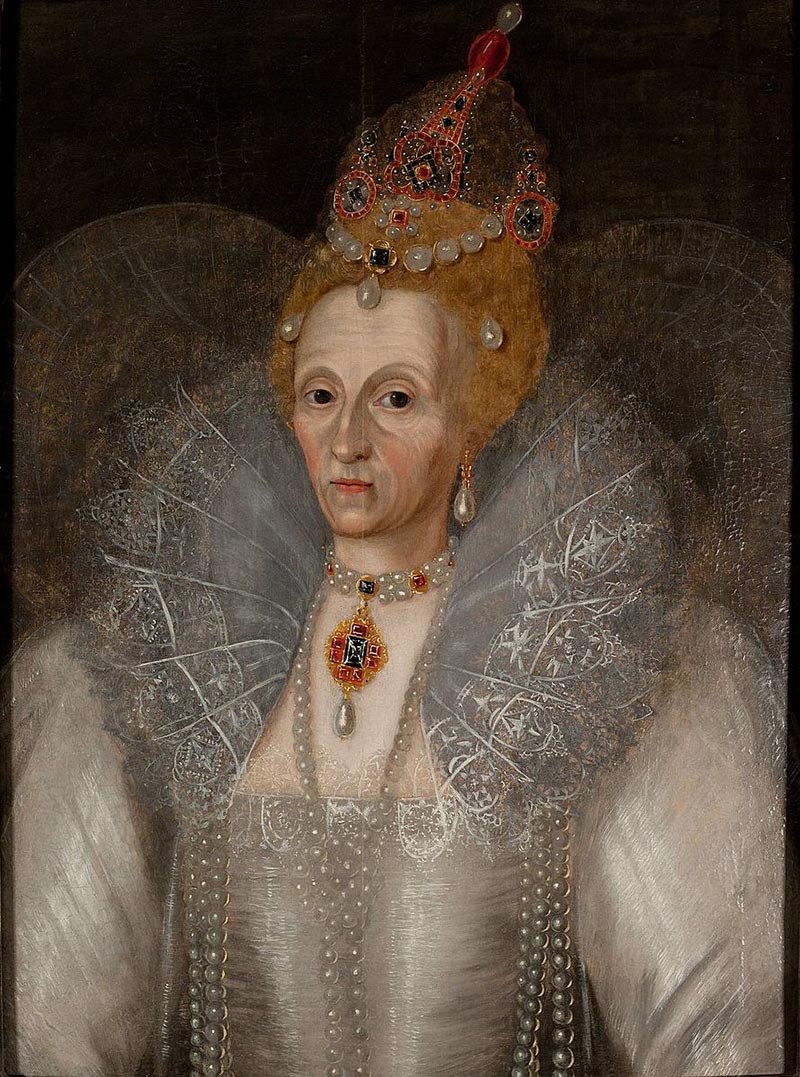
Source: Marcus Gheeraerts the younger, portrait of Queen Elizabeth I, c. 1595. Public domain, via Wikimedia Commons.
- Am I despised because you say,
- And I dare swear, that I am gray?
- Know, lady, you have but your day:
- And time will come when you shall wear
- Such frost and snow upon your hair.
- And when (though long, it comes to pass)
- You question with your looking-glass,
- And in that sincere crystal seek,
- But find no rose-bud in your cheek:
- Nor any bed to give the show
- Where such a rare carnation grew.
- Ah! then too late, close in your chamber keeping,
- It will be told
- That you are old,
- By those true tears you’re weeping
A Lady Dressed by Youth
- Her hair was curls of pleasures and delight,
- Which through her skin did cast a glimmering light.
- As lace, her bashful eyelids downwards hung;
- A modest countenance o’er her face was flung.
- Blushes, as coral beads, she strung to wear
- About her neck, and pendants for each ear.
- Her gown was by proportion cut and made,
- With veins embroidered, with complexion laid.
- Light words with ribbons of chaste thoughts up ties,
- And loose behavior, which through errors flies.
- Rich jewels of bright honor she did wear,
- By noble actions placed were everywhere.
- Thus dressed, to fame’s great court straightways she went,
- To dance a brawl* with youth, love, mirth, content.*French dance
A Woman Dressed by Age
- A Milk-white hair-lace* wound up all her hairs,*headband
- And a deaf coif* did cover both her ears.*tight cap
- A sober countenance about her face she ties,
- And a dim sight doth cover half her eyes.
- About her neck a kerchief of coarse skin,
- Which time had crumpled and worn creases in.
- Her gown was turned to melancholy black,
- Which loose did hang upon her sides and back.
- Her stockings cramps had knit, red worsted gout,
- And pains, as garters, tied her legs about.
- A pair of palsy gloves her hands draw on,
- With weakness stitched, and numbness trimmed upon.
- Her shoes were corns and hard skin sewed together;
- Hard skin were soles, and corns the upper leather.
- A mantle of diseases laps her round,
- And thus she’s dressed till death lays her in ground.
A Bisk* for Nature's Table
- A fore-head high, broad, smooth, and very sleek,
- A large great eye, black and very quick.
- A brow that’s arched, or like a bow that’s bent,
- A rosy cheek, and in the midst a dent.* *dimple
- Two cherry lips, whereon the dew lies wet,
- A nose between the eyes that’s even set.
- A chin that’s neither short, nor very long,
- A sharp, and quick, and ready, pleasing tongue.
- A breath of musk and amber in do strew,
- Two soft round breasts, that are as white as snow.
- A body plump, white, of an even growth,
- Quick, active lives, that’s void of sloth.
- A sound firm heart, a liver good,
- A speech that’s plain, and easy understood.
- A hand that’s fat, smooth, and very white,
- The inside moist, and red, like rubies bright.
- A brawny arm, a wrist that’s round and small,
- And fingers long, and joints not big withal.
- A stomach strong, and easy to digest,
- A swan-like neck and an out-bearing chest:
- These mixing, all with pleasure and delight,
- And strew upon them eyes that’s quick of sight;
- Putting them in a dish of admiration,
- And serves them up with praises of a nation
Chapter VI: To smooth the face disfigured with wrinkles
The smiling glories of beauty’s spring are often nipped with an early autumn, when sharp-scythed time cuts those flowery graces down and shrouds them in the furrows of a wrinkled face. Now to make your verdant features flourish in spite of envious time, or after their decay to smooth the face for a new plantation,
Take oil of bitter almonds, two ounces,
Lilly roots finely powdered, one ounce,
Make it into an ointment with the oil of roses and a little wax, and so apply it to the face.
Chapter XXX: How to keep the breasts from growing too big, and to make them plump and round.
Your care, Ladies, to preserve the beauty of these parts must not be inferior to that wherewith you cherish any: for the breast must be made remarkable with an outvying [transcendent] splendor, that so the graceful rising of those snowy hills might, like a pair of stately promontories, tempt wandering lovers, and make them take your microcosms for the only Fortunate Islands [mythical islands] .... When the breasts are flaccid, and hang down too low, you may make them round and plump thus:
Take quinces, green grapes a like quantity, beat them well together;
Add a little bole seed [bolus or large pill size?] plantane, anise, fennel, cumin;
With the juice of plantane and vinegar mixed, spread it upon the breast in form of a plaster.That same effects have dried figs, incorporated well with cumin and a little vinegar. You may likewise dissolve pitch, mix it together with oil, and apply it to the breasts.
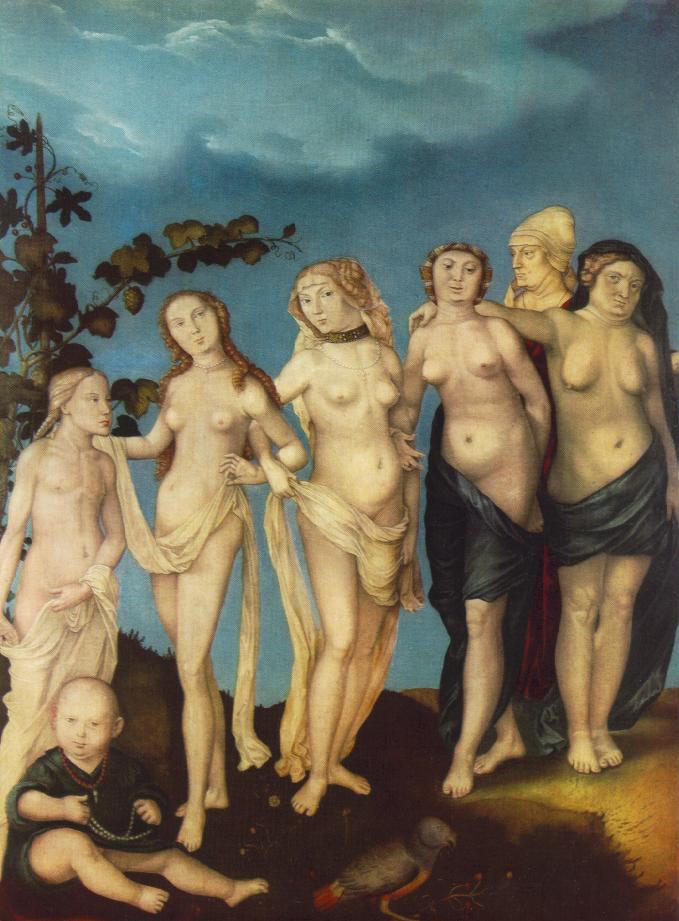
Source: Hans Baldung, The Seven Ages of Woman (1544), Museum der Bildenden Kunste, Leipzig, Germany. Public domain, via Wikimedia Commons.
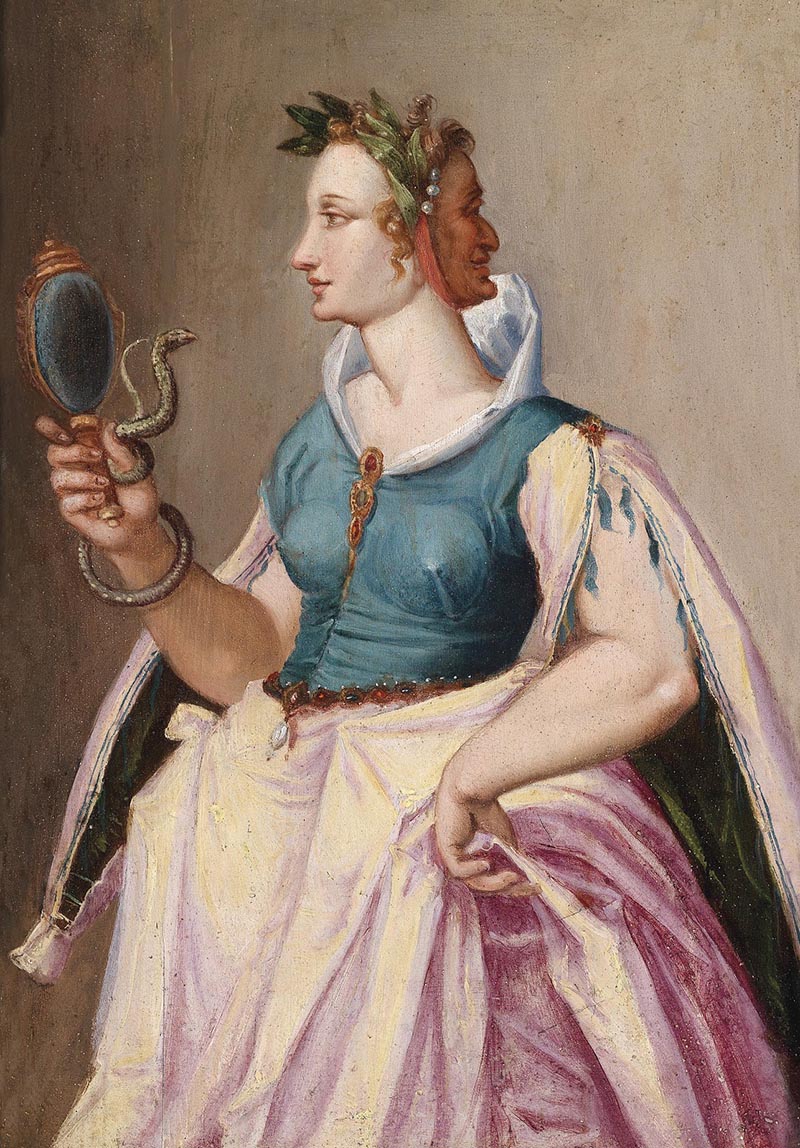
Source: Peter Candid, Allegory of Vanity (seventeenth century). Public domain, via Wikimedia commons.
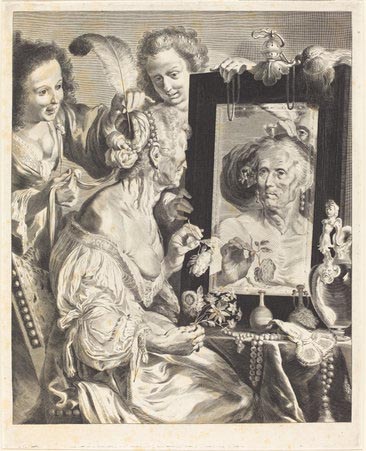
Source: Jeremias Falck after Johann Liss after Bernardo Strozzi, An Old Woman at the Toilet Table (seventeenth century, National Gallery of Art). Courtesy National Gallery of Art, Washington.