The Royalist River: The Thames and Early Modern Fluvial Cultures
In The Complaint of Thames4, Pulter situates herself within the early modern European discourse of royal and imperial rivers, yet she does so not through the customary celebratory register, but through a tone of elegiac reflection, articulating the loss of royalist cultural values in the context of the Civil War. In Pulter’s poem, the Thames’ decision to abandon London and provoke a drought serves as a symbolic enactment of how rivers in literature often register political transformation. Within royalist discourse, territory is frequently imagined as a political body unified under the sovereign, with the king as its head, governing and sustaining the whole. Pulter draws on this metaphorical framework to reconceptualize London’s hydrography: in the absence of the monarch, the princely river likewise proposes to withdraw, as the Thames threatens: “Then Heaven, just Heaven, withhold thy rain, / And I will leave my channel once again, As when my holy Albian’s blood was split” (15-17). Only when the city has burned in punishment for having slandered the king and queen “Then I, triumphant with my watery train, / Will make this city quagmires once again” (29-30). This logic resonates with both epic and chorographic traditions that envision the river as a figure of political unity and geographical coherence, as well as with the pageantry that celebrated the Thames as a stage for civic festivity and royal authority. Furthermore, in this focus on inversion—from pageant to elegy, from epic to lament, from flow to drought, from monarchy to Civil War—Pulter also decides to give a female voice to a river that has been constantly masculinized by the poetic and iconographic tradition, a feature that will allow her to further explore the gendering of poetic voice in political contexts.
Across the continent, rivers—especially those coursing through major cities—were central to displays of royal and princely power. The Tagus in Lisbon, the Seine in Paris, and the Arno in Florence, among others, functioned as stages for spectacle, celebration, and sovereign assertion. The Thames was no exception: it was a vital artery of civic life, hosting Lord Mayors’ processions and grand water pageants in which monarchs paraded in expressions of royal authority. In this poem, the river mourns the loss of that celebratory tradition, disrupted by the Civil War, where the collapse of monarchical order is metaphorized through the material destabilization of the land itself, reflecting a conception of the nation as intimately rooted in its land and waters. To understand the cultural and political weight of what the Thames laments, we will examine how poets in early modern England and beyond articulated a poetics of royal rivers, imagining them in the context of monarchical and imperial imaginaries, crafting visions of territorial concord, sovereign power, and, at times, unruliness and disorder. In early modern political thought, rivers became key instruments in articulating sovereignty over the land, with hydrography functioning as a means of inscribing authority onto the landscape. Finally, we will explore the gendered connotations of a river that, in this royalist tradition, is usually imagined as male.
Alongside the culture of waterborne celebrations on Europe’s rivers, we find epic poems that glorify empire through territorial allegories of power—traditions in which rivers play a central role. This literary lineage can be traced back to Virgil’s Aeneid, particularly to the prophetic vision delivered by the Tiberinus—the river god of the Tiber—to Aeneas as he sleeps. In this dream, Tiberinus designates the future site of Rome, marking it as the divinely ordained foundation of imperial rule.
- ’Twas night: And weary Nature lulled asleep
- The birds of air, and fishes of the deep;
- And beasts, and mortal men: the Trojan chief
- Was laid on Tiber’s banks, oppressed with grief,
- And found in silent slumber late relief.
- Then, through the shadows of the poplar wood,
- Arose the father of the Roman flood;
- An azure robe was o’er his body spread,
- A wreath of shady reeds adorned his head:
- Thus, manifest to sight, the God appeared
- And with these pleasing Words his [Aeneas’] Sorrow cheered.
- Undoubted offspring of ethereal race,
- O long expected in this promised place,
- Who, through the foes, hast borne thy banished Gods,
- Restored them to their hearths, and old abodes;
- This is thy happy Home! The clime where fate
- Ordains thee to restore the Trojan state.
- Fear not, the war shall end in lasting peace;
- And all the rage of haughty Juno cease.
- And that this nightly vision may not seem
- The effect of fancy, or an idle dream,
- A sow beneath an oak shall lie along;
- All white herself, and white her thirty young.
- When thirty rolling years have run their race,
- Thy son, Ascanius, on this empty space,
- Shall build a royal town, of lasting fame;
- Which from this omen shall receive the name.
- Time shall approve the truth: For what remains,
- And how with sure success to crown thy pains,
- With patience next attend. A banished band,
- Driven with Evander from the Arcadian land,
- Have planted here: and placed on high their walls;
- Their town the founder, Palanteum calls:
- Derived from Pallas, his grandsire’s name:
- But the fierce Latians old possession claim:
- With war infesting the new colony;
- These make thy friends, and on their aid rely.
- To thy free passage I submit my streams:
- Wake son of Venus from thy pleasing dreams;
- And, when the setting stars are lost in day,
- To Juno’s power thy just devotion pay.
- With sacrifice the wrathful Queen appease;
- Her pride at length shall fall, her fury cease.
- When thou return’st victorious from the war,
- Perform thy vows to me with grateful care.
- The God am I, whose yellow water flows
- Around these fields, and fattens as it goes:
- Tiber my name: among the rolling floods,
- Renowned on Earth, esteemed among the Gods.
- This is my certain seat: in times to come,
- My waves shall wash the walls of mighty Rome.
- He said; and plunged below, while yet he spoke:
- His dream Aeneas and his sleep forsook.
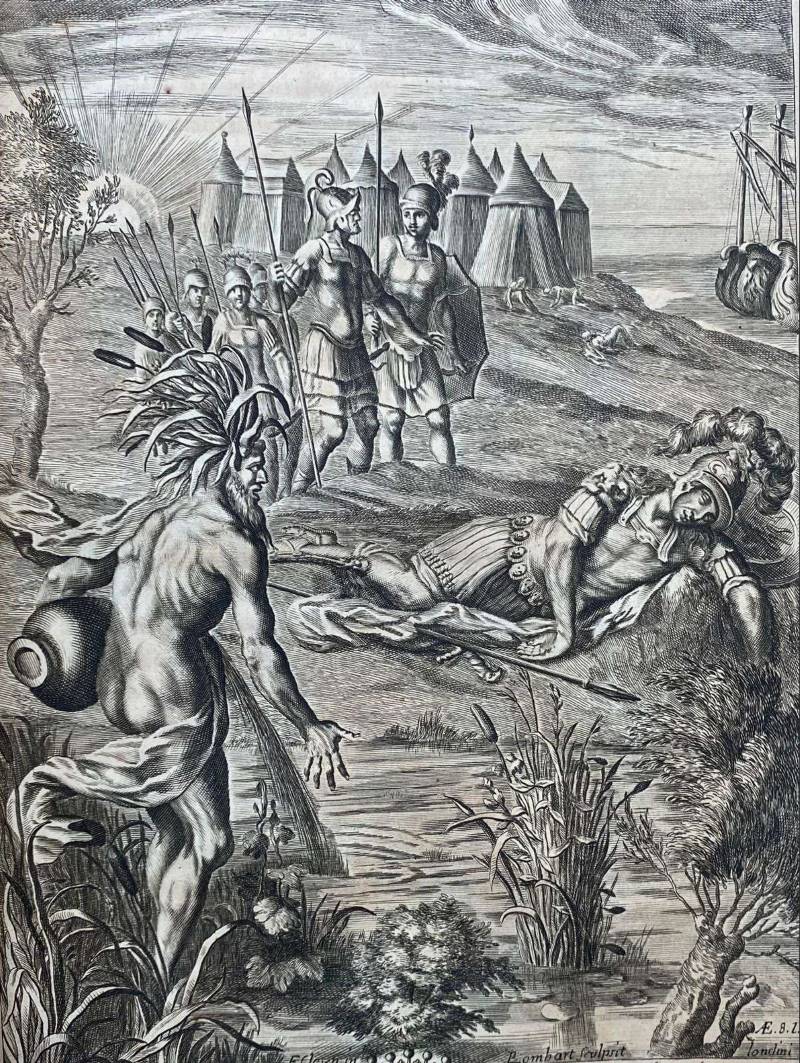
Virgil, Aeneis. The works of Virgil containing his Pastorals, Georgics and Aeneis: Adorn’d with a hundred sculptures / translated into English verse by Mr. Dryden (London, 1697), 378. Courtesy of the Newberry Library
As early modern intellectuals turned to the medieval myth of Troia Nova or New Troy to imagine London as an imperial city, images of imperial rivers—such as those framed by Virgil—gained renewed relevance.
Within this tradition that links hydrography to the building of nation and empire, Edmund Spenser integrates these motifs in The Faerie Queene, an epic poem whose imperial aspirations parallel those of Virgil. In Book IV we find the celebration of the marriage of the river Thames and the river Medway, where the Thames is celebrated as a kingly river. The wedding is attended by the famous rivers of the world (including the Americas) alongside all the rivers of England, producing a hydrographic map of power that converges in the royal figure of the Thames.
- And after him [the Thames] the famous rivers came,
- Which doe the earth enrich and beautifie:
- The fertile Nile, which creatures new doth frame;
- Long Rhodanus,whose source springs from the skie;
- Faire Ister, flowing from the mountaines hie;
- Divine Scamander, purpled yet with blood
- Of Greekes and Trojans, which therein did die;
- Pactolus glistening with his golden flood,
- And Tygris’ fierce, whose streames of none may be withstood.
- Great Ganges, and immortall Euphrates,
- Deepe Indus, and Mænder intricate,
- Slow Peneus, and tempestuous Phasides,
- Swift Rhene, and Alpheus still immaculate:
- Ooraxes, feared for great Cyrus fate;
- Tybris, renowned for the Romaines fame,
- Rich Oranochy, though but knowen late;
- And that huge River, which doth beare his name
- Of warlike Amazons, which doe possesse the same.
- Joy on those warlike women, which so long
- Can from all men so rich a kingdome hold;
- And shame on you, o men, which boast your strong
- And valiant hearts, in thoughts lesse hard and bold,
- Yet quaile in conquest of that land of gold.
- But this to you, ô Britons, most pertaines,
- To whom the right hereof it selfe hath sold;
- The which for sparing little cost or paines,
- Loose so immortall glory, and so endlesse gaines.
- (...)
- Then came his neighbour flouds, which nigh him dwell,
- And water all the English soile throughout;
- They all on him this day attended well;
- And with meet service waited him about
These nuptial allegories encode and stabilize territorial power through hydrographic symbolism. In the context of the union between the Thames and the Medway, river marriage becomes a formal device for imagining political harmony and naturalized sovereignty. Within the tradition of English river poetry, the Thames itself is figured as the offspring of such a union, in this case of the Rivers Tame and Isis, who produce the royal river of Thames, legitimizing its centrality within the national landscape. This union is staged in the fifteenth song of Michael Drayton’s Poly-Olbion (1612), which narrates the marriage of the Tame and the Isis and the birth of the Thames. Each song of this chorographic poem is accompanied by a regional map; in the case of this song, the two rivers meet in Oxfordshire. Drayton imagines this hydrographical feature through personified figures—river gods who embody the streams. The engravers’ decision to crown these figures underscores their status as royal rivers, especially given that they are imagined as “parents” of the Thames.
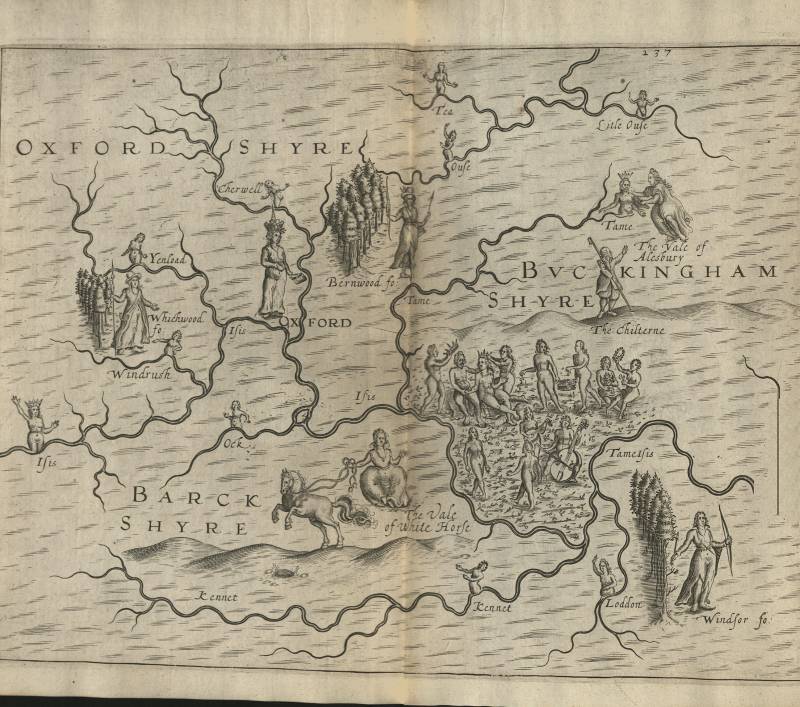
Marriage of Tame and Isis in Michael Drayton’s A Chorographicall Description of All the Tracts, Rivers, Mountains, Forests, and Other Parts ... of Great Britain ... : Digested into a Poem / by Michael Drayton ... London: Printed for Iohn Marriott, Iohn Grismand, and Thomas Dewe, 1622. Courtesy of the Newberry Library
As was mentioned above, rivers found a place not only in epic poems, but also in royal celebrations such as triumphal entries, masques, ballets, and intermezzi, serving as powerful emblems of territorial control and sovereign authority. In the renowned triumphal entry of Archduke Ernest of Austria into Antwerp in 1594, one of the many arches constructed for the occasion symbolized Habsburg dominion over a global empire, an imagery that echoes Edmund Spenser’s unification of the world’s rivers in The Faerie Queene to commemorate the allegorical marriage of the Thames and the Medway. The arch celebrated imperial power, particularly following the 1580 Iberian Union through which Portugal was annexed to the Habsburg monarchy. It featured river gods representing the Ganges and the Hydaspes (or Jhelum) from the Indian subcontinent, the Tagus in Portugal, and the Río de la Plata in the Portuguese-controlled regions of South America.
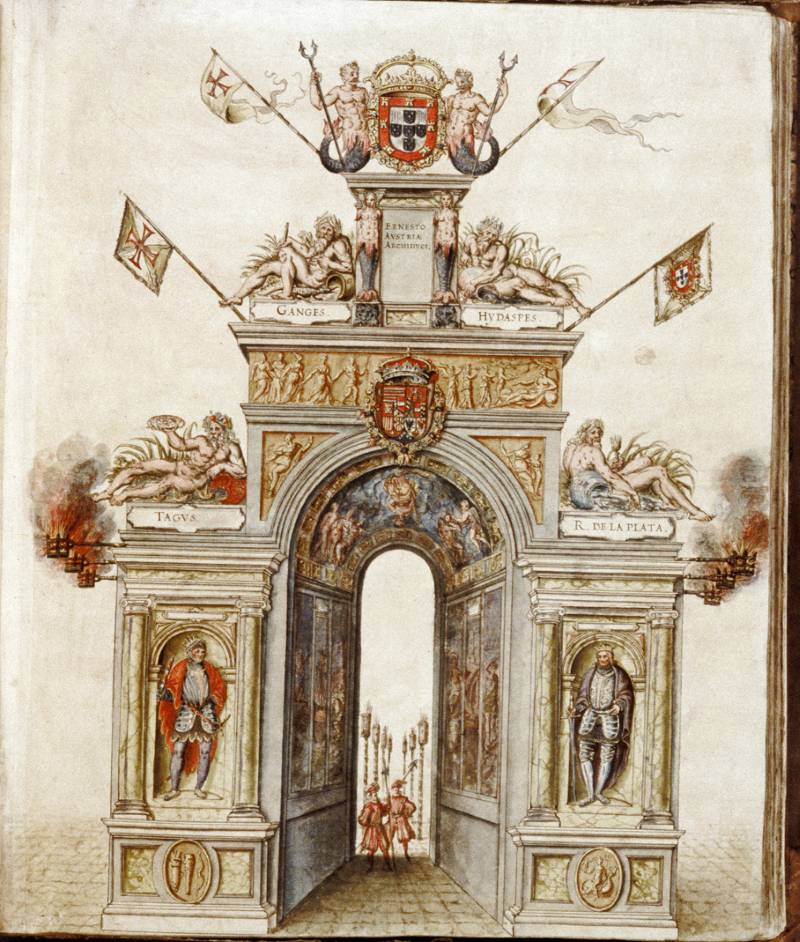
Arcus triumphalis Lusitanorum. Descriptio Publicae Gratulationis ... in Aduentu Sereniss. Principis Ernesti Archiducis Austriae engravings by Martin de Vos (Antwerp, 1594). Oxford, Bodleian Library MS. Douce 387: https://digital.bodleian.ox.ac.uk/objects/46ff8d52-905a-499d-9653-1c92452caa54/ © Bodleian Libraries, University of Oxford. Shared under: CC BY-NC 4.0.
The Thames had its own local history within the broader European context of royal rivers, serving as the site of grand celebrations in early modern London. Most notably, it hosted the Lord Mayor’s procession, in which the newly appointed mayor of the City of London would travel by river to mark the beginning of his term. This ritual transformed the Thames into a celebratory space that affirmed the city’s grandeur and the vitality of civic life, an important dimension of early modern European ceremonial culture. Although the river was not used for coronations during the late Tudor and Stuart periods, it retained a symbolic presence in these royal festivities. In the case of James I’s triumphal entry into London, for instance, the first arch he passed through represented the city itself, with the Thames personified as a river god at its center.
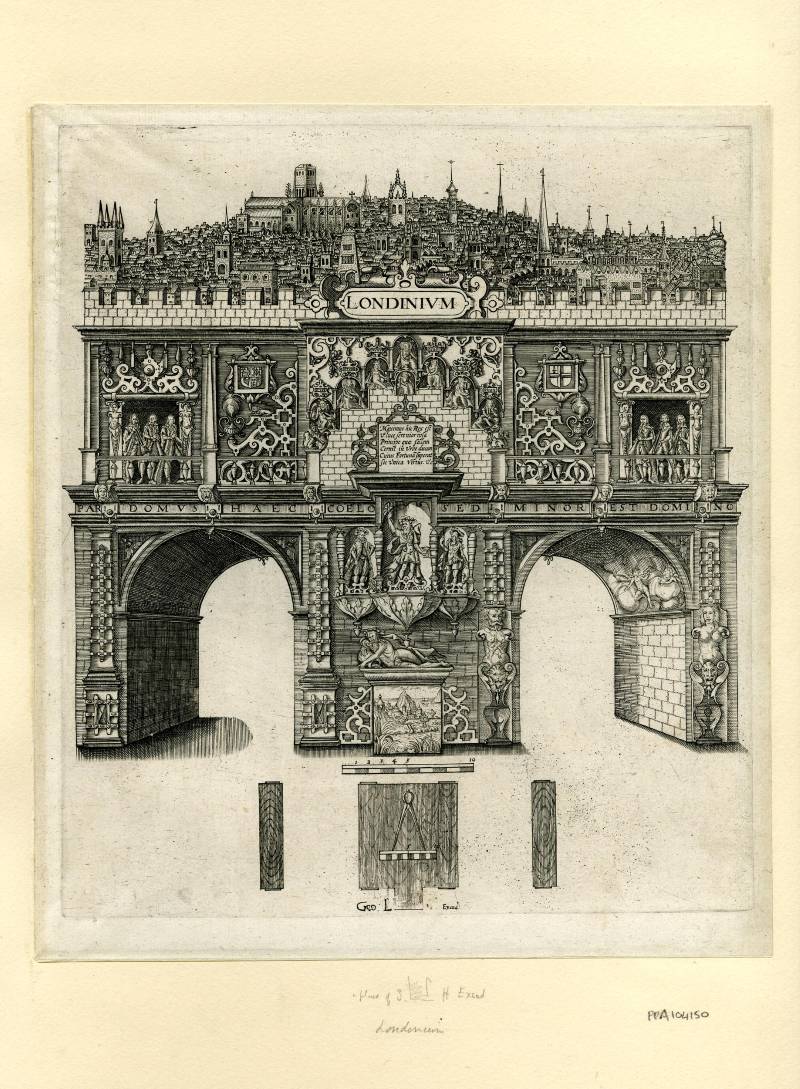
Stephen Harrison, The arch's of triumph erected in honor of the high and mighty prince. Iames. the first of that name. King, of England. and the sixt of Scotland at his Maiesties entrance and passage through his honorable citty & chamber of London. vpon the 15th. day of march 1603, engravings by William Kip (London, 1604). © The Trustees of the British Museum. Shared under a Creative Commons Attribution-NonCommercial-ShareAlike 4.0 International (CC BY-NC-SA 4.0) licence.
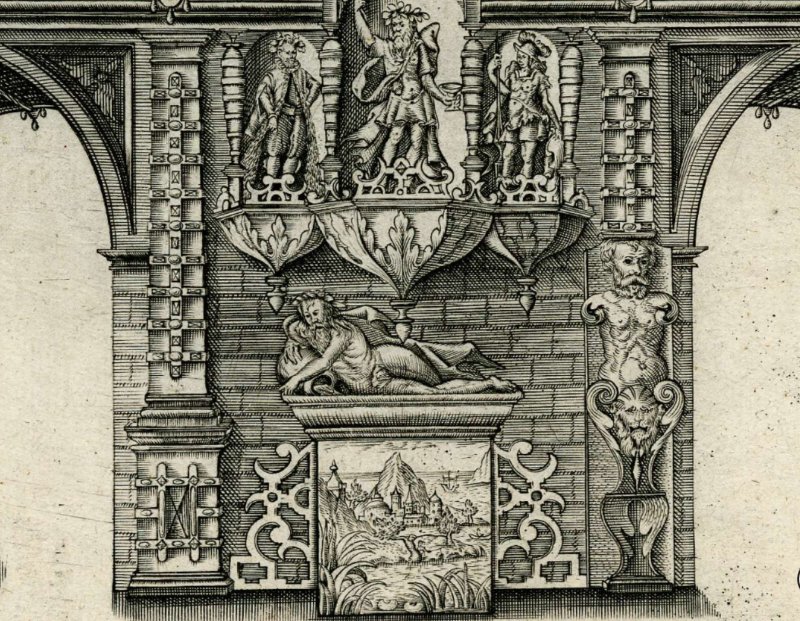
Detail of the central pillar with the Thames personified as a river god.
Beyond triumphal entries, the Thames also figured prominently in court masques, where the river symbolically entered the confined space of the court theater, as we will see below. This tradition of court masques is echoed in Pulter’s poetry, where she allegorizes Queen Henrietta Maria as Chloris (both in The Invitation into the Country2, lines 27-28, and The Complaint of Thames, 1647.4, lines 5-7), likely alluding to Ben Jonson’s Chloridia (1631), in which the Queen also represented Chloris. The Thames appears explicitly in Tethys’ Festival (1610), a masque by Samuel Daniel with designs by Inigo Jones, performed at Whitehall during the reign of James I. In this performance, Queen Anne assumed the role of Tethys, Queen of the Ocean, while Princess Elizabeth personified the nymph of the Thames. Other noblewomen and countesses embodied various English rivers, reinforcing a symbolic geography that celebrated dynastic and territorial unity.
- From that intelligence which moves the sphere
- Of circling waves (the mighty Tethys, Queen
- Of nymphs and rivers, who will straight appear,
- And in a humane character be seen)
- We have in charge to say, that even as seas
- And lands, are graced by men of worth and might,
- So they return their favors; and in these
- Exalting of the good seem to delight.
- Which she, in glory, lately visiting
- The sweet, and pleasant shores of Cambria, found
- By an unusual, and most forward spring
- Of comfort, wherewith all things did abound,
- For joy of the Investiture at hand
- Of their new Prince, whose rites, with acts renowned
- Were here to be solemnized on this strand:
- And therefore straight resolves to adorn the day
- With her all-gracing presence, and the train,
- Of some choice nymphs she pleased to call away
- From several rivers which they entertain.
- And first the lovely nymph of stately Thames,
- (The darling of the Ocean) summoned is:
- Then those of Trent and Arun’s graceful streams,
- Then Darwent next with clear-waved worthiness.
- The beauteous nymph of crystal-streaming Lee
- Gives next attendance: then the nymph of Ayr
- With modest motion makes her sweet repair.
- The nymph of Severn follows in degree,
- With ample streams of grace: and next to her
- The cheerful nymph of Rother does appear
- With comely Medway, the ornament of Kent,
- And then four goodly nymphs that beautify
- Camber’s fair shores, and all that continent
- The graces of clear Usk, Olwy, Dulesse, Wy.
With the Restoration in 1660, it is no coincidence that the Thames stood at the center of the celebrations. The river symbolically enacted the restoration of territorial unity to a nation fractured by civil war, reclaiming its princely character. Two years later, in 1662, the river once again became a stage for royal spectacle with the arrival of Catherine of Braganza. Her entry into London by way of the Thames was marked by the Aqua Triumphalis, a fluvial procession that celebrated the royal marriage and reaffirmed the river’s ceremonial and symbolic significance.
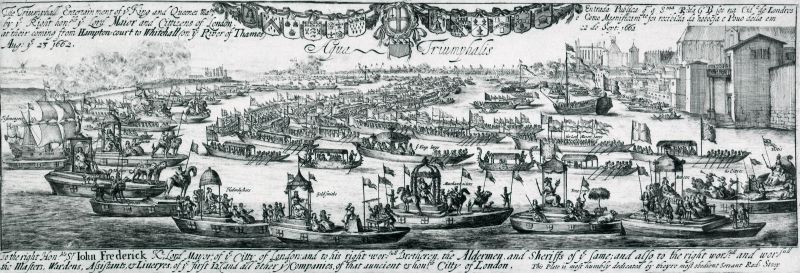
Aqua Triumphalis. The Entry of the Queen in London on the River Thames, welcomed by the Lord Mayor and the citizens of London, surrounded by little boats representing the different guilds in the foreground, several houses to the right; from a series of seven prints showing the journey of the Infant Catherine of Braganza from Portugal to marry Charles II in London (London, 1662). © The Trustees of the British Museum. Shared under a Creative Commons Attribution-NonCommercial-ShareAlike 4.0 International (CC BY-NC-SA 4.0) licence.
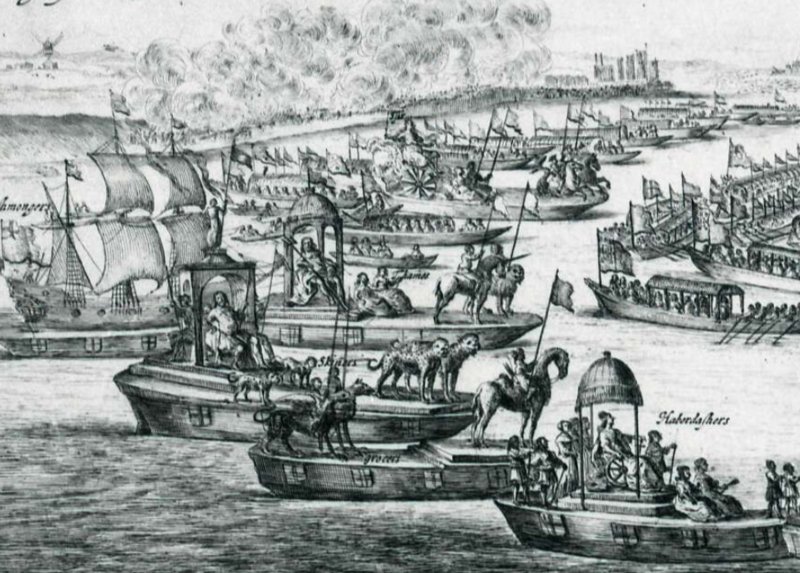
Detail of the personification of the Thames. Second rowboat ascending from the bottom margin, with a river god bearing a trident and the word “Thames” by its side.
As the monarchs navigated the river, they encountered various allegorical figures who performed songs in their honor. In John Tatham’s description of the celebration, we see that two rivers, the Isis and the Thames, are personified in the pageantry, each dedicating a song to the king and queen. The Thames’s song celebrates the restoration of Charles II’s throne and gestures toward the elemental disorder that Pulter invokes in her poem, though here it is reversed. Whereas in Pulter’s poem the Thames threatens to recede and dry up (lines 11-20), in Tatham’s account the river is newly enclosed within the bounds of the nation, its course re-stabilized by the monarch’s return. The song also participates in the genre of the river marriage signaled above, staging a symbolic union between the Thames and the Tagus, the river of Lisbon, from which Catherine of Braganza arrived.
- When you (great sir!) did in Caesarean state
- Through the glad city, ride to meet your fate,
- (the hand-maid to your right) your regal throne
- Which had been lost, had it not been your own;
- So many false pretenders laying claim
- To what, they wanted virtue to maintain:
- Among the rest did that day press to see
- Phoebus display his beams in monarchy,
- I, a sub-servant, strove beyond my bound,
- To express a loyal error on the ground:
- Nor wonder now them in a house is pent,
- Britain is by this floating island meant,
- Environed with the German Ocean,
- The Irish, Scottish, and the Belgian:
- This spot of earth that doth so much create
- In other nations fear, ’twixt love, and hate;
- The name of England shakes them, war, and it
- Strikes them into their mother ague fit:
- And that your ample glories may increase,
- Portugal clasps you with the arms of peace.
- That Portugal is so famous for their kings,
- And wondrous acts, which worthy Clio sings,
- England and Portugal are one in fame,
- There is no difference ’twixt them but in name,
- Lisbon is London, Tagus Thames, and then,
- The Portuguese are become Englishmen,
- The English, Portuguese; both meet in hearts,
- Thus providence unites remotest parts
- This strange conjunction staggers the dull age.
As noted earlier, rivers often served as symbols of national concord and sovereign authority. Conversely, rivers were also used to represent moments of crisis and disorder. Pulter reconfigures these traditions to mourn the chaos of the civil war, channeling the voice of the Thames to articulate her royalist position. The river’s rage thus aligns with a broader literary tradition in which riverine landscapes are imbued with political significance, responding dynamically to moments of historical rupture. This association between political power, unruliness and rivers figures prominently in Shakespeare’s Richard II, where Bolingbroke’s desire for usurpation is allegorized as a tempestuous river:
- RICHARD: Not all the water in the rough rude sea
- Can wash the balm off from an anointed king;
- The breath of worldly men cannot depose
- The deputy elected by the Lord.
- For every man that Bolingbroke hath pressed
- To lift shrewd steel against our golden crown,
- God for His Richard hath in heavenly pay
- A glorious angel. Then, if angels fight,
- Weak men must fall, for heaven still guards the right.
- (...)
- SCROOP: Glad am I that your highness is so armed
- To bear the tidings of calamity.
- Like an unseasonable stormy day,
- Which makes the silver rivers drown their shores
- As if the world were all dissolved to tears,
- So high above his limits swells the rage
- Of Bolingbroke, covering your fearful land
- With hard bright steel and hearts harder than steel.
Finally, as we have seen above, the Thames is consistently gendered male in early modern literature, iconography, and festival culture. Following the Roman precedent, the principal river of an empire is represented in masculine form: Virgil personifies the Tiber as the male river god Tiberinus, and English poets adopt similar models. In Spenser’s The Faerie Queene (Canto IV), the male Thames marries the female Medway, while in Drayton’s Poly-Olbion, a male Tame unites with a female Isis, producing a male Thames (as illustrated in the image below). Such literary conventions are mirrored in London’s triumphal iconography, which consistently depicts the Thames as a masculine river god. Pulter’s The Complaint of Thames, 1647.4, however, feminizes the river—a significant and deliberate departure from these conventions. This poetic intervention engages directly with the male-dominated tradition of English river poetics, particularly the vision of Spenser, and can be read in two complementary ways: first, as an acknowledgment that the epic, triumphal mode is no longer tenable in the fractured political reality of the Civil War, yielding instead to the elegiac tones of pastoral; and second, as a deliberate effort to assert a female poetic voice within a tradition that had consistently imagined the Thames as male, thereby recasting both the river and Pulter’s own authorship.
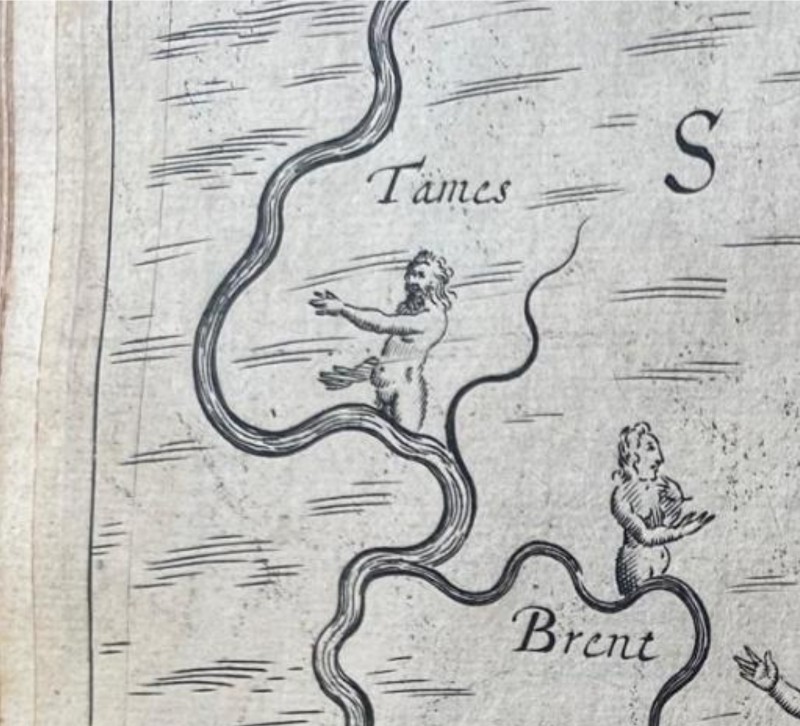
Personification of the Thames.
Michael Drayton, Poly-Olbion (London: 1612), 245. Courtesy of the Newberry Library.
Similarly, Philip Galle’s Semideorum marinorum amnicorumque (Of Sea and River Demigods) presents a series of engravings depicting oceanic and fluvial deities, an exclusively male pantheon that extends from Neptune to the river gods of the Danube, Rhine, and Tiber, and culminates with the Thames, figured as a male river god melancholically pouring his waters into the stream.
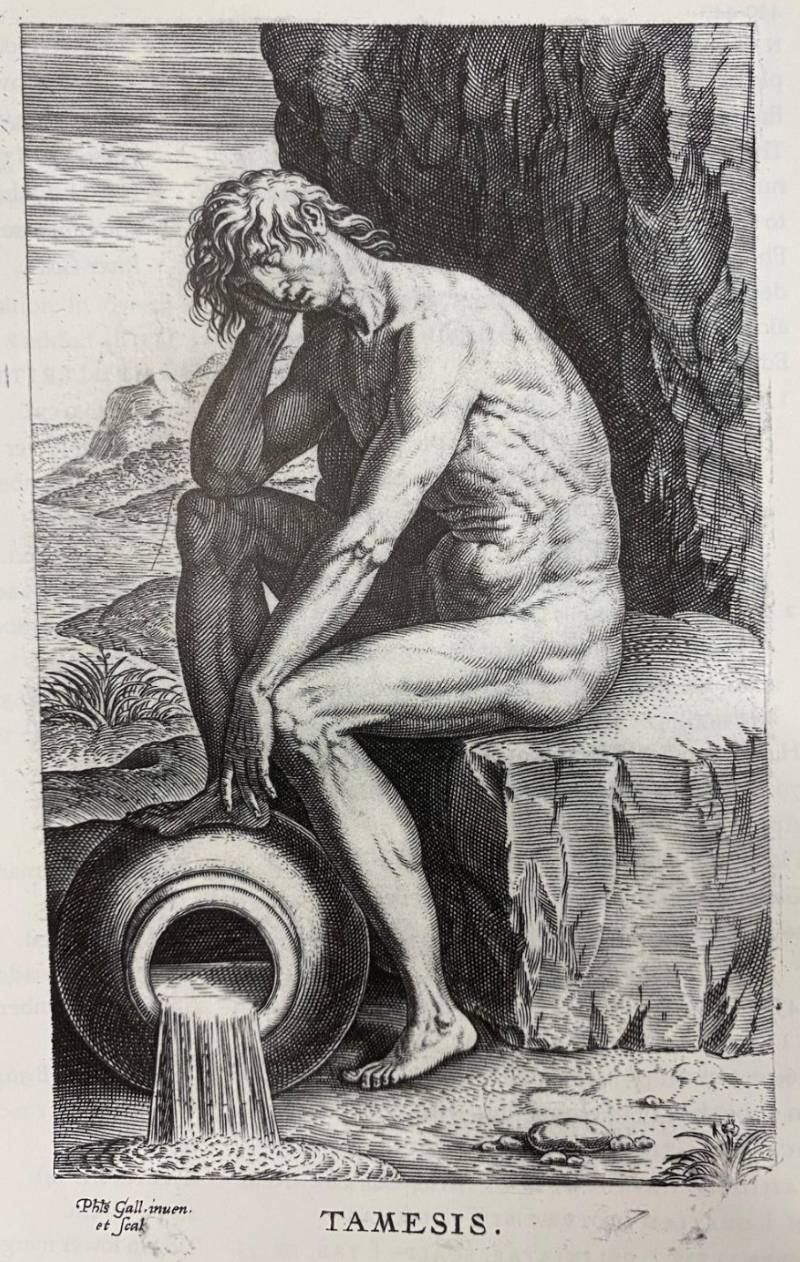
River Thames.
Philip Galle, Semideorum marinorum amnicorumque sigallariae imagines perelegantes, in picturae statuariaeque atris tyronym usum(Antwerp, 1586), 55. Wikipedia Commons.
.jpg)
However, there are certain exceptions to the general claim that the Thames is personified male. Michael Drayton, who personifies the Thames as male in his Poly-Olbion, feminizes the Thames in one of his sonnets:
- Our floods-queen, Thames, for ships and swans is crowned,
- And stately Severn for her shores is praised,
- The crystal Trent for fords and fish renowned,
- And Avon’s fame to Albion’s cliffs is raised.
- Carlegion Chester vaunts her holy Dee,
- York many wonders of her Ouse can tell,
- The Peak her Dove, whose banks so fertile be,
- And Kent will say her Medway doth excel.
- Cotswold commends her Isis and her Tame,
- Our northern borders boast of Tweed’s fair flood;
- Our western parts extol their Wily’s fame,
- And old Legea brags of Danish blood:
- Arden’s sweet Ankor, let thy glory be
- That fair Idea she doth live by thee.
Another work that feminizes the Thames does so in order to articulate a rape: Thameseidos (attributed to Edward Wilkinson and to William Evans) from 1600, where a feminized Thames is being constantly chased by Neptune:
- In all the world so great an enemy,
- Either to man, or man’s felicity
- There never was, if we do judge aright,
- And be not led away with blinded sight,
- Then is our own over-bold severity:
- For still thereby fit opportunity,
- Our foes have for to seize on us, before
- We think that they are near aboard the shore:
- Witness fair Thames, who doubting nought at all,
- Was nigh surprised, and made God Neptune’s thrall:
- Who next day, when Hyperion’s son began
- To drive his chariot to the ocean,
- Arrived in the meadow where as she
- Was sporting in her maidens’ company:
- Whom happily fair Thamisis espied;
- And spying, her fair lovely cheeks (straight) died
- With a vermilion blush, abashed as
- Naked Diana amongst her maidens was:
- Then when she in the clear Gargaphian Spring,
- By the hapless nephew of the Theban King
- Unawares was found; and from the place straight fled,
- Leaving her maids behind all in the mead:
- Away she ran, as raging storms do fly,
- Tumbling up clouds within the fabled sky,
- Near looking back, nor making any stay:
- So feared she the sovereign of the sea.
- Not half so fast distressed Florimel
- Fled from the sight of that hyena fell,
- Which the despightful witch after her sent,
- To bring her back, and her in pieces rent.
- Nor half so fast from Phoebus Daphne fled,
- As Isis now, to save her maidenhead:
- Whereat the lord of the unconstant sea
- Did chafe, yet loath that she should get away,
- He began with sugared speeches for to woo her,
- But all was spent in vain, that he said to her.
Although with exceptions such as these, the Thames was generally subject to male personification by male poets, who crafted their poetics within a context of celebratory national imagining. Pulter writes in the aftermath of this tradition of grand national epics that celebrated the Thames as the royal river, whose flow symbolized England’s greatness. These representations not only affirmed monarchy, territorial unity, and sovereignty, but also consistently imagined the river as male. Writing in a very different political and cultural moment, Pulter reframes the Thames within the crisis of the Civil War, revealing both the shifting cultural uses of rivers and the gendered dimensions of England’s hydrography. In the disillusioned atmosphere of a waning world—an aesthetic that marked seventeenth-century Europe and, more specifically, the turmoil of the English Civil War—Pulter finds her poetic voice in lament, offering a distinctly female, riverine perspective.