Pismires
We move here from the earliest texts assigning moral meaning to the pismire (Aesop and Proverbs), to commentaries and sermons (Burton), to natural history (Topsell and Moffett’s detailed descriptions of the pismire), to Walter Blith’s agricultural advice, to Bunyan’s improving rhymes for children, another emblem (Comenius), Margaret Cavendish’s moralizing accounts of ants in prose and verse, and a heraldic rationale for a pismire escutcheon or crest. Across centuries and very different genres, descriptions of the pismire depict it as a model for human conduct.
- Go to the ant, thou sluggard; consider her ways, and be wise:
- Which having no guide, overseer, or ruler,
- Provides her meat in the summer, and gathers her food in the harvest.
- How long wilt thou sleep, O sluggard? when wilt thou arise out of thy sleep?
- Yet a little sleep, a little slumber, a little folding of the hands to sleep:
- So shall thy poverty come as one that travels [or travails], and thy want as an armed man.
The matter of these verses is in general a dissuasion from idleness and negligence. Idleness for want of a calling and negligence in a man’s calling are the principal things which the spirit of God here deals against, persuading also to faithful diligence by the example of a silly creature, the pismire. But more particularly, these points are in these verses to be considered of: first, the sluggard’s schoolmaster, and his lesson that he must learn, in the 6th, 7th, 8th verses; then the sluggard’s examination in the 9th verse; then his answer in the 10th verse; and lastly his judgment in the 11th verse.
And this text may be called the rousing of the sluggard, because it has to deal with one that is fast asleep and therefore comes to awaken him by all the means he [the author] can devise, as it were by calling, pulling, and hallowing, and pinching, and terrifying, as if he would not leave him, ’til he has awakened him, if he will be awakened. For first, he persuades him by the example of the pismire, to shame him withal. Then he debates the matter with him to know how long he shall sleep, to see if that will awake him. And then he shows him his nature and property, to see if that will awaken him. And then seeing he will not awake, he shews him the danger of it, and so he leaves him. And the same course will I take.
- When winter drew near, the pismire hurried corn into the barn floor in the sunshine.
- The grasshopper seeing that, she ran to her and begged a grain.
- The pismire said, “why do not you also by my example hurry what you can in summer, and add to the heap?”
- She answered that she spent that time in singing.
- The pismire, smiling, said, “If you used to sing in summer, you are worthy to starve now.”
- Moral: We are put in mind by this little fable, while yet we have strength of body, to get those things whereby our feeble old age may be maintained.
Pismires also, as I am informed, have some kind of prescience, for when there shall be a famine, they take pains extraordinarily to carry in provision, and lay up corn and other grain on which they feed.
The History of Four-Footed Beasts. Dedicatory epistle
These things have I principally labored in this treatise, to show unto men what beasts are their friends, and what their enemies, which to trust, and which avoid, in which to find nourishment, and which to shun as poison. Another thing that persuades me in the necessary use of this history—that it was divine—was the preservation of all creatures living, which are engendered by copulation (except fishes) in the ark of Noah, unto whom it pleased the creator at that time to infuse an instinct, and bring them home to man as to a fold. Surely it was for that a man might gain out of them much divine knowledge, such as is imprinted in them by nature, as a type or spark of that great wisdom whereby they were created. In mice and serpents a foreknowledge of things to come; in the ant and pismire a providence against old age; in the bear, the love of young; in the lion his stately pace; in the cock and sheep, change of weather.
This extract captures how Moffett combines natural history, moral advice, poetry, and recipes, admiration for the pismire as a model for human conduct and directions for how to kill and consume it.
The Theater of Insects
To begin with the commendations of the pismires, I know not whether I shall first speak of their body or mind, since ants for both are not only to be preferred before many insects, but also before many men. For they are not one-eyed, nor horrid skew-eyed, nor do they walk with crammed guts, as Ballio doth in Plautus*, nor yet are they misshapen, crook-legged any way, gorbellied [big-bellied or fat], over close-kneed, blub-cheeked, great mouthed, lean chopped, rude foreheads, or barren, as many great ladies and noble women are, who have lost the faculty of generation. But the beauty of their body follows the goodness of their mind, and nature hath given them for their degree and order a constant and absolute perfection. Cardan [a Renaissance physician] was the first said they were blind because their body is small, not remembering that there are many flies and gnats that are far less than ants, yet they have eyes and can see well. If they were blind, I see not what the light could profit them, and they would work as well in the night as in the day. I confess that their foreyards [antennae] serve them for a staff to prove the way, not that they do not see what way they go, but because by those means they try the hardness and softness of things. They have a very little head, but round as the heavens are, wild brained, set with eyes, a mouth with teeth, and a throat not without a tongue and a palate; they have a square breast with ribs to defend it, with lungs or bellows that supply their room, that are so firm and yet loose that they never grow out of wind by laboring, but always draw their breath most freely. They have a stomach in their belly that is strong to digest venom, (for they feed often on serpents and toads) and they are very hot in the matrix [womb], and very fruitful, to their commendation [credit]. What should I here mention their swift walking, and their equal motion when they go? For they not only outgo pack-horses for the proportion of their bodies, but outrun the swiftest chariots. They vary in color, according to the difference of their kinds and places. For there are red ones in Mauritania, and the inhabitants of Budemelum [?] have white ones. In Europe, they are most[ly] black ones, yellow, and somewhat red from tawny. Here they seem very short, smaller, fine necked, slender, and weak bodied; yet these will carry a weight thrice as great and heavy as themselves; and those in India of a great bigness, will carry great pieces of flesh with them, and devour it.
- Their bodies you have seen, now see their mind,
- It’s a sparing and laborious kind,
- And holds and keeps whatever she can find.
- -Virgil’s Aeneid Book 4.
Truly, as often as I remember the profuseness of Caius Julius Caesar, the luxury of Caligula, the prodigality of Nero, the excessive gluttony of Apicius, and the great waste of Heliogabalus, so often do I exceedingly commend the wit and ingenuity of the pismire, and prefer her prudence before that of men. I know that they lived sweetly, and with fat patrimonies from their fathers, they gained large inheritances; yet they found out new use of baths, dangerous kinds of meats, curiosity in banquets, ships made of cedars adorned with jewels, the drinking of pearls, and they wasted as much in one year, as they could extort for tributes and customs, or by plunder both at home and abroad all their lifetime. Licinius Crassus had formerly much riches, who being brought to need, was laughed at by all that met him, and the people in a jeer, called him the rich Crassus. And (Oh God!) says the comedian [Aesop], what a miserable thing it is for a man to have had a great estate formerly, and to have nothing now? How much better were it for us to imitate the ant, who gathering corn in autumn, doth not waste it prodigally in winter rioting, but keeps it providently for future use, and daily store? Hence it is that she is never tortured with hard poverty, nor is she tossed on the billows of cross fortune, nor is she indebted or in danger by borrowing from others; nor doth she seek from other creatures either work, or sustenance to maintain her, and keep her in health: and if frugality comes from fruits, as the etymologist derives it, (for our ancestors, the masters of old sobriety, scarce knew any other diet) it is very credible that that virtue is passed from our first parents into the pismires, who feed only on dry corn to maintain their lives, and avoid all superfluity of many dishes. Hence the poet [Homer] elegantly feigned that the Myrmidons, the most excellent people of the Greek nation (if you consider their temperance, their labor, and their diligence) were descended of the pismires. For whence could they have gotten so great abundance of riches and goods, unless by an emmet’s [ant’s] prudence they had preserved what they had gotten and laid up to prevent poverty? And as sparing in keeping, so diligence in getting, and wisdom and industry, is found to be admirable in them. They take a very commendable way first to preserve their life, then for their posterity, and lastly to provide their victuals. First of all, they build themselves a house, as in the golden age, not covered with tiles for delight, but with green turfs, and not made of bricks, but fenced with mud walls. Histories do mightily magnify the pyramids, and trenches of Egypt, and the labyrinth of Crete. But no man can sufficiently set forth the excellent work of trenches that the ants make, the figure, the magnificence, the turnings, windings, and revolutions thereof. For these by an unspeakable prudence, beyond all man’s art, make houses underground with such strange turnings, that they open only the way that is inaccessible to others, and is not possible for any that would do them wrong to enter at. First, they make the earth hollow with their tender nails in the place of spades, and to throw the earth forth, they use their hinder feet for shovels. Hereby they cast up a mount, and fence it about as with walls or forts; then they cover their work with chaff, straw, leaves, bows, bark, and pieces of sticks, and laying on new matter, they raise a tower that may be seen afar off (called an ant-hill) which is far higher and more sloping than the foundation, partly that their houses may not fall by rain staying about them, and partly that they may live the more healthfully by reason of the air that penetrates and passes through. This divine little creature fetches the fashion of its building from heaven, either because their multitudes required room, or their excellence required the best. The entrance is not right forth but turning with many labyrinths and muses [carrels]; they distinguish their chambers in this tower of theirs in a threefold order, yet it is so hard to come into them, that Argus, who was all eyes, may be often deceived in them. The first room is large enough, like the presence-chamber, where they all meet, and convene. We call it the universal congregation house of ants. Under this, for the females there is the feminine room arched by Daedalean art, wherein the eggs are laid safe that they may produce their young ones; it is made lest they should be thought careless of posterity. The third chamber is most inward, and most safe from showers, and that is built for their storehouse for their corn, that as it were in a granary they may lay up their belly-timber [food], and may fence it well from the winter cold that searches into all things. The adjacent parts and outmost skirts of their castle they appoint for a place of burial, and there they bury their dead with honor and state. And this is the manner of their building, plain indeed, and within the ground, as were the houses of the wise men of elder times, before that pride, and the head-strong ambition of Ninus [the founder of the ancient city of Nineveh] invented to build up towers to heaven. Since his death, shall I speak of kings or princes? Truly there are some citizens of the lower bench, who with extraordinary charge do build up, not an anthill, but mausoleum, or a prison for their bodies, and adorn it with all the cost and art they can. Worthy they are indeed to be devoured by pismires while they live, that dying by the force of a wise creature, they may suffer for their folly. Nor do ants build houses that are places for idle people, or such as are mischievous to harbor themselves in, but every one, yet without any commander, follows some honest labor, and for the good of their democratic state, each one mutually employs his pains by turn. For they all, like those that labor in the mines, do stoutly exercise themselves in digging of trenches. Some serve to repair their houses, to adorn them, and to keep them clean. Others with great assemblies and funeral solemnities bury their dead, in the place of burial adjacent; others again visit the sick, and out of their granary they fetch some physical grain (for they have corn [wheat] and grain almost of all plants), and prepare that and carry it to them. They have officers of all sorts, as purveyors for corn, gleaners, storers, yeomen of the larder, householders, carpenters, masons, arch-workers, pioneers. For such is the virtue and skill of everyone, that each ant knows what is needful to be done, and willingly doth his best to help the commonwealth. But in their ordinary work what labor and diligence do they use? If they be minded to build an anthill presently, or else are forced on a sudden to raise a new house, the old one being undermined and decayed by the moles digging under them, they go forth all in troops, and from the rubbish of their houses thrown down they build new ones hard by. First, they gather together their scattered eggs, and corn, and put each of them in their proper places. Afterwards, they repair their hill, and covering and thatching that well, they keep all safe and dry. When the sun shines, when they go forth to fetch corn, the greater and elder go before them as captains; the rest follow after. They creeping up to the top of the stalk, bite off the ears of corn, and the young ones stay and gather them up, and the chaff being fallen off, they pull the corn out of the husks, and then they carry it home; and the end of it being eaten off, if there be necessity, they set it at their doors a sunning, and when it is ventilated they lay it up again. When gleaning is done, they frequent the threshing floors, and there not by stealth, but openly they take sustenance for their lives, and they enrich their treasury. Which labor of theirs Virgil wittily describes in these verses:
- As when the ants plunder a heap of wheat,
- Minding cold winter, store it up for meat,
- Their black regiments through narrow ways pass,
- And carry their prey over fields of grass,
- Some bear the burden, some them forward drive,
- Chastening delays, who shall work most they strive.
Wherefore not unfitly did the prince of moral wisdom [Solomon, often considered the source of Proverbs] send those sluggish and slothful monsters of mankind (who like mice live always on other men’s labors, and go from door to door like vagabonds to beg a penny) to learn wisdom of the ant, that by the example of the ant, they may use opportunity, and lay aside begging, esteeming labor much, which is the merchant for all that is good. Hitherto belongs that of the French poet:
- Poor sluggard who dost live in penury and want,
- Behold the household prudence and wisdom o’th’ ant,
- Lest she should stand in need, which she doth greatly fear.
- She gathers in one month, to serve her a whole year.
This is their diligence in gathering, their care in preserving, their prudence in storing, their economical skill in distributing what they have laid up. I shall show you also their modesty on the way, which methinks should not be over-passed. For though they go in a narrow way, yet are there no brawlings, contentions or strivings for it, nor yet any murmurings, or fightings, or slaughters amongst them for place (as it is usual amongst proud men). But the younger gives place to the elder, and he that carries no burden, to him that is loaded, and each of them is ready modestly rather to pass by an injury, than waspishly to offer one. If any man compares their burdens with their bodies, he will confess that no creature hath more strength, considering their proportion. They carry their burdens in their mouths; the greater burdens they attempt to take up backwards with their hinder feet, and lay their shoulders to them with all their might. They have all a care and mindfulness and endeavor for the public good. They store up the seed they first bite, lest they should grow again in the earth; when they are subject to grow moldy, and are wet with rain, they bring them out and dry them in the sun, wipe and torrefy [dry or toast] them, and then they lay them up in their granaries again. The greater seeds they divide at the entering. They work also at the full moon in the night (as good mowers are wont to do), and when the moon is in conjunction and hid, then they forbear laboring. But what pains do they take in laboring? How diligent are they? And because they work in diverse places, to come home with it, the one not knowing what the other doth. Certain days (says Pliny) are appointed for a general survey, and meeting to enquire into the business, what running together of them is there then? How civil is their conversation? How complementally do they salute one the other? How diligently do they seem as it were to talk together, and to make enquiry? You shall see flints worn in the path they go, and a path made in marble stones, that no man may doubt but that diligence will do something in any matter; for they all goes almost in the same path. For if one carries a burthen too heavy for him, the rest in the way will come and help him, lending their legs and shoulders, if it be a light burthen the fewer come to assist, if a weighty, more come, and either draw back, or thrust forward, or if the burthen be too great, by biting it in sunder, and dividing it, they promote their business: And by this means they bring home a great heap of straw and sticks to their houses. Now if any will attempt to hinder the ants in their labor, (as the serpents and toads often do when they meet them,)
- —They fight and will not fly,
- And hold it noble in these wars to die.
For then (making as it were an agreement) they conspire together, and with horrid and cruel bitings they destroy the enemy. He that hath not fastened upon the common enemy, thinks he hath deserved little of the commonwealth, and upon that score they fight. In the time of harvest, when such an accident falls out, they do not meddle with a dead body, but presently as the enemy is vanquished, they fall to their labor again, and they gather up again the corn they laid aside before the battle, and lay them up; for they hold it no prudence to stay to plunder, when greater business doth require their industry, and they hold it ignoble to contest with those that are dead. They feed chiefly on grains of wheat, winter corn, barley, and hard meat which they delight in. They take great pleasure in cyprus nuts, and the tender flowers of herbs that are red. They eat scorpions called geraret, says Rhasis [Muhammad ibn Zakariya Razi], and they feed on the carcasses of serpents and frogs when they are hungry. Otherwise, they abhor to eat corrupt and venomous things; nor will they touch fruit polluted with menstrual blood, nor taste of them. Have not men by reason of hunger been compelled to feed on horses, wolves, serpents, grass, and dead bodies in time of narrow sieges? That is sufficient to prove their [pismires’] cleanliness, that they carry out their dead in the husks or bladders of trees and corn, as of old time the Romans buried their dead in pots, but they now carry them forth on biers. They delight to live in clean houses, and for that purpose they do not lay their dung (that is like to urine) within doors; and when they travel through dirt, and are bedaubed, at the entrance of their houses, they rub themselves clean against some rough bark. They love and take such care for their young ones, that they always carry their eggs in their bosoms, so long as they are little, and not so overgrown that they hinder their labor; but then they lay them up in their deep hollow cave, that they frustrate the birds that prey upon them, as the woodpecker, the nightingale, and also the bear. But so soon as the young pismires come forth of the eggs, they immediately show them the way to labor and take pains, and if they refuse to work they will give them no meat. Hence you may observe that they set everyone his task: the stronger with their mouths, feet, little noses, do cast up the earth, and when they have cast it forth, they make it up in heaps. When they heap it up, they mingle straw with it, that it may lie light, and lie hollow. The wiser sort of them do build; the lesser of them remain in their trenches, and work. The more expert make windings like meanders and labyrinths, and frame vaulted chambers. If they observe any to be idle, they not only drive them out, pinched with famine as a base breed, but they bring him before the door, and calling a council of them all, they put them to death, that their young ones may take example, that they may not hereafter addict their minds to sloth and idleness. The days appointed for labor and gathering corn, they set venereous [sexual] action aside; and chiefly in winter (when there is neither sowing nor mowing) they couple together. Yet for modesty sake they use venereous actions within doors, as the bees do. At this time they make much of their females, and when they are great with eggs they embrace and love them most. Above all they take care (O wonderful love to their young ones) that nothing may be wanting to their offspring for food or instruction. He only can doubt of the valor of pismires who never saw them fight, nor heard the report of their battles. For they are not only full of choler (as the proverb is) but they have a purpose to fight, so that they either join battle with external enemies, or else hold civil wars amongst themselves, when they want food. For though pismires never fight when their granary is full, and their democratic government stands fast whilst they have plenty of food, yet (what we read to have happened in the best ordered monarchies) in a dearth, or rather want of provision, they fight desperately for food, and for their lives, and the lesser of them will rebel against the greater (as being the greater gulfs [mouths, appetites or consumers] of the commonwealth). It is the nature of necessity to give and not to take laws, and then chiefly when the belly, a troublesome client, doth feed on itself, and the guts croak [growl] and are empty. …
Also, they hurt elephants and bears, but not unless they be first hurt by them. They afflict serpents and dragons and make them mad, but it is either because they hinder them in their labor and stop the way, or because they breathe their venomous breath into their caves and turrets. Grasshoppers and dormice, they hate exceedingly, those because they spend the summertime in singing, these because they lose the winter in sleeping. For a commonwealth well-regulated doth punish idle persons as well as those that are wicked, and the Spartans were wont to cast forth those that would not labor. They live very long, and would hardly ever die, unless the birds did catch them before their time, or the floods and waters drowned them. They are for the most part very healthful, because they observe those three rules of Plato very exactly: mirth in labor, temperance in diet, and sparing in venereous actions. For what creature labors more cheerfully, diets more moderately, or did nature ever produce that is more temperate in venery? Also, there is in them many seeds of domestic discipline, justice, friendship and other virtues; and had we the like, either by nature or by art in us, we would scorn to live basely on the labors of others, and we would refuse to be slaves to our bellies. Moreover, they have some sense of future things. For before a famine they labor exceedingly, continuing their work night and day, and everywhere laying up a great store, as Juvenal has it in Satire 6:
- —Hunger and cold away drive,
- And from the ant learn thou an art to thrive
Since therefore (to wind up all in a few words) they are so exemplary for their great piety, prudence, justice, valor, temperance, modesty, charity, friendship, frugality, perseverance, industry, and art, it is no wonder that Plato in The Phaedo has determined that they who without the help of philosophy have led a civil life by custom or from their own diligence, they had their souls from ants, and when they die they are turned to ants again. To this may be added, as I related before, the fable of the Myrmidons, who being a people of Aegina applied themselves to diligent labor in tilling the ground, continual digging, hard toiling, and constant sparing joined with virtue, and they grew thereby so rich, that they passed the common condition and ingenuity of men, and Theognis knew not how to compare them better than to pismires, that they were originally descended from them, or were transformed into them, and as Strabo reports they were therefore called Myrmidons. The Greeks relate the history otherwise than other men do; namely, that Jupiter was changed into a pismire, and so deflowered Eurymedusa, the mother of the Graces, as if he could no otherwise deceive the best woman, than in the shape of the best creature. Hence ever after he was called Pismire Jupiter; or, Jupiter King of Pismires. For the generation of pismires are endowed with so much virtue and justice, that they need no king to govern them, for each of them can regulate his own passions; or if they have any king, it is the Supreme Jupiter, that governs all, who is deservedly thought to be the fountain and author of all virtue both in men and pismires, and all other creatures. For there is none amongst men that doth govern better than the pismire. And we that should teach them (as says St. Hieronymus) may learn of them divers things that are necessary for our souls and bodies. For when, contrary to their nature and industry, they hide themselves, we are certain that rain is not far off. And when we see them running here and there, and carrying their eggs before them, we are warned thereby of great winds and tempests. Also, those that are well acquainted with country learning, when they see the pismires run here and there, extreme fast, twice as much almost as at other times, and take such huge pains in gathering and storing up corn, they are warned of a famine at hand, and so buy up all the corn they are able. For they more rightly and certainly by their natural magic foreshow tempests, than our soothsaying almanac-makers, that are derided and exploded for vain fellows by all godly and truly learned men. …
They do better, in my opinion, who observe the pismire, and grow rich by following his manners in labor, industry, rest and study. … They [pismires] do teach us by their example of labor and virtue, both because they do inculcate unto us parsimony and perseverance, and also because when they are grown rich they maintain perpetual and inviolable friendship. For though at such a time one man is a wolf to another, and the desire of having more increases with gain (which the Greeks call covetousness), yet as the comedian speaks:
- In good or bad what ere it be,
- The ant with ant doth still agree.
And they never fight and jar but upon occasion of extreme famine. Horace charges them with covetousness because they always heap up more; but since they do that for the common welfare, that reproach of his is not their fault. But they eat serpents, and live sometimes on venomous things: I grant that, and maybe they use it for their theriac [medicine]. And are not therefore pismires to be commended? Yes, as well as the storks, they ought to be fed from the common treasure, and I might say to be adored as well as the Indian rat ichneumon [the mongoose]. In Isthmus, the priests sacrificed pismires to the sun, either because they thought the sun the most beautiful—and therefore they would offer unto him the most beautiful creature—or the most wise, as seeing all things, and therefore they offered unto him the wisest creature. But you will say, they are most hurtful creatures to vines, to dittany [an herb], to young shoots, and to many tender plants, and Pliny [a first-century Roman writer of natural history] calls them the plague of trees. But Gellius [Aulus Gellius, a second-century writer] calls them more properly the revengers and judges of idle people; for they by their labor call us out of our lurking holes, and drinking houses, to till our grounds, and take care of our orchards more diligently, and to exercise our wits, and to be more industrious in our business, and to do what is just and equal.
Go forth then, idle companions, and pour on a little hot water wherein lime hath been infused, and believe me not, but you shall drive all pismires away, and shall infuse more life and spirit into all thy plants. Origanum [oregano], brimstone, assa, nitre, snails’-shells, lupines, lazerwort, wild cucumbers, bulls-gall: boil and cast on or but enfume [burn so that the smoke envelops the ants] or sprinkle. Also, many things there are ready to be had for one that is diligent and laborious, whereby you may quickly drive out this plague from your grounds, and you may expect a great retribution for your pains: abundance of fruit. Moreover, all those things that drive away wasps and hornets, that we spoke of before, will afford you a sufficient remedy, and will also kill all the pismires. Yet in truth, thou sluggard, thou hast more need to nourish up this creature and set up for it a statue of gold. For so of old time they are said to have done, when they worshipped the ant, in a hieroglyphic, holding three ears of corn in the mouth of it, as being an emblem of divine providence, and labor, and of household care. For they are, to use Aristotle’s words, without any king, and under a popular government. Yet every one of them is for himself a father of his country, and they do to their power increase the common good as if it were for themselves in particular. But if you object, that the pismires by biting cause redness, tumor, tickling, and then a grievous pain where they bite, I do not wonder at that. I rather wonder at this: how thou canst look upon them, and not blush extremely, for thou canst not choose but blush to see such great industry in so small a creature, and to behold the watchfulness, labors, journeys, sweat, and toil that he is busied in. Yet they do not wound idle people so much (whom alone they are said to sting) but it will be cured with an emplaister of Varignana [an Italian healing plaster or salve], made of flies and pismires mingled together. For as scorpions, so are they the remedy for the wounds they make; and they bring their cure along with them when they bite. Pliny, Columella, Arnoldus, Aelianus, Albertus, and Vitalis will direct you in other helps, but you must not draw them out and apply them, without using the prudence of the pismire. Will you give me leave to reckon up the infinite benefits you may receive from them, for this small detriment you accuse them for? …
As concerning physic, there are but a few diseases that these creatures, as the hand of God, do not yield some help unto. Doth a fever burn and scorch thee alive as it were in the engine of Perillus?* Hearken and I shall tell thee of an admirable water to quench that fire, and most effectual against it, as [Conrad] Gesner received it from a friend: Take fountain water one pound, honey three spoonsful, shake them in a can, and set them in an emmet’s hill, so that pismires may easily fall into it. When you find that so many are fallen in as will thicken the water, shake the can, and as you use to do in making rosewater, so distill them. The dose is half a spoonful, or more as the patient can endure it by reason of his force more or less. It will wonderfully provoke vomiting, and will also evacuate the matter of the disease by urine. Pliny, the author from the old, says that a quotidian, tertian, quartan [fevers], and all intermitting fevers will be cured, if the sick cause the parings of his nails to be cast before the entering of the ant hill, and if he catches the first of them that lays hold of them, and bind him up and tie him about his neck. …
… I would no longer play the pismire, lest seeming to be eloquent I might grow impertinent, and searching every creek too narrowly, I should make more gaps. God grant that we whom God hath commanded to learn of ants, when we are idle and mind nothing but our bellies, may by his good guiding learn of them, and he instructing us, we may perform our duty. It is a small creature, and contemptible for its magnitude, yet we must know that goodness is not in greatness, but what is good is to be accounted great. I have said.
So, God was the original, and first husbandman, the pattern of all husbandry, and first projector of that great design to bring that old mass and chaos of confusion unto so vast an improvement, as all the world admires and subsists from. And having given man such a pattern both for precept and precedent for his encouragement, he makes him lord of all until the fall. And after that, God intending the preservation of what he made, notwithstanding the great curse upon Adam, Eve, and [the] serpent, the earth not going free, but a curse of barrenness cast upon it also, yet Adam is sent forth to till the earth, and improve it, in the sweat of his face he must eat bread until he return to the earth again.
And so down to Cain and Abel, the one husbanding the earth for tillage, and the other the sheep in pasturing and grazing. And so down to Noah—he began to be a husbandman—and to Abraham, and to Jacob and Esau, and so along still till they came to the government by kings, where Uzziah his commendation was beloved husbandry, and many excellent things, as if husbandry were the most excellent, as indeed it is here on earth. Else ask Solomon the wisest, the second husbandman or improver of the world, and you shall find, how out of the depth of his experience, he cries up diligence and activity in good husbandry, therefore sends us to the pismire, cries down the sluggard, and slothful, on whom comes poverty as an armed man, and extols the diligent as fittest to converse with kings, whose very thoughts bring abundance, even of the diligent, whose hand and heart are best to bear rule, when the idle shall be under tribute. But to multiply more scripture, where all experience holds it so clear, is but to prove a principle ungainsaid. I’ll say no more. But for the usefulness of it, it’s no less than the maintenance of our lives, estates, this commonwealth, and world. And the improvement or advancement of the fruits and profits of the earth by ingenuity, is little less than an addition of a new world; for what is gained hereby either above the natural fruitfulness of the earth, or else by reducement [reduction] of that which is destroyed, or impoverished from his natural fruitfulness, to greater fertility, is a clear augmentation or addition to the commonwealth.
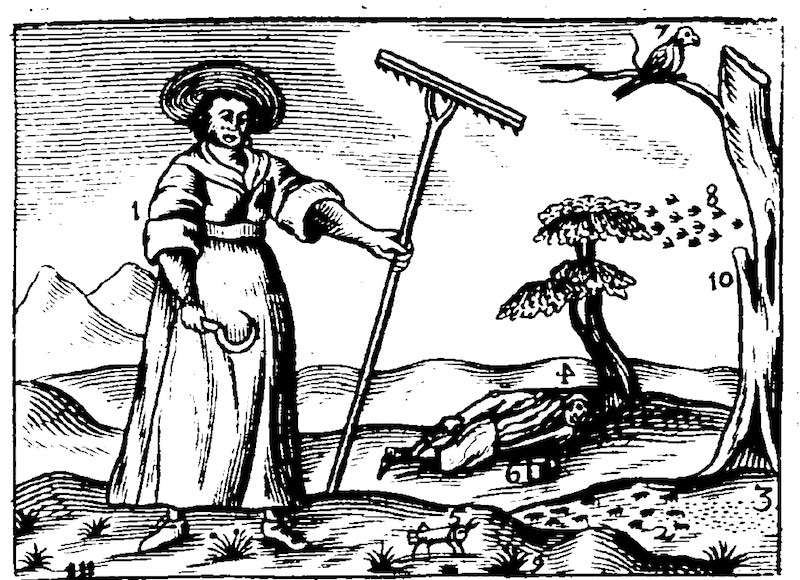
Note that this emblem genders diligence female, linking her industry to that of the pismire and the bee.
Diligence (1) loves labor, avoids sloth, is always at work, like the pismire (2), and carries together, as she does, for herself store of all things (3).
She does not always sleep, or make holidays, as the sluggard (4) and the grasshopper (5) do, whom want (6) at the last overtakes.
She pursues what things she has undertaken cheerfully, even to the end. She puts nothing off till the morrow, nor does she sing the crow’s song (7), which says over and over “cras, cras” [both the Latin word for “tomorrow” and something like the crow’s caw].
After labor’s undergone, and ended, being even wearied, she rests herself. But being refreshed with rest, that she may not use herself [get used] to idleness, she falls again to her business.
A diligent scholar is like bees (8), which carry honey from divers flowers (9) to their hive (10).
- Mark but the little ant, how she doth run,
- In what a busy motion goeth on,
- As if she ordered all the world’s affairs,
- When ’tis but only one small straw she bears.
- But when they find a fly which on the ground lies dead,
- Lord, how they stir; so full is every head.
- Some with their feet and mouths draw it along;
- Others their tails and shoulders thrust it on.
- And if a stranger ant comes on that way,
- She helps them straight, ne’er asketh if she may,
- Nor stays to ask rewards, but is well pleased,
- Thus pays herself, with her own pains, their ease.
- They live as the Lacedemonians did,
- All is in common, nothing is forbid.
- No private feast, but altogether meet,
- Wholesome, though plain, in public do they eat.
- They have no envy, all ambition’s down;
- There is no superiority, or clown.
- No stately palaces for pride to dwell:
- Their house is common, called the hill.
- All help to build and keep it in repair,
- No special workmen—all laborers they are.
- No[thing they] keep, no[thing] they have to sell,
- For what each one doth eat, all welcome is, and well.
- No jealousy, each takes his neighbor’s wife
- Without offence, which never breedeth [strife].
- Nor fight they duels, nor do give the lie,
- Their greatest honor is to live, not die.
- For they, to keep in life, through dangers run,
- To get provisions in ’gainst winter comes.
- But many lose their life, as chance doth fall.
- None is perpetual. Death devours all.
A Moral Tale of the Ant and the Bee
In the midst of a pleasant wood, stood a large oak in its prime and strength of years, which by long time was brought to a huge bigness. A company of ants meeting together chose the root or bottom thereof to build a city. But wheresoever any of them build, they build after one fashion, which is like a hill, or half-globe, the outside being convex, the inside concave—a figure, it seems, they think most lasting, and least subject to ruin, having no corners, points, or joints to break off. And every one of the little creatures [is] industrious for the common good, in which they never loiter, but labor and take pains. […] They are also as prudent for their provisions, having a magazine of meat in their city, as men have of arms. But this magazine is like a farmer’s cupboard, which is never without bread and cheese, wholesome, although not delicious fare. So is theirs. Neither do they shut their door, for all is open and free. They need not beg for victuals, since everyone labors and takes pains for what they eat. Neither are they factious and mutinous, through envy, by reason there is no superiority amongst them, for their commonwealth is composed of laborers. They have no impertinent commanding magistrates, nor unjust judges, nor wrangling lawyers. For, as their commonwealth is as one body; or rather all those little bodies are as one great head, or rather, as one wise brain, […] these citizen-ants, have little heads, and great wisdom. […] Although they have little hearts, yet they have great generosity, compassion, and charity to each other. (281-3).
[The ants have enemies, which] makes them fearful, and careful in concealing themselves, creeping always out at little holes, lest they should be discovered. It happened, upon a hot summer’s day, a company of bees flying to that tree, to swarm on a bough thereof; that they, thinking it might be some of their enemy-birds, were in an extraordinary fright, whereupon they withdrew all into the city, shutting up the gates thereof, only sending out a few spies at postern-doors, and setting sentinels to view their approaches. At last they observed, these birds (which men call bees) gathered in a round figure, or globe […] There was such a humming-noise, as did more affright the ants than it had before: for bees do not, as men in public councils, speak by turns; but they speak all at once, after the leading-bee hath spoke, I suppose, either all consenting, or not consenting to the chief bee’s proposition. Neither can I perceive that they speak studied speeches, as men do, taking more care and pains therein, than for the common good. Neither do they, as men do, which is, to speak as passion persuades them, not as reason advises, or truth discovers, or honesty commands them; but as self-love or self-will draws them, driving their own particular interest […] But bees are wiser, for they know, that if the commonwealth be ruined, no particular person can be free. […] But this colony of bees swarming together agreed where to settle, and so to meet all at the appointed place, whereupon the council broke up, and everyone took their flight several ways, to gather honey and wax, wisely providing for food, and store-houses to lay their provisions in […] But when the ants had heard their wise propositions, their general agreements, their firm conclusions, their quick executions, their methodical orders, their prudent managements or comportments, and their laborious industry, they did admire, commend, and approve of their commonwealth […]. But the truth is, the ant and the bee resemble one another more in their wise industry, than in their government of the commonwealth. For the bees are a monarchical government, as any may observe, and the ants are a republic. But by this we may perceive, it is not such and such kinds of government, but such and such ways of governing, that make a commonwealth flourish with plenty, convenience, peace, and tranquility. For the monarchical government of the bees is as wise and happy as the republic of the ants. (284-5)

One example more I will propose which shall be of the Emmet, as in this next escutcheon. He beareth, argent, eleven emmets, 3.2.3.2.1 sable [this means an escutcheon with 11 black pismires on a silver background]. Of this silly creature also does Solomon make mention, saying, “the pismires a people not strong, yet prepare they their meat in summer” (Proverbs 30.25). To this simple and feeble creature is the slothful man sent to learn wisdom, where it is said, “Go to the pismire, O sluggard, behold her ways and be wise. For she having no guide, governor nor ruler, prepares her meat in the summer, and gathers her food in harvest, etc.” (Proverbs 6:6-7). Very often do the sacred scriptures propose unto us examples of brute creatures, as well to upbraid us with our vices as to stir us up unto virtue. For as there are in man sparks of the understanding and practice of heavenly spirits, even so the brute animals have certain shadows or footsteps of the virtuous qualities that are or ought to be in men. Moreover, “Ask now the beasts and the fouls of the heavens, and they shall tell thee; or speak to the earth, and it will show thee, or the fish of the sea, and they shall declare unto thee” (Job 12.7). And by the least of God’s creatures may we learn many exemplary inducements to virtue, as also many forcible dissuasions from vice, by reason of the apparent signs of wisdom, power, and mercy of God that are found in them. By the emmet or pismire may be signifed a man of great labor, wisdom and providence in all his affairs and of a pregnant and ready memory.
- Must we unto the pismire go to school,
- To learn of her, in summer to provide
- For winter next ensuing? Man’s a fool,
- Or silly ants would not be made his guide.
- But, sluggard, is it not a shame for thee
- To be outdone by pismires? Prithee hear:
- Their works too will thy condemnation be,
- When at the judgment seat thou shalt appear.
- But since thy god doth bid thee to her go,
- Obey, her ways consider, and be wise.
- The piss-ants tell thee well what thou must do,
- And set the way to life before thine eyes.