Other Garden Poems
Many seventeenth-century writers wrote poems about gardens: as familiar, beloved spaces, sites of work (viewed positively or negatively), aspirations of pleasurable occupation, emblems of paradise, and models of human cognition and cultivation. Gathering some of them together here, one notices that women poets, including Pulter, seem to have taken up this topic before many of the male poets who subsequently wrote the poems on the topic that are now best known. One of the questions this raises is whether Marvell’s fantasy of a paradise without women (in his “The Garden”) is motivated in part by a desire to escape their competition and repudiate their inspiration.
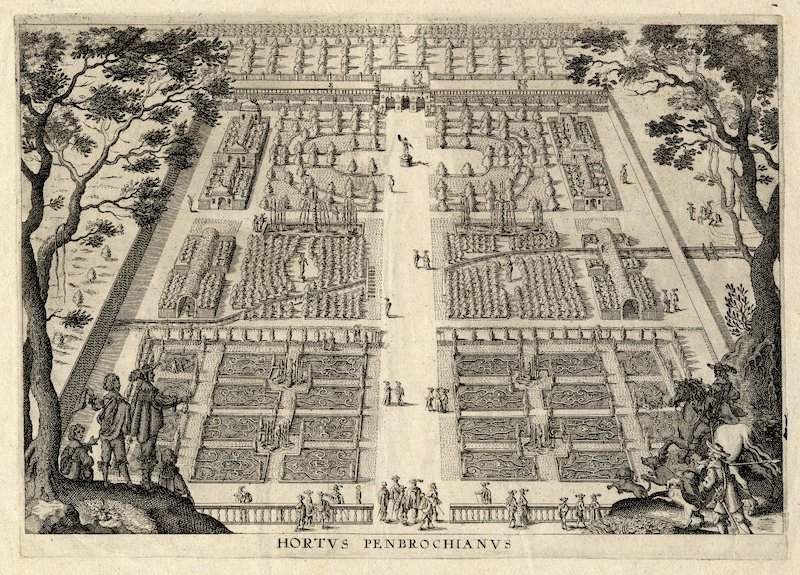
This print is copied from the large folding plate “Wilton Garden” (Wing C1530), which was most likely etched by Isaac de Caus, capturing the garden he designed for the 4th Earl of Pembroke, and appeared in Hortorum viridariorumque noviter in Europa (1655). Folger Shakespeare Library, the Folger Digital Image Collection.
- The brain a garden seems, full of delight,
- Whereon the sun of knowledge shineth bright,
- Where fancy flows, and runs in bubbling streams,
- Where flowers grow upon the banks of dreams,
- Whereon the dew of sleepy eyes doth fall,
- Bathing each leaf, and every flower small.
- There various thoughts as several flowers grow;
- Some milk-white innocence, as lilies, show.
- Fancies, as painted tulips’ colors fixed,
- By Nature’s pencils they are intermixed.
- Some as sweet roses, which are newly blown,
- Others as tender buds, not full outgrown.
- Some, as small violets, yet much sweetness bring.
- Thus many fancies from the brain still spring.
- Their wit, as butterflies, hot love do make,
- On every flower fine their pleasure take.
- Dancing about each leaf in pleasant sort,
- Passing their time away in amorous sport.
- Like Cupid’s young, their painted wings display,
- And with Apollo’s golden beams they play.
- Industry, as bees suck out the sweet,
- Wax of invention gather with their feet.
- Then on their wings of fame fly to their hive,
- From winter of sad death keeps them alive.
- There birds of poetry sweet notes still sing,
- Which through the world, as through the air, ring.
- Where on the branches of delight do sit,
- Pruning their wings, which are with study wet.
- Then to the cedars of high honor fly,
- Yet rest not there, but mount up to the sky.
- A garden is some Paradise do call;
- The place is always th’equinoctial.
- Echoes there are most artificial made,
- And cooling grottoes, from the heat to shade.
- The azure sky is always bright, and clear;
- No gross thick vapors in the clouds appear.
- There many stars do comfort the sad Night;
- The fixed with twinkling with the rest give light.
- No noise is heard, but what the ear delights;
- No fruits are there, but what the taste invites.
- Up through the nose bruised flowers fume the brain,
- As honeydew in balmy showers rain.
- Various colors, by Nature intermixed,
- Direct the eyes, as no one thing can fix.
- Here atoms small on sunbeams dance all day,
- While Zephyrus sweet doth on the air play,
- Which music from Apollo bears the praise,
- And Orpheus at the sound his harp down lays.
- Apollo yields, and not contends with spite,
- Presenting Zephyrus with twelve hours of light;
- And Night, though sad, in quiet pleasure takes,
- With silence listens when he music makes.
- And when Day comes, with grief descends down low,
- That she no longer must hear Zephyrus blow,
- And with her mantle black herself enshrouds,
- Which is embroidered all of stars in clouds.
- Here are intermixing walks of pleasure,
- Grass, sand, short, broad, and all sorts of measure.
- Some shaded, fit for lovers’ musing thought
- Of Love’s idea, when the mind’s full fraught.
- The walks are firm, and hard as marble are,
- Yet soft as down, by grass that groweth there,
- Where daisies grow as mushrooms, in a night,
- Mixed white, and yellow, green, to please the sight.
- At dawning Day the dew all overspreads,
- In little drops upon those daisies’ heads:
- As thick as stars are set in heaven high,
- So daisies on the earth as close do lie.
- Here emerald banks, from whence fine flowers spring,
- Whose scents and colors various pleasure bring.
- Primroses, cowslips, violets, daffodils,
- Roses, honeysuckles, and white lilies,
- Wallflowers, pinks, and marigolds besides,
- Sit on the bank, enriched with Nature’s pride.
- On other banks grow simples, which are good
- For medicines, well applied and understood.
- There trees do grow, that proper are, and tall,
- Their bark is smooth, and bodies sound withal;
- Whose spreading tops are full and evergreen
- As Nazarite’s heads where razor hath not been:
- And curled leaves, which bowing branches bear,
- By warmth are fed; for winter ne’er comes there.
- There fruits delicious to the taste do grow,
- Where with delight the sense doth overflow;
- And arched arbors, where sweet birds do sing,
- Whose hollow rooves do make each echo ring.
- Prospects, which trees and clouds by mixing shows,
- Joined by the eye, one perfect piece it grows.
- Here fountains are, where trilling drops down run,
- Which sparks do twinkle like fixed stars or sun;
- And through each several spout such noise it makes,
- As bird in spring, when he his pleasure takes.
- Some chirping sparrow, and the singing lark,
- Or quavering nightingale in evening dark;
- And whistling blackbird, with the pleasant thrush,
- Linnet, Bulfinch, which sing in every bush.
- No weeds are here, nor withered leaves and dry,
- But evergreen, and pleasant to the eye.
- No frost to nip the tender buds in birth,
- Nor winter snow to fall on this sweet earth.
- For here the Spring is always in her prime,
- Because this place is underneath the line:
- The Day and Night, equal, by turns keep watch,
- That thievish time should nothing from them catch.
- And every Muse a several walk enjoys,
- The sad in shades, the light with sports employs.
- Censuring satyrs: they in corners lurk;
- Yet, as their gard’ners, they with art do work,
- To cut and prune, to sow, engraft, and set,
- Gather fruits, flowers, what each Muse thinks fit:
- And nymphs, as handmaids, their attendance give,
- Which, for reward, their fames by Muses live.
- Poor desolate garden smile no more on me
- To whom glad looks rude entertainments be;
- While thou and I for thy dear Master mourn,
- That’s best becoming that doth least adorn.
- Shall we for any meaner eyes be dressed
- Who had the glory once to please thee best?
- Or shall we prostitute those joys again
- Which once [his noble soul did] entertain?
- Forbid it honor and [just] gratitude!
- ’Tis now our best grace to be wild and rude.
- He that empaled you from the common ground,
- Who all thy walls with shining fruit trees crowned,
- Me also above vulgar girls did raise
- And planted in me all that yielded praise.
- He that with various beauties decked thy face
- Gave my youth lustre and becoming grace.
- But he is gone and these gone with him too.
- Let now thy flowers rise charged with weeping dew
- And missing him shrink back into their beds.
- So my poor virgins hang their drooping heads
- And missing the dear object of their sight
- Close up their eyes in sorrow’s gloomy night.
- Let thy young trees which sad and fading stand,
- Dried up since they lost his refreshing hand,
- Tell me too sadly how their noblest plant
- Degenerates if it usual culture want.
- There, spreading weeds, which while his watchful eyes
- Checked their pernicious growth, durst never rise—
- Let them o’er run all the sweet fragrant banks
- And [hide] what grows in better ordered ranks.
- Too much—alas!—this parallel I find
- In the disordered passions of my mind.
- But thy late loveliness is only hid;
- Mine like the shadow with its substance fled.
- Another gardener and another spring
- May into you new grace and new lustre bring,
- While beauty’s seeds do yet remain alive.
- But ah, my glories never can revive,
- No more than new leaves or new smiling fruit
- Can reinvest that tree that’s dead at root.
- When to his worthy memory thou then
- Hast offered one year’s fruit, thou mayst again
- In gaudy dresses to thy next lord shine
- And show weak semblance of his grace in thine.
- For all that’s generous, healthful, sweet and fair
- Imperfect emblems of his virtue are.
- But could I call back hasty flying time
- The vanished glories that decked once my prime
- To me that resurrection would be vain,
- And like ungathered flowers would die again.
- In vain would doting time which can no more
- Give such, a lover[’s] loveliness restore.
Cowley, whose work you will also find in the Curation Parliaments of Flowers, dedicated this poem to John Evelyn, a founding member of the Royal Society, an avid gardener, and the author of several important books on plants and gardening. In the dedicatory epistle, Cowley says of Evelyn: “I know nobody that possesses more private happiness than you do in your garden, and yet no man who makes his happiness more public by a free communication of the art and knowledge of it to others. All that I myself am able yet to do is only to recommend to mankind the search of that felicity which you instruct them how to find and to enjoy.” Cowley also describes his greedy desire “that I might be master at last of a small house and large garden, with very moderate conveniences joined to them, and there dedicate the remainder of my life only to the culture of them and the study of nature. And there (with no design beyond my wall) whole and entire to lie, in no unactive ease, and no unglorious poverty.” Thwarted thus far in this desire, Cowley offers this poem. Evelyn in turn dedicated the 1666 edition of his Kalendarium Hortense: or, The Gardener’s Almanac to Cowley.
I.
- Happy art thou whom God does bless
- With the full choice of thine own happiness;
- And happier yet, because thou’rt blessed
- With prudence how to choose the best.
- In books and gardens thou hast placed aright, —
- Things which thou well dost understand,
- And both dost make with thy laborious hand —
- Thy noble, innocent delight,
- And in thy virtuous wife, where thou again dost meet
- Both pleasures more refined and sweet:
- The fairest garden in her looks,
- And in her mind the wisest books.
- Oh! who would change these soft, yet solid joys,
- For empty shows and senseless noise,
- And all which rank ambition breeds,
- Which seem such beauteous flowers, and are such poisonous weeds!
II.
- When God did man to his own likeness make,
- As much as clay, though of the purest kind
- By the Great Potter’s art refined,
- Could the Divine impression take,
- He thought it fit to place him where
- A kind of heaven, too, did appear,
- As far as earth could such a likeness bear.
- That Man no happiness might want,
- Which earth to her first master could afford,
- He did a garden for him plant
- By the quick hand of his omnipotent word,
- As the chief help and joy of human life,
- He gave him the first gift; first, even, before a wife.
III.
- For God, the universal architect,
- ’T had been as easy to erect
- A Louvre, or Escurial, or a tower
- That might with heaven communication hold,
- As Babel vainly thought to do of old.
- He wanted not the skill or power,
- In the world’s fabric those were shown,
- And the materials were all his own.
- But well he knew what place would best agree
- With innocence and with felicity;
- And we elsewhere still seek for them in vain.
- If any part of either yet remain,
- If any part of either we expect,
- This may our judgment in the search direct;
- God the first garden made, and the first city, Cain.
IV.
- Oh, blessed shades! Oh, gentle, cool retreat
- From all the immoderate heat,
- In which the frantic world does burn and sweat!
- This does the lion-star, Ambition’s rage;
- This Avarice, the dog-star’s thirst assuage;
- Everywhere else their fatal power we see,
- They make and rule man’s wretched destiny;
- They neither set nor disappear,
- But tyrannise o’er all the year;
- Whilst we ne’er feel their flame or influence here.
- The birds that dance from bough to bough,
- And sing above in every tree,
- Are not from fears and cares more free,
- Than we who lie, or sit, or walk below,
- And should by right be singers too.
- What prince’s choir of music can excel
- That which within this shade does dwell,
- To which we nothing pay or give —
- They, like all other poets, live
- Without reward or thanks for their obliging pains.
- ’Tis well if they become not prey.
- The whistling winds add their less artful strains,
- And a grave base the murmuring fountains play.
- Nature does all this harmony bestow;
- But to our plants, art’s music too,
- The pipe, theorbo, and guitar we owe;
- The lute itself, which once was green and mute,
- When Orpheus struck the inspired lute,
- The trees danced round, and understood
- By sympathy the voice of wood.
V.
- These are the spells that to kind sleep invite,
- And nothing does within resistance make;
- Which yet we moderately take;
- Who would not choose to be awake,
- While he’s encompassed round with such delight;
- To the ear, the nose, the touch, the taste and sight?
- When Venus would her dear Ascanius keep
- A prisoner in the downy bands of sleep,
- She odorous herbs and flowers beneath him spread,
- As the most soft and sweetest bed;
- Not her own lap would more have charmed his head.
- Who that has reason and his smell
- Would not among roses and jasmine dwell,
- Rather than all his spirits choke,
- With exhalations of dirt and smoke,
- And all the uncleanness which does drown
- In pestilential clouds a populous town?
- The earth itself breathes better perfumes here,
- Than all the female men or women there,
- Not without cause, about them bear.
VI.
- When Epicurus to the world had taught
- That pleasure was the chiefest good,
- (And was perhaps i’ th’ right, if rightly understood)
- His life he to his doctrine brought,
- And in a garden’s shade that sovereign pleasure sought.
- Whoever a true epicure would be,
- May there find cheap and virtuous luxury.
- Vitellius his table, which did hold
- As many creatures as the Ark of old,
- That fiscal table, to which every day
- All countries did a constant tribute pay,
- Could nothing more delicious afford
- Than Nature’s liberality,
- Helped with a little art and industry,
- Allows the meanest gardener’s board.
- The wanton taste no fish or fowl can choose
- For which the grape or melon she would lose,
- Though all the inhabitants of sea and air
- Be listed in the glutton’s bill of fare;
- Yet still the fruits of earth we see
- Placed the third storey high in all her luxury.
VII.
- But with no sense the garden does comply,
- None courts or flatters, as it does the eye;
- When the great Hebrew king did almost strain
- The wondrous treasures of his wealth and brain
- His royal southern guest to entertain,
- Though, she on silver floors did tread,
- With bright Assyrian carpets on them spread
- To hide the metal’s poverty;
- Though she looked up to roofs of gold,
- And nought around her could behold
- But silk and rich embroidery,
- And Babylonian tapestry,
- And wealthy Hiram’s princely dye:
- Though Ophir’s starry stones met everywhere her eye;
- Though she herself and her gay host were dressed
- With all the shining glories of the East;
- When lavish art her costly work had done;
- The honour and the prize of bravery
- Was by the Garden from the Palace won;
- And every rose and lily there did stand
- Better attired by Nature’s hand:
- The case thus judged against the king we see,
- By one that would not be so rich, though wiser far than he.
VIII.
- Nor does this happy place only dispense
- Such various pleasures to the sense:
- Here health itself does live,
- That salt of life, which does to all a relish give,
- Its standing pleasure, and intrinsic wealth,
- The body’s virtue, and the soul’s good fortune, health.
- The tree life, when it in Eden stood,
- Did its immortal head to heaven rear;
- It lasted a tall cedar till the flood;
- Now a small thorny shrub it does appear;
- Nor will it thrive too everywhere:
- It always here is freshest seen,
- ’Tis only here an evergreen.
- If through the strong and beauteous fence
- Of temperance and innocence,
- And wholesome labours and a quiet mind,
- Any diseases passage find,
- They must not think here to assail
- A land unarmed, or without a guard;
- They must fight for it, and dispute it hard,
- Before they can prevail.
- Scarce any plant is growing here
- Which against death some weapon does not bear,
- Let cities boast that they provide
- For life the ornaments of pride;
- But ’tis the country and the field
- That furnish it with staff and shield.
IX.
- Where does the wisdom and the power divine
- In a more bright and sweet reflection shine?
- Where do we finer strokes and colours see
- Of the Creator’s real poetry,
- Than when we with attention look
- Upon the third day’s volume of the book?
- If we could open and intend our eye,
- We all like Moses should espy
- Even in a bush the radiant Deity.
- But we despise these his inferior ways
- Though no less full of miracle and praise;
- Upon the flowers of heaven we gaze,
- The stars of earth no wonder in us raise,
- Though these perhaps do more than they
- The life of mankind sway.
- Although no part of mighty Nature be
- More stored with beauty, power, and mystery,
- Yet to encourage human industry,
- God has so ordered that no other part
- Such space and such dominion leaves for art.
X.
- We nowhere art do so triumphant see,
- As when it grafts or buds the tree;
- In other things we count it to excel,
- If it a docile scholar can appear
- To Nature, and but imitate her well:
- It over-rules, and is her master here.
- It imitates her Maker’s power divine,
- And changes her sometimes, and sometimes does refine:
- It does, like grace, the fallen-tree restore
- To its blest state of Paradise before:
- Who would not joy to see his conquering hand
- O’er all the vegetable world command,
- And the wild giants of the wood receive
- What laws he’s pleased to give?
- He bids the ill-natured crab produce
- The gentler apple’s winy juice,
- The golden fruit that worthy is,
- Of Galatea’s purple kiss;
- He does the savage hawthorn teach
- To bear the medlar and the pear;
- He bids the rustic plum to rear
- A noble trunk, and be a peach.
- Even Daphne’s coyness he does mock,
- And weds the cherry to her stock,
- Though she refused Apollo’s suit,
- Even she, that chaste and virgin tree,
- Now wonders at herself to see
- That she’s a mother made, and blushes in her fruit.
XI.
- Methinks I see great Diocletian walk
- In the Salonian garden’s noble shade,
- Which by his own imperial hands was made:
- I see him smile, methinks, as he does talk
- With the ambassadors, who come in vain,
- To entice him to a throne again.
- “If I, my friends,” said he, “should to you show
- All the delights which in these gardens grow;
- ’Tis likelier much that you should with me stay,
- Than ’tis that you should carry me away;
- And trust me not, my friends, if every day
- I walk not here with more delight,
- Than ever, after the most happy fight,
- In triumph to the Capitol I rode,
- To thank the gods, and to be thought myself almost a god.”
- How vainly men themselves amaze
- To win the palm, the oak, or bays;
- And their uncessant labors see
- Crowned from some single herb or tree,
- Whose short and narrow-vergèd shade
- Does prudently their toils upbraid;
- While all the flowers and trees do close
- To weave the garlands of repose.
- Fair Quiet, have I found thee here,
- And Innocence, thy sister dear!
- Mistaken long, I sought you then
- In busy companies of men:
- Your sacred plants, if here below,
- Only among the plants will grow;
- Society is all but rude,
- To this delicious solitude.
- No white nor red was ever seen
- So amorous as this lovely green;
- Fond lovers, cruel as their flame,
- Cut in these trees their mistress’ name.
- Little, alas, they know or heed,
- How far these beauties hers exceed!
- Fair trees! wheresoe’er your barks I wound
- No name shall but your own be found.
- When we have run our passion’s heat,
- Love hither makes his best retreat:
- The gods who mortal beauty chase,
- Still in a tree did end their race.
- Apollo hunted Daphne so,
- Only that she might laurel grow,
- And Pan did after Syrinx speed,
- Not as a nymph, but for a reed.
- What wondrous life is this I lead!
- Ripe apples drop about my head;
- The luscious clusters of the vine
- Upon my mouth do crush their wine;
- The nectarine and curious peach
- Into my hands themselves do reach;
- Stumbling on melons as I pass,
- Insnared with flowers, I fall on grass.
- Meanwhile the mind, from pleasure less,
- Withdraws into its happiness:
- The mind, that ocean where each kind
- Does straight its own resemblance find;
- Yet it creates, transcending these,
- Far other worlds, and other seas;
- Annihilating all that’s made
- To a green thought in a green shade.
- Here at the fountain’s sliding foot,
- Or at some fruit-tree’s mossy root,
- Casting the body’s vest aside,
- My soul into the boughs does glide:
- There like a bird it sits and sings,
- Then whets and combs its silver wings;
- And, till prepared for longer flight,
- Waves in its plumes the various light.
- Such was that happy garden-state,
- While man there walked without a mate:
- After a place so pure and sweet,
- What other help could yet be meet!
- But ’twas beyond a mortal’s share
- To wander solitary there:
- Two paradises ’twere in one
- To live in Paradise alone.
- How well the skillful gard’ner drew
- Of flowers and herbs this dial new;
- Where from above the milder sun
- Does through a fragrant zodiac run;
- And, as it works, th’ industrious bee
- Computes its time as well as we.
- How could such sweet and wholesome hours
- Be reckoned but with herbs and flowers!
“The Mower Against Gardens”
- Luxurious man, to bring his vice in use,
- Did after him the world seduce,
- And from the fields the flowers and plants allure,
- Where Nature was most plain and pure.
- He first inclosed within the gardens square
- A dead and standing pool of air,
- And a more luscious earth for them did knead,
- Which stupefied them while it fed.
- The pink grew then as double as his mind;
- The nutriment did change the kind.
- With strange perfumes he did the roses taint;
- And flowers themselves were taught to paint.
- The tulip white did for complexion seek,
- And learned to interline its cheek;
- Its onion root they then so high did hold,
- That one was for a meadow sold:
- Another world was searched through oceans new,
- To find the marvel of Peru;
- And yet these rarities might be allowed
- To man, that sovereign thing and proud,
- Had he not dealt between the bark and tree,
- Forbidden mixtures there to see.
- No plant now knew the stock from which it came;
- He grafts upon the wild the tame,
- That the uncertain and adulterate fruit
- Might put the palate in dispute.
- His green seraglio has its eunuchs too,
- Lest any tyrant him outdo;
- And in the cherry he does Nature vex,
- To procreate without a sex.
- ’Tis all enforced, the fountain and the grot,
- While the sweet fields do lie forgot,
- Where willing Nature does to all dispense
- A wild and fragrant innocence;
- And fauns and fairies do the meadows till
- More by their presence than their skill.
- Their statues polished by some ancient hand,
- May to adorn the gardens stand;
- But, howsoe’er the figures do excel,
- The Gods themselves with us do dwell.