Flower People
The flowers in “The Garden” defend themselves in terms of their intimate relationship to humans: their usefulness as medicines, pleasures, and consolations; their key roles in myth and history; their proximity to human bodies. Gendered and endowed with the power of speech, they express recognizable human emotions. In doing so, they participate in a long history of understanding humans and flowers as what the Masque of Flowers below calls “a lovely parallel,” upright, single-headed, beautiful, and vulnerable beings. The Book of Job, for example, advises that “Man that is born of a woman is of few days, and full of trouble. He cometh forth like a flower, and is cut down” (Job 14:1–2 [KJV]; this appears in the Church of England Book of Common Prayer burial service). This analogy then informed how both poets and botanists described flowers and people: “For every poet who put plants with heads, cheeks, necks, hair, skin, and blood in his poems, there were botanists who described plants with tongues, hearts, bosoms, faces, teeth, and knees in their botanical writings” (Charlotte Otten, Environ’d with Eternity: God, Poems, and Plants in Sixteenth- and Seventeenth-century England [Coronado Press, 1985], p. 89). Flowers also provided a vocabulary for the human reproductive system, particularly the female body, with menstrual flow, for instance, commonly called “the flowers” (Mary Fissell, “Gender and Generation: Representing Reproduction in Early Modern England,” Gender and History 7 [1995]: pp. 433–56; see also Jennifer Munroe, Gender and the Garden in Early Modern English Literature [Ashgate, 2008]). This section explores the analogy between humans, especially women, and flowers, in images, poems, and a masque, and traces how this tradition extends to a famous chapter in Lewis Carroll’s Through the Looking Glass.
Jacques Le Moyne de Morgues, “A Young Daughter of the Picts”
This sixteenth-century miniature of a “A Young Daughter of the Picts” decorates the young woman’s very white body with some of the flowers in contention in Pulter’s poem: we see a rose on each breast, red tulips and possibly poppies on her thighs, heartsease on her waist, calves, and hips, irises or flowers de luce on her shoulders and knees. As Theresa Kelley points out, “The flowers drawn on her body include highly valued European species and varieties and several exotic plants that had been only recently ‘discovered’ by Europeans” (Clandestine Marriage: Botany and Romantic Culture [Johns Hopkins UP, 2012], pp. 90–91). Amy Tigner suggests that the artist creates a kind of fantasy back-formation in which a newly fashionable flower such as the tulip was always already there in the ancient British past (Amy Tigner, Literature and the Renaissance Garden [Routledge, 2012], p. 188).

Jacques Le Moyne de Morgues, “A Young Daughter of the Picts,” ca. 1585, Yale Center for British Art, Paul Mellon Collection. Public Domain.
John Parkinson, Paradisi in Sole Paradisus Terrestris, title page
In this image of paradise from the title page of John Parkinson’s influential herbal, Paradisi in Sole Paradisus Terrestris (London, 1629), which he dedicates to Queen Henrietta Maria as “this speaking garden,” Adam and Eve are of equal stature with the flowers.

John Parkinson, Paradisi in Sole Paradisus Terrestris (London, 1629). Wikimedia Commons. Public Domain.
The Masque of Flowers
This masque was performed by the gentlemen of Gray’s Inn on Twelfth Night, 1614, at the wedding of Frances Howard and King James I’s favorite Robert Carr, the Earl of Somerset. (This was a wedding that depended on scandal, the annulment of Frances Howard’s marriage to the Earl of Essex on the grounds that it had not been consummated, and that generated scandal, the newly married couple’s implication in the murder of Thomas Overbury in 1613). Francis Bacon commissioned the masque and it is dedicated to him. He may even be its author (Christine Adams, “Francis Bacon’s Wedding Gift of ‘A Garden of a Glorious and Strange Beauty’ for the Earl and Countess of Somerset,” Garden History, 36.1 [Spring, 2008], pp. 36–58; on the masque, see also Amy Tigner, Literature and the Renaissance Garden [Routledge, 2012], pp. 175–190; and Edward McLean Test, Sacred Seeds: New World Plants in Early Modern English Literature [Lincoln: University of Nebraska Press, 2019], pp. 58–64).
At the center of this masque are men who have been transformed into flowers and first appear dressed as them: “The banks of flowers softly descending and vanishing, the masquers, in number thirteen, appeared, seated in their arches, apparelled in doublets and round hose of white satin, long white silk stockings, white satin pumps. The doublet richly embroidered in curious panes with embossed flowers of silver; the panes bordered with embroidery of carnation silk and silver; the hose cut in panes answerable to the embroidery of the doublets. The skirts of the doublets embroidered and cut into lily flowers, and the wings set forth with flowers of several colors, made in silk and frosted with silver; ruff bands edged with a lace of carnation silk & silver, spangled very thick, and stuck full of flowers of several kinds, fair vizards and tresses, delicate caps of silk and silver flowers of sundry kinds, with plumes of the same, in the top whereof stuck a great bunch of egrets [feathers]. Every masker’s pump fastened with a flower suitable to his cap; on their left arms a white scarf fairly embroidered sent them by the bride, and on their hands a rich pair of embroidered gloves, sent them by the bridegroom.”
The embroidered gloves, a frequent favor or gift, and often scented, might have looked something like this:

English man’s gauntlet, c. 1625–1640, once the property of Thomas, first Lord Fairfax (1560–1640). The embroidery includes flowers and birds, as well as gilt lace.
Los Angeles County Museum of Art. Public Domain.
- *Cantus 2*In the masque, the Flower Men transform back into humans.
- Thrice happy Flowers,
- Your leaves are turned into fine hair,
- Your stalks to bodies straight and fair,
- Your sprigs to limbs, as once they were,
- Your verdure to fresh blood, your smell
- To breath, your blooms your seedy cell,
- All have a lovely parallel.
- Chorus
- The Nymphs that on their heads did wear you,
- Henceforth in their hearts will bear you.
- That done, they dance their second measure, after which follows the third song, referring to the Ladies.
- Cantus 3
- Of creatures are the flowers (fair Ladies)
- The prettiest, if we shall speak true;
- The Earth’s Coronet, the Sun’s Babies,
- Enamelled cups of Heaven’s sweet dew,
- Your fairer hands have often blest them,
- When your needles have expressed them.
- Chorus
- Therefore, though their shapes be changed,
- Let not your favors be estranged.
- This ended, they took their Ladies, with whom they danced Measures, Corantoes, Durettoes, Moriscoes, Galliards.
Wenceslaus Hollar, Women and Flowers

Wenceslaus Hollar, Spring, from The Seasons (1643–44), Metropolitan Museum of Art. Public Domain.
We see the association of women and flowers in these three etchings from two series by Wenceslaus Hollar, figuring the seasons of spring and summer through women. In this first one, Spring wears a flower in her hair and carries a bunch of fashionable tulips. The house and gardens behind her may be “Tart Hall, a relatively isolated villa on the edge of St. James’s Park that belonged to Lord and Lady Arundel; it was used mainly by the Countess in the 1630s as a refuge from the spotlight of the court and Arundel House in the Strand, and was, it seems, her most favourite of all their properties” (Diana Duggan, “‘A Rather Fascinating Hybrid’: Tart Hall: Lady Arundel’s ‘Casino at Whitehall’,” British Art Journal 4.3 [2003], p. 54).

Wenceslaus Hollar, Spring, from the three-quarter-length seasons series (1641). Metropolitan Museum of Art. Public Domain.
Here Spring is again figured as a woman holding tulips. She gestures toward a sumptuous bouquet and we can glimpse gardens through the window behind her. The verse explains what is in the box next to her left elbow: “Fur fare you well”—she is packing up her fur muff or hat for the season.

Wenceslaus Hollar, Summer, from the three-quarter-length seasons series (1641). Metropolitan Museum of Art. Public Domain.
This image shows a striking contrast to the floral abundance of the images of spring. Here the woman is associated with melons or pumpkins—fruits of high summer—rather than flowers. Summer is depicted here as a time of shrinking from nature, relying on a veil, fan, and gloves to “keep our faces fair” and keep beauty from being “soiled with sweat.”
Henry Hawkins, Partheneia Sacra

Henry Hawkins, Partheneia Sacra (Rouen, 1633), facing page one (The Platform of the Garden), Folger Digital Image Collection. Public Domain.
Henry Hawkins was an English Jesuit whose text in honor of the Virgin Mary, Partheneia Sacra, elaborated at length on the conventional depiction of the Virgin Mary as an enclosed garden and as a rose. Each section begins with a detailed discussion of the “character” of the figure whose symbolism he will go on to explore.
The character of the garden
The garden is a goodly amphitheater of flowers upon whose leaves delicious beauties stand as on a stage to be gazed on and to play their parts, not to see so much as to be seen; and like wantons to allure with their looks, or enchant with their words, the civets and perfumes they wear about them. It is even the pride of Nature, her best array, which she puts on to entertain the Spring withall. It is the rich magazine or burse of the best perfumes or Roman wash: a poesy of more worth than a ball of pomander, to make one grateful where he comes; the one being sweetly sweet, the other importunely. It is a monopoly of all the pleasures and delights that are on earth, amassed together to make a dearth thereof elsewhere, and to set what price they list vpon them. It is the precious cabinet of flowery gems, or gems of flowers: The shop of simples in their element, delighting rather to live delicious in themselves at home, where they are bred, than changing their conditions to become restoratives to others; or to die to their beauties to satisfy the covetous humor of every apothecary, to enrich himself with their spoils. It is the palace of Flora’s pomps, where is the wardrobe of her richest mantles, powdered with stars of flowers, and all embroidered with flowery stones. It is the laughter and smile of Nature: her lapful of flowers, and the garland she is crowned with in triumphs. It is a Paradise of pleasures, whose open walks are terraces, the close, the galleries, the arbors, the pavilions, the flowery banks, the easy and soft couches. It is, in a word, a world of sweets that live in a fair community together, where is no envy of another’s happiness or contempt of others’ poverty, while every flower is contented with its own estate; nor would the daisy wish to be a rose, nor yet the rose contemns the meanest flower….
The character of the rose
The Rose is the Imperial Queen of flowers, which all do homage to, as to their princess, she being the glory and delight of that monarchy. She is herself a treasury of all sweets, a cabinet of musks, which she commends to none to keep, but holds them folded in her leaves, as knowing well, how little conscience is made of such stealths. If any have a will to seek diamonds among flowers, he may seek long enough ere he find them; but if a ruby he seeks for, the Rose is a precious ruby. It is the darling of the garden nymphs, and the cause sometimes perhaps of much debate between them, while each one strives to have it proper to herself, being made for all, and is verily enough for all. It is the palace of the flowery numens1, environed round with a court-of-guard about her, that stand in a readiness with javelins in hand, and the “qui va la”2 in the mouth, with whom is but a word and a blow, or rather whose words are blows that fetch the blood. It is the metropolis of the Graces, where they hold their commonwealth, and where the senate of all odoriferous spices keep their court. It is the chiefest grace of spouses on their nuptial days, and the bride will as soon forget her fillet as her rose. It is the masterpiece of Nature in her garden-works, and even a very spell to artisans to frame the like; for though perhaps they may delude the eye, yet by no means can they counterfeit the odor, the life, and spirit of the rose. When Flora is disposed to deliciate with her minions, the Rose is her Adonis, bleeding in her lap; the Rose her Ganymede, presenting her cups full of the nectar of her sweets. It is even the confectionary-box of the daintiest conserves, which Nature hath to cherish-up herself with, when she languisheth in autumn. The cellar of the sweetest liquors, either wine or water; her wines being nectars, and her waters no less precious than they, whose dried leaves are the empty bottles. In a word, the Rose for beauty is a rose, for sweetness a rose, and for all the graces possible in flowers, a very rose; the quintessence of beauty, sweets, and graces, all at once, and all as epitomized in the name of Rose.
John Donne
- Little think’st thou, poor flower,
- Whom I’ve watch’d six or seven days,
- And seen thy birth, and seen what every hour
- Gave to thy growth, thee to this height to raise,
- And now dost laugh and triumph on this bough,
- Little think’st thou,
- That it will freeze anon, and that I shall
- To-morrow find thee fallen, or not at all.
- Little think’st thou, poor heart,
- That labourest yet to nestle thee,
- And think’st by hovering here to get a part
- In a forbidden or forbidding tree,
- And hopest her stiffness by long siege to bow,
- Little think’st thou
- That thou to-morrow, ere the sun doth wake,
- Must with the sun and me a journey take.
- But thou, which lovest to be
- Subtle to plague thyself, wilt say,
- Alas! if you must go, what’s that to me?
- Here lies my business, and here I will stay.
- You go to friends, whose love and means present
- Various content
- To your eyes, ears, and taste, and every part;
- If then your body go, what need your heart?
- Well then, stay here: but know,
- When thou hast stay’d and done thy most,
- A naked thinking heart, that makes no show,
- Is to a woman but a kind of ghost.
- How shall she know my heart; or having none,
- Know thee for one?
- Practice may make her know some other part;
- But take my word, she doth not know a heart.
- Meet me in London, then,
- Twenty days hence, and thou shalt see
- Me fresher and more fat, by being with men,
- Than if I had stay’d still with her and thee.
- For God’s sake, if you can, be you so too;
- I will give you
- There to another friend, whom we shall find
- As glad to have my body as my mind.
George Herbert
- How Fresh, O Lord, how sweet and clean
- Are thy returns! ev’n as the flowers in spring;
- To which, besides their own demean,
- The late-past frosts tributes of pleasure bring.
- And now dost laugh and triumph on this bough,
- Grief melts away
- Like snow in May,
- As if there were no such cold thing.
- Who would have thought my shriveled heart
- Could have recovered greenness? It was gone
- Quite underground, as flowers depart
- To see their mother-root, when they have blown;
- And hopest her stiffness by long siege to bow,
- Where they together
- All the hard weather,
- Dead to the world, keep house unknown.
- These are thy wonders, Lord of power,
- Killing and quick’ning, bringing down to hell
- And up to heaven in an hour;
- Making a chiming of a passing-bell.
- We say amiss,
- This or that is:
- Thy word is all, if we could spell.
- O that I once past changing were;
- Fast in thy Paradise, where no flower can wither!
- Many a spring I shoot up fair,
- Off’ring at heav’n, growing and groaning thither:
- Nor doth my flower
- Want a spring-shower,
- My sins and I joining together.
- But while I grow to a straight line,
- Still upwards bent, as if heav’n were mine own,
- Thy anger comes, and I decline.
- What frost to that? what pole is not the zone,
- Where all things burn,
- When thou dost turn,
- And the least frown of thine is shown?
- And now in age I bud again,
- After so many deaths I live and write;
- I once more smell the dew and rain,
- And relish versing: O my only light,
- It cannot be
- That I am he
- On whom thy tempests fell all night.
- These are thy wonders, Lord of love,
- To make us see we are but flowers that glide:
- Which when we once can find and prove,
- Thou hast a garden for us, where to bide.
- Who would be more,
- Swelling through store,
- Forfeit their Paradise by their pride.
- Gardens, who were your Lady’s darling, begin at last to die back;
- You have adorned the coffin, and so cannot live.
- See, your glory shudders with thorns, summoning
- With sharp sorrow the hand of her who cared for you:
- Flowers smell of the earth and funerals:
- And in fact the Cadaver of their Lady breathes
- On nearby root stocks, and they on the roses;
- Violets bent into earth with their death-dark head
- Teach by their very weight what home their Lady has.
- So I won’t call you gardens at all but burial grounds,
- Since each raised bed inters its missing owner.
- Well done, fade, all of you; indeed from now on let no
- Bud or perennial shoot up in search of its Lady.
- May all depart to their roots and ancestral barrows;
- (Without question divinity has given Enough free graves.)
- Die; or live whole only this long, till,
- In the evening, dew adorns the corpse with dolorous waters.
Robert Herrick
Robert Herrick is perhaps most famous for his poem “To the Virgins, To Make Much of Time,” which begins with the line “gather ye rosebuds while ye may,” linking the virgins to the buds as doomed, vulnerable victims of time’s swift, cruel passage. But this is just one of Herrick’s many poems that anthropomorphize flowers and botanize humans. Luminarium.org offers a helpful gathering of Herrick’s flower poems. Here are a few of them.
“To Blossoms”
- Fair pledges of a fruitful tree,
- Why do ye fall so fast?
- Your date is not so past
- But you may stay yet here a while,
- To blush and gently smile;
- And go at last.
- What! were ye born to be
- An hour or half’s delight,
- And so to bid good-night?
- ’Twas pity Nature brought ye forth
- Merely to show your worth,
- And lose you quite.
- But you are lovely leaves, where we
- May read how soon things have
- Their end, though ne’er so brave:
- And after they have shown their pride
- Like you a while, they glide
- Into the grave.
“To a Bed of Tulips”
- Bright tulips, we do know
- You had your coming hither,
- And fading-time does show
- That ye must quickly wither.
- Your sisterhoods may stay,
- And smile here for your hour;
- But die ye must away,
- Even as the meanest flower.
- Come, virgins, then and see
- Your frailties, and bemoan ye;
- For, lost like these, ’twill be
- As time had never known ye.
“The Funeral Rites of the Rose”
- The rose was sick, and smiling died;
- And, being to be sanctified,
- About the bed there sighing stood
- The sweet and flowery sisterhood.
- Some hung the head, while some did bring,
- To wash her, water from the spring.
- Some laid her forth, while other wept,
- But all a solemn fast there kept.
- The holy sisters, some among,
- The sacred dirge and trentall* sung.*funeral service
- But ah! what sweet smelt everywhere,
- As heaven had spent all perfumes there.
- At last, when prayers for the dead
- And rites were all accomplished,
- They, weeping, spread a lawny loom
- And clos’d her up, as in a tomb.
John Milton
- He sought them both, but wish’d his hap might find
- Eve separate; he wished, but not with hope
- Of what so seldom chanced, when to his wish,
- Beyond his hope, Eve separate he spies,
- Veiled in a cloud of fragrance, where she stood,
- Half spied, so thick the roses bushing round
- About her glowed, oft stooping to support
- Each flow’r of slender stalk, whose head though gay
- Carnation, purple, azure, or specked with gold,
- Hung drooping unsustained; them she upstays
- Gently with myrtle band, mindless the while,
- Herself, though fairest unsupported flow’r,
- From her best prop so far, and storm so nigh.
- Nearer he drew, and many a walk traversed
- Of stateliest covert, cedar, pine, or palm,
- Then voluble and bold, now hid, now seen
- Among thick-woven arborets and flow’rs
- Imbordered on each bank, the hand of Eve:
- Spot more delicious than those gardens feigned
- Or of revived Adonis, or renowned
- Alcinous, host of old Laertes’ Son,
- Or that, not mystic, where the sapient king
- Held dalliance with his fair Egyptian Spouse.
- Much he the place admired, the person more.
Lewis Carroll, “The Garden of Live Flowers”
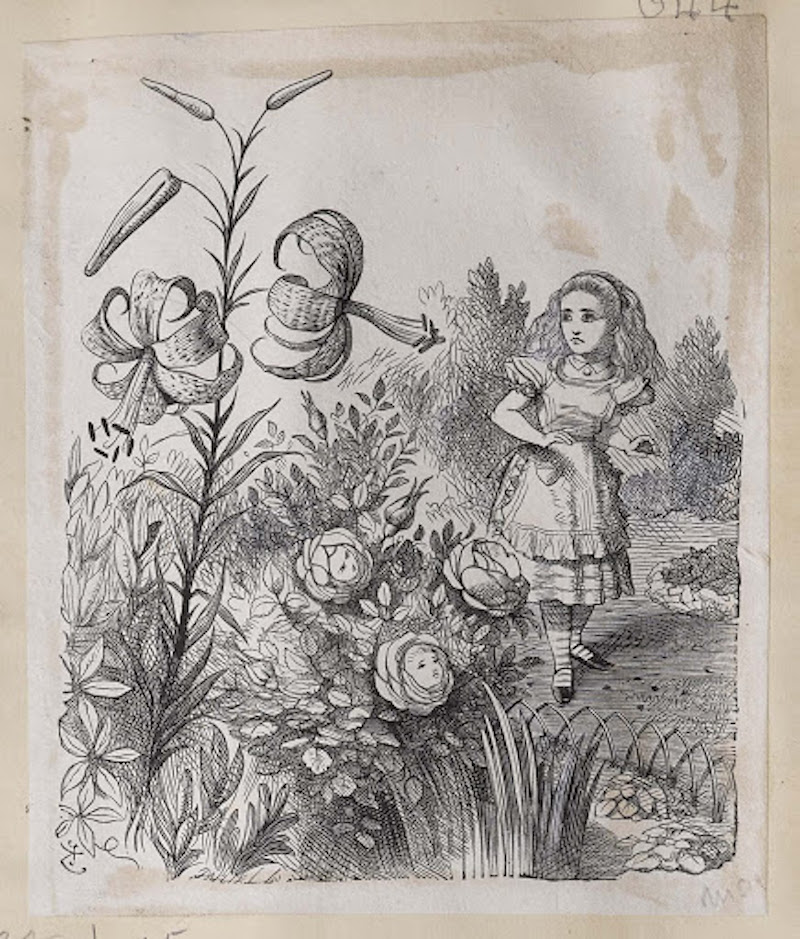
Dalziel after John Tenniel, illustration for “The Garden of Live Flowers,” Lewis Carroll [Charles Lutwidge Dodgson], Through the Looking-Glass, and What Alice Found There (London: Macmillan, 1871). By Permission of the Trustees of The British Museum. All Rights Reserved © Sylph Editions, 2016. With thanks to Dr. Bethan Stevens.
As Elizabeth Hope Chang points out, all flowers are “live” and what Carroll’s fantasy conveys here is not liveness but speech. Like Pulter’s flowers centuries earlier, Carroll’s flowers talk. They also resemble their Pulterian predecessors by being color-struck, class-conscious, and xenophobic. “Even in Carroll’s nonsense garden, the rose and the lily represent varieties of domestic English flowers already supplemented in the English garden by Asian cultivars” (Elizabeth Hope Chang, Novel Cultivations: Plants in British Literature of the Global Nineteenth Century [UVA, 2019], p. 86).
This time she came upon a large flower-bed, with a border of daisies, and a willow-tree growing in the middle.
“O Tiger-lily,” said Alice, addressing herself to one that was waving gracefully about in the wind, “I wish you could talk!”
“We can talk,” said the Tiger-lily: “when there’s anybody worth talking to.”
Alice was so astonished that she could not speak for a minute: it quite seemed to take her breath away. At length, as the Tiger-lily only went on waving about, she spoke again, in a timid voice—almost in a whisper. “And can ALL the flowers talk?”
“As well as you can,” said the Tiger-lily. “And a great deal louder.”
“It isn’t manners for us to begin, you know,” said the Rose, “and I really was wondering when you’d speak! Said I to myself, ‘Her face has got SOME sense in it, though it’s not a clever one!’ Still, you’re the right color, and that goes a long way.”
“I don’t care about the color,” the Tiger-lily remarked. “If only her petals curled up a little more, she’d be alright.”
Alice didn’t like being criticized, so she began asking questions. “Aren’t you sometimes frightened at being planted out here, with nobody to take care of you?”
“There’s the tree in the middle,” said the Rose, “what else is it good for?”
“But what could it do, if any danger came?” Alice asked.
“It says ‘Bough-wough!’” cried a Daisy: “that’s why its branches are called boughs!”
“Didn’t you know THAT?” cried another Daisy, and here they all began shouting together, till the air seemed quite full of little shrill voices. “Silence, every one of you!” cried the Tiger-lily, waving itself passionately from side to side, and trembling with excitement. “They know I can’t get at them!” it panted, bending its quivering head towards Alice, “or they wouldn’t dare to do it!”
“Never mind!” Alice said in a soothing tone, and stooping down to the daisies, who were just beginning again, she whispered, “If you don’t hold your tongues, I’ll pick you!”
There was silence in a moment, and several of the pink daisies turned white.
“That’s right!” said the Tiger-lily. “The daisies are worst of all. When one speaks, they all begin together, and it’s enough to make one wither to hear the way they go on!”
“How is it you can all talk so nicely?” Alice said, hoping to get it into a better temper by a compliment. “I’ve been in many gardens before, but none of the flowers could talk.”
“Put your hand down, and feel the ground,” said the Tiger-lily. “Then you’ll know why.”
Alice did so. “It’s very hard,” she said, “but I don’t see what that has to do with it.”
“In most gardens,” the Tiger-lily said, “they make the beds too soft—so that the flowers are always asleep.”
This sounded a very good reason, and Alice was quite pleased to know it. “I never thought of that before!” she said.
“It’s MY opinion that you never think AT ALL,” the Rose said in a rather severe tone.
“I never saw anybody that looked stupider,” a Violet said, so suddenly, that Alice quite jumped, for it hadn’t spoken before.
“Hold YOUR tongue!” cried the Tiger-lily. “As if YOU ever saw anybody! You keep your head under the leaves, and snore away there, till you know no more what’s going on in the world, than if you were a bud!”
“Are there any more people in the garden besides me?” Alice said, not choosing to notice the Rose’s last remark.
“There’s one other flower in the garden that can move about like you,” said the Rose. “I wonder how you do it—” (“You’re always wondering,” said the Tiger-lily), “but she’s more bushy than you are.”
“Is she like me?” Alice asked eagerly, for the thought crossed her mind, “There’s another little girl in the garden, somewhere!”
“Well, she has the same awkward shape as you,” the Rose said, “but she’s redder—and her petals are shorter, I think.”
“Her petals are done up close, almost like a dahlia,” the Tiger-lily interrupted, “not tumbled about anyhow, like yours.”
“But that’s not YOUR fault,” the Rose added kindly: “you’re beginning to fade, you know—and then one can’t help one’s petals getting a little untidy.”
Alice didn’t like this idea at all.