Pulter’s Garden
Pulter’s poems are full of gardens. In some poems, such as The Lark46, the poet observes something in the garden that prompts an extended meditation. In other poems, a specific flower becomes a site for contemplation, as in Heliotropians69. And in some poems, the poet’s garden is the setting for the poem’s action, as we see in “The Snail, the Tulip, and the Bee” (Poem 118).
Gardening was a “flourishing practice[ ]” in early modern England, and all of the flowers and plants Pulter notes in this poem would have been familiar sights to a contemporary reader (see Rebecca Bushnell, Imagining Early Modern English Gardens, Cornell University Press, 2003, 16). Alongside the practice of gardening, writing about gardening and botany gained immense popularity, and early modern women were keen readers of herbals—treatises on medicinal plants (see Rebecca Laroche, Medical Authority and Englishwomen’s Herbal Texts, 1550-1650, Routledge, 2009; and Elaine Leong, “‘Herbals she peruseth’: reading medicine in early modern England,” Renaissance Studies 28.4 [2014]: 556-578).
Herbals invited their readers to navigate the relationship between theory and practice: take the study of plant knowledge and apply it to specific situations in the garden. In her use of ornamental flowers in Poem 118—specifically, auriculas and tulips—Pulter invites her reader to think about the garden itself as a space for theoretical exploration. The flowers and insects become a prompt for study and an invitation to civic and political action.
The first flowers Pulter references in Poem 118 are “auriculas” (line 19). Primula auricula, also known as mountain cowslip or bear’s ear, is a species of flowering plant native to the mountain ranges of central Europe. In John Gerard’s widely circulated Herball, or Generall Historie of Plantes (1597), he describes the auricula as a “beautiful and brave plant” with “thicke, greene and fat leaves,” “a slender stem,” and “a tuft of flowers at the top of a faire yellow colour.”

Jacob Sturm and Johann Georg Sturm, Deutschlands Flora in Abbildungen, Nurnberg, 1796. Image courtesy of Group of Kurt Stüber, Max Planck Institute for Plant Breeding Research.
In the sixteenth and seventeenth centuries, auriculas were bred and cultivated for desirable traits. Like the other flowers Pulter references in this poem, auriculas are noteworthy for their beauty and their cultural capital. Thomas Hanmer’s The Garden Book (c.1653), a collection of extensive notes on the author’s own seventeenth-century garden, describes over fifty auricula cultivars—plant varieties produced through selective breeding—in a wide array of colors and petal patterns.
The second flower Pulter references is the iris (line 20), a genus of flowering plants with showy flowers that fall away from the top center of the stem, as we can see in Gerard’s woodcuts of different iris varieties.
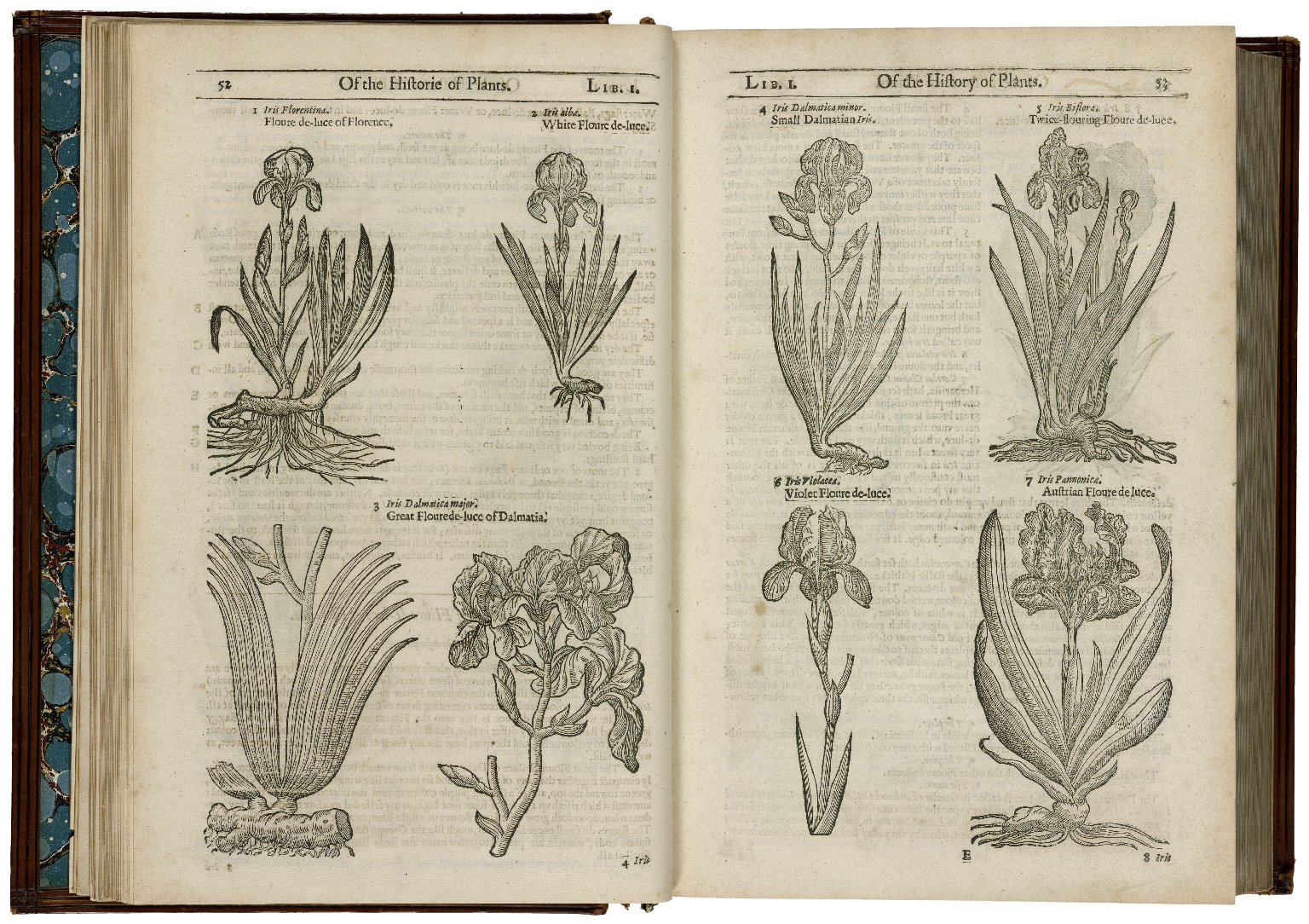
John Gerard, The herball or Generall historie of plantes (London, 1633), 52-53. Call #: STC 11751 Copy 1. Used by permission of the Folger Shakespeare Library under a Creative Commons Attribution-ShareAlike 4.0 International License.
Importantly, though, the iris does not seem to be part of the poet’s garden in “The Snail, the Tulip, and the Bee.” Pulter cites it as a comparison point to draw attention to the beauty of the auriculas: “to see the curious auriculas dressed / more variously than Iris’s dewy breast” (lines 19-20). Iris is also a goddess in Greek mythology, personification of the rainbow. Pulter’s reference to Iris (capitalized in the manuscript, unlike the other flower names) seems meant to conjure the many colors of the rainbow, helping the reader paint a mental picture of the brightly and variously colored auriculas.

Ralf Wimmer, Garden Auricula, 2008, Wikimedia Commons, public domain image.
The tulip is the third flower Pulter references in Poem 118 (line 21). It is the specific site of the poem’s action, which relies on one of the tulip’s characteristic features—its petals open with the sun and close at sunset. This action on the part of the flower is what ultimately tests the character of both bee and snail.
Gerard dedicates ten pages to the “tulipa, or dalmatian cap,” in his Herball. He includes thirty different illustrations as he tries to convey the sheer variety of tulip flowers, “almost infinite in number” (page 137).
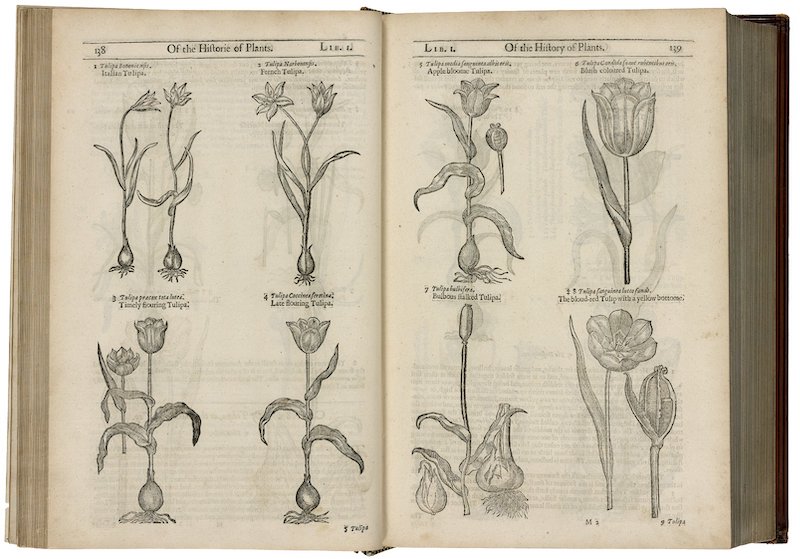
John Gerard, The herball or Generall historie of plantes (London, 1633), 138-139. Call #: STC 11751 Copy 1. Used by permission of the Folger Shakespeare Library under a Creative Commons Attribution-ShareAlike 4.0 International License.
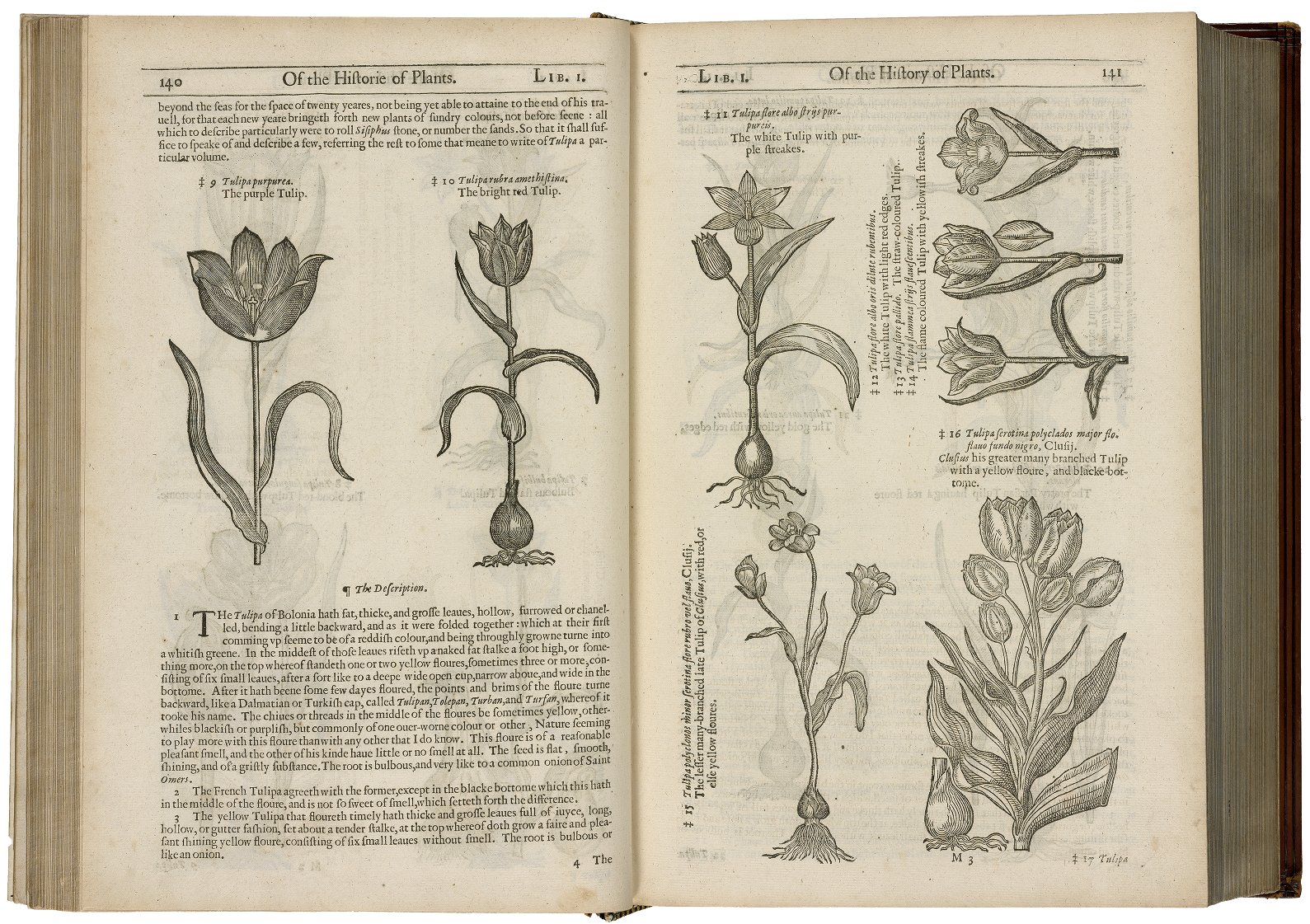
John Gerard, The herball or Generall historie of plantes (London, 1633), 140-141. Call #: STC 11751 Copy 1. Used by permission of the Folger Shakespeare Library under a Creative Commons Attribution-ShareAlike 4.0 International License.
Gerard’s extended study of this flower offers a glimpse into the “tulipmania” that swept Europe in the late-sixteenth and early-seventeenth centuries. The tulip was cultivated for its economic and aesthetic value, evidence of a broader shift in early seventeenth-century botanical study from a focus on medicinal plants to an interest in ornamental flowers (see Brent Elliott, “The World of the Renaissance Herbal,” Renaissance Studies 25.1 [2011]: 24-41). As Anne Goldgar notes in her book on the “fever” surrounding tulips in the 1600’s, tulipmania was not so much an economic craze as it was a mark of social and cultural upheaval. “Tulipmania,” Goldgar argues, “rendered unstable the whole notion of how to assess value” (Goldgar, Tulipmania: Money, Honor, and Knowledge in the Dutch Golden Age, University of Chicago Press, 2008, 17).
Dutch still-life paintings from this era offer additional, visual context for this flower’s cultural capital. The first image below, by Jan Davidsz de Heem, features several tulips, along with honeybees and a snail. The second image comes from a text known as the Great Tulip Book, an album used by Dutch merchants to display their wares. The album featured watercolors of the different varieties of tulip bulbs available for purchase, along with inscriptions detailing the weight and price of each bulb. Finally, we see the full impact of the tulip bulb craze displayed in Jan Brueghel the Younger’s painting, Satire on Tulip Mania (c.1640), which depicts tulip merchants and their clients as monkeys run wild.
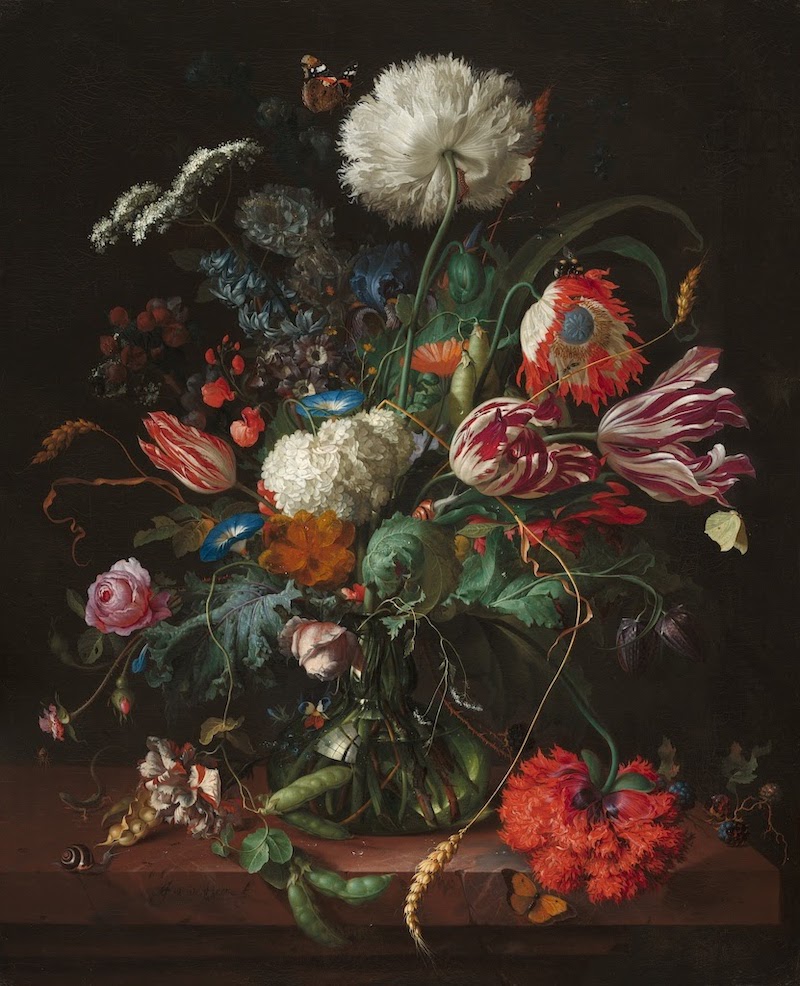
Jan Davidsz de Heem, Vase of Flowers, c.1660, oil on canvas. Open access image, courtesy National Gallery of Art, Washington.
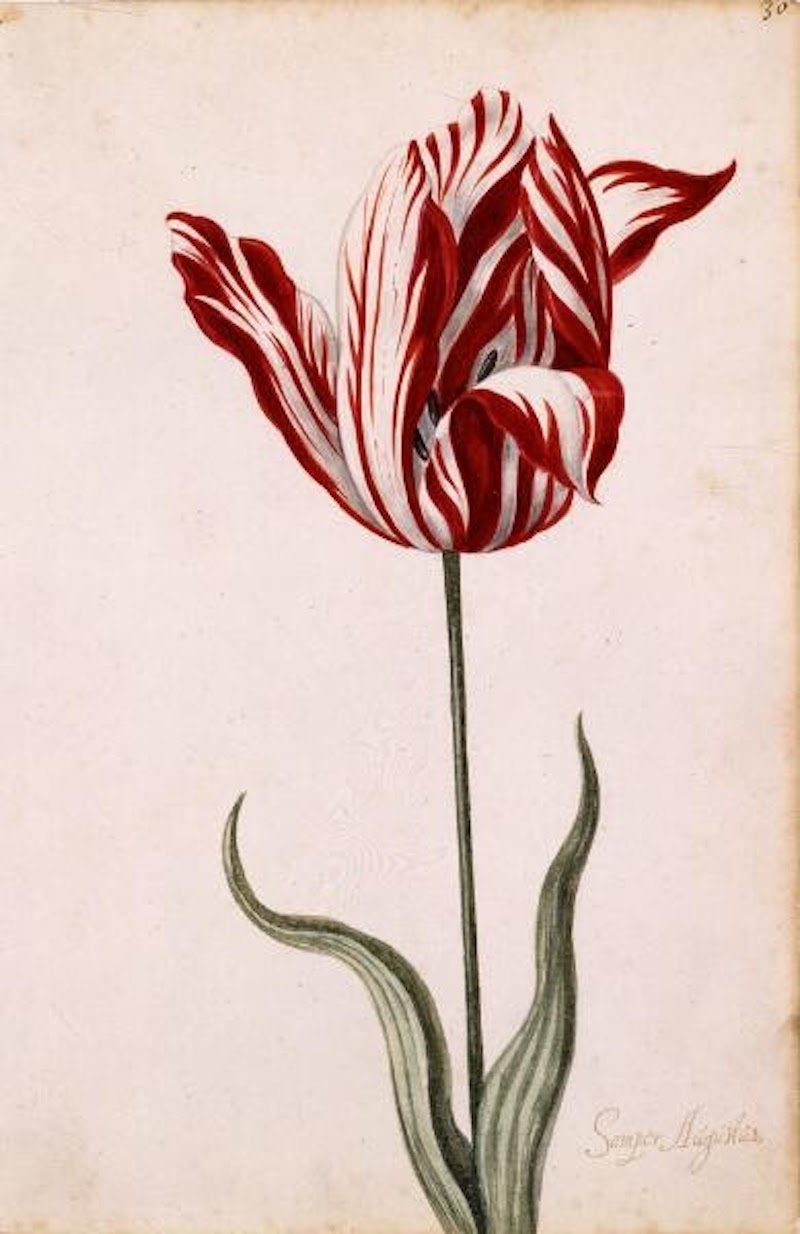
Unknown Artist, "Semper Augustus," Great Tulip Book, 17th Century. Wikimedia Commons, public domain image.
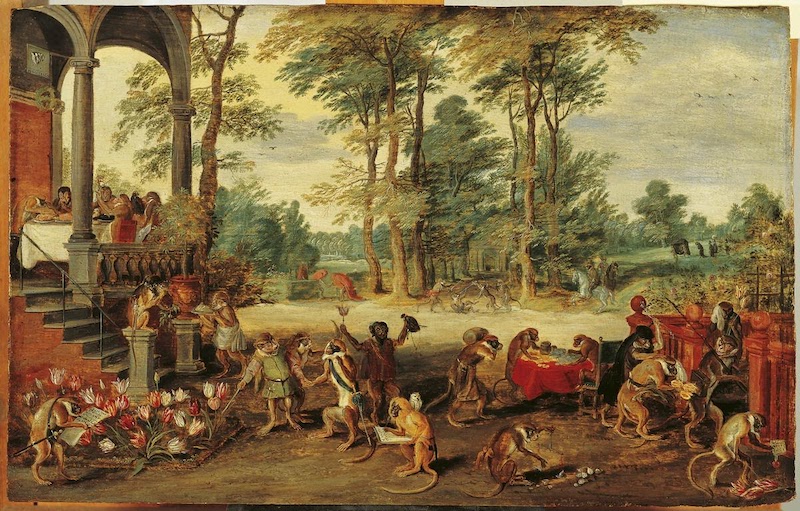
Jan Brueghel the Younger, A Satire of Tulip Mania, c.1640, Wikimedia commons, public domain image.
Pulter hints at the tulip’s cultural importance when she describes the “covetous” bee (line 22) eying the poet’s garden tulips, “painted in their pride” (line 21) and adorned with “gilded leaves” (line 34). But then she veers from a lesson on value and covetousness into a lesson on freedom and resistance (linked, as I suggest in my annotations on the poem’s various mottoes, to the surrounding context of the English Civil Wars).
While the Tulip claims a singular status as the setting for Poem 118, Pulter’s poetic gardens prove diverse and vast as we read her manuscript, and they turn her poetry into a multi-sensory experience filled with sounds, scents, and sights (for the best example, see The Garden12). The result is a collection of writing that nudges us out into the natural world to notice and learn from the environment, as the poet seems to do in so many of Pulter’s poems.