Picturing Rats and Mice in Early Modern English Culture
Like her other emblematic poems, Pulter’s “The Bishop and the Rats” (Emblem 46) is a nude emblem; it lacks the pictura that was a defining feature of many emblematic texts following Andrea Alciato’s foundational Emblematum Liber (1531). Along with Pulter’s other emblems that contemplate rodents, including The Piper of Hamelin83, The Marmottane89, and The Oyster and the Mouse113, “The Bishop and the Rats” invites readers’ curiosity: what kinds of images might Pulter have had in mind as she composed these poems? How were such creatures pictured in early modern texts?
First, it’s worth noting that to early moderns, rats and mice were closely related, even thought to be of the same species (see Lisa Sarasohn, “Rodents Gnaw through the Centuries,” Getting Under Our Skin: The Cultural and Social History of Vermin [Johns Hopkins University Press, 2021], 176-77 and passim). Though Edward Topsell distinguishes between them, he acknowledges their kinship: “Of the Rat” begins with the statement that “There is no doubt that this beast belongeth also to the rank of mice” (Historie of Four-Footed Beasts [London, 1607], 519). The primary differences, for Topsell, derive from rats’ great size compared to mice and their ability, proportional to scale, to be more devastating:
They are more noysome then the little Mouse, for they live by stelth, and feed upon the same meat that they feede upon, and therefore as they exceede in quantity, so they devoure more, and doe farre more harme. They are killed by the same poysons and meates that the common Mice are killed … They are also taken in the same traps, but 3. or foure times so big.
Topsell’s entry “Of the Vulgar Little Mouse” includes instructions for trapping these creatures: “although every woman, and silly Rat-ketcher can give instruction enough therin, yet their knowledge cannot excuse my negligence if I should omit the inventions and devises of the auncient, whereby they deliverd themselves from the annoiances of these beasts” (509).
The “annoiances” of vermin may be a fact of everyday life, but as Pulter’s emblems emphasize, they may also be read in the framework of God’s providence. When Topsell’s “vulgar mouse” entry turns to “The morrall story of mice,” Topsell invokes Archbishop Hatto as well as other figures to whom Pulter refers in “The Bishop and the Rats”:
they which have thought it an unreasonable thinge, that so small beastes should destroy so mighty a prince, have rather attributed it to the Rats then to the mice; but they ought to have rememberd, that it was an extraordinary iudgement of God to punish a cruell covetous wretch, and that therefore it was as easie for him to make the little mouse his instrument, as the great Rat: for we read, that Herod was devourd by worms, and other have beene eaten up with lyce. Adrian the Pope was strangled by a flye, and therefore Hatto an Archbishop might aswel perish through the afflicting hand of God by a multitude of mice.
While initially standing upon the distinction between rats and mice (and stating that it was the latter, in fact, that were made God’s instruments against Hatto, not, as Pulter has it, rats), Topsell’s narrative ultimately aligns with Pulter’s moral: “From God’s revenging hand no place is free; / For each despiséd reptile or insect / He can empower, when we his laws neglect” (24-26). It’s clear, then, that rats and mice were both ordinary domestic pests and potential vehicles for divine justice. There is no shortage of illustrated texts depicting these complex creatures.
Most relevant to “The Bishop and the Rats” is Pierre Boaistuau’s manuscript of Histoires prodigieuses (1559), which includes a miniature that depicts the swarm of rats that consumes both Archbishop Hatto II and Prince Popiel. The French print editions that followed include a woodcut based on this miniature, and Edward Fenton’s English translation includes a woodcut of the same image.
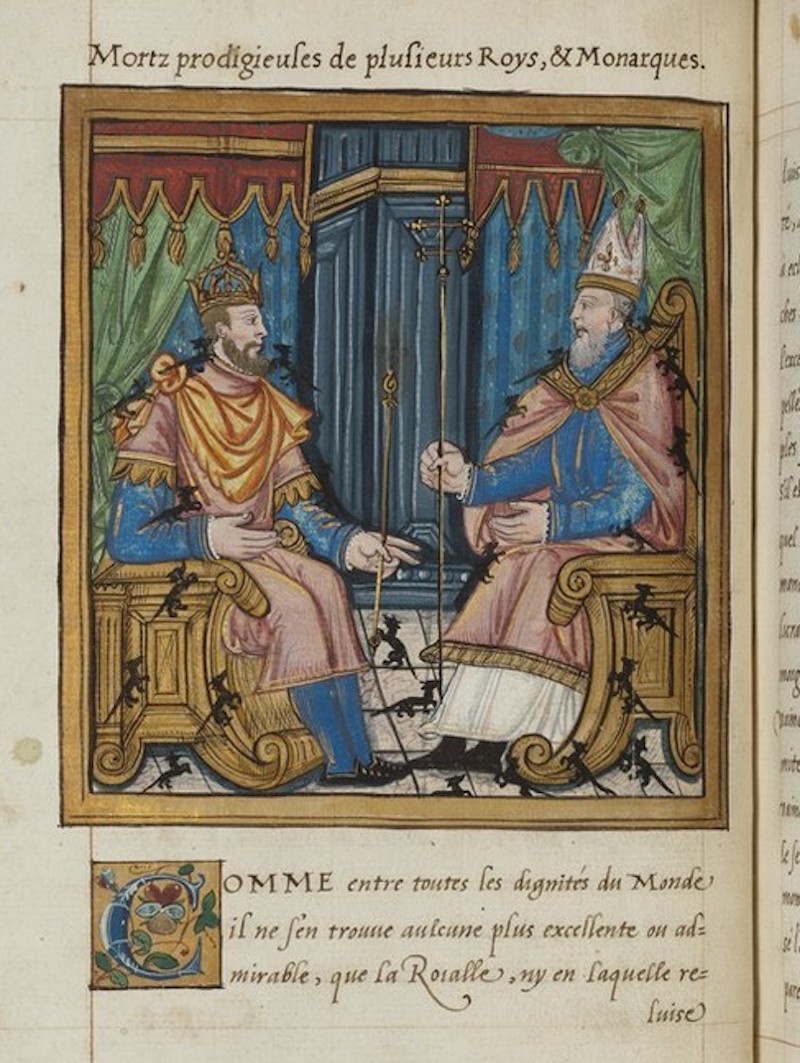
Boaistuau, Pierre. Histoires prodigieuses. [1559]. MS.136, Wellcome Collection. [14v].
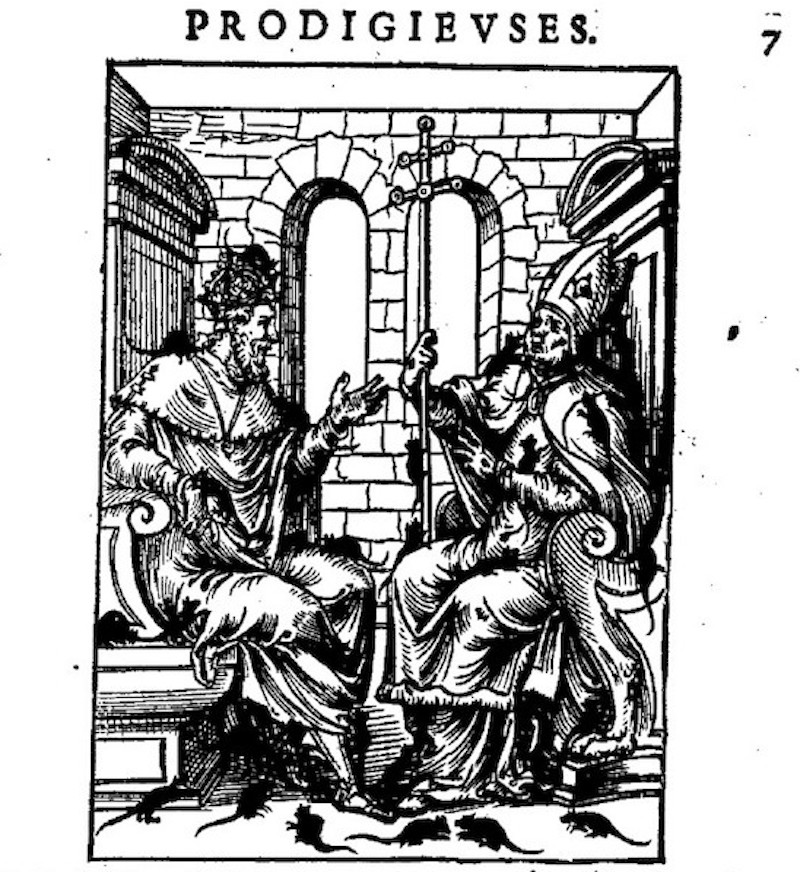
Boaistuau, Pierre. Histoires prodigieuses. Paris, 1560. Biii.
It’s tempting to think Pulter had these images in mind when describing the rats that attacked Hatto and Popiel; however, rats appear in a number of other texts. A popular broadside ballad, “The famous ratketcher,” includes a woodcut showing a man with a device for catching rats and other vermin, with a cat not far behind.
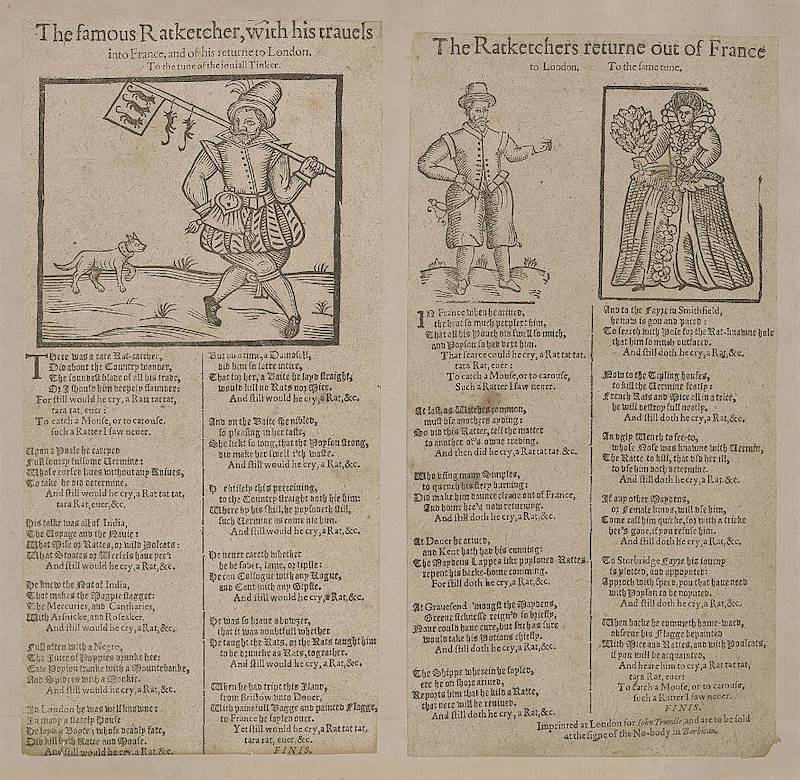
“The famous Ratketcher.” London, [1616?]. Pepys Ballad 1.458-459, Magdalene College - Pepys Collection.
The ballad is more a bawdy song of the rat catcher’s adventures than it is a tale with a moral in the style of Pulter’s emblem or Boaistuau’s narrative. But other emblematic and moralizing texts with illustrations of rats and mice were available. George Wither’s Collection of emblemes, ancient and moderne (1635), with engravings from copper plates by Crispijn van de Passe the elder originally created for Gabriel Rollenhagen’s emblems (1611), includes one emblem depicting a cat surrounded by mice to illustrate the subscriptio’s lesson about tyranny.
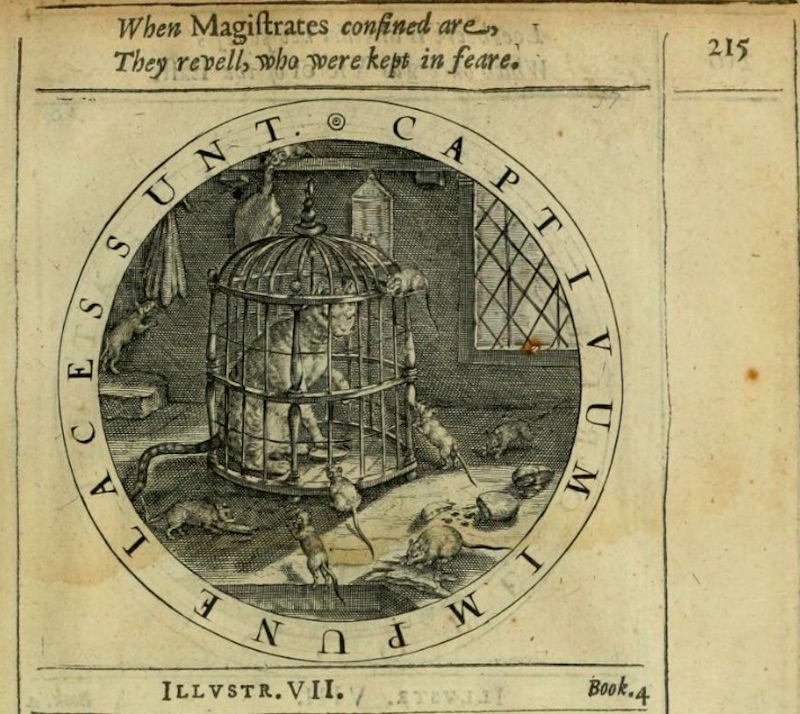
Wither, George. A collection of emblemes, ancient and moderne. London, 1635. 215.
Editions of Aesop’s fables also picture mice. John Ogilby, a royalist like Pulter, produced Fables of Aesop paraphras’d in verse (1665), illustrated with elaborate engravings by Wenceslas Hollar. Pulter was familiar with Ogilby, referring to this text in The Oyster and the Mouse113. While many of Ogilby’s fables offer political morals, the engravings offer images of creatures that are quite true to life (see Katherine Acheson, “The Picture of Nature: Seventeenth-Century English Aesop's Fables,” Journal for Early Modern Cultural Studies Vol. 9, No. 2 [2009]: 25-50). “Of the Cat and the Mice” and “Of the Court Mouse and Country Mouse” exemplify the naturalistic style of the illustrations.
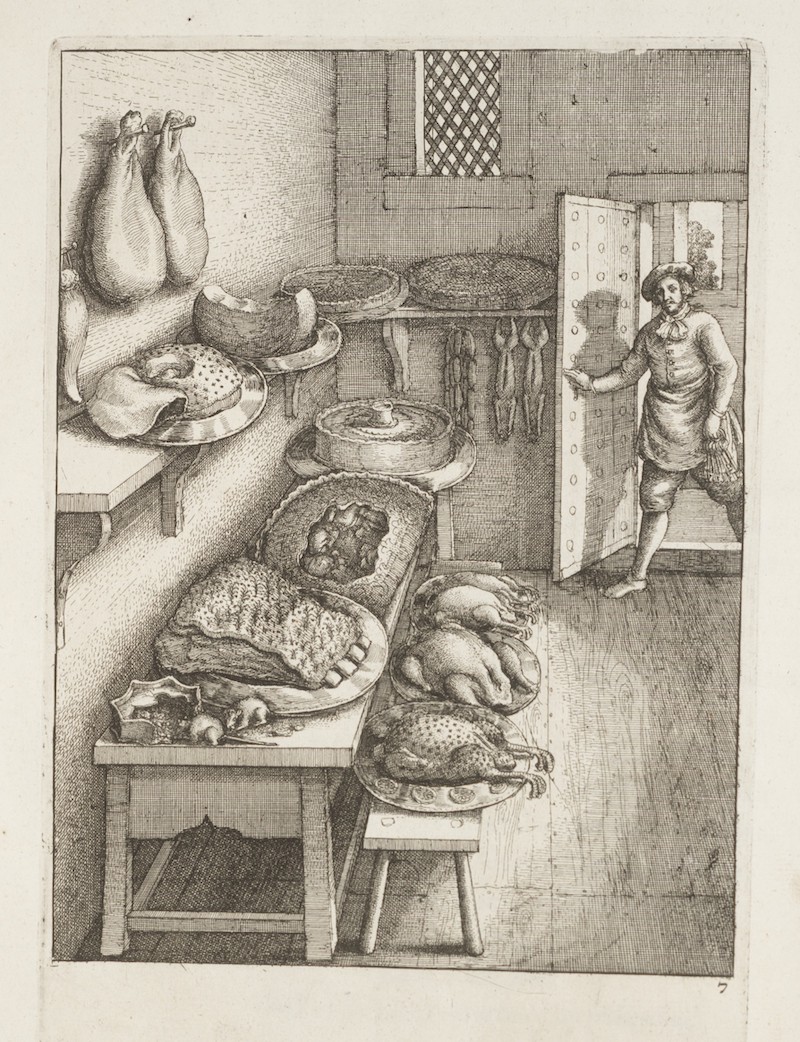
Ogilby, John. The fables of Aesop paraphras'd in verse. London, 1665. Unmarked leaf between p. 18 and p. 19.
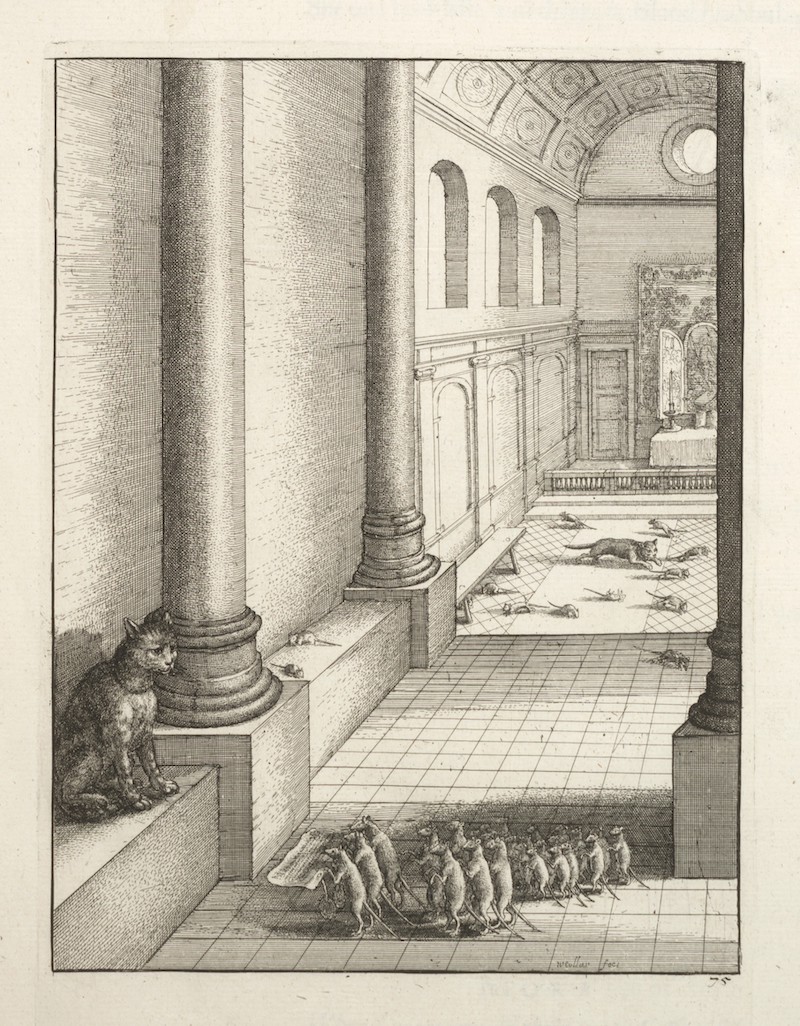
Ogilby, John. The fables of Aesop paraphras'd in verse. London, 1665. Unmarked leaf between p. 190 and p. 191.
1. I’m grateful to Nadia Nolan for her research assistance on this curation. Nadia located and composed alt text for these images.