Visualizing Monist and Dualist Theories of Resurrection
The Christian idea of the resurrection of the body and the hope for a life after death ripples through many of Pulter’s poems and gives to many of them their ideational power, especially when applied as a framework to understand and come to terms with her own body as the scene of (rarely) joy and (more often) suffering and pain. Part of the reason that Pulter can wring so much drama out of the notion of resurrection is that she, as a seventeenth-century poet, stands at a complex and tense moment in the long intellectual history of Christian ideas about resurrection. Though the intellectual history of resurrection and its associated ideas about identity and personhood are too complex to describe fully here, a broad sketch can help to contextualize Pulter’s thinking about resurrection in her poetry.
In the first decades of the Common Era, early adopters of Christianity held a theory of resurrection derived from the Jewish school of the Pharisees in which resurrection is the literal reassembly of the original physical body. This concept faced sharp critique from Hellenistic philosophers influenced by Platonic thought, such as Celsus. Celsus famously derided the belief in physical resurrection as “the hope of worms” since he deemed the wish for eternal corporeal life as contemptible. Like all sophisticated Hellenistic philosophers of the first century, Celsus did not reject the notion of life after death; the idea of a soul living on seemed almost commonsensical, but the irreducible Christian desire for a return to one’s physical body seemed contemptible.
The integration of Platonic principles into Christian theology has a complicated intellectual history with Augustine playing a key role. His distinctive fusion of Christianity and a revised Neo-Platonism led Augustine to adopt a bifurcated model of resurrection, arguing that the soul, in good Platonic fashion, was immortal and could exist separate from the body, but also arguing (in good corporeal Christian terms) that the soul will eventually be reunited with a physically reconstructed body. Augustine poses (but does not always answer) a number of questions about the exact mechanics of this two-stage process, including wondering how God could gather and sort out all of the elements that constituted a singular person, including in the case of cannibalism. Augustine also engaged in influential philosophical questions about personal identity which he addressed through thought experiments about what resurrected bodies would be like—including such questions as whether they would all be male (answer: no, despite the fact that the male form was presumed to be the perfected form of the human being), whether wounds and scars would still be visible on resurrected bodies (answer: only in the case of martyrs), and whether internal organs would still be present even in the absence of digestion (answer: yes, and moreover internal organs would be visible through newly transparent skin for the purpose of heightening the beauty of the resurrected).
The Augustinian synthesis which held the idea of a soul in tension with the emphasis on the importance and beauty of the material body defined the terms of intellectual speculation until it was recast in a more Aristotelian form by Thomas Aquinas. Aquinas articulated a view of the soul as the form of the body, the body insofar as it has a distinct and unique shape, and postulated that though the soul could, indeed, exist apart from the body, such an existence would be a diminished and less individualized reality—a kind of potential personhood rather than realized personhood. According to Aquinas, the final resurrection would recreate actual bodies and by recombining the soul with the reassembled elements of the original body return a full vibrant life to persons.
Quickly gaining canonical status in medieval Christianity, Aquinas’s view held sway until the Reformation which catalyzed substantial theological debate in how various Christian communities imagined resurrection and life after death. These theories ranged from the return of starkly dualistic theories, where the soul and body were entirely separate, to wholly corporeal understandings which posited that the person completely ceases at the death of the body. In the context of the new science of natural philosophy in the seventeenth century, early scientific practitioners, including in René Descartes, increasingly threw their weight behind a generalized metaphysical dualism. Such natural philosophers conceived of a material universe governed by mechanistic and predictable scientific laws and a distinct realm of mind or soul which is wholly separate from the physical world and therefore beyond scientific study. This bifurcation extended to the human body itself, viewed as a machine governed by the laws of physics, while the mind or soul belonged to a wholly different dimension. This hard dualism dovetailed with an emerging scientific understanding in which empirical and mathematical science could model a completely deterministic universe while the soul or mind is simply ruled out of bounds of scientific analysis.
When applied to the question of resurrection this “science-friendly” dualism encouraged a disembodied view of resurrection in which the soul simply lives on after the death of the merely mechanical body in which it was housed. Talk of a body that would need to be physically reassembled out of its constituent atoms was increasingly cast into polite silence. In popular Christianity, this view began to encourage a vision of the souls of the dead ascending to heaven immediately upon death, an epochal change within the Christian tradition that had previously held body and soul together in a tense fusion. This notion of a separate life for souls that is real and completely parallel to the life of corporeal persons in the here-and-now is already suggested by the horizontal parallelism of Heaven and Earth in the fresco of “The Disputation of the Holy Sacrament” painted by Raphael (1483-1520) in the Vatican.
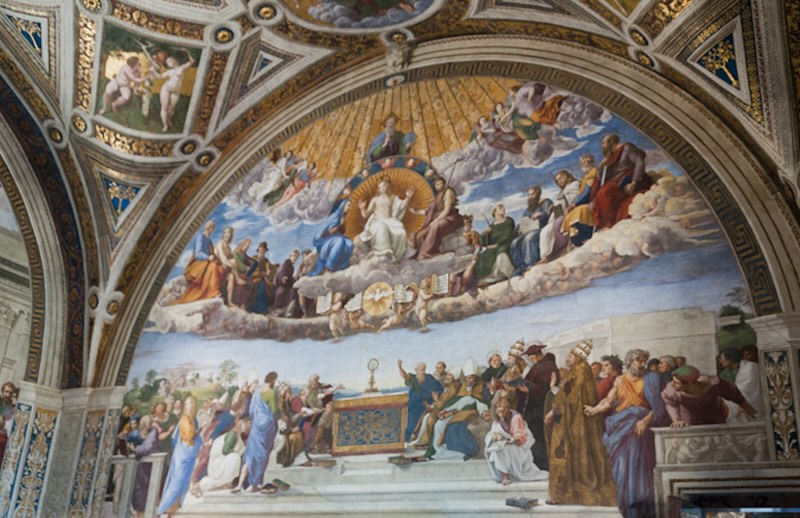
Disputation of the Holy Sacrament. Fresco by Raphael, Stanza della Segnatura, Vatican. This image is in the public domain.
Yet, the enduring Christian legacy of valuing the body as integral to human personhood persisted. This undercurrent placed continuing importance on the body as an essential and valuable aspect of personal identity, fostering a wish for its material resurrection. But in the seventeenth century, especially in Protestant communities, this view, which had once been a core component of Christianity, now acquired a certain avant-garde frisson. Experimental poets, including Donne, Vaughan, Herbert and Pulter herself began to be drawn to the weirdness and deranging power of seeing the body as central to personal identity and yet as also containing a strange, transcendent physicality that would ultimately be reanimated with a new and strange life. Such poets started to see the body as inhabiting two time zones, as it were, with one foot in the historical world and the other in the time of apocalyptic resurrection, and they used their avant-garde poetry to chart this strange body’s life and experience in the light of time and eternity. The weird, deranging power of the body seen in this light can also be glimpsed in Luca Signorelli’s sixteenth-century fresco, “Resurrezione della carne”:
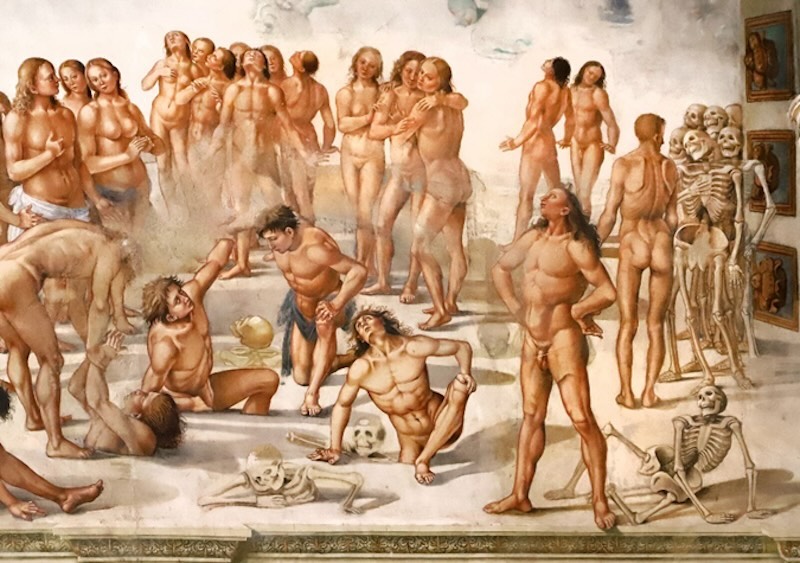
Luca Signorelli, Resurrezione della carne, Orvieto Cathedral. This image is in the public domain.
One of the things that makes Pulter’s poetry so interesting is her engagement with deep currents and tensions in the intellectual history of resurrection and using ideas about resurrection to understand or conceptualize bodily experiences, including experiences of suffering. The tension between dualist and monist-corporeal conceptions of resurrection, and the way in which this tension can endow bodily life with a strange capacity for transcendence, is poignantly encapsulated in Pulter’s poem The Brahman109, which grapples with these contrasting visions of life after death.